
Handouts Phones Up Electricity Potential difference voltage energy


- Slides: 45
Handouts Phones Up
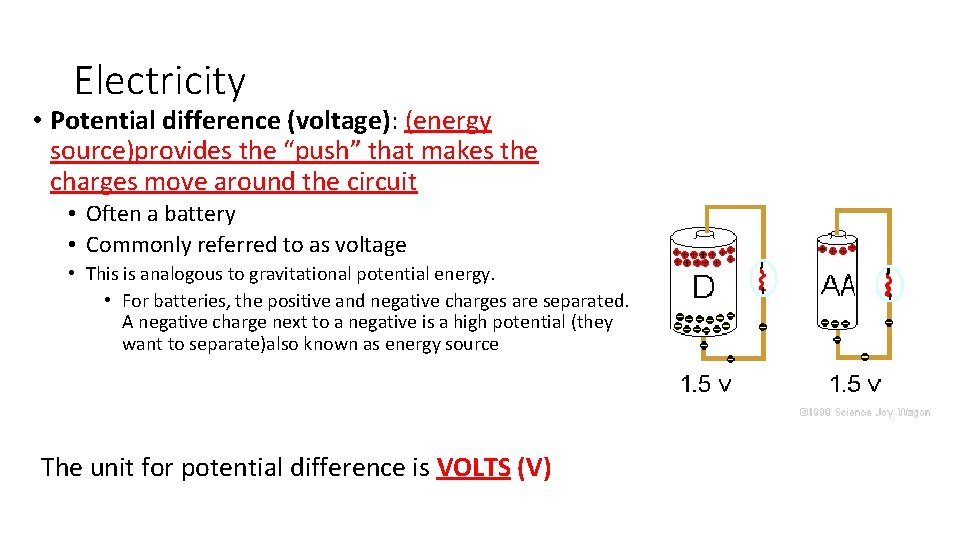
Electricity • Potential difference (voltage): (energy source)provides the “push” that makes the charges move around the circuit • Often a battery • Commonly referred to as voltage • This is analogous to gravitational potential energy. • For batteries, the positive and negative charges are separated. A negative charge next to a negative is a high potential (they want to separate)also known as energy source The unit for potential difference is VOLTS (V)
SIMPLE CIRCUIT – diagram a circuit with a potential difference, switch, resistor, and an ammeter.
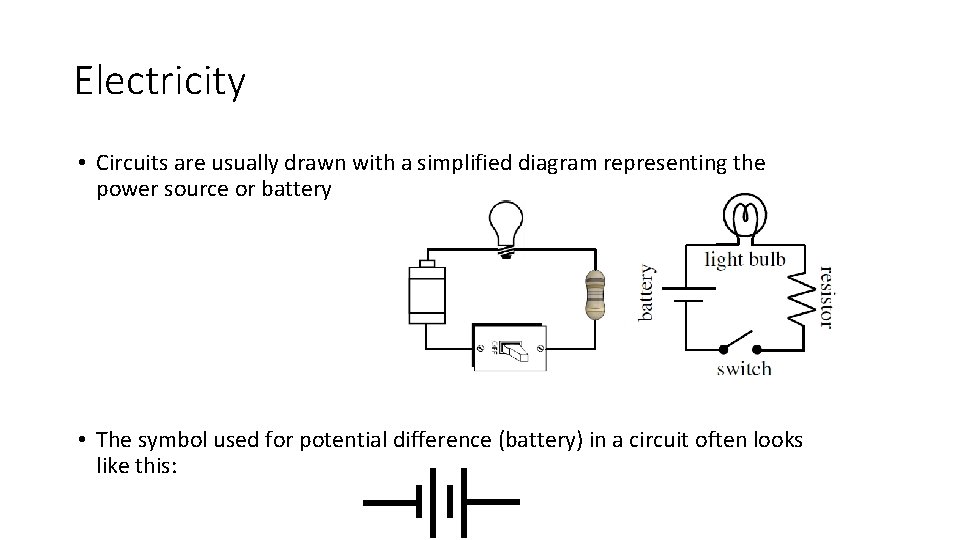
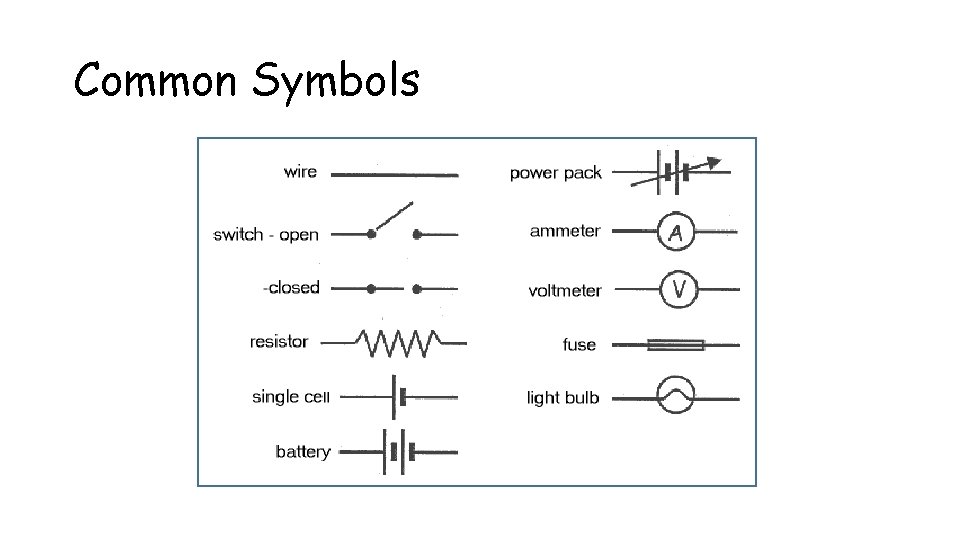
Electricity • Circuits are usually drawn with a simplified diagram representing the power source or battery • The symbol used for potential difference (battery) in a circuit often looks like this:
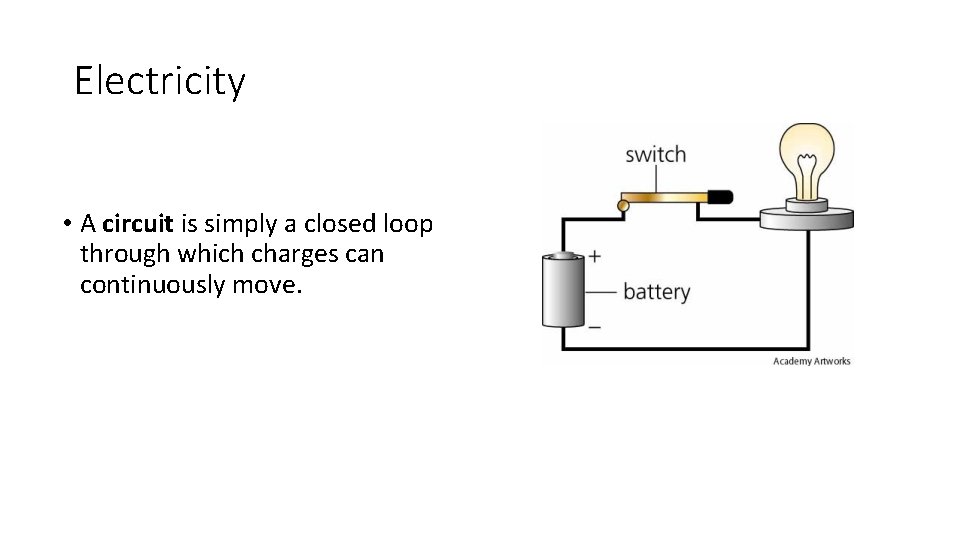
Electricity • A circuit is simply a closed loop through which charges can continuously move.
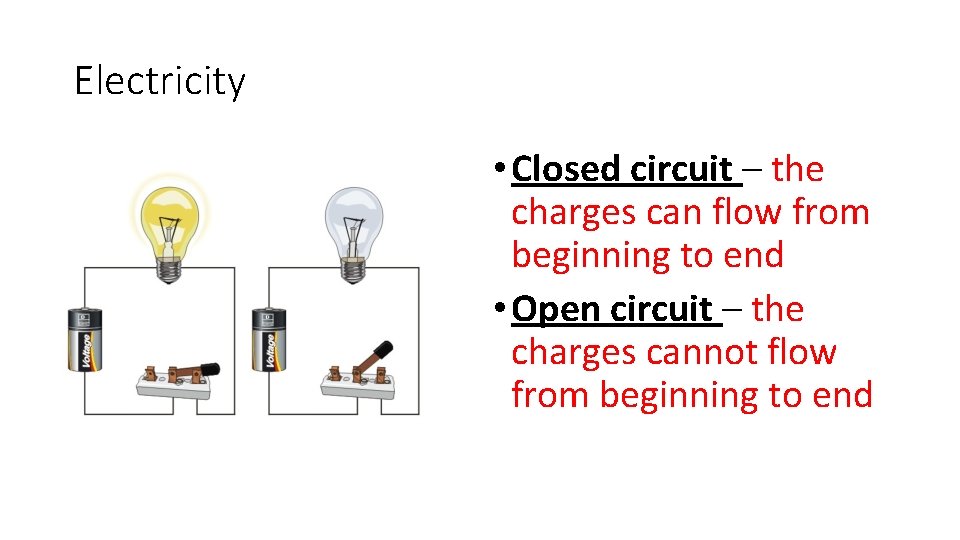
Electricity • Closed circuit – the charges can flow from beginning to end • Open circuit – the charges cannot flow from beginning to end
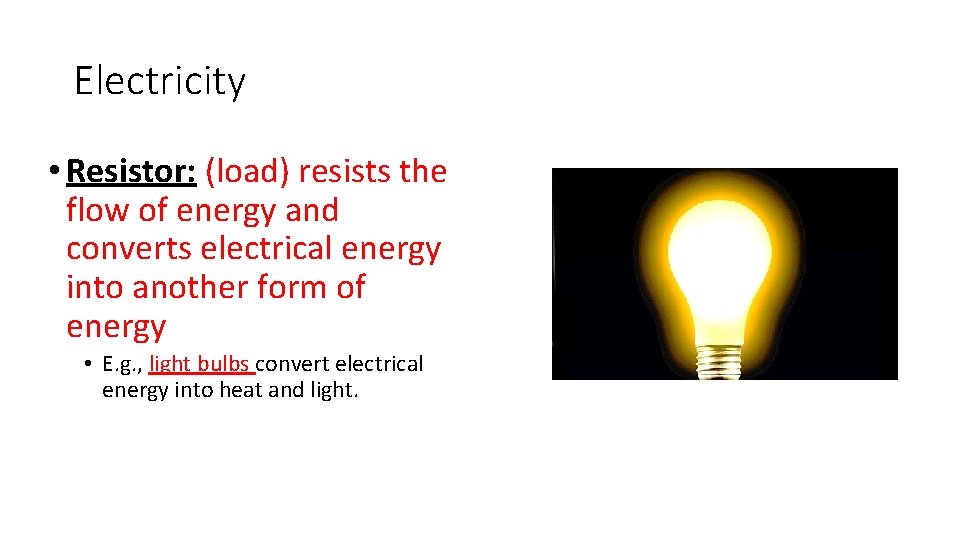
Electricity • Resistor: (load) resists the flow of energy and converts electrical energy into another form of energy • E. g. , light bulbs convert electrical energy into heat and light.
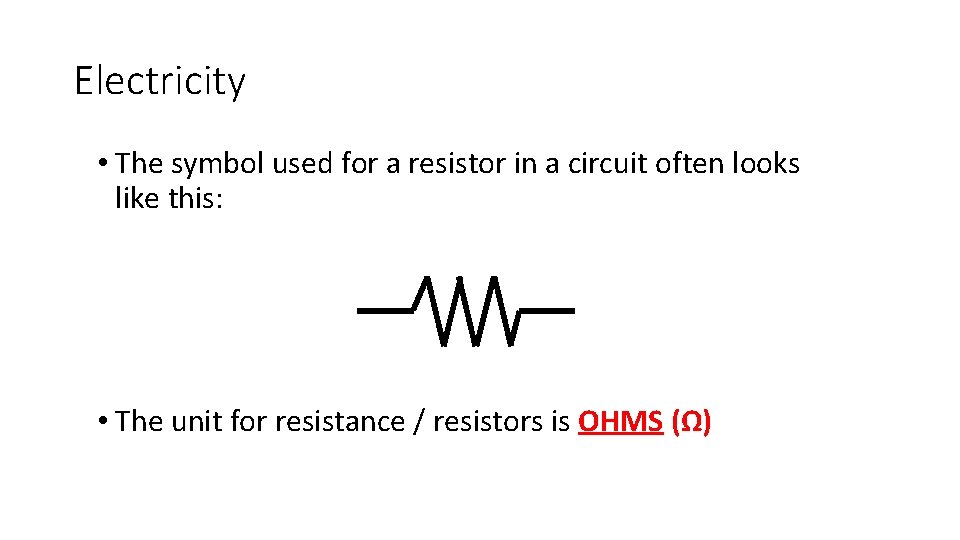
Electricity • The symbol used for a resistor in a circuit often looks like this: • The unit for resistance / resistors is OHMS (Ω)
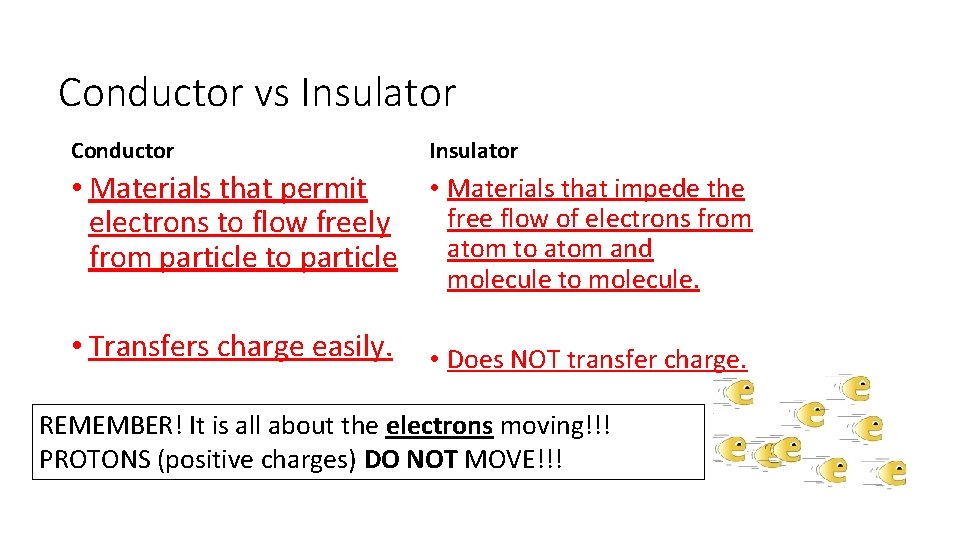
Conductor vs Insulator Conductor Insulator • Materials that impede the • Materials that permit free flow of electrons from electrons to flow freely atom to atom and from particle to particle molecule to molecule. • Transfers charge easily. • Does NOT transfer charge. REMEMBER! It is all about the electrons moving!!! PROTONS (positive charges) DO NOT MOVE!!!
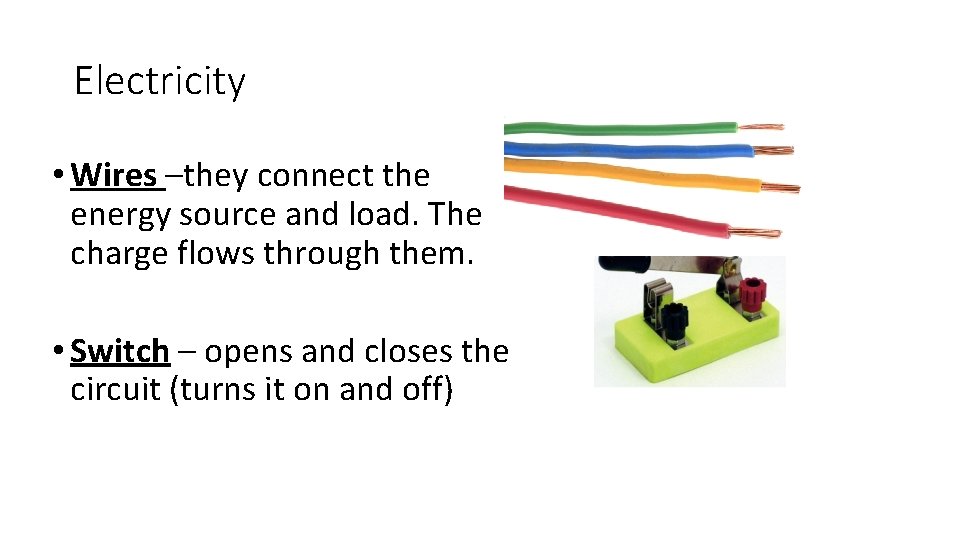
Electricity • Wires –they connect the energy source and load. The charge flows through them. • Switch – opens and closes the circuit (turns it on and off)
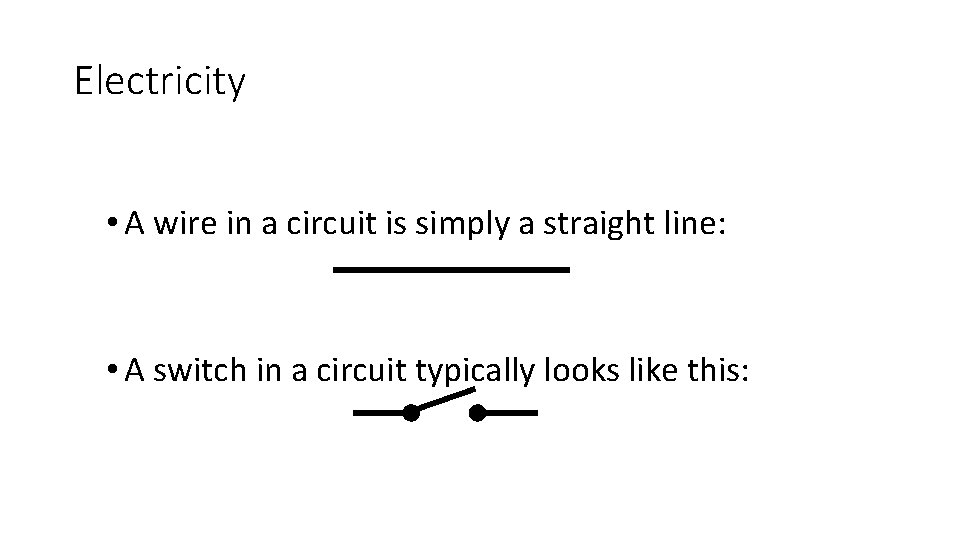
Electricity • A wire in a circuit is simply a straight line: • A switch in a circuit typically looks like this:
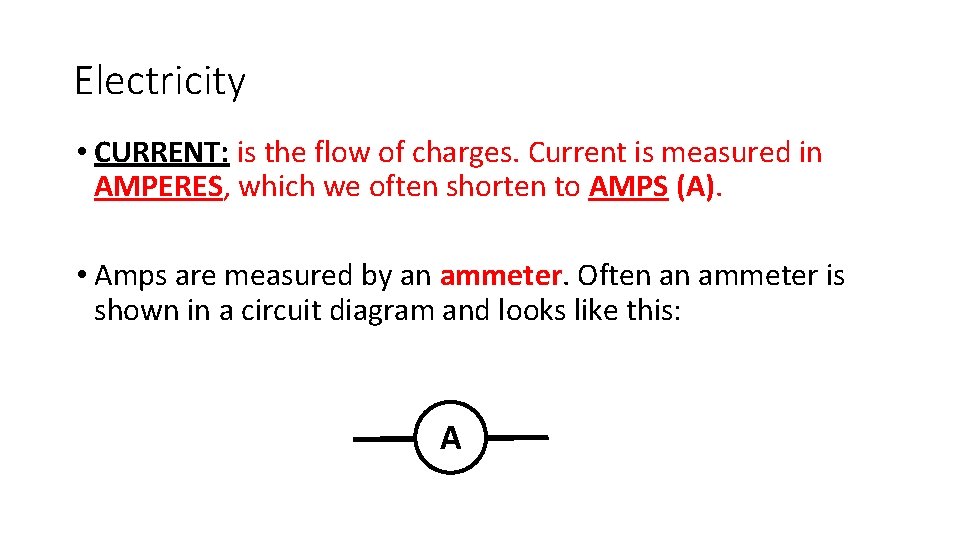
Electricity • CURRENT: is the flow of charges. Current is measured in AMPERES, which we often shorten to AMPS (A). • Amps are measured by an ammeter. Often an ammeter is shown in a circuit diagram and looks like this: A
Starter Pg 92 -93 YOU NEED A CALCULATOR • What is a short circuit? • Give three examples of a resistor. • What is the unit for current? • What two parts of the light bulb must be touched in order for the light bulb to light up? • What is the symbol for a resistor? • What is the difference between a closed an open circuit?
Common Symbols
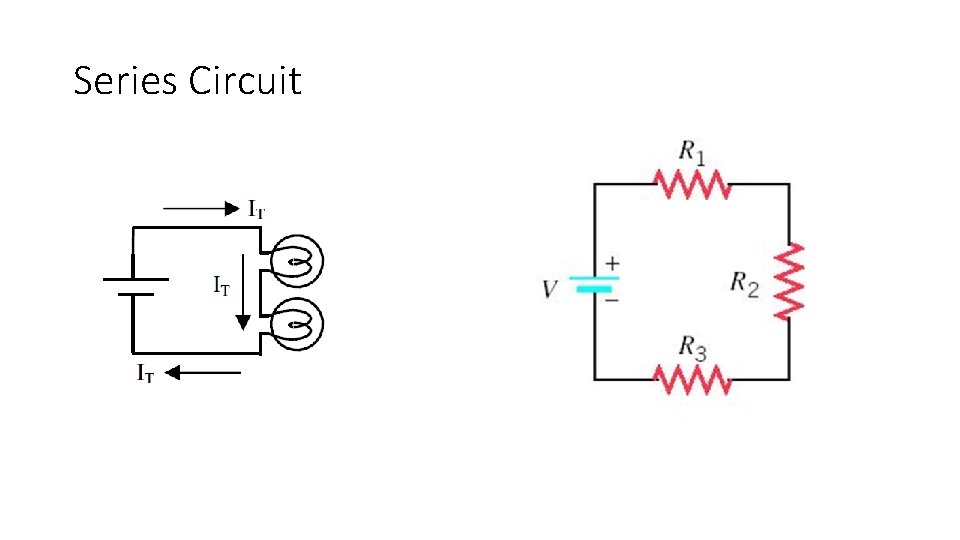
Series Circuit
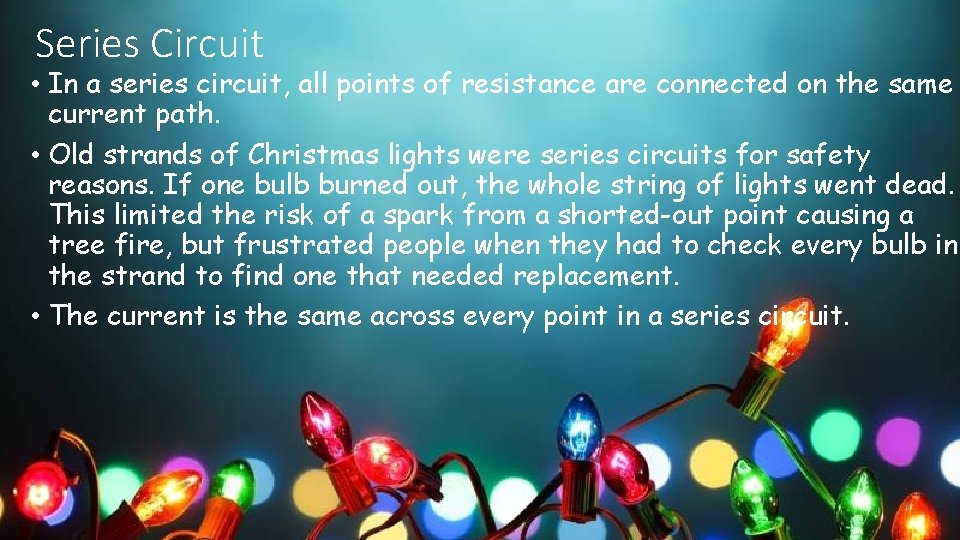
Series Circuit • In a series circuit, all points of resistance are connected on the same current path. • Old strands of Christmas lights were series circuits for safety reasons. If one bulb burned out, the whole string of lights went dead. This limited the risk of a spark from a shorted-out point causing a tree fire, but frustrated people when they had to check every bulb in the strand to find one that needed replacement. • The current is the same across every point in a series circuit.
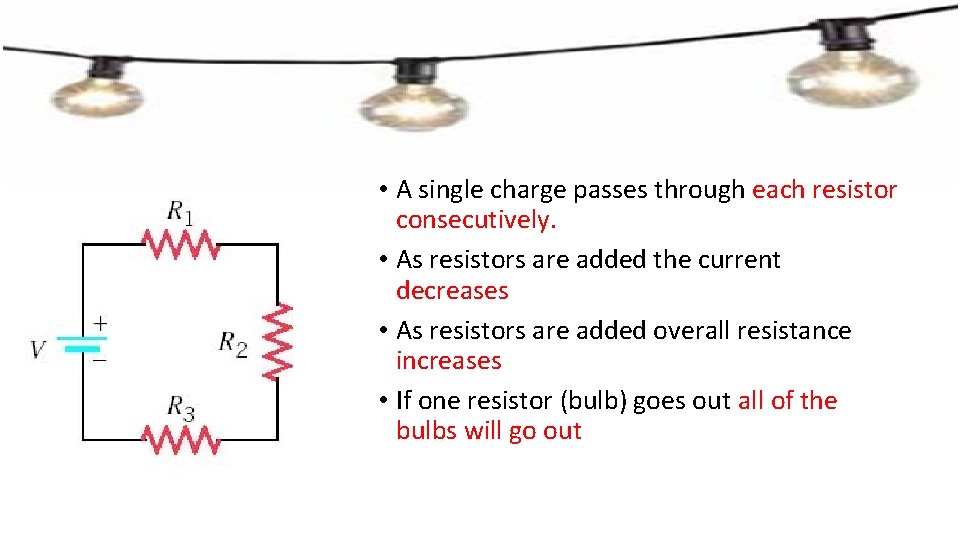
• A single charge passes through each resistor consecutively. • As resistors are added the current decreases • As resistors are added overall resistance increases • If one resistor (bulb) goes out all of the bulbs will go out
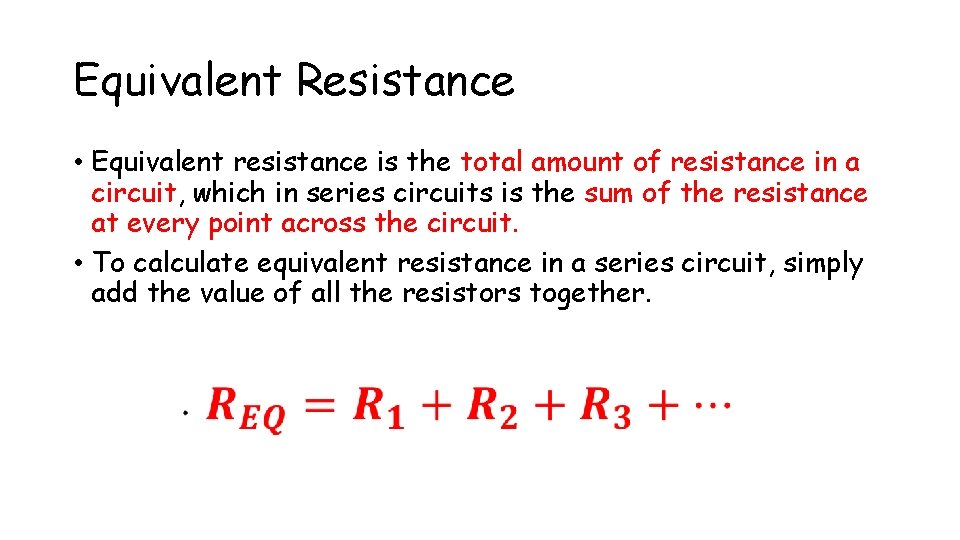
Equivalent Resistance • Equivalent resistance is the total amount of resistance in a circuit, which in series circuits is the sum of the resistance at every point across the circuit. • To calculate equivalent resistance in a series circuit, simply add the value of all the resistors together.
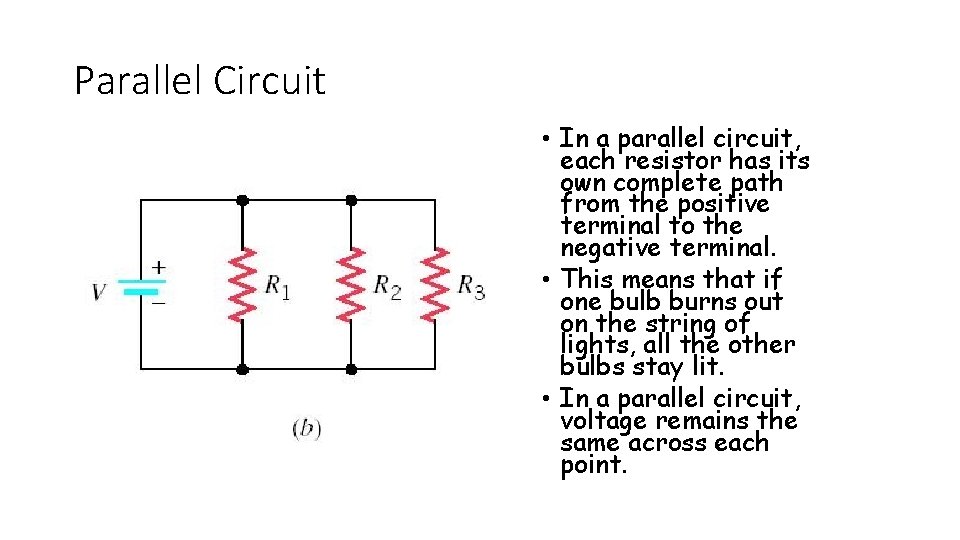
Parallel Circuit • In a parallel circuit, each resistor has its own complete path from the positive terminal to the negative terminal. • This means that if one bulb burns out on the string of lights, all the other bulbs stay lit. • In a parallel circuit, voltage remains the same across each point.
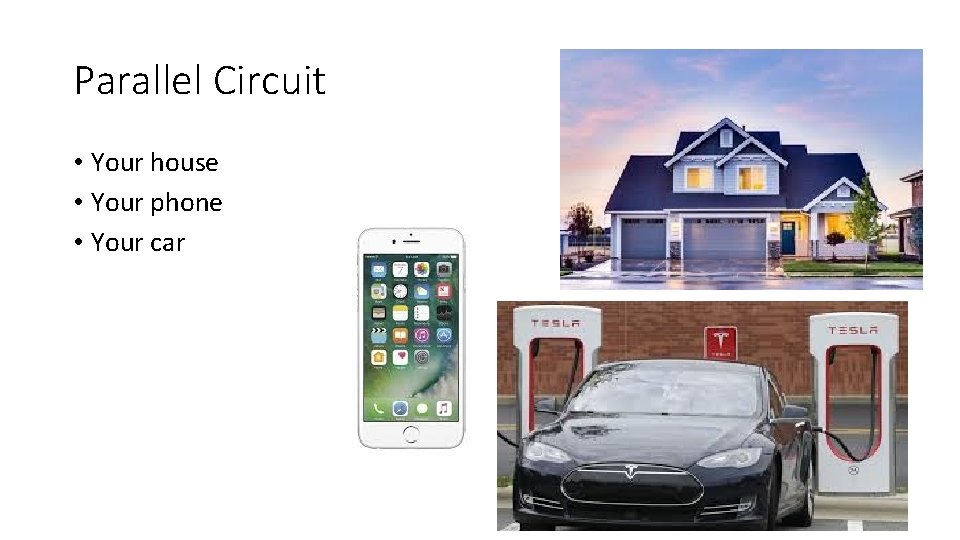
Parallel Circuit • Your house • Your phone • Your car
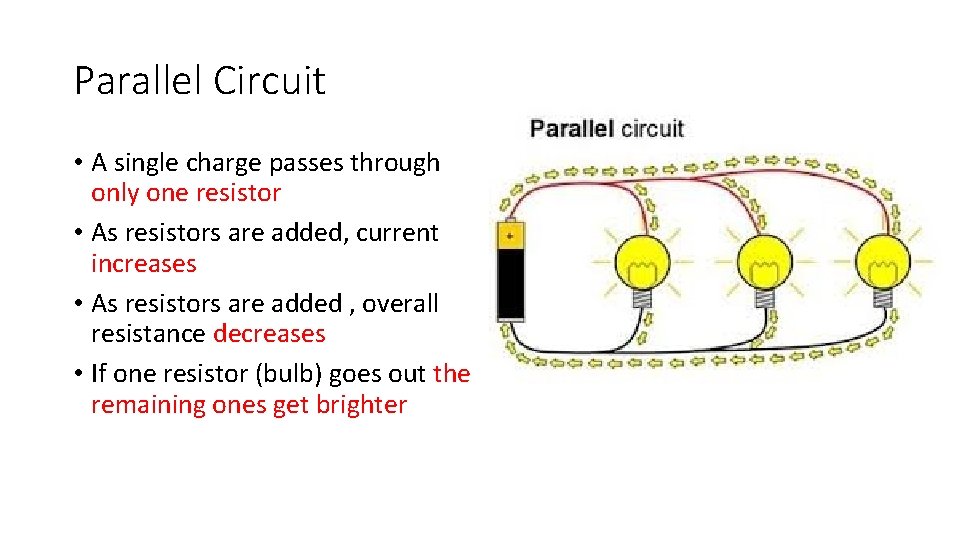
Parallel Circuit • A single charge passes through only one resistor • As resistors are added, current increases • As resistors are added , overall resistance decreases • If one resistor (bulb) goes out the remaining ones get brighter
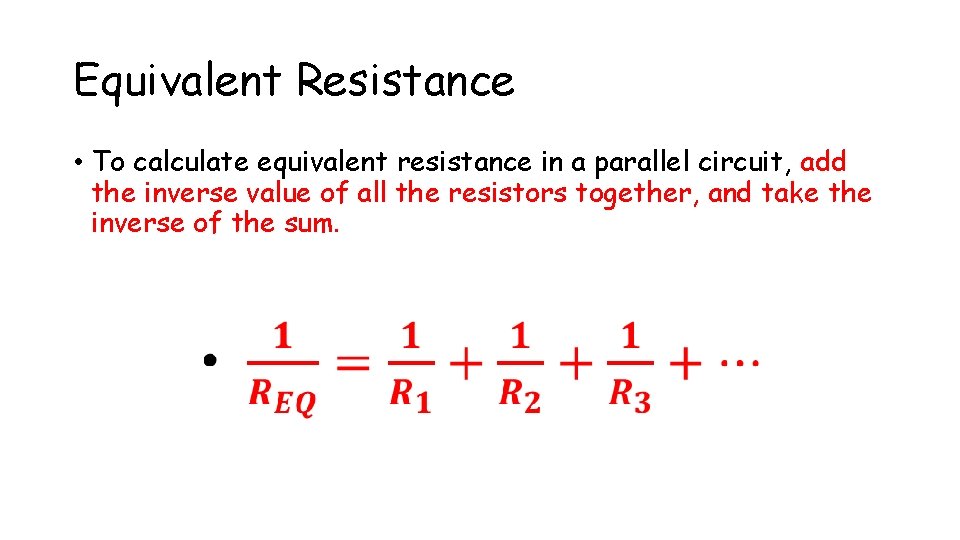
Equivalent Resistance • To calculate equivalent resistance in a parallel circuit, add the inverse value of all the resistors together, and take the inverse of the sum.
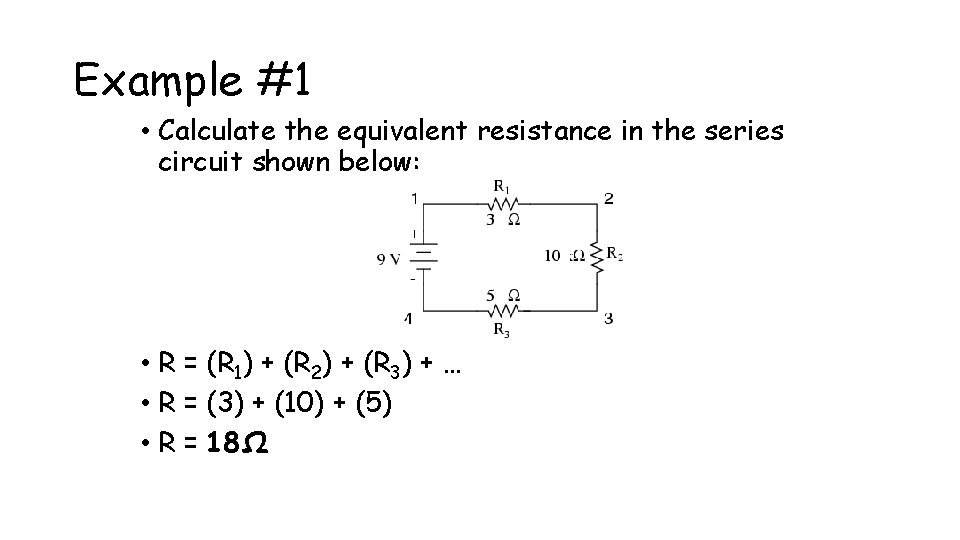
Example #1 • Calculate the equivalent resistance in the series circuit shown below: • R = (R 1) + (R 2) + (R 3) + … • R = (3) + (10) + (5) • R = 18Ω
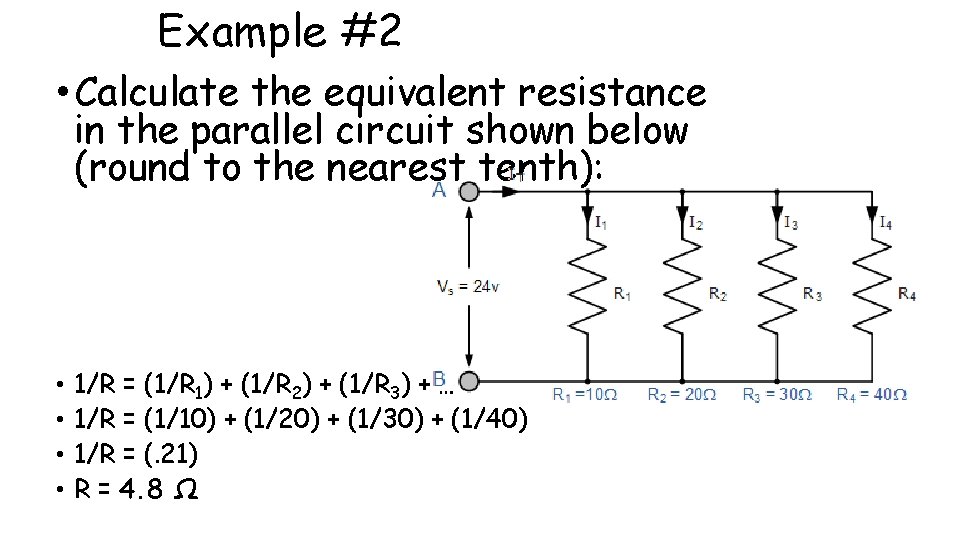
Example #2 • Calculate the equivalent resistance in the parallel circuit shown below (round to the nearest tenth): • • 1/R = (1/R 1) + (1/R 2) + (1/R 3) + … 1/R = (1/10) + (1/20) + (1/30) + (1/40) 1/R = (. 21) R = 4. 8 Ω
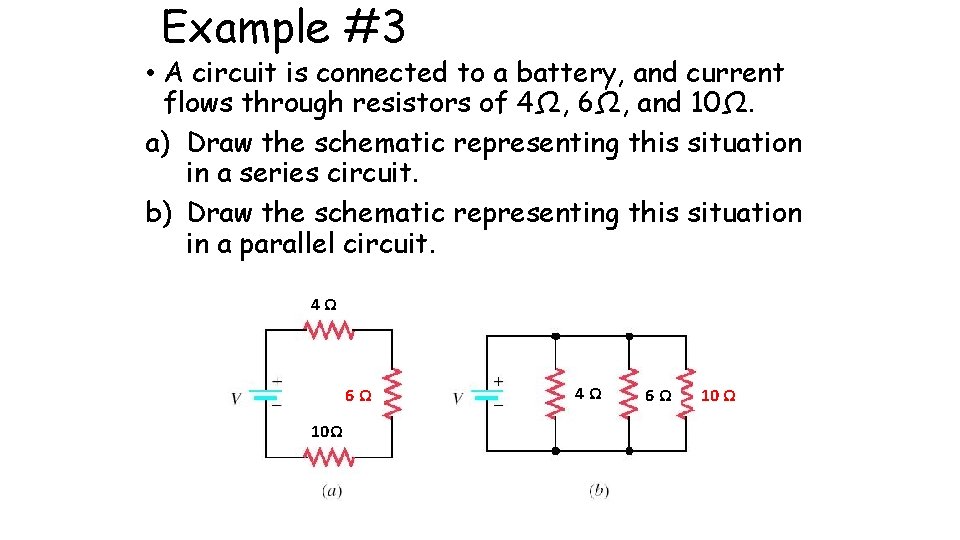
Example #3 • A circuit is connected to a battery, and current flows through resistors of 4Ω, 6Ω, and 10Ω. a) Draw the schematic representing this situation in a series circuit. b) Draw the schematic representing this situation in a parallel circuit. 4Ω 6Ω 10Ω 4Ω 6Ω 10 Ω
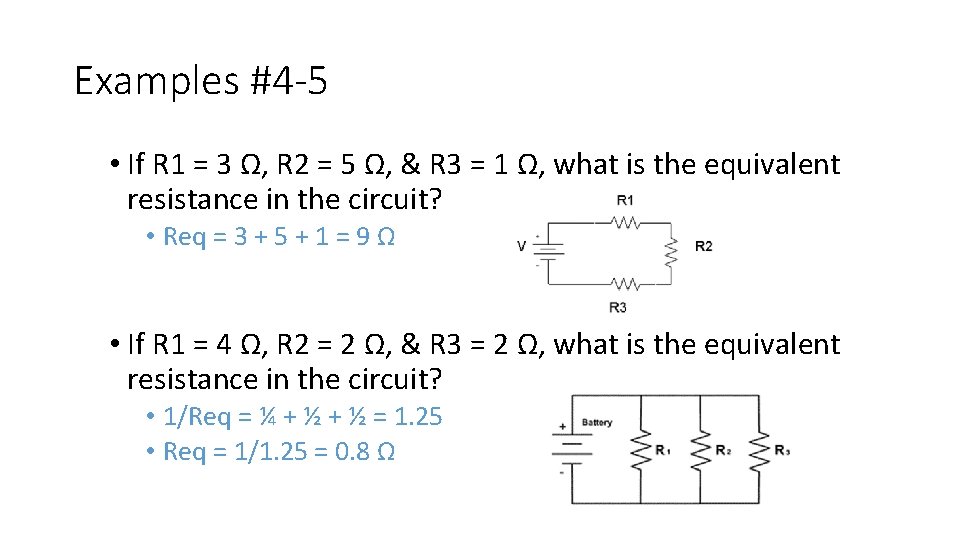
Examples #4 -5 • If R 1 = 3 Ω, R 2 = 5 Ω, & R 3 = 1 Ω, what is the equivalent resistance in the circuit? • Req = 3 + 5 + 1 = 9 Ω • If R 1 = 4 Ω, R 2 = 2 Ω, & R 3 = 2 Ω, what is the equivalent resistance in the circuit? • 1/Req = ¼ + ½ = 1. 25 • Req = 1/1. 25 = 0. 8 Ω
• https: //www. youtube. com/watch? v=4 th. VCsp. Af. K 4 • https: //www. youtube. com/watch? v=a 3 Ftc_2 iu 7 s&t=110 s • https: //www. youtube. co 6 m/watch? v=Je. Fy. JN 9 q. W 48 • https: //www. youtube. com/watch? v=0 j 0 w. UOt 9 PK 0
CALCULATOR TODAY!! Handouts Phones Up Starter pg 92 -93
Starter pg 92 -93 You need a calculator today • What is a series circuit? Define and give example. • What is a parallel circuit? Define and give example.
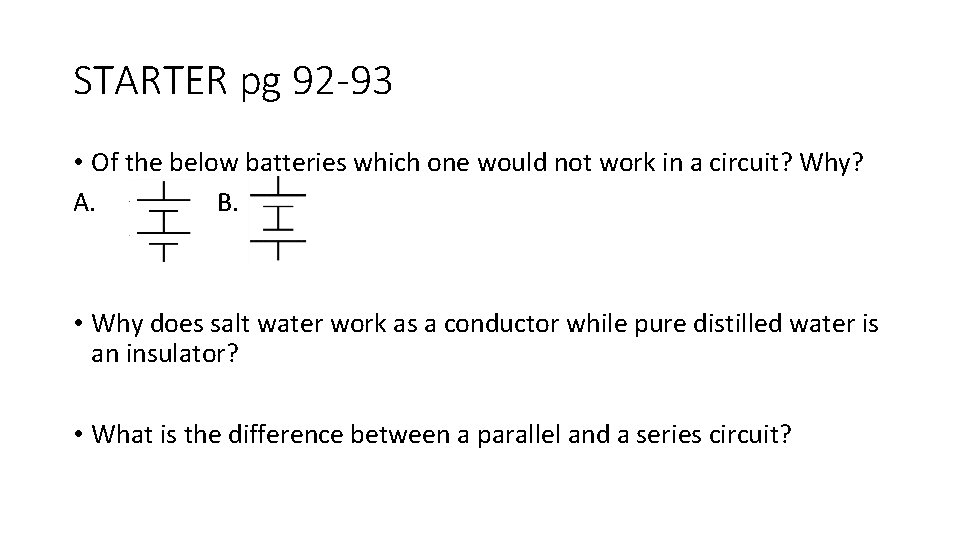
STARTER pg 92 -93 • Of the below batteries which one would not work in a circuit? Why? A. B. • Why does salt water work as a conductor while pure distilled water is an insulator? • What is the difference between a parallel and a series circuit?
Electricity Today we will: Show to calculate resistance, potential difference and power in a circuit using ohms law. Demonstrate how to use ohms law to solve word problems. Questions: How does energy flow through a system? How is electrical energy converted into other forms of energy?
Electricity
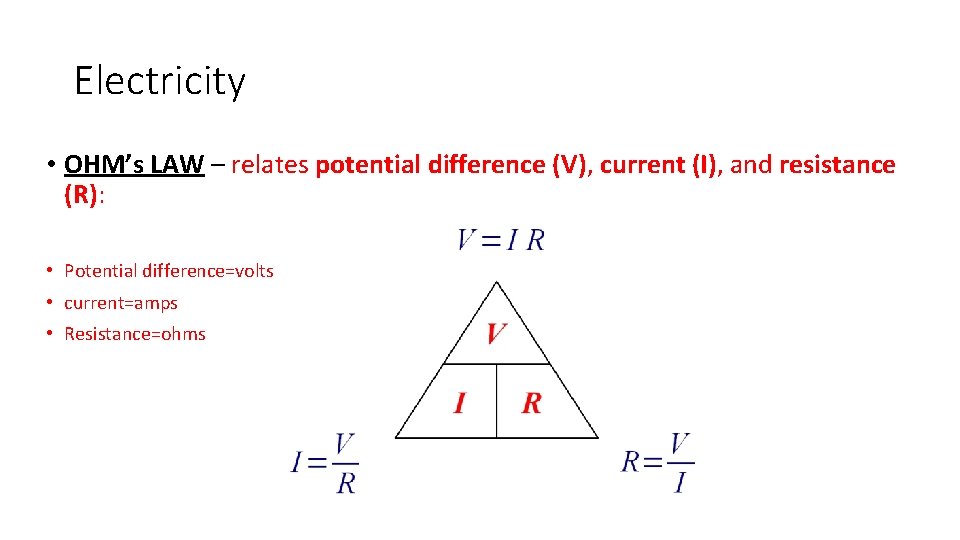
Electricity • OHM’s LAW – relates potential difference (V), current (I), and resistance (R): • Potential difference=volts • current=amps • Resistance=ohms
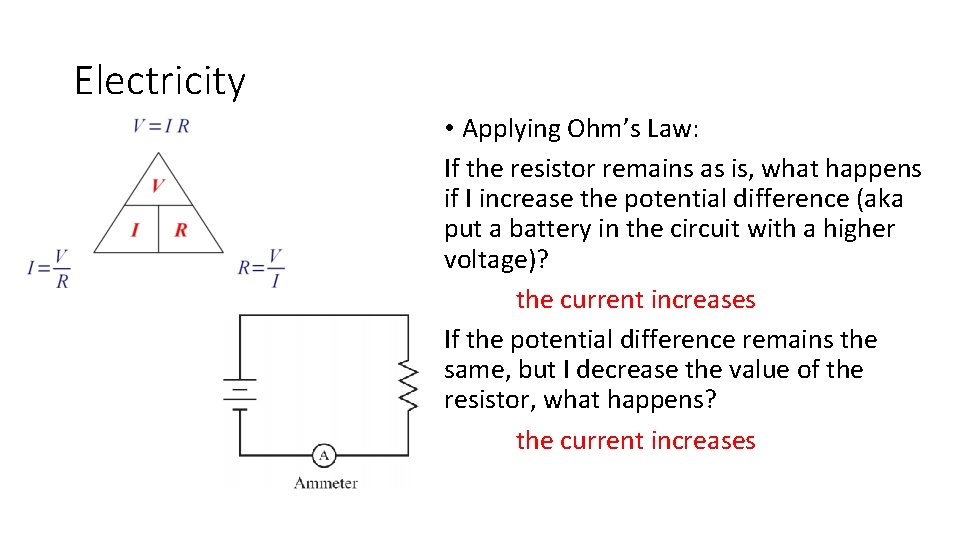
Electricity • Applying Ohm’s Law: If the resistor remains as is, what happens if I increase the potential difference (aka put a battery in the circuit with a higher voltage)? the current increases If the potential difference remains the same, but I decrease the value of the resistor, what happens? the current increases
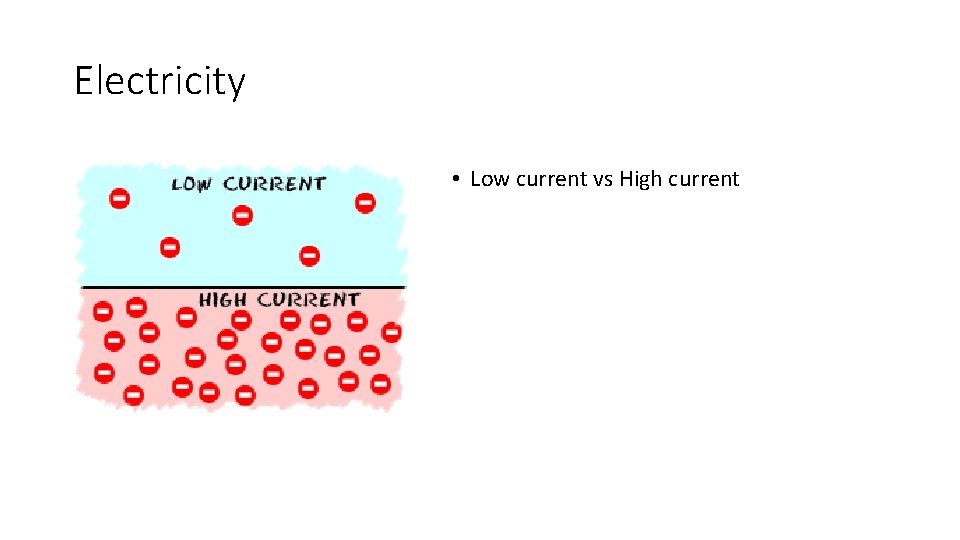
Electricity • Low current vs High current
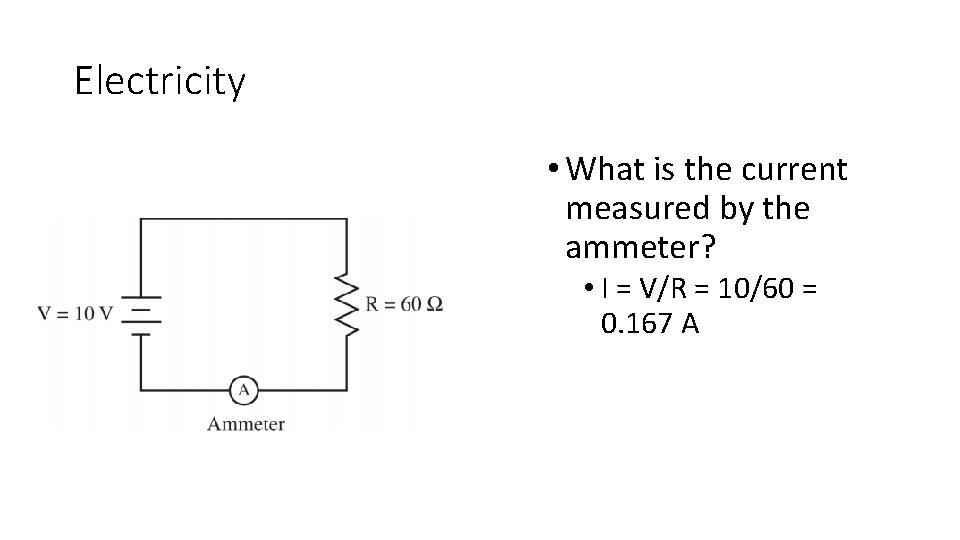
Electricity • What is the current measured by the ammeter? • I = V/R = 10/60 = 0. 167 A
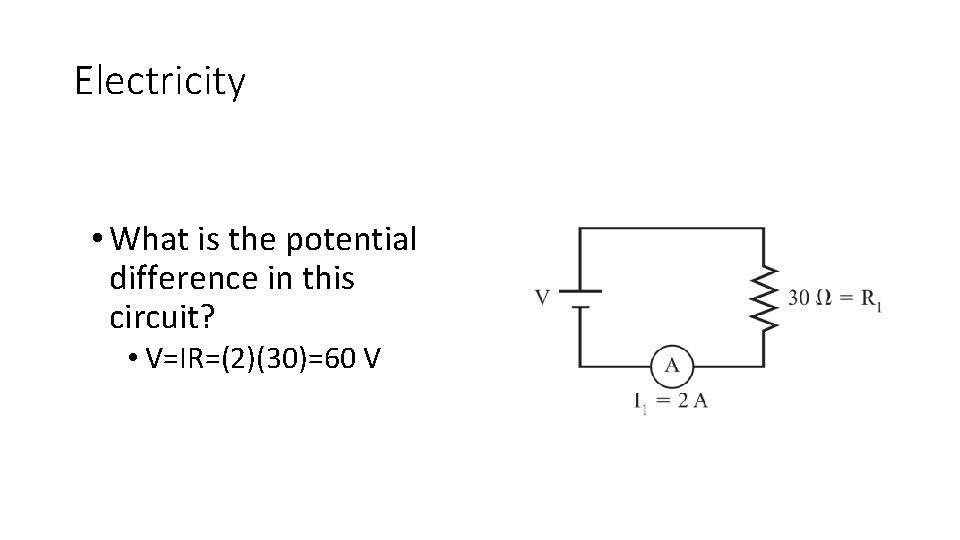
Electricity • What is the potential difference in this circuit? • V=IR=(2)(30)=60 V
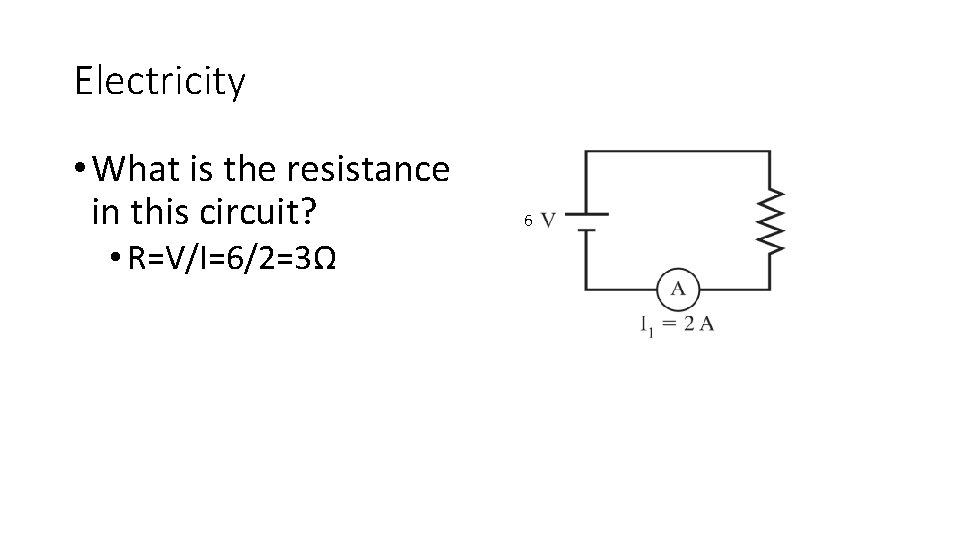
Electricity • What is the resistance in this circuit? • R=V/I=6/2=3Ω 6
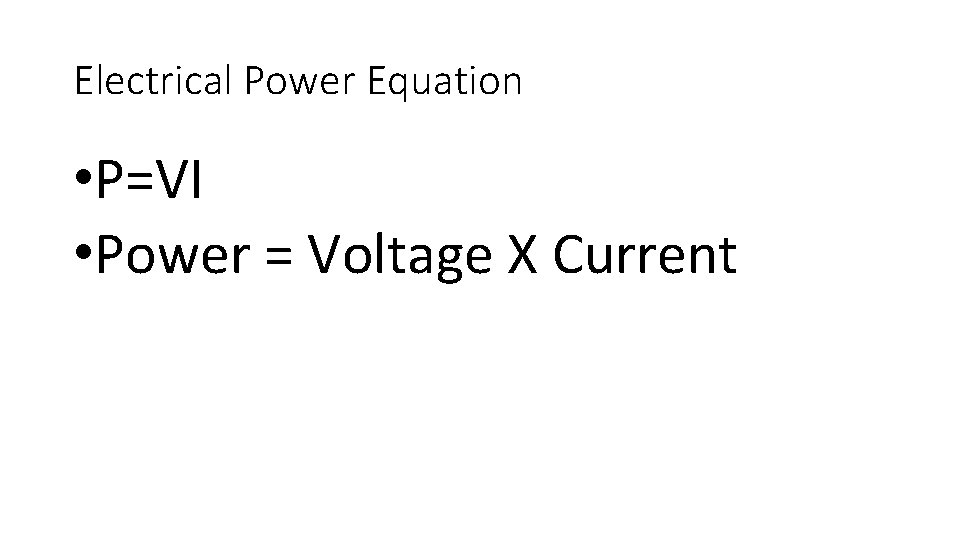
Electrical Power Equation • P=VI • Power = Voltage X Current
AC/DC • Direct Current: a constant stream of electrons in one direction. • DC example: a battery • https: //www. youtube. com/watc h? v=5 UYF 23 C 2 Hew • Alternating Current: charges constantly reverse directions (60 times per second in the US) • AC example: 120 Volt wall outlet
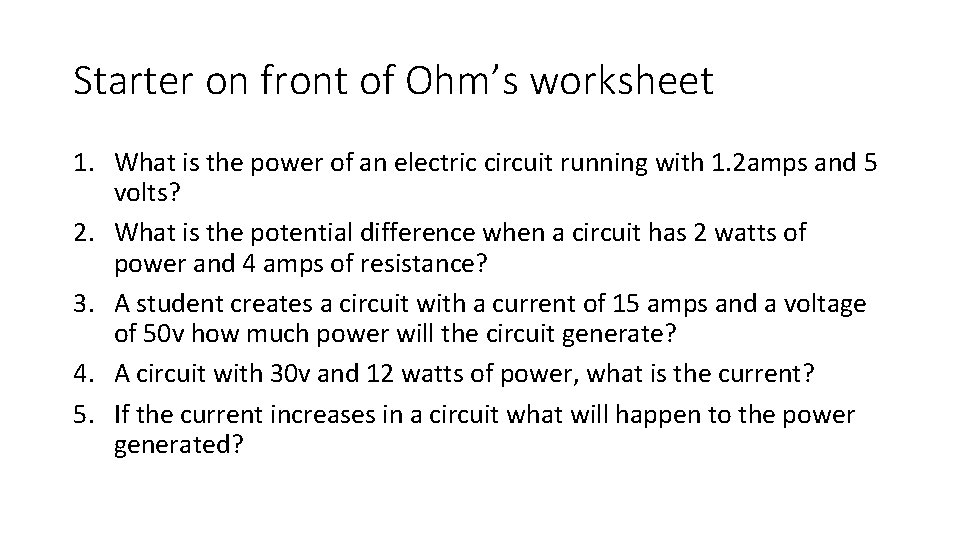
Starter on front of Ohm’s worksheet 1. What is the power of an electric circuit running with 1. 2 amps and 5 volts? 2. What is the potential difference when a circuit has 2 watts of power and 4 amps of resistance? 3. A student creates a circuit with a current of 15 amps and a voltage of 50 v how much power will the circuit generate? 4. A circuit with 30 v and 12 watts of power, what is the current? 5. If the current increases in a circuit what will happen to the power generated?
You need a calculator today! Put your phone away Get out your homework and turn it in ASAP TRANSFORMERS Objective: Identify the different types of transformers. Review electrical energy and demonstrate understanding of electricity through a quiz.
https: //www. youtube. com/watch? v=w 9 ug. Mmr. CTg 0 • Transformers are composed of: iron core ring wrapped in coils • • One coil is connected to an AC input voltage and is called the primary coil (input). The other coil is connected to an output circuit with a load resistance and is called the secondary coil(output). • • The two coils are well insulated from each other and do not form a physical electrical connection. • • Transformers can either step up or step down a voltage. • • The constantly changing current induces a changing magnetic field in the core of the transformer. • • If there are fewer coil turns in the secondary than the primary, it is a step-down transformer (high voltage to low). • • Step-up is the opposite of step-down, it has fewer coil turns on input the than the output and changes the voltage from lower into higher.
Review • 1. What type of current is used to power your house? AC • 2. If a circuit has a current of 4 A and a power of 12 W, what is the potential difference? V=P/I 12/4=3 v • 3. What is the resistance of a circuit with a voltage of 9 v and a current of 7 A? R=V/I 9/7=1. 29Ω • 4. What is the equivalent resistance of a series circuit with resistors at 3Ω, 4 Ω, and 6 Ω? R = (R 1) + (R 2) + (R 3) 3+4+6=13Ω • 5. 4. What is the equivalent resistance of a parallel circuit with resistors at 3Ω, 4 Ω, and 6 Ω? 1/R = (1/R 1) + (1/R 2) + (1/R 3) 1/R = (1/3) + (1/4) + (1/6) 1/. 75=1. 33Ω
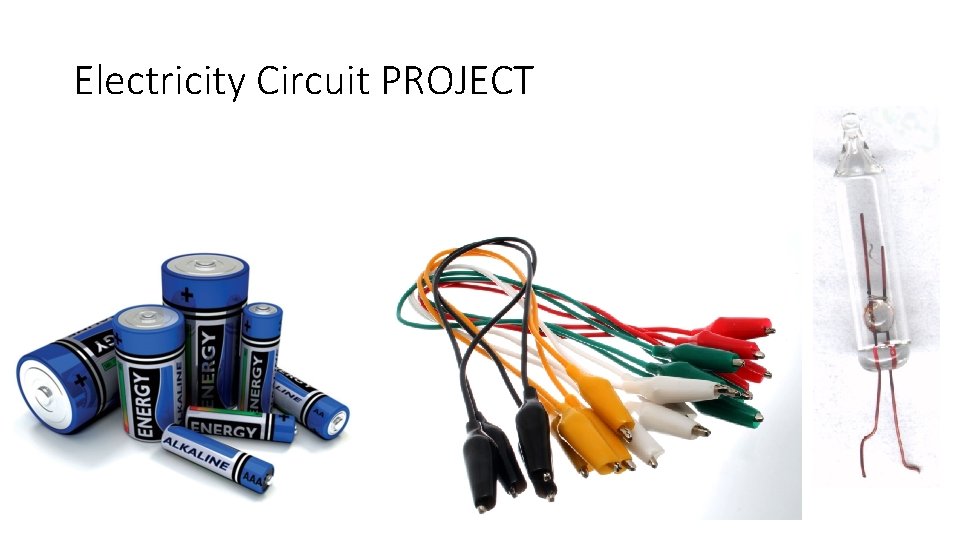
Electricity Circuit PROJECT