
Handouts Materials Worksheetchapter 3 Class Schedule Overview Post

- Slides: 29
Handouts / Materials • Worksheet_chapter 3 Class Schedule Overview • Post slides. • In-class activity: Example 3. 2 • Reading assignments. 1
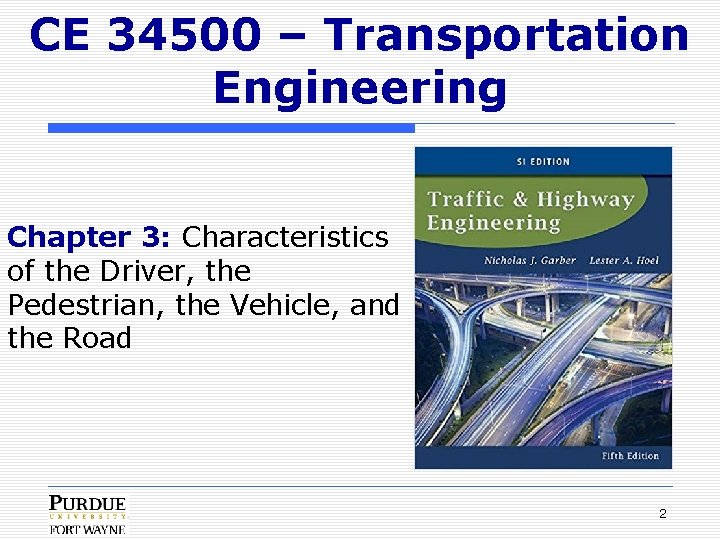
CE 34500 – Transportation Engineering Chapter 3: Characteristics of the Driver, the Pedestrian, the Vehicle, and the Road 2
Characteristics of Driver, Pedestrian, Vehicle & Road As a Transportation Engineer, What Do We Have Control Over?
Characteristics of Driver, Pedestrian, Vehicle & Road If We Do Not Have Full Control Over All of the Characteristics, Why do We Study Them?
Driver Characteristics § No “Design Driver” o Wide range of abilities q Abilities vary under different conditions q 85 th to 95 th percentile used for design criteria § How Do We Regulate Drivers? o Driver licensing q Minimum knowledge of the rules of the road q Minimum driving ability q Minimum physical ability
Driver Characteristics § Human Response Process o Five senses q q q See / Visual reception Hear / Hearing perception Touch / Kinesthetic / Equilibrium Smell Taste § What Sensory Processes Do We Use When Driving?
Driver Characteristics § Visual and Hearing Important o Visual most important q q q Visual acuity Peripheral vision Color vision Glare vision & recovery Depth perception o Hearing less important q Can compensate for deafness & operate vehicle safely
Visual Reception § Visual Acuity o Ability to see fine details o Static acuity o Dynamic acuity Normal visual acuity taken as 20/20 --an individual with a 20/20 visual acuity can distinguish a letter that is subtended by an angle of 5' of arc ( 1/12 of a degree) at the eye--0. 35 in therefore represents the height of a 20/20 letter – prove?
In Class Problem 1 Example 3. 1: A driver with w visual acuity of 20/30 can just decipher a sign a distance 20 ft. from a sign. Determine the maximum distance from the sign at which drivers with the following visual acuity will be able to see the same sign: [Ans. 40, 12 ft. ] q 20/15 q 20/50
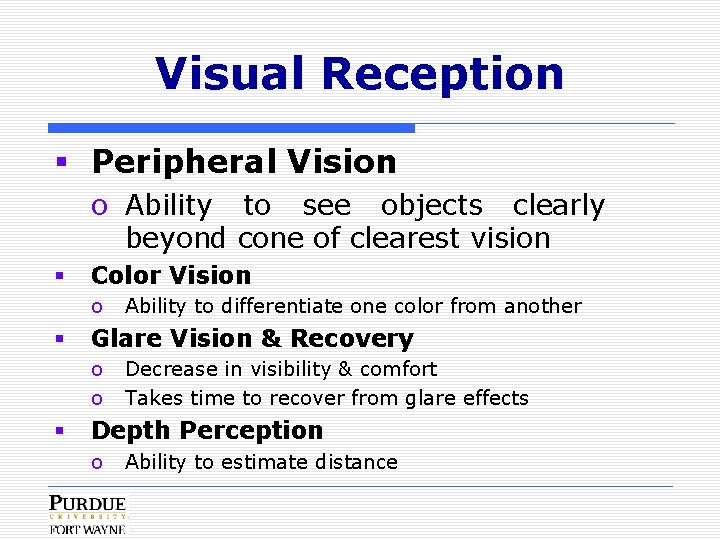
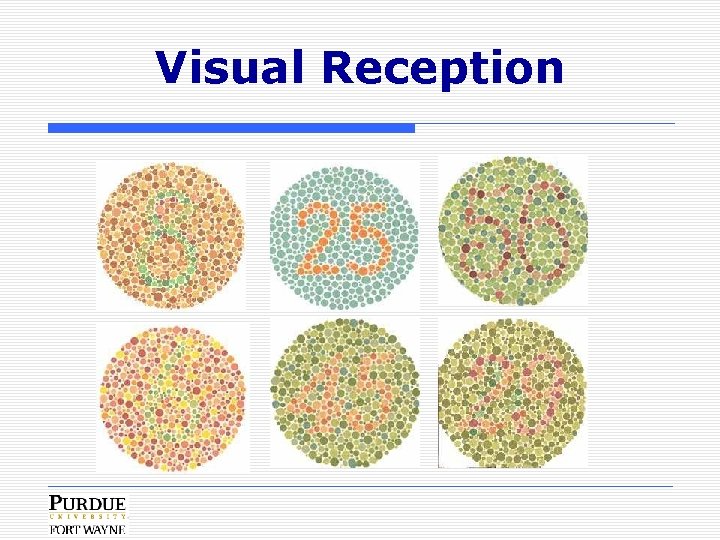
Visual Reception § Peripheral Vision o Ability to see objects clearly beyond cone of clearest vision § Color Vision o § Glare Vision & Recovery o o § Ability to differentiate one color from another Decrease in visibility & comfort Takes time to recover from glare effects Depth Perception o Ability to estimate distance
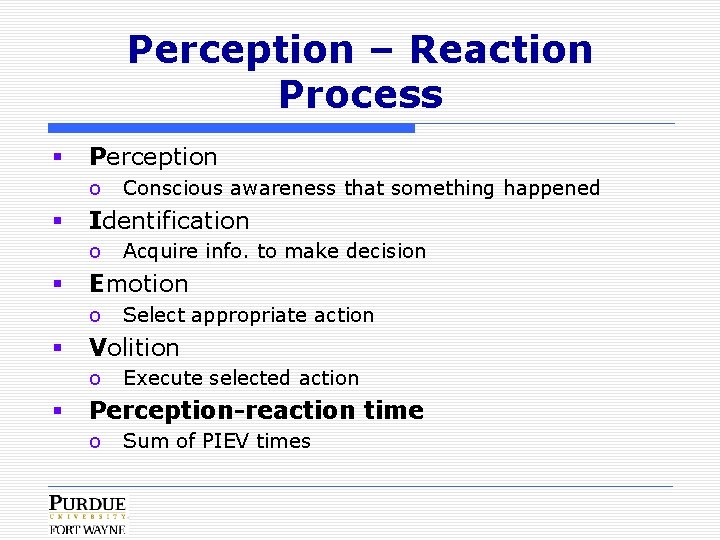
Perception – Reaction Process § Perception o § Identification o § Select appropriate action Volition o § Acquire info. to make decision Emotion o § Conscious awareness that something happened Execute selected action Perception-reaction time o Sum of PIEV times
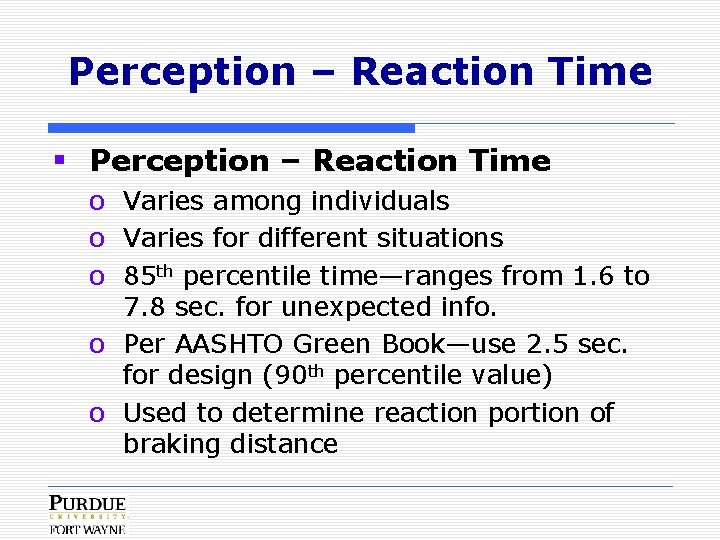
Perception – Reaction Time § Perception – Reaction Time o Varies among individuals o Varies for different situations o 85 th percentile time—ranges from 1. 6 to 7. 8 sec. for unexpected info. o Per AASHTO Green Book—use 2. 5 sec. for design (90 th percentile value) o Used to determine reaction portion of braking distance
Perception – Reaction Time § What Does 2. 5 Sec. Perception Reaction Time Mean in Terms of Roadway Design?
Perception – Reaction Time In Class Problem 2 A driver with a perception reaction time of 2. 5 sec is driving at 65 mph when she observes that an accident has blocked the road ahead. Determine the distance the vehicle would move before the driver could activate the brakes. The vehicle to continue to move at 65 mph during the perception reaction time of 2. 5 sec. [Ans. 238. 9 ft. ]
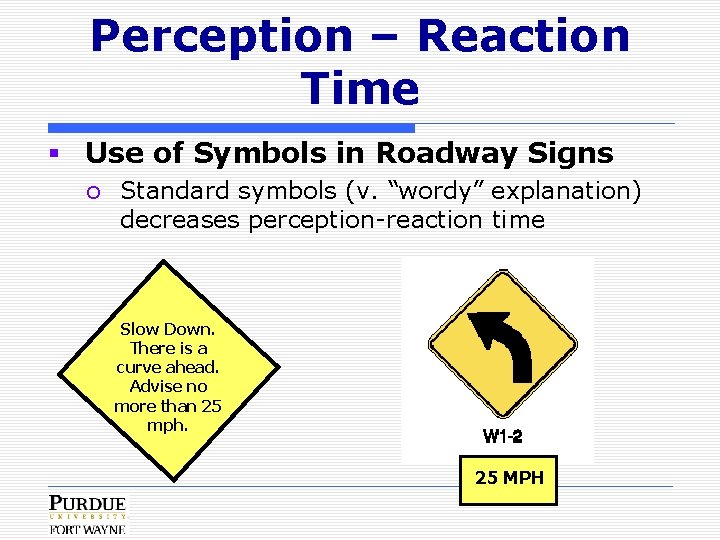
Perception – Reaction Time § Use of Symbols in Roadway Signs o Standard symbols (v. “wordy” explanation) decreases perception-reaction time Slow Down. There is a curve ahead. Advise no more than 25 mph. 25 MPH
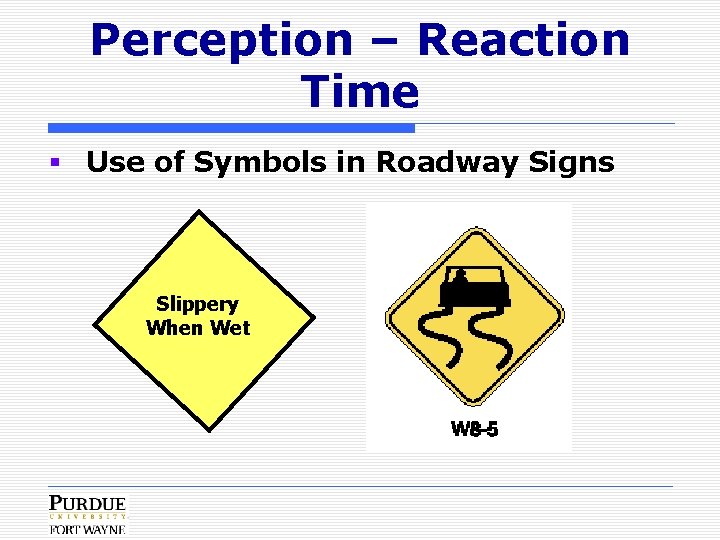
Perception – Reaction Time § Use of Symbols in Roadway Signs Slippery When Wet
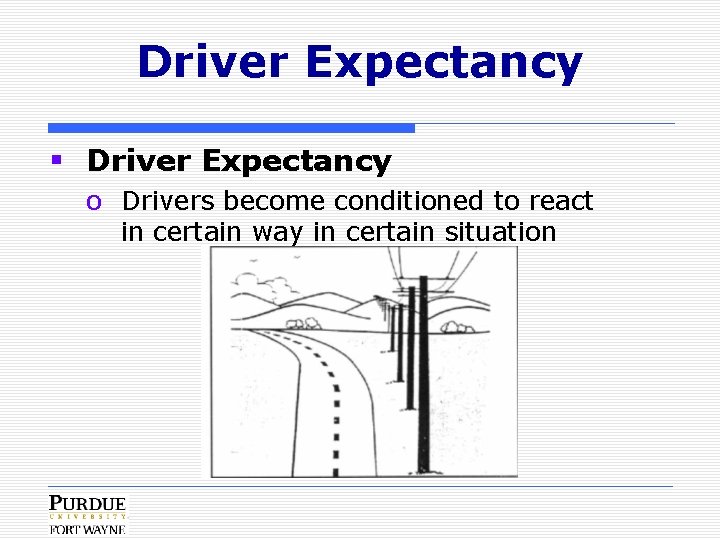
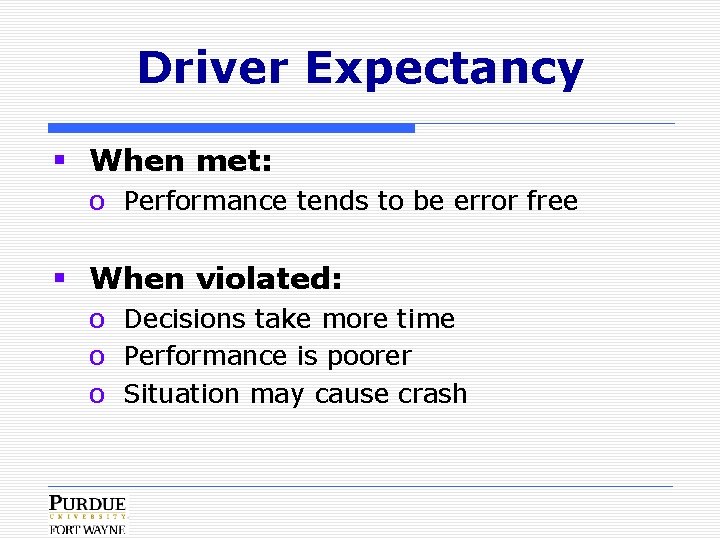
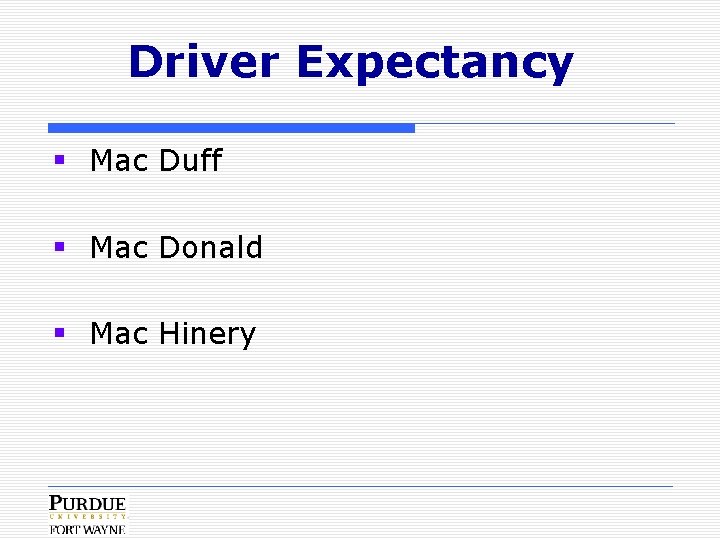
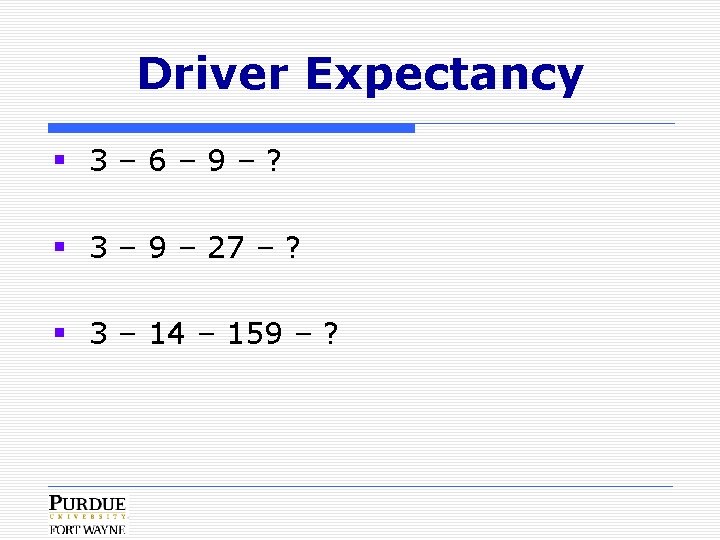
Driver Expectancy § Driver Expectancy o Drivers become conditioned to react in certain way in certain situation
Driver Expectancy § When met: o Performance tends to be error free § When violated: o Decisions take more time o Performance is poorer o Situation may cause crash
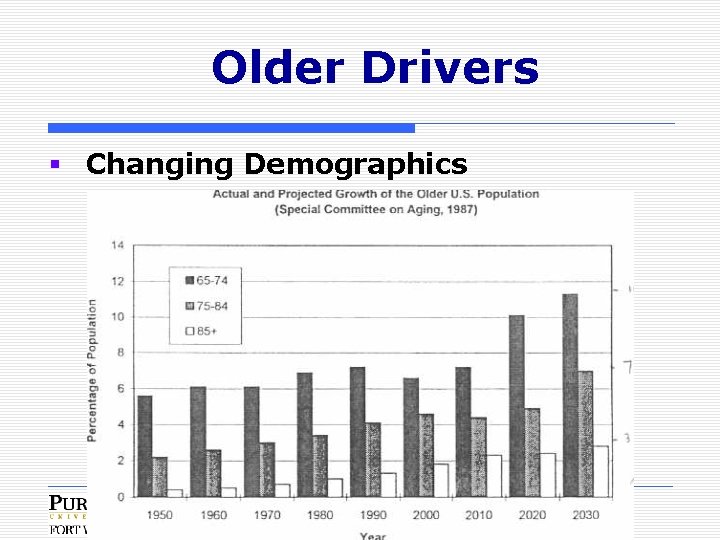
Older Drivers § Changing Demographics
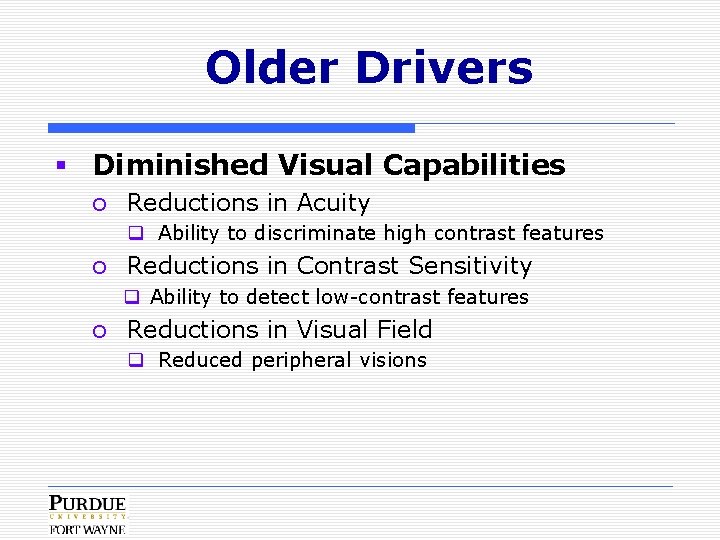
Older Drivers § Diminished Visual Capabilities o Reductions in Acuity q Ability to discriminate high contrast features o Reductions in Contrast Sensitivity q Ability to detect low-contrast features o Reductions in Visual Field q Reduced peripheral visions
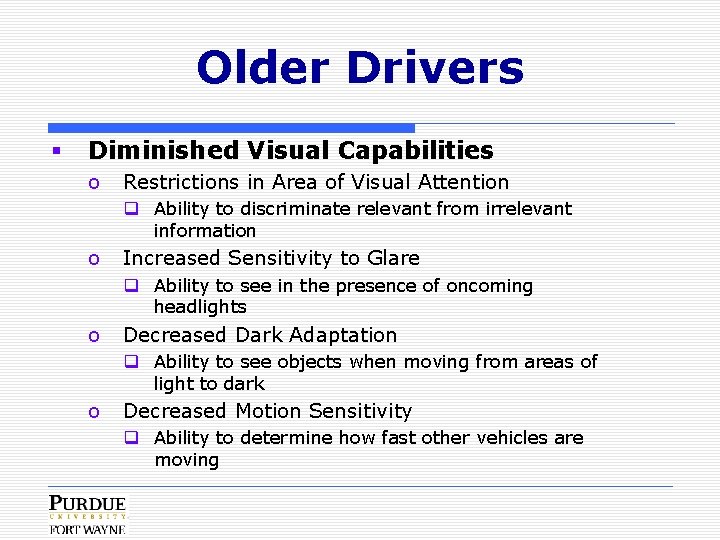
Older Drivers § Diminished Visual Capabilities o Restrictions in Area of Visual Attention q Ability to discriminate relevant from irrelevant information o Increased Sensitivity to Glare q Ability to see in the presence of oncoming headlights o Decreased Dark Adaptation q Ability to see objects when moving from areas of light to dark o Decreased Motion Sensitivity q Ability to determine how fast other vehicles are moving
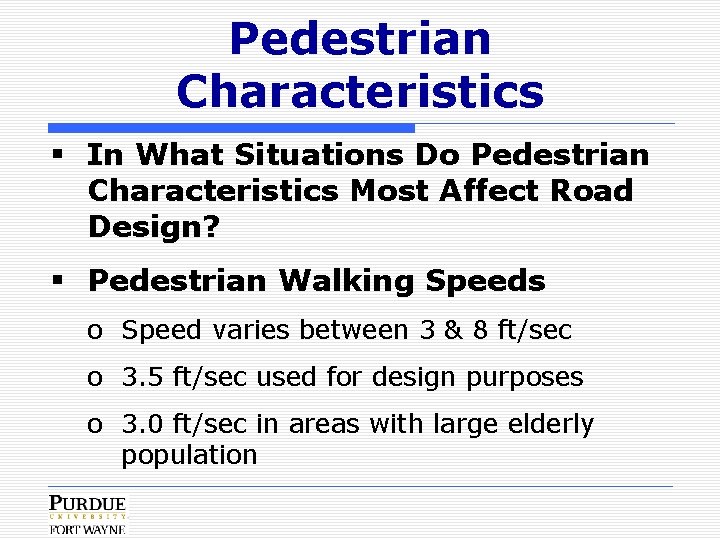
Pedestrian Characteristics § In What Situations Do Pedestrian Characteristics Most Affect Road Design? § Pedestrian Walking Speeds o Speed varies between 3 & 8 ft/sec o 3. 5 ft/sec used for design purposes o 3. 0 ft/sec in areas with large elderly population
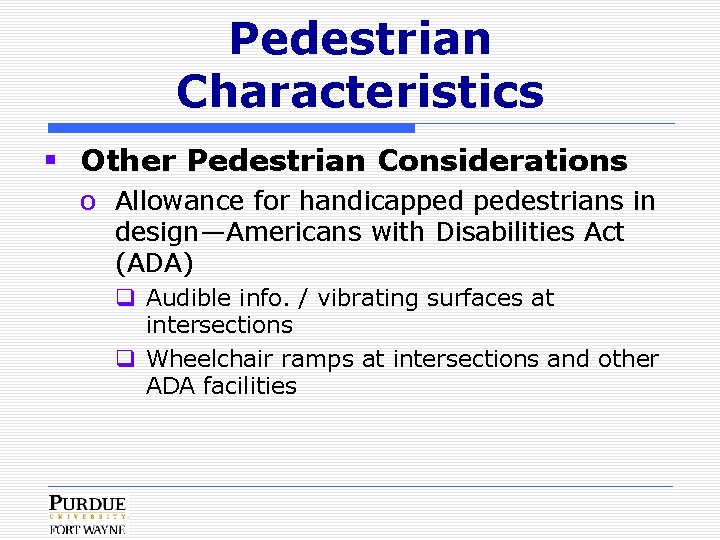
Pedestrian Characteristics § Other Pedestrian Considerations o Allowance for handicapped pedestrians in design—Americans with Disabilities Act (ADA) q Audible info. / vibrating surfaces at intersections q Wheelchair ramps at intersections and other ADA facilities
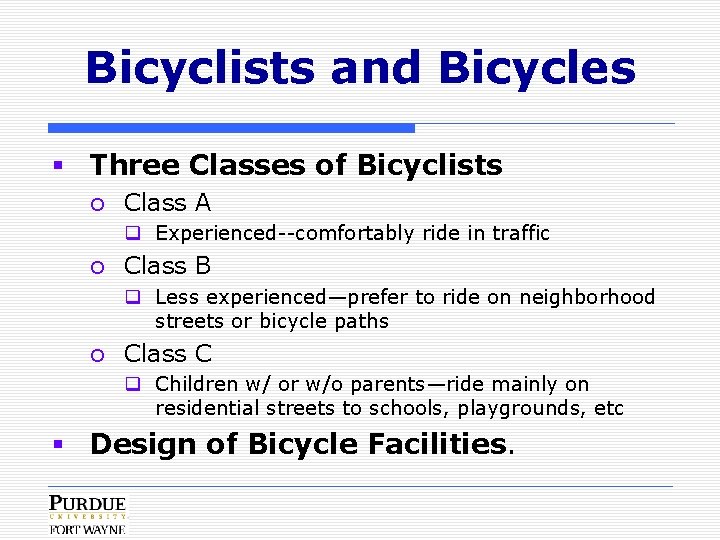
Bicyclists and Bicycles § Three Classes of Bicyclists o Class A q Experienced--comfortably ride in traffic o Class B q Less experienced—prefer to ride on neighborhood streets or bicycle paths o Class C q Children w/ or w/o parents—ride mainly on residential streets to schools, playgrounds, etc § Design of Bicycle Facilities.
Visual Reception
Driver Expectancy § Mac Duff § Mac Donald § Mac Hinery
Driver Expectancy § 3– 6– 9–? § 3 – 9 – 27 – ? § 3 – 14 – 159 – ?
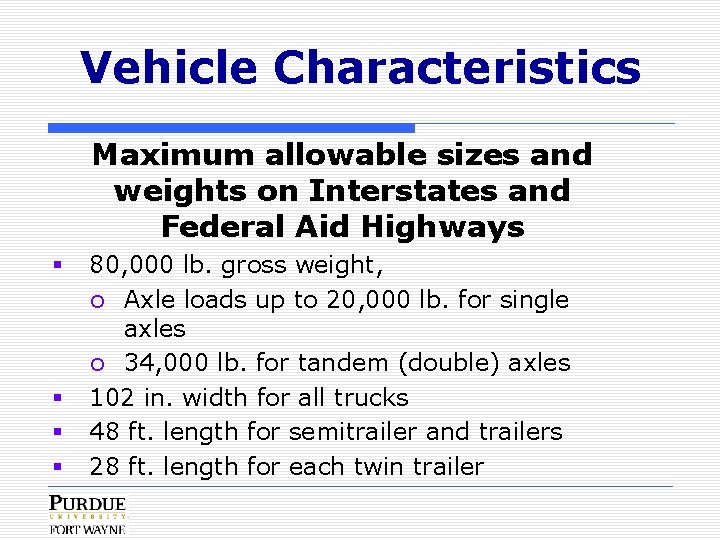
Vehicle Characteristics Maximum allowable sizes and weights on Interstates and Federal Aid Highways § § 80, 000 lb. gross weight, o Axle loads up to 20, 000 lb. for single axles o 34, 000 lb. for tandem (double) axles 102 in. width for all trucks 48 ft. length for semitrailer and trailers 28 ft. length for each twin trailer
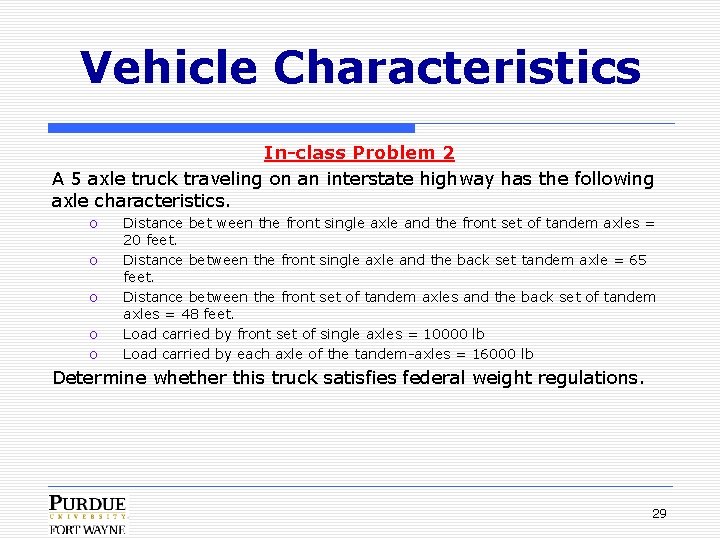
Vehicle Characteristics In-class Problem 2 A 5 axle truck traveling on an interstate highway has the following axle characteristics. o o o Distance bet ween the front single axle and the front set of tandem axles = 20 feet. Distance between the front single axle and the back set tandem axle = 65 feet. Distance between the front set of tandem axles and the back set of tandem axles = 48 feet. Load carried by front set of single axles = 10000 lb Load carried by each axle of the tandem-axles = 16000 lb Determine whether this truck satisfies federal weight regulations. 29