
Handout 4 Natural classes and distinctive features Consonants
![Other consonant classes • • Affricates: [t. S, d. Z, pf, bv, ts, dz]](https://slidetodoc.com/presentation_image_h/a60e44c1f05fc3353846e394e22032e0/image-3.jpg "Other consonant classes • • Affricates: [t. S, d. Z, pf, bv, ts, dz]")
![The major class features • The major class features are: – [consonantal] – [sonorant]](https://slidetodoc.com/presentation_image_h/a60e44c1f05fc3353846e394e22032e0/image-12.jpg "The major class features • The major class features are: – [consonantal] – [sonorant]")
![The major class features • [consonantal]: A sound is [+cons] if it is produced](https://slidetodoc.com/presentation_image_h/a60e44c1f05fc3353846e394e22032e0/image-13.jpg "The major class features • [consonantal]: A sound is [+cons] if it is produced")
![The major class features • [sonorant]: A sound is [+son] if it is produced](https://slidetodoc.com/presentation_image_h/a60e44c1f05fc3353846e394e22032e0/image-14.jpg "The major class features • [sonorant]: A sound is [+son] if it is produced")
![The major class features • [syllabic]: A sound is [+syll] if it is the](https://slidetodoc.com/presentation_image_h/a60e44c1f05fc3353846e394e22032e0/image-15.jpg "The major class features • [syllabic]: A sound is [+syll] if it is the")


![Place features • [labial]: A sound is [+lab] if it is articulated with the](https://slidetodoc.com/presentation_image_h/a60e44c1f05fc3353846e394e22032e0/image-18.jpg "Place features • [labial]: A sound is [+lab] if it is articulated with the")
![Place features • [coronal]: A sound is [+cor] if it is articulated with the](https://slidetodoc.com/presentation_image_h/a60e44c1f05fc3353846e394e22032e0/image-19.jpg "Place features • [coronal]: A sound is [+cor] if it is articulated with the")
![Place features • [anterior]: A sound is [+ant] if it is [+cor] and it](https://slidetodoc.com/presentation_image_h/a60e44c1f05fc3353846e394e22032e0/image-20.jpg "Place features • [anterior]: A sound is [+ant] if it is [+cor] and it")
![Place features • [distributed]: A sound is [+dist] if it is [+cor] and it](https://slidetodoc.com/presentation_image_h/a60e44c1f05fc3353846e394e22032e0/image-21.jpg "Place features • [distributed]: A sound is [+dist] if it is [+cor] and it")
![Place features • [back]: A sound is [+back] if it is articulated behind the](https://slidetodoc.com/presentation_image_h/a60e44c1f05fc3353846e394e22032e0/image-22.jpg "Place features • [back]: A sound is [+back] if it is articulated behind the")
![Height features • [high]: A sound is [+high] if it is produced with the](https://slidetodoc.com/presentation_image_h/a60e44c1f05fc3353846e394e22032e0/image-24.jpg "Height features • [high]: A sound is [+high] if it is produced with the")
![Height features • [low]: A sound is [+low] if it is produced with the](https://slidetodoc.com/presentation_image_h/a60e44c1f05fc3353846e394e22032e0/image-25.jpg "Height features • [low]: A sound is [+low] if it is produced with the")

![Place of articulation in consonants [lab] [cor] [dist] [ant] [back] Bilabial, labiodental Dental +](https://slidetodoc.com/presentation_image_h/a60e44c1f05fc3353846e394e22032e0/image-27.jpg "Place of articulation in consonants [lab] [cor] [dist] [ant] [back] Bilabial, labiodental Dental +")
![Place of articulation in consonants [lab] [cor] [back] [high] [low] Velar - - +](https://slidetodoc.com/presentation_image_h/a60e44c1f05fc3353846e394e22032e0/image-28.jpg "Place of articulation in consonants [lab] [cor] [back] [high] [low] Velar - - +")
![Laryngeal features • [voice]: A sound is [+voice] if it is produced with vocal](https://slidetodoc.com/presentation_image_h/a60e44c1f05fc3353846e394e22032e0/image-29.jpg "Laryngeal features • [voice]: A sound is [+voice] if it is produced with vocal")
![Laryngeal features • [spread glottis]: A sound is [+spread] if it is produced with](https://slidetodoc.com/presentation_image_h/a60e44c1f05fc3353846e394e22032e0/image-30.jpg "Laryngeal features • [spread glottis]: A sound is [+spread] if it is produced with")
![Laryngeal features • [constricted glottis]: A sound is [+constr] if it is produced with](https://slidetodoc.com/presentation_image_h/a60e44c1f05fc3353846e394e22032e0/image-31.jpg "Laryngeal features • [constricted glottis]: A sound is [+constr] if it is produced with")
![Manner features • [continuant]: A sound is [+cont] if it is produced without closure](https://slidetodoc.com/presentation_image_h/a60e44c1f05fc3353846e394e22032e0/image-34.jpg "Manner features • [continuant]: A sound is [+cont] if it is produced without closure")
![Manner features • [delayed release]: A sound is [+del rel] if it is produced](https://slidetodoc.com/presentation_image_h/a60e44c1f05fc3353846e394e22032e0/image-35.jpg "Manner features • [delayed release]: A sound is [+del rel] if it is produced")
![Manner features • [lateral]: A sound is [+lat] if it is produced with airflow](https://slidetodoc.com/presentation_image_h/a60e44c1f05fc3353846e394e22032e0/image-36.jpg "Manner features • [lateral]: A sound is [+lat] if it is produced with airflow")
![Manner features • [nasal]: A sound is [+nas] if it is produced with airflow](https://slidetodoc.com/presentation_image_h/a60e44c1f05fc3353846e394e22032e0/image-37.jpg "Manner features • [nasal]: A sound is [+nas] if it is produced with airflow")
![Manner features • [Advanced Tongue Root]: A sound is [+ATR] if it is produced](https://slidetodoc.com/presentation_image_h/a60e44c1f05fc3353846e394e22032e0/image-38.jpg "Manner features • [Advanced Tongue Root]: A sound is [+ATR] if it is produced")
![Unrounded vowels ([-lab]) [-back] [+high, -low, +ATR] i ˆ, µ [+high, -low, -ATR] I](https://slidetodoc.com/presentation_image_h/a60e44c1f05fc3353846e394e22032e0/image-40.jpg "Unrounded vowels ([-lab]) [-back] [+high, -low, +ATR] i ˆ, µ [+high, -low, -ATR] I")
![Rounded vowels ([+lab]) [-back] [+high, -low, +ATR] y ¨, u [+high, -low, -ATR] Y](https://slidetodoc.com/presentation_image_h/a60e44c1f05fc3353846e394e22032e0/image-41.jpg "Rounded vowels ([+lab]) [-back] [+high, -low, +ATR] y ¨, u [+high, -low, -ATR] Y")
- Slides: 45
Handout #4 Natural classes and distinctive features
Consonants
Other consonant classes • • Affricates: [t. S, d. Z, pf, bv, ts, dz] Labiovelars: [w, kp, gb] Placeless aspirated continuant: [h] Glottal stop: [/] Implosives: [∫, Î , © ] Ejectives: [p» , t» , k» ] Clicks: Dental [k|], Alveolar [k!], Lateral [k||]
Rounded vowels
Unrounded vowels
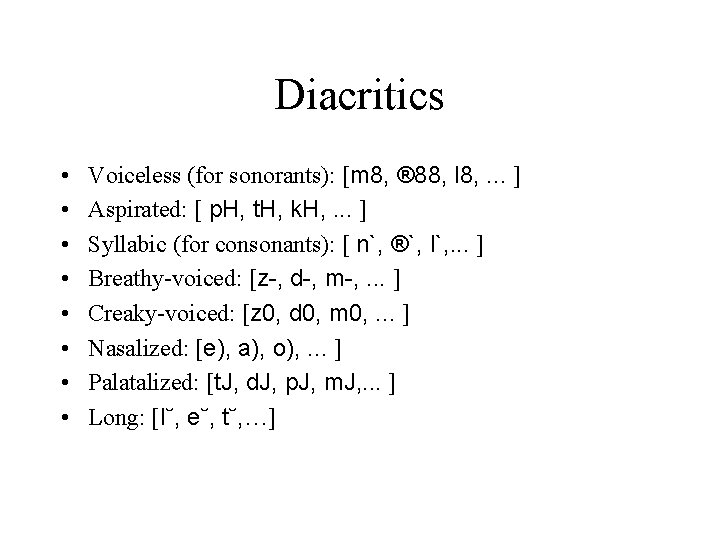
Diacritics • • Voiceless (for sonorants): [m 8, ® 88, l 8, . . . ] Aspirated: [ p. H, t. H, k. H, . . . ] Syllabic (for consonants): [ n`, ®`, l`, . . . ] Breathy-voiced: [z-, d-, m-, . . . ] Creaky-voiced: [z 0, d 0, m 0, . . . ] Nasalized: [e), a), o), . . . ] Palatalized: [t. J, d. J, p. J, m. J, . . . ] Long: [I˘, e˘, t˘, …]
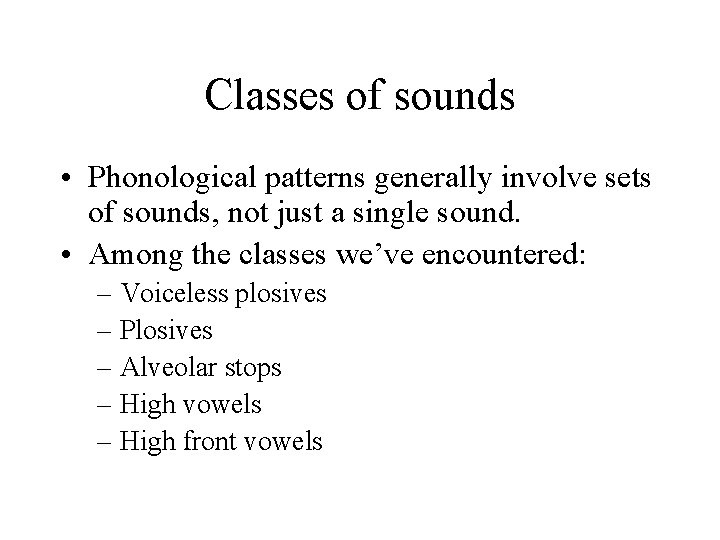
Classes of sounds • Phonological patterns generally involve sets of sounds, not just a single sound. • Among the classes we’ve encountered: – Voiceless plosives – Plosives – Alveolar stops – High vowels – High front vowels
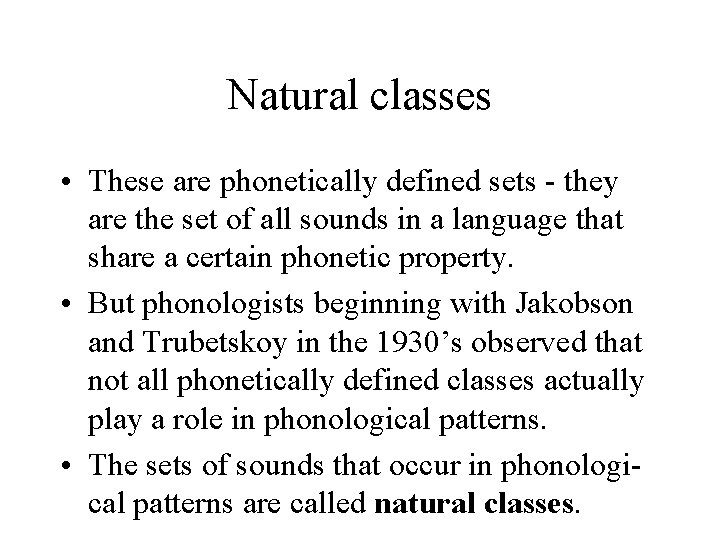
Natural classes • These are phonetically defined sets - they are the set of all sounds in a language that share a certain phonetic property. • But phonologists beginning with Jakobson and Trubetskoy in the 1930’s observed that not all phonetically defined classes actually play a role in phonological patterns. • The sets of sounds that occur in phonological patterns are called natural classes.
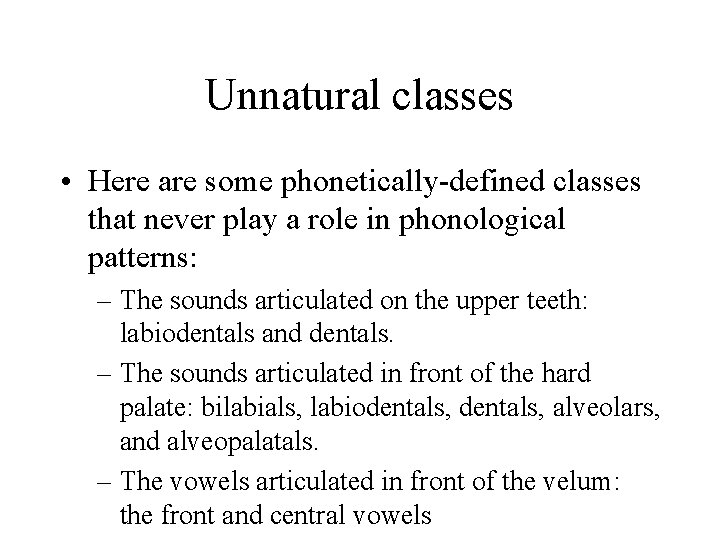
Unnatural classes • Here are some phonetically-defined classes that never play a role in phonological patterns: – The sounds articulated on the upper teeth: labiodentals and dentals. – The sounds articulated in front of the hard palate: bilabials, labiodentals, alveolars, and alveopalatals. – The vowels articulated in front of the velum: the front and central vowels
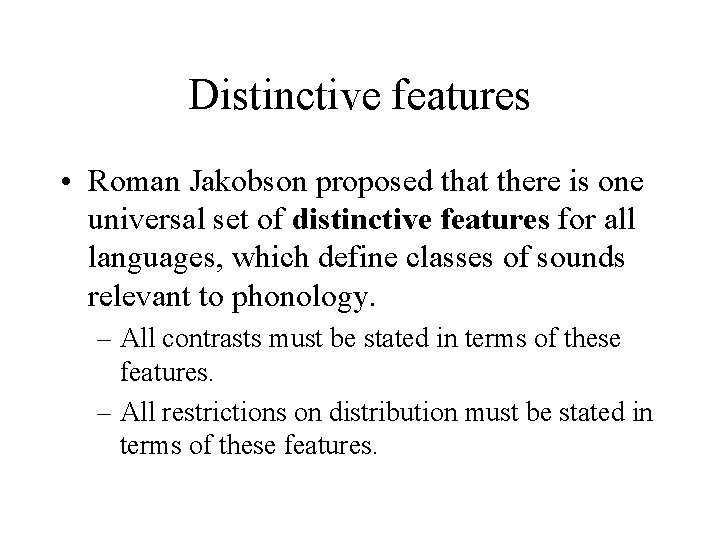
Distinctive features • Roman Jakobson proposed that there is one universal set of distinctive features for all languages, which define classes of sounds relevant to phonology. – All contrasts must be stated in terms of these features. – All restrictions on distribution must be stated in terms of these features.
The sources of the distinctive features • Chomsky, N. and Halle, M. (1968). The Sound Pattern of English. Harper and Row, New York. • Halle, M. and K. Stevens (1971). A note on laryngeal features. Quarterly Progress Report 101. Research Laboratory of Electronics, MIT. 198 -212. • Jakobson, R. , Fant, G. , and Halle, M. (1952). Preliminaries to Speech Analysis. MIT Press, Cambridge. • Keating, P. (1988). A Survey of Phonological Features. Indiana University Linguistics Club, Bloomington. • Mc. Carthy, J. (1988). Feature geometry and dependency: A review. Phonetica 43. 84 -108
The major class features • The major class features are: – [consonantal] – [sonorant] – [syllabic] • They define major classes of sounds, such as consonant and vowel, sonorant and obstruent.
The major class features • [consonantal]: A sound is [+cons] if it is produced with significant obstruction of the oral vocal tract; otherwise it is [-cons]. – [+cons]: Obstruents, nasal stops, liquids (r’s and l’s). – [-cons]: Vowels, semivowels (i. e. glides like [j] and [w]).
The major class features • [sonorant]: A sound is [+son] if it is produced with a vocal tract sufficiently open that with modal voiced airflow there is no turbulence; otherwise it is [-son]. – [+son]: Vowels, semivowels, approximants, nasal stops, trills. – [-son]: Obstruents (oral stops, fricatives)
The major class features • [syllabic]: A sound is [+syll] if it is the most prominent sound in its syllable; otherwise it is [-syll]. – [+syll]: Vowels, syllabic consonants – [-syll]: Semivowels, nonsyllabic consonants. – V = [+syll] – C = [-syll]
The major class features
The major class features
Place features • [labial]: A sound is [+lab] if it is articulated with the lips; otherwise it is [-lab]. – [+lab]: Bilabials, labiodentals, rounded vowels, labiovelars, labialized consonants. – [-lab]: All other sounds.
Place features • [coronal]: A sound is [+cor] if it is articulated with the tongue blade or front of the tongue; otherwise it is [-cor]. – [+cor]: Dentals, alveolars, alveopalatals, retroflexes, palatals, front vowels, palatalized consonants. – [-cor]: All other sounds.
Place features • [anterior]: A sound is [+ant] if it is [+cor] and it is produced on or in front of the alveolar ridge; otherwise it is [-ant]. – [+ant]: Dentals, alveolars. – [-ant]: All other sounds.
Place features • [distributed]: A sound is [+dist] if it is [+cor] and it is produced with the whole tongue blade; otherwise it is [-dist]. – [+dist]: Alveolars, alveopalatals – [-dist]: All other sounds.
Place features • [back]: A sound is [+back] if it is articulated behind the hard palate; otherwise it is [-back]. – [+back]: Velars, uvulars, pharyngeals, back vowels, central vowels, labiovelars, velarized consonants, pharuyngealized consonants – [-back]: All other sounds.
Place features
Height features • [high]: A sound is [+high] if it is produced with the tongue body raised from neutral (mid central) position; otherwise it is [-high]. – [+high]: High vowels, high semivowels, velars, palatals, velarized consonants, palatalized consonants. – [-high]: All other sounds.
Height features • [low]: A sound is [+low] if it is produced with the tongue body lowered from neutral (mid central) position; otherwise it is [-low]. – [+low]: Low vowels, pharyngealized consonants. – [-low]: All other sounds.
Height features in vowels
Place of articulation in consonants [lab] [cor] [dist] [ant] [back] Bilabial, labiodental Dental + - - - + - Alveolar - + + + - Alveopalatal, palatal Retroflex - + + - - -
Place of articulation in consonants [lab] [cor] [back] [high] [low] Velar - - + + - Uvular - - + - - Pharyngeal - - +
Laryngeal features • [voice]: A sound is [+voice] if it is produced with vocal fold vibration; otherwise it is [voice]. – [+voice]: All voiced sounds. – [-voice]: All voiceless sounds.
Laryngeal features • [spread glottis]: A sound is [+spread] if it is produced with the vocal folds spread far enough apart that there is uninterrupted airflow; otherwise it is [-spread]. – [+spread]: Aspirated sounds, breathy-voiced sounds – [-spread]: Voiceless unaspirated sounds, modal voiced sounds, creaky-voiced sounds.
Laryngeal features • [constricted glottis]: A sound is [+constr] if it is produced with the vocal folds closer than in modal voicing; otherwise it is [-constr]. – [+constr]: Glottal stop, creaky-voiced sounds, ejectives. – [-constr]: All other sounds.
Voiced sounds
Voiceless sounds
Manner features • [continuant]: A sound is [+cont] if it is produced without closure in the oral cavity; otherwise it is [-cont]. – [+cont]: Fricatives, approximants, vowels. – [-cont]: Oral stops (including affricates), nasal stops.
Manner features • [delayed release]: A sound is [+del rel] if it is produced with an oral passage so narrow that airflow through it is turbulent; otherwise it is [-del rel]. – [+del rel]: Fricatives, affricates. – [-del rel]: All other sounds.
Manner features • [lateral]: A sound is [+lat] if it is produced with airflow around a side of the oral cavity but not the center; otherwise it is [-lat]. – [+lat]: Laterals. – [-lat]: All other sounds.
Manner features • [nasal]: A sound is [+nas] if it is produced with airflow through the nasal cavity; otherwise it is [-nas]. – [+nas]: Nasals. – [-nas]: All other sounds.
Manner features • [Advanced Tongue Root]: A sound is [+ATR] if it is produced with the tongue root advanced from neutral position; otherwise it is [-ATR]. – [+ATR]: Tense vowels. – [-ATR]: All other sounds.
Some consonant classes
Unrounded vowels ([-lab]) [-back] [+high, -low, +ATR] i ˆ, µ [+high, -low, -ATR] I ˆ, µ [-high, -low, +ATR] e ´, F [-high, -low, -ATR] E ´, F [-high, +low, -ATR] Q a, √, A
Rounded vowels ([+lab]) [-back] [+high, -low, +ATR] y ¨, u [+high, -low, -ATR] Y ¨, U [-high, -low, +ATR] O o [-high, -low, -ATR] ø ç [-high, +low, -ATR] Ø Å
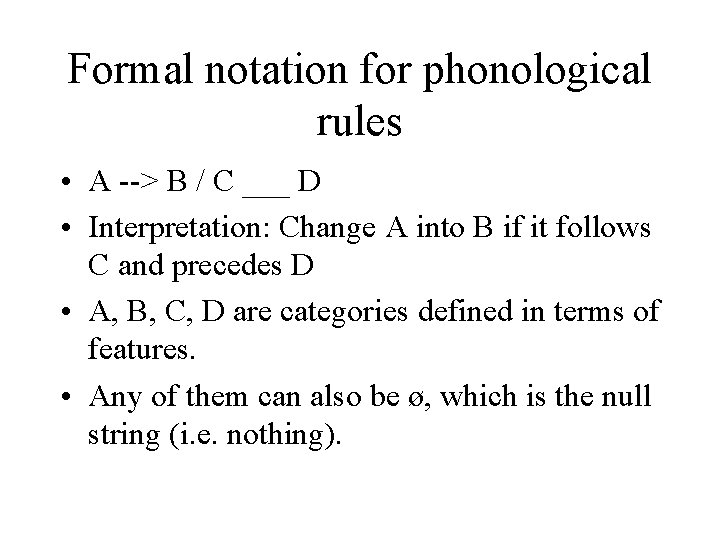
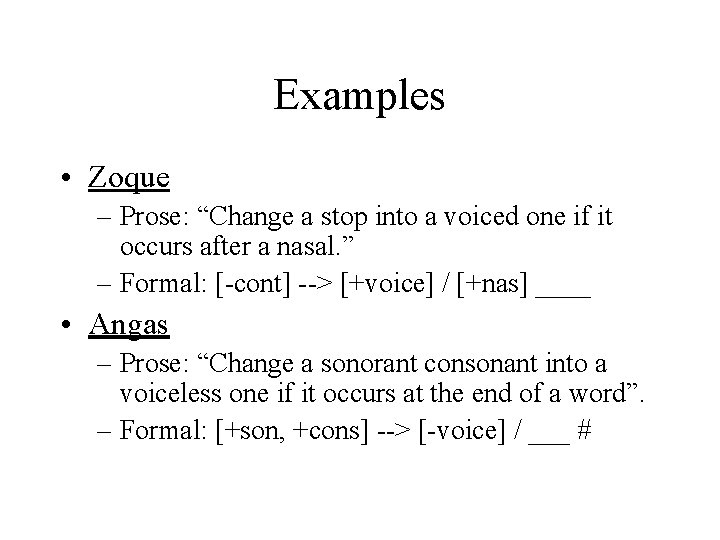
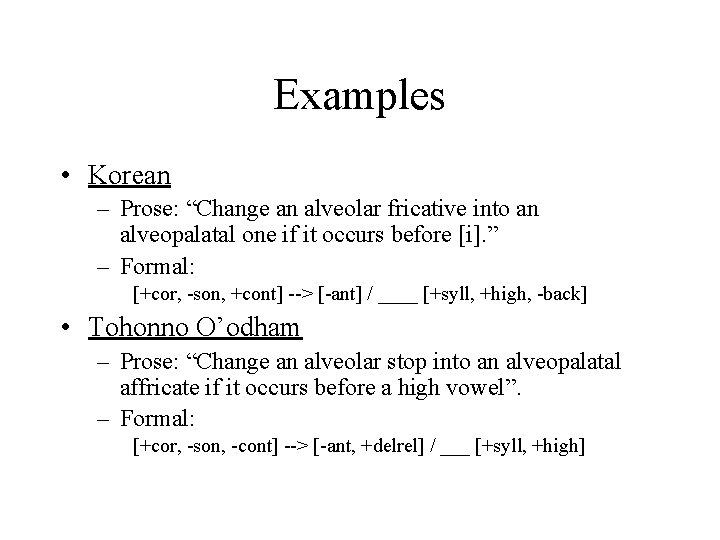
Formal notation for phonological rules • A --> B / C ___ D • Interpretation: Change A into B if it follows C and precedes D • A, B, C, D are categories defined in terms of features. • Any of them can also be ø, which is the null string (i. e. nothing).
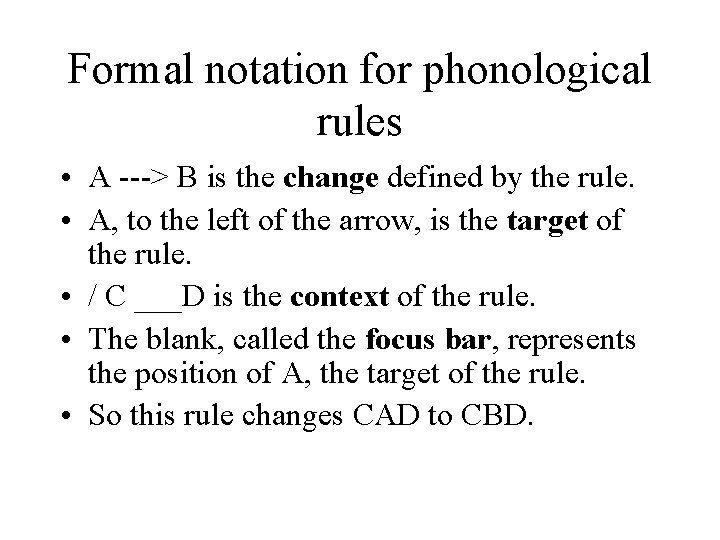
Formal notation for phonological rules • A ---> B is the change defined by the rule. • A, to the left of the arrow, is the target of the rule. • / C ___D is the context of the rule. • The blank, called the focus bar, represents the position of A, the target of the rule. • So this rule changes CAD to CBD.
Examples • Zoque – Prose: “Change a stop into a voiced one if it occurs after a nasal. ” – Formal: [-cont] --> [+voice] / [+nas] ____ • Angas – Prose: “Change a sonorant consonant into a voiceless one if it occurs at the end of a word”. – Formal: [+son, +cons] --> [-voice] / ___ #
Examples • Korean – Prose: “Change an alveolar fricative into an alveopalatal one if it occurs before [i]. ” – Formal: [+cor, -son, +cont] --> [-ant] / ____ [+syll, +high, -back] • Tohonno O’odham – Prose: “Change an alveolar stop into an alveopalatal affricate if it occurs before a high vowel”. – Formal: [+cor, -son, -cont] --> [-ant, +delrel] / ___ [+syll, +high]