
Handbook on measuring equity in learning Chapter 2
Handbook on measuring equity in learning Chapter 2: Setting out a conceptual framework for measuring equity in learning March 2018
Introduction The basic idea: we’re distributing an educational good, and ultimately we’re interested in learning Equity, equality of opportunity, and equality of outcome ‘We believe in equity, not equality’ ‘We believe in equality of opportunity. Equality of outcome isn’t possible, or isn’t desirable. ’ But: – What do these really mean? – What are we ‘distributing’ – equality or equity of what? – How does the distribution of some indicator relate to our normative judgements about what a good distribution would look like? Mar 2018 © 2018 Oxford Policy Management Ltd 2
1. Theoretical background Rawls theory of justice as fairness Walzer – spheres of justice Sen – capabilities and individual differences Equity vs. equality Equality of opportunity vs. equality of outcome Content of learning measures Mar 2018 © 2018 Oxford Policy Management Ltd 3

Reaching (some) agreement on principles of equity Justice as fairness and the social contract ( Rawls) – – What kind of society would we choose to live in if we didn’t know what type of person we’d be born as? Start from total equality, but trade off some to make everyone richer What about individual differences? ( Sen, capabilities) – – Different abilities and needs Different preferences and motivation Equality of opportunity ( Roemer) – – Increasingly used in empirical studies: opportunities have not been equal if an outcome inequality is observed and can be traced back to differences in circumstances Less ‘radical’ than equality of outcome? What if (empirically) trade-offs can’t be justified after all? Mar 2018 © 2018 Oxford Policy Management Ltd 4
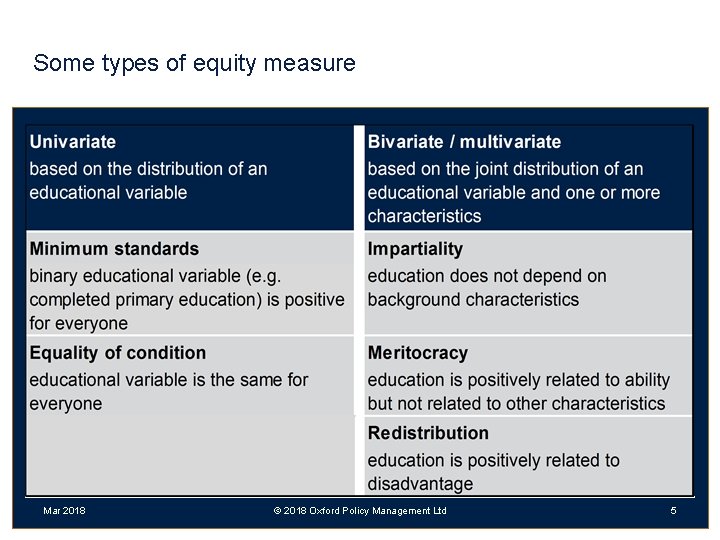
Some types of equity measure Mar 2018 © 2018 Oxford Policy Management Ltd 5
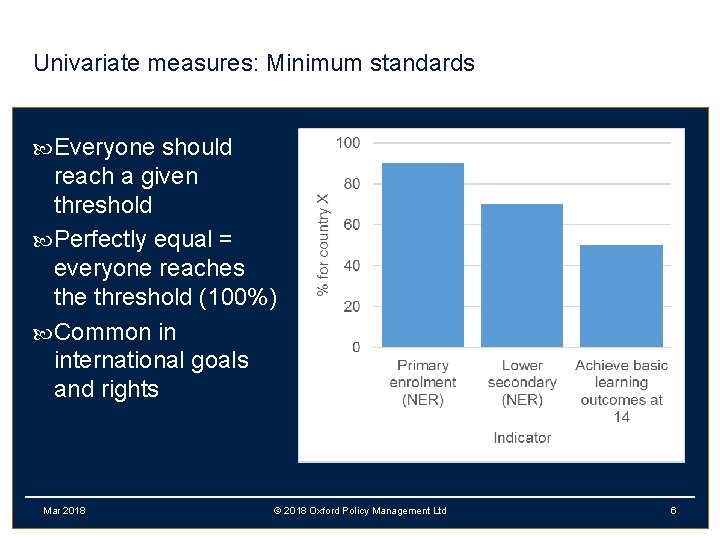
Univariate measures: Minimum standards Everyone should reach a given threshold Perfectly equal = everyone reaches the threshold (100%) Common in international goals and rights Mar 2018 © 2018 Oxford Policy Management Ltd 6
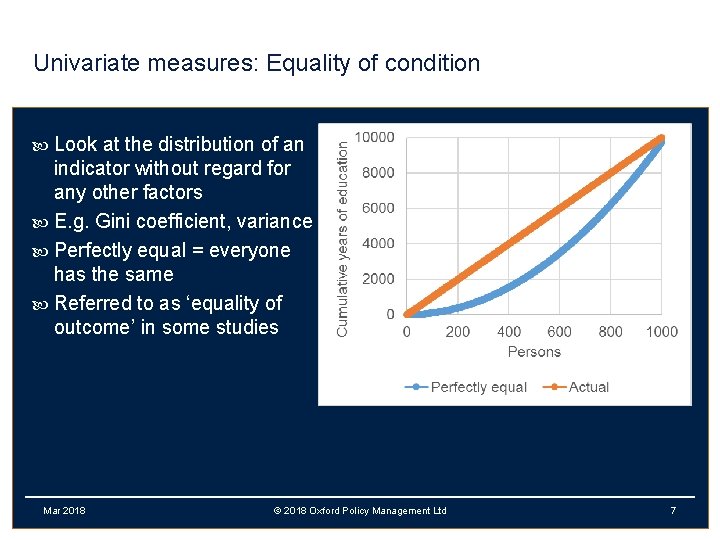
Univariate measures: Equality of condition Look at the distribution of an indicator without regard for any other factors E. g. Gini coefficient, variance Perfectly equal = everyone has the same Referred to as ‘equality of outcome’ in some studies Mar 2018 © 2018 Oxford Policy Management Ltd 7
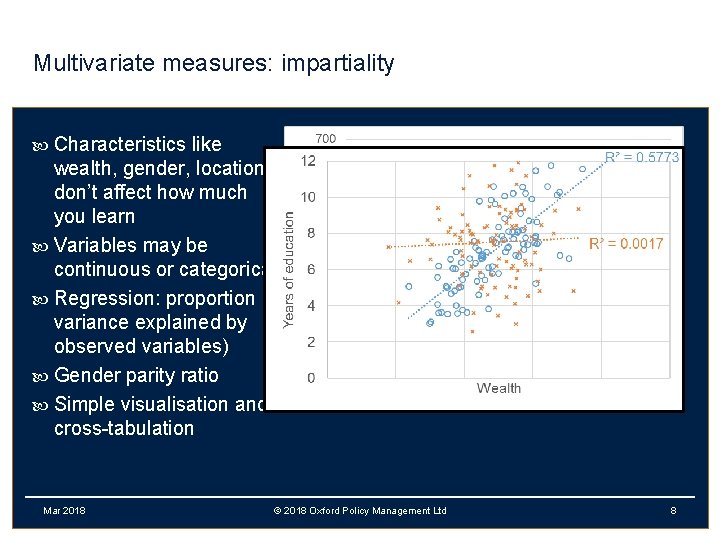
Multivariate measures: impartiality Characteristics like wealth, gender, location don’t affect how much you learn Variables may be continuous or categorical Regression: proportion of variance explained by observed variables) Gender parity ratio Simple visualisation and cross-tabulation Mar 2018 © 2018 Oxford Policy Management Ltd 8
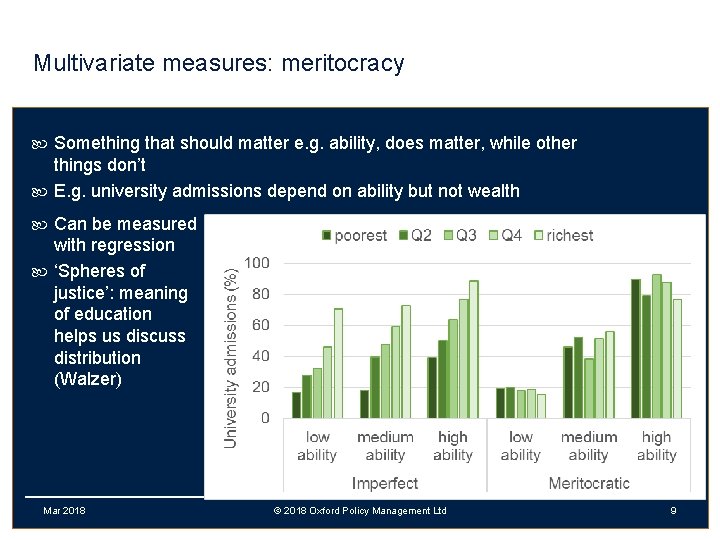
Multivariate measures: meritocracy Something that should matter e. g. ability, does matter, while other things don’t E. g. university admissions depend on ability but not wealth Can be measured with regression ‘Spheres of justice’: meaning of education helps us discuss distribution (Walzer) Mar 2018 © 2018 Oxford Policy Management Ltd 9
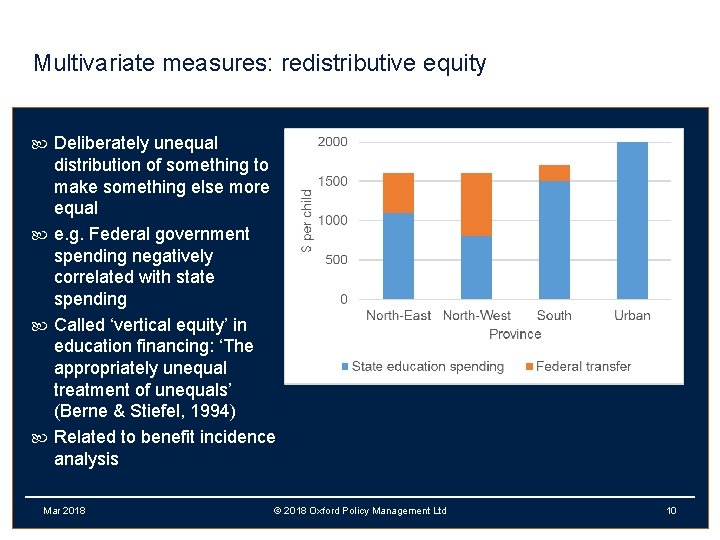
Multivariate measures: redistributive equity Deliberately unequal distribution of something to make something else more equal e. g. Federal government spending negatively correlated with state spending Called ‘vertical equity’ in education financing: ‘The appropriately unequal treatment of unequals’ (Berne & Stiefel, 1994) Related to benefit incidence analysis Mar 2018 © 2018 Oxford Policy Management Ltd 10
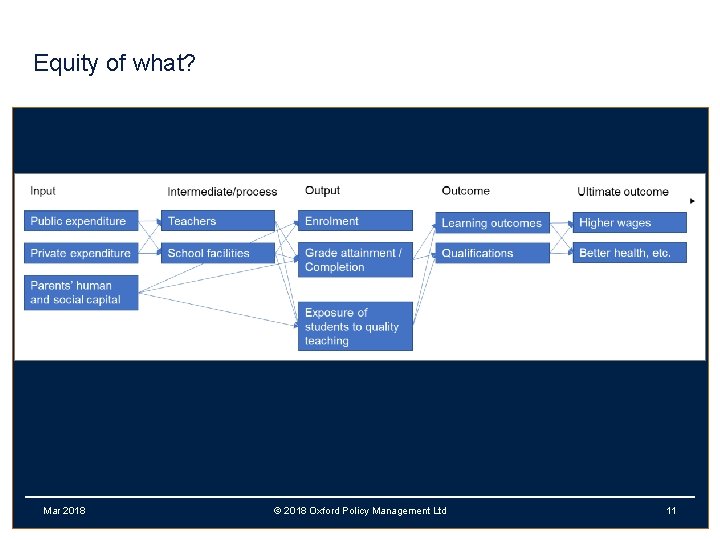
Equity of what? Mar 2018 © 2018 Oxford Policy Management Ltd 11
Desirable properties Symmetry / anonymity Defined value for perfect equality Transfer principles – what happens to our measure when we transfer some education from rich to poor? Scale and translation invariance – not always clear if these are desirable Decomposability – nice but non-essential? Mar 2018 © 2018 Oxford Policy Management Ltd 12
Summary Equity measurement is tied to a normative framework (Nearly) everyone agrees on ‘Equality of opportunity’ but not what it means Different types of equity measure are needed for different indicators (inputs, intermediate, outputs) Education is also a means to an end – this affects what form of equity we are interested in Equality of condition, minimum standards and impartiality are widely measured Meritocratic and redistributive concepts of equity should probably be measured more Mar 2018 © 2018 Oxford Policy Management Ltd 13
Thank you
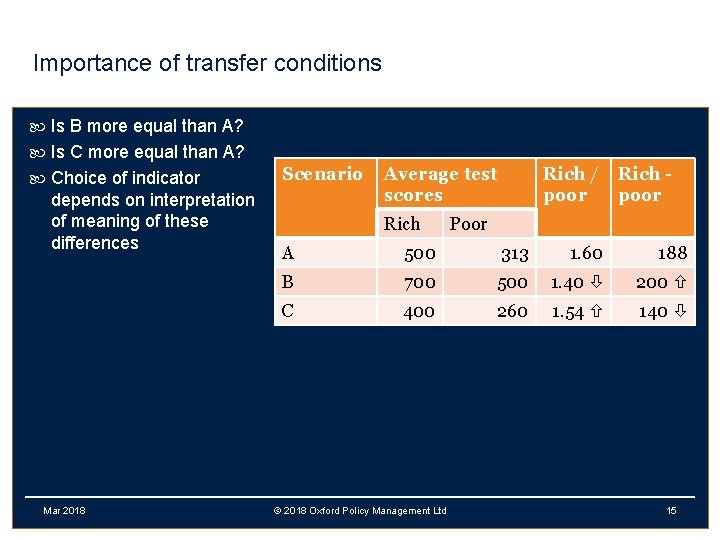
Importance of transfer conditions Is B more equal than A? Is C more equal than A? Choice of indicator depends on interpretation of meaning of these differences Mar 2018 Scenario Average test scores Rich / poor Rich poor Poor A 500 313 1. 60 188 B 700 500 1. 40 200 C 400 260 1. 54 140 © 2018 Oxford Policy Management Ltd 15
- Slides: 15