
Hand sectioning a mushroom 1cut a wedge from
- Slides: 9
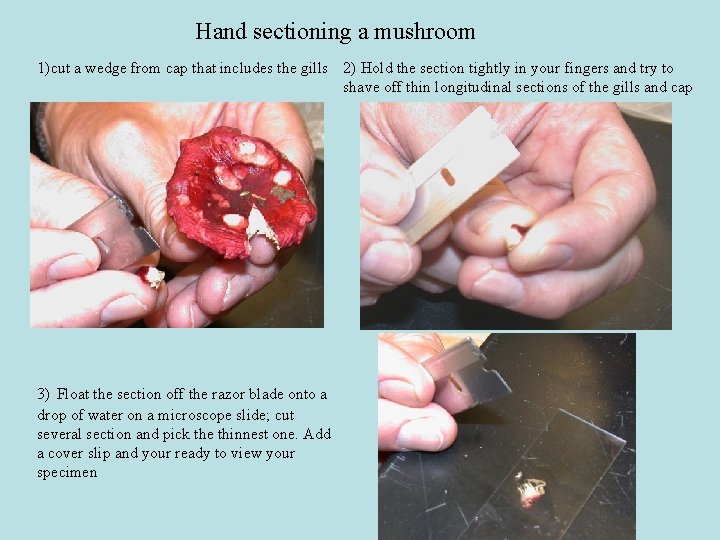
Hand sectioning a mushroom 1)cut a wedge from cap that includes the gills 2) Hold the section tightly in your fingers and try to shave off thin longitudinal sections of the gills and cap 3) Float the section off the razor blade onto a drop of water on a microscope slide; cut several section and pick the thinnest one. Add a cover slip and your ready to view your specimen
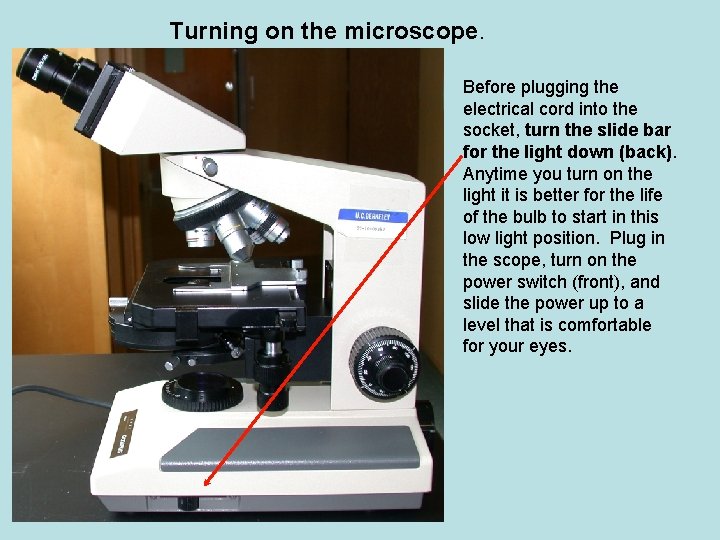
Turning on the microscope. Before plugging the electrical cord into the socket, turn the slide bar for the light down (back). Anytime you turn on the light it is better for the life of the bulb to start in this low light position. Plug in the scope, turn on the power switch (front), and slide the power up to a level that is comfortable for your eyes.
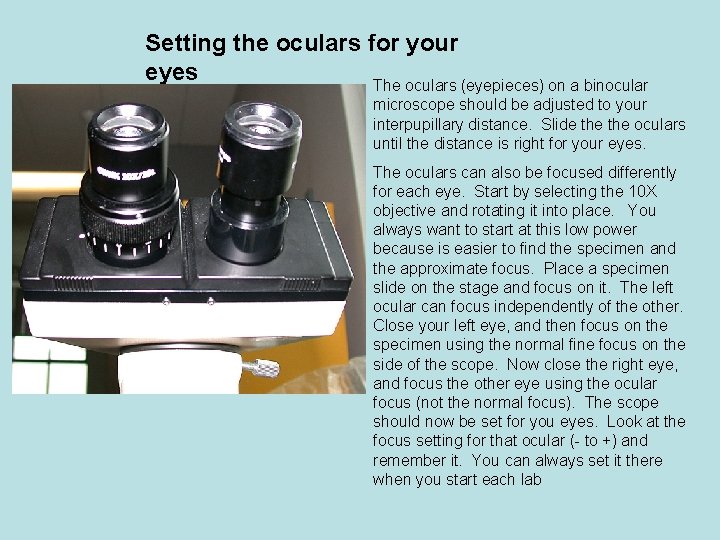
Setting the oculars for your eyes The oculars (eyepieces) on a binocular microscope should be adjusted to your interpupillary distance. Slide the oculars until the distance is right for your eyes. The oculars can also be focused differently for each eye. Start by selecting the 10 X objective and rotating it into place. You always want to start at this low power because is easier to find the specimen and the approximate focus. Place a specimen slide on the stage and focus on it. The left ocular can focus independently of the other. Close your left eye, and then focus on the specimen using the normal fine focus on the side of the scope. Now close the right eye, and focus the other eye using the ocular focus (not the normal focus). The scope should now be set for you eyes. Look at the focus setting for that ocular (- to +) and remember it. You can always set it there when you start each lab
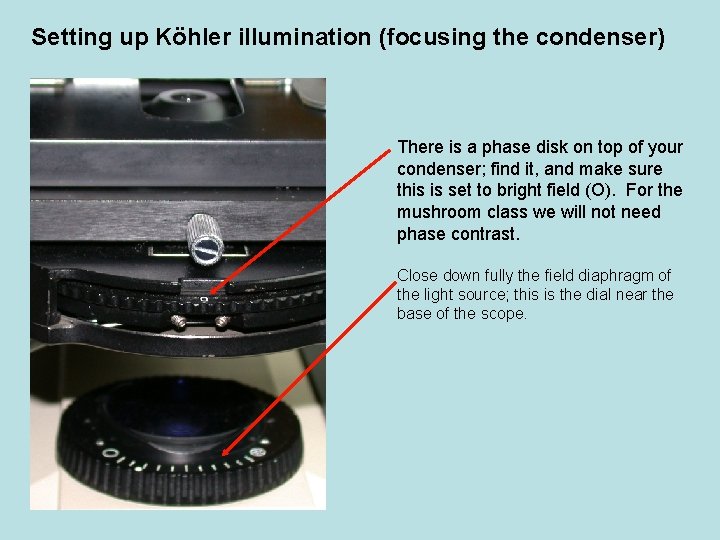
Setting up Köhler illumination (focusing the condenser) There is a phase disk on top of your condenser; find it, and make sure this is set to bright field (O). For the mushroom class we will not need phase contrast. Close down fully the field diaphragm of the light source; this is the dial near the base of the scope.
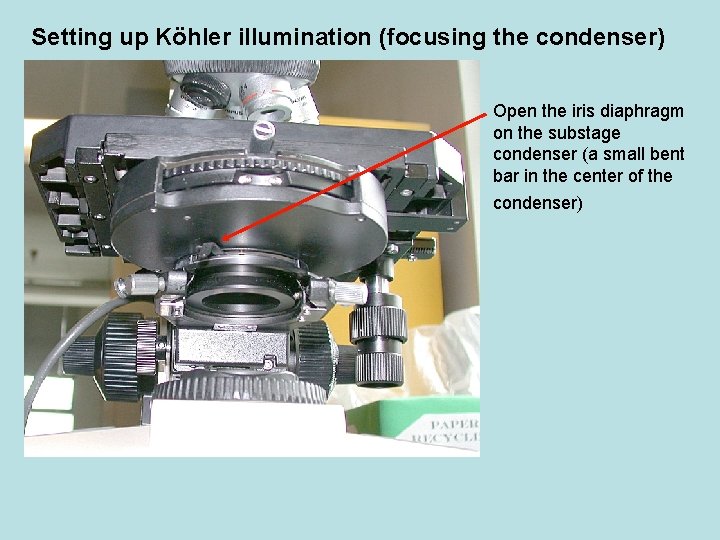
Setting up Köhler illumination (focusing the condenser) Open the iris diaphragm on the substage condenser (a small bent bar in the center of the condenser)
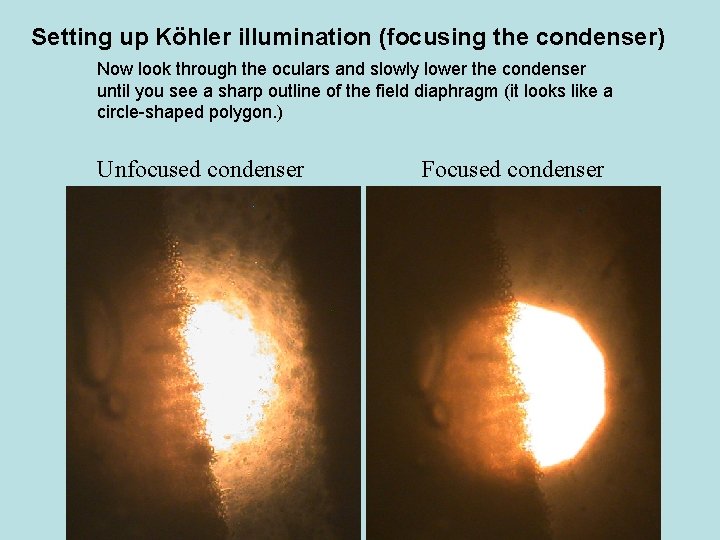
Setting up Köhler illumination (focusing the condenser) Now look through the oculars and slowly lower the condenser until you see a sharp outline of the field diaphragm (it looks like a circle-shaped polygon. ) Unfocused condenser Focused condenser
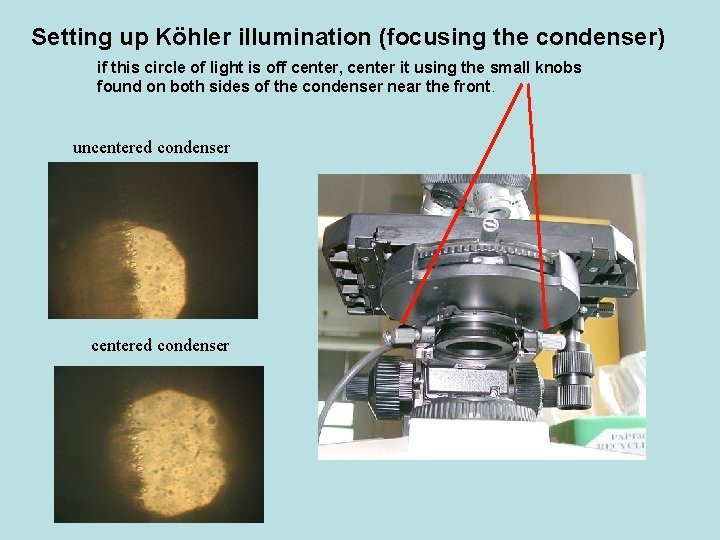
Setting up Köhler illumination (focusing the condenser) if this circle of light is off center, center it using the small knobs found on both sides of the condenser near the front. uncentered condenser
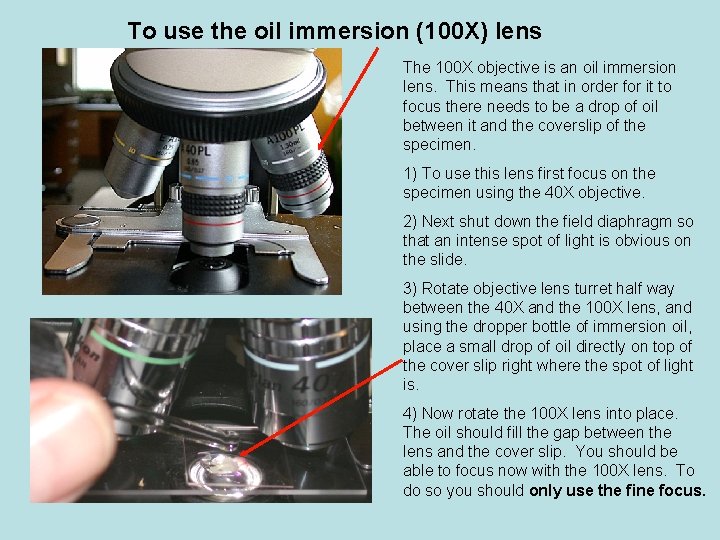
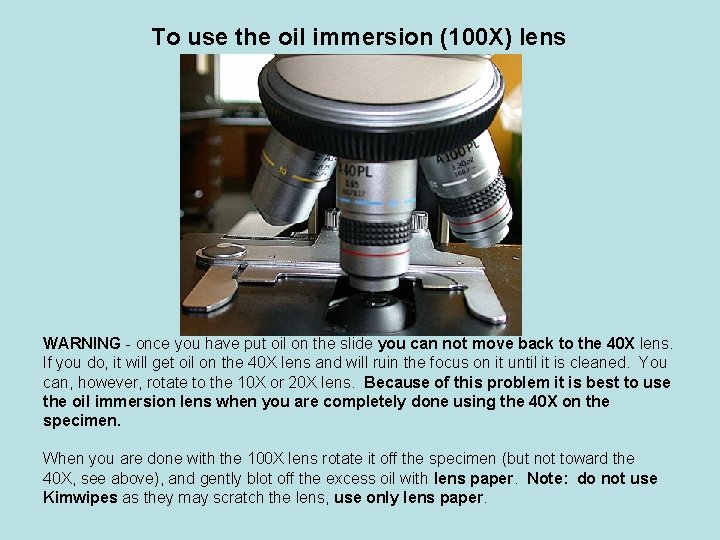
To use the oil immersion (100 X) lens The 100 X objective is an oil immersion lens. This means that in order for it to focus there needs to be a drop of oil between it and the coverslip of the specimen. 1) To use this lens first focus on the specimen using the 40 X objective. 2) Next shut down the field diaphragm so that an intense spot of light is obvious on the slide. 3) Rotate objective lens turret half way between the 40 X and the 100 X lens, and using the dropper bottle of immersion oil, place a small drop of oil directly on top of the cover slip right where the spot of light is. 4) Now rotate the 100 X lens into place. The oil should fill the gap between the lens and the cover slip. You should be able to focus now with the 100 X lens. To do so you should only use the fine focus.
To use the oil immersion (100 X) lens WARNING - once you have put oil on the slide you can not move back to the 40 X lens. If you do, it will get oil on the 40 X lens and will ruin the focus on it until it is cleaned. You can, however, rotate to the 10 X or 20 X lens. Because of this problem it is best to use the oil immersion lens when you are completely done using the 40 X on the specimen. When you are done with the 100 X lens rotate it off the specimen (but not toward the 40 X, see above), and gently blot off the excess oil with lens paper. Note: do not use Kimwipes as they may scratch the lens, use only lens paper.