
Hand Safety 2011 Types of Hand Hazards Health
- Slides: 14
Hand Safety 2011 Types of Hand Hazards Health, Safety and Environment
Objectives Upon the successful completion of this presentation, you will be able to: List the 10 most common hand hazards in the workplace Explain the goal of Jacobs Hand Safety Campaign Describe how to either eliminate or control exposure to the different types of hand hazards Name some mental ‘checks’ you can perform to avoid inattention while working Health, Safety and Environment
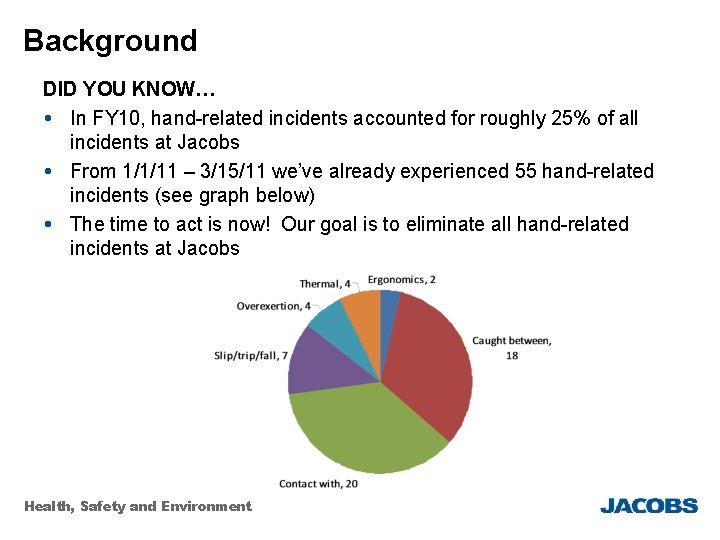
Background DID YOU KNOW… In FY 10, hand-related incidents accounted for roughly 25% of all incidents at Jacobs From 1/1/11 – 3/15/11 we’ve already experienced 55 hand-related incidents (see graph below) The time to act is now! Our goal is to eliminate all hand-related incidents at Jacobs Health, Safety and Environment
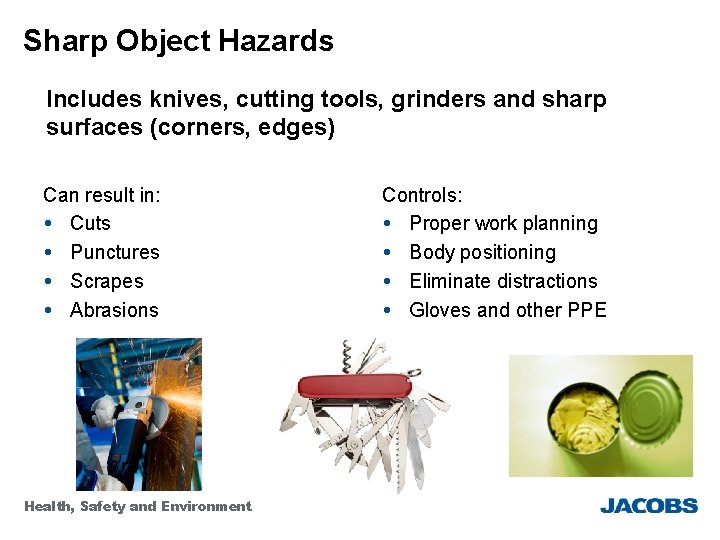
Sharp Object Hazards Includes knives, cutting tools, grinders and sharp surfaces (corners, edges) Can result in: Cuts Punctures Scrapes Abrasions Health, Safety and Environment Controls: Proper work planning Body positioning Eliminate distractions Gloves and other PPE
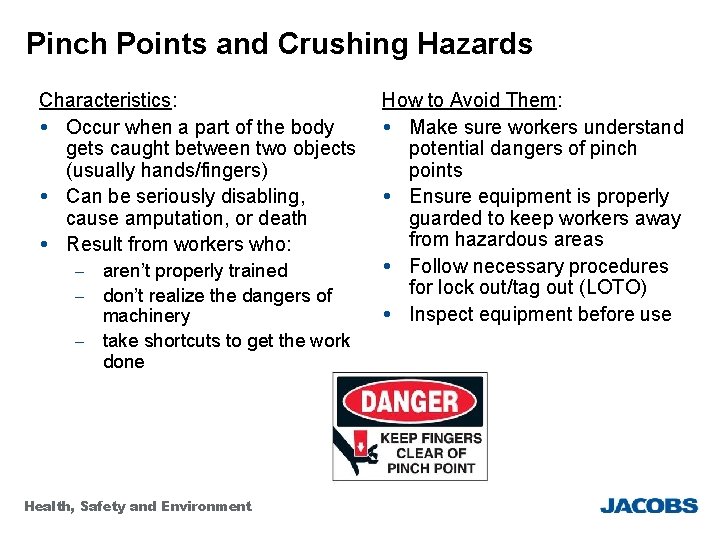
Pinch Points and Crushing Hazards Characteristics: Occur when a part of the body gets caught between two objects (usually hands/fingers) Can be seriously disabling, cause amputation, or death Result from workers who: - aren’t properly trained - don’t realize the dangers of machinery - take shortcuts to get the work done Health, Safety and Environment How to Avoid Them: Make sure workers understand potential dangers of pinch points Ensure equipment is properly guarded to keep workers away from hazardous areas Follow necessary procedures for lock out/tag out (LOTO) Inspect equipment before use
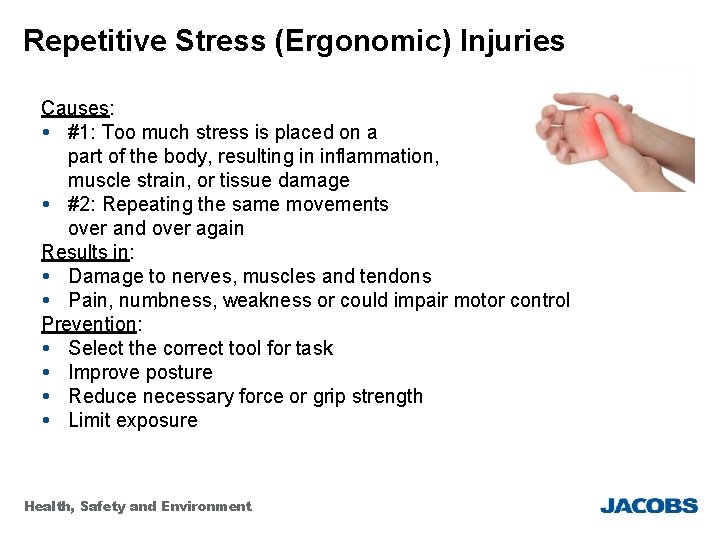
Repetitive Stress (Ergonomic) Injuries Causes: #1: Too much stress is placed on a part of the body, resulting in inflammation, muscle strain, or tissue damage #2: Repeating the same movements over and over again Results in: Damage to nerves, muscles and tendons Pain, numbness, weakness or could impair motor control Prevention: Select the correct tool for task Improve posture Reduce necessary force or grip strength Limit exposure Health, Safety and Environment
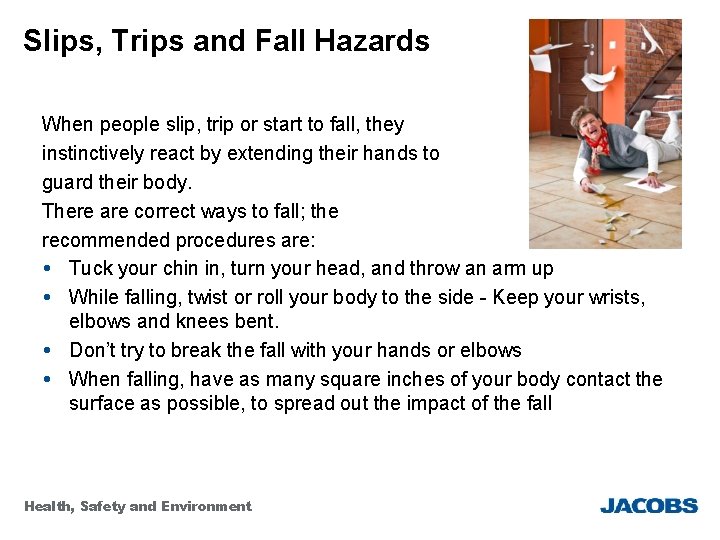
Slips, Trips and Fall Hazards When people slip, trip or start to fall, they instinctively react by extending their hands to guard their body. There are correct ways to fall; the recommended procedures are: Tuck your chin in, turn your head, and throw an arm up While falling, twist or roll your body to the side - Keep your wrists, elbows and knees bent. Don’t try to break the fall with your hands or elbows When falling, have as many square inches of your body contact the surface as possible, to spread out the impact of the fall Health, Safety and Environment
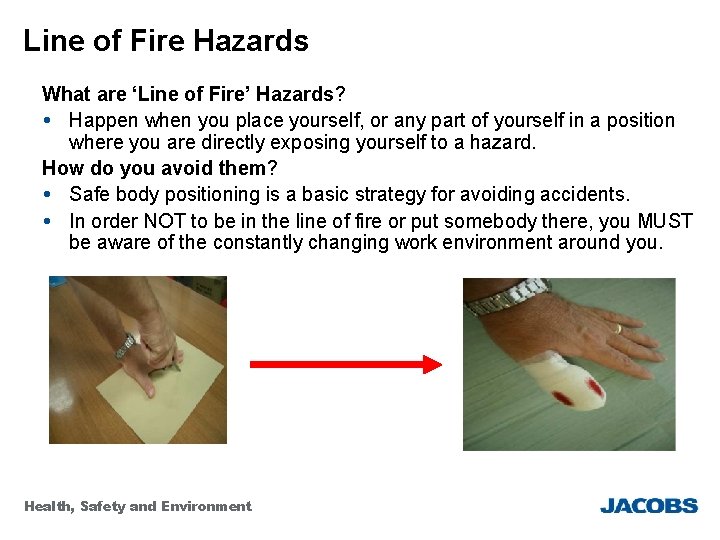
Line of Fire Hazards What are ‘Line of Fire’ Hazards? Happen when you place yourself, or any part of yourself in a position where you are directly exposing yourself to a hazard. How do you avoid them? Safe body positioning is a basic strategy for avoiding accidents. In order NOT to be in the line of fire or put somebody there, you MUST be aware of the constantly changing work environment around you. Health, Safety and Environment
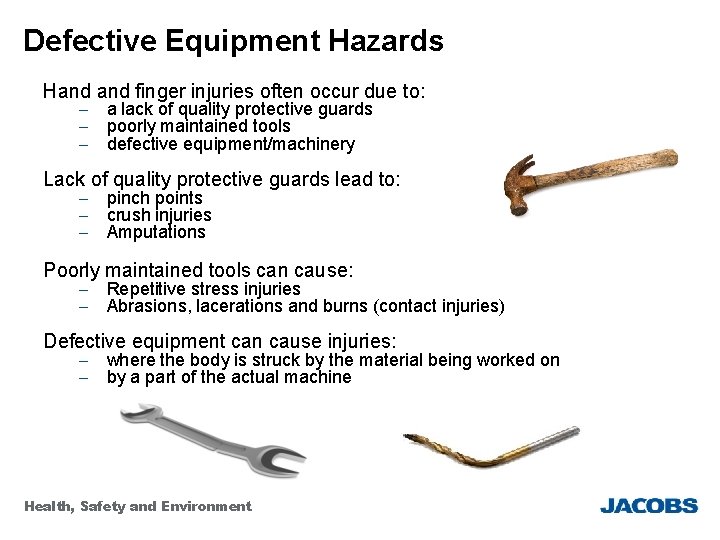
Defective Equipment Hazards Hand finger injuries often occur due to: - a lack of quality protective guards - poorly maintained tools - defective equipment/machinery Lack of quality protective guards lead to: - pinch points - crush injuries - Amputations Poorly maintained tools can cause: - Repetitive stress injuries - Abrasions, lacerations and burns (contact injuries) Defective equipment can cause injuries: - where the body is struck by the material being worked on - by a part of the actual machine Health, Safety and Environment
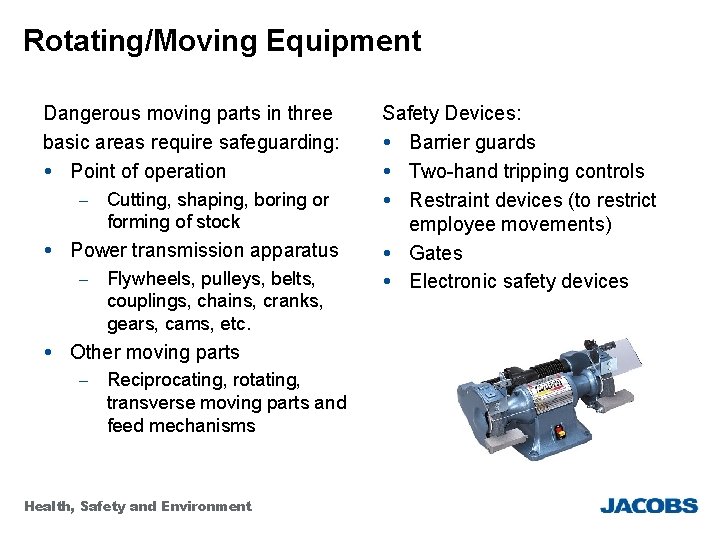
Rotating/Moving Equipment Dangerous moving parts in three basic areas require safeguarding: Point of operation - Cutting, shaping, boring or forming of stock Power transmission apparatus - Flywheels, pulleys, belts, couplings, chains, cranks, gears, cams, etc. Other moving parts - Reciprocating, rotating, transverse moving parts and feed mechanisms Health, Safety and Environment Safety Devices: Barrier guards Two-hand tripping controls Restraint devices (to restrict employee movements) Gates Electronic safety devices
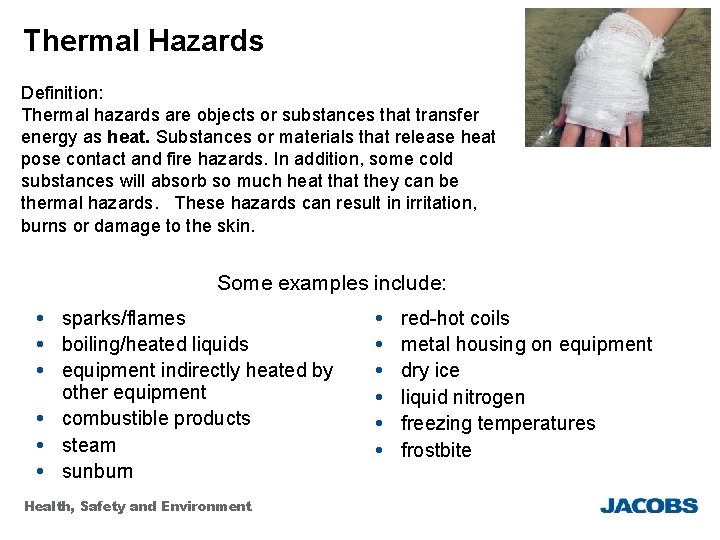
Thermal Hazards Definition: Thermal hazards are objects or substances that transfer energy as heat. Substances or materials that release heat pose contact and fire hazards. In addition, some cold substances will absorb so much heat they can be thermal hazards. These hazards can result in irritation, burns or damage to the skin. Some examples include: sparks/flames boiling/heated liquids equipment indirectly heated by other equipment combustible products steam sunburn Health, Safety and Environment red-hot coils metal housing on equipment dry ice liquid nitrogen freezing temperatures frostbite
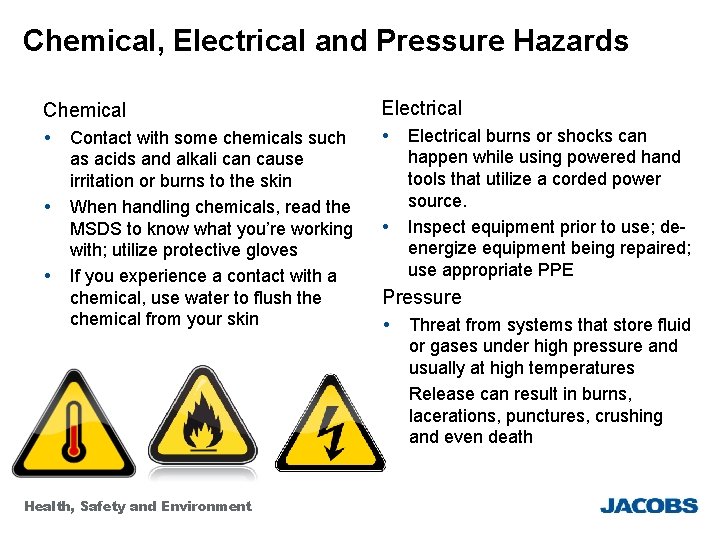
Chemical, Electrical and Pressure Hazards Chemical Electrical Contact with some chemicals such as acids and alkali can cause irritation or burns to the skin When handling chemicals, read the MSDS to know what you’re working with; utilize protective gloves If you experience a contact with a chemical, use water to flush the chemical from your skin Pressure Health, Safety and Environment Electrical burns or shocks can happen while using powered hand tools that utilize a corded power source. Inspect equipment prior to use; deenergize equipment being repaired; use appropriate PPE Threat from systems that store fluid or gases under high pressure and usually at high temperatures Release can result in burns, lacerations, punctures, crushing and even death
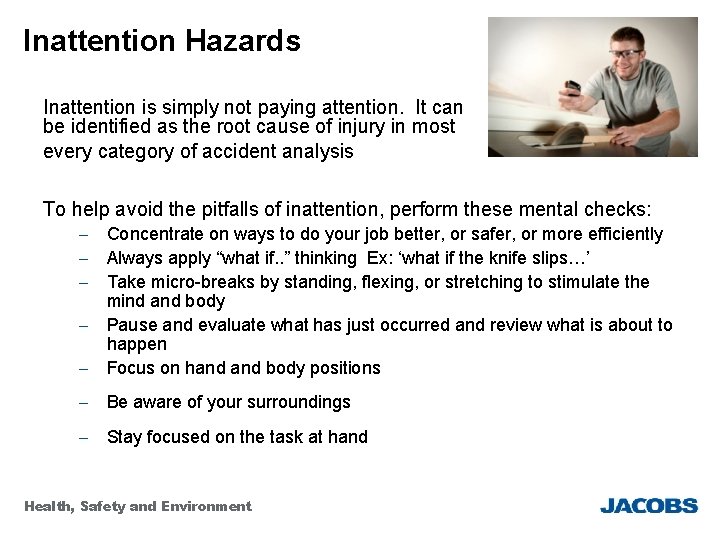
Inattention Hazards Inattention is simply not paying attention. It can be identified as the root cause of injury in most every category of accident analysis To help avoid the pitfalls of inattention, perform these mental checks: - Concentrate on ways to do your job better, or safer, or more efficiently - Always apply “what if. . ” thinking Ex: ‘what if the knife slips…’ - Take micro-breaks by standing, flexing, or stretching to stimulate the mind and body - Pause and evaluate what has just occurred and review what is about to happen - Focus on hand body positions - Be aware of your surroundings - Stay focused on the task at hand Health, Safety and Environment
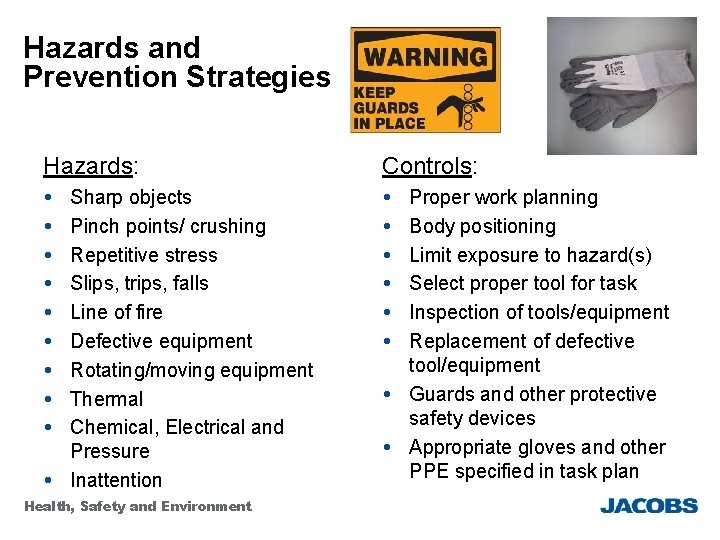
Hazards and Prevention Strategies Hazards: Controls: Sharp objects Pinch points/ crushing Repetitive stress Slips, trips, falls Line of fire Defective equipment Rotating/moving equipment Thermal Chemical, Electrical and Pressure Inattention Health, Safety and Environment Proper work planning Body positioning Limit exposure to hazard(s) Select proper tool for task Inspection of tools/equipment Replacement of defective tool/equipment Guards and other protective safety devices Appropriate gloves and other PPE specified in task plan