
Hand Hygiene Practices An InService Training Program Instructor

- Slides: 20
Hand Hygiene Practices An In-Service Training Program Instructor Presentation & Notes Provided Courtesy of © 2020 - W. H. HEATON 1
Session Objectives Upon completion of this training session, you should be able to: q Define hand hygiene practices. q Discuss the importance of hand hygiene. q Discuss reasons staff give for not performing hand hygiene practices. q Provide examples of when hands should be washed with soap and water. q Discuss why “jewelry” should not be worn when providing care to residents. q Discuss the relationship between gloving and hygiene. q Discuss when gloves should be used. q Identify and provide examples of the 5 moments when hand hygiene must be performed. q Discuss and review the facility’s Hand Hygiene Policies and Procedures. © 2020 - W. H. HEATON 2
Definitions q “Hand Hygiene” is a general term that applies to hand washing with soap and water, or the use of a waterless alcohol-based antiseptic handrub (ABHR). q “Hand Washing” is defined as the vigorous, brief rubbing together of all surfaces of hands with soap and water, followed by rinsing under a stream of water. q “Alcohol-Based Handrub (ABHR)” is defined as rubbing the hands with an alcohol-containing preparation (liquid, gel, or foam) containing at least 60% alcohol. © 2020 - W. H. HEATON 3
Reasons Staff Gives for NOT Performing Hand Hygiene Practices q Handwashing agents cause irritation and dryness. q Sinks are inconveniently located. q Lack of sinks. q Lack of soap, hand sanitizers, paper towels. q Too busy / not enough time. q Resident’s needs takes priority. © 2020 - W. H. HEATON 4
The Importance of Hand Hygiene q The most common way that germs are spread and cause infection is by being carried on people’s hands. q According to the Centers for Disease Control (CDC), hand hygiene is the most important measure to prevent the spread of harmful germs and to prevent health care associated infections. q Regular and thorough hand hygiene is always important when working in the health care environment. q Having clean hands helps to protect our residents, as well as yourself and others. © 2020 - W. H. HEATON 5
Hand Hygiene Practices q You should wash your hands with soap and water after using the restroom, before and after preparing or serving a meal, if visibly dirty, when exposed to C. difficle, or when exposed to blood or other body fluids. q Do not use hot water to wash or rinse your hands as it can cause skin to dry and crack. q If hands are NOT visibly soiled, use an alcohol-based handrub (liquid, gel, or foam), containing at least 60% alcohol, to routinely clean your hands. q The use of gloves does NOT eliminate the need for hand hygiene. q Fingernails and jewelry play a key but an over-looked role in hand hygiene. q You should always wash your hands prior to beginning and upon leaving work. © 2020 - W. H. HEATON 6
Hand Hygiene Practices (continued) q While artificial nails may not spread infection, caregivers with artificial nails are more likely to harbor pathogens on their fingertips even after performing hand hygiene. q Keep natural nails less than one-quarter (1/4) inch long. q Chipped nail polish may support the growth of germs and bacteria. q Skin underneath rings and bracelets has more germs than the surrounding skin. q Remove jewelry before cleaning hands. If you want to keep your wedding band on, be sure you clean underneath it. © 2020 - W. H. HEATON 7
Hand Hygiene Practices (continued) q Towelettes and hand wipes should NOT be used in place of alcohol -based handrubs or soap and water. q Frequent hand washing can cause skin irritation and dermatitis. q Use a hand cream or lotion daily to help the skin better withstand frequent hand hygiene cleaning. q Be sure your hands are completely dry before putting on gloves. q After removing gloves, wash your hands. © 2020 - W. H. HEATON 8
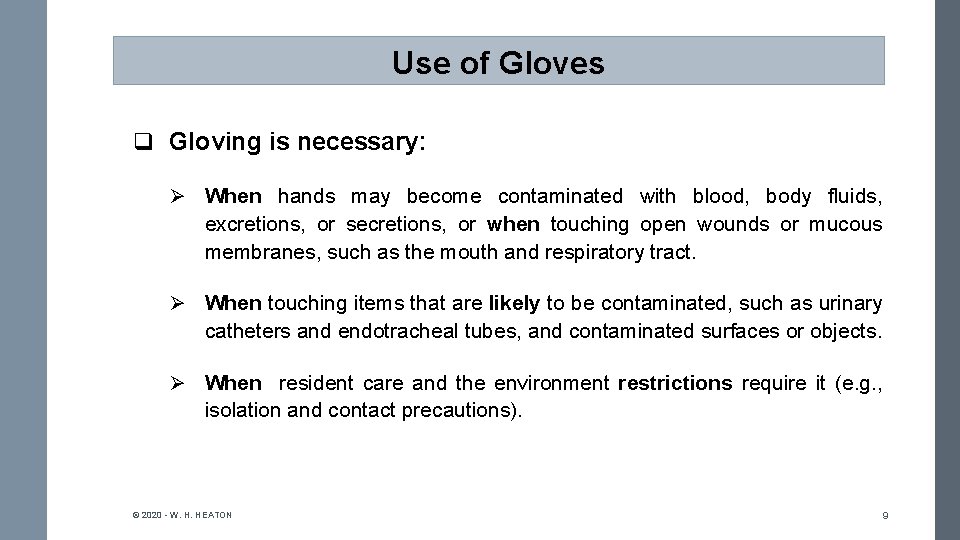
Use of Gloves q Gloving is necessary: Ø When hands may become contaminated with blood, body fluids, excretions, or secretions, or when touching open wounds or mucous membranes, such as the mouth and respiratory tract. Ø When touching items that are likely to be contaminated, such as urinary catheters and endotracheal tubes, and contaminated surfaces or objects. Ø When resident care and the environment restrictions require it (e. g. , isolation and contact precautions). © 2020 - W. H. HEATON 9
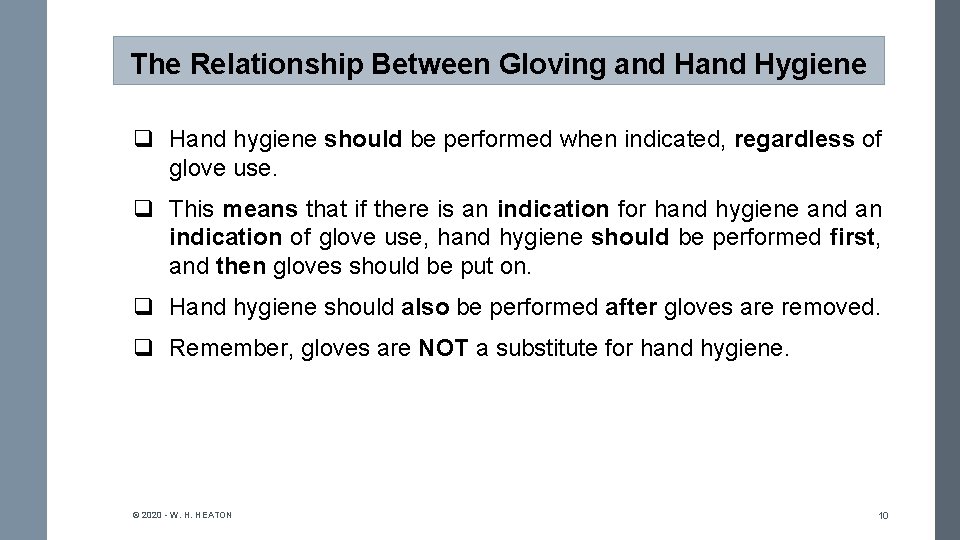
The Relationship Between Gloving and Hygiene q Hand hygiene should be performed when indicated, regardless of glove use. q This means that if there is an indication for hand hygiene and an indication of glove use, hand hygiene should be performed first, and then gloves should be put on. q Hand hygiene should also be performed after gloves are removed. q Remember, gloves are NOT a substitute for hand hygiene. © 2020 - W. H. HEATON 10
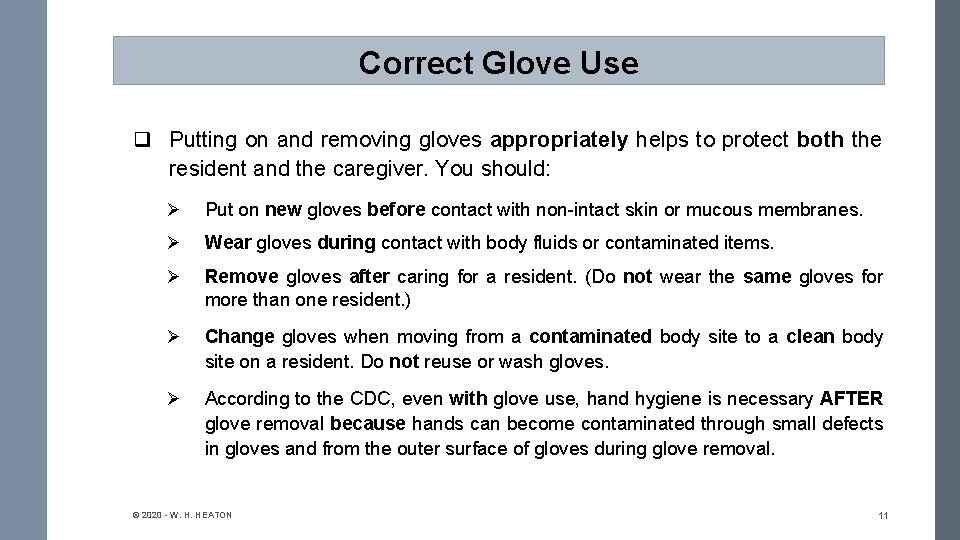
Correct Glove Use q Putting on and removing gloves appropriately helps to protect both the resident and the caregiver. You should: Ø Put on new gloves before contact with non-intact skin or mucous membranes. Ø Wear gloves during contact with body fluids or contaminated items. Ø Remove gloves after caring for a resident. (Do not wear the same gloves for more than one resident. ) Ø Change gloves when moving from a contaminated body site to a clean body site on a resident. Do not reuse or wash gloves. Ø According to the CDC, even with glove use, hand hygiene is necessary AFTER glove removal because hands can become contaminated through small defects in gloves and from the outer surface of gloves during glove removal. © 2020 - W. H. HEATON 11
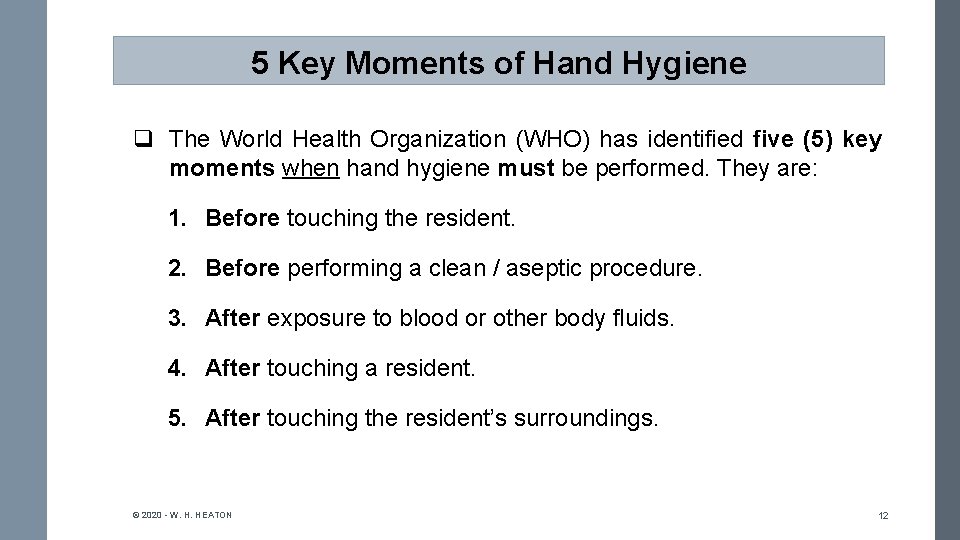
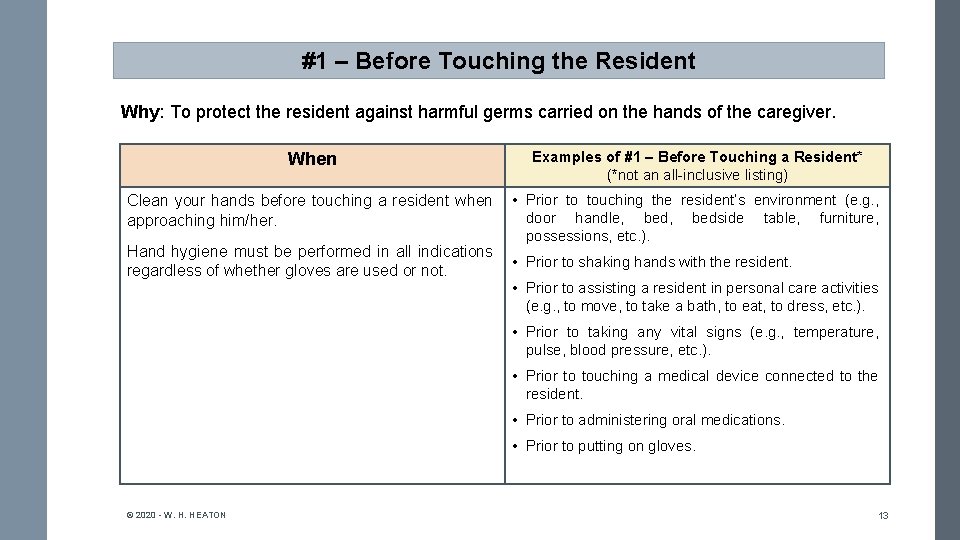
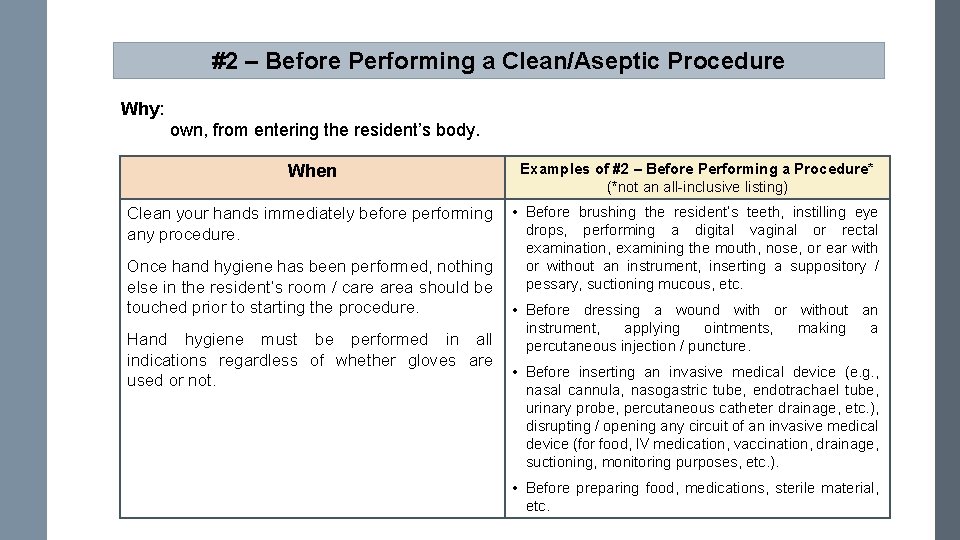
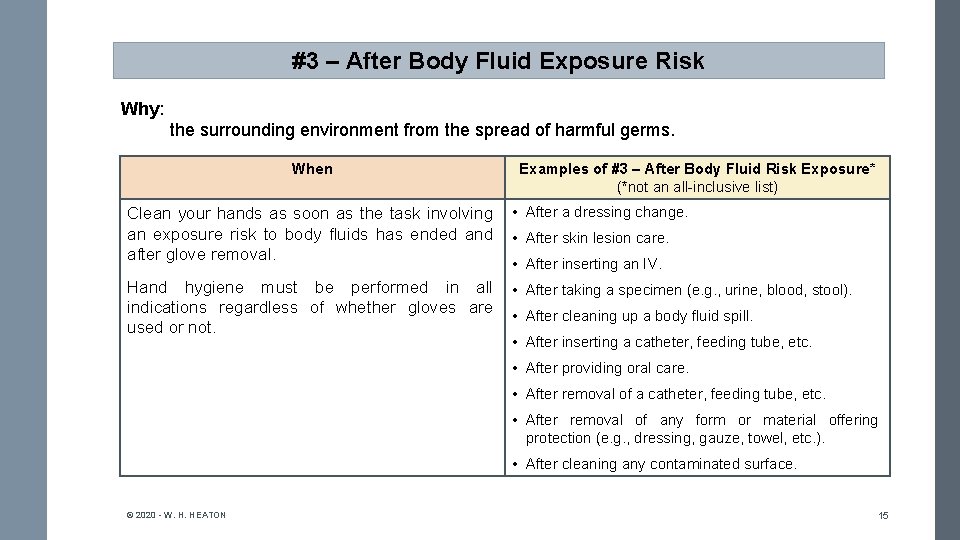
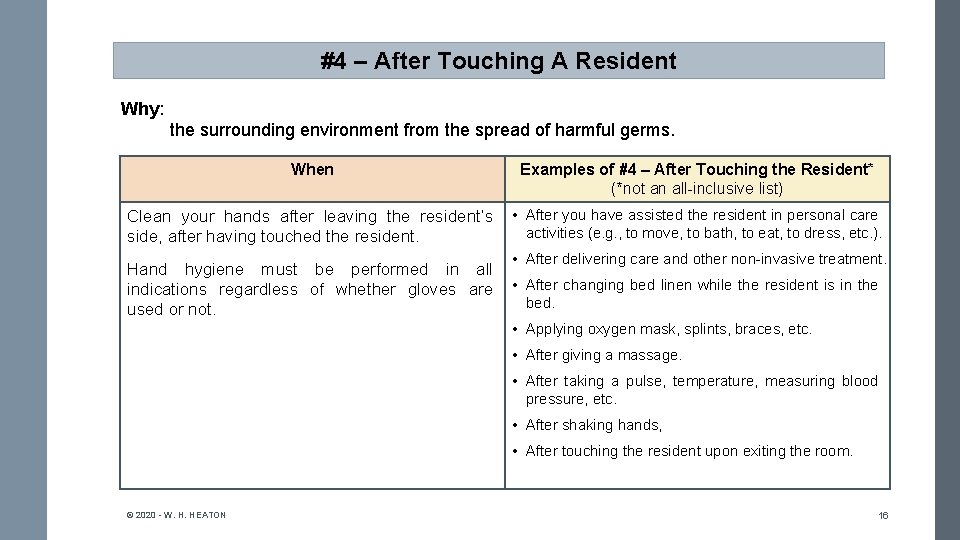
5 Key Moments of Hand Hygiene q The World Health Organization (WHO) has identified five (5) key moments when hand hygiene must be performed. They are: 1. Before touching the resident. 2. Before performing a clean / aseptic procedure. 3. After exposure to blood or other body fluids. 4. After touching a resident. 5. After touching the resident’s surroundings. © 2020 - W. H. HEATON 12
#1 – Before Touching the Resident Why: To protect the resident against harmful germs carried on the hands of the caregiver. When Examples of #1 – Before Touching a Resident* (*not an all-inclusive listing) Clean your hands before touching a resident when approaching him/her. • Prior to touching the resident’s environment (e. g. , door handle, bedside table, furniture, possessions, etc. ). Hand hygiene must be performed in all indications regardless of whether gloves are used or not. • Prior to shaking hands with the resident. • Prior to assisting a resident in personal care activities (e. g. , to move, to take a bath, to eat, to dress, etc. ). • Prior to taking any vital signs (e. g. , temperature, pulse, blood pressure, etc. ). • Prior to touching a medical device connected to the resident. • Prior to administering oral medications. • Prior to putting on gloves. © 2020 - W. H. HEATON 13
#2 – Before Performing a Clean/Aseptic Procedure Why: own, from entering the resident’s body. When Examples of #2 – Before Performing a Procedure* (*not an all-inclusive listing) Clean your hands immediately before performing any procedure. • Before brushing the resident’s teeth, instilling eye drops, performing a digital vaginal or rectal examination, examining the mouth, nose, or ear with or without an instrument, inserting a suppository / pessary, suctioning mucous, etc. Once hand hygiene has been performed, nothing else in the resident’s room / care area should be touched prior to starting the procedure. Hand hygiene must be performed in all indications regardless of whether gloves are used or not. © 2020 - W. H. HEATON • Before dressing a wound with or without an instrument, applying ointments, making a percutaneous injection / puncture. • Before inserting an invasive medical device (e. g. , nasal cannula, nasogastric tube, endotrachael tube, urinary probe, percutaneous catheter drainage, etc. ), disrupting / opening any circuit of an invasive medical device (for food, IV medication, vaccination, drainage, suctioning, monitoring purposes, etc. ). • Before preparing food, medications, sterile material, etc. 14
#3 – After Body Fluid Exposure Risk Why: the surrounding environment from the spread of harmful germs. When Examples of #3 – After Body Fluid Risk Exposure* (*not an all-inclusive list) Clean your hands as soon as the task involving an exposure risk to body fluids has ended and after glove removal. • After a dressing change. Hand hygiene must be performed in all indications regardless of whether gloves are used or not. • After taking a specimen (e. g. , urine, blood, stool). • After skin lesion care. • After inserting an IV. • After cleaning up a body fluid spill. • After inserting a catheter, feeding tube, etc. • After providing oral care. • After removal of a catheter, feeding tube, etc. • After removal of any form or material offering protection (e. g. , dressing, gauze, towel, etc. ). • After cleaning any contaminated surface. © 2020 - W. H. HEATON 15
#4 – After Touching A Resident Why: the surrounding environment from the spread of harmful germs. When Examples of #4 – After Touching the Resident* (*not an all-inclusive list) Clean your hands after leaving the resident’s side, after having touched the resident. • After you have assisted the resident in personal care activities (e. g. , to move, to bath, to eat, to dress, etc. ). Hand hygiene must be performed in all indications regardless of whether gloves are used or not. • After delivering care and other non-invasive treatment. • After changing bed linen while the resident is in the bed. • Applying oxygen mask, splints, braces, etc. • After giving a massage. • After taking a pulse, temperature, measuring blood pressure, etc. • After shaking hands, • After touching the resident upon exiting the room. © 2020 - W. H. HEATON 16
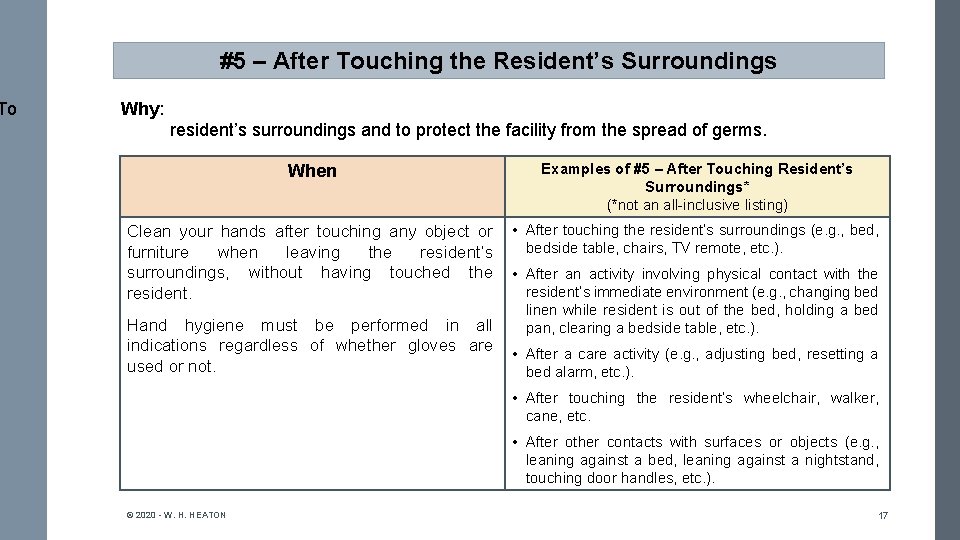
To #5 – After Touching the Resident’s Surroundings Why: resident’s surroundings and to protect the facility from the spread of germs. When Examples of #5 – After Touching Resident’s Surroundings* (*not an all-inclusive listing) Clean your hands after touching any object or furniture when leaving the resident’s surroundings, without having touched the resident. • After touching the resident’s surroundings (e. g. , bedside table, chairs, TV remote, etc. ). Hand hygiene must be performed in all indications regardless of whether gloves are used or not. • After an activity involving physical contact with the resident’s immediate environment (e. g. , changing bed linen while resident is out of the bed, holding a bed pan, clearing a bedside table, etc. ). • After a care activity (e. g. , adjusting bed, resetting a bed alarm, etc. ). • After touching the resident’s wheelchair, walker, cane, etc. • After other contacts with surfaces or objects (e. g. , leaning against a bed, leaning against a nightstand, touching door handles, etc. ). © 2020 - W. H. HEATON 17
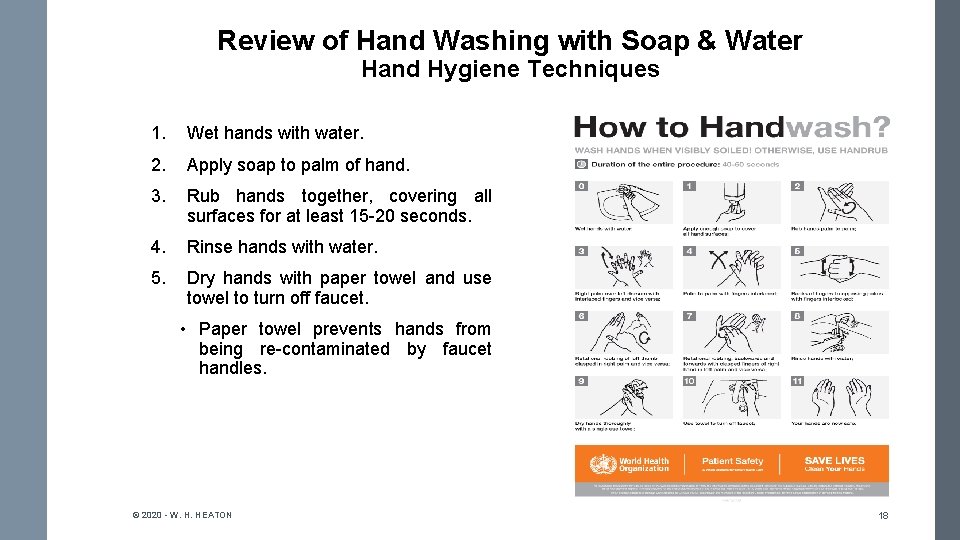
Review of Hand Washing with Soap & Water Hand Hygiene Techniques 1. Wet hands with water. 2. Apply soap to palm of hand. 3. Rub hands together, covering all surfaces for at least 15 -20 seconds. 4. Rinse hands with water. 5. Dry hands with paper towel and use towel to turn off faucet. • Paper towel prevents hands from being re-contaminated by faucet handles. © 2020 - W. H. HEATON 18
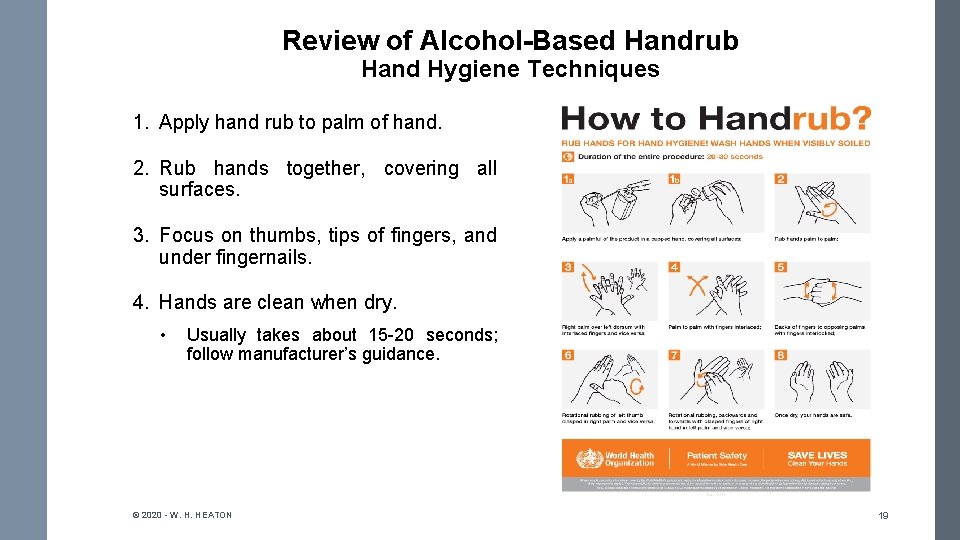
Review of Alcohol-Based Handrub Hand Hygiene Techniques 1. Apply hand rub to palm of hand. 2. Rub hands together, covering all surfaces. 3. Focus on thumbs, tips of fingers, and under fingernails. 4. Hands are clean when dry. • Usually takes about 15 -20 seconds; follow manufacturer’s guidance. © 2020 - W. H. HEATON 19
Question and Answer Session © 2020 - W. H. HEATON 20