
Hamstring Strains possible cause and risk factors Biomechanics
Hamstring Strains – possible cause and risk factors Biomechanics of Orthopedic Injury Dr. Johnson Enja Schenck, March 17, 2015
HAMSTRING STRAINS Introduction • Hamstring injuries are the most common type of muscular strain to affect the lower limb in the elite athlete. • They are associated with sports which involve rapid acceleration or deceleration, jumping, pivoting, turning or kicking. • In sport, they are particularly associated with Australian Rules Football (AFL), rugby and soccer.
HAMSTRING STRAINS Mechanism of Injury • The hamstrings function primarily by eccentric contraction. • Eccentric contraction is more efficient. • The tension generated is much higher predisposing to injury. • Disruption results in loss of normal eccentric control. • Hamstring tears are stretch induced injuries caused by a sudden forced lengthening.
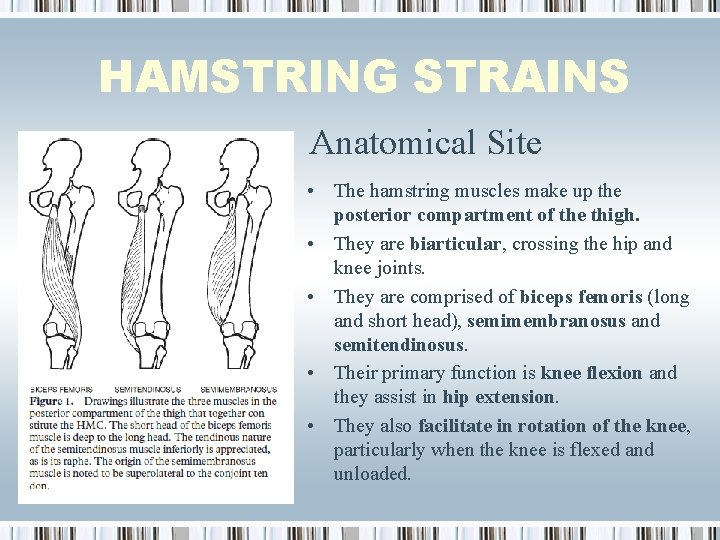
HAMSTRING STRAINS Anatomical Site • The hamstring muscles make up the posterior compartment of the thigh. • They are biarticular, crossing the hip and knee joints. • They are comprised of biceps femoris (long and short head), semimembranosus and semitendinosus. • Their primary function is knee flexion and they assist in hip extension. • They also facilitate in rotation of the knee, particularly when the knee is flexed and unloaded.
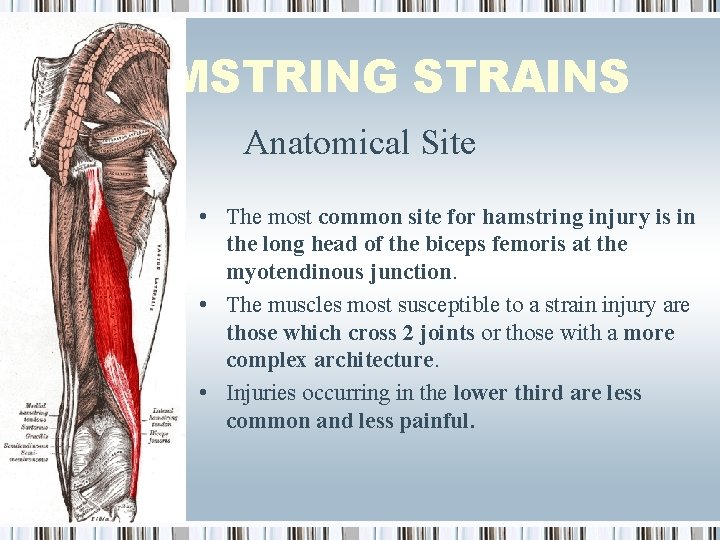
HAMSTRING STRAINS Anatomical Site • The most common site for hamstring injury is in the long head of the biceps femoris at the myotendinous junction. • The muscles most susceptible to a strain injury are those which cross 2 joints or those with a more complex architecture. • Injuries occurring in the lower third are less common and less painful.
HAMSTRING STRAINS Classification • Grade 1 or 1 st Degree: No appreciable tissue disruption, no loss of function or strength. • Grade 2 or 2 nd degree: Actual tissue damage occurs that reduces the strength of the musculotendinous unit. There is some residual function. • Grade 3 or 3 rd degree: Complete disruption of the musculotendinous unit with complete loss of function.
HAMSTRING STRAINS Factors predisposing to injury – Previous injury • Previous injury to the hamstrings was shown to be the most significant risk factor. • The resulting scar tissue has a reduced tensile strength. • The scar is also stiffer than normal tissue and therefore causes reduced range of motion.
HAMSTRING STRAINS Factors predisposing to injury – Fatigue • In animal studies, muscle fatigue has been shown to predispose to injury. • Fatigued muscles absorb less energy. • Fatigued muscle also demonstrates increased stiffness
HAMSTRING STRAINS Factors predisposing to injury – Reduced flexibility / stiffness • Muscle that is cyclically stretched demonstrates an increased ability to increase length prior to failure. • A decrease in muscle stiffness is seen with warming up. • There’s a strong correlation between preseason hamstring tightness and subsequent hamstring injury. • Sprinters with a history of previous injury have significantly tighter hamstrings.
HAMSTRING STRAINS Factors predisposing to injury – Weakness • Poor strength is associated with hamstring injury. • Uninjured sprinters have significantly higher eccentric hamstring torques at all angular velocities. • Strong correlation between preseason weakness and subsequent hamstring injury.
HAMSTRING STRAINS Factors predisposing to injury Structural factors: Biarticular nature • Contraction cannot be localized to only one joint. • Crucial that one joint be stabilized to act on the other. • This stabilization is brought about by the quadriceps or ground reaction forces and the hamstrings must counteract. • Imbalance between the strength of the hamstring and quadriceps muscles or difference between the two sides of the hamstrings have been proposed as biomechanical factors contributing to injury.
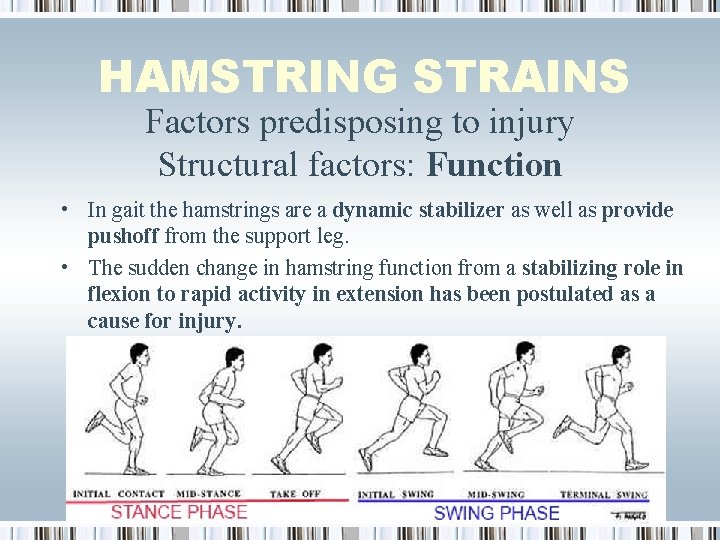
HAMSTRING STRAINS Factors predisposing to injury Structural factors: Function • In gait the hamstrings are a dynamic stabilizer as well as provide pushoff from the support leg. • The sudden change in hamstring function from a stabilizing role in flexion to rapid activity in extension has been postulated as a cause for injury.
HAMSTRING STRAINS Factors predisposing to injury Structural factors: Fiber type distribution • The hamstrings possess a large proportion of type 2 fibers. • Myofibrillar damage is most pronounced in muscles with a large proportion of these fibers, which are capable of producing more tension at a greater rate.
HAMSTRING STRAINS Factors predisposing to injury Structural factors: Degree of anterior pelvic tilt • Excessive anterior pelvic tilt places the hamstring muscle group at longer lengths which may increase the risk of strain injury. • Study: Uninjured and previously injured group – no difference in posture or flexibility between groups EXCEPT a significant difference in lumbar lordosis.
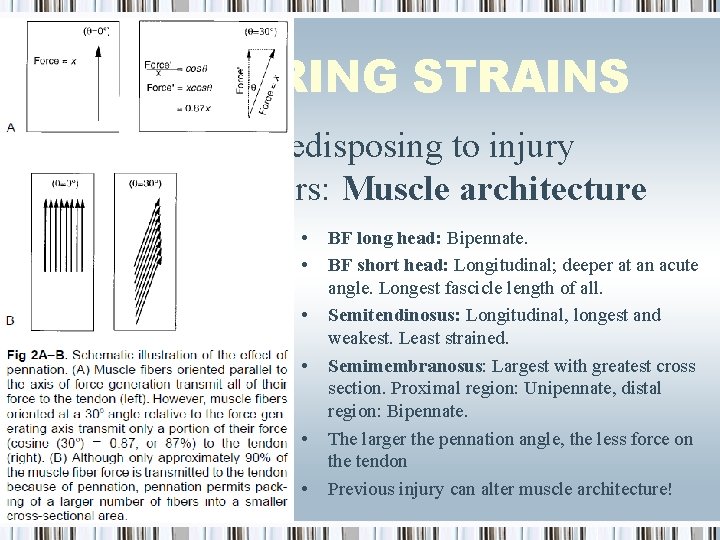
HAMSTRING STRAINS Factors predisposing to injury Structural factors: Muscle architecture • • • BF long head: Bipennate. BF short head: Longitudinal; deeper at an acute angle. Longest fascicle length of all. Semitendinosus: Longitudinal, longest and weakest. Least strained. Semimembranosus: Largest with greatest cross section. Proximal region: Unipennate, distal region: Bipennate. The larger the pennation angle, the less force on the tendon Previous injury can alter muscle architecture!
HAMSTRING STRAINS Factors predisposing to injury Structural factors: Attachment type • The distal biceps femoris tendon inserts onto the head of the fibula, the lateral condyle of the tibia, and the fascia of the leg, a rather extensive attachment that is thought to predispose it to tears.
HAMSTRING STRAINS Factors predisposing to injury Structural factors: Musculotendinous junction type • The proximal and distal tendons span almost the entire length of the biceps femoris muscle. • The MTJ is not a distinct area but a zone of transition. • Most strains occur in the region of the MTJ… • … even though the MTJ has several structural features that aim to reduce effects of stress concentration. • The proximal MTJ is more commonly strained than the distal.
HAMSTRING STRAINS Factors predisposing to injury Structural factors: Dual innervation of biceps femoris • The long head of the biceps femoris is innervated by the tibial portion of the sciatic nerve and the short head by the peroneal division. • This may result in asynchrony in the coordination or intensity of stimulation of the two heads.
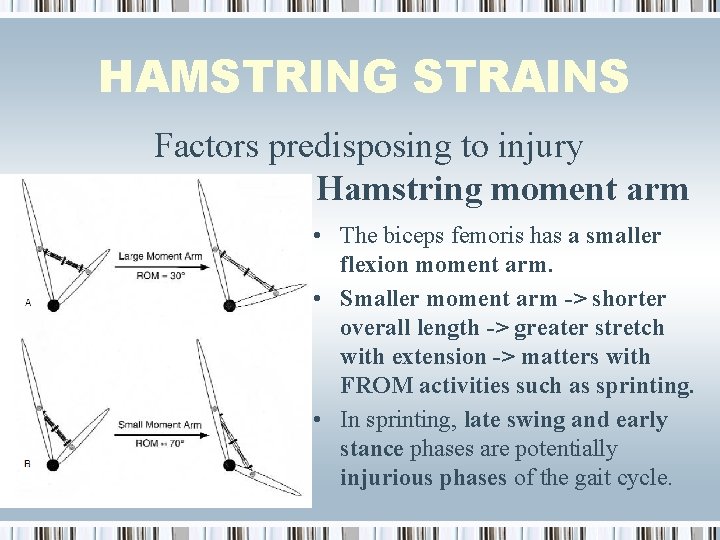
HAMSTRING STRAINS Factors predisposing to injury Structural factors: Hamstring moment arm • The biceps femoris has a smaller flexion moment arm. • Smaller moment arm -> shorter overall length -> greater stretch with extension -> matters with FROM activities such as sprinting. • In sprinting, late swing and early stance phases are potentially injurious phases of the gait cycle.
HAMSTRING STRAINS Injury prevention – Flexibility • Study results: Group that added three daily hamstring stretching sessions to their routine experienced significantly lower subsequent injuries (incidence rate 16. 7% v 29. 1%).
HAMSTRING STRAINS Injury prevention – Strength • Study results: Effect of preseason strength training with eccentric overload in Swedish elite soccer players. The number of hamstring injuries decreased significantly in the training group: of the (13/30) reported hamstring injuries in the two groups during the 10 month study period, 10 (10/15) occurred in the control group and only three (3/15) in the training group.
HAMSTRING STRAINS Injury prevention – Warm up • Animal study showed that: • Preconditioned muscles required more force to fail than the contralateral controls; • Preconditioned muscle can be stretched to a greater length from rest before failing • The site of failure was not altered by condition • The preconditioned muscle attained less force at each given increase in length before failure.

HAMSTRING STRAINS Bibliography • • • • Garrett W. Muscle Strain Injuries. Am J Sports Med, Nov 1996 v 24: 6; p 32 Hennessy L and Watson AWS. Flexibility and posture assessment in relation to hamstring injury. Br J Sp Med 1993; 27(4) Jonhagen S, Nemeth G, Eriksson E. hamstring injuries in sprinters: the role of concentric and eccentric hamstring muscle strength and flexibility. Am J Sports Med. March 1994: 22: 262 -265 Koulouris G, Connell D. Hamstring Muscle Complex: An Imaging Review. Radiographics 2005; 25: 571– 586 Lieberman GM, Harwin SF: Pelvis, hip and thigh: Sports medicine: principles of primary care. Mosby, 1997 pp 306 -314 O’Donoghue DO: Treatment of injuries to athletes. WB Saunders 1894, p 51 -56 Opar DA, Williams MD and Shield AJ. Hamstring Strain Injuries. Factors that Lead to Injury and Re-Injury. Sports Med 2012; 42 (3): 209226 Orchard JW. Intrinsic and Extrinsic Risk Factors for muscle strains in Australian Football. Am J Spots Med, May 200: 29; 3 p 300 Orchard J, Marsden J, Lord S. Preseason hamstring weakness associated with hamstring muscle injury in Australian footballers. Am J Sports Med jan 1997: 25; 1 9 81 Petersen FJ, Hölmich P. Evidence based prevention of hamstring injuries in sport. Br J Sports Med 2005; 39: 319 -323 doi: 10. 1136/bjsm. 2005. 018549 Timmins, Shield, Williams, Lorenzen, and Opar. Biceps femoris long-head architecture – a reliability and retrospective injury study in Medicine & Science in Sports & Exercise, Publish Ahead of Print Speer K, Lohnes J, Garrett W. Radiographic imaging of muscle strain injury. Am J Sports Med Jan 1993: 21 1 p 89 THELEN DG, CHUMANOV ES, HOERTH DM, BEST TM, SWANSON S , LI L , YOUNG M, and HEIDERSCHEI B. Hamstring Muscle Kinematics during Treadmill Sprinting. University of Wisconsin-Madison, WI; The Orthopedic Specialty Hospital, Murray, UT; and Lousiana State University, Baton Rouge, LA Verall GM, Slavotinek J, Barnes P. Diagnostic and prognostic value of clinical findings in 83 athletes with posterior thigh injury: comparison of clinical findings with magnetic resonance imaging documentation of hamstring muscle strain. Am J Sports Medicine, Nov 2003: 31; 6 p 969 Whiting W, Zernicke R. Biomechanics of Musculoskeletal Injury. 2008. ISBN-13: 9780736054423 Witvrouw E, Daneels L, Asselman. Muscle flexibility as a risk factor for developing muscle injuries in male professional soccer players: a prospective study. Am J Sports Med Jan 2003: 31; 1: p 41 -6
- Slides: 23