
Hamstring Avulsion Repair Nate Emily Matt Doug Jen

- Slides: 17
Hamstring Avulsion Repair Nate, Emily, Matt, Doug, Jen
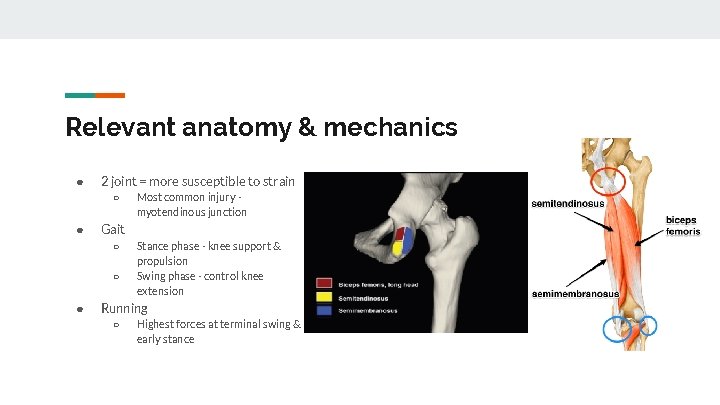
Relevant anatomy & mechanics ● 2 joint = more susceptible to strain ○ ● Gait ○ ○ ● Most common injury myotendinous junction Stance phase - knee support & propulsion Swing phase - control knee extension Running ○ Highest forces at terminal swing & early stance
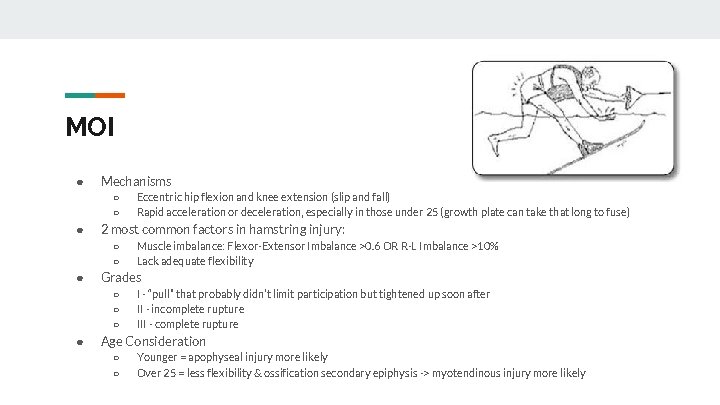
MOI ● Mechanisms ○ ○ ● 2 most common factors in hamstring injury: ○ ○ ● Muscle imbalance: Flexor-Extensor Imbalance >0. 6 OR R-L Imbalance >10% Lack adequate flexibility Grades ○ ○ ○ ● Eccentric hip flexion and knee extension (slip and fall) Rapid acceleration or deceleration, especially in those under 25 (growth plate can take that long to fuse) I - “pull” that probably didn’t limit participation but tightened up soon after II - incomplete rupture III - complete rupture Age Consideration ○ ○ Younger = apophyseal injury more likely Over 25 = less flexibility & ossification secondary epiphysis -> myotendinous injury more likely
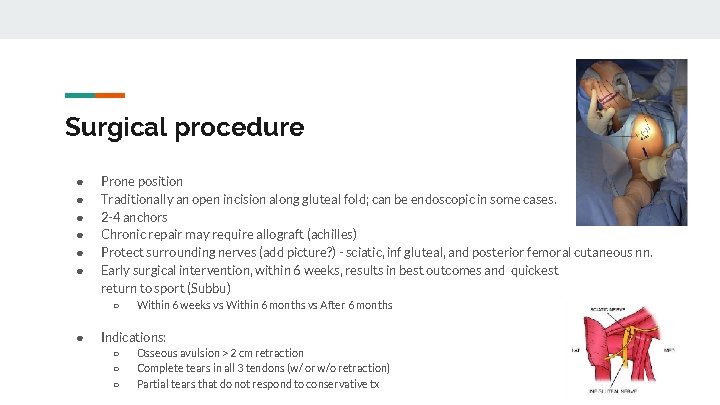
Surgical procedure ● ● ● Prone position Traditionally an open incision along gluteal fold; can be endoscopic in some cases. 2 -4 anchors Chronic repair may require allograft (achilles) Protect surrounding nerves (add picture? ) - sciatic, inf gluteal, and posterior femoral cutaneous nn. Early surgical intervention, within 6 weeks, results in best outcomes and quickest return to sport (Subbu) ○ ● Within 6 weeks vs Within 6 months vs After 6 months Indications: ○ ○ ○ Osseous avulsion > 2 cm retraction Complete tears in all 3 tendons (w/ or w/o retraction) Partial tears that do not respond to conservative tx
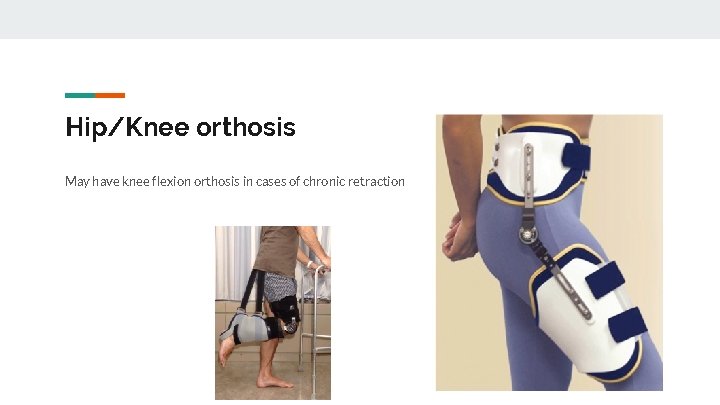
Hip/Knee orthosis May have knee flexion orthosis in cases of chronic retraction
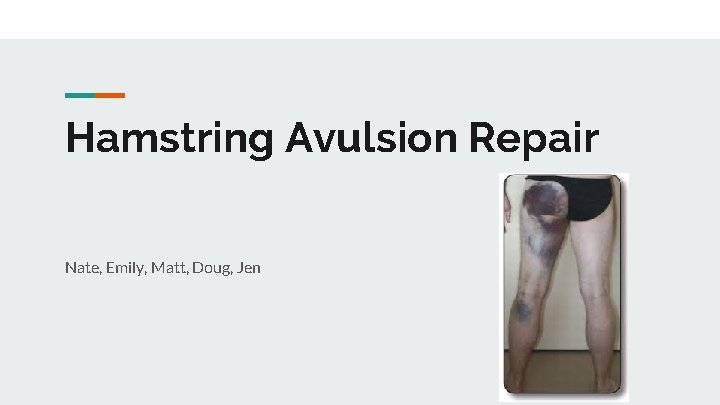
Patient case AJ Purple is a 17 y/o male presenting to the clinic 7 days post-op acute Hamstring Avulsion Repair. Injury was sustained on 1/13/18 as pt was performing biweekly sprinting activities. Pt heard an audible pop and felt pain in his posterior thigh which caused him to fall to the ground. Pt presented the following day to Dr. Smith with severe ecchymosis, pain, and swelling in the posterior thigh as well as discomfort sitting & weight-bearing on the L leg. An A-P view plain radiograph confirmed a suspected avulsion fracture of the hamstrings (grade IIIB strain) with 2. 5 cm retraction. Pt underwent Hamstring Avulsion Repair by Dr. Smith on 1/15/18.
Phase 1 Goals (Wk 0 -6) ● ● ● Promote soft tissue healing Protect incision and prevent infection Control pain Provide gait & transfer training with AD & hip orthosis Maintain hip and knee ROM in protected range (what is the target ROM? ? ? ) Maintain strength and ROM in surrounding joints Restrictions (*Follow MD Script* ); Example: ● ● WB Status - Follow MD Script. Ex: Wk 0 -2 TDWB; increase to 25% until FWB at Wk 6 Hip/Knee Orthosis: Wk 0 -3 at 0 -30° hip flexion, Wk 3 -6 0 -60° hip flexion. May also have knee orthosis locked in flexion if hamstring retraction was significant.
Phase 1 Rehab ● Post-Op Eval Activities ○ ○ ● ● ● Lumbopelvic exercises (TA) Ankle isotonics with TB & rocker board proprioception exercises Towel scrunches (caution with WB status) Hip Abduction Isometrics [Belt/Ball Squeeze] -> working into clamshells & isotonics Wk 2 - PROM hip & knee ○ ○ ● Check sensation Wound inspection and wound care Light STM to wound when healed Modalities for pain control - ice, e-stim, US Knee Flexion: Heel slides with towel. Walk feet down wall. Knee Extension: long sitting with weight over anterior thigh Wk 4 - AROM hip & knee ○ ○ Hip ROM advanced 10* each week after surgery Stationary biking possible in late phase I
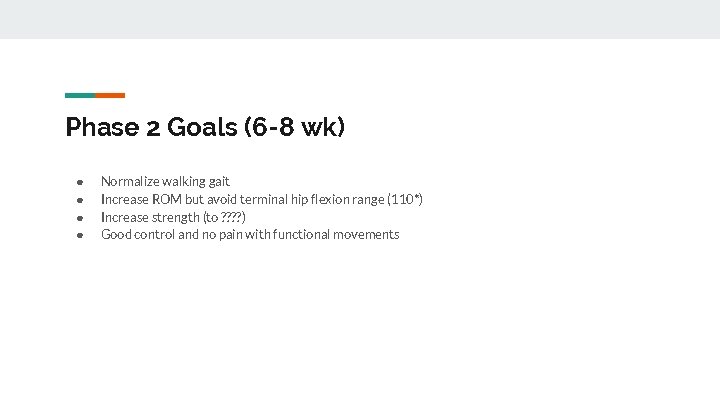
Phase 2 Goals (6 -8 wk) ● ● Normalize walking gait Increase ROM but avoid terminal hip flexion range (110*) Increase strength (to ? ? ) Good control and no pain with functional movements
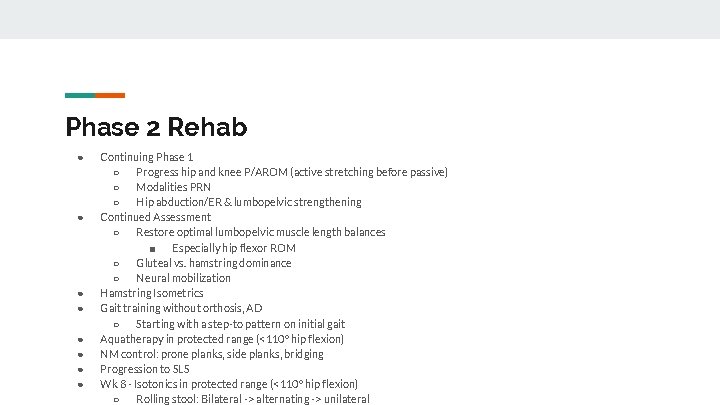
Phase 2 Rehab ● ● ● ● Continuing Phase 1 ○ Progress hip and knee P/AROM (active stretching before passive) ○ Modalities PRN ○ Hip abduction/ER & lumbopelvic strengthening Continued Assessment ○ Restore optimal lumbopelvic muscle length balances ■ Especially hip flexor ROM ○ Gluteal vs. hamstring dominance ○ Neural mobilization Hamstring Isometrics Gait training without orthosis, AD ○ Starting with a step-to pattern on initial gait Aquatherapy in protected range (<110° hip flexion) NM control: prone planks, side planks, bridging Progression to SLS Wk 8 - Isotonics in protected range (<110° hip flexion) ○ Rolling stool: Bilateral -> alternating -> unilateral
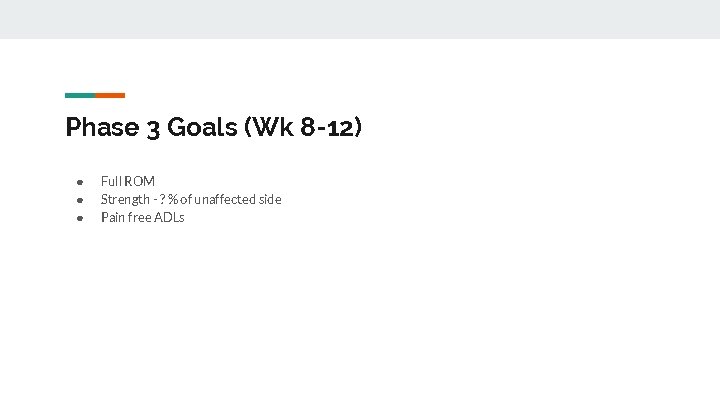
Phase 3 Goals (Wk 8 -12) ● ● ● Full ROM Strength - ? % of unaffected side Pain free ADLs
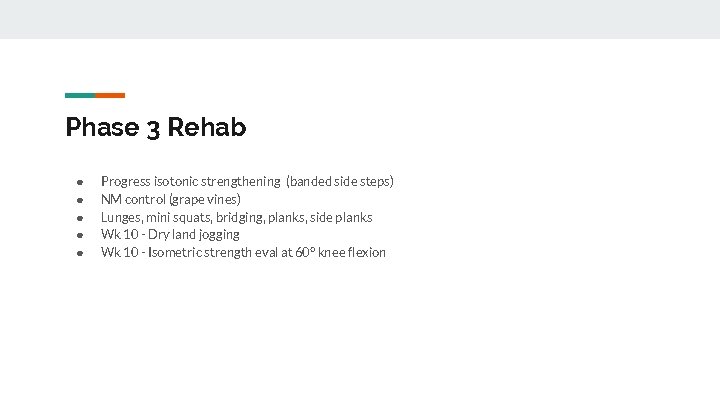
Phase 3 Rehab ● ● ● Progress isotonic strengthening (banded side steps) NM control (grape vines) Lunges, mini squats, bridging, planks, side planks Wk 10 - Dry land jogging Wk 10 - Isometric strength eval at 60° knee flexion
Phase 4 Goals ● ● ● Dynamic NM control in multiple planes at high velocities Good control and no pain with sport or work specific movements Return to Sport - when repaired leg is at 80% strength (6 -9 months)
Phase 4 Rehab ● ● ● Progressive eccentric activity Progressive running and sprinting drills Progressive jumping (start with both feet, move to single leg hops)
Evidence / Outcomes ● ● ● Outcomes are influenced by several factors: acuity of repair, extent of injury, use of allograph, PLOF 80 -95% patient satisfaction Low-demand outcomes are good; high-demand outcomes are mixed. ○ ○ ● ● 80 -90% LEFS scores 50 -60% returned to prior level of sporting activity Significantly lower hamstring peak strength and functional ability (ex, single leg hop) 1/3 rd athletes with hamstring injury have a recurring hamstring injury within 1 year RTP
References Cohen SB, Rangavajjula A, Vyas D, Bradley JP. Functional Results and Outcomes After Repair of Proximal Hamstring Avulsions. The American Journal of Sports Medicine. 2012; 40: 2092 -2098. Domb BG, Linder D, Sharp KG, Sadik A, Gerhardt MB. Endoscopic repair of proximal hamstring avulsion. Arthrosc Tech. 2013 Jan 18; 2(1): e 35 -9. Rust DA, Giveans MR, Stone RM, Samuelson KM, Larson CM. Functional Outcomes and Return to Sports After Acute Repair, Chronic Repair, and Allograft Reconstruction for Proximal Hamstring Ruptures. Am J Sports Med. 2014 Jun; 42(6): 1377 -83. Schoensee SK, Nilsson KJ. A NOVEL APPROACH TO TREATMENT FOR CHRONIC AVULSION FRACTURE OF THE ISCHIAL TUBEROSITY IN THREE ADOLESCENT ATHLETES: A CASE SERIES. International Journal of Sports Physical Therapy. 2014; 9(7): 974 -990. Sikka RS, Fetzer GB, Fischer DA. Ischial Apophyseal Avulsions: Proximal Hamstring Repair With Bony Fragment Excision. Journal of Pediatric Orthopaedics. 2013; 33: e 72 -e 76. Skaara HE, Moksnes H, Frihagen F, Stuge B. Self-reported and performance-based functional outcomes after surgical repair of proximal hamstring avulsions. Am J Sports Med. 2013 Nov; 41(11): 2577 -84. Subbu R, Benjamin-Laing H, Haddad F. Timing of surgery for complete proximal hamstring avulsion injuries: successful clinical outcomes at 6
I will AMA later https: //www. ncbi. nlm. nih. gov/pmc/articles/PMC 4691307/ - Matt https: //www. ncbi. nlm. nih. gov/pmc/articles/PMC 2867336/ - Matt https: //www. ncbi. nlm. nih. gov/pubmed/17659291/ - Matt http: //www. jospt. org/doi/pdf/10. 2519/jospt. 2008. 2845? code=jospt-site - Matt https: //www. ncbi. nlm. nih. gov/pubmed/22763118/ - still need to look at