
Hams Without Borders International Operating and Third Party
Hams Without Borders International Operating and Third Party Communications with Other Countries
With which countries are FCC-licensed amateur stations prohibited from exchanging communications? (T 1 D 01) • A. Any country whose administration has notified the ITU that it objects to such communications • B. Any country whose administration has notified the United Nations that it objects to such communications • C. Any country engaged in hostilities with another country • D. Any country in violation of the War Powers Act of 1934 2
International Messages Between Hams 2 • Ham-to-Ham contact is generally OK • Countries that do not license their citizens: – Yemen (they do allow DX Expeditions to operate in-country with the required permits) – North Korea (no activity permitted at all) 3
Third-Party Communications ? • Third-party means that a non-ham is involved in communication via ham radio – Could be actually speaking on the air, or – Could be passing a message to or from the non-ham • Remember that when operating in a foreign country or even here in the U. S. , communications “incidental to the purpose of the amateur service and remarks of a personal nature” are the only types of communications that may be transmitted to amateur stations in foreign countries. • Let’s look at two situations – different rules 1. 2. Within the US Communication that crosses international borders 4
Third-Party Communications within US • No special rules • Just make sure: – Control Operator is present – The message is non-commercial in nature – Station ID rules are followed 5
Third-Party Communications Across Borders • Make sure that a 3 rd-party agreement exists – Check for current third-party agreements from ARRL Web site or FCC sources if in doubt http: //www. arrl. org/third-party-operating-agreements – You might be surprised at the countries that we do not have third-party agreements with • During station identification you must say both stations’ call signs 6
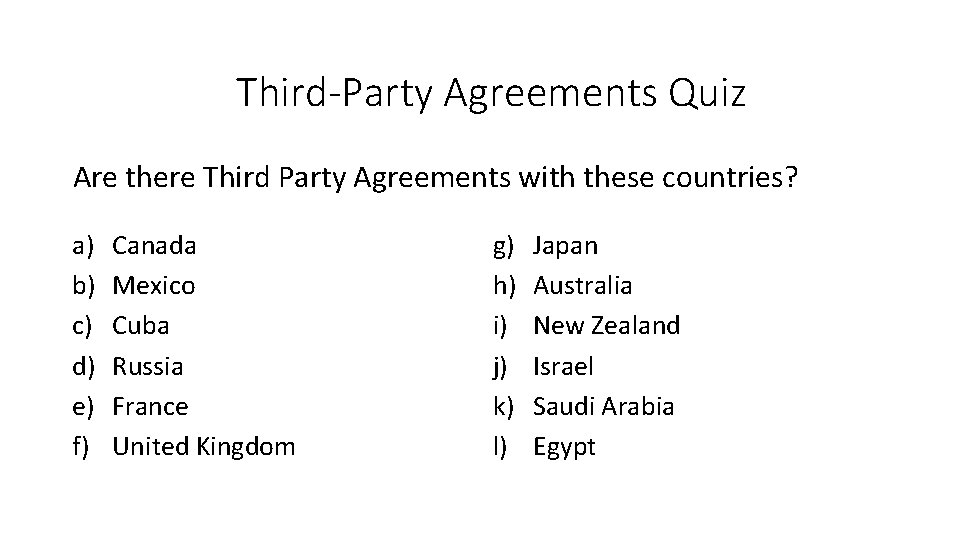
Third-Party Agreements Quiz Are there Third Party Agreements with these countries? a) b) c) d) e) f) Canada Mexico Cuba Russia France United Kingdom g) h) i) j) k) l) Japan Australia New Zealand Israel Saudi Arabia Egypt
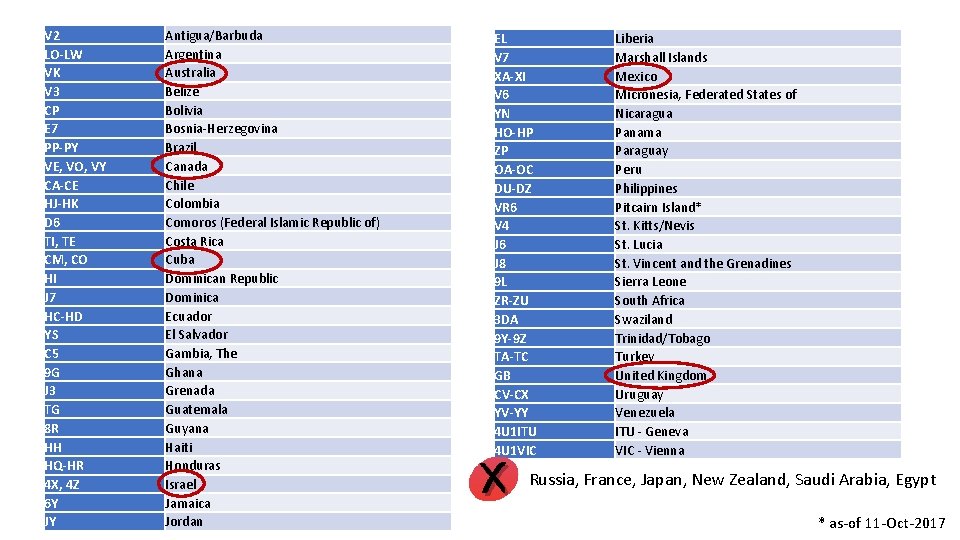
V 2 LO-LW VK V 3 CP E 7 PP-PY VE, VO, VY CA-CE HJ-HK D 6 TI, TE CM, CO HI J 7 HC-HD YS C 5 9 G J 3 TG 8 R HH HQ-HR 4 X, 4 Z 6 Y JY Antigua/Barbuda Argentina Australia Belize Bolivia Bosnia-Herzegovina Brazil Canada Chile Colombia Comoros (Federal Islamic Republic of) Costa Rica Cuba Dominican Republic Dominica Ecuador El Salvador Gambia, The Ghana Grenada Guatemala Guyana Haiti Honduras Israel Jamaica Jordan EL V 7 XA-XI V 6 YN HO-HP ZP OA-OC DU-DZ VR 6 V 4 J 6 J 8 9 L ZR-ZU 3 DA 9 Y-9 Z TA-TC GB CV-CX YV-YY 4 U 1 ITU 4 U 1 VIC Liberia Marshall Islands Mexico Micronesia, Federated States of Nicaragua Panama Paraguay Peru Philippines Pitcairn Island* St. Kitts/Nevis St. Lucia St. Vincent and the Grenadines Sierra Leone South Africa Swaziland Trinidad/Tobago Turkey United Kingdom Uruguay Venezuela ITU - Geneva VIC - Vienna Russia, France, Japan, New Zealand, Saudi Arabia, Egypt * as-of 11 -Oct-2017
A difference that makes a difference. . . (the FCC is very restrictive) • FCC: https: //www. fcc. gov/wireless/bureau-divisions/mobility-division/amateur-radio-service/international-arrangements “No amateur station, however, shall transmit messages for a third party. . . whose administration has not made arrangements with the United States to allow amateur stations to be used for transmitting international communications on behalf of third parties. ” • Industry Canada: https: //www. ic. gc. ca/eic/site/smt-gst. nsf/eng/sf 01226. html “In cases of emergencies or disaster relief, international third party communications are expressly permitted unless specifically prohibited by a foreign administration. Any foreign administration may permit its amateur stations to communicate on behalf of third parties without having to enter into any special arrangements with Canada does not prohibit international communications on behalf of third parties. “ • Australian Communications and Media Authority: https: //www. legislation. gov. au/Details/F 2013 C 00061 “. . . a licensee may transmit messages on behalf of a third party to an amateur station, including an amateur station in a foreign country. Other countries may permit the transmission or reception of messages on behalf of third parties only in the case of emergencies or disaster relief. The ACMA recommends that licensees respect any restrictions applied to amateur stations in foreign countries in relation to the transmission or reception of messages on behalf of a third party. ”
International Operating • Foreign operation is dictated by that country’s rules and regulations, such as band plans, power limits, etc. • Reciprocal operating authorizations allow you to operate in foreign countries • Is your license good enough? What class? • Do you need a permit? • Use your ARRL benefits – they offer a no-cost licensing service • Some countries restrict ham radio contacts entirely, e. g. North Korea
Basic Types of Authorization • Canada. . . A very special neighbor. . . • Multilateral Agreement • All European Countries accept CEPT (no permit required; but there are documentation requirements) http: //www. arrl. org/cept • North, South, and Central American countries, through the Inter-American Telecommunication Commission (CITEL), an entity of the Organization of American States, uses IARP http: //www. arrl. org/iarp • Some non-European countries that have “implemented” CEPT • Australia, Canada, Israel, New Zealand, Netherlands Antilles, Peru, South Africa, and USA • Bilateral Agreements – Check country requirements • More info: http: //www. arrl. org/reciprocal-permit

Reciprocal Agreements by Country https: //en. wikipedia. org/wiki/Amateur_radio_international_operation
Operating in Canada • In 1952, Canada and the United States signed a Reciprocal Operating Agreement treaty. • No permits are required when exchanging visits between Canada and the US. • Visiting Canadian amateurs operate under the FCC; and US amateurs operate under the Industry Canada rules and regulations. • Morse code capabilities determine the class of license: • If qualified to send and receive at least 5 wpm Amateur Operator's Certificate with Basic, Morse Code (5 wpm) and Advanced Qualifications (2250 W PEP SSB, or 750 W otherwise) • No Morse code competency Amateur Operator's Certificate with Basic Qualifications (560 W PEP SSB, or 190 W otherwise) • Pay careful note to Canadian rules and regulations: • Band plan is slightly different, i. e. bands, band edges, license restrictions within the band, power levels, etc. • Station identification can be in English or in French; must identify at the beginning and at the end of each period of exchange of communication or test transmission, and at intervals of not more than 30 minutes throughout. • Visitors must identify using his or her call sign followed by a call area suffix, e. g. , VE 3 FRV/W 9 or N 9 CFX/VE 3. • For details, see: http: //wp. rac. ca/operating/canada-united-states-reciprocal-operating-agreement/
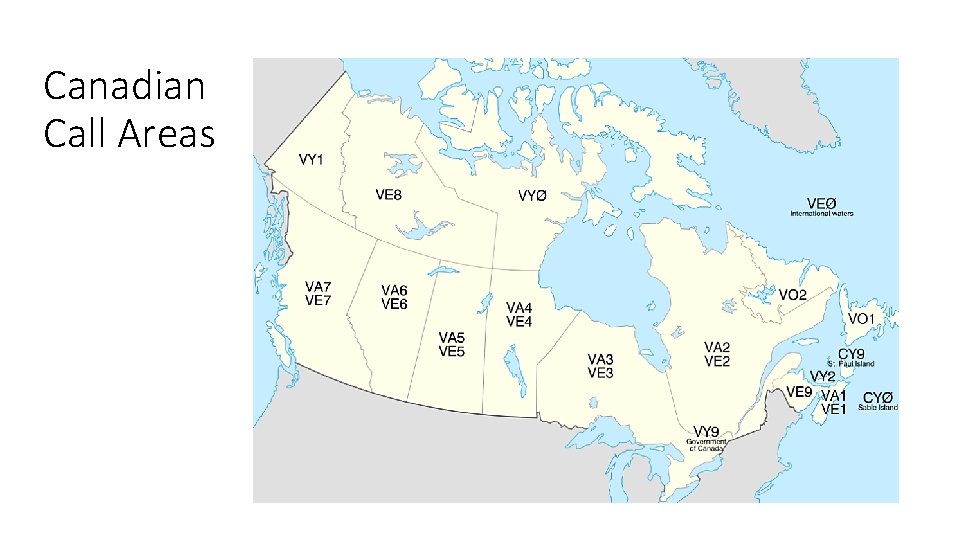
Canadian Call Areas
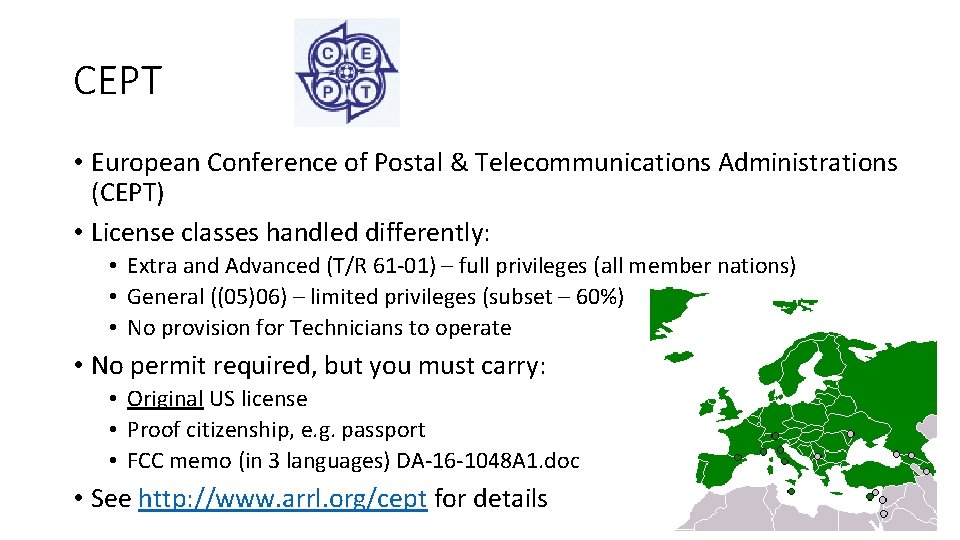
CEPT • European Conference of Postal & Telecommunications Administrations (CEPT) • License classes handled differently: • Extra and Advanced (T/R 61 -01) – full privileges (all member nations) • General ((05)06) – limited privileges (subset – 60%) • No provision for Technicians to operate • No permit required, but you must carry: • Original US license • Proof citizenship, e. g. passport • FCC memo (in 3 languages) DA-16 -1048 A 1. doc • See http: //www. arrl. org/cept for details
IARP International Amateur Radio Permit • Primarily for operation in countries of the Americas • Application made through ARRL • Permit good for 365 days • Morse code requirement • Details at http: //www. arrl. org/iarp
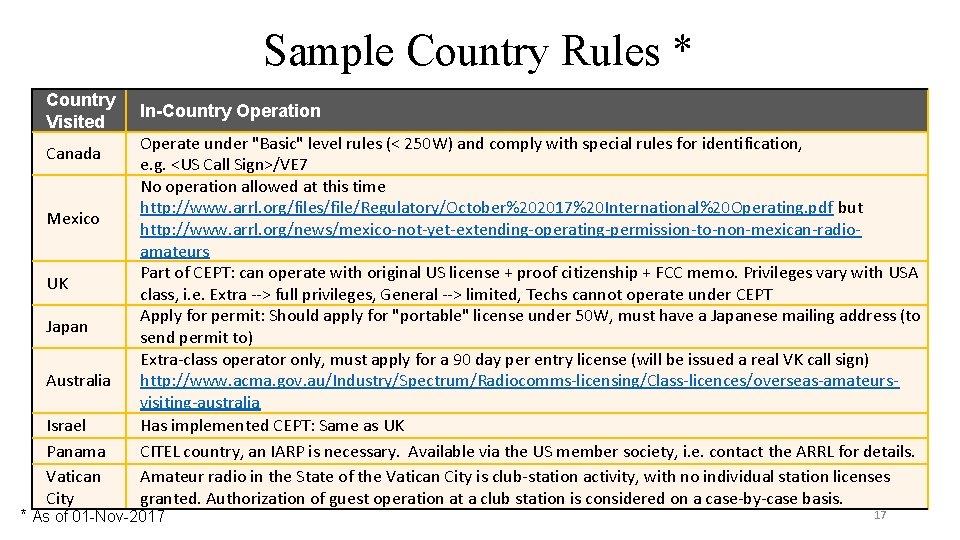
Sample Country Rules * Country Visited Canada Mexico UK Japan Australia Israel Panama Vatican City In-Country Operation Operate under "Basic" level rules (< 250 W) and comply with special rules for identification, e. g. <US Call Sign>/VE 7 No operation allowed at this time http: //www. arrl. org/files/file/Regulatory/October%202017%20 International%20 Operating. pdf but http: //www. arrl. org/news/mexico-not-yet-extending-operating-permission-to-non-mexican-radioamateurs Part of CEPT: can operate with original US license + proof citizenship + FCC memo. Privileges vary with USA class, i. e. Extra --> full privileges, General --> limited, Techs cannot operate under CEPT Apply for permit: Should apply for "portable" license under 50 W, must have a Japanese mailing address (to send permit to) Extra-class operator only, must apply for a 90 day per entry license (will be issued a real VK call sign) http: //www. acma. gov. au/Industry/Spectrum/Radiocomms-licensing/Class-licences/overseas-amateursvisiting-australia Has implemented CEPT: Same as UK CITEL country, an IARP is necessary. Available via the US member society, i. e. contact the ARRL for details. Amateur radio in the State of the Vatican City is club-station activity, with no individual station licenses granted. Authorization of guest operation at a club station is considered on a case-by-case basis. * As of 01 -Nov-2017 17
Case Study • Destination wedding in Belize • To research: http: //www. arrl. org/reciprocal-permit • Notice: • Equipment is specifically known (by model and serial number) – the USA is actually unusual that we don’t directly track radio equipment. • You will get a Belize call sign for identification. • Leave yourself extra time. Remember that not everyone runs on “instant service” time. There are slower places in the world – friendly and courteous, but they run on their own clock.
- Slides: 18