
Hamiltons National Bank How do banks promote economic
Hamilton’s National Bank How do banks promote economic growth? 1
Lesson Objectives Students will • Define banks, capital formation, capital resources, collateral, gross domestic product (GDP), loan, risk-reward relationship and usury. • Explain the meaning of capital formation and its role in economic growth; • Assess the role of banks in capital formation; • Compare the views of Jefferson and Hamilton regarding banks. 2
Who was Alexander Hamilton? Discuss. Banks Usury Bubbles What happened to people who could not pay their debts in the 1790 s? 3
Building the Wealth of a Nation What does it take? • Capital resources: Goods that are used over and over again to make another good or service. • Capital formation: Making more capital resources (e. g. , tools, machines etc. ) for future production of goods and services. It provides an income stream and usually contributes to increases in the standard of living. How do we measure growth? • Gross domestic product (GDP): The total market value, expressed in dollars, of all final goods and services produced in an economy in a given year. 4
Building the Wealth of a Nation Application Ø If you are a stylist or barber what capital resources would you use? Ø Is a haircut an example of a good or service? Ø If you worked at a salon owned by someone else and want to open your own shop what would you need? 5
Words to know and understand. Banks: Businesses that accept deposits and make loans. Savings: The accumulation of money set aside for future spending. Collateral: Property required by a lender and offered by a borrower as a guarantee of payment on a loan. Loan: A sum of money provided temporarily on the condition that the amount borrowed be repaid, usually with interest. Risk: The chance of loss. Risk-reward relationship: The direct relationship between the risk of a person not repaying a loan and the amount of interest that person must pay. 6
United States in the 1790 s Role play life in the 1790 s There will be 2 rounds 7
Role Play Round 1 1. Review your card 2. Determine if you are a borrower or lender 3. Savers/lenders are seeking high interest 4. Borrowers/spenders- low interest 5. Take handout 2 and record any transaction you are able to make. 6. Debrief round 1 7. *Corn sold for $. 56 -$1. 00 per bushel in 1795 8
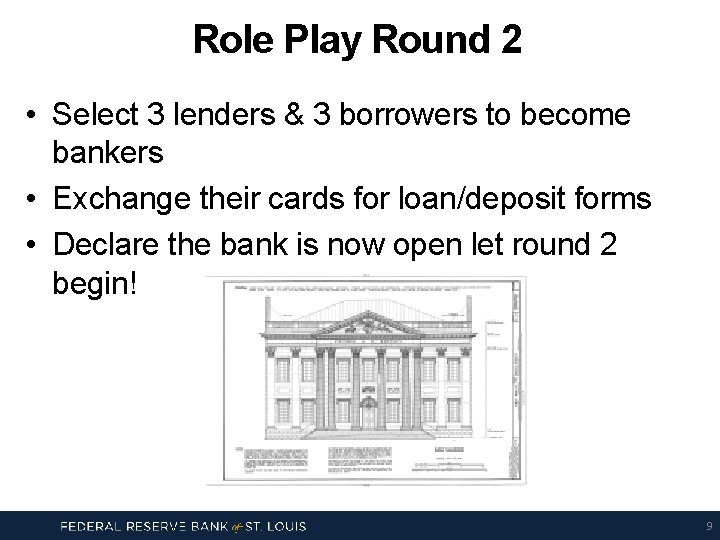
Role Play Round 2 • Select 3 lenders & 3 borrowers to become bankers • Exchange their cards for loan/deposit forms • Declare the bank is now open let round 2 begin! 9
Compare Round 1 and 2 From the borrowers point of view • Which round had more transactions? • What were borrowers going to buy with the money they borrowed? • How would this impact capital formation? • Which round had more potential capital formation? 10
Compare Round 1 and 2 From the saver/lenders point of view • Which round had more transactions? • What were savers/lenders going to do with their earnings? • What impact would savings have on capital formation? 11

12
Understanding Hamilton • What did he mean by saying gold and silver were dead stock, but when deposited in banks acquire life? • How would depositing in a bank or investing in stock of a bank yield profit? • How do borrowers benefit from a bank? 13
Take a Stand 1. Distribute copies of both Hamilton’s list of advantages of a national bank and Jefferson’s opposition either electronically or paper. 2. Give 10 minutes reading time 3. Designate one side of the room as Hamilton and the other as Jefferson and have students move to the side that they most agree with. 4. Discuss 14
Discussion Questions 1. What were Jefferson’s main concerns about creating a national bank? 2. What were Hamilton’s main reasons to support the creation of a national bank? 3. Why was it important to put branch banks throughout the United States? 15

16
How do banks promote economic growth? Ø Review vocabularyØ What is capital formation and why does it matter? Ø Why do people save? Ø How do banks reward saving and facilitate borrowing? Ø What is the risk-reward relationship? Ø How does having collateral affect the amount of interest a borrower is charged? 17
1790 s Banking in the US Only 4 cities in North America had banks ü Philadelphia ü New York ü Boston ü Baltimore What advantages did Hamilton see in creating a national bank? Why did Jefferson oppose the national bank? 18
- Slides: 18