
Ham Radio Technician Class Licensing Course Chapter 1
- Slides: 50
Ham Radio Technician Class Licensing Course Chapter 1 Lesson Plan Module 1 – Welcome to Amateur Radio
Introductions • State your name and a little about yourself.
Let’s Get Started • Our goal during this class is for each of you to achieve the Technician Class Amateur Radio License! – The license will authorize you to operate an Amateur Radio (Ham Radio) transmitter.
What is Amateur Radio? • Amateur (or Ham) Radio is a personal radio service authorized by the Federal Communications Commission (FCC). – To encourage the advancement of the art and science of radio. – To promote the development of an emergency communication capability to assist communities when needed. – To develop a pool of trained radio operators. – To promote international good will by connecting private citizens in countries around the globe. • Through ham radio, you will become an ambassador for your community and your country.
What Do Hams Do? • • Communicate Participate Experiment Build Compete Serve their communities Life-long learning
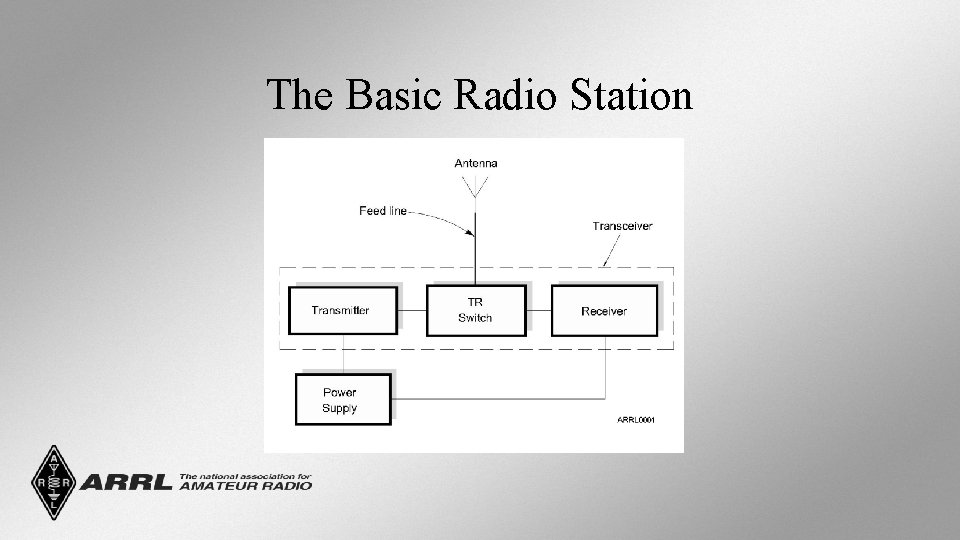
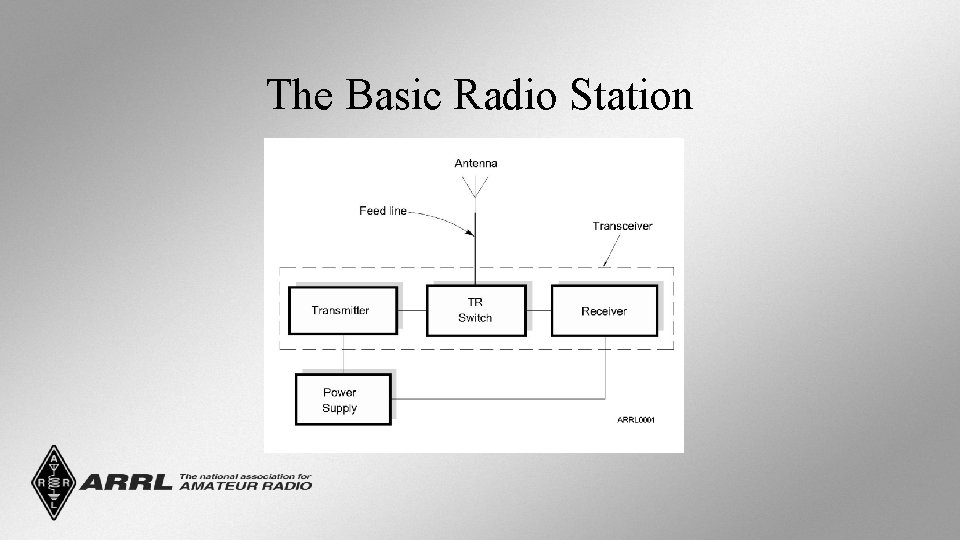
The Basic Radio Station
What Happens During Radio Communication? • Transmitting (sending a signal): – Information (voice, data, video, commands, etc. ) is converted to electronic form. – The information in electronic form is attached or embedded on a radio wave (a carrier). – The radio wave is sent out from the station antenna into space.
What Happens During Radio Communication? • Receiving end: – The radio wave (carrier) with the information is intercepted by the receiving station antenna. – The receiver extracts the information from the carrier wave. – The information is then presented to the user in a format that can be understood (sound, picture, words on a computer screen, response to a command).
What Happens During Radio Communication? • This sounds pretty simple, but it in reality is pretty complex. • This complexity is one thing that makes ham radio fun…learning all about how radios work. • Don’t be intimidated. You will be required to only know the basics, but you can learn as much about the “art and science” of radio as you want.
Radio Waves are AC • Radio waves (electromagnetic radiation) are ac waves. • Radio waves are used to carry the information you want to convey to someone else.
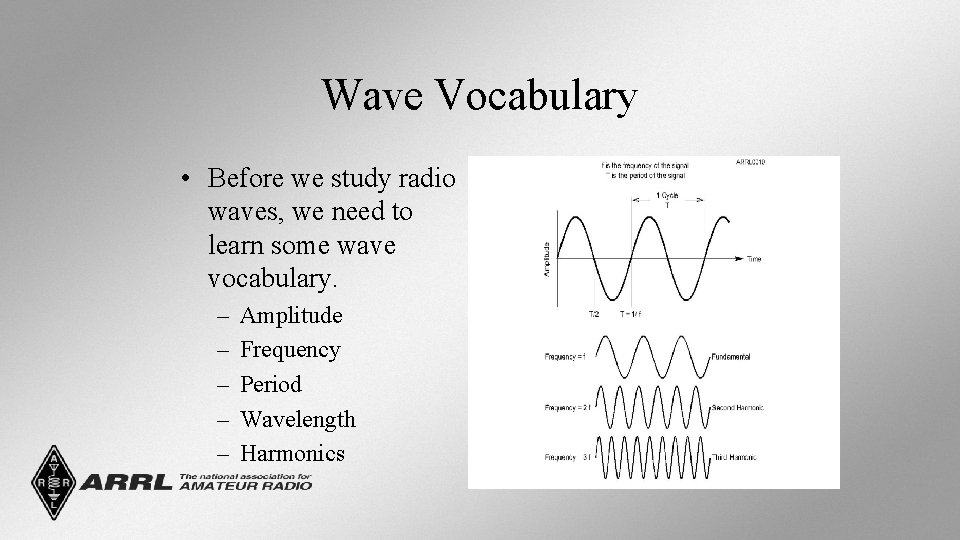
Wave Vocabulary • Before we study radio waves, we need to learn some wave vocabulary. – – – Amplitude Frequency Period Wavelength Harmonics
Now for a Powerful Demonstration • What happens when you drop a magnet through a non-ferrous conductive pipe?
How Radio Waves Travel You have just witnessed in a way how radio waves travel. 1. Moving electrons in the antenna create a magnetic field. 2. This changing magnetic field creates an electric field. 3. Then back and forth between magnetic and electric fields from point A to point B.
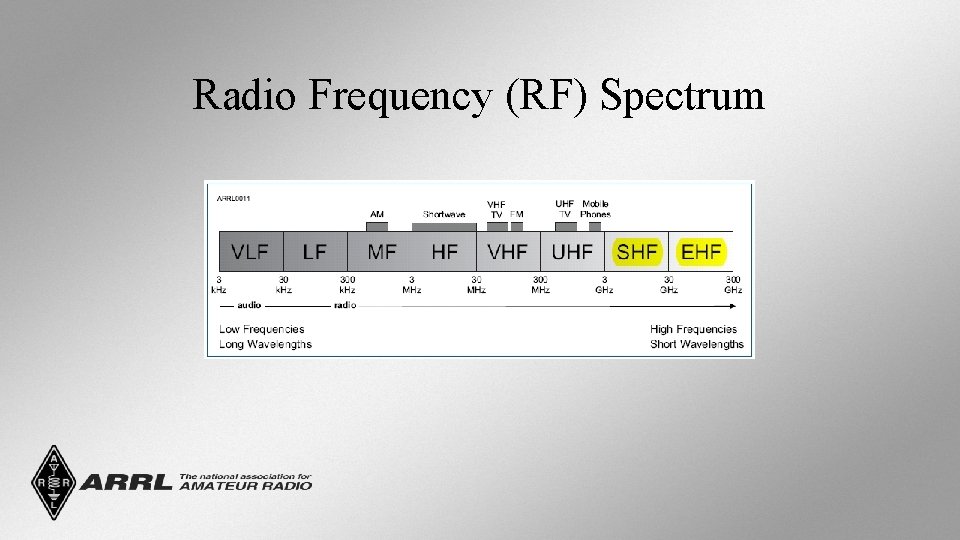
Finding Where You are on the Radio Dial • There are two ways to tell someone where to meet you on the radio dial (spectrum). – Band – Frequency
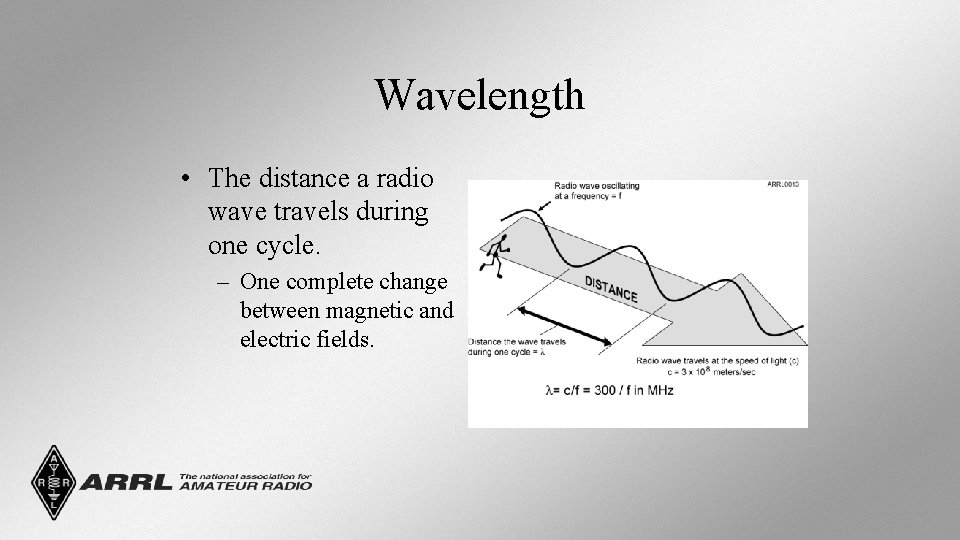
Wavelength • The distance a radio wave travels during one cycle. – One complete change between magnetic and electric fields.
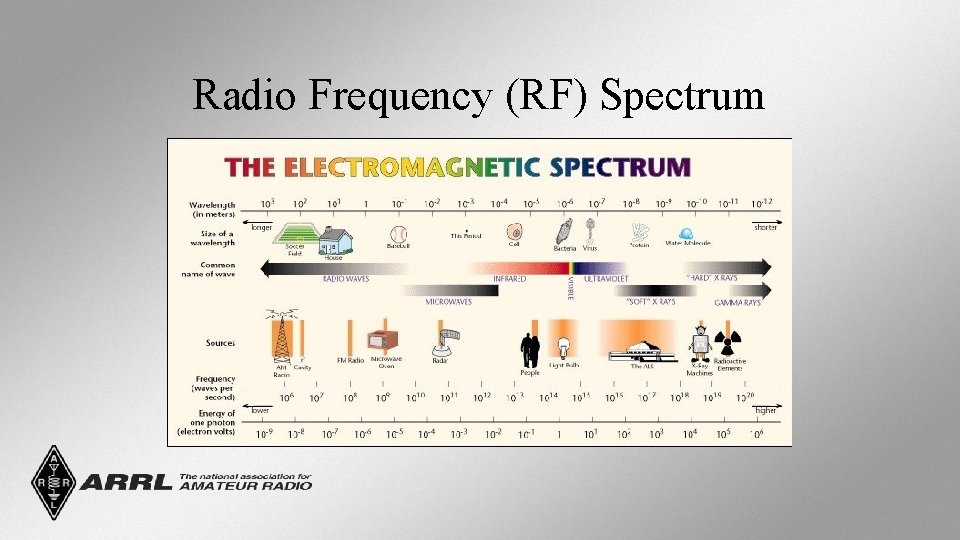
Radio Frequency (RF) Spectrum
Radio Frequency (RF) Spectrum
So, Where Am I? • Back to how to tell where you are in the spectrum. • Bands identify the segment of the spectrum where you will operate. – Wavelength is used to identify the band. • Frequencies identify specifically where you are within the band.
Another Use for Frequency and Wavelength • For the station antenna to efficiently send the radio wave out into space, the antenna must be designed for the specific operating frequency. – The antenna length needs to closely match the wavelength of the frequency to be used. – Any mismatch between antenna length and frequency wavelength will result in radio frequency energy being reflected back to the transmitter, not going (being emitted) into space.
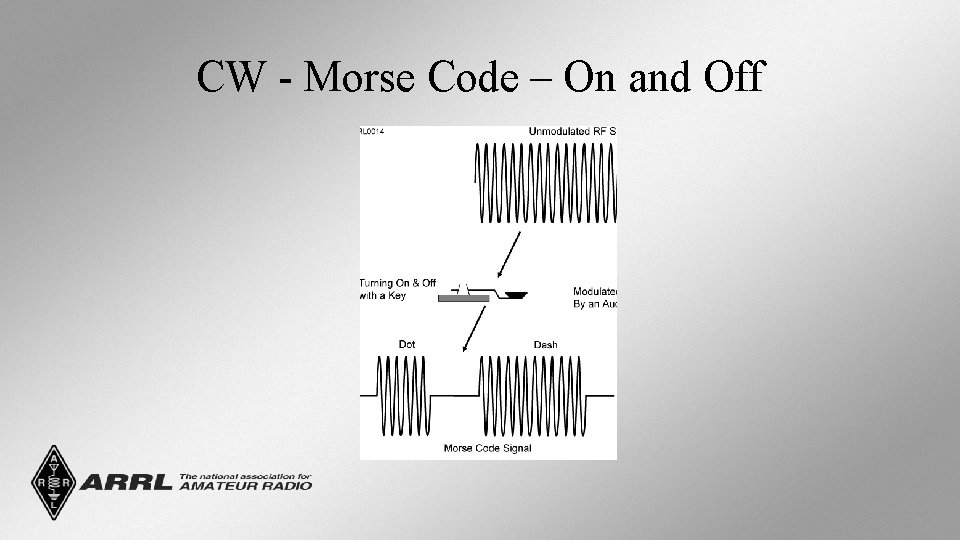
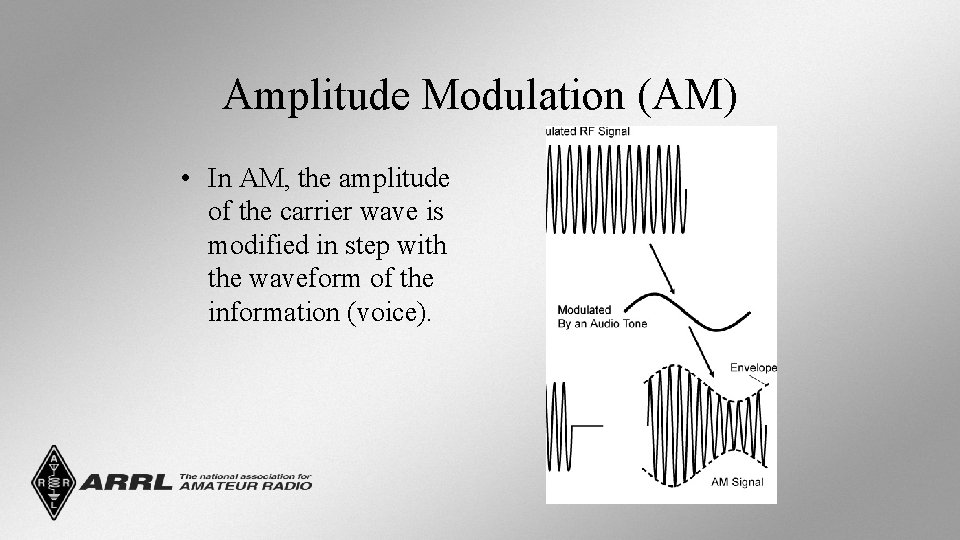
Adding Information - Modulation • When we imprint some information on the radio wave, we modulate the wave. – Turn the wave on and off – Voice -- AM and FM – Data • Different modulation techniques are called modes.
CW - Morse Code – On and Off
Amplitude Modulation (AM) • In AM, the amplitude of the carrier wave is modified in step with the waveform of the information (voice).
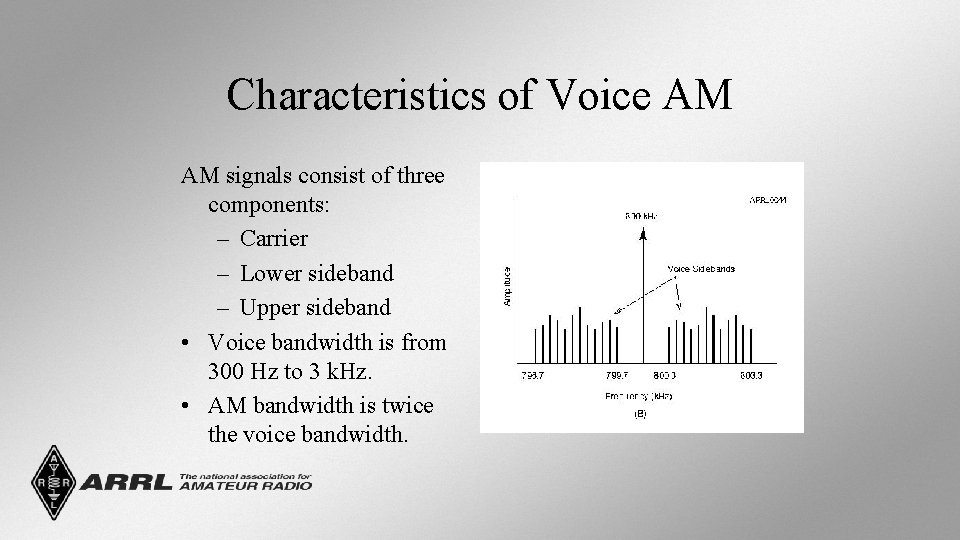
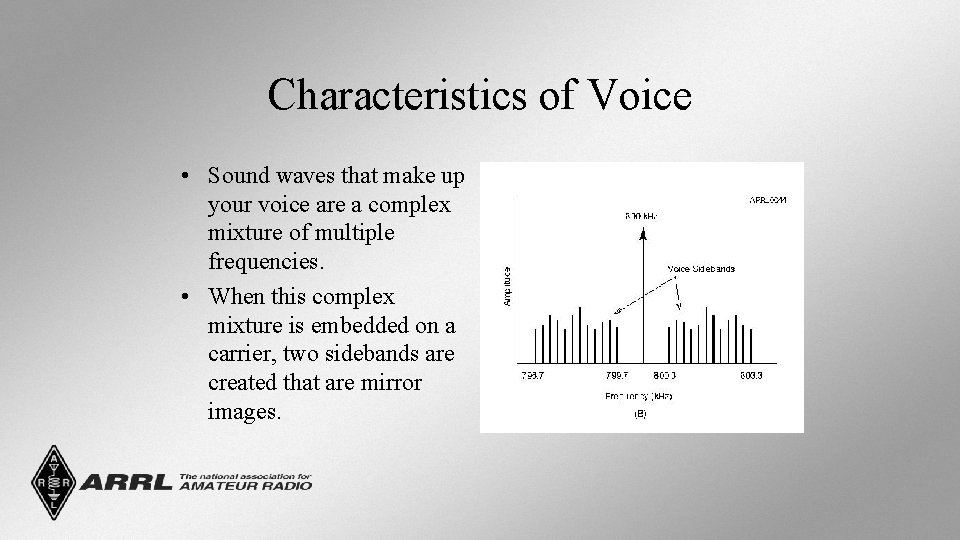
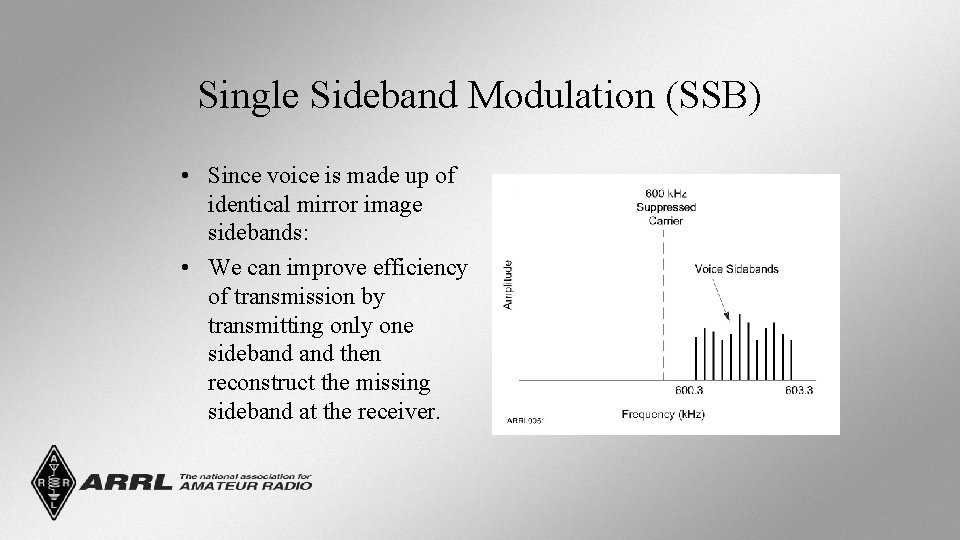
Characteristics of Voice AM AM signals consist of three components: – Carrier – Lower sideband – Upper sideband • Voice bandwidth is from 300 Hz to 3 k. Hz. • AM bandwidth is twice the voice bandwidth.
Characteristics of Voice • Sound waves that make up your voice are a complex mixture of multiple frequencies. • When this complex mixture is embedded on a carrier, two sidebands are created that are mirror images.
Single Sideband Modulation (SSB) • Since voice is made up of identical mirror image sidebands: • We can improve efficiency of transmission by transmitting only one sideband then reconstruct the missing sideband at the receiver.
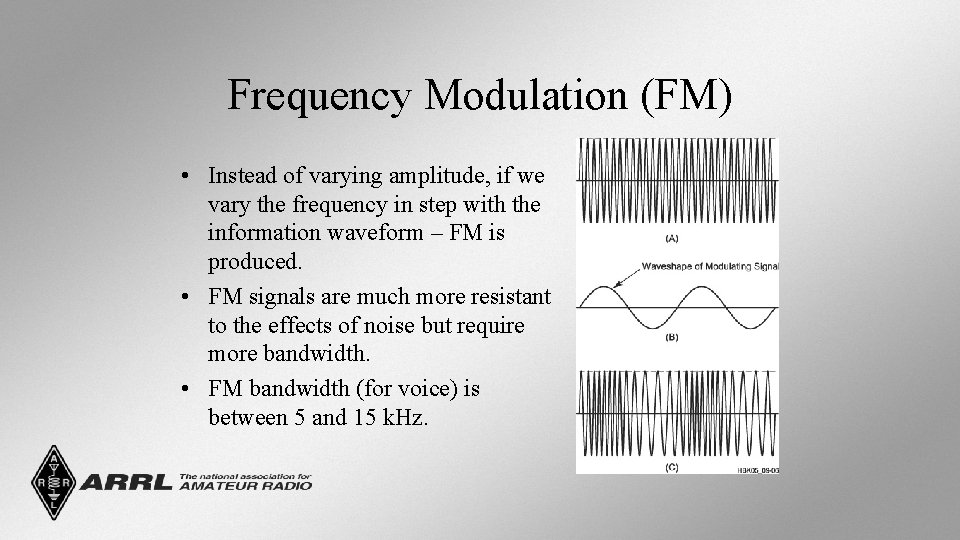
Frequency Modulation (FM) • Instead of varying amplitude, if we vary the frequency in step with the information waveform – FM is produced. • FM signals are much more resistant to the effects of noise but require more bandwidth. • FM bandwidth (for voice) is between 5 and 15 k. Hz.
Technician License Course Chapter 2 Lesson Plan Module 3 – Radio Equipment Basics
The Basic Radio Station
Basic Station Organization • Station Equipment – Receiver – Transmitter – Antenna – Power Supply • Accessory Station Equipment • Repeaters
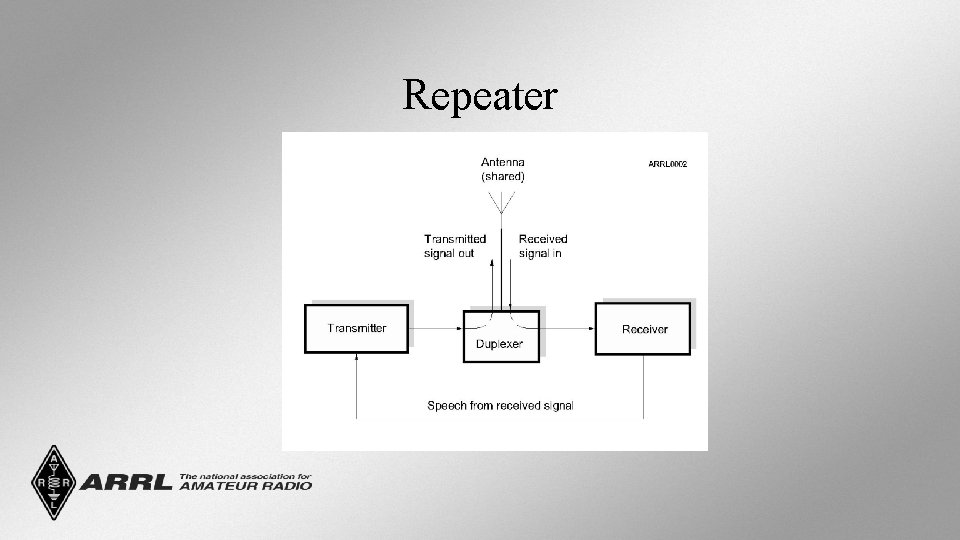
Special Stations You Will Use (Repeaters) • Repeaters are automated stations located at high places that receive and then retransmit your signal – simultaneously. – Dramatically improves range. • The basic components of a repeater are the same as your station: receiver, transmitter, antenna and power supply.
Repeaters • But, repeaters are transmitting and receiving at the same time using the same antenna. • This requires a very high quality and specialized filter to prevent the transmitted signal from overpowering the receiver. • This specialized filter is called a duplexer.
Repeater
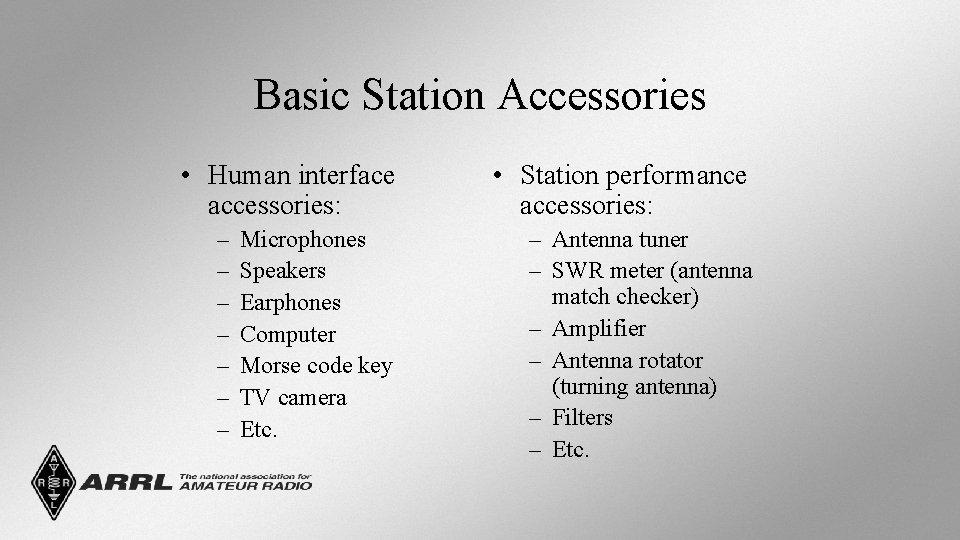
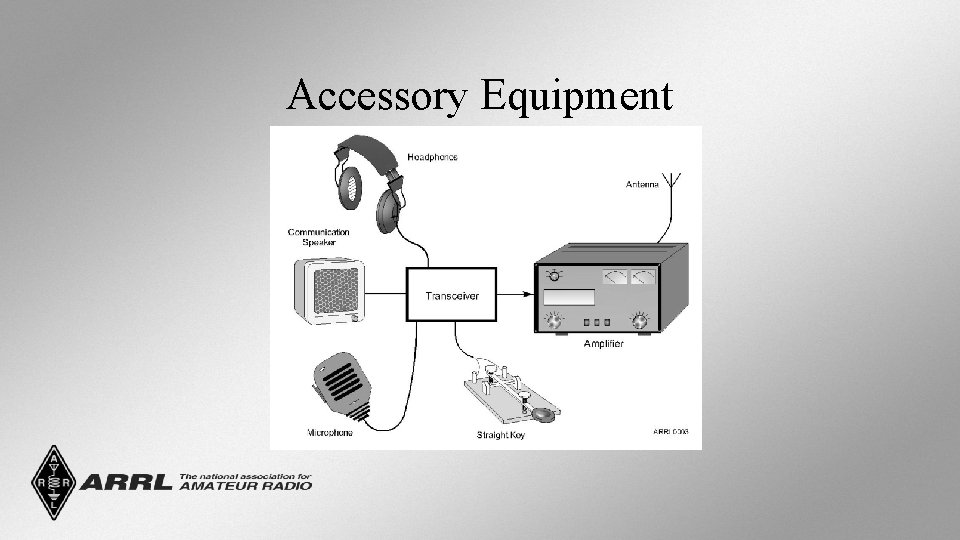
Basic Station Accessories • Human interface accessories: – – – – Microphones Speakers Earphones Computer Morse code key TV camera Etc. • Station performance accessories: – Antenna tuner – SWR meter (antenna match checker) – Amplifier – Antenna rotator (turning antenna) – Filters – Etc.
Accessory Equipment
Technician License Course Chapter 2 & 3 Basic Math Practice Lesson Plan Module 4
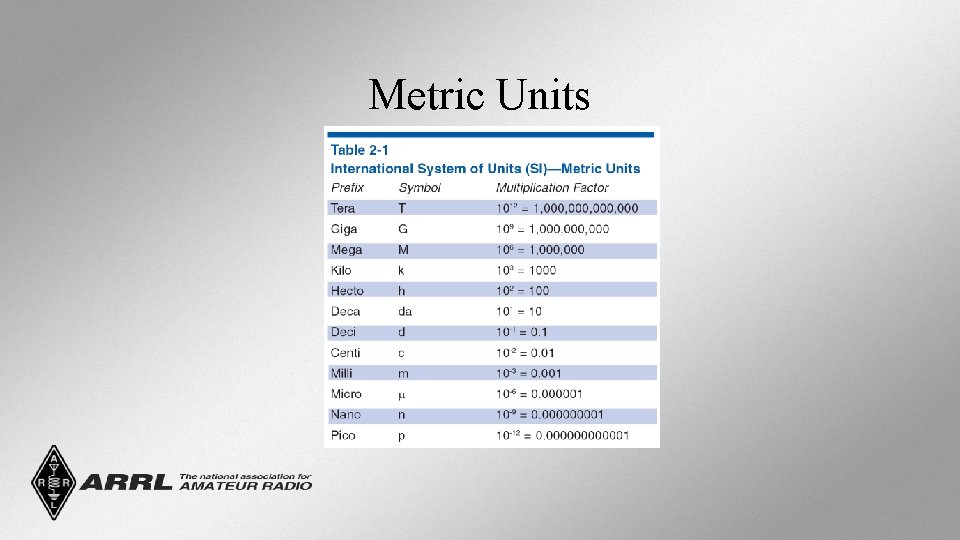
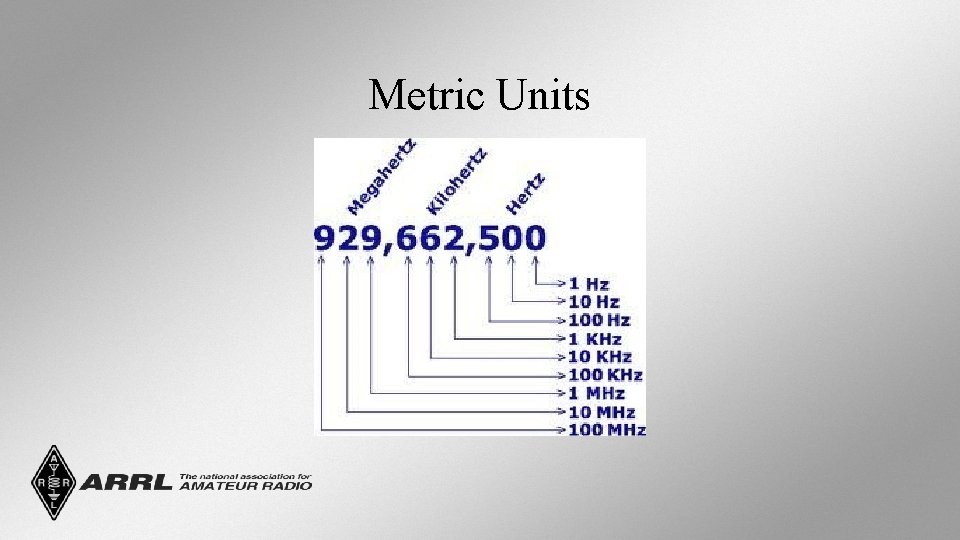
Metric Units
Metric Units
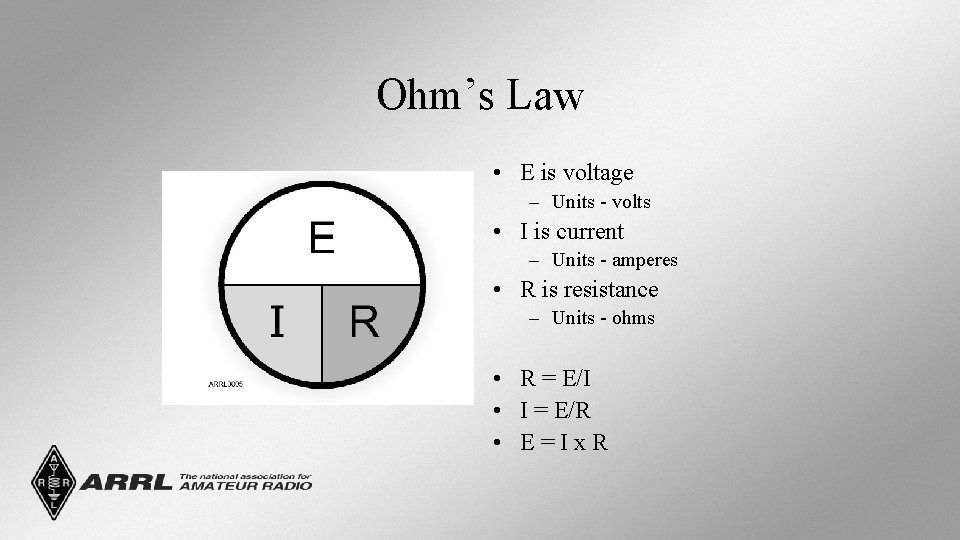
Ohm’s Law • E is voltage – Units - volts • I is current – Units - amperes • R is resistance – Units - ohms • R = E/I • I = E/R • E=Ix. R
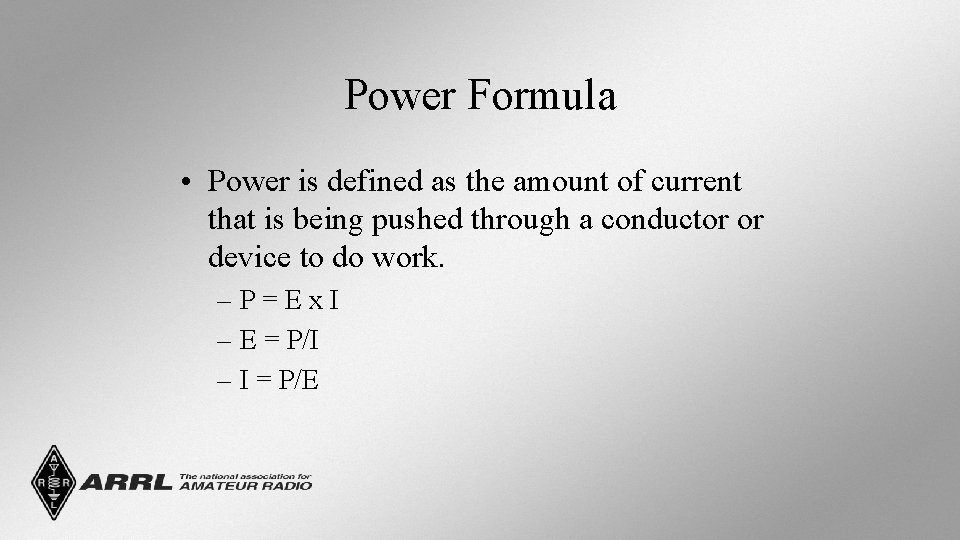
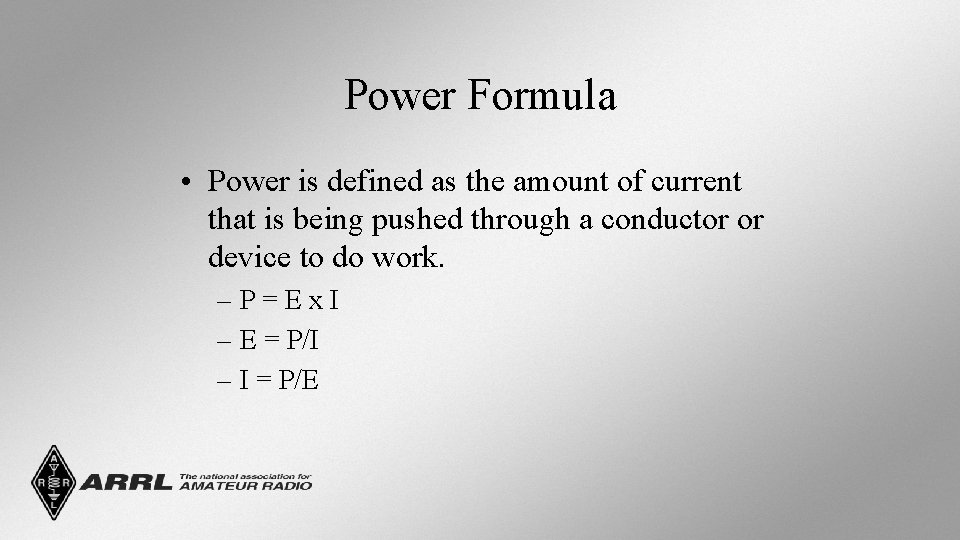
Power Formula • Power is defined as the amount of current that is being pushed through a conductor or device to do work. –P=Ex. I – E = P/I – I = P/E
Pause!
Fundamentals of Electricity • When dealing with electricity, what we are referring to is the flow of electrons through a conductor. – Electrons are negatively charged atomic particles. • The opposite charge is the positive charge – A conductor is a material that allows electrons to move with relative freedom within the material.
Fundamentals of Electricity • In electronics and radio, we control the flow of electrons to make things happen. • You need to have a basic understanding of how and why we control the flow of electrons so that you can better operate your radio.
Basic Characteristics of Electricity • There are three characteristics of electricity: – Voltage – Current – Resistance • All three must be present for electrons to flow.
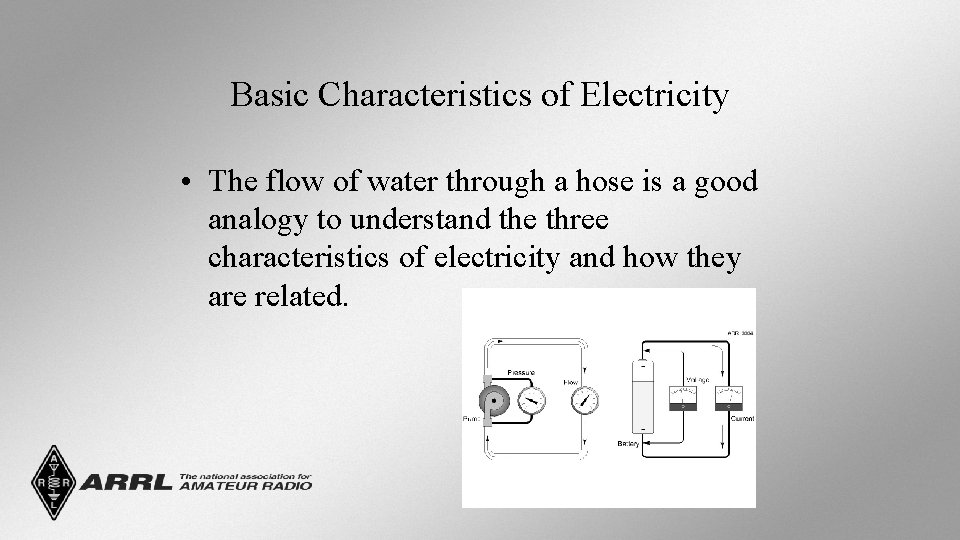
Basic Characteristics of Electricity • The flow of water through a hose is a good analogy to understand the three characteristics of electricity and how they are related.
The Electric Circuit: An Electronic Roadmap • For current to flow, there must be a path from one side of the source of the current to the other side of the source – this path is called a circuit. – There must be a hose (conductive path) through which the water (current) can flow. • The following are some vocabulary words that help describe an electronic circuit.
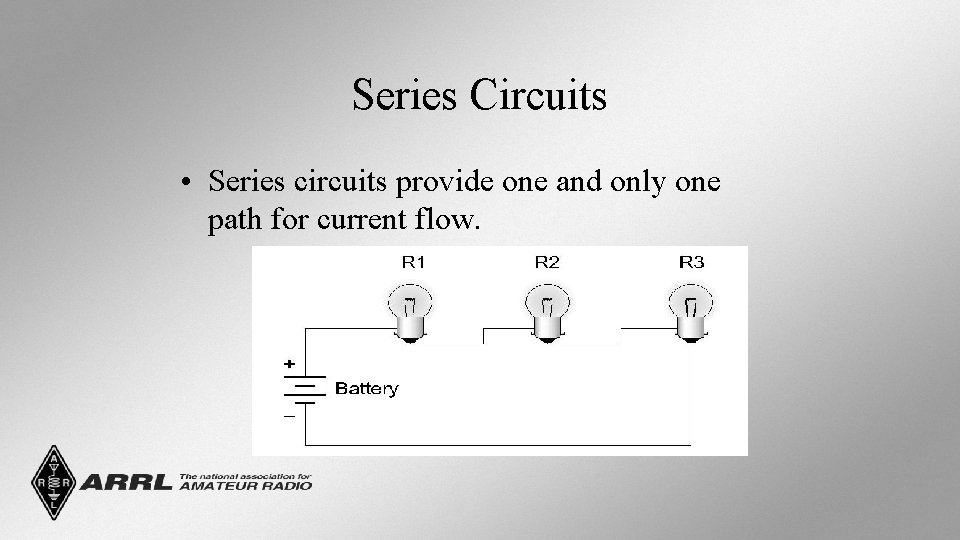
Series Circuits • Series circuits provide one and only one path for current flow.
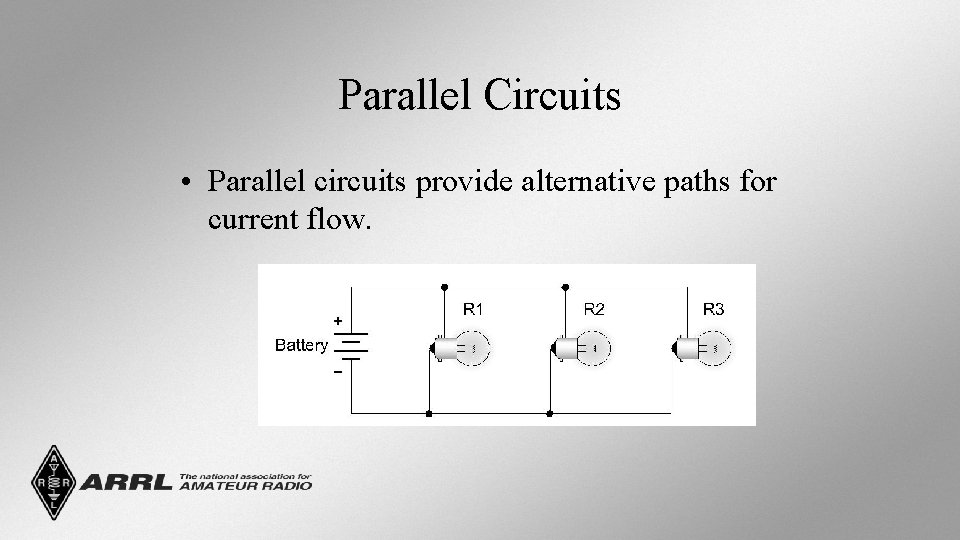
Parallel Circuits • Parallel circuits provide alternative paths for current flow.
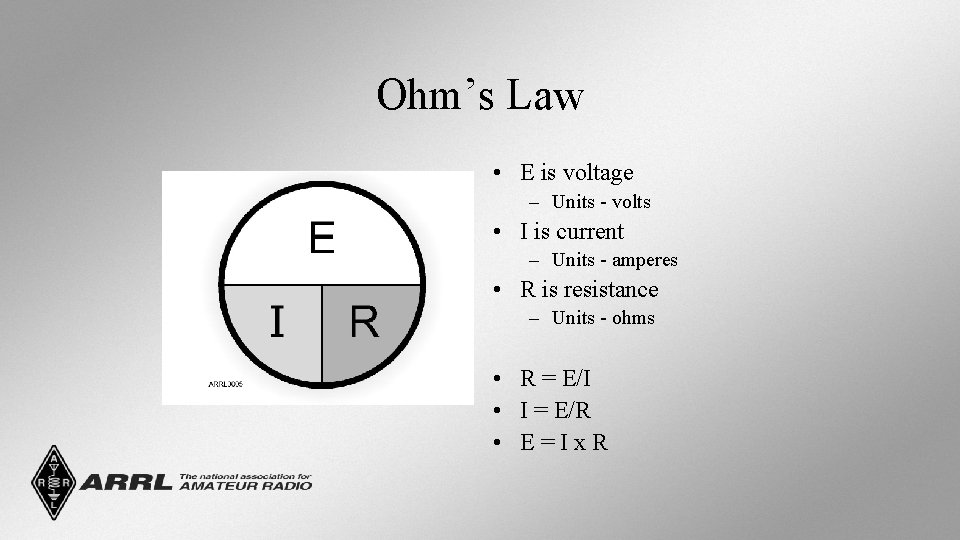
Ohm’s Law • E is voltage – Units - volts • I is current – Units - amperes • R is resistance – Units - ohms • R = E/I • I = E/R • E=Ix. R
Power Formula • Power is defined as the amount of current that is being pushed through a conductor or device to do work. –P=Ex. I – E = P/I – I = P/E
Two Basic Kinds of Current • When current flows in only one direction, it is called direct current (dc). – Batteries are a common source of dc. – Most electronic devices are powered by dc. • When current flows alternatively in one direction then in the opposite direction, it is called alternating current (ac). – Your household current is ac.