
Ham Radio Extra Class License Day 5 Noji
![Frequency modulation analyzed (for your education only) = Acos[2πfct + 2πfΔ m(s)ds] y(t) =](https://slidetodoc.com/presentation_image_h2/7c14401355439bc54a8247b7036d49eb/image-15.jpg "Frequency modulation analyzed (for your education only) = Acos[2πfct + 2πfΔ m(s)ds] y(t) =")
- Slides: 41
Ham Radio Extra Class License Day 5 Noji Ratzlaff KNØJI noji. com/hamradio Copyright © 2021 Noji Ratzlaff
Ham. Study progress Show me Copyright © 2021 Noji Ratzlaff
What we plan to accomplish today Cover • E 8 : Signals and emissions • E 3 : Radio wave propagation • EØ : Safety Copyright © 2021 Noji Ratzlaff
E 8 : Signals and emissions Electromagnetic waves AC waveforms and measurement Frequency modulation Digital signals Copyright © 2021 Noji Ratzlaff
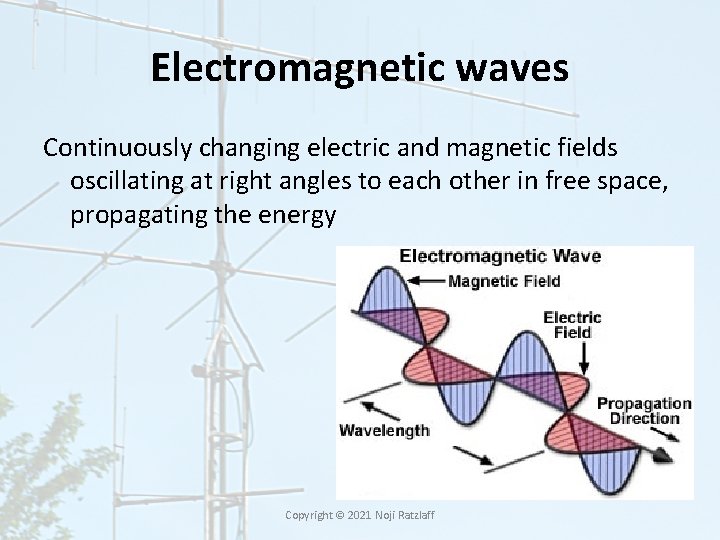
Electromagnetic waves Continuously changing electric and magnetic fields oscillating at right angles to each other in free space, propagating the energy Copyright © 2021 Noji Ratzlaff
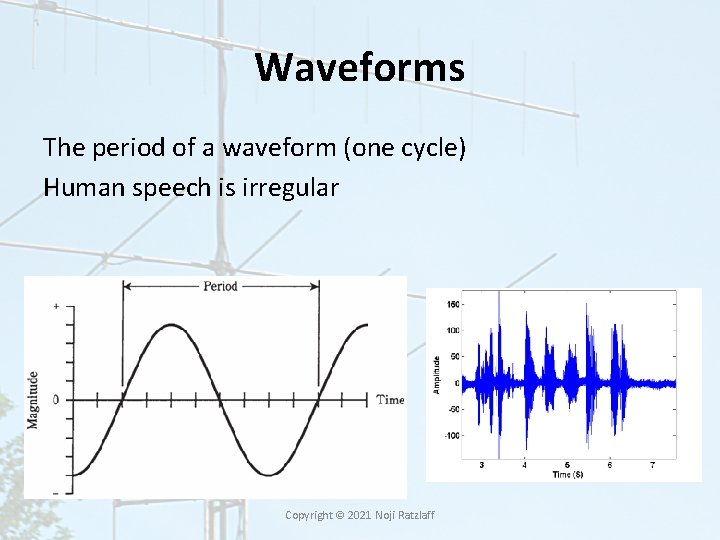
Waveforms The period of a waveform (one cycle) Human speech is irregular Copyright © 2021 Noji Ratzlaff
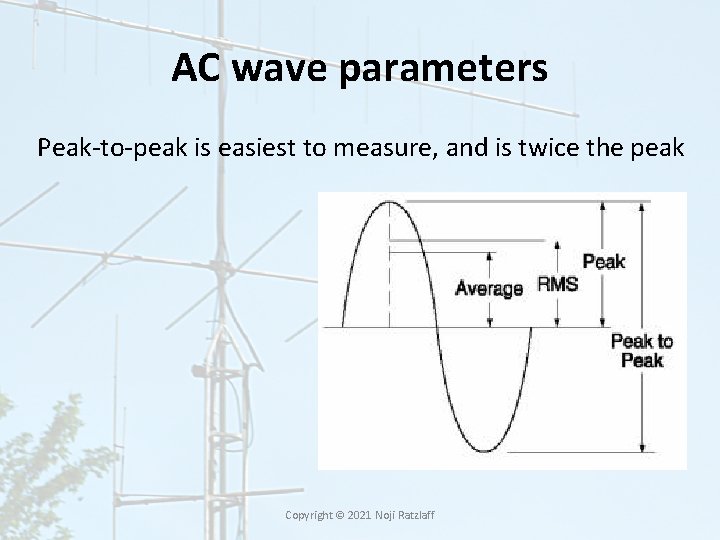
AC wave parameters Peak-to-peak is easiest to measure, and is twice the peak Copyright © 2021 Noji Ratzlaff
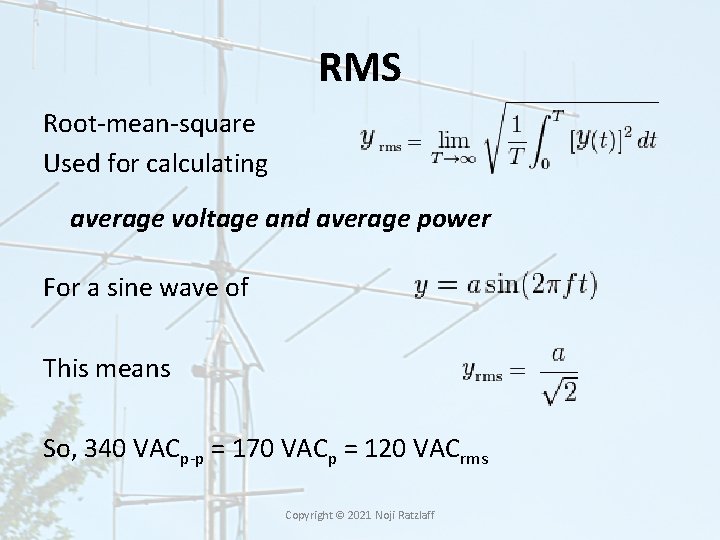
RMS Root-mean-square Used for calculating average voltage and average power For a sine wave of This means So, 340 VACp-p = 170 VACp = 120 VACrms Copyright © 2021 Noji Ratzlaff
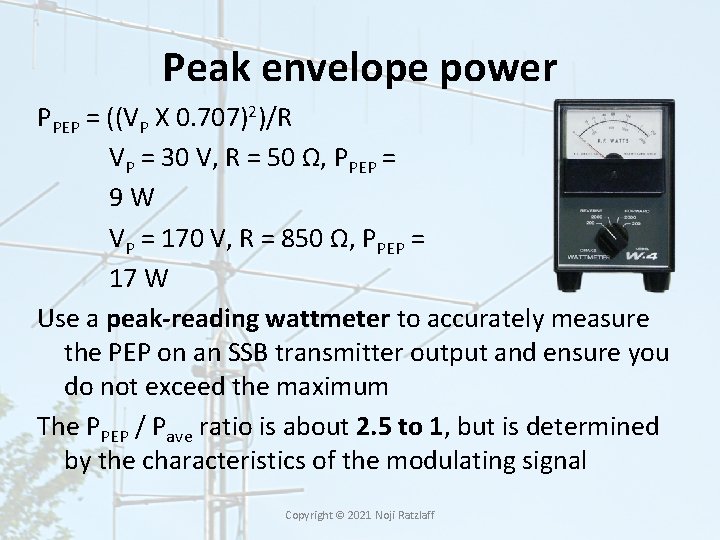
Peak envelope power PPEP = ((VP X 0. 707)2)/R VP = 30 V, R = 50 Ω, PPEP = 9 W VP = 170 V, R = 850 Ω, PPEP = 17 W Use a peak-reading wattmeter to accurately measure the PEP on an SSB transmitter output and ensure you do not exceed the maximum The PPEP / Pave ratio is about 2. 5 to 1, but is determined by the characteristics of the modulating signal Copyright © 2021 Noji Ratzlaff
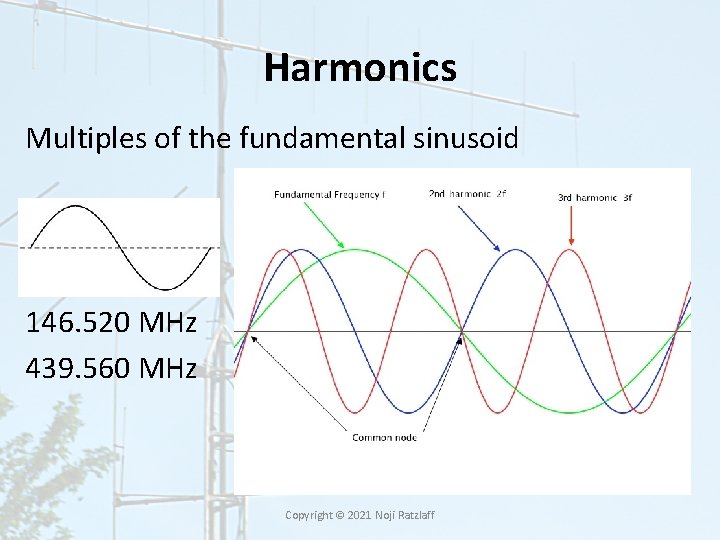
Harmonics Multiples of the fundamental sinusoid 146. 520 MHz 439. 560 MHz Copyright © 2021 Noji Ratzlaff
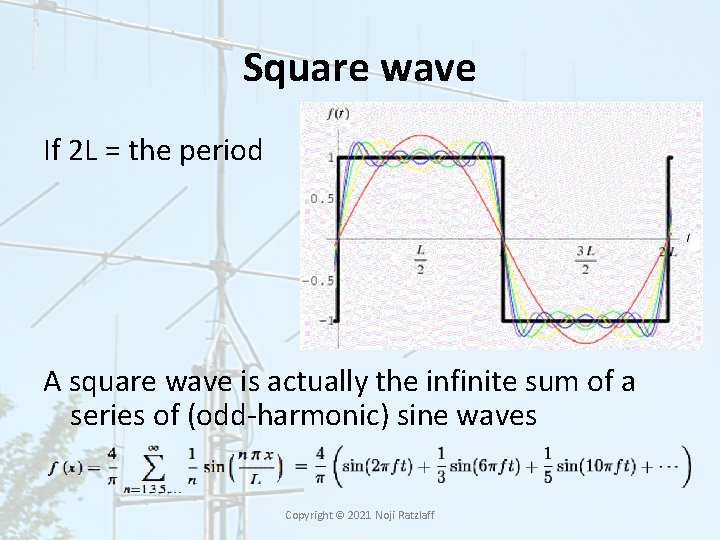
Square wave If 2 L = the period A square wave is actually the infinite sum of a series of (odd-harmonic) sine waves Copyright © 2021 Noji Ratzlaff
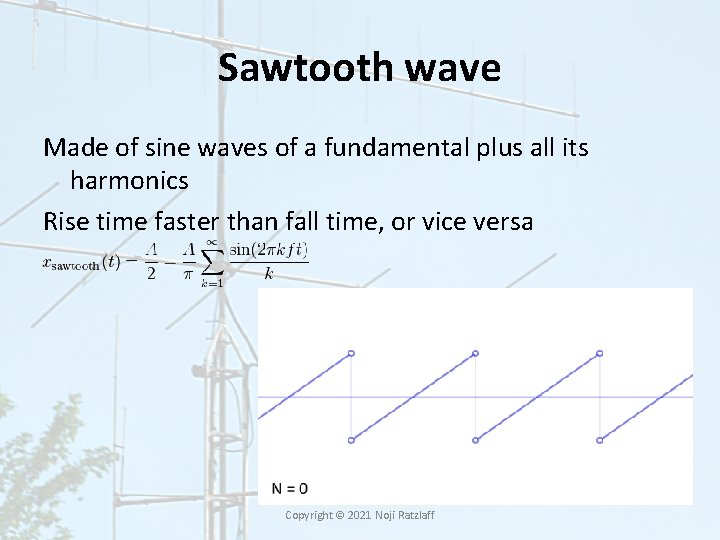
Sawtooth wave Made of sine waves of a fundamental plus all its harmonics Rise time faster than fall time, or vice versa Copyright © 2021 Noji Ratzlaff
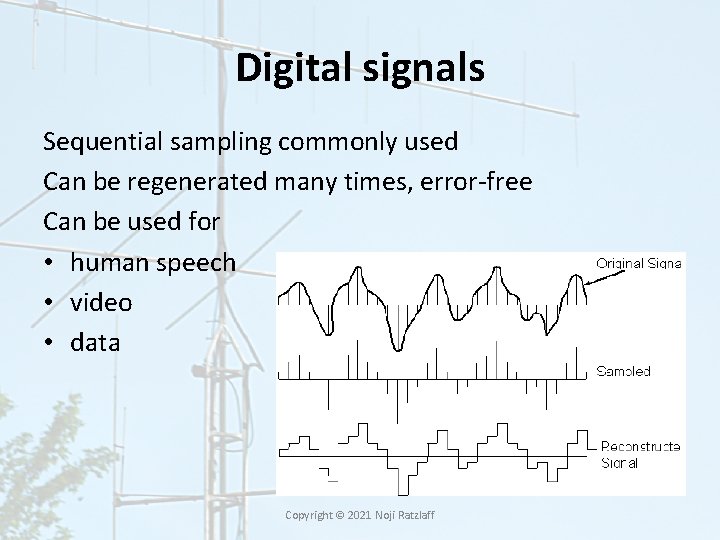
Digital signals Sequential sampling commonly used Can be regenerated many times, error-free Can be used for • human speech • video • data Copyright © 2021 Noji Ratzlaff
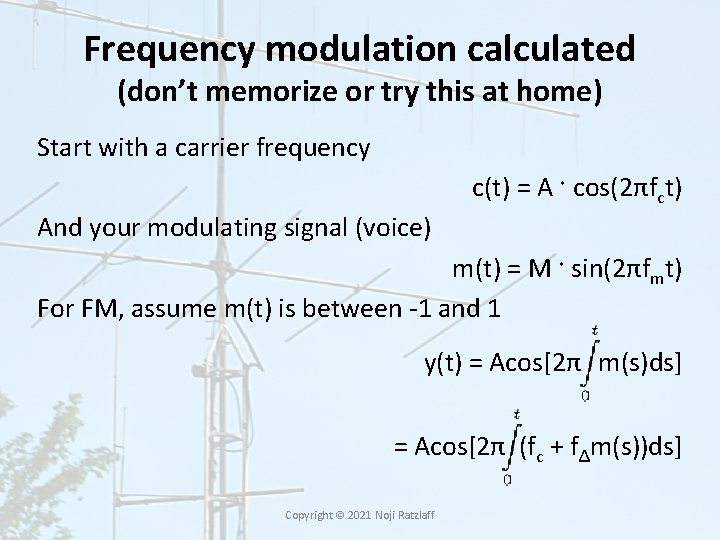
Frequency modulation calculated (don’t memorize or try this at home) Start with a carrier frequency c(t) = A · cos(2πfct) And your modulating signal (voice) m(t) = M · sin(2πfmt) For FM, assume m(t) is between -1 and 1 y(t) = Acos[2π m(s)ds] = Acos[2π (fc + fΔm(s))ds] Copyright © 2021 Noji Ratzlaff
Frequency modulation analyzed (for your education only) = Acos[2πfct + 2πfΔ m(s)ds] y(t) = Acos[2πfct + (fΔ/fm)cos(2πfmt)] In which fΔ is the deviation and fm is the modulating frequency, and the ratio fΔ/fm is the modulation index or deviation ratio Now you know all about FM Copyright © 2021 Noji Ratzlaff
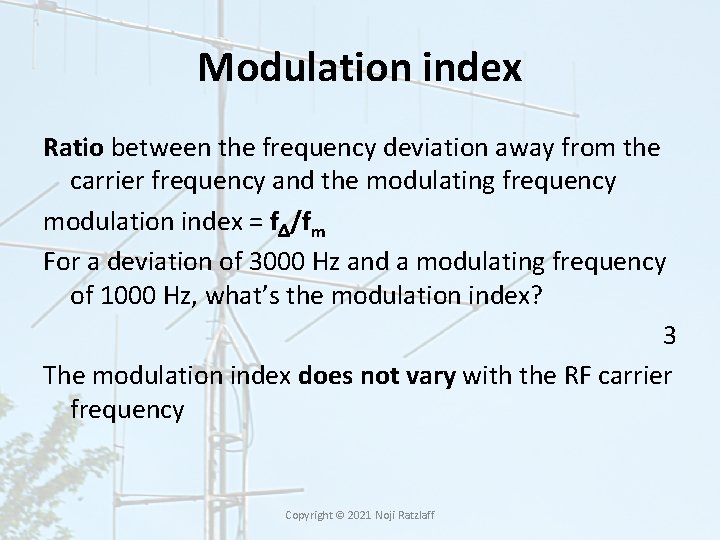
Modulation index Ratio between the frequency deviation away from the carrier frequency and the modulating frequency modulation index = fΔ/fm For a deviation of 3000 Hz and a modulating frequency of 1000 Hz, what’s the modulation index? 3 The modulation index does not vary with the RF carrier frequency Copyright © 2021 Noji Ratzlaff
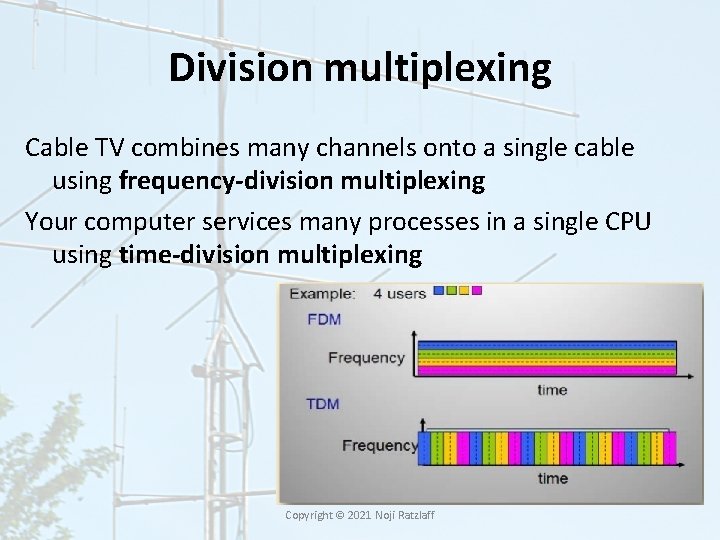
Division multiplexing Cable TV combines many channels onto a single cable using frequency-division multiplexing Your computer services many processes in a single CPU using time-division multiplexing Copyright © 2021 Noji Ratzlaff
Digital codes Baudot uses five bits per character, plus two characters for shift codes ASCII uses seven or eight bits per character ASCII can transmit uppercase and lowercase Parity can be used with an ASCII stream to detect some types of errors Copyright © 2021 Noji Ratzlaff
Digital code bandwidth Morse code bandwidth ≈ 4 X word rate Limit PSK 31 bandwidth by sinusoidal pulses ASCII bandwidth ≈ shift + (rate X 1. 1) What BW for 300 -baud and 170 Hz shift? 500 Hz What BW for 9600 -baud and 4800 Hz shift? 15. 36 k. Hz Copyright © 2021 Noji Ratzlaff
Spread-spectrum revisited Frequency-hopping changes the transmitted signal very rapidly according to a sequence also used by the receiving station Direct-sequence uses a high-speed bit stream to shift the phase of an RF carrier Copyright © 2021 Noji Ratzlaff
E 3 : Radio wave propagation EME communication Meteor scatter Trans-equatorial, long-path, and gray-line propagation Aurora propagation Horizontal propagation and take-off angles Ground-wave propagation Copyright © 2021 Noji Ratzlaff
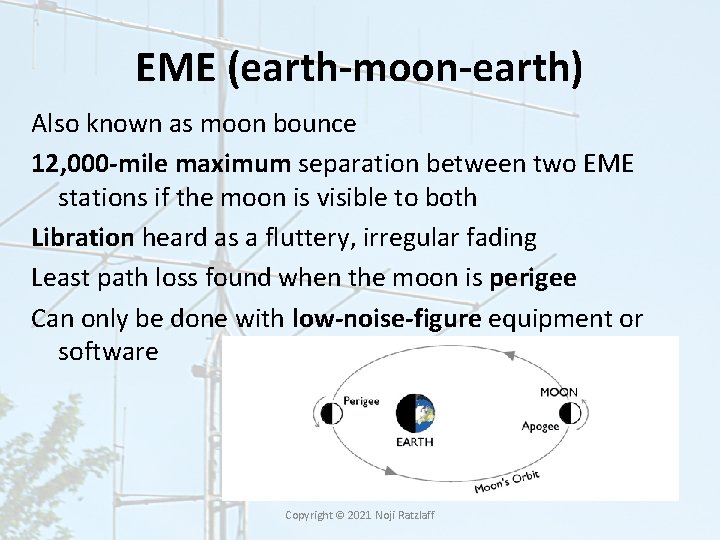
EME (earth-moon-earth) Also known as moon bounce 12, 000 -mile maximum separation between two EME stations if the moon is visible to both Libration heard as a fluttery, irregular fading Least path loss found when the moon is perigee Can only be done with low-noise-figure equipment or software Copyright © 2021 Noji Ratzlaff
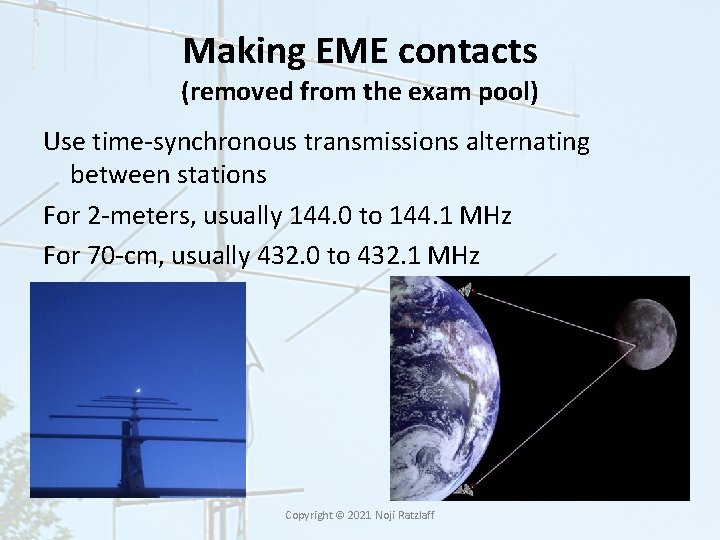
Making EME contacts (removed from the exam pool) Use time-synchronous transmissions alternating between stations For 2 -meters, usually 144. 0 to 144. 1 MHz For 70 -cm, usually 432. 0 to 432. 1 MHz Copyright © 2021 Noji Ratzlaff
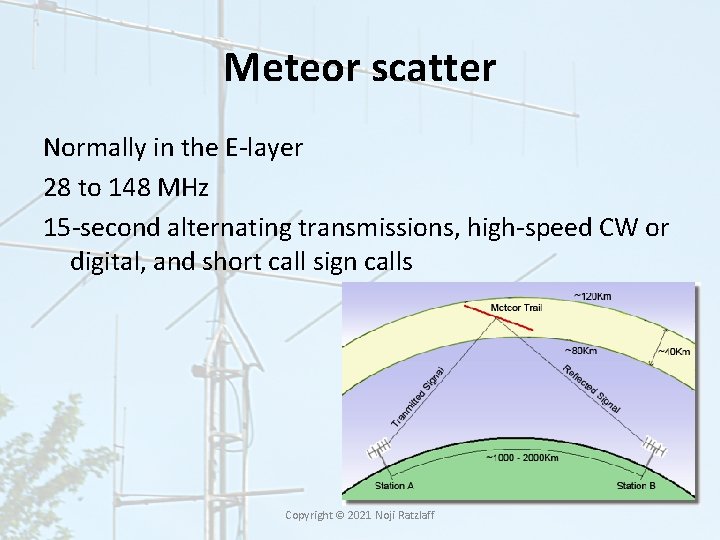
Meteor scatter Normally in the E-layer 28 to 148 MHz 15 -second alternating transmissions, high-speed CW or digital, and short call sign calls Copyright © 2021 Noji Ratzlaff
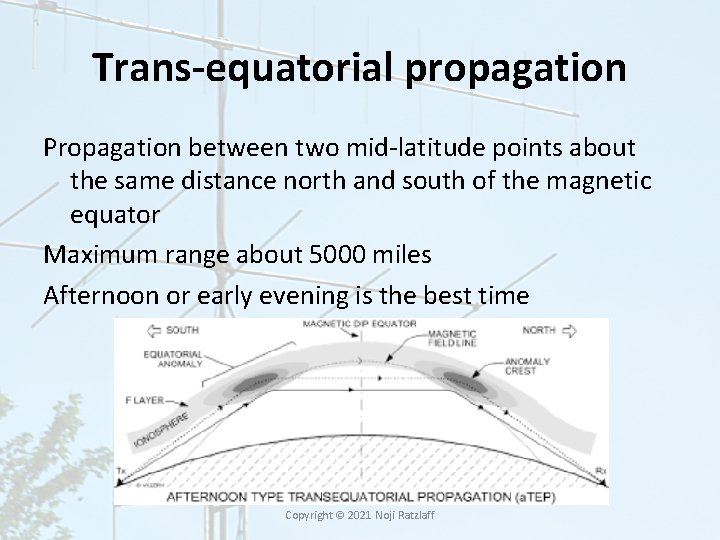
Trans-equatorial propagation Propagation between two mid-latitude points about the same distance north and south of the magnetic equator Maximum range about 5000 miles Afternoon or early evening is the best time Copyright © 2021 Noji Ratzlaff
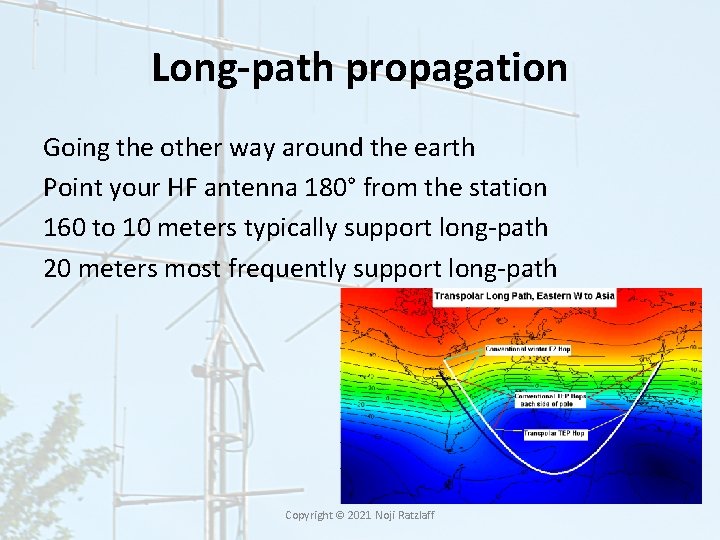
Long-path propagation Going the other way around the earth Point your HF antenna 180° from the station 160 to 10 meters typically support long-path 20 meters most frequently support long-path Copyright © 2021 Noji Ratzlaff
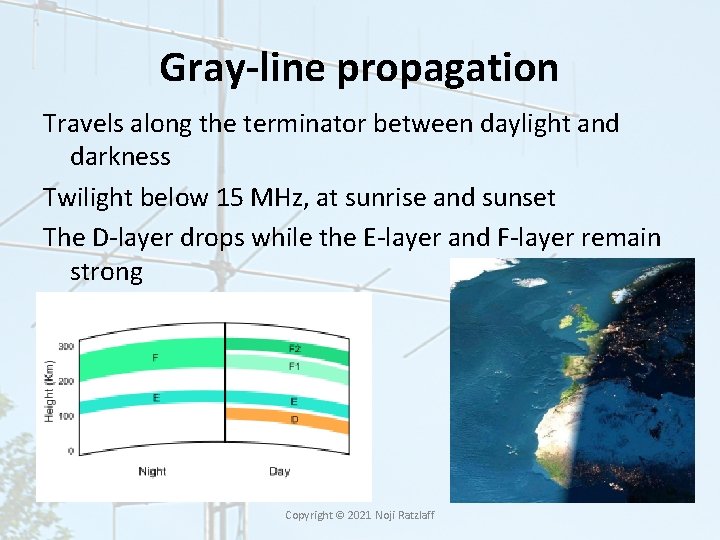
Gray-line propagation Travels along the terminator between daylight and darkness Twilight below 15 MHz, at sunrise and sunset The D-layer drops while the E-layer and F-layer remain strong Copyright © 2021 Noji Ratzlaff
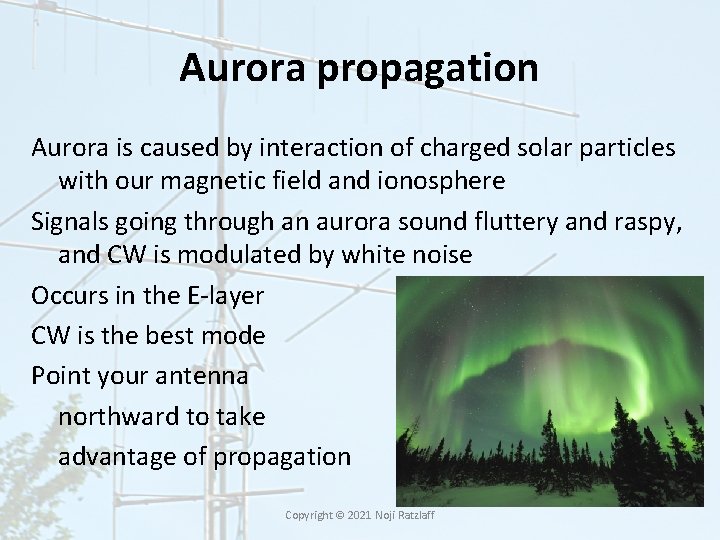
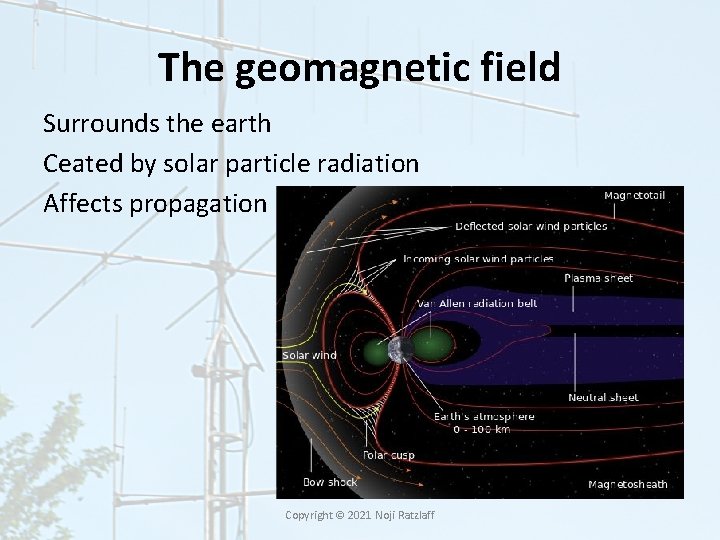
Aurora propagation Aurora is caused by interaction of charged solar particles with our magnetic field and ionosphere Signals going through an aurora sound fluttery and raspy, and CW is modulated by white noise Occurs in the E-layer CW is the best mode Point your antenna northward to take advantage of propagation Copyright © 2021 Noji Ratzlaff
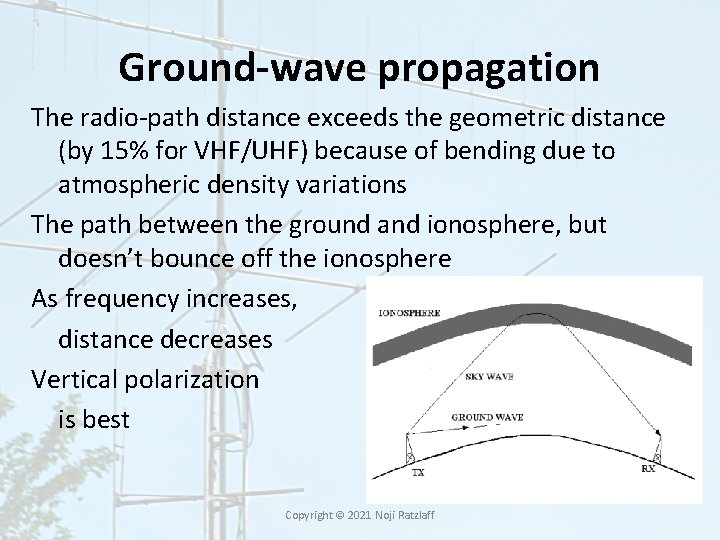
Ground-wave propagation The radio-path distance exceeds the geometric distance (by 15% for VHF/UHF) because of bending due to atmospheric density variations The path between the ground and ionosphere, but doesn’t bounce off the ionosphere As frequency increases, distance decreases Vertical polarization is best Copyright © 2021 Noji Ratzlaff
The geomagnetic field Surrounds the earth Ceated by solar particle radiation Affects propagation Copyright © 2021 Noji Ratzlaff
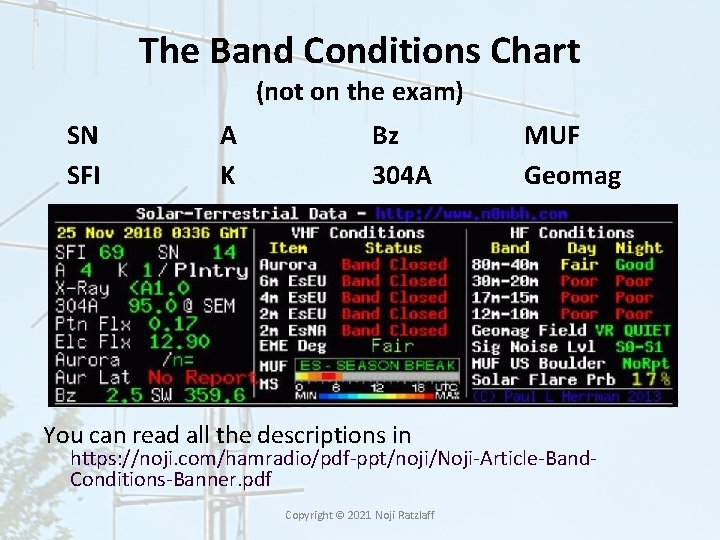
The Band Conditions Chart (not on the exam) SN SFI A K Bz 304 A You can read all the descriptions in MUF Geomag https: //noji. com/hamradio/pdf-ppt/noji/Noji-Article-Band. Conditions-Banner. pdf Copyright © 2021 Noji Ratzlaff
EØ : Safety RF radiation hazards Safe practices Hazardous materials Copyright © 2021 Noji Ratzlaff
Radiation exposure Radioactivity vs. RF radiation RF has less energy, while RA materials emit ionizing radiation Use an antenna modeling to calculate the field strength of your station Using microwaves with high-gain antennas can result in high exposure levels Copyright © 2021 Noji Ratzlaff
Exposure limits MPE maximum permissible exposure Controlled vs. uncontrolled limits Controlled : within your property Uncontrolled : otherwise Defined by separate electric and magnetic field limits because the human body reacts to both, but their intensity peaks can vary by location Copyright © 2021 Noji Ratzlaff
Radiation mitigation Each operator and licensee whose transmitter produces 5% of the MPE must mitigate when multiple operators are running multiple transmitters simultaneously SAR (specific absorption rate) measures absorbed RF energy Copyright © 2021 Noji Ratzlaff
Some hazardous materials Beryllium oxide Thermal conductors for some electronic devices Not to be confused with thermal paste Polychlorinated Biphenyls (PCBs) High-voltage capacitors and transformers Carbon monoxide Emergency generator Only be detected with a CO detector Copyright © 2021 Noji Ratzlaff
End of Day 5 Your homework: Master E 3, EØ, Practice Test on Ham. Study Register for an exam PIN See you at the exam session…good luck! Copyright © 2021 Noji Ratzlaff
Skipped slides The slides that follow were removed from the main presentation in the interest of time, but are included here for future consideration or to augment your study of the applicable subelements Copyright © 2021 Noji Ratzlaff
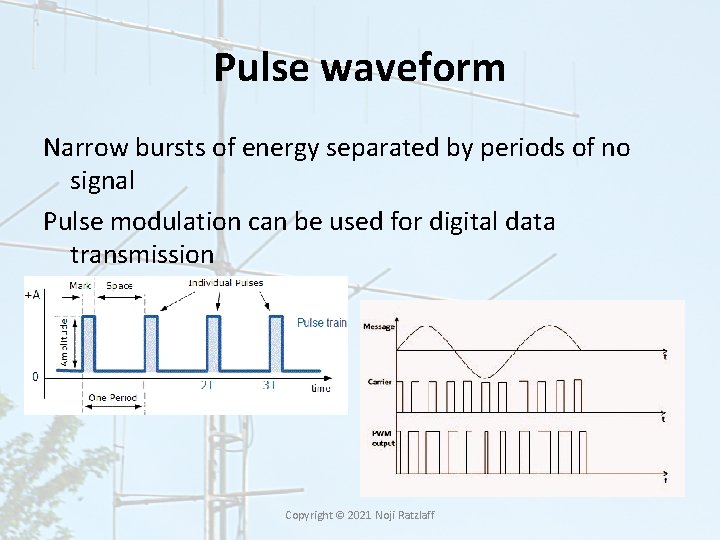
Pulse waveform Narrow bursts of energy separated by periods of no signal Pulse modulation can be used for digital data transmission Copyright © 2021 Noji Ratzlaff
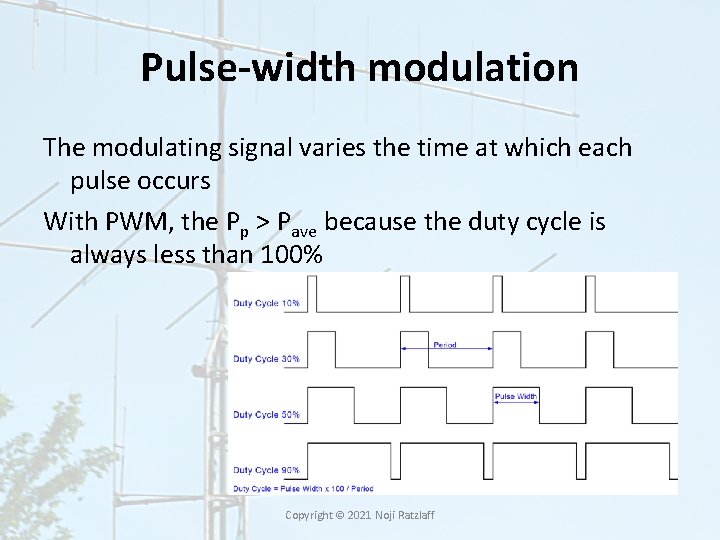
Pulse-width modulation The modulating signal varies the time at which each pulse occurs With PWM, the Pp > Pave because the duty cycle is always less than 100% Copyright © 2021 Noji Ratzlaff
Other propagation notes Name of the high-angle HF propagation in F 2 Pedersen Ray Name of VHF propagation for hundreds of miles Tropospheric ducting Cancellation of some pass-band receive frequencies Selective fading Copyright © 2021 Noji Ratzlaff