
Halves Quarters and Eighths Remember the equivalent fractions
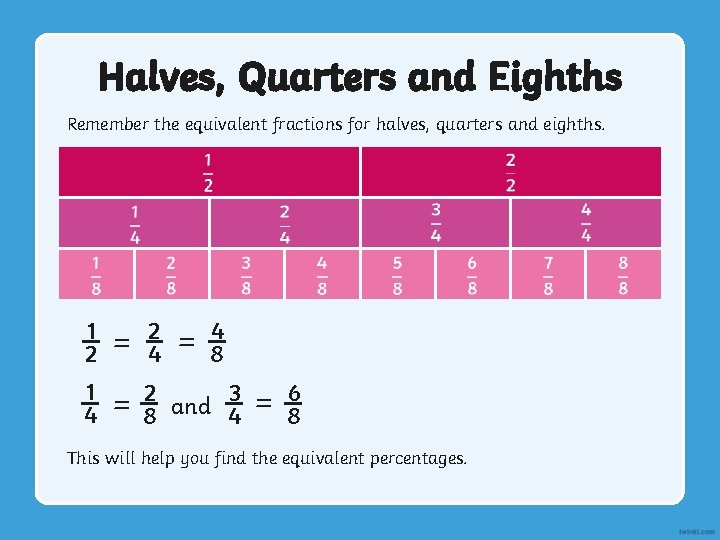
Halves, Quarters and Eighths Remember the equivalent fractions for halves, quarters and eighths. 1 2 1 4 = 2 3 and 8 4 = 4 8 = 6 8 This will help you find the equivalent percentages.
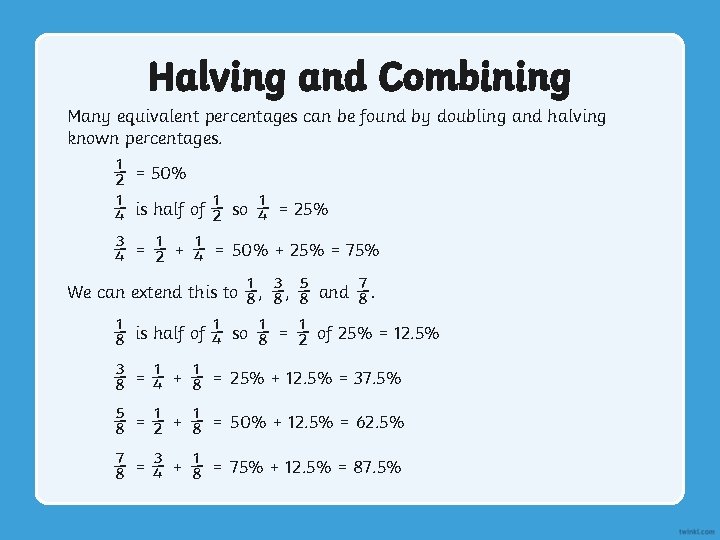
Halving and Combining Many equivalent percentages can be found by doubling and halving known percentages. ½ ¼ = 50% ¾ = is half of ½ + ¼ ½ so is half of = 25% = 50% + 25% = 75% We can extend this to ⅛ ¼ ¼ ⅛, ⅜, ⅝ so ⅛ = ½ and ⅞. of 25% = 12. 5% ⅜ =¼ + ⅛ = 25% + 12. 5% = 37. 5% ⅝ =½ + ⅛ = 50% + 12. 5% = 62. 5% ⅞ =¾ + ⅛ = 75% + 12. 5% = 87. 5%
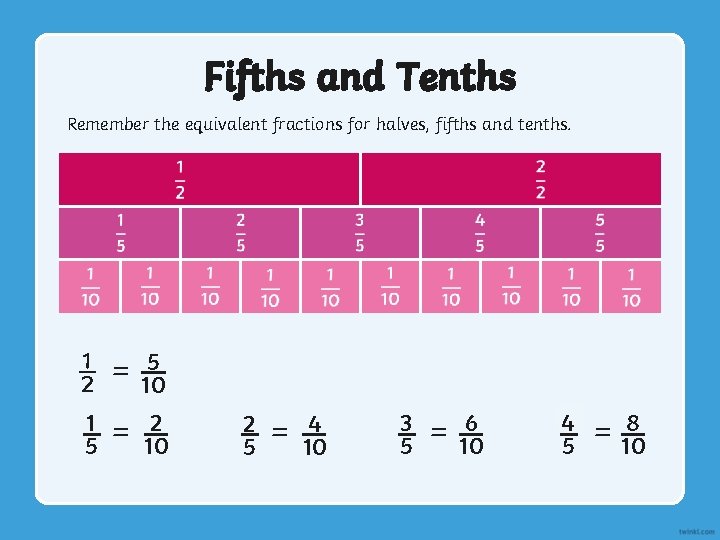
Fifths and Tenths Remember the equivalent fractions for halves, fifths and tenths. 5 ½ = 10 1 5 = 2 10 2 5 = 4 10 3 5 6 = 10 4 5 8 = 10
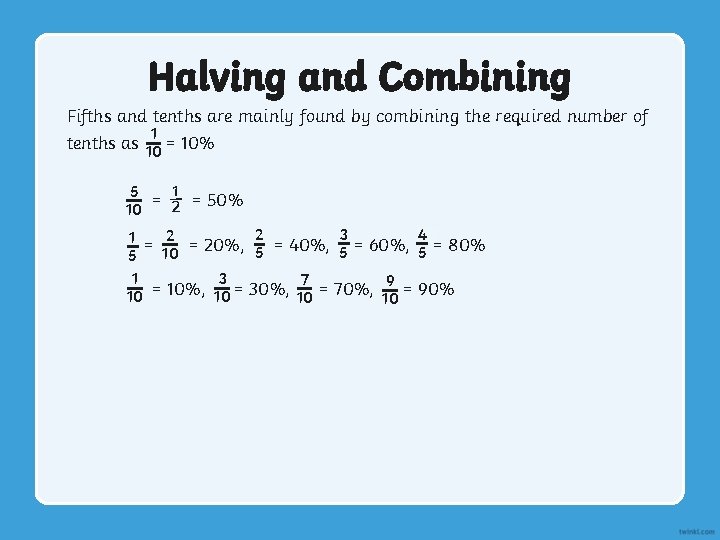
Halving and Combining Fifths and tenths are mainly found by combining the required number of 1 tenths as 10 = 10% 5 = 10 ½ = 50% 1 = 20%, 2 = 40%, 3 = 60%, 4 = 80% 5 5 5 10 5 1 3 7 9 = 10%, = 30%, = 70%, = 90% 10 10

Thirds, Sixths and Twelfths Remember the equivalent fractions for halves, thirds, sixths and twelfths. ½= 3 6 ⅓= 2 6 2 12 1 6 = 4 8 = 124 and 23 and 5 = 10 6 12 = = 4 6 = 8 12
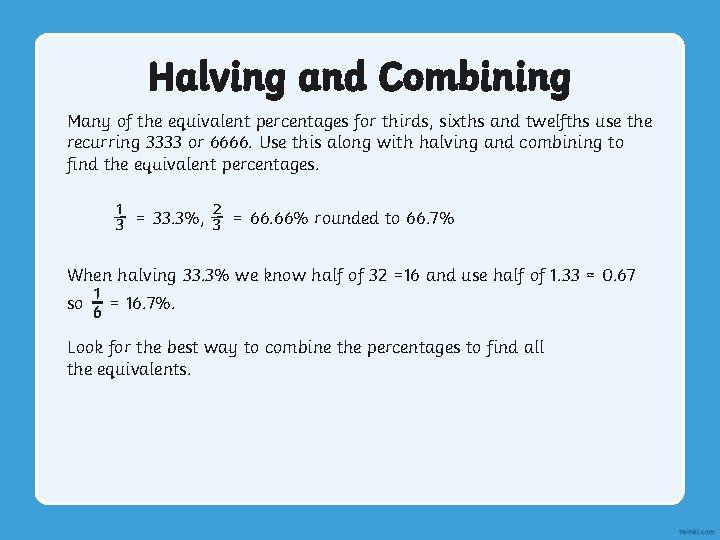
Halving and Combining Many of the equivalent percentages for thirds, sixths and twelfths use the recurring 3333 or 6666. Use this along with halving and combining to find the equivalent percentages. ⅓ = 33. 3%, ⅔ = 66. 66% rounded to 66. 7% When halving 33. 3% we know half of 32 =16 and use half of 1. 33 ≈ 0. 67 1 so 6 = 16. 7%. Look for the best way to combine the percentages to find all the equivalents.
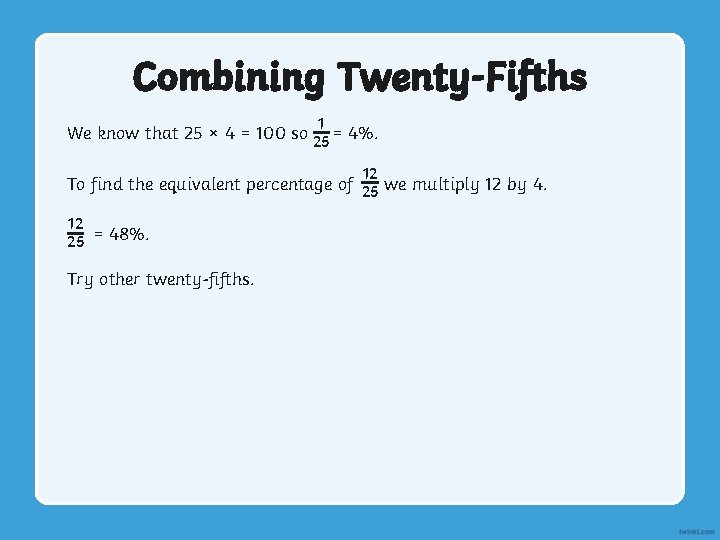
Combining Twenty-Fifths 1 We know that 25 × 4 = 100 so 25 = 4%. 12 To find the equivalent percentage of 25 we multiply 12 by 4. 12 25 = 48%. Try other twenty-fifths.
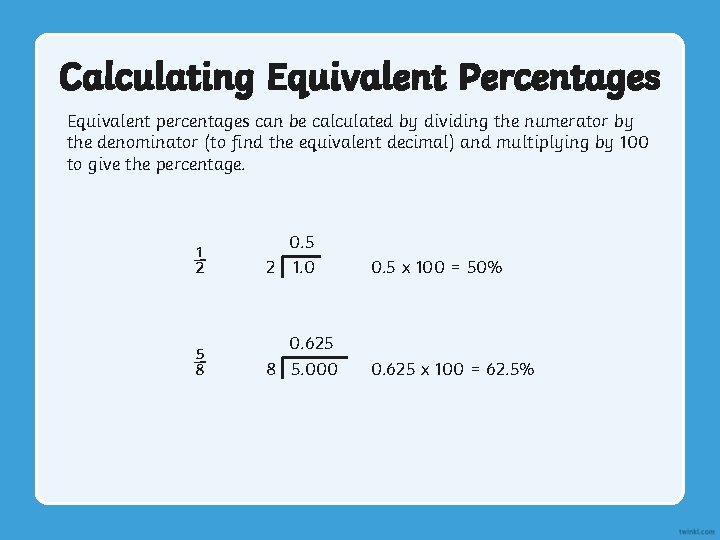
Calculating Equivalent Percentages Equivalent percentages can be calculated by dividing the numerator by the denominator (to find the equivalent decimal) and multiplying by 100 to give the percentage. ½ 0. 5 2 1. 0 0. 5 x 100 = 50% ⅝ 0. 625 8 5. 000 0. 625 x 100 = 62. 5%
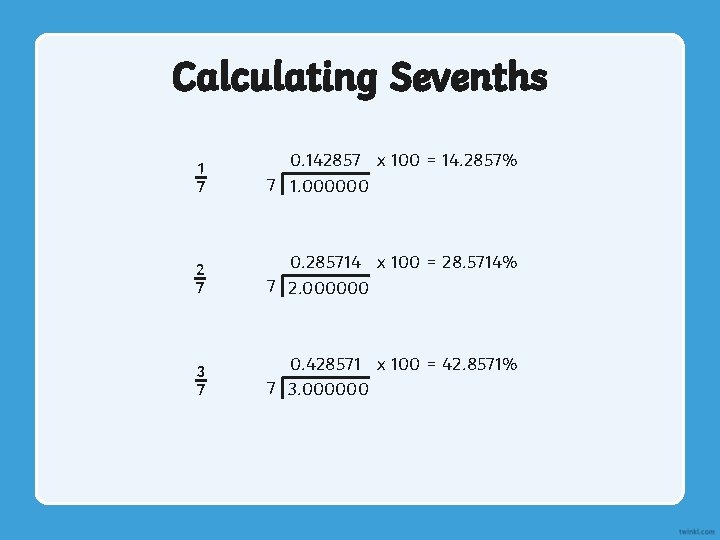
Calculating Sevenths 1 7 0. 142857 x 100 = 14. 2857% 7 1. 000000 2 7 0. 285714 x 100 = 28. 5714% 7 2. 000000 3 7 0. 428571 x 100 = 42. 8571% 7 3. 000000
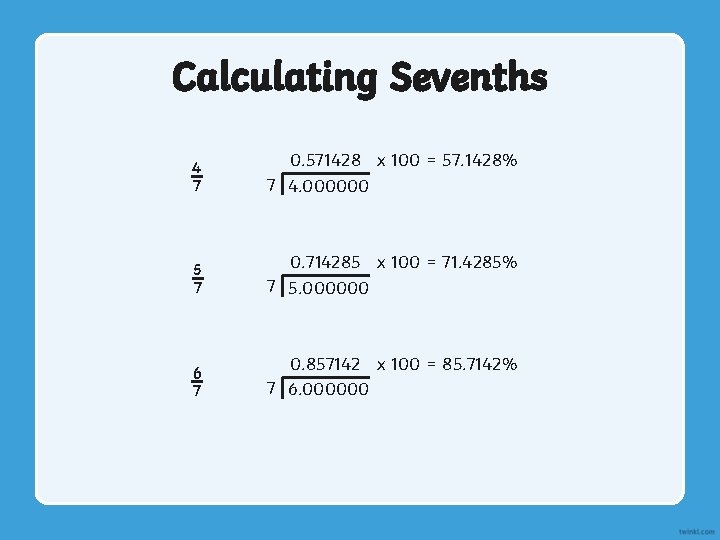
Calculating Sevenths 4 7 0. 571428 x 100 = 57. 1428% 7 4. 000000 5 7 0. 714285 x 100 = 71. 4285% 7 5. 000000 6 7 0. 857142 x 100 = 85. 7142% 7 6. 000000
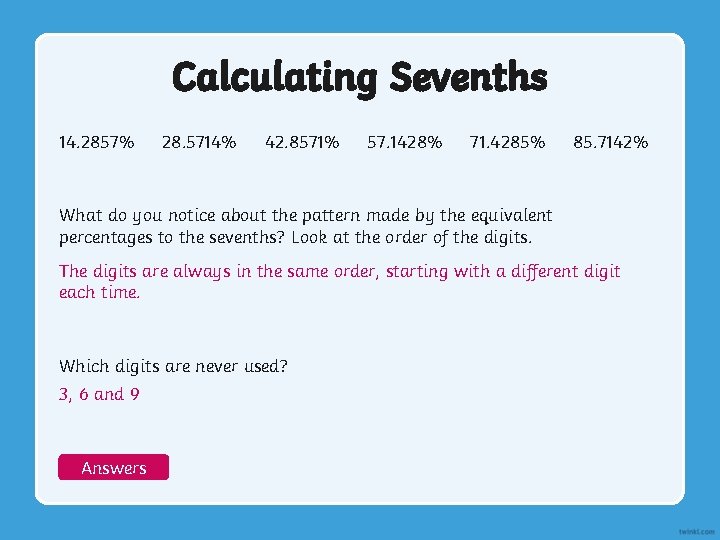
Calculating Sevenths 14. 2857% 28. 5714% 42. 8571% 57. 1428% 71. 4285% 85. 7142% What do you notice about the pattern made by the equivalent percentages to the sevenths? Look at the order of the digits. The digits are always in the same order, starting with a different digit each time. Which digits are never used? 3, 6 and 9 Answers
- Slides: 13