
HALOS AND MIRAGES REBECCA SCHMIDT ENGINEERING PHYSICS 111
HALOS AND MIRAGES REBECCA SCHMIDT ENGINEERING PHYSICS 111, 2017
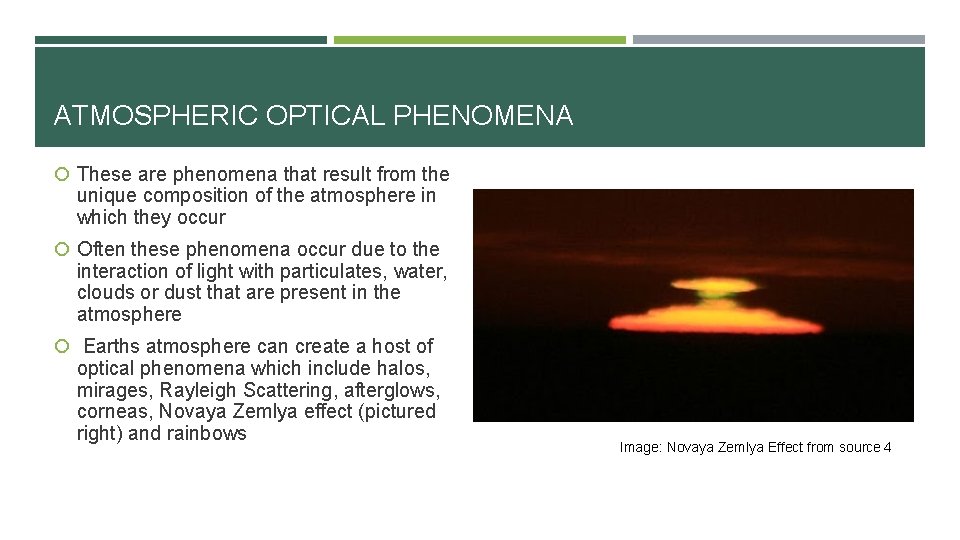
ATMOSPHERIC OPTICAL PHENOMENA These are phenomena that result from the unique composition of the atmosphere in which they occur Often these phenomena occur due to the interaction of light with particulates, water, clouds or dust that are present in the atmosphere Earths atmosphere can create a host of optical phenomena which include halos, mirages, Rayleigh Scattering, afterglows, corneas, Novaya Zemlya effect (pictured right) and rainbows Image: Novaya Zemlya Effect from source 4

MIRAGES: A BRIEF INTRO Mirages are caused by two major things, refraction of light due to different air temperatures, and the human brain assuming that light will travel in a straight line There are two major stories accounted to mirages, finding an oasis in the desert (one that keeps moving), and the flying Dutchman

MIRAGES Mirages are created by light being bent due to thermal variations and cause both distorted and displaced images, they are phenomena of atmospheric refraction The thermal variance creates layers of more and less dense air with different refraction index values There are 3 major types of mirages Inferior Superior Fata Morgana (type of superior) Image from source 12

ATMOSPHERIC REFRACTION • There is always atmospheric refraction that occurs as the atmosphere changes in composition and temperature. As the altitude increases density decreases and light rays are bent toward the earth. However, these are not normally detectable to the human eye. 8

• Superior Mirage: mirage is seen above actual object 1 • Inferior Mirage: mirage is seen below actual object and a reflection 1 SUPERIOR AND INFERIOR MIRAGES

SUPERIOR AND INFERIOR MIRAGES: THE MOST COMMON SUPERIOR MIRAGES INFERIOR MIRAGES Caused by a layer of hot air not far above Caused by a thin layer of hot air below the viewers head 6 viewers eye level 6
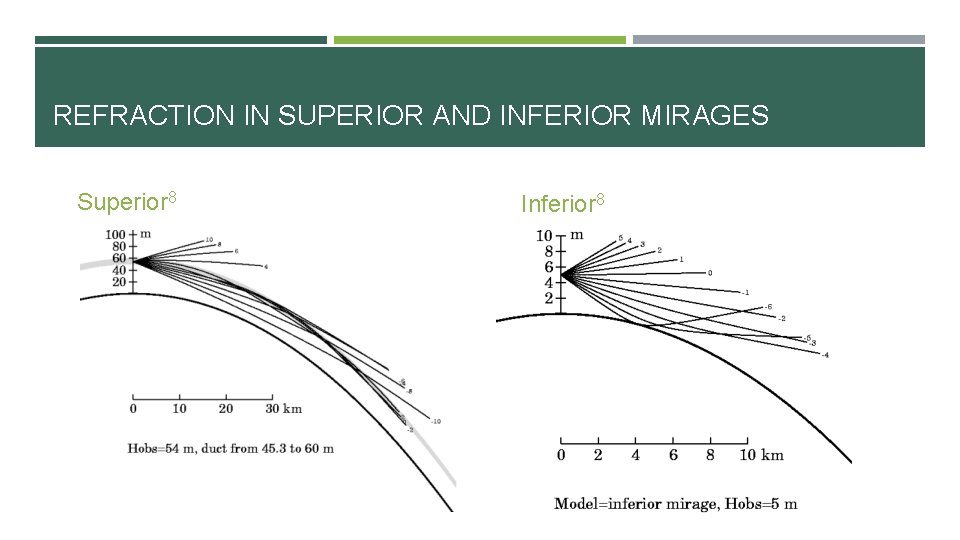
REFRACTION IN SUPERIOR AND INFERIOR MIRAGES Superior 8 Inferior 8
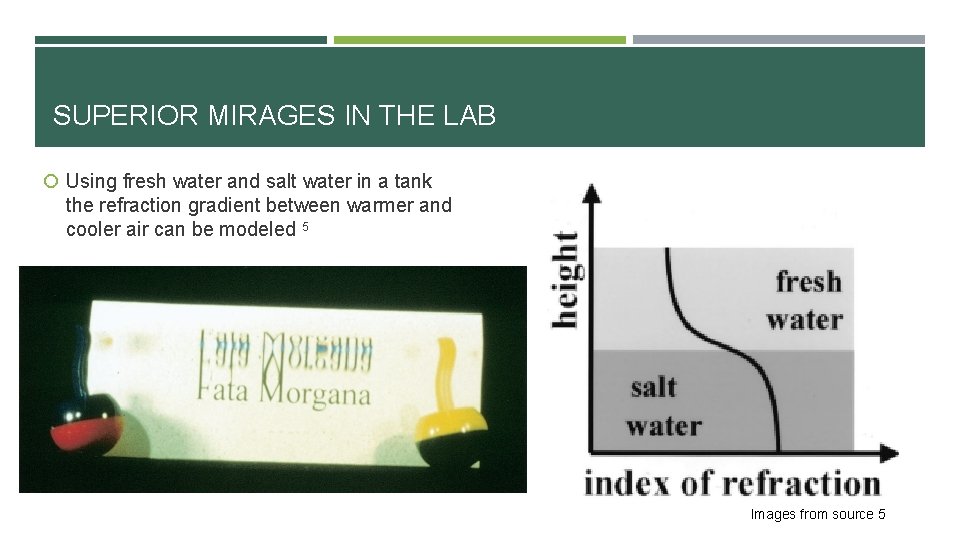
SUPERIOR MIRAGES IN THE LAB Using fresh water and salt water in a tank the refraction gradient between warmer and cooler air can be modeled 5 Images from source 5
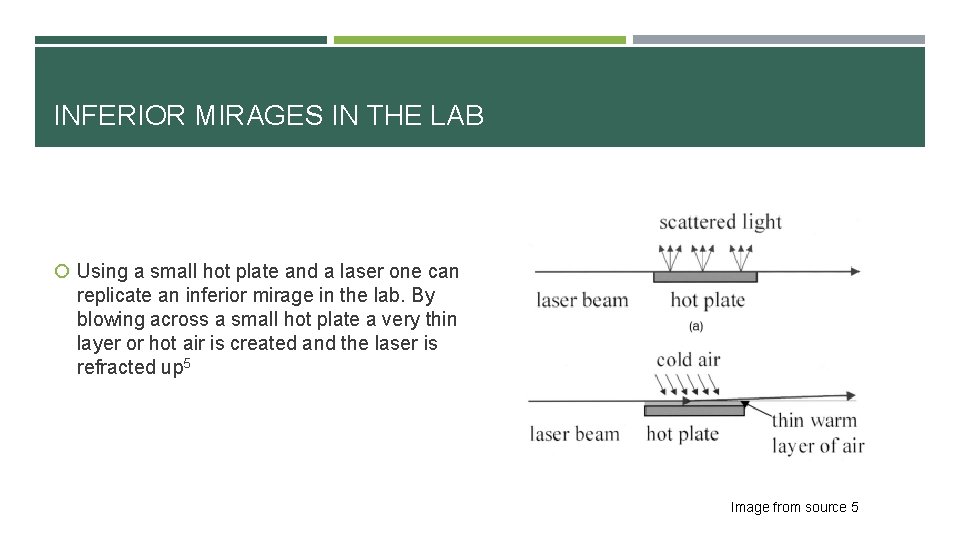
INFERIOR MIRAGES IN THE LAB Using a small hot plate and a laser one can replicate an inferior mirage in the lab. By blowing across a small hot plate a very thin layer or hot air is created and the laser is refracted up 5 Image from source 5
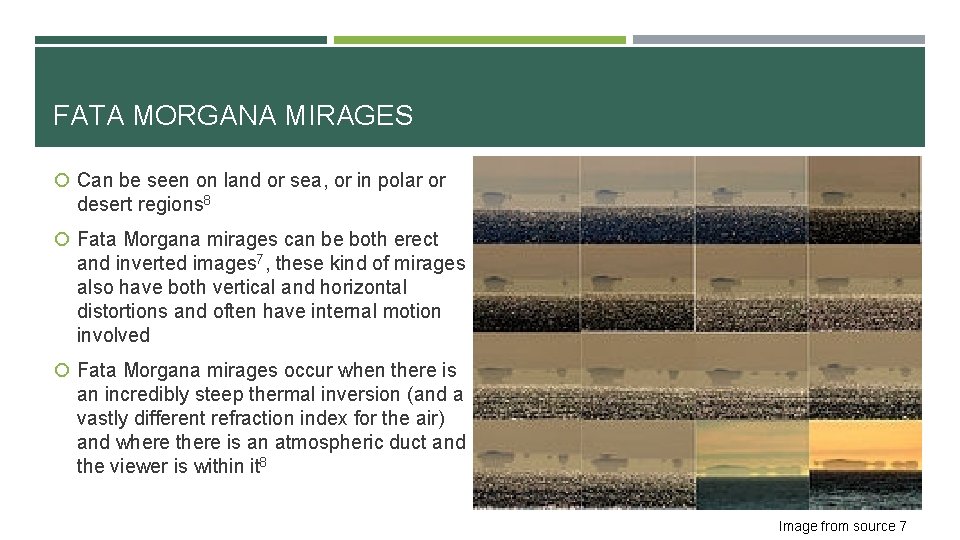
FATA MORGANA MIRAGES Can be seen on land or sea, or in polar or desert regions 8 Fata Morgana mirages can be both erect and inverted images 7, these kind of mirages also have both vertical and horizontal distortions and often have internal motion involved Fata Morgana mirages occur when there is an incredibly steep thermal inversion (and a vastly different refraction index for the air) and where there is an atmospheric duct and the viewer is within it 8 Image from source 7
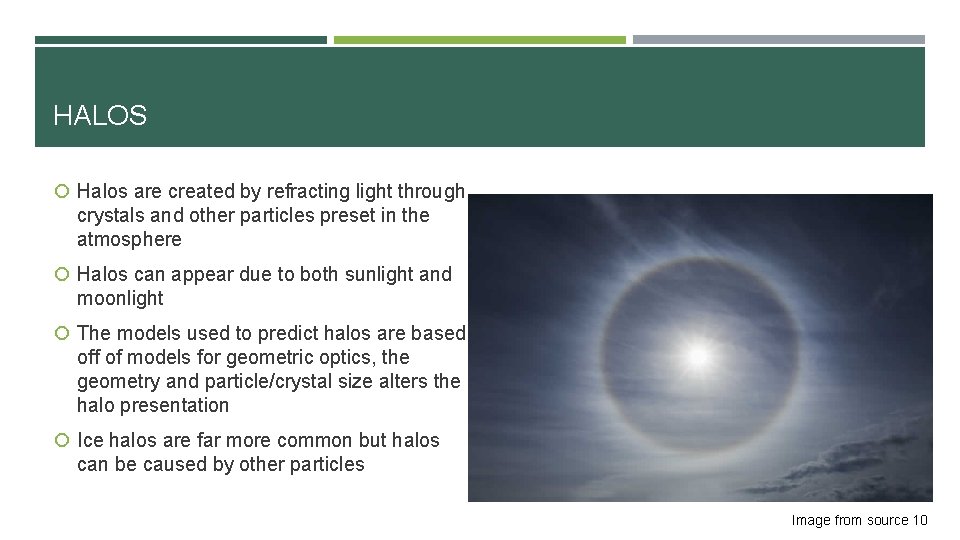
HALOS Halos are created by refracting light through crystals and other particles preset in the atmosphere Halos can appear due to both sunlight and moonlight The models used to predict halos are based off of models for geometric optics, the geometry and particle/crystal size alters the halo presentation Ice halos are far more common but halos can be caused by other particles Image from source 10
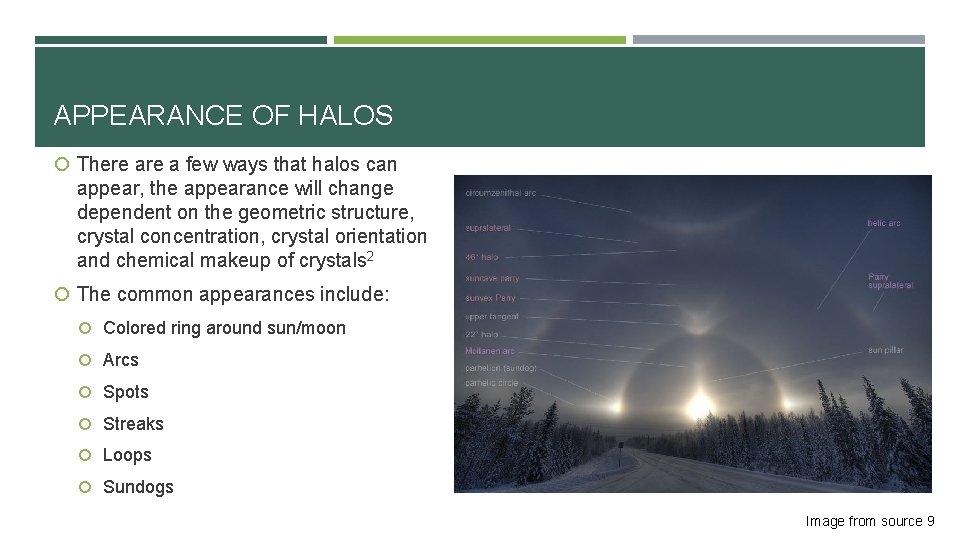
APPEARANCE OF HALOS There a few ways that halos can appear, the appearance will change dependent on the geometric structure, crystal concentration, crystal orientation and chemical makeup of crystals 2 The common appearances include: Colored ring around sun/moon Arcs Spots Streaks Loops Sundogs Image from source 9
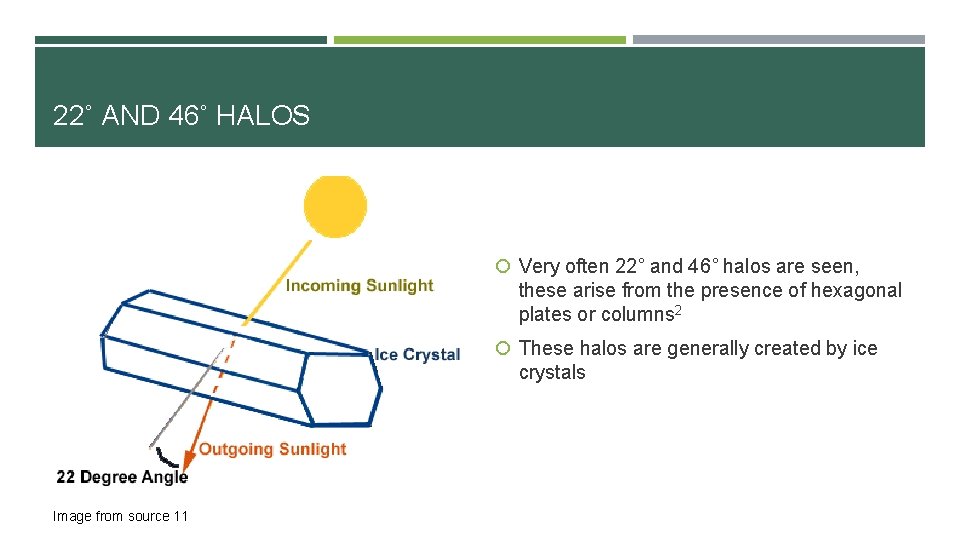
22˚ AND 46˚ HALOS Very often 22˚ and 46˚ halos are seen, these arise from the presence of hexagonal plates or columns 2 These halos are generally created by ice crystals Image from source 11
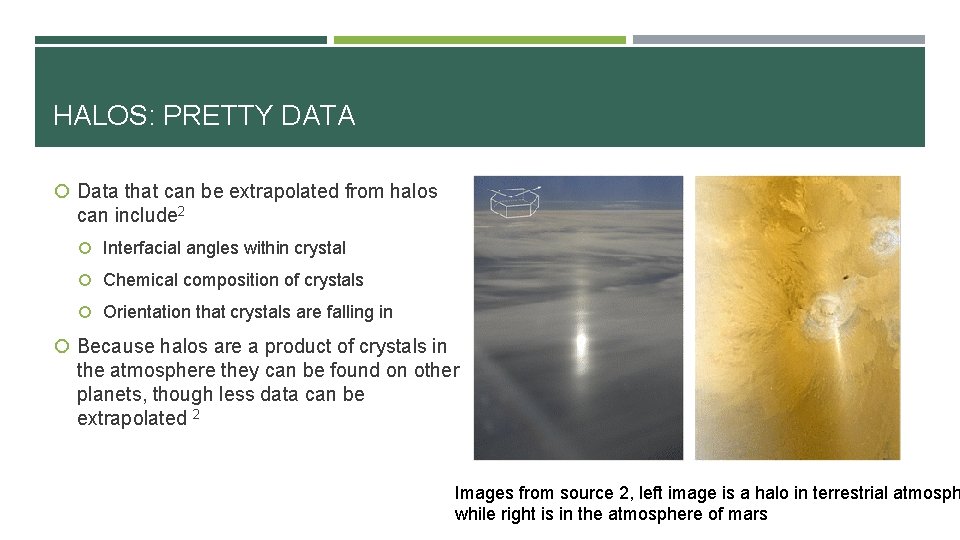
HALOS: PRETTY DATA Data that can be extrapolated from halos can include 2 Interfacial angles within crystal Chemical composition of crystals Orientation that crystals are falling in Because halos are a product of crystals in the atmosphere they can be found on other planets, though less data can be extrapolated 2 Images from source 2, left image is a halo in terrestrial atmosph while right is in the atmosphere of mars
BIBLIOGRAPHY 1. ATMOSPHERIC OPTICAL PHENOMENA. In: ATMOSPHERIC OPTICAL PHENOMENA. http: //meteorologytraining. tpub. com/14312/css/14312_153. htm. Accessed 29 May 2017 2. Gedzelman SD, Vollmer M (2008) Atmospheric Optical Phenomena and Radiative Transfer. Bulletin of the American Meteorological Society 89: 471– 485. doi: 10. 1175/bams-89 -4 -471 3. Können GP (2017) Rainbows, Halos, Coronas and Glories: Beautiful Sources of Information. Bulletin of the American Meteorological Society 98: 485– 494. doi: 10. 1175/bams-d-16 -0014. 1 4. Novaya Zemlya Effect. 5. Vollmer M, Greenler R (2003) Halo and mirage demonstrations in atmospheric optics. Applied Optics 42: 394. doi: 10. 1364/ao. 42. 000394 6. Types of Mirages. In: Types of Mirages. http: //aty. sdsu. edu/mirages/mirtypes. html. Accessed 29 May 2017 7. Fata Morgana. In: Fata Morgana. http: //aty. sdsu. edu/mirages/FM/FM. html. Accessed 29 May 2017 8. An Introduction to Mirages. In: Mirages and Green Flashes. http: //aty. sdsu. edu/mirages/mirintro. html. Accessed 29 May 2017 9. Complex Halo Display, Imgur. 10. Sickles H (2017) 22 Degree Halos. In: 22 Degree Halo • World of Phenomena. http: //www. phenomena. world/atmospheric/22 halo/. Accessed 1 Jun 2017 11. 22 Halo. In: 22 Degree Halo: a ring of light 22 degrees from the sun or moon. http: //ww 2010. atmos. uiuc. edu/(Gh)/guides/mtr/opt/ice/halo/22. rxml. Accessed 1 Jun 2017 12. EPOD - a service of USRA. In: EPOD - a service of USRA. http: //epod. usra. edu/blog/2010/03/highway-mirage. html. Accessed 1 Jun 2017
- Slides: 16