
Halogens Group 17 Seven valence electrons 1 charge
- Slides: 6
Halogens • Group 17 • Seven valence electrons • -1 charge • Gained 1 electron • Very reactive
Noble Gases • Group 18 • Octet of valence electrons. (Full valence shell) • Inert – do not react
Metalloids • B, Si, Ge, As, Sb, Te, Po Other Non-Metals • H, C, N, O, P, S, Se Other Metals Al, Ga, In, Sn, Tl, Pb, Bi
Lanthanide and Actinide Series • The Lan. Series is Period 6 • The Act. Series is Period 7 • Also known as Rare Earth Elements
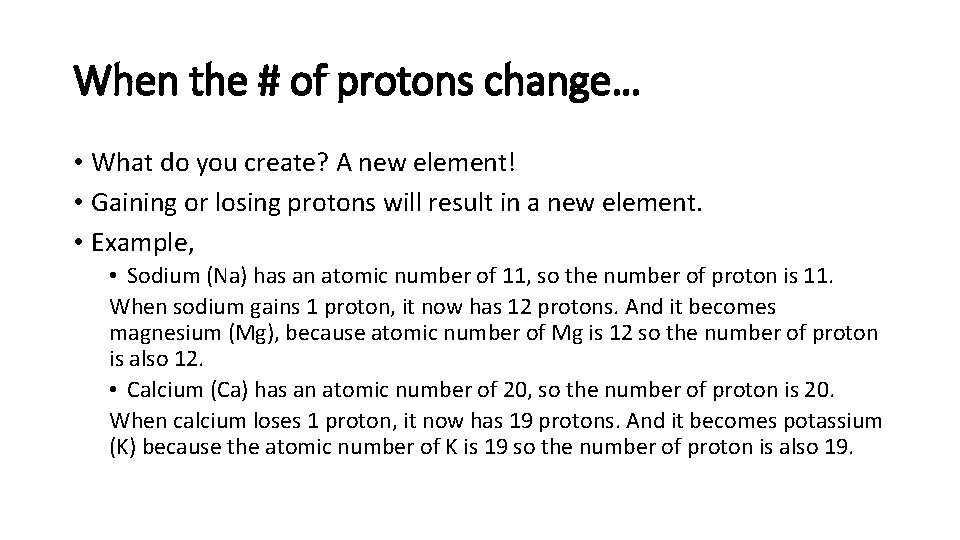
When the # of protons change… • What do you create? A new element! • Gaining or losing protons will result in a new element. • Example, • Sodium (Na) has an atomic number of 11, so the number of proton is 11. When sodium gains 1 proton, it now has 12 protons. And it becomes magnesium (Mg), because atomic number of Mg is 12 so the number of proton is also 12. • Calcium (Ca) has an atomic number of 20, so the number of proton is 20. When calcium loses 1 proton, it now has 19 protons. And it becomes potassium (K) because the atomic number of K is 19 so the number of proton is also 19.
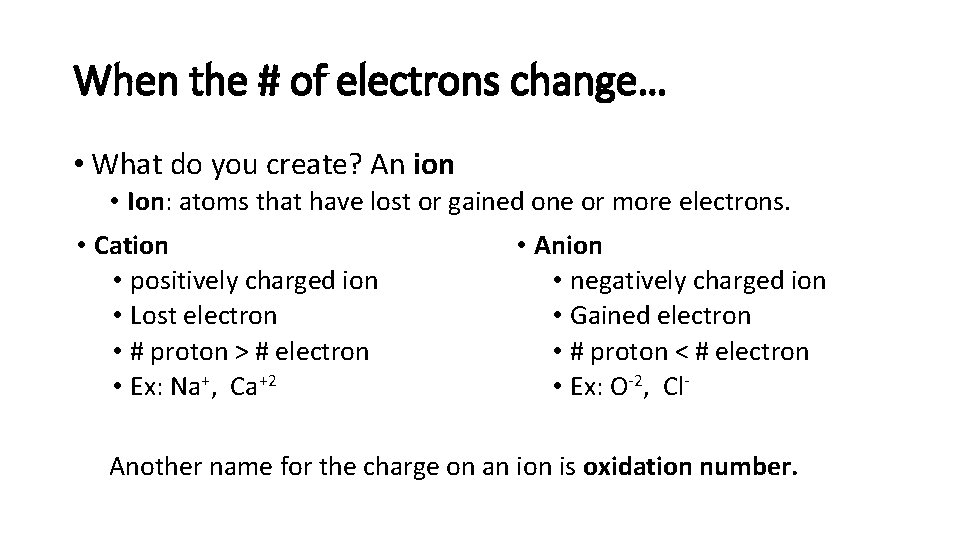
When the # of electrons change… • What do you create? An ion • Ion: atoms that have lost or gained one or more electrons. • Cation • positively charged ion • Lost electron • # proton > # electron • Ex: Na+, Ca+2 • Anion • negatively charged ion • Gained electron • # proton < # electron • Ex: O-2, Cl- Another name for the charge on an ion is oxidation number.