
Halloum Negotiation Competition Be a Lawyer Negotiation Essentials
Halloum Negotiation Competition Be a Lawyer: Negotiation Essentials Simao (Sim) J. Avila Senior Counsel Kaiser Foundation Health Plan
Agenda Negotiation Theory Short Exercise Negotiation Process Questions?
Critical Negotiation Theory
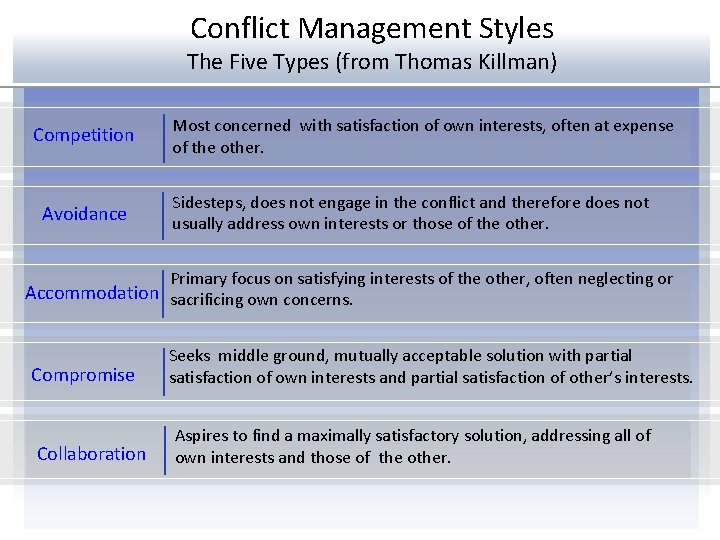
Conflict Management Styles The Five Types (from Thomas Killman) Competition Avoidance Most concerned with satisfaction of own interests, often at expense of the other. Sidesteps, does not engage in the conflict and therefore does not usually address own interests or those of the other. Primary focus on satisfying interests of the other, often neglecting or Accommodation sacrificing own concerns. Compromise Collaboration Seeks middle ground, mutually acceptable solution with partial satisfaction of own interests and partial satisfaction of other’s interests. Aspires to find a maximally satisfactory solution, addressing all of own interests and those of the other.

Conflict Management Styles The Five Types (from Thomas Killman) Competition Avoidance Accommodation Compromise Collaboration Learning About Our Tendencies in Conflict, While Understanding That We All Have and Use All of These Styles to Different Degrees in Different Moments

Collaborative vs. Adversarial Collaborative/Interest-Based • Focus on mutual gain • Seek underlying needs • Joint problem solvers • Separate the people from “the problem” • Share information • Build relationship • Invent multiple options • Use objective criteria and principled approach Adversarial/Positional • Focus on maximizing own gain • Stay at position level • View other as “opponent” • Attack people rather than “the problem” • Guard/Withhold information • Discount relationship or willing to sacrifice it in competition • Drive for desired outcome • More likely to use negative leverage
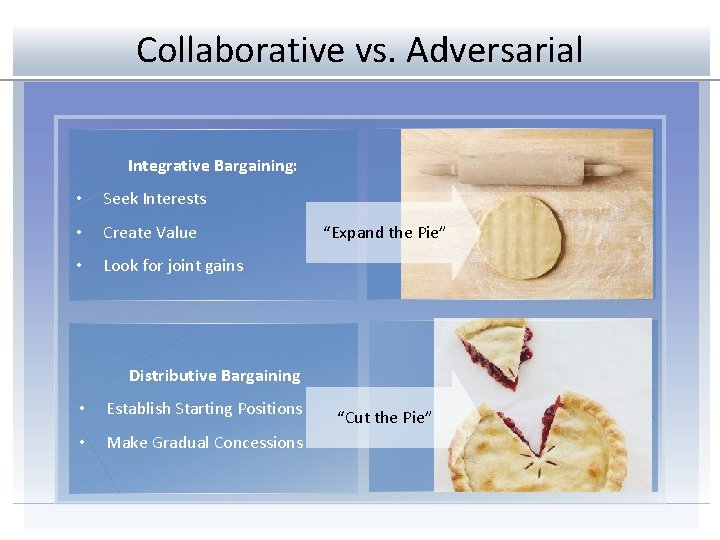
Collaborative vs. Adversarial Integrative Bargaining: • Seek Interests • Create Value • Look for joint gains “Expand the Pie” Distributive Bargaining • Establish Starting Positions • Make Gradual Concessions “Cut the Pie”
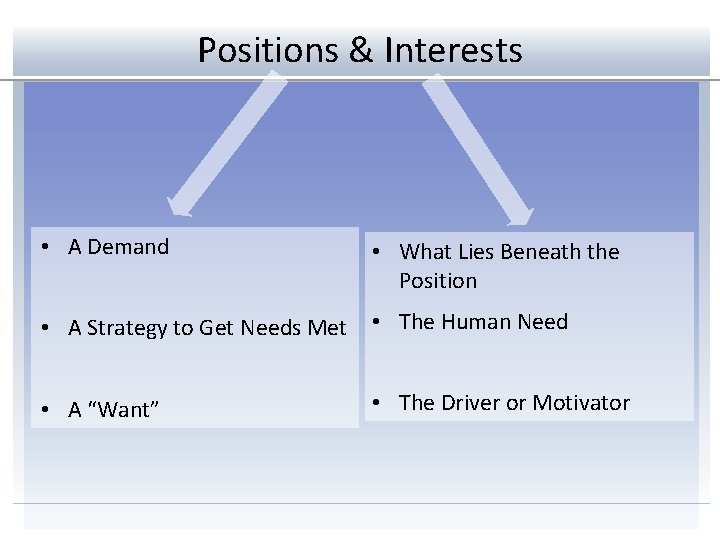
Positions & Interests • A Demand • What Lies Beneath the Position • A Strategy to Get Needs Met • The Human Need • A “Want” • The Driver or Motivator
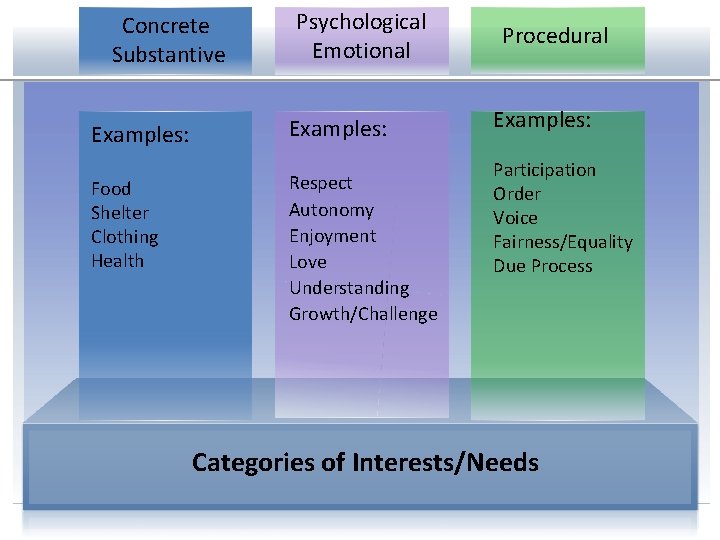
Concrete Substantive Examples: Food Shelter Clothing Health Psychological Emotional Examples: Respect Autonomy Enjoyment Love Understanding Growth/Challenge Procedural Examples: Participation Order Voice Fairness/Equality Due Process Categories of Interests/Needs
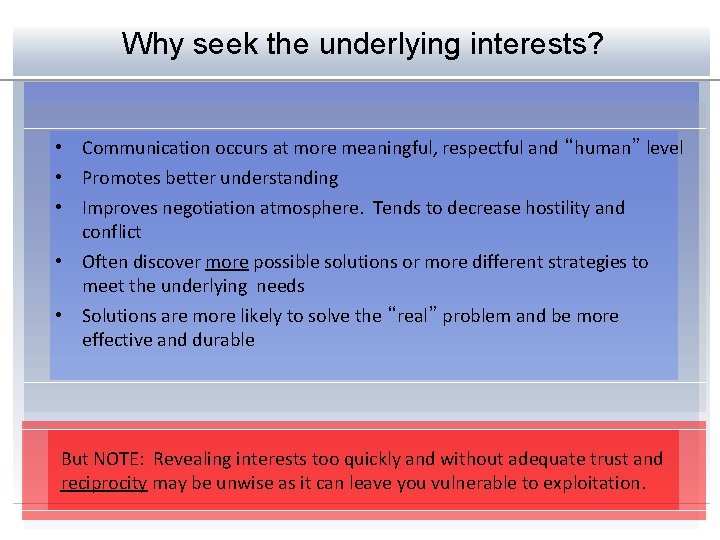
Why seek the underlying interests? • Communication occurs at more meaningful, respectful and “human” level • Promotes better understanding • Improves negotiation atmosphere. Tends to decrease hostility and conflict • Often discover more possible solutions or more different strategies to meet the underlying needs • Solutions are more likely to solve the “real” problem and be more effective and durable But NOTE: Revealing interests too quickly and without adequate trust and reciprocity may be unwise as it can leave you vulnerable to exploitation.

Leverage in Negotiation Positive “the carrot” Something you can offer that they want. Better yet something they need. Better yet, something they “must have. ” Negative “the stick” A course of action or consequence that will occur and/or which you can cause to occur, in the absence of a negotiated agreement, that is potentially detrimental to the other person. Normative Standards, “objective” criteria Established guidelines that are relevant in the context (e. g. law, industry norms, religious or family values, company policy). Guidelines are more persuasive to the extent that they are broadly accepted and viewed as relatively “objective. ” Psychology: Human desire to appear consistent with norms. Note: Watch out for self-interested selection of “objective” criteria
Short Exercise
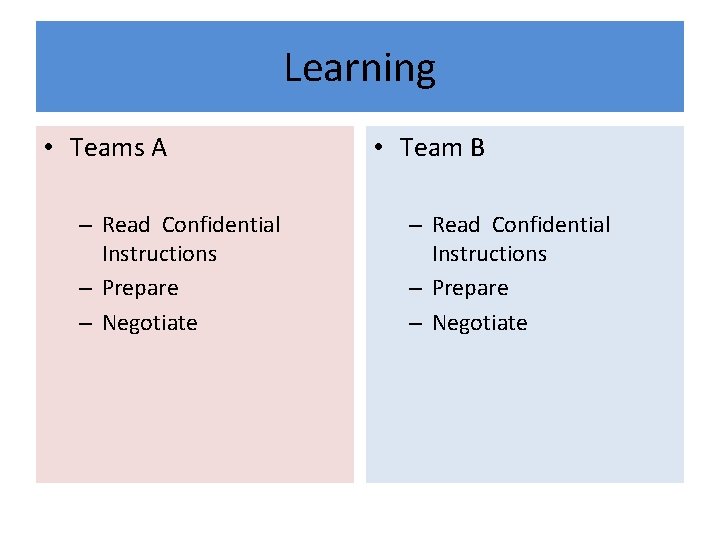
Learning • Teams A – Read Confidential Instructions – Prepare – Negotiate • Team B – Read Confidential Instructions – Prepare – Negotiate
The Negotiation Process
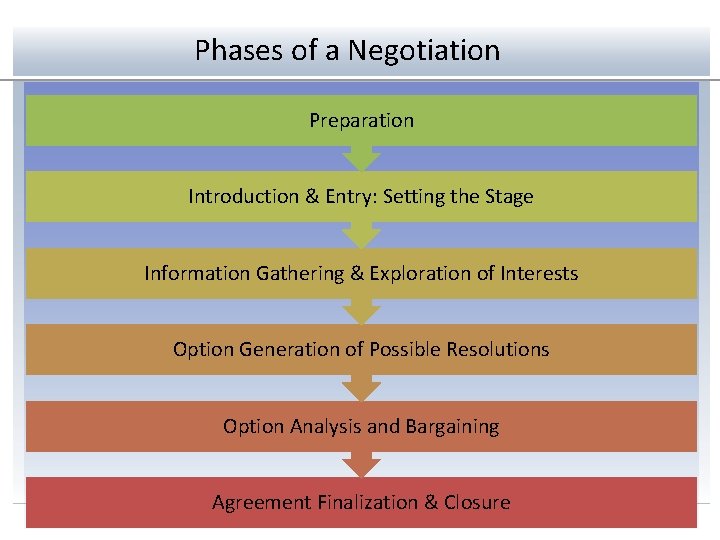
Phases of a Negotiation Preparation Introduction & Entry: Setting the Stage Information Gathering & Exploration of Interests Option Generation of Possible Resolutions Option Analysis and Bargaining Agreement Finalization & Closure
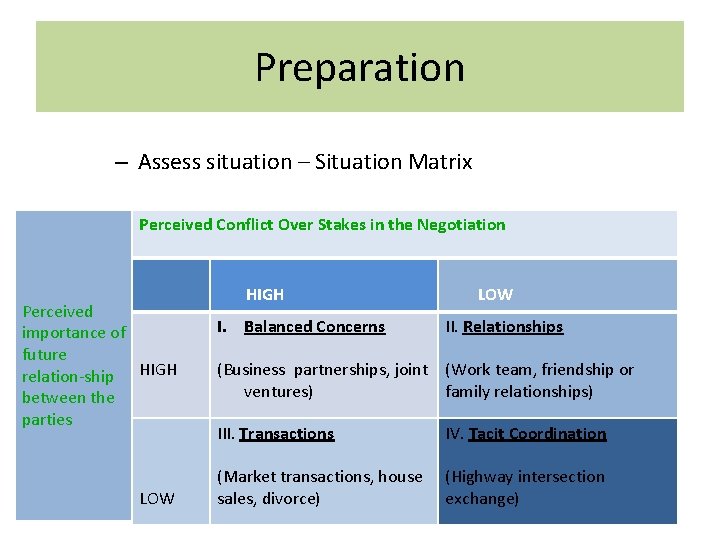
Preparation – Assess situation – Situation Matrix Perceived Conflict Over Stakes in the Negotiation Perceived importance of future relation-ship HIGH between the parties LOW HIGH I. Balanced Concerns LOW II. Relationships (Business partnerships, joint (Work team, friendship or ventures) family relationships) III. Transactions IV. Tacit Coordination (Market transactions, house sales, divorce) (Highway intersection exchange)
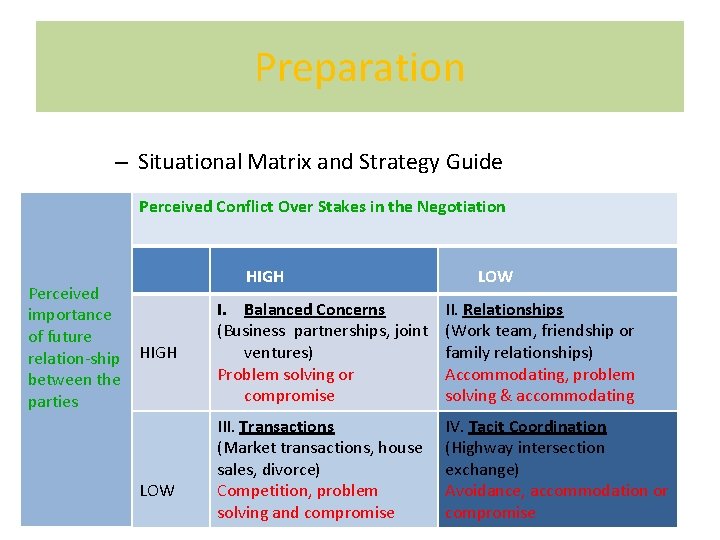
Preparation – Situational Matrix and Strategy Guide Perceived Conflict Over Stakes in the Negotiation Perceived importance of future relation-ship between the parties HIGH LOW I. Balanced Concerns (Business partnerships, joint ventures) Problem solving or compromise II. Relationships (Work team, friendship or family relationships) Accommodating, problem solving & accommodating III. Transactions (Market transactions, house sales, divorce) Competition, problem solving and compromise IV. Tacit Coordination (Highway intersection exchange) Avoidance, accommodation or compromise
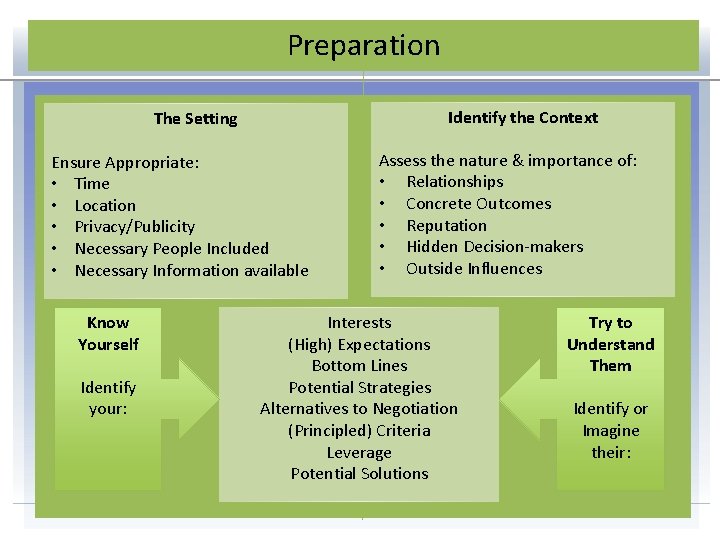
Preparation Identify the Context The Setting Ensure Appropriate: • Time • Location • Privacy/Publicity • Necessary People Included • Necessary Information available Know Yourself Identify your: Assess the nature & importance of: • Relationships • Concrete Outcomes • Reputation • Hidden Decision-makers • Outside Influences Interests (High) Expectations Bottom Lines Potential Strategies Alternatives to Negotiation (Principled) Criteria Leverage Potential Solutions Try to Understand Them Identify or Imagine their:
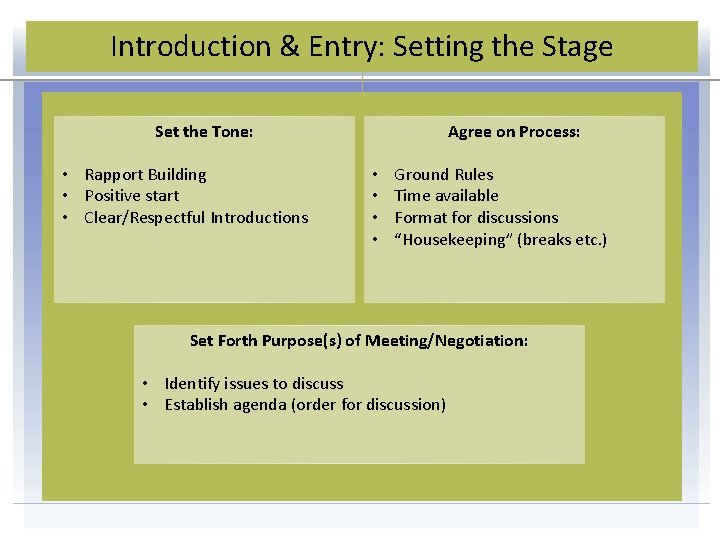
Introduction & Entry: Setting the Stage Set the Tone: • Rapport Building • Positive start • Clear/Respectful Introductions Agree on Process: • • Ground Rules Time available Format for discussions “Housekeeping” (breaks etc. ) Set Forth Purpose(s) of Meeting/Negotiation: • Identify issues to discuss • Establish agenda (order for discussion)
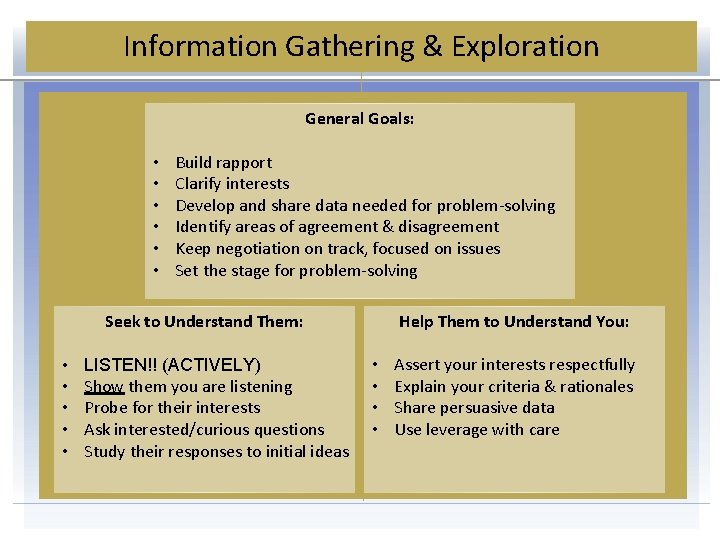
Information Gathering & Exploration General Goals: • • • Build rapport Clarify interests Develop and share data needed for problem-solving Identify areas of agreement & disagreement Keep negotiation on track, focused on issues Set the stage for problem-solving Seek to Understand Them: • • • LISTEN!! (ACTIVELY) Show them you are listening Probe for their interests Ask interested/curious questions Study their responses to initial ideas Help Them to Understand You: • • Assert your interests respectfully Explain your criteria & rationales Share persuasive data Use leverage with care
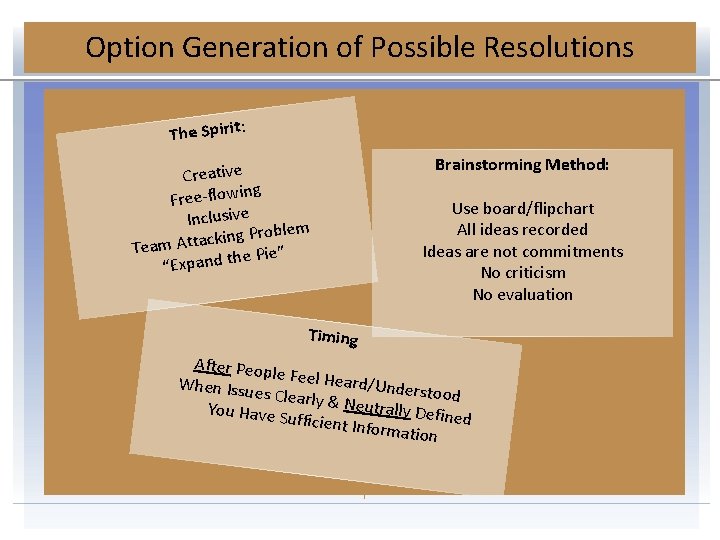
Option Generation of Possible Resolutions The Spirit: Creative ng Free-flowi Inclusive Problem g n i k c a t t Team A e Pie” h t d n a p x E “ Brainstorming Method: Use board/flipchart All ideas recorded Ideas are not commitments No criticism No evaluation Timing After Peop le Feel Hea rd/Unders When Issu tood es Clearly & N e u trally Defin You Have S ed ufficient In formation
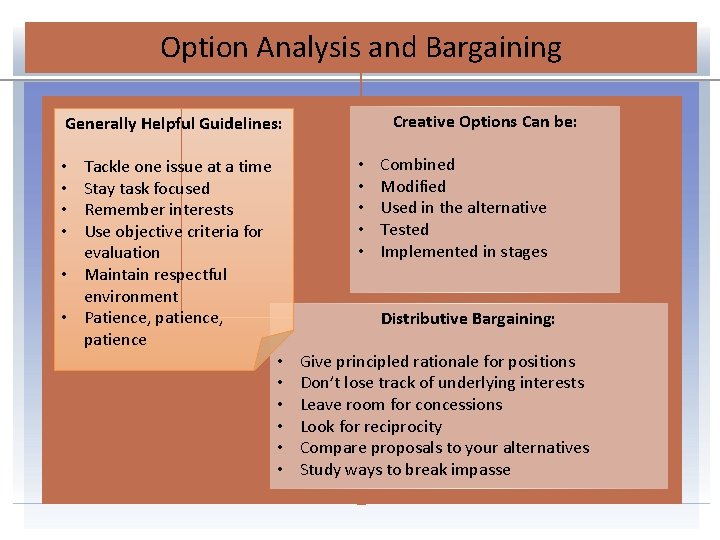
Option Analysis and Bargaining Creative Options Can be: Generally Helpful Guidelines: • • • Tackle one issue at a time Stay task focused Remember interests Use objective criteria for evaluation • Maintain respectful environment • Patience, patience • • Combined Modified Used in the alternative Tested Implemented in stages Distributive Bargaining: • • • Give principled rationale for positions Don’t lose track of underlying interests Leave room for concessions Look for reciprocity Compare proposals to your alternatives Study ways to break impasse
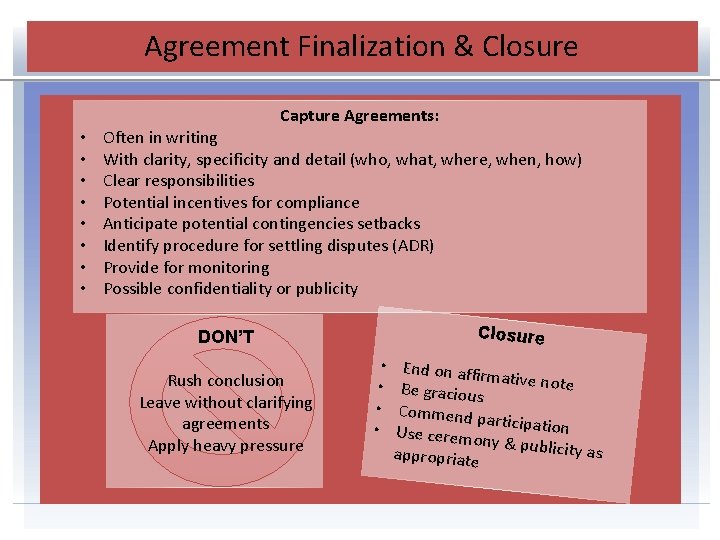
Agreement Finalization & Closure Capture Agreements: • • Often in writing With clarity, specificity and detail (who, what, where, when, how) Clear responsibilities Potential incentives for compliance Anticipate potential contingencies setbacks Identify procedure for settling disputes (ADR) Provide for monitoring Possible confidentiality or publicity Closure DON’T Rush conclusion Leave without clarifying agreements Apply heavy pressure • • End on affirm ative note Be gracious Commend p articipation Use ceremo ny & publicit y as appropriate
Good Negotiations = • Awareness of and ability to apply negotiation theory • Development of an effective negotiation style • Understanding of the negotiation process • Improvement of critical communication skills
Where to Get More Information • Richard Shell: Bargaining for Advantage • Folberg & Golann: Lawyer Negotiation; Theory, Practice and Law. • Fisher & Ury: Getting to Yes
- Slides: 25