
Hallgrmur Snorrason Organizing and operationalizing The National Statistical

- Slides: 17
Hallgrímur Snorrason Organizing and operationalizing The National Statistical System (NSS) With particular reference to developing countries ISI Workshop on Leadership in Modern Statistical Systems Daejeon, Korea 12 -14 November 2012 1
Background: The Speaker n n n Hallgrímur Snorrason, born 1947, Icelandic Educated in Iceland, Scotland Sweden National Economic Institute, Iceland 1972 -1984 Director General of Statistics Iceland 1985 -2007 Active participant in international statistical cooperation – Nordic stat. coop. , EFTA, UNECE, UN Statistical Commission, European Union (European Statistical System), IAOS (President 1993 -1995), ISI Vice-President 2009 -2013 Consultant/lecturer on official statistics (e. g. Baltic, Balkan, African, and Arab countries, Ukraine, Greece; work for EFTA, Eurostat, World Bank, IMF, Nordic statistical institutes) 2
The NSS – what is it, does it exist? n n A national statistical system is not a precise term – refers to the national statistical institute (NSI) and main government agencies which are involved in the production of official statistics The use of the term recognizes that – – – The NSI is not the only public body which produces statistics for use by government and in the society at large or provides statistical data/information for decision making The production and usefulness of official statistics will gain by the cooperation of such institutions and by coordination of their statistical activities Such cooperation may be enhanced or cemented by the organization of these institutions into a coherent system 3
The NSS – what is it, does it exist? (2) n n Some will argue that an NSS exists in one sense or another in all countries which have public institutions producing statistics However, it differs widely between countries to what extent such a „system“ is recognized and organized – – It may not be recognized in countries with very strong NSIs There may be cooperation between producers of official statistics without formal recognition of a system There may be a loose forum for consultation/cooperation Several countries have established formal systems for continuous cooperation and coordination of the official statistical activities 4
Organizing and coordinating the NSS n In most countries there are several producers of official statistics – – n n n A central statistical office designated as the national statistical institute (NSI) Ministries – min. of finance often most important, also subject matter/sector specific ministries (health, education, agriculture etc) The central bank Other producers (e. g. specialized institutions) The producers of official statistics and stakeholders must be organized to form a coherent system of official statistics The system should be based on a legal act – statistics act The system should have a strong coordinator – the NSI 5
Organizing a national statistical system n Different opportunities to establish/organize the NSS – – – As part of the work programme for drawing up a strategic plan for official statistics: NSDS, SMP, SP or whatever name is given to strategic plans – involvement of partners at the earliest stage As part of the government decision to accept World Bank grant for NSDS work – committing the government to support the organization and operation of the NSS In connection with reviews/revisions of NSDSs, SMPs As part of increased donor cooperation and coordination As a specific action for enhancing the coverage, coherence and quality of the official statistics – need to involve government 6
Establishing NSSs in developing countries n n The Marrakech Action Plan in Statistics (MAPS) is oriented towards statistical capacity building across government in developing countries MAPS envisages and encourages that actions in statistical capacity building are directed at NSSs, not only NSIs PARIS 21 and World Bank support of drawing up national strategies for the development of statistics (NSDSs) include all statistical producers and encourages the organization of an NSS In most countries recent NSDSs have been prepared with the participation of several public institutions and some have included common multi-year activity plans 7
Some experience of establishing NSSs n n n It seems to have proved relatively easy to gather statistical producers around the goal of drawing up NSDSs or SMPs – thereby establishing cooperation and coordination = NSS This is often facilitated through the funds made available for establishing NSDSs/SMPs and related government decisions In some countries, NSSs have been established by fanfare and speaches. . . There are several examples of joint strategic plans, of fruitful cooperation and even of joint plans for implementation But there also difficulties or obstacles 8
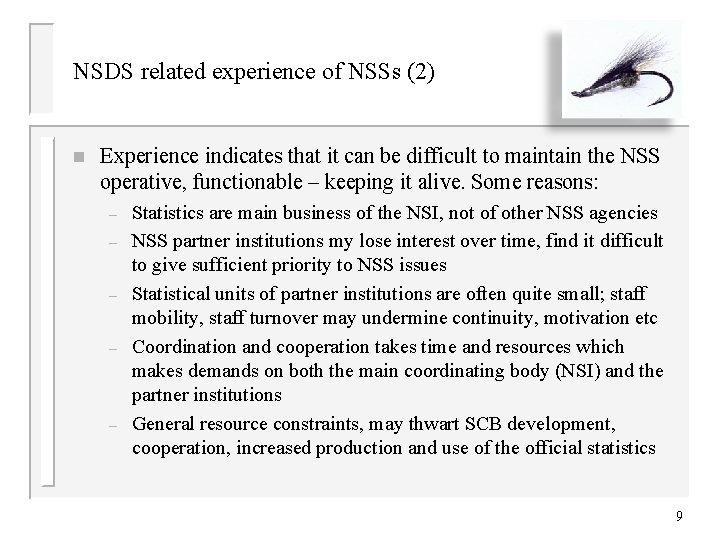
NSDS related experience of NSSs (2) n Experience indicates that it can be difficult to maintain the NSS operative, functionable – keeping it alive. Some reasons: – – – Statistics are main business of the NSI, not of other NSS agencies NSS partner institutions my lose interest over time, find it difficult to give sufficient priority to NSS issues Statistical units of partner institutions are often quite small; staff mobility, staff turnover may undermine continuity, motivation etc Coordination and cooperation takes time and resources which makes demands on both the main coordinating body (NSI) and the partner institutions General resource constraints, may thwart SCB development, cooperation, increased production and use of the official statistics 9
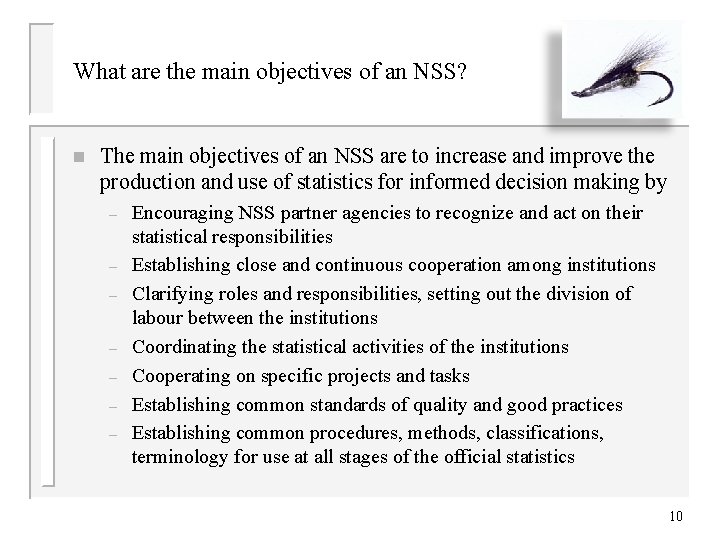
What are the main objectives of an NSS? n The main objectives of an NSS are to increase and improve the production and use of statistics for informed decision making by – – – – Encouraging NSS partner agencies to recognize and act on their statistical responsibilities Establishing close and continuous cooperation among institutions Clarifying roles and responsibilities, setting out the division of labour between the institutions Coordinating the statistical activities of the institutions Cooperating on specific projects and tasks Establishing common standards of quality and good practices Establishing common procedures, methods, classifications, terminology for use at all stages of the official statistics 10
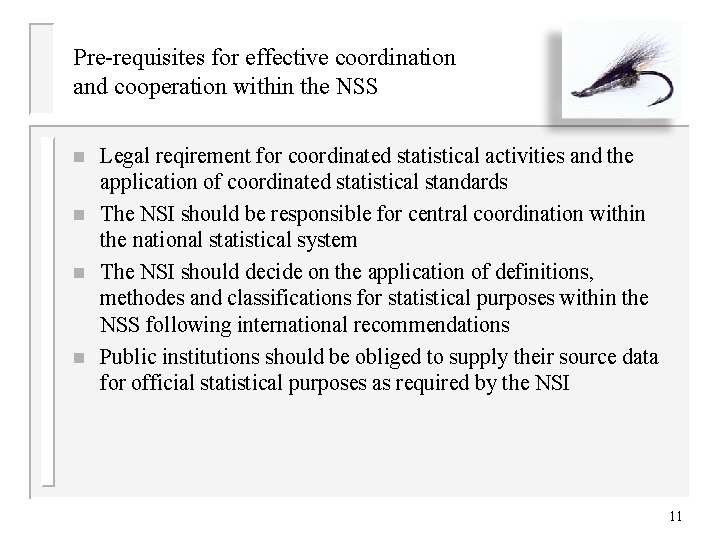
Pre-requisites for effective coordination and cooperation within the NSS n n Legal reqirement for coordinated statistical activities and the application of coordinated statistical standards The NSI should be responsible for central coordination within the national statistical system The NSI should decide on the application of definitions, methodes and classifications for statistical purposes within the NSS following international recommendations Public institutions should be obliged to supply their source data for official statistical purposes as required by the NSI 11
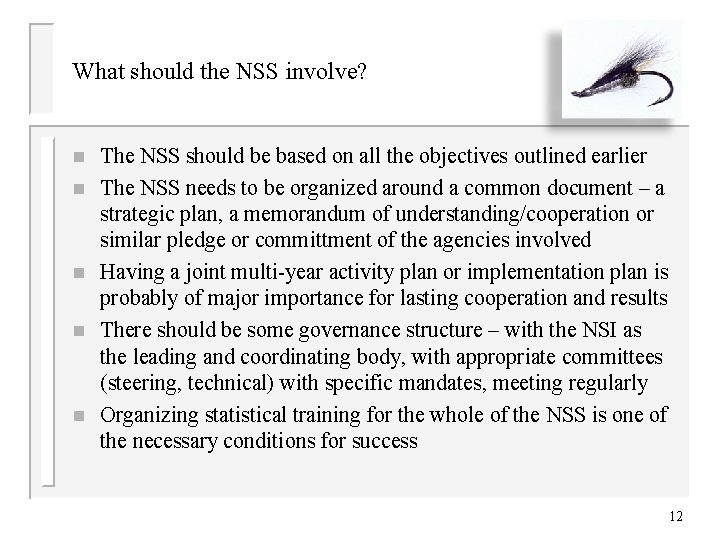
What should the NSS involve? n n n The NSS should be based on all the objectives outlined earlier The NSS needs to be organized around a common document – a strategic plan, a memorandum of understanding/cooperation or similar pledge or committment of the agencies involved Having a joint multi-year activity plan or implementation plan is probably of major importance for lasting cooperation and results There should be some governance structure – with the NSI as the leading and coordinating body, with appropriate committees (steering, technical) with specific mandates, meeting regularly Organizing statistical training for the whole of the NSS is one of the necessary conditions for success 12
Some important tasks for the NSS n n n The importance of good practices, statistical principles and quality needs to be preached and observed across the NSS Awareness of and compliance with the UN Principles, the ISI Code of Ethics and relevant codes of procedures should be advocated among staff and the management of NSS agencies The NSS might establish a common code of practice The NSS agencies should cooperate on setting uniform quality standards for official statistics The NSS could be a forum for enhancing cooperation with donors, coordination of agendas and plans and their alignment with the overall statistical programme of the NSS 13
Some further tasks, considerations n n Establishing a common NSS front – website, publications, logo Establishing and operating common NSS fora: – – – n n On internal cooperation issues, good practices, principles, ethics For user contacts and dialogue For information and discussion with development agencies Operating a joint training programme and liaising with national universities and research centres in that connection Funding issues – exploring possibilities of using joint funds for specific projects, or a common fund (government budget allocations + donor funds) for a common programme 14
Role and requirements of the NSI n n n A strong and committed NSI is a pre-requisite for the operation of the NSS The NSI must assume the leadership role for the NSS The NSI has to organize its leadership and coordination of the NSS and allocate adequate resources (HR, time) to that task The NSI has to give sufficient priority to NSS issues The NSI should extend its statistical training programme to the staff of its NSS partner institutions The NSI should involve as appropriate the NSS agencies in multi-year planning and in cooperation with donors 15
Some discussion points - suggestions n n n Do we agree on the importance of organizing an NSS? Do you see other advantages or drawbacks than the ones outlined in the presentation? Does the description of difficulties, obstacles fit with your experience? The more decentralized the official statistics are, the greater the need for an organized NSS? Does an NSS really contribute to the SCB process and regular production of statistics or is it a waste of time and energy? Is the role of the NSI adequately described in the presentation? 16
Hallgrímur Snorrason Thank you for your attention 17