
Hall D Tagger and Beamline Review Nov 19
Hall D Tagger and Beamline Review Nov. 19 -20, 2008, Newport News The Hall D Photon Beam Overview presented by Richard Jones, University of Connecticut Glue. X Tagged Beam Working Group Jefferson Laboratory University of Connecticut Catholic University of America Hall D Tagger and Beamline Review, University of Glasgow Nov. 19 -20, 2008, Newport News
Outline n n n Photon beam requirements Photon beam collimation Beam rates and polarization Diamond crystal requirements Beam monitoring and instrumentation Hall D Tagger and Beamline Review, Nov. 19 -20, 2008, Newport News 2
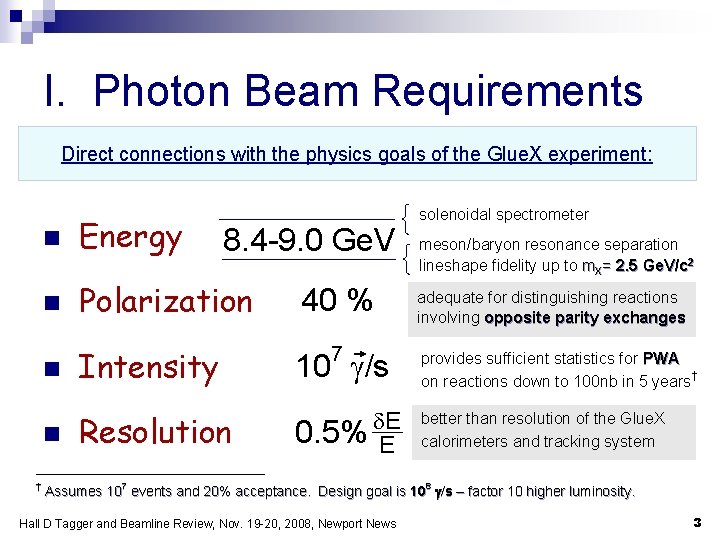
I. Photon Beam Requirements Direct connections with the physics goals of the Glue. X experiment: n Energy n Polarization n n † 8. 4 -9. 0 Ge. V 40 % 7 solenoidal spectrometer meson/baryon resonance separation lineshape fidelity up to m. X= 2. 5 Ge. V/c 2 adequate for distinguishing reactions involving opposite parity exchanges Intensity 10 /s provides sufficient statistics for PWA on reactions down to 100 nb in 5 years† Resolution 0. 5% d. E E better than resolution of the Glue. X calorimeters and tracking system Assumes 107 events and 20% acceptance. Design goal is 108 g/s – factor 10 higher luminosity. Hall D Tagger and Beamline Review, Nov. 19 -20, 2008, Newport News 3
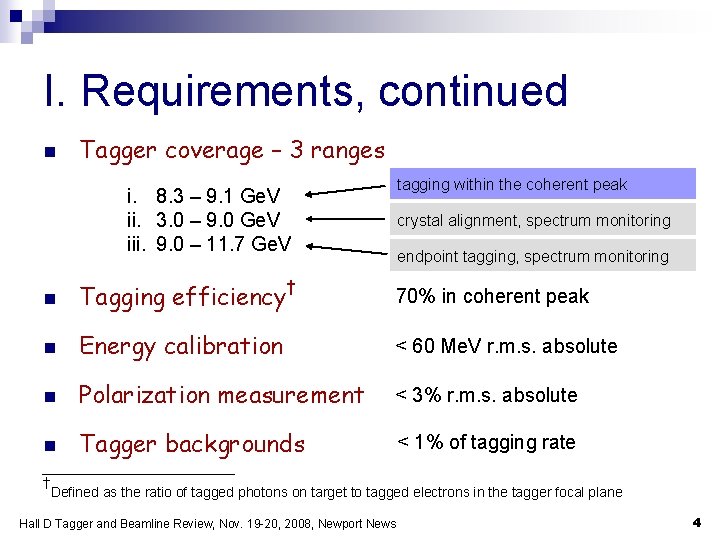
I. Requirements, continued n Tagger coverage – 3 ranges tagging within the coherent peak i. 8. 3 – 9. 1 Ge. V ii. 3. 0 – 9. 0 Ge. V iii. 9. 0 – 11. 7 Ge. V crystal alignment, spectrum monitoring endpoint tagging, spectrum monitoring n Tagging efficiency† 70% in coherent peak n Energy calibration < 60 Me. V r. m. s. absolute n Polarization measurement < 3% r. m. s. absolute n Tagger backgrounds < 1% of tagging rate † Defined as the ratio of tagged photons on target to tagged electrons in the tagger focal plane Hall D Tagger and Beamline Review, Nov. 19 -20, 2008, Newport News 4
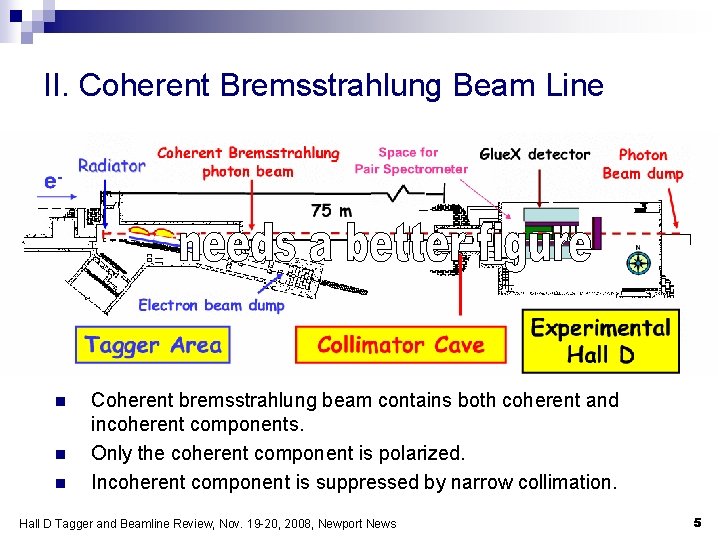
II. Coherent Bremsstrahlung Beam Line n n n Coherent bremsstrahlung beam contains both coherent and incoherent components. Only the coherent component is polarized. Incoherent component is suppressed by narrow collimation. Hall D Tagger and Beamline Review, Nov. 19 -20, 2008, Newport News 5
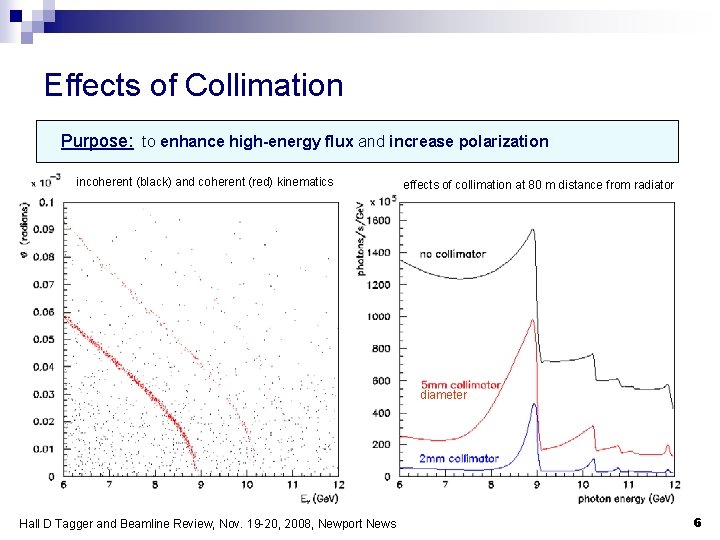
Effects of Collimation Purpose: to enhance high-energy flux and increase polarization incoherent (black) and coherent (red) kinematics effects of collimation at 80 m distance from radiator diameter Hall D Tagger and Beamline Review, Nov. 19 -20, 2008, Newport News 6
Photon Beam Collimation Geometry Steps taken to fix the collimator geometry: 1. Determine constraints from beam emittance, radiator size, and radiator quality on collimator geometry. 2. Optimize collimation angle as a compromise between high beam polarization and high tagging efficiency. Hall D Tagger and Beamline Review, Nov. 19 -20, 2008, Newport News 7
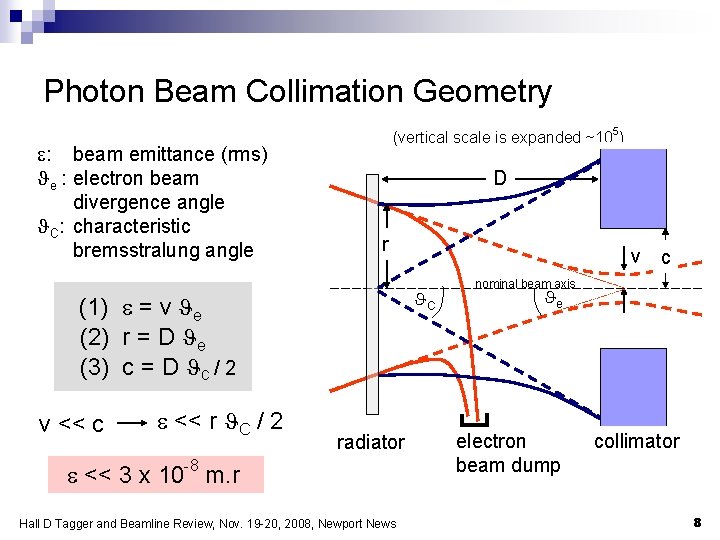
Photon Beam Collimation Geometry : beam emittance (rms) e : electron beam divergence angle C: characteristic bremsstralung angle (vertical scale is expanded ~105) D r C (1) = v e (2) r = D e (3) c = D C / 2 v << c << r C / 2 v c radiator << 3 x 10 -8 m. r Hall D Tagger and Beamline Review, Nov. 19 -20, 2008, Newport News nominal beam axis e electron beam dump collimator 8
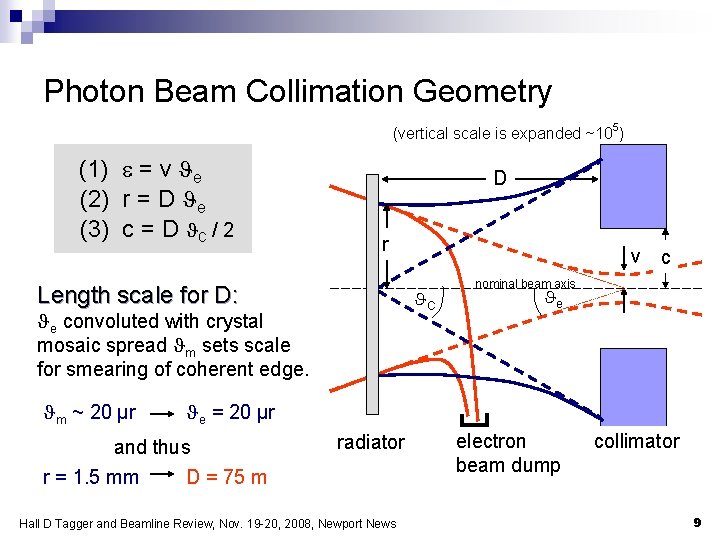
Photon Beam Collimation Geometry (vertical scale is expanded ~105) (1) = v e (2) r = D e (3) c = D C / 2 D r Length scale for D: C e convoluted with crystal mosaic spread m sets scale for smearing of coherent edge. m ~ 20 µr v c nominal beam axis e e = 20 µr and thus r = 1. 5 mm D = 75 m radiator Hall D Tagger and Beamline Review, Nov. 19 -20, 2008, Newport News electron beam dump collimator 9
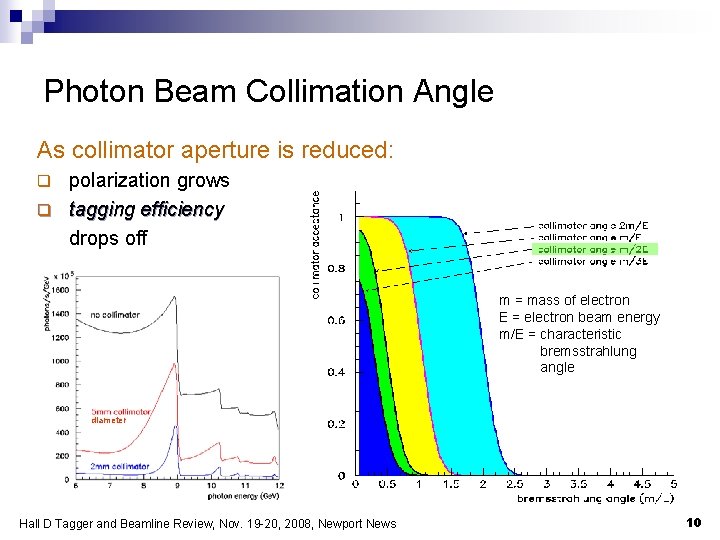
Photon Beam Collimation Angle As collimator aperture is reduced: polarization grows q tagging efficiency drops off q m = mass of electron E = electron beam energy m/E = characteristic bremsstrahlung angle diameter Hall D Tagger and Beamline Review, Nov. 19 -20, 2008, Newport News 10
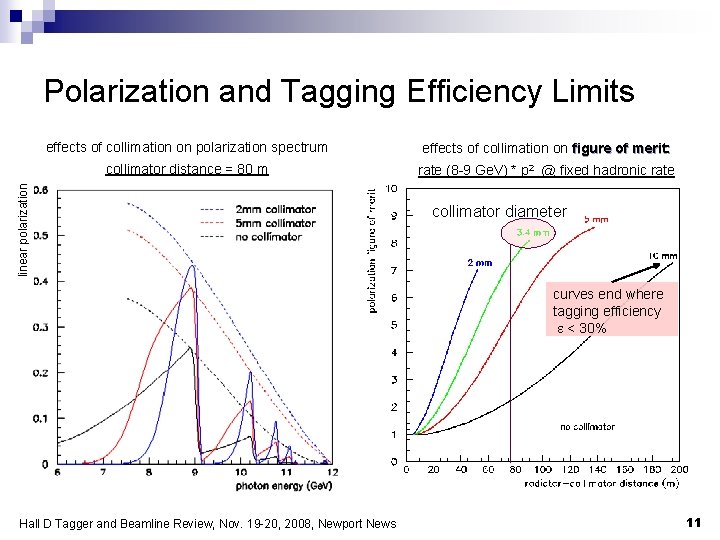
Polarization and Tagging Efficiency Limits effects of collimation on figure of merit: collimator distance = 80 m rate (8 -9 Ge. V) * p 2 @ fixed hadronic rate linear polarization effects of collimation on polarization spectrum collimator diameter curves end where tagging efficiency < 30% Hall D Tagger and Beamline Review, Nov. 19 -20, 2008, Newport News 11
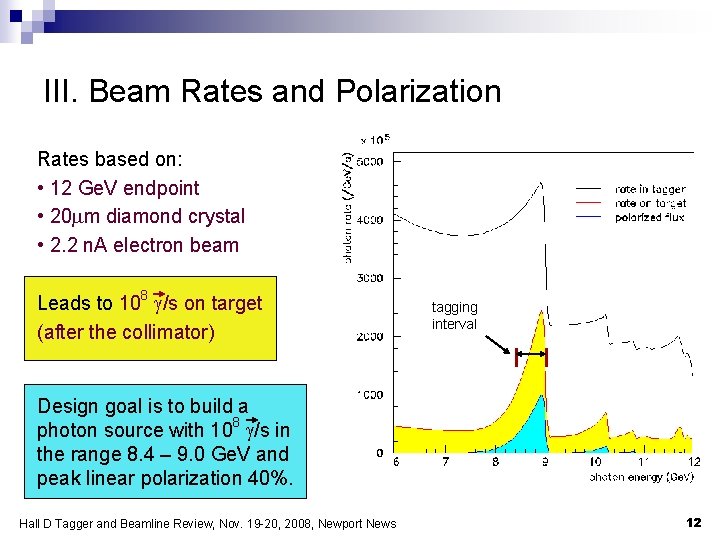
III. Beam Rates and Polarization Rates based on: • 12 Ge. V endpoint • 20 mm diamond crystal • 2. 2 n. A electron beam Leads to 108 /s on target (after the collimator) tagging interval Design goal is to build a photon source with 108 /s in the range 8. 4 – 9. 0 Ge. V and peak linear polarization 40%. Hall D Tagger and Beamline Review, Nov. 19 -20, 2008, Newport News 12
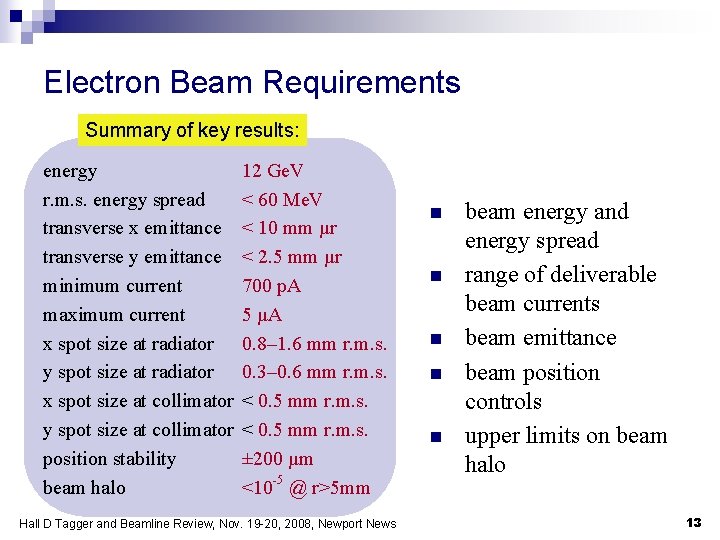
Electron Beam Requirements Summary of key results: energy r. m. s. energy spread transverse x emittance transverse y emittance minimum current maximum current x spot size at radiator y spot size at radiator x spot size at collimator y spot size at collimator position stability beam halo 12 Ge. V < 60 Me. V < 10 mm µr < 2. 5 mm µr 700 p. A 5 µA 0. 8– 1. 6 mm r. m. s. 0. 3– 0. 6 mm r. m. s. < 0. 5 mm r. m. s. ± 200 µm <10 -5 @ r>5 mm Hall D Tagger and Beamline Review, Nov. 19 -20, 2008, Newport News n n n beam energy and energy spread range of deliverable beam currents beam emittance beam position controls upper limits on beam halo 13
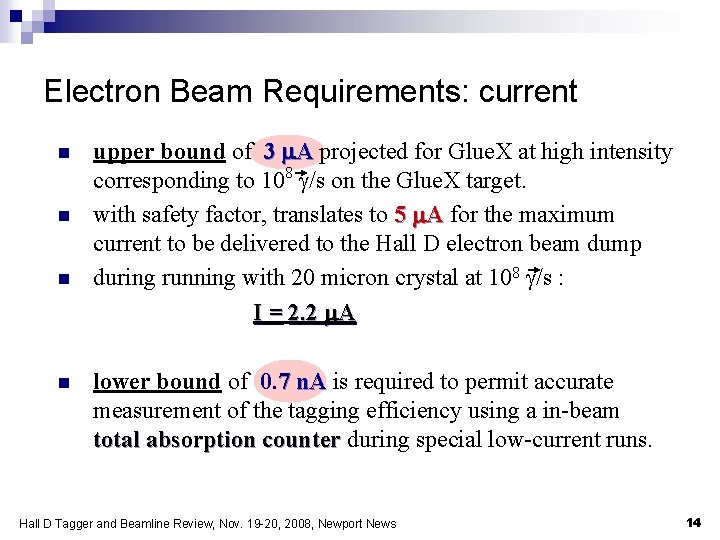
Electron Beam Requirements: current n n upper bound of 3 A projected for Glue. X at high intensity corresponding to 108 /s on the Glue. X target. with safety factor, translates to 5 A for the maximum current to be delivered to the Hall D electron beam dump during running with 20 micron crystal at 108 /s : I = 2. 2 A lower bound of 0. 7 n. A is required to permit accurate measurement of the tagging efficiency using a in-beam total absorption counter during special low-current runs. Hall D Tagger and Beamline Review, Nov. 19 -20, 2008, Newport News 14
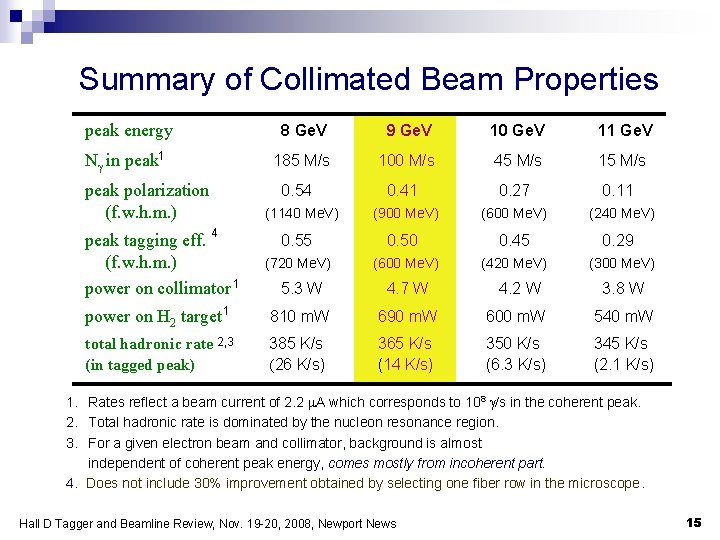
Summary of Collimated Beam Properties peak energy 8 Ge. V 9 Ge. V 10 Ge. V 11 Ge. V N in peak 1 185 M/s 100 M/s 45 M/s 15 M/s 0. 41 0. 27 0. 11 (900 Me. V) (600 Me. V) (240 Me. V) 0. 55 0. 50 0. 45 0. 29 (720 Me. V) (600 Me. V) (420 Me. V) (300 Me. V) 5. 3 W 4. 7 W 4. 2 W 3. 8 W power on H 2 target 1 810 m. W 690 m. W 600 m. W 540 m. W total hadronic rate 2, 3 (in tagged peak) 385 K/s (26 K/s) 365 K/s (14 K/s) 350 K/s (6. 3 K/s) 345 K/s (2. 1 K/s) peak polarization (f. w. h. m. ) peak tagging eff. 4 (f. w. h. m. ) power on collimator 1 0. 54 (1140 Me. V) 1. Rates reflect a beam current of 2. 2 m. A which corresponds to 108 /s in the coherent peak. 2. Total hadronic rate is dominated by the nucleon resonance region. 3. For a given electron beam and collimator, background is almost independent of coherent peak energy, comes mostly from incoherent part. 4. Does not include 30% improvement obtained by selecting one fiber row in the microscope. Hall D Tagger and Beamline Review, Nov. 19 -20, 2008, Newport News 15
IV. Diamond crystal requirements orientation requirements n mosaic spread requirement n thickness requirements n radiation damage lifetime n mount and heat relief n Hall D Tagger and Beamline Review, Nov. 19 -20, 2008, Newport News 16
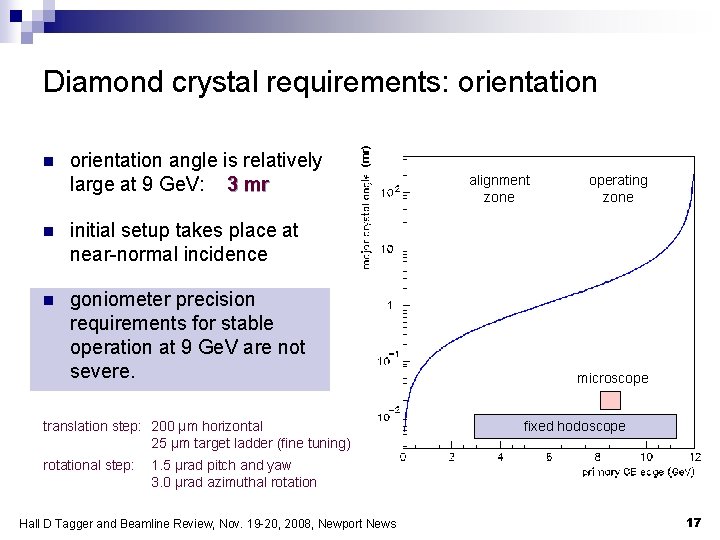
n orientation angle is relatively large at 9 Ge. V: 3 mr n initial setup takes place at near-normal incidence n goniometer precision requirements for stable operation at 9 Ge. V are not severe. (mr) Diamond crystal requirements: orientation translation step: 200 μm horizontal 25 μm target ladder (fine tuning) rotational step: alignment zone operating zone microscope fixed hodoscope 1. 5 μrad pitch and yaw 3. 0 μrad azimuthal rotation Hall D Tagger and Beamline Review, Nov. 19 -20, 2008, Newport News 17
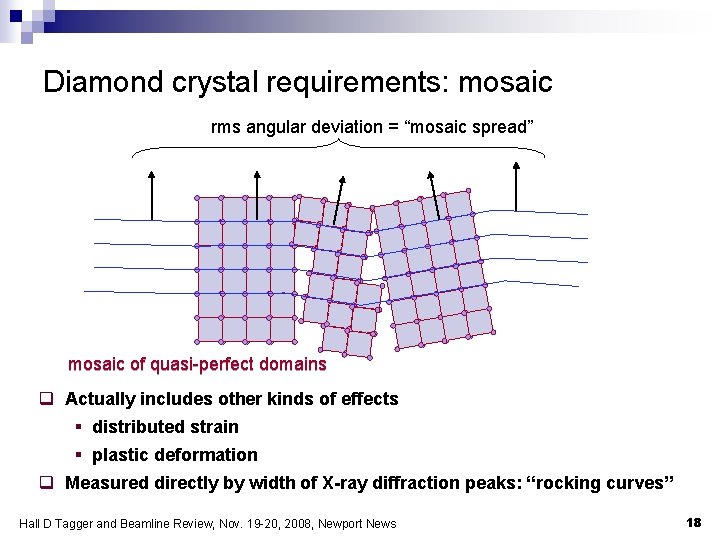
Diamond crystal requirements: mosaic rms angular deviation = “mosaic spread” mosaic of quasi-perfect domains q Actually includes other kinds of effects § distributed strain § plastic deformation q Measured directly by width of X-ray diffraction peaks: “rocking curves” Hall D Tagger and Beamline Review, Nov. 19 -20, 2008, Newport News 18
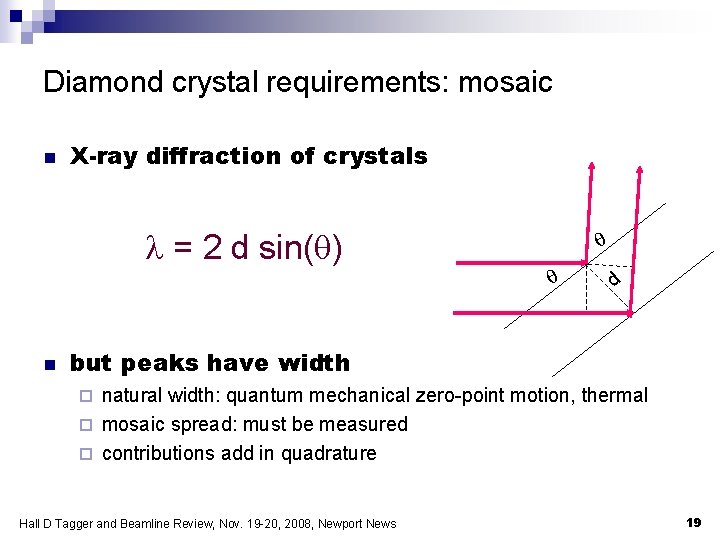
Diamond crystal requirements: mosaic n X-ray diffraction of crystals l = 2 d sin(q) n q q d but peaks have width natural width: quantum mechanical zero-point motion, thermal ¨ mosaic spread: must be measured ¨ contributions add in quadrature ¨ Hall D Tagger and Beamline Review, Nov. 19 -20, 2008, Newport News 19
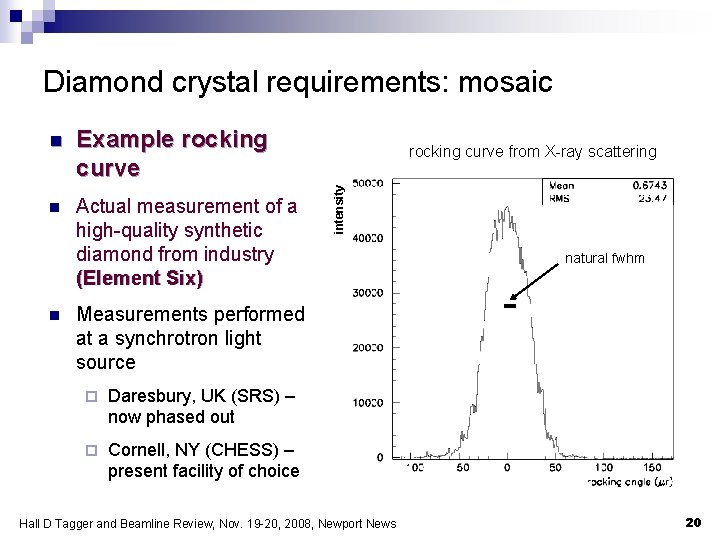
Diamond crystal requirements: mosaic Example rocking curve n Actual measurement of a high-quality synthetic diamond from industry (Element Six) n rocking curve from X-ray scattering intensity n natural fwhm Measurements performed at a synchrotron light source ¨ Daresbury, UK (SRS) – now phased out ¨ Cornell, NY (CHESS) – present facility of choice Hall D Tagger and Beamline Review, Nov. 19 -20, 2008, Newport News 20
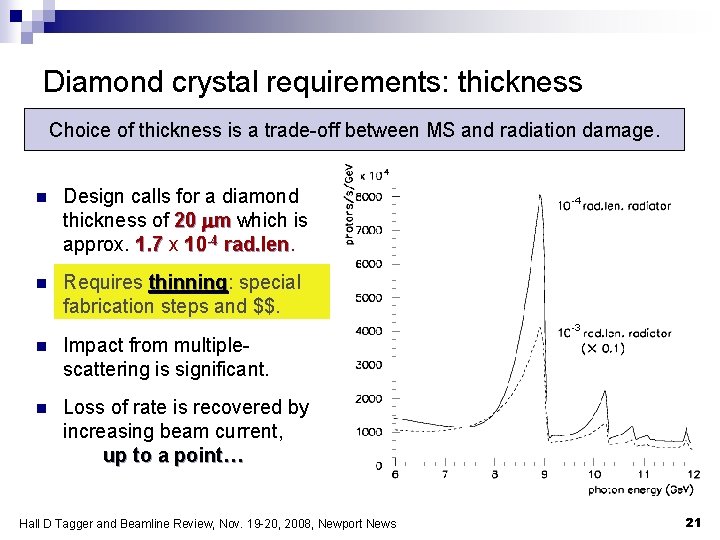
Diamond crystal requirements: thickness Choice of thickness is a trade-off between MS and radiation damage. n Design calls for a diamond thickness of 20 m which is approx. 1. 7 x 10 -4 rad. len n Requires thinning: thinning special fabrication steps and $$. -4 -3 n Impact from multiplescattering is significant. n Loss of rate is recovered by increasing beam current, up to a point… Hall D Tagger and Beamline Review, Nov. 19 -20, 2008, Newport News 21
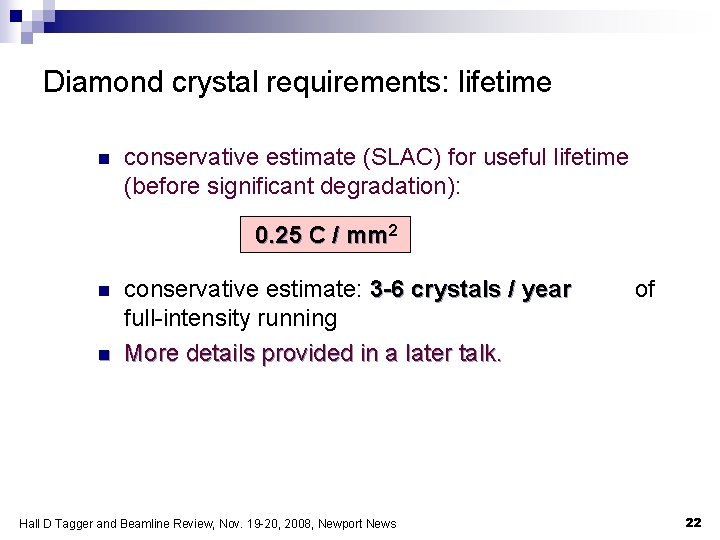
Diamond crystal requirements: lifetime n conservative estimate (SLAC) for useful lifetime (before significant degradation): 0. 25 C / mm 2 n n conservative estimate: 3 -6 crystals / year full-intensity running More details provided in a later talk. Hall D Tagger and Beamline Review, Nov. 19 -20, 2008, Newport News of 22
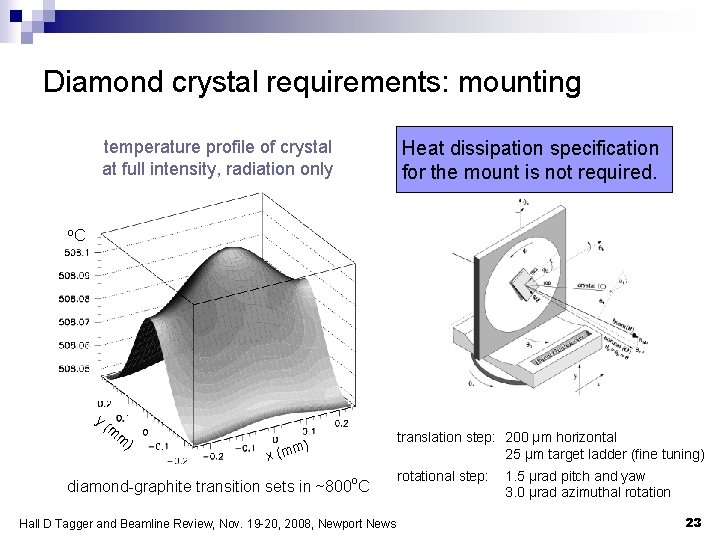
Diamond crystal requirements: mounting temperature profile of crystal at full intensity, radiation only Heat dissipation specification for the mount is not required. o. C y (m m ) m) x (m diamond-graphite transition sets in ~800 o. C Hall D Tagger and Beamline Review, Nov. 19 -20, 2008, Newport News translation step: 200 μm horizontal 25 μm target ladder (fine tuning) rotational step: 1. 5 μrad pitch and yaw 3. 0 μrad azimuthal rotation 23
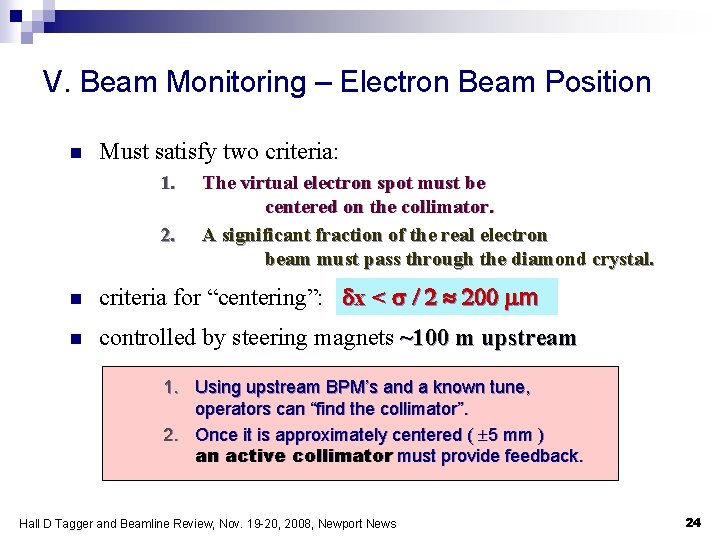
V. Beam Monitoring – Electron Beam Position n Must satisfy two criteria: 1. 2. The virtual electron spot must be centered on the collimator. A significant fraction of the real electron beam must pass through the diamond crystal. n criteria for “centering”: dx < s / 2 200 m n controlled by steering magnets ~100 m upstream 1. Using upstream BPM’s and a known tune, operators can “find the collimator”. 2. Once it is approximately centered ( 5 mm ) an active collimator must provide feedback. Hall D Tagger and Beamline Review, Nov. 19 -20, 2008, Newport News 24
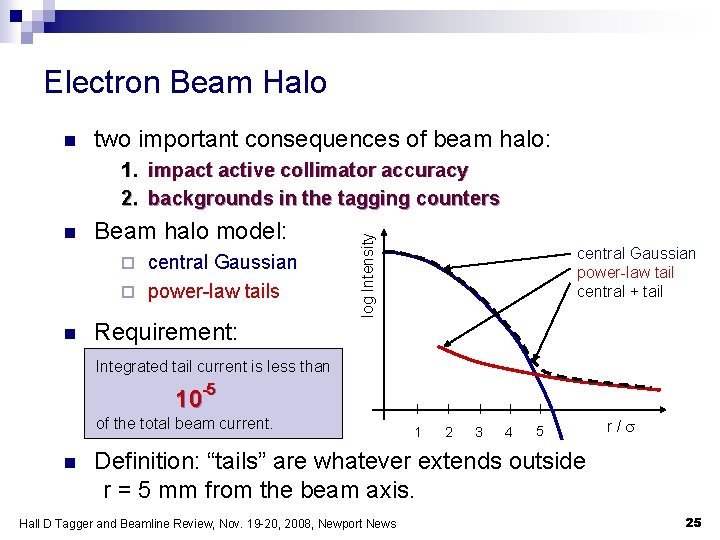
Electron Beam Halo n two important consequences of beam halo: n Beam halo model: central Gaussian ¨ power-law tails ¨ n log Intensity 1. impact active collimator accuracy 2. backgrounds in the tagging counters central Gaussian power-law tail central + tail Requirement: Integrated tail current is less than -5 10 of the total beam current. n 1 2 3 4 5 r/s Definition: “tails” are whatever extends outside r = 5 mm from the beam axis. Hall D Tagger and Beamline Review, Nov. 19 -20, 2008, Newport News 25
Photon Beam Position Controls n electron Beam Position Monitors provide coarse centering position resolution 100 m r. m. s. ¨ a pair separated by 10 m : ~1 mm r. m. s. at the collimator ¨ matches the collimator aperture: can find the collimator ¨ n primary beam collimator is instrumented provides photon beam position measurement ¨ position sensitivity out to 30 mm from beam axis ¨ maximum sensitivity of 200 m r. m. s. within 2 mm ¨ Hall D Tagger and Beamline Review, Nov. 19 -20, 2008, Newport News 26
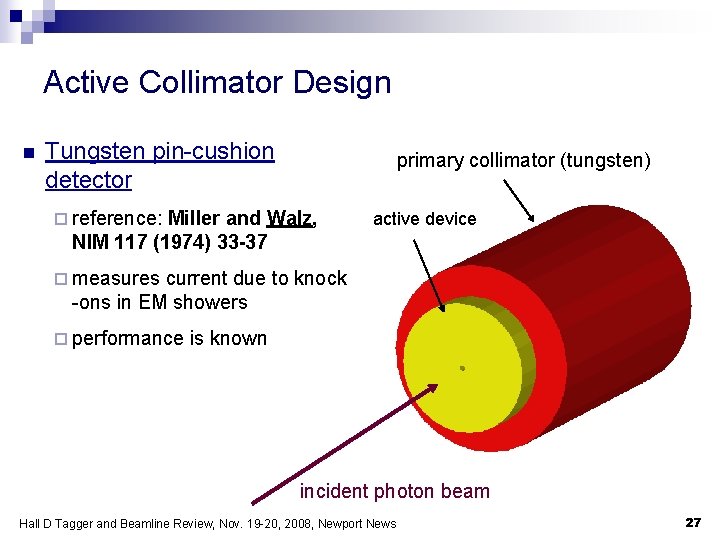
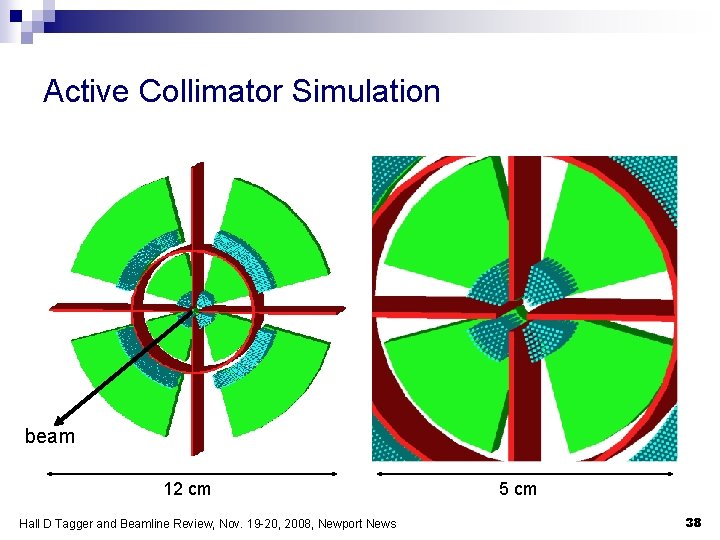
Active Collimator Design n Tungsten pin-cushion detector primary collimator (tungsten) ¨ reference: Miller and Walz, NIM 117 (1974) 33 -37 active device ¨ measures current due to knock -ons in EM showers ¨ performance is known incident photon beam Hall D Tagger and Beamline Review, Nov. 19 -20, 2008, Newport News 27
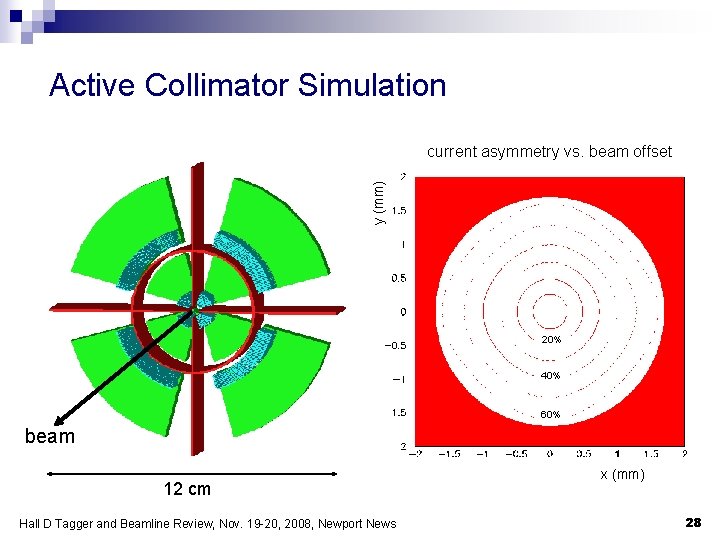
Active Collimator Simulation y (mm) current asymmetry vs. beam offset 20% 40% 60% beam 12 cm Hall D Tagger and Beamline Review, Nov. 19 -20, 2008, Newport News x (mm) 28
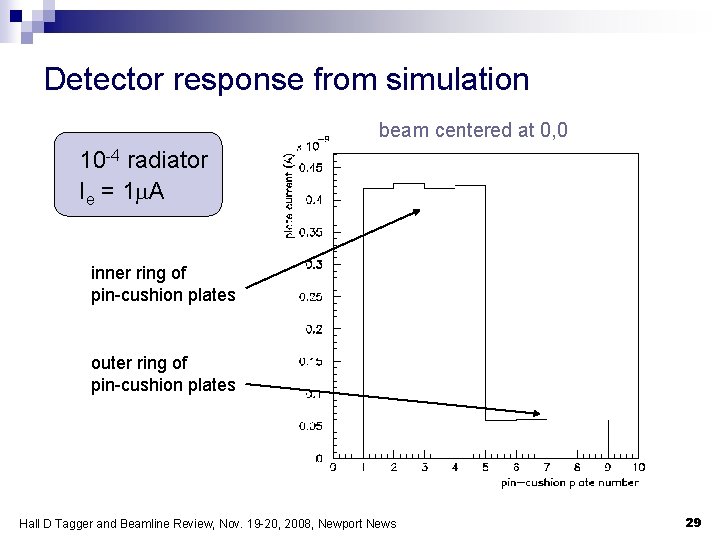
Detector response from simulation beam centered at 0, 0 10 -4 radiator Ie = 1 m. A inner ring of pin-cushion plates outer ring of pin-cushion plates Hall D Tagger and Beamline Review, Nov. 19 -20, 2008, Newport News 29
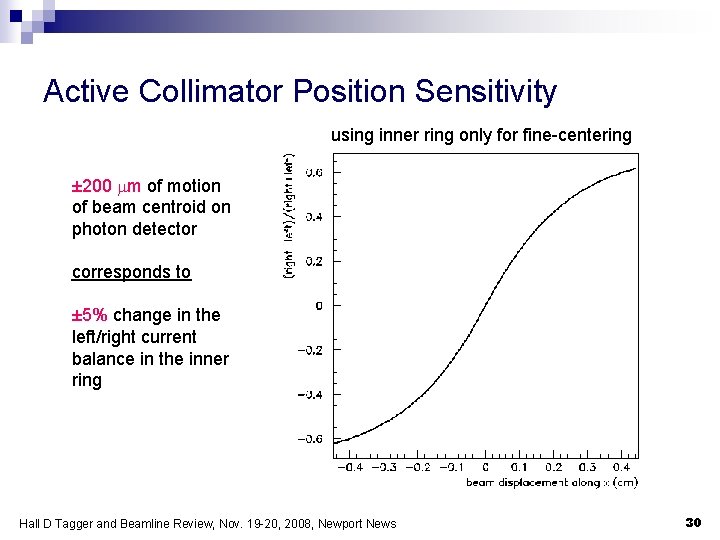
Active Collimator Position Sensitivity using inner ring only for fine-centering ± 200 mm of motion of beam centroid on photon detector corresponds to ± 5% change in the left/right current balance in the inner ring Hall D Tagger and Beamline Review, Nov. 19 -20, 2008, Newport News 30
Summary n A design has been put forward for a polarized photon beam line that meets the requirements for the experimental program in Hall D. n The properties of the photon beam were generated and successfully simulated using the nominal parameters of the 12 Ge. V electron beam. n The design parameters have been carefully optimized. n The design includes sufficient beam line instrumentation to insure stable operation. Hall D Tagger and Beamline Review, Nov. 19 -20, 2008, Newport News 31
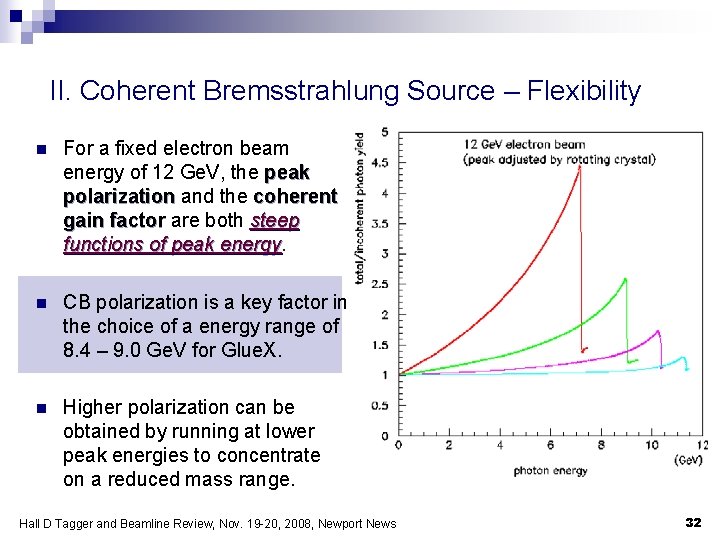
II. Coherent Bremsstrahlung Source – Flexibility n For a fixed electron beam energy of 12 Ge. V, the peak polarization and the coherent gain factor are both steep functions of peak energy n CB polarization is a key factor in the choice of a energy range of 8. 4 – 9. 0 Ge. V for Glue. X. n Higher polarization can be obtained by running at lower peak energies to concentrate on a reduced mass range. Hall D Tagger and Beamline Review, Nov. 19 -20, 2008, Newport News 32
Photon Beam Quality Monitoring n tagger broad-band focal plane counter array necessary for crystal alignment during setup ¨ provides a continuous monitor of beam/crystal stability ¨ n electron pair spectrometer ¨ ¨ ¨ located downstream of the collimation area sees post-collimated photon beam directly after cleanup 10 -3 radiator located upstream of pair spectrometer pairs swept from beamline by spectrometer field and detected in a coarse-grained hodoscope energy resolution in PS not critical, only left+right timing coincidences with the tagger provide a continuous monitor of the post-collimator photon beam spectrum. Hall D Tagger and Beamline Review, Nov. 19 -20, 2008, Newport News 33
Other Photon Beam Instrumentation n visual photon beam monitors total absorption counter safety systems Hall D Tagger and Beamline Review, Nov. 19 -20, 2008, Newport News 34
Coherent Bremsstrahlung with Collimation Unique: No other solution was found that could meet all of these requirements at an existing or planned nuclear physics facility. n A laser backscatter facility would need to wait for new construction of a new multi-G$ 20 Ge. V+ storage ring (XFEL? ). n Even with a future for high-energy beams at SLAC, the low duty factor <10 -4 essentially eliminates photon tagging there. n The continuous beams from CEBAF are essential for tagging and well-suited to detecting multi-particle final states. n By upgrading CEBAF to 12 Ge. V, a 9 Ge. V polarized photon beam can be produced with high polarization and intensity. Hall D Tagger and Beamline Review, Nov. 19 -20, 2008, Newport News 35
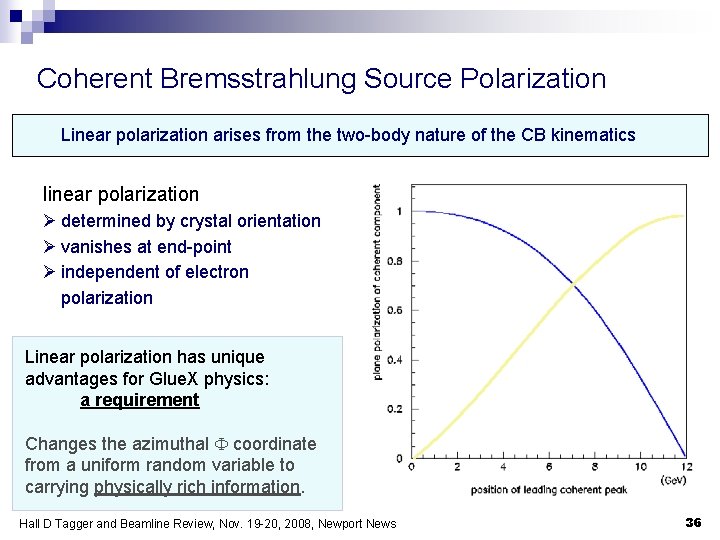
Coherent Bremsstrahlung Source Polarization Linear polarization arises from the two-body nature of the CB kinematics linear polarization Ø determined by crystal orientation Ø vanishes at end-point Ø independent of electron circular polarization Ø transfer from electron beam Ø reaches 100% at end-point Linear polarization has unique advantages for Glue. X physics: a requirement Changes the azimuthal F coordinate from a uniform random variable to carrying physically rich information. Hall D Tagger and Beamline Review, Nov. 19 -20, 2008, Newport News 36
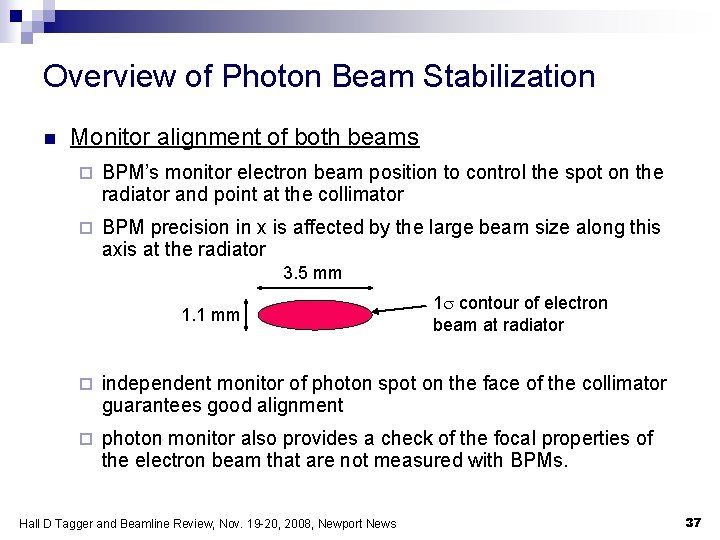
Overview of Photon Beam Stabilization n Monitor alignment of both beams ¨ BPM’s monitor electron beam position to control the spot on the radiator and point at the collimator ¨ BPM precision in x is affected by the large beam size along this axis at the radiator 3. 5 mm 1. 1 mm 1 s contour of electron beam at radiator ¨ independent monitor of photon spot on the face of the collimator guarantees good alignment ¨ photon monitor also provides a check of the focal properties of the electron beam that are not measured with BPMs. Hall D Tagger and Beamline Review, Nov. 19 -20, 2008, Newport News 37
Active Collimator Simulation beam 12 cm Hall D Tagger and Beamline Review, Nov. 19 -20, 2008, Newport News 5 cm 38
- Slides: 38