
Hairy cell Leukemia CASE STUDY Case details An


- Slides: 14
Hairy cell Leukemia CASE STUDY
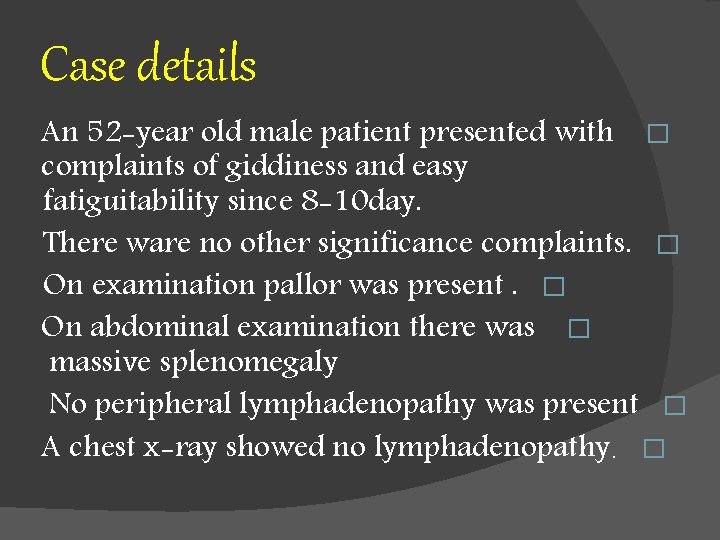
Case details An 52 -year old male patient presented with � complaints of giddiness and easy fatiguitability since 8 -10 day. There ware no other significance complaints. � On examination pallor was present. � On abdominal examination there was � massive splenomegaly No peripheral lymphadenopathy was present � A chest x-ray showed no lymphadenopathy. �
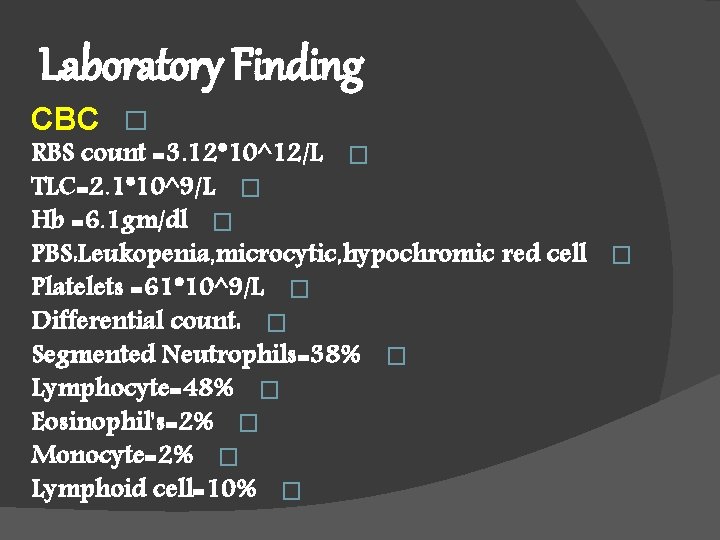
Laboratory Finding CBC � RBS count =3. 12*10^12/L � TLC=2. 1*10^9/L � Hb =6. 1 gm/dl � PBS: Leukopenia, microcytic, hypochromic red cell � Platelets =61*10^9/L � Differential count: � Segmented Neutrophils=38% � Lymphocyte=48% � Eosinophil's=2% � Monocyte=2% � Lymphoid cell=10% �
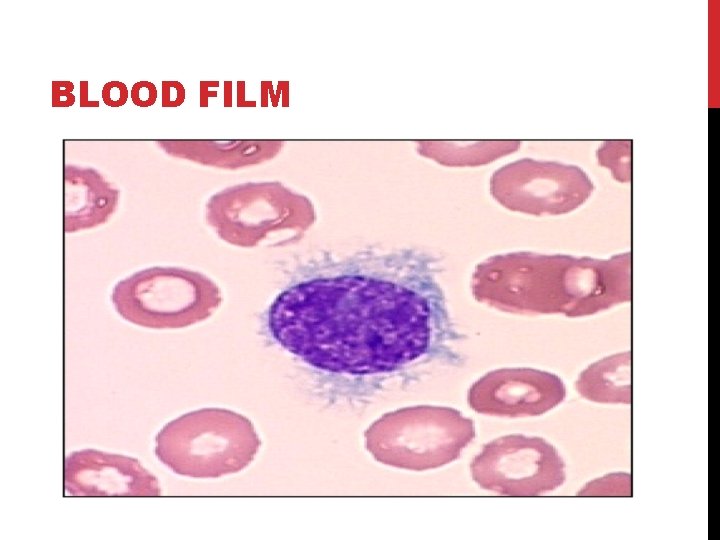
BLOOD FILM
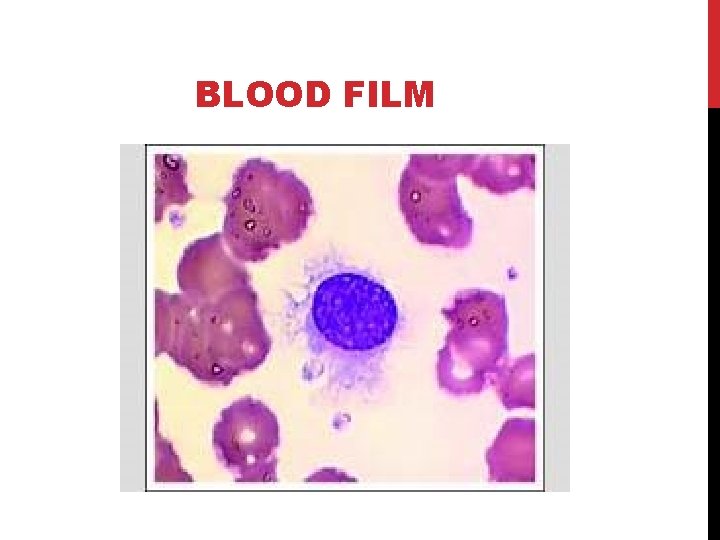
BLOOD FILM
The diagnosis for � cases HAIRY CELL LEUKEMIA �
Discussion of the cases The patient presented with leukocytopenia � without peripheral lymphadenopathy and prominent splenomegaly Further investigation like bone marrow � aspiration , biopsy and immunohistochemical stain confirmed the diagnosis of HCL Careful attention to morphologic details is � important to recognize HCL from other variant particularly when low percentage of hairy cell are present.
What is Hairy cell leukemia HCL is a rare chronic B cell lymph proliferative disorder. Characterized by splenomegaly , pancytopenia and bone marrow infiltration by atypical lymphocyte with circumferential prominent hairy cytoplasmic projection. HCL has been known by several names � including: Leukemia reticuloendotheliosis � Lymphoid marrow fibrosis � Medullosplenic histolymphocytosis of primitive appearance Reticulum cell leukemia. � �
What cause HCL The cause of HCL is not known � The only factor which are definitely known to increase � the chance of developing the condition are older age and being male HCL is considered a rare disease as it affect fewer � than 0. 3 people in every 100000 per year It affect men about 3 -5 times as often as women � HCL is unheard of it in children and is very rare in � young adult , it is most commonly diagnosed in patient between 55 and 70 year of age
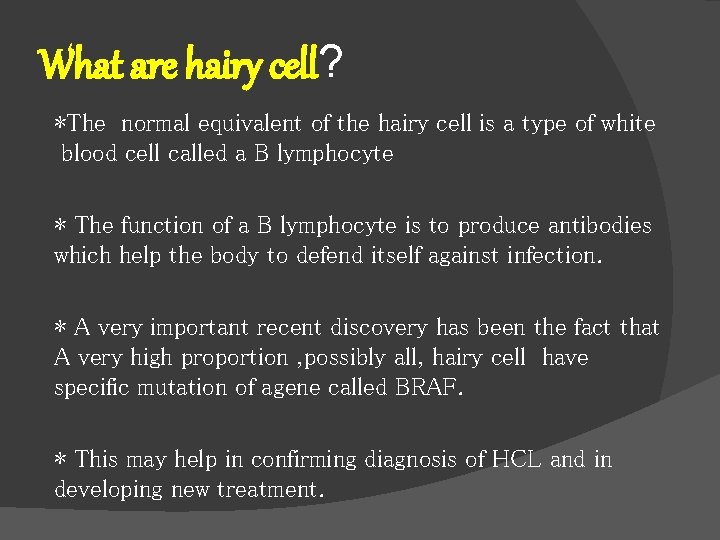
What are hairy cell? *The normal equivalent of the hairy cell is a type of white blood cell called a B lymphocyte * The function of a B lymphocyte is to produce antibodies which help the body to defend itself against infection. * A very important recent discovery has been the fact that A very high proportion , possibly all, hairy cell have specific mutation of agene called BRAF. * This may help in confirming diagnosis of HCL and in developing new treatment.
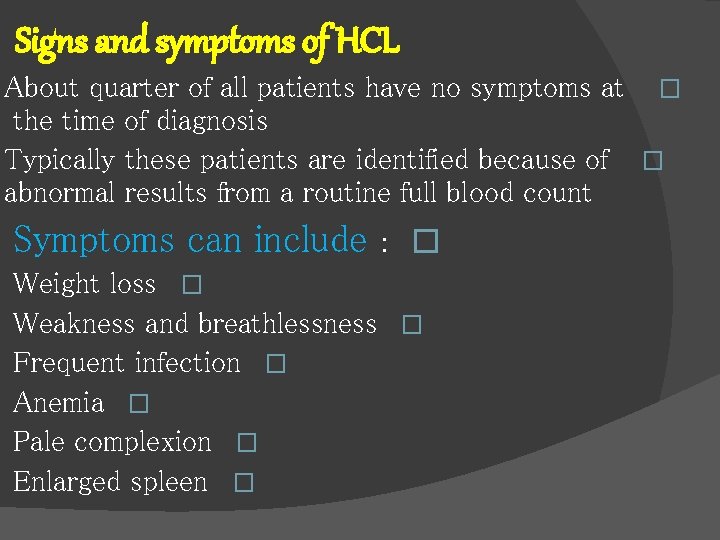
Signs and symptoms of HCL About quarter of all patients have no symptoms at � the time of diagnosis Typically these patients are identified because of � abnormal results from a routine full blood count Symptoms can include : � Weight loss � Weakness and breathlessness � Frequent infection � Anemia � Pale complexion � Enlarged spleen �
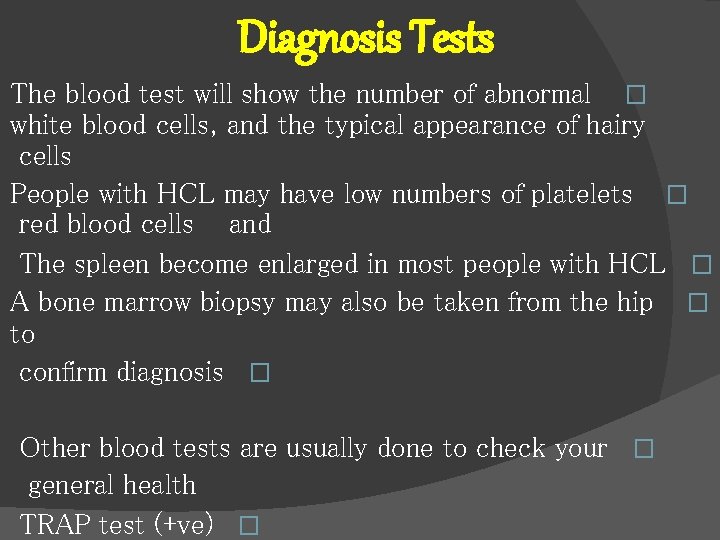
Diagnosis Tests The blood test will show the number of abnormal � white blood cells, and the typical appearance of hairy cells People with HCL may have low numbers of platelets � red blood cells and The spleen become enlarged in most people with HCL � A bone marrow biopsy may also be taken from the hip � to confirm diagnosis � Other blood tests are usually done to check your � general health TRAP test (+ve) �
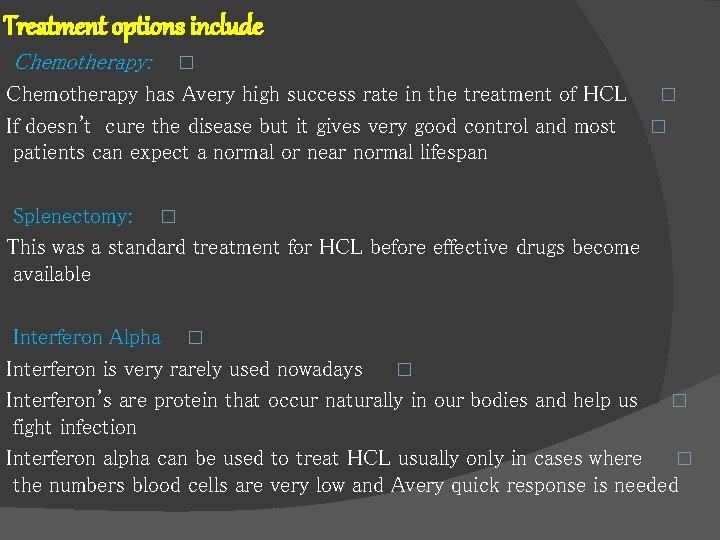
Treatment options include Chemotherapy: � Chemotherapy has Avery high success rate in the treatment of HCL If doesn't cure the disease but it gives very good control and most patients can expect a normal or near normal lifespan � � Splenectomy: � This was a standard treatment for HCL before effective drugs become available Interferon Alpha � Interferon is very rarely used nowadays � Interferon's are protein that occur naturally in our bodies and help us � fight infection Interferon alpha can be used to treat HCL usually only in cases where � the numbers blood cells are very low and Avery quick response is needed
THANK YOU SO MUCH FOR � YOUR ATTENTION