
Hair Loss Series Module 1 Hair Anatomy Hair
- Slides: 11
Hair Loss Series Module 1 - Hair Anatomy
Hair Anatomy Module 1: Hair Anatomy 1. 2. 3. 4. 5. Hair Components: What is hair made of? Hair Growth Phases: Anagen, Catagen, Telogen Hair Properties Basic Hair Care: Shampooing/Conditioning, Styling, Protecting Client Fact Finding Hair Fun Facts: – – Each head contains approximately 100, 000 hair follicles Hair follicles are not actively growing at the same time. Growing and shedding happens randomly Each follicle grows an average new hair at least 20 times in a lifetime – If you pluck a hair, the next period of hair growth occurs – As we age, the number of follicles capable of growing hair declines. – Hair is 91% protein Sources: The World of Hair, an on-line reference by Dr. John Gray, provided by the P&G Hair Care Research Center. Hair Club for Men and Women Milady’s Standard Cosmetology, Thomson, Delmar Learning 2004 2 Overview
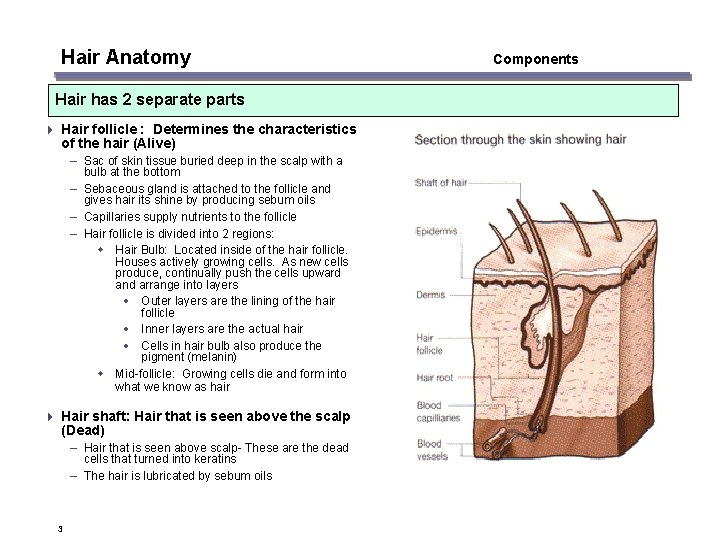
Hair Anatomy Hair has 2 separate parts 4 Hair follicle : Determines the characteristics of the hair (Alive) – Sac of skin tissue buried deep in the scalp with a bulb at the bottom – Sebaceous gland is attached to the follicle and gives hair its shine by producing sebum oils – Capillaries supply nutrients to the follicle – Hair follicle is divided into 2 regions: w Hair Bulb: Located inside of the hair follicle. Houses actively growing cells. As new cells produce, continually push the cells upward and arrange into layers · Outer layers are the lining of the hair follicle · Inner layers are the actual hair · Cells in hair bulb also produce the pigment (melanin) w Mid-follicle: Growing cells die and form into what we know as hair 4 Hair shaft: Hair that is seen above the scalp (Dead) – Hair that is seen above scalp- These are the dead cells that turned into keratins – The hair is lubricated by sebum oils 3 Components
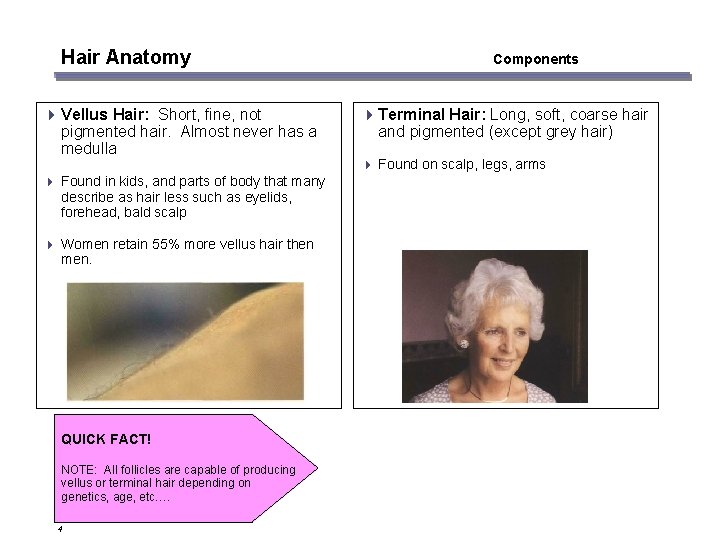
Hair Anatomy 4 Vellus Hair: Short, fine, not pigmented hair. Almost never has a medulla 4 Found in kids, and parts of body that many describe as hair less such as eyelids, forehead, bald scalp 4 Women retain 55% more vellus hair then men. QUICK FACT! NOTE: All follicles are capable of producing vellus or terminal hair depending on genetics, age, etc…. 4 Components 4 Terminal Hair: Long, soft, coarse hair and pigmented (except grey hair) 4 Found on scalp, legs, arms
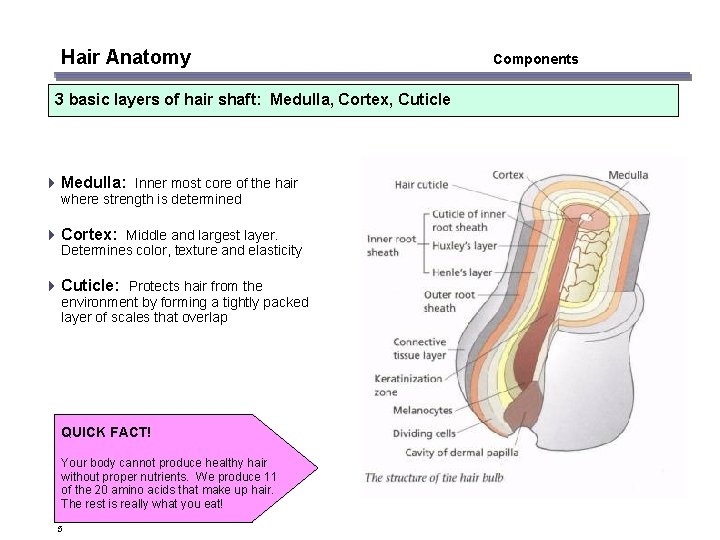
Hair Anatomy 3 basic layers of hair shaft: Medulla, Cortex, Cuticle 4 Medulla: Inner most core of the hair where strength is determined 4 Cortex: Middle and largest layer. Determines color, texture and elasticity 4 Cuticle: Protects hair from the environment by forming a tightly packed layer of scales that overlap QUICK FACT! Your body cannot produce healthy hair without proper nutrients. We produce 11 of the 20 amino acids that make up hair. The rest is really what you eat! 5 Components
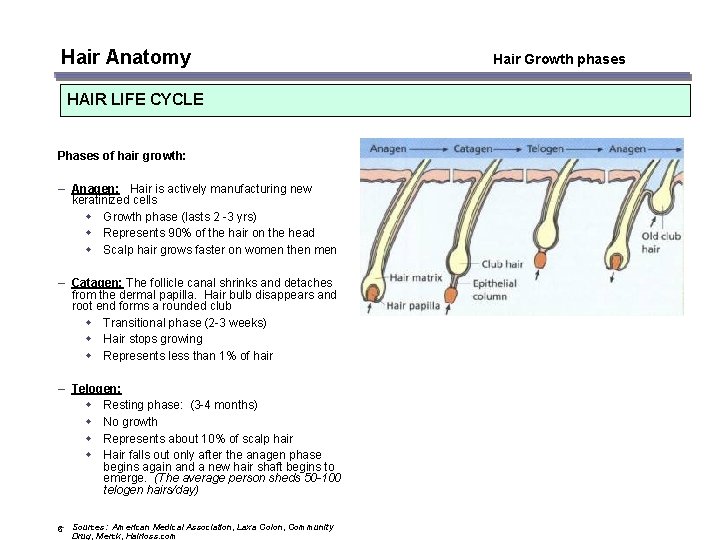
Hair Anatomy HAIR LIFE CYCLE Phases of hair growth: – Anagen: Hair is actively manufacturing new keratinized cells w Growth phase (lasts 2 -3 yrs) w Represents 90% of the hair on the head w Scalp hair grows faster on women then men – Catagen: The follicle canal shrinks and detaches from the dermal papilla. Hair bulb disappears and root end forms a rounded club w Transitional phase (2 -3 weeks) w Hair stops growing w Represents less than 1% of hair – Telogen: w Resting phase: (3 -4 months) w No growth w Represents about 10% of scalp hair w Hair falls out only after the anagen phase begins again and a new hair shaft begins to emerge. (The average person sheds 50 -100 telogen hairs/day) 6– Sources: American Medical Association, Laxa Colon, Community Drug, Merck, Hairloss. com Hair Growth phases
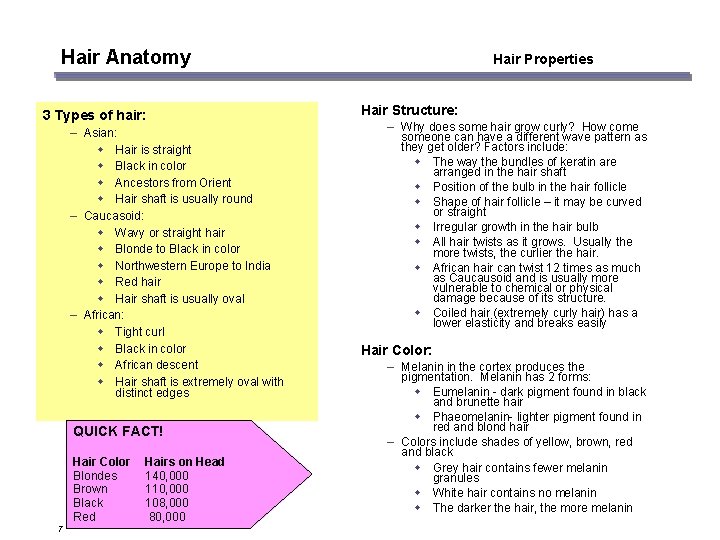
Hair Anatomy 3 Types of hair: – Asian: w Hair is straight w Black in color w Ancestors from Orient w Hair shaft is usually round – Caucasoid: w Wavy or straight hair w Blonde to Black in color w Northwestern Europe to India w Red hair w Hair shaft is usually oval – African: w Tight curl w Black in color w African descent w Hair shaft is extremely oval with distinct edges QUICK FACT! Hair Color Blondes Brown Black Red 7 Hairs on Head 140, 000 110, 000 108, 000 80, 000 Hair Properties Hair Structure: – Why does some hair grow curly? How come someone can have a different wave pattern as they get older? Factors include: w The way the bundles of keratin are arranged in the hair shaft w Position of the bulb in the hair follicle w Shape of hair follicle – it may be curved or straight w Irregular growth in the hair bulb w All hair twists as it grows. Usually the more twists, the curlier the hair. w African hair can twist 12 times as much as Caucausoid and is usually more vulnerable to chemical or physical damage because of its structure. w Coiled hair (extremely curly hair) has a lower elasticity and breaks easily Hair Color: – Melanin in the cortex produces the pigmentation. Melanin has 2 forms: w Eumelanin - dark pigment found in black and brunette hair w Phaeomelanin- lighter pigment found in red and blond hair – Colors include shades of yellow, brown, red and black w Grey hair contains fewer melanin granules w White hair contains no melanin w The darker the hair, the more melanin
Hair Anatomy Hair Properties Hair- What to look for in a client’s hair: – Healthy hair reflects light and looks shiny – Damaged hair looks dry, weak and dull: w As hair grows, the layers are worn down. This is sped up by wetting, sunlight, heat, sun, chemicals and friction. Hair Damage Facts: Usually hair damage takes place gradually in following stages: : – Hair is weakened – Cuticle begins to break down – Cuticle disappears, layer by layer – Cortex is exposed – Split ends appear – Hair breaks. Is conditioning really that important? YES! – – 8 Slows down the natural weathering and wearing down of the cortex Dry hair lacks moisture, and moisture must be restored to regain the healthy look Lack of moisture means the number of hydrogen bonds may be reduced Conditioning re-establishes the hydrogen bonds and improves the moisture content of the hair by improving the weatherproofing of the cuticle
Hair Anatomy Basic Hair Care 4 Step 1: Shampoo hair a minimum of 3 times weekly – Helps to remove dirt and buildup on the hair that can deteriorate the condition of the scalp – Shampoo must be worked through all of the hair – Rinse thoroughly to eliminate any residual detergents that can damage the hair shaft and scalp 4 Step 2: Condition and moisturize, moisturize – After shampooing the hair, condition for 3 to 5 minutes – Correct use of conditioners containing light proteins, such as hydrolyzed human hair keratin proteins, can help strengthen your hair – A good conditioner with these proteins can easily penetrate the hair shaft to replenish nutrients. These proteins can also repair split ends. Split ends develop after the protective cuticle has been stripped away from the end of hair fibers as a result of harsh chemicals or even vigorous brushing 4 Step 3: Protect the hair from the elements. – Use a leave-in conditioner that contains sun block (UV protector) – Excessive exposure to the sun can damage the hair by inducing oxidation of the sulfur molecules within the hair shaft, leaving the hair weak, brittle, dry and faded. People who bleach or lighten their natural hair color may also notice slight color changes in their hair when it is exposed to sun – Blond hair may turn yellow, fade or become dull due to UV exposure. Even natural brunette hair tends to develop reddish hues from sun exposure due to oxidation of melanin pigments 4 Step 4: Maintain a healthy diet – Hair requires the same overall nutrition that the body does: plenty of fresh fruits and vegetables, grains and protein including lean meat and fish – Dietitians recommend foods high in biotin, including brown rice, bulgar, brewer’s yeast, soybeans, green peas, lentils, oats, sunflower, seeds and nutritious nuts – Nutritionists advise healthy hair seekers to eat well-balanced diets that incorporate healthy proteins along with foods high in vitamins B, C, E, A and K – Hair instantly responds to the addition of protein-rich foods such as meats, eggs, cheese, seeds and nuts. Fish packs a double punch of protein combined with healthbuilding essential fatty acids and natural oils. 9
Hair Anatomy Client Fact Finding What you should know about your client: – Hair Type and implications for having different types of hair – Salon habits of your client w How often is he/she visiting a salon? w Why types of services? Hair Cut, chemical treatments, other – Hair Care Habits at home w Products w How often shampooing and conditioning hair? w Is he/she doing something to contribute to hair loss? · Heat, tight braids, chemical damage? 10
Hair Anatomy Fun Quiz QUIZ: 1. What are the 2 types of hair found on the body? 2. What are the 3 phases of hair growth and how long do they last? 3. What are the 3 layers of the hair shaft? 4. What is the difference between the hair follicle and hair shaft? 5. Why is some hair curly and some straight? BONUS QUESTIONS: 1. What is a furuncle? 2. What is pediculosis capitis? What should you do if you have a client that has this condition? 11