
Hair Evidence Notes on Provided Notes Page The



- Slides: 23
Hair Evidence Notes on Provided Notes Page
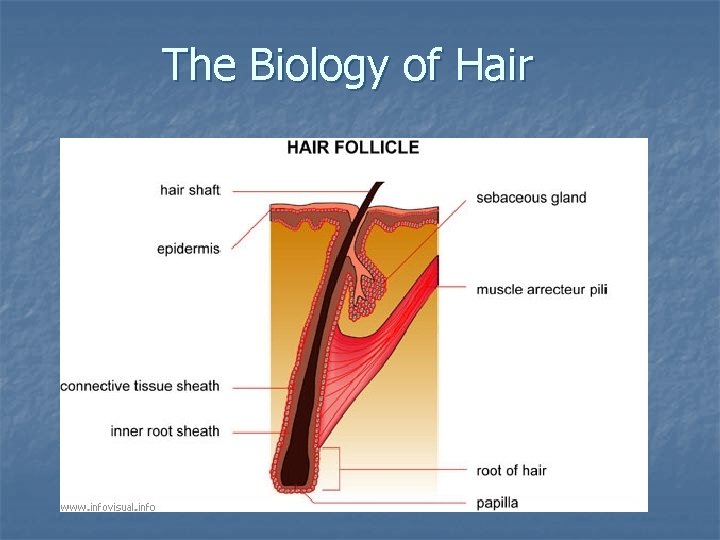
The Biology of Hair
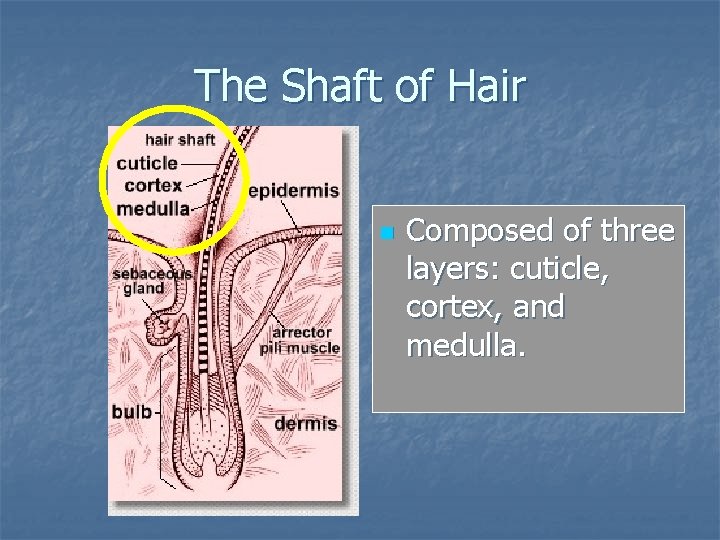
The Shaft of Hair n Composed of three layers: cuticle, cortex, and medulla.
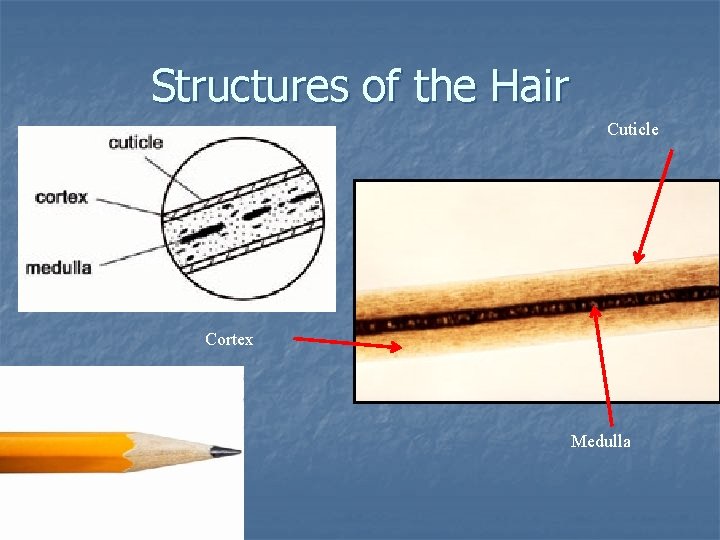
Structures of the Hair Cuticle Cortex Medulla
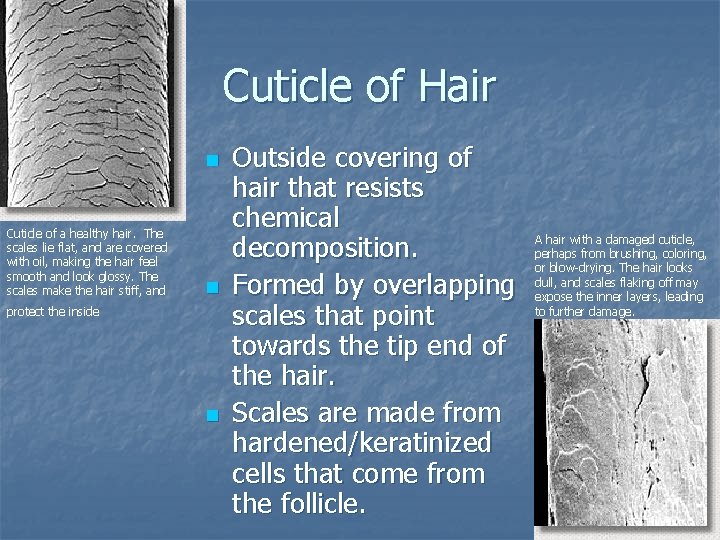
Cuticle of Hair n Cuticle of a healthy hair. The scales lie flat, and are covered with oil, making the hair feel smooth and look glossy. The scales make the hair stiff, and n protect the inside n Outside covering of hair that resists chemical decomposition. Formed by overlapping scales that point towards the tip end of the hair. Scales are made from hardened/keratinized cells that come from the follicle. A hair with a damaged cuticle, perhaps from brushing, coloring, or blow-drying. The hair looks dull, and scales flaking off may expose the inner layers, leading to further damage.
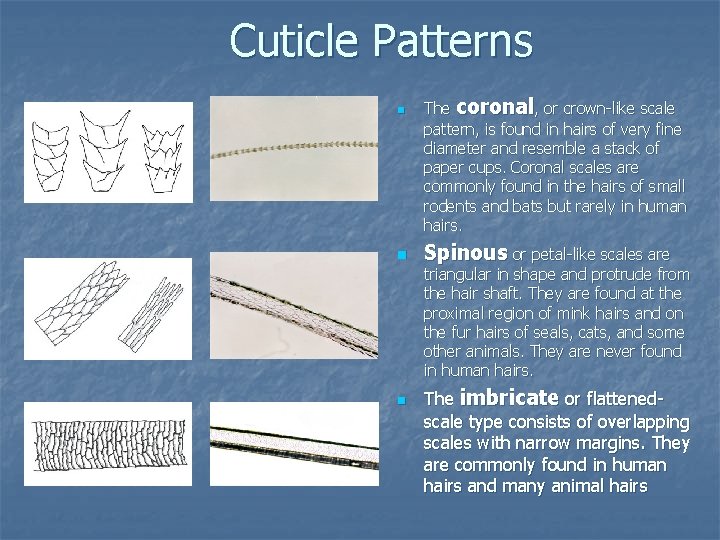
Cuticle Patterns n n The coronal, or crown-like scale pattern, is found in hairs of very fine diameter and resemble a stack of paper cups. Coronal scales are commonly found in the hairs of small rodents and bats but rarely in human hairs. Spinous or petal-like scales are triangular in shape and protrude from the hair shaft. They are found at the proximal region of mink hairs and on the fur hairs of seals, cats, and some other animals. They are never found in human hairs. n The imbricate or flattenedscale type consists of overlapping scales with narrow margins. They are commonly found in human hairs and many animal hairs
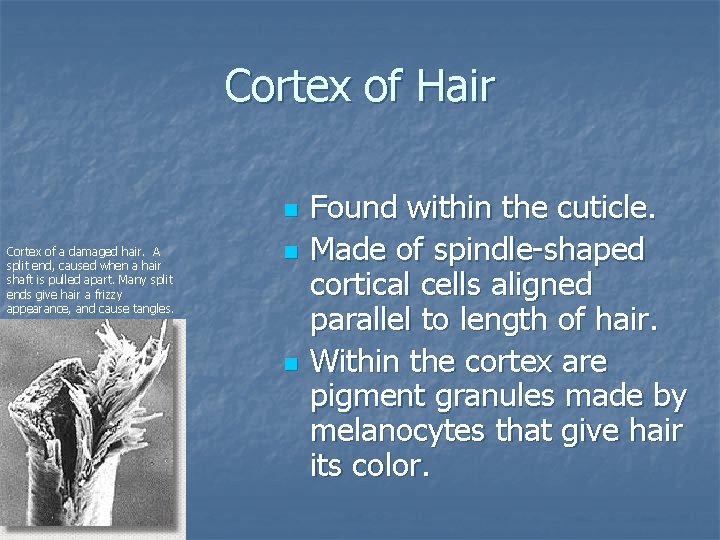
Cortex of Hair n Cortex of a damaged hair. A split end, caused when a hair shaft is pulled apart. Many split ends give hair a frizzy appearance, and cause tangles. n n Found within the cuticle. Made of spindle-shaped cortical cells aligned parallel to length of hair. Within the cortex are pigment granules made by melanocytes that give hair its color.
Just for fun! Your natural Hair color is determined by three factors 1. The type of natural color pigment melanin present in your hair's cortex. n Eumelanin (black pigment) n Phenomelanin (red/yellow pigment) 2. How many melanin granules exist 3. Whether those granules are close together or far apart
How Melanin pigments determine your or f t natural haircolor: Jus ! n u f n n Black hair contains densely packed melanin granules full of eumelanin. Brown hair has a loose pattern of eumelanin-filled granules or granules blended with eumelanin and phenomelanin, depending upon its cool or warm tones and its darkness or lightness. Blonde hair contains few granules with minimal bits of eumelanin. In fact, the eumelanin is so sparse that the color of blonde hair is the color of the hair fiber itself. Red hair has loosely packed granules containing phenomelanin.
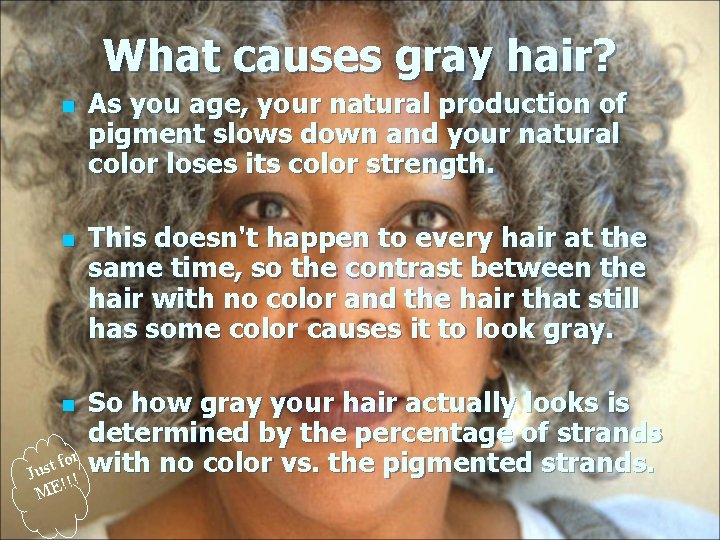
What causes gray hair? n n As you age, your natural production of pigment slows down and your natural color loses its color strength. This doesn't happen to every hair at the same time, so the contrast between the hair with no color and the hair that still has some color causes it to look gray. So how gray your hair actually looks is determined by the percentage of strands for with no color vs. the pigmented strands. t s Ju ! n !! E M
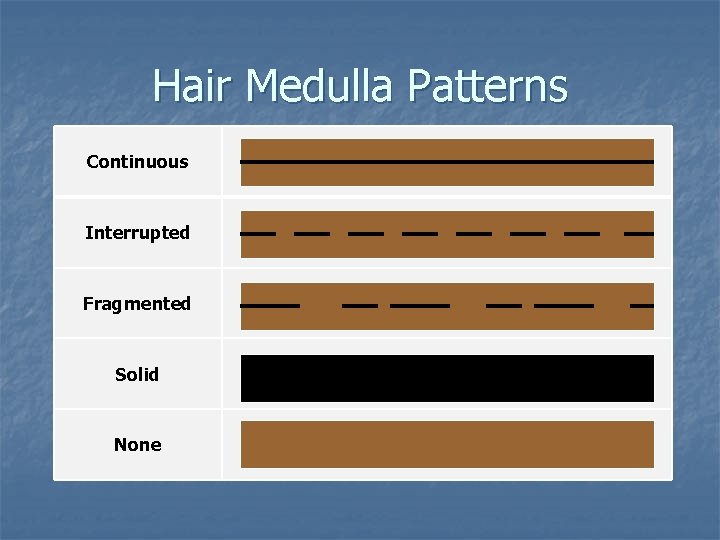
Medulla of Hair n n n Collection of cells that look like a canal running through a hair. Not all hairs have medullae Can be classified as continuous ( most animals, human rare, Mongoloid race), fragmented (most animals, human) or absent (human).
Hair Medulla Patterns Continuous Interrupted Fragmented Solid None
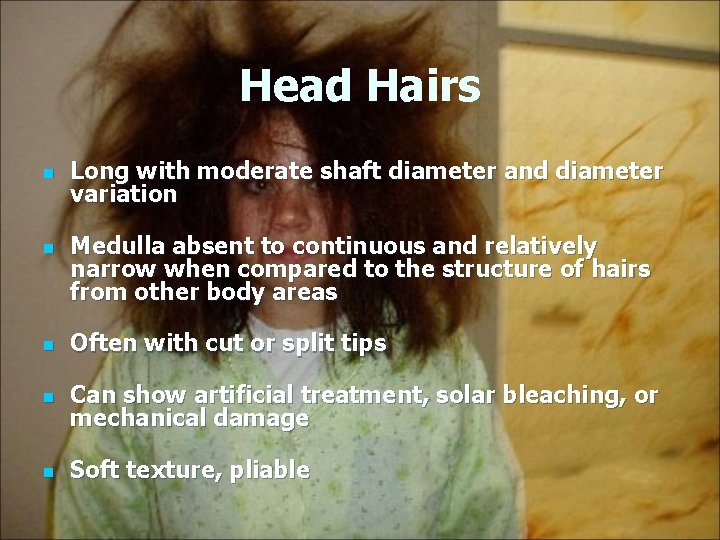
Head Hairs n n Long with moderate shaft diameter and diameter variation Medulla absent to continuous and relatively narrow when compared to the structure of hairs from other body areas n Often with cut or split tips n Can show artificial treatment, solar bleaching, or mechanical damage n Soft texture, pliable
Pubic Hairs Medulla relatively broad and usually continuous when present Shaft diameter coarse with wide variations and buckling Root frequently with tag Tip usually tapered, rounded, or abraded Stiff texture, wiry
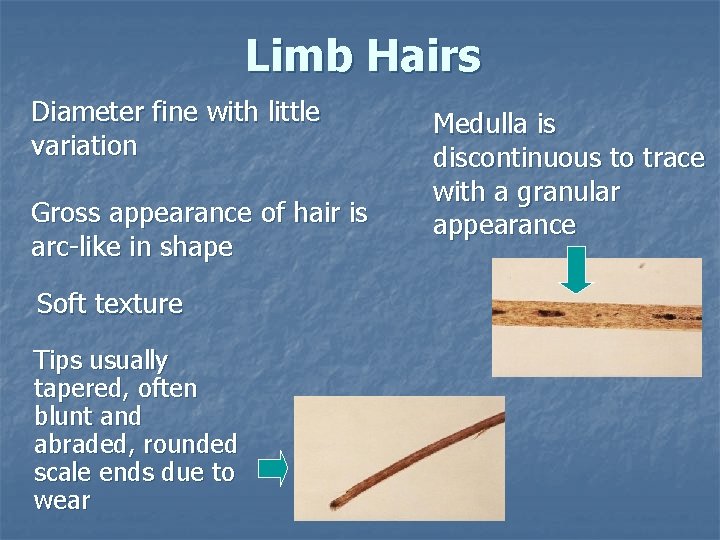
Limb Hairs Diameter fine with little variation Gross appearance of hair is arc-like in shape Soft texture Tips usually tapered, often blunt and abraded, rounded scale ends due to wear Medulla is discontinuous to trace with a granular appearance
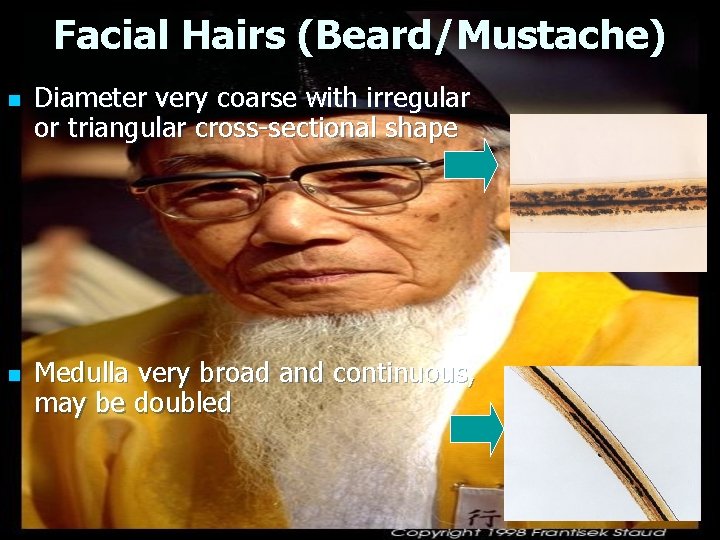
Facial Hairs (Beard/Mustache) n n Diameter very coarse with irregular or triangular cross-sectional shape Medulla very broad and continuous, may be doubled
Chest Hairs n Shaft diameter moderate and variable n Tip often darker in color, long and fine, arc -like n Medulla may be granular n Stiff texture
Axillary or Underarm Hairs n Resemble pubic hairs in general appearance, but less wiry n Medullary appearance similar to limb hairs n Diameter moderate and variable with less buckling than pubic hairs n Tips long and fine, frequently with bleached appearance
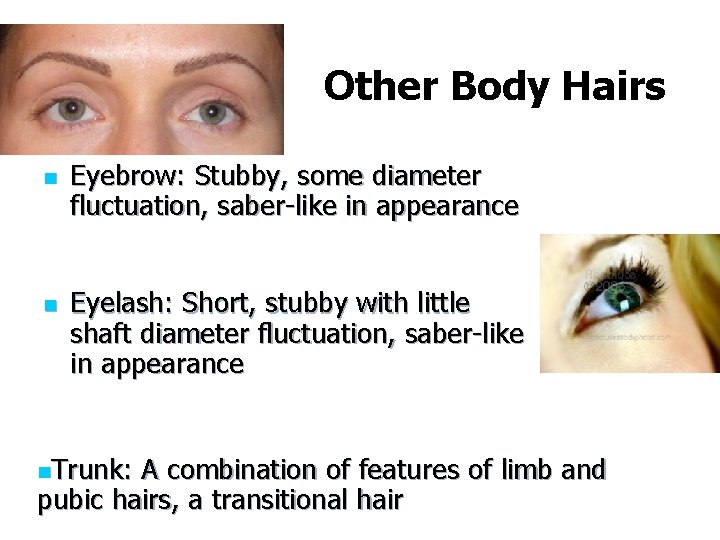
Other Body Hairs n n Eyebrow: Stubby, some diameter fluctuation, saber-like in appearance Eyelash: Short, stubby with little shaft diameter fluctuation, saber-like in appearance n. Trunk: A combination of features of limb and pubic hairs, a transitional hair
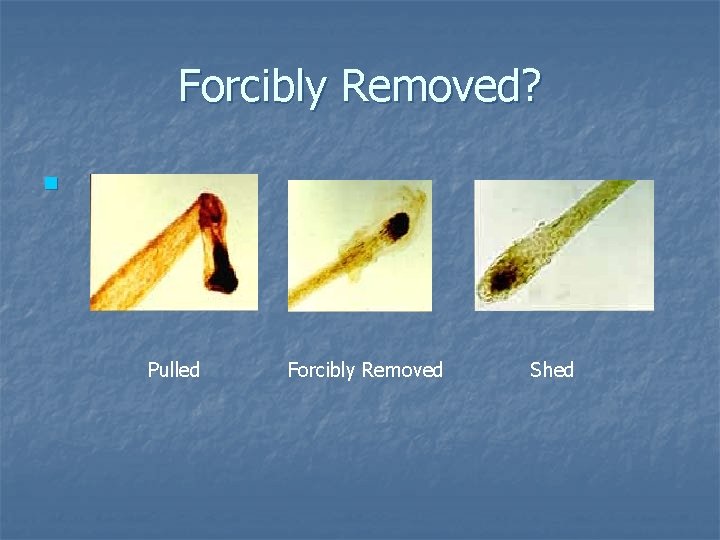
Forcibly Removed? n Pulled Forcibly Removed Shed
Collection of Hair Evidence n n Questioned and Reference hair must come from same area of the body; one cannot, for instance compare head hair to pubic hair. The collection of 50 full length hairs from all areas of the scalp will normally ensure a representative sampling of head hair.
Collection of Hair Evidence n n A minimum collection of 24 full length pubic hairs should cover the range of characteristics present in this type of hair. All collected hairs must be full-length so that the investigator can see if the color and morphological features vary throughout the length of the hair.
Packaging of Hair Evidence n n n Recover all hair present. If possible, use fingers or tweezers to pick up hair, place in paper bindles or coin envelopes which should then be folded and sealed in larger envelopes. Label the outer sealed envelope. If hair is attached, such as in dry blood, or caught in metal or a crack of glass, do not attempt to remove it but rather leave hair intact on the object. If the object is small, mark it, wrap it, and seal it in an envelope. If the object is large, wrap the area containing the hair in paper to prevent loss of hairs during shipment