
Hair Evidence Hairs as physical evidence Valuable because
Hair Evidence
Hairs as physical evidence • Valuable because can remain intact for years • So strong that they have same tensile strength of steel of same gauge • Presence often denotes physical contact

Morphology (Structure) of Hair • Made of keratin -- a protein • Consists of: – Root (bulb) – Shaft – Tip http: //www. hshairclinic. co. uk/_images/hair_structure. jpg

Root • When pulled from head, some translucent tissue surrounding the hair shaft near the root may be found • Called “follicular tag” http: //www. fbi. gov/about-us/lab/forensic-sciencecommunications/fsc/jan 2004/research/images/fig 58. jpg

Follicular Tags: Can be used for DNA analysis http: //hannahc 12. files. wordpress. com/2010/04/picture-92. png

Hair Shaft Structure: Cuticle, Cortex and Medulla • 3 sections to a hair shaft – Medulla (interior) – Cortex (main section) – Cuticle (exterior) http: //3. bp. blogspot. com/_xvkl. Wr. DLexk/S 8 tx. NTzo. Vb. I/AAAACAg/ Kbk 03 a. J 5 u 64/s 320/hair-cross-section. gif
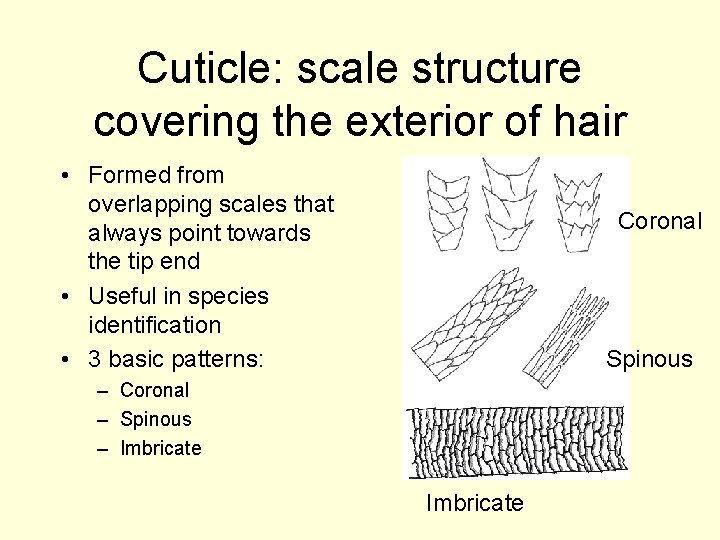
Cuticle: scale structure covering the exterior of hair • Formed from overlapping scales that always point towards the tip end • Useful in species identification • 3 basic patterns: Coronal Spinous – Coronal – Spinous – Imbricate
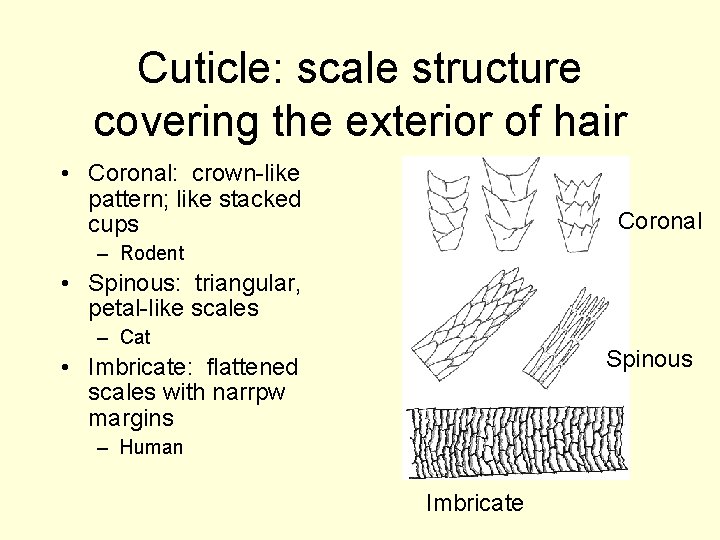
Cuticle: scale structure covering the exterior of hair • Coronal: crown-like pattern; like stacked cups Coronal – Rodent • Spinous: triangular, petal-like scales – Cat Spinous • Imbricate: flattened scales with narrpw margins – Human Imbricate
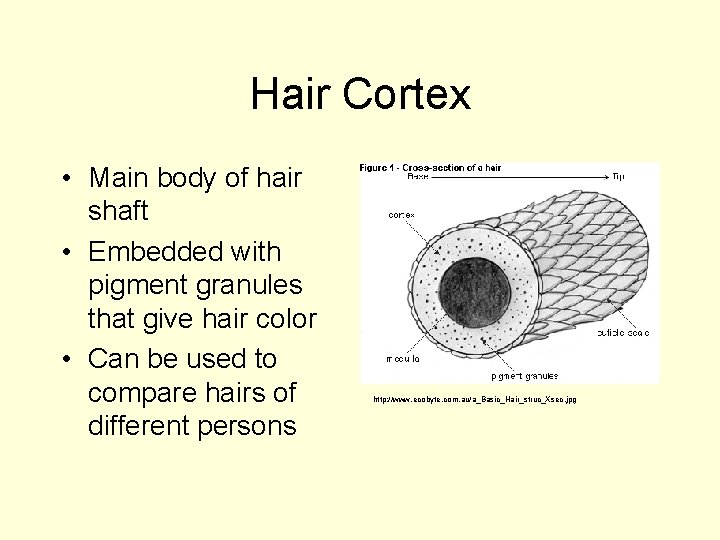
Hair Cortex • Main body of hair shaft • Embedded with pigment granules that give hair color • Can be used to compare hairs of different persons http: //www. ecobyte. com. au/a_Basic_Hair_struc_Xsec. jpg
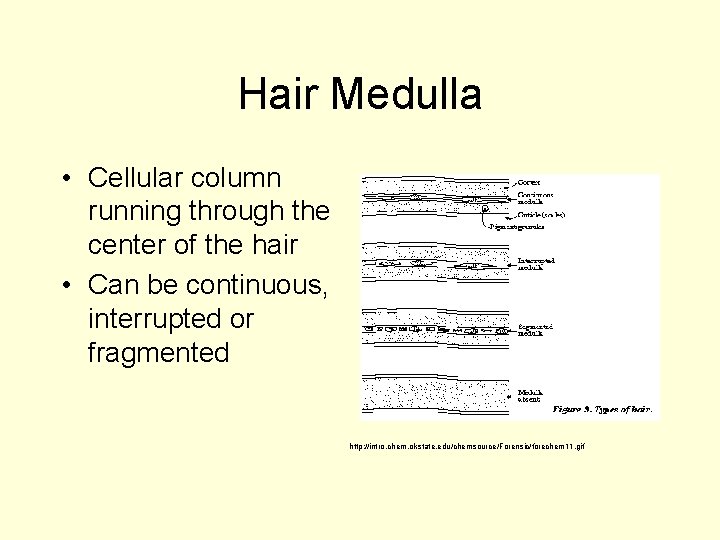
Hair Medulla • Cellular column running through the center of the hair • Can be continuous, interrupted or fragmented http: //intro. chem. okstate. edu/chemsource/Forensic/forechem 11. gif
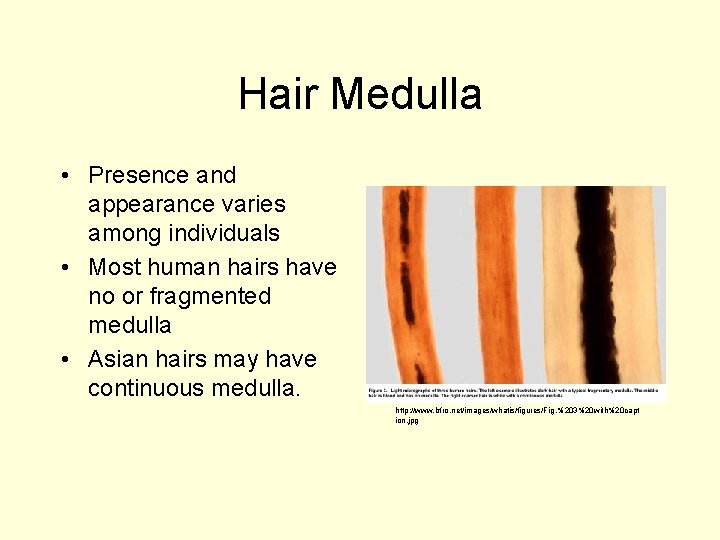
Hair Medulla • Presence and appearance varies among individuals • Most human hairs have no or fragmented medulla • Asian hairs may have continuous medulla. http: //www. bfro. net/images/whatis/figures/Fig. %203%20 with%20 capt ion. jpg
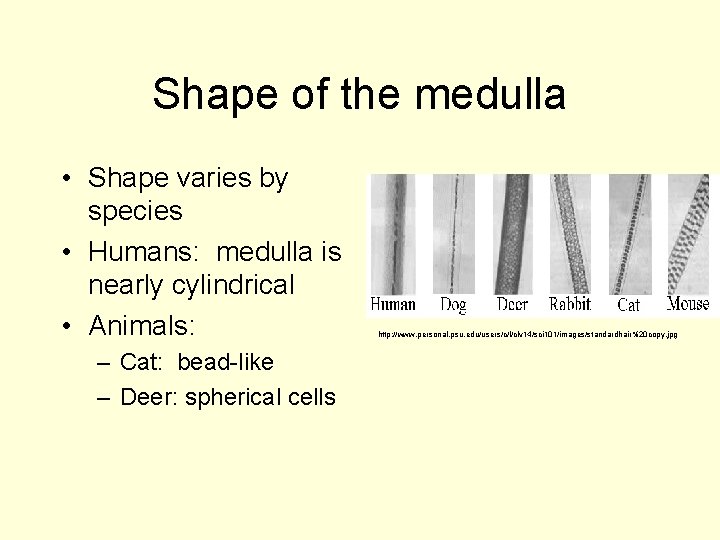
Shape of the medulla • Shape varies by species • Humans: medulla is nearly cylindrical • Animals: – Cat: bead-like – Deer: spherical cells http: //www. personal. psu. edu/users/c/l/clv 14/sci 101/images/standardhair%20 copy. jpg

Medullary Index • Varies by species • Calculation: Width of Medulla = MI Width of Cortex
Hair Comparison • Matching color, length and diameter • Can use microscope to distinguish animal hair from human hair • Animals: distinguish using scale structure, medullary index and shape • Humans: – distinguish by looking at presence or absence of medulla. – Distribution, shape and color intensity of pigment granules in cortex
Hair and DNA • Mitochondrial DNA can be extracted from the hair shaft – Inherited only from mother • The root contains nuclear DNA – Only present if hair is forcibly removed
- Slides: 15