
HAHNEMANNS INSTRUCTIONS CASE TAKING Dr PRIYANKA P S

- Slides: 135
HAHNEMANN’S INSTRUCTIONS –CASE TAKING Dr. PRIYANKA P. S, M. D (Hom) Asst. Professor, Department of Repertory Sarada Krishna Homoeopathic Medical College Kulasekharam SARADA KRISHNA HOMOEOPATHIC MEDICAL COLLEGE, DEPT. OF REPERTORY 1
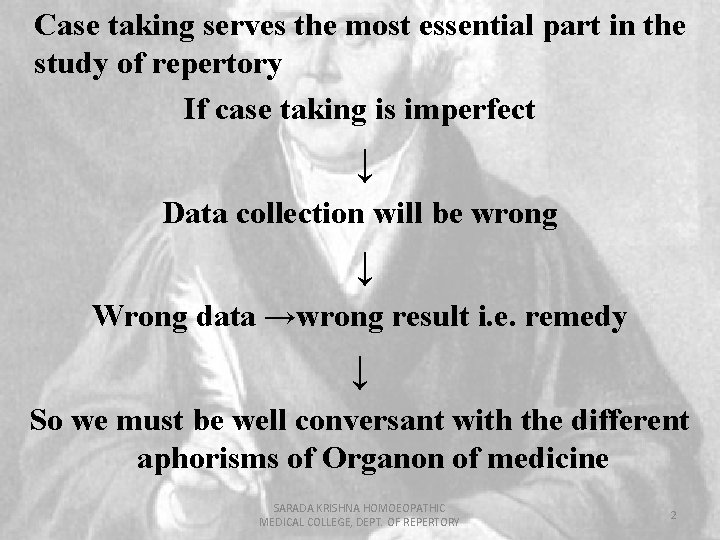
Case taking serves the most essential part in the study of repertory If case taking is imperfect ↓ Data collection will be wrong ↓ Wrong data →wrong result i. e. remedy ↓ So we must be well conversant with the different aphorisms of Organon of medicine SARADA KRISHNA HOMOEOPATHIC MEDICAL COLLEGE, DEPT. OF REPERTORY 2
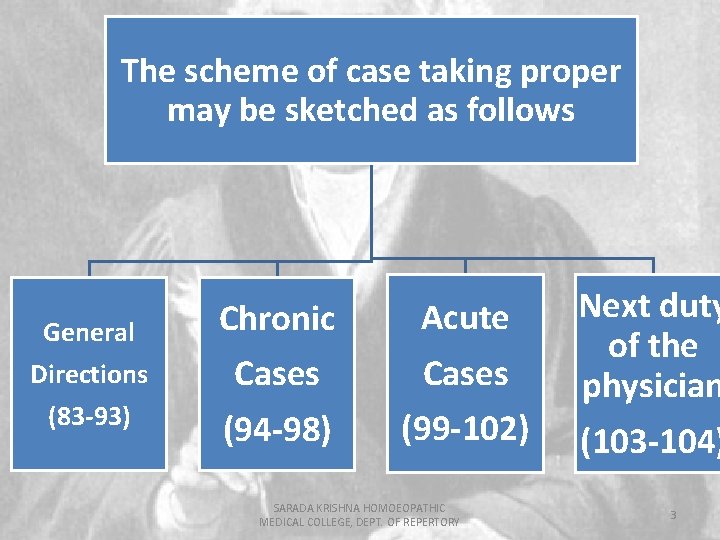
The scheme of case taking proper may be sketched as follows General Directions (83 -93) Chronic Cases (94 -98) Acute Cases (99 -102) SARADA KRISHNA HOMOEOPATHIC MEDICAL COLLEGE, DEPT. OF REPERTORY Next duty of the physician (103 -104) 3
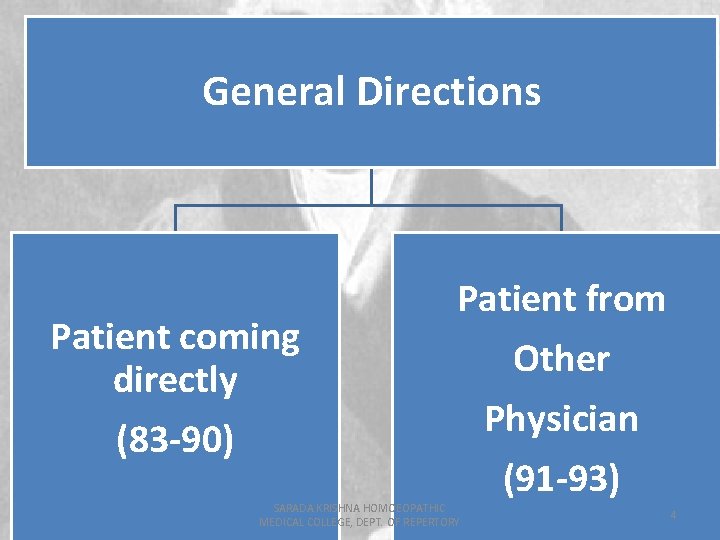
General Directions Patient coming directly (83 -90) Patient from SARADA KRISHNA HOMOEOPATHIC MEDICAL COLLEGE, DEPT. OF REPERTORY Other Physician (91 -93) 4
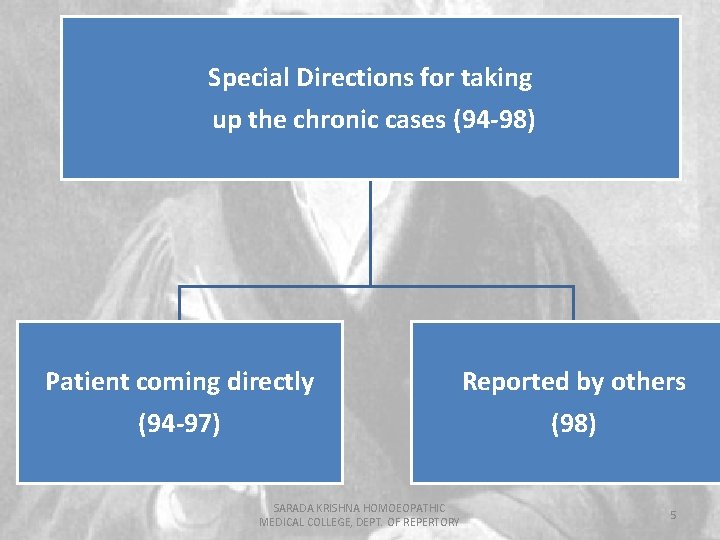
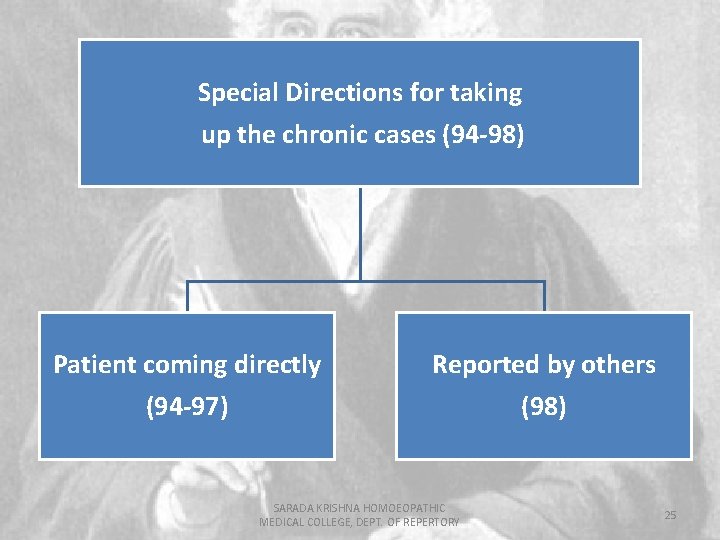
Special Directions for taking up the chronic cases (94 -98) Patient coming directly (94 -97) SARADA KRISHNA HOMOEOPATHIC MEDICAL COLLEGE, DEPT. OF REPERTORY Reported by others (98) 5
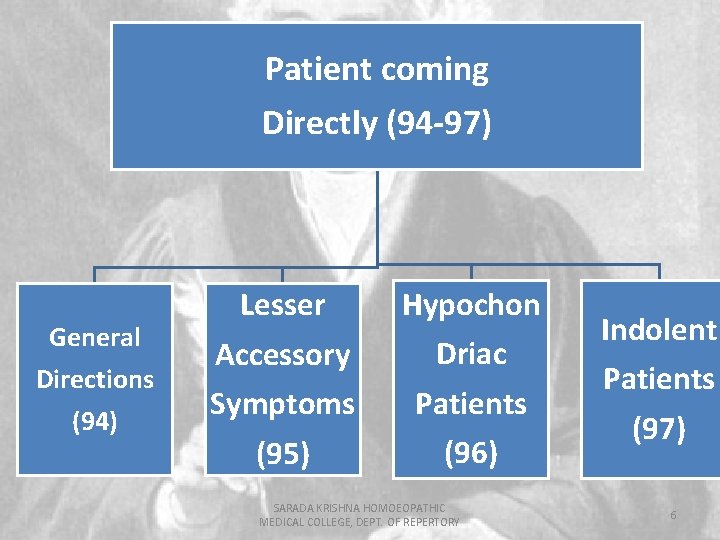
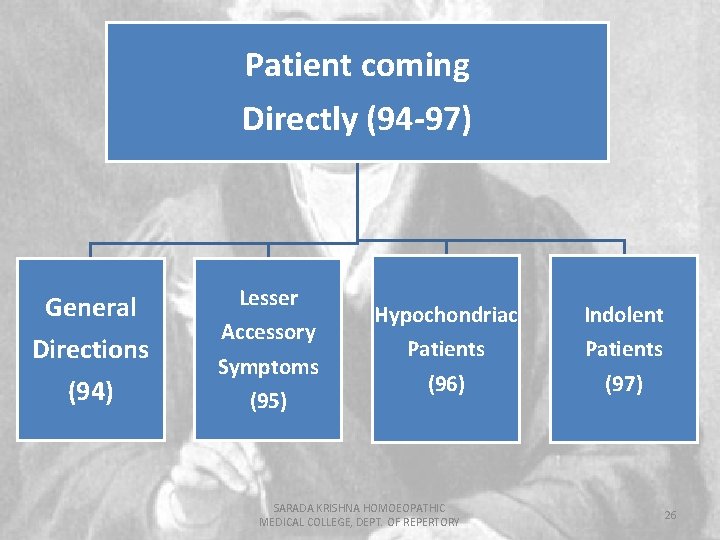
Patient coming Directly (94 -97) General Directions (94) Lesser Accessory Symptoms (95) Hypochon Driac Patients (96) SARADA KRISHNA HOMOEOPATHIC MEDICAL COLLEGE, DEPT. OF REPERTORY Indolent Patients (97) 6
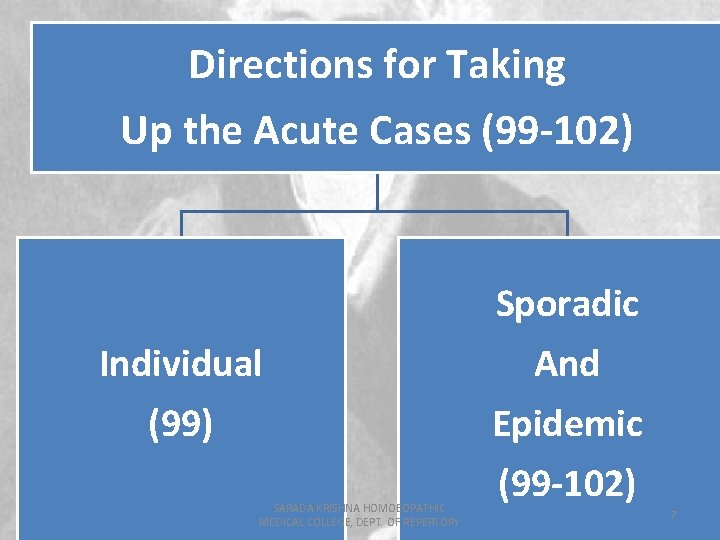
Directions for Taking Up the Acute Cases (99 -102) Sporadic Individual (99) SARADA KRISHNA HOMOEOPATHIC MEDICAL COLLEGE, DEPT. OF REPERTORY And Epidemic (99 -102) 7
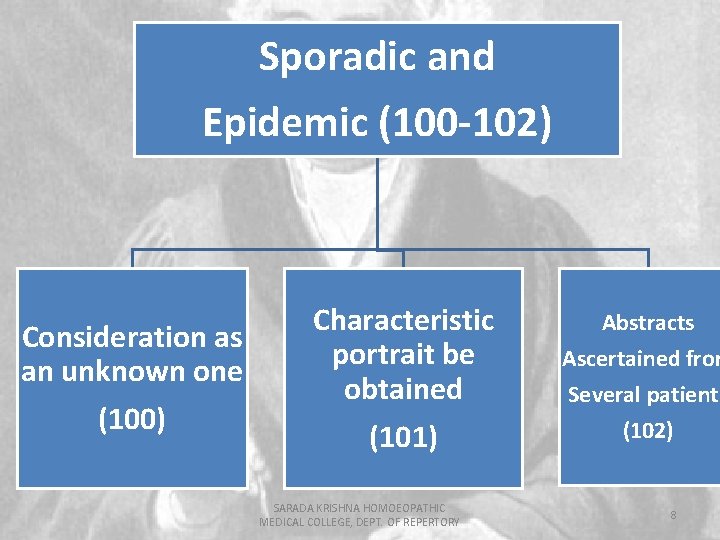
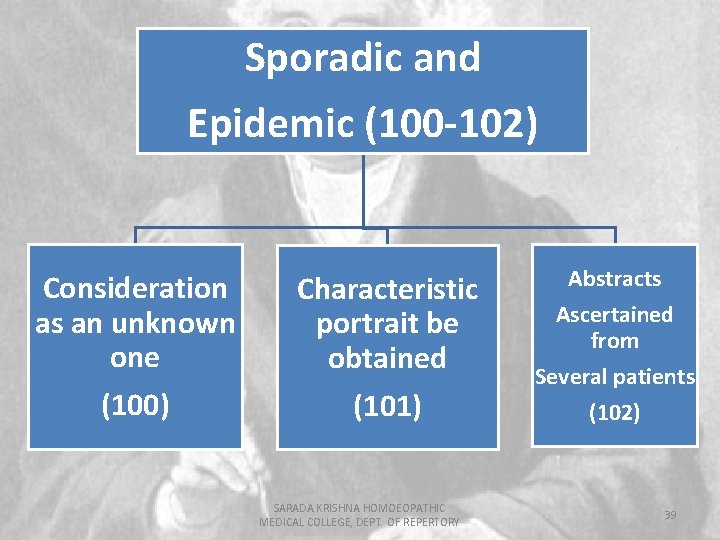
Sporadic and Epidemic (100 -102) Consideration as an unknown one (100) Characteristic portrait be obtained (101) SARADA KRISHNA HOMOEOPATHIC MEDICAL COLLEGE, DEPT. OF REPERTORY Abstracts Ascertained from Several patients (102) 8
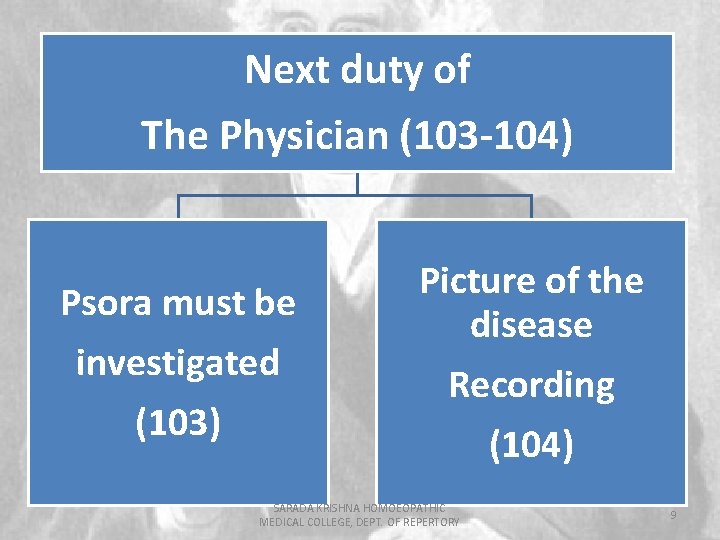
Next duty of The Physician (103 -104) Psora must be investigated (103) Picture of the disease Recording (104) SARADA KRISHNA HOMOEOPATHIC MEDICAL COLLEGE, DEPT. OF REPERTORY 9
Aphorism- 83 • Physician’s Special Qualifications – Freedom from prejudice – Sound senses – Attention in observing – Fidelity in tracing the picture of the disease – What is applicable in each individual case of disease SARADA KRISHNA HOMOEOPATHIC MEDICAL COLLEGE, DEPT. OF REPERTORY 10
Aphorism -84 • Expression of patient & its important parts recordings SARADA KRISHNA HOMOEOPATHIC MEDICAL COLLEGE, DEPT. OF REPERTORY 11
Aphorism -85 Fresh line – separately arranged. 1. The process of writing down symptom during case taking Ø The symptoms should be written in 3 steps (84 -85) 1. Patient’s reports 2. Attendant’s reports 3. Physician’s observations 2. Very expression of the patient & his friends should be written down accurately SARADA KRISHNA HOMOEOPATHIC MEDICAL COLLEGE, DEPT. OF REPERTORY 12
The physician keeps himself silent and must not interfere during their detailment unless they wander off to other maters. 4. The physician advises them to speak slowly. 5. The physician should take down only the important parts of what the speakers say. 6. The physician should begin a fresh line with every new circumstances mentioned by the patient and his attendants, one below the other and later subsequently when more explicitly explained, be added up. 3. SARADA KRISHNA HOMOEOPATHIC MEDICAL COLLEGE, DEPT. OF REPERTORY 13
Aphorism -86 More precise information For having more precise information in case taking, the physician reads over the symptoms as they were related to him, one by one, and about each of them, he enquires for further particulars as follows 1. Location 5. concomitants 2. Sensation 6. Duration 3. Complaints 7. Causation 4. Modalities 8. Extensions 9. Time of occurrence SARADA KRISHNA HOMOEOPATHIC MEDICAL COLLEGE, DEPT. OF REPERTORY 14
Aphorism -87 No suggestive questions • • The physician must not frame his questions so as to suggest the answer to the patient If the physician asks suggestive questions, the answer will be in most cases “Yes” or “No”. This will: Mislead to answer in affirmative or negative These will be something untrue These will be half true These may not be strictly correct This sort of answer may take place due to the indolency of the patient. This sort of answer may be made to please the interrogator This sort of answer will produce a false picture of the disease, and SARADA KRISHNA HOMOEOPATHIC 15 MEDICAL COLLEGE, DEPT. OF REPERTORY an unsuitable mode of treatment then must result.
Aphorism -88 • • More special questions Then we will have to collect the symptoms of the parts not detailed before or we will have to enquire into the state of disposition of mind In doing this, the physician only makes use of general expressions, in order that his informants may be obliged to enter into special details concerning them. SARADA KRISHNA HOMOEOPATHIC MEDICAL COLLEGE, DEPT. OF REPERTORY 16
Aphorism -89 • More special questions If the physician feels he has not yet gained all the information he needs, he is at liberty and obliged to ask more precise and more special questions. SARADA KRISHNA HOMOEOPATHIC MEDICAL COLLEGE, DEPT. OF REPERTORY 17
Aphorism- 90 • • Observations and Ascertains Hahnemann in his case taking chapters has also advised for any manual or mechanical or laboratory examinations and diagnosis and prognosis by the following sentence. “He then makes a note of what he himself observes in the patient and ascertain how much of that peculiar to the patient in his healthy state. SARADA KRISHNA HOMOEOPATHIC MEDICAL COLLEGE, DEPT. OF REPERTORY 18
This discussion may be made in two steps. 1. Observation of the patient – includes mechanical, manual and laboratory examinations 1. Mechanical examinations include examination by the instruments e. g. stethoscope, hammer, needle, probe, auroscope, ENT set etc. 2. Manual examinations include palpation, percussion and inspection. 3. Laboratory examinations include chemical, microscopical examinations of stool, urine, blood, sputum, X-ray etc. SARADA KRISHNA HOMOEOPATHIC MEDICAL COLLEGE, DEPT. OF REPERTORY 19
2. Ascertains – may be divided into diagnosis and prognosis 1. The diagnosis may be by the modern conception of the disease- the names of different diseases as per their pathological states etc. or by homoeopathic nosology e. g. acute diseases, chronic diseases and their individual types e. g. Epidemic, Sporadic, Pseudochronic, Artificial, True etc. to Intermittent, Mental, Local etc. 2. The prognosis also may be done in both ways 1. 2. By modern way – for the next coming diseases or the effects. By homoeopathic thinking – curable or incurable, the processes of developments to take place after the SARADA KRISHNA HOMOEOPATHIC application of medicine. MEDICAL COLLEGE, DEPT. OF REPERTORY 20
Aphorism- 91 • If it is a slow case The symptoms and feelings of the patient during previous course of medicine do not furnish the pure picture of the disease. The physician requires 1. 2. • Symptoms and ailments which he suffered from before the use of the medicines Symptoms and ailments after they have been discontinued the medicines for several days So when such a slow or chronic case comes from other physician’s hands he must judge the above two points. SARADA KRISHNA HOMOEOPATHIC MEDICAL COLLEGE, DEPT. OF REPERTORY 21
If the patient comes after taking the medicines whose actions are still going on, he will take the following measures 1. The physician leaves him some days quite without medicine. 2. The physician administers something of an unmedicinal nature and defer to a subsequent period. 3. After the subsequent period he takes up the case as per direction set up in the case taking of the chronic cases with the general directions. • SARADA KRISHNA HOMOEOPATHIC MEDICAL COLLEGE, DEPT. OF REPERTORY 22
Aphorism- 92 • If it be of a rapid course The physician must not follow the above advice, because 1. 2. 3. The serious character admit of no delay The physician cannot ascertain what symptoms were present before the employment of medicine The complete picture of the disease will then be the conjoint malady formed by medicinal and original diseases and hence is more serious and dangerous. Here the patient demands prompt and efficient relief. So the physician should 1. Trace out the complete picture of the disease, i. e. conjoint malady formed by medicinal and original disease 2. Amply apply a suitable homoeopathic remedy by the conjoint totality. Thus the patient shall not fall a sacrifice to the injurious drugs he has swallowed. SARADA KRISHNA HOMOEOPATHIC MEDICAL COLLEGE, DEPT. OF REPERTORY 23
Aphorism- 93 If it be by some obvious cause – In either acute or chronic cases, the patient or his friends are questioned privately then, 1. Either they will mention it spontaneously. 2. They will tell everything when carefully interrogated SARADA KRISHNA HOMOEOPATHIC MEDICAL COLLEGE, DEPT. OF REPERTORY 24
Special Directions for taking up the chronic cases (94 -98) Patient coming directly (94 -97) Reported by others (98) SARADA KRISHNA HOMOEOPATHIC MEDICAL COLLEGE, DEPT. OF REPERTORY 25
Patient coming Directly (94 -97) General Directions (94) Lesser Accessory Symptoms (95) Hypochondriac Indolent Patients (96) Patients (97) SARADA KRISHNA HOMOEOPATHIC MEDICAL COLLEGE, DEPT. OF REPERTORY 26
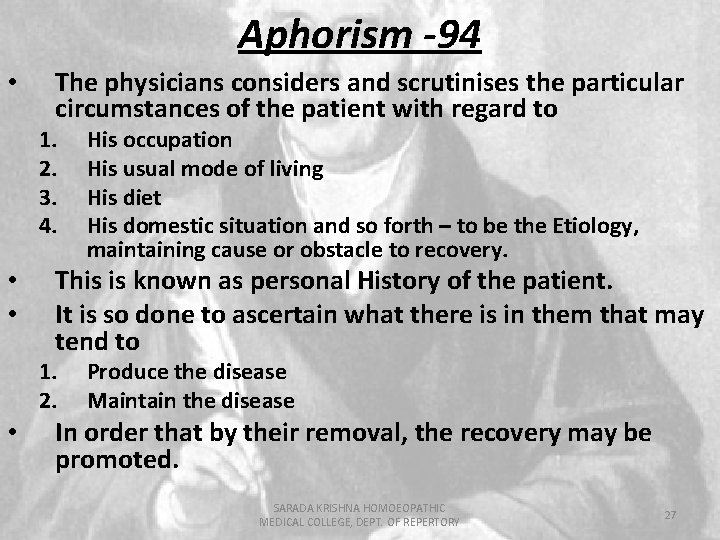
Aphorism -94 • The physicians considers and scrutinises the particular circumstances of the patient with regard to 1. 2. 3. 4. • • This is known as personal History of the patient. It is so done to ascertain what there is in them that may tend to 1. 2. • His occupation His usual mode of living His diet His domestic situation and so forth – to be the Etiology, maintaining cause or obstacle to recovery. Produce the disease Maintain the disease In order that by their removal, the recovery may be promoted. SARADA KRISHNA HOMOEOPATHIC MEDICAL COLLEGE, DEPT. OF REPERTORY 27
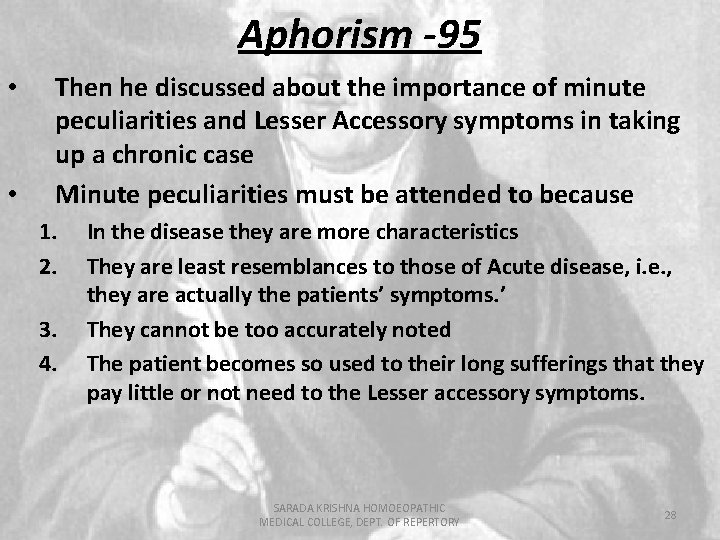
Aphorism -95 • • Then he discussed about the importance of minute peculiarities and Lesser Accessory symptoms in taking up a chronic case Minute peculiarities must be attended to because 1. 2. 3. 4. In the disease they are more characteristics They are least resemblances to those of Acute disease, i. e. , they are actually the patients’ symptoms. ’ They cannot be too accurately noted The patient becomes so used to their long sufferings that they pay little or not need to the Lesser accessory symptoms. SARADA KRISHNA HOMOEOPATHIC MEDICAL COLLEGE, DEPT. OF REPERTORY 28
The accessory symptoms are 1. Often very pregnant with meaning (characteristics) 2. Often very helpful in determining the choice of remedy and regard them as 1. 2. 3. A necessary part of their condition, almost as health Forget them sometimes, 15 or 20 years sufferings. Scarcely believes that these Accessory symptoms can have any connection with their principal malady SARADA KRISHNA HOMOEOPATHIC MEDICAL COLLEGE, DEPT. OF REPERTORY 29
Aphorism- 96 • He also warns about the Hypochondriac patient who detail much. They detail much due to their 1. Great sensitiveness 2. Impatient of sufferings 3. Habit of portraying their symptoms in the vivid colours. 4. Describe their symptoms in exaggerated expressions in order to induce the physician to give them prompt relief SARADA KRISHNA HOMOEOPATHIC MEDICAL COLLEGE, DEPT. OF REPERTORY 30
Aphorism- 97 • Similarly the indolent patient details less and they detail less due to 1. From indolence 2. From false modestly 3. From a kind of mildness of disposition or weakness of mind and thus 1. Refrain from mentioning a number of their symptoms. 2. Describe them in vague terms 3. Allege some of them to be of no consequence. SARADA KRISHNA HOMOEOPATHIC MEDICAL COLLEGE, DEPT. OF REPERTORY 31
Aphorism -98 • We shall attach credence (The mental attitude that something is believable and should be accepted as true) especially to the own expression of the patient, because 1. 2. 3. The patient endeavors to make us understand his ailments In the mouth of the friends and attendants they are usually altered and erroneously stated. The investigation of a true complete picture and its peculiarities demands 1. 2. 3. 4. 5. Special circumspection Tact Knowledge of human nature Caution in conducting the enquiry Patience in an eminent degree SARADA KRISHNA HOMOEOPATHIC MEDICAL COLLEGE, DEPT. OF REPERTORY 32
• Special circumspection – The physician should carefully observe and take note of all the thing peculiar to health and disease. He should be cautious, prudent (careful and sensible) and have an examining attitude. • Tact – A physician should be skilful and ingenious (showing inventiveness and skill) in managing the feeling of a patient. He should have the right perception in seeing and doing exactly what is best in the circumstance. • Knowledge of human nature – The physician should be aware of normal feelings, common reactions in various conditions and needs of the mind at various stages of SARADA KRISHNA HOMOEOPATHIC 33 MEDICAL COLLEGE, DEPT. OF REPERTORY life.
Caution in conducting the enquiry – The inquiry should be made with great care and respect to human life. The dignity of the individual should be maintained at any cost. The feelings of the patient should be respected and the physician should try to understand it in each case because the feelings and thoughts make a man, the physician should not scope or confront the past if it is not unavoidable. At any stage he should not enter into unnecessary arguments with the patients. The physician’s attitude and words should not be unpleasing to the patient. • SARADA KRISHNA HOMOEOPATHIC MEDICAL COLLEGE, DEPT. OF REPERTORY 34
• • Patience – the physician should have the quality of being able to listen patiently in order to understand the patient and his sickness. The physician’s patience gives a great relief and satisfaction to the patient and he is encouraged to narrate the story of his sickness by this attitude of the physician. Patience is also necessary to understand a person in totality. This helps the physician to have a controlled reaction while taking a case, SARADA KRISHNA HOMOEOPATHIC MEDICAL COLLEGE, DEPT. OF REPERTORY 35
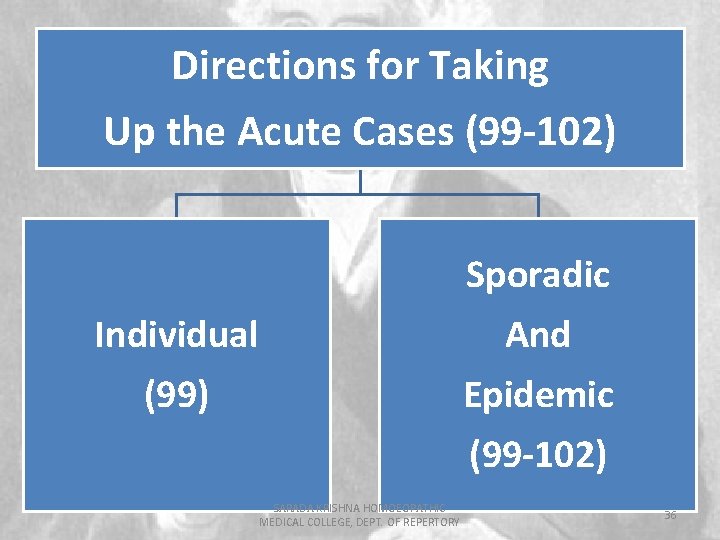
Directions for Taking Up the Acute Cases (99 -102) Sporadic Individual (99) And Epidemic (99 -102) SARADA KRISHNA HOMOEOPATHIC MEDICAL COLLEGE, DEPT. OF REPERTORY 36
Aphorism 99 -102 Hahnemann also has grouped the Acute diseases for proper case taking • Hahnemann has grouped the Acute diseases mainly into two. The two main groups are Individual types Sporadic and Epidemic types – – • He has put the sporadic and epidemic types into one group, because 1. 2. The peculiarity or novelty of the diseases of these kinds makes no difference either in their mode of examining or of treating it. Epidemics and sporadics resulting from a contagious principle always remains the same e. g. small pox, Measles, Cholera etc. SARADA KRISHNA HOMOEOPATHIC MEDICAL COLLEGE, DEPT. OF REPERTORY 37
Aphorism- 99 • • Individual acute diseases He also says that the investigation of an acute case is much easy for the Physician. The causes are 1. All the phenomena and deviation from the health of the patient are still fresh in the memory of the patient and his friends 2. These still continue to be novel (unusual) and striking 3. The physician has much less to inquire into. 4. Due to recent origin and nature of disease the symptoms come into notice of the physician without much difficulty. SARADA KRISHNA HOMOEOPATHIC 38 MEDICAL COLLEGE, DEPT. OF REPERTORY
Sporadic and Epidemic (100 -102) Consideration as an unknown one Characteristic portrait be obtained (100) (101) SARADA KRISHNA HOMOEOPATHIC MEDICAL COLLEGE, DEPT. OF REPERTORY Abstracts Ascertained from Several patients (102) 39
Aphorism -100 Consideration as an unknown one • – – – In case of an acute disease i. e. epidemic and sporadic a physician should study the disease carefully and examine it properly without being biased by earlier experiences. He should treat such disease as a unique and unknown one which might have some similarity in presentation or even in name but there always exists an individual characteristic. Even if the causation is same because of difference in constitution of a person, the effect i. e. the expressions would be always different at some sphere. However, the epidemics caused by the same source are found to be similar in common symptoms. SARADA KRISHNA HOMOEOPATHIC MEDICAL COLLEGE, DEPT. OF REPERTORY 40
Hahnemann has given some special advice in taking up an epidemic or sporadic cases in the following ways: 1. There is no difference either in the mode of examining or treating it, as, the physician must always regard the pure picture of every prevailing disease as it were something new and unknown and investigate thoroughly for itself. 2. He never substitutes conjectures for actual observations 3. He never takes for granted that the case of disease before him is already wholly or partially known SARADA KRISHNA HOMOEOPATHIC MEDICAL COLLEGE, DEPT. OF REPERTORY 41
1. He always carefully examines it in all its parts. 2. He knows, ”every prevailing disease is in many respects a phenomena of unique character differing vastly from all previous epidemics” 3. He knows, ” few exceptions of epidemics resulting from a contagious principle that always remain the same e. g. small pox, measles etc. SARADA KRISHNA HOMOEOPATHIC MEDICAL COLLEGE, DEPT. OF REPERTORY 42
Aphorism -101 § Characteristic portrait to be obtained § § § In epidemic cases the totality of disease is only known after the physician makes a study of several cases since the study of one case would only provide a partial picture of the disease. However an experienced physician might get a complete picture by studying a single case of epidemics just as an experiences person can perceive a complete picture by seeing a part alone And thus an experienced physician can prescribe a suitable homoeopathic remedy even after studying a single case or a few cases SARADA KRISHNA HOMOEOPATHIC MEDICAL COLLEGE, DEPT. OF REPERTORY 43
To get the complete picture of an epidemic case 1. It is only possible by a close examination of several cases of every such collective diseases. In that he can become conversant with the totality of its signs and symptoms. 2. The carefully observing physician can, however, from the examination of even the first or second patient often arrive so nearly at a knowledge of the true state as to have in his mind a characteristic portrait of it and even to succeed in finding a suitable, Homoeopathically adapted remedy for it. SARADA KRISHNA HOMOEOPATHIC MEDICAL COLLEGE, DEPT. OF REPERTORY 44
Aphorism -102 • Abstracts ascertained from several patients. – After a physician has studied several cases, it would be easy for him to get a clearer and more complete picture. – He should write them under general symptom and characteristic particulars. – These together constitute the totality of epidemics. – To know the complete picture of any epidemic, a physician must study its symptoms in several patients of different constitutions. – A medicine selected on the basis of this final totality is known as genus epidemicus. – It can be used for treating all the persons affected by the epidemic and also as a preventive medicine. SARADA KRISHNA HOMOEOPATHIC MEDICAL COLLEGE, DEPT. OF REPERTORY 45
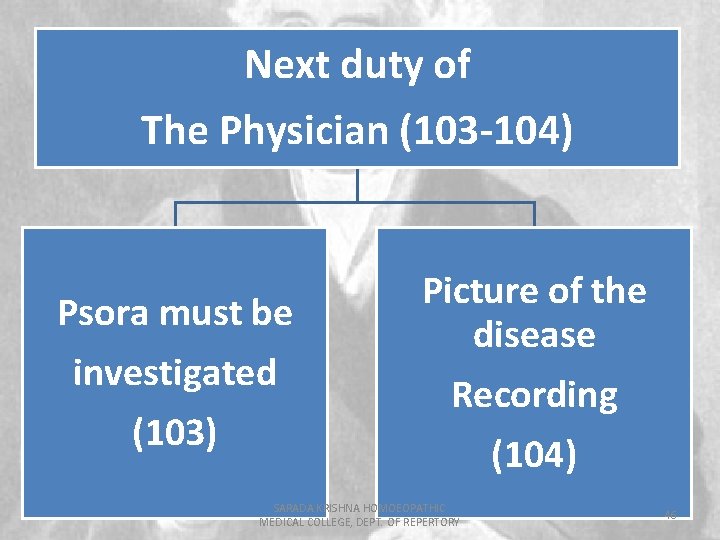
Next duty of The Physician (103 -104) Psora must be investigated (103) Picture of the disease Recording (104) SARADA KRISHNA HOMOEOPATHIC MEDICAL COLLEGE, DEPT. OF REPERTORY 46
Aphorism -103 • Psora must be investigated. – Because it is the fundamental cause of all diseases and is the mother of all chronic diseases. – From whatever kind of diseases the patient is suffering from, the background is always psoric. It is the soil on which the seeds of the other diseases germinate, grow and develops. Now the question is how? Here Hahnemann advises: SARADA KRISHNA HOMOEOPATHIC MEDICAL COLLEGE, DEPT. OF REPERTORY 47
1. Just like the processes of finding the specific medicine in epidemic diseases, we shall have to proceed to examine several cases suffering from psoric manifestations. 2. We shall have to note the whole sphere of their symptoms in much more minute manner. 3. In them, one patient only exhibits a portion of their symptoms a second, third and so on, present some other symptoms which are portions of the totality of the symptoms. SARADA KRISHNA HOMOEOPATHIC MEDICAL COLLEGE, DEPT. OF REPERTORY 48
4. The whole array of symptoms of such a miasmatic chronic disease can only be ascertained from observation of very many single patients affected with such a chronic disease 5. By the complete survey and collective picture of disease symptoms, the medicine capable of curing whole malady Homoeopathically can thus be discovered. 6. These maladies are at the same time remedies of several patients suffering from such chronic affections. SARADA KRISHNA HOMOEOPATHIC MEDICAL COLLEGE, DEPT. OF REPERTORY 49
Aphorism -104 • When the case taking is completed, the most difficult task of the physician is accomplished. The next duty of the physician will be – He will consider the CT reports to frame a picture of the disease especially if it be a chronic one – He will consider it as a guide in his treatment. – He will investigate in all its parts – He will pick up the characteristic symptoms – He will try to find out a very similar homoeopathic medicine from the list of symptoms of all medicines whose pure effects have been ascertained. SARADA KRISHNA HOMOEOPATHIC MEDICAL COLLEGE, DEPT. OF REPERTORY 50
The duty of a physician when the patient comes to him second time has been discussed in the following manner. 1. After prescribing a medicine, the physician will ask the patient to report him a few hours or days after as per type of disease and medicine with potency. 2. He will then note the effect of medicine and the changes that has taken place in the patient’s state of present health. SARADA KRISHNA HOMOEOPATHIC MEDICAL COLLEGE, DEPT. OF REPERTORY 51
3. He will have a fresh examination of the patient only on the following points: 1. He will strike out of the list of symptoms noted down at the first visit those that have been abolished (end). 2. He will mark what still remains. 3. He will add any new symptoms that may supervene (developed). 4. He will apply a + sign upon those symptoms which have been aggravated. 5. He will apply a – sign upon those symptoms which have become ameliorated but not completely abolished. SARADA KRISHNA HOMOEOPATHIC MEDICAL COLLEGE, DEPT. OF REPERTORY 52
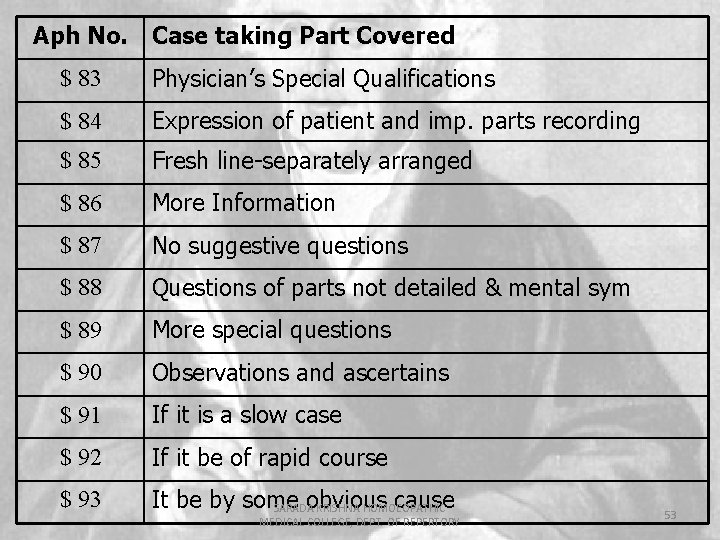
Aph No. Case taking Part Covered $ 83 Physician’s Special Qualifications $ 84 Expression of patient and imp. parts recording $ 85 Fresh line-separately arranged $ 86 More Information $ 87 No suggestive questions $ 88 Questions of parts not detailed & mental sym $ 89 More special questions $ 90 Observations and ascertains $ 91 If it is a slow case $ 92 If it be of rapid course $ 93 It be by some obvious cause SARADA KRISHNA HOMOEOPATHIC MEDICAL COLLEGE, DEPT. OF REPERTORY 53
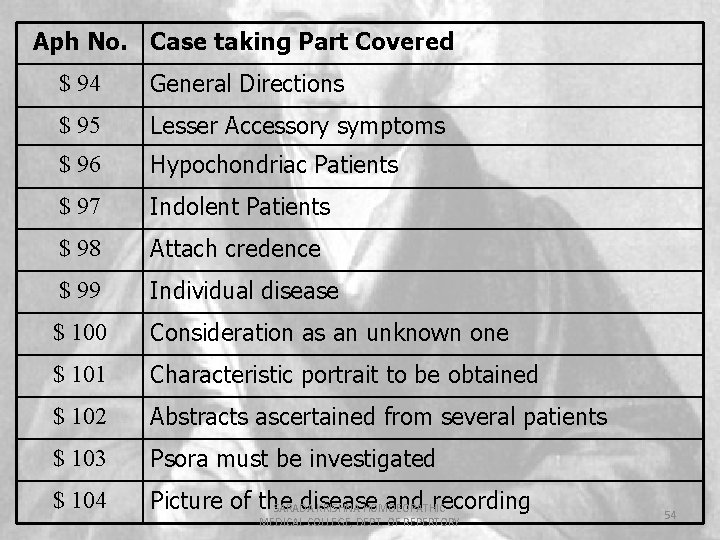
Aph No. Case taking Part Covered $ 94 General Directions $ 95 Lesser Accessory symptoms $ 96 Hypochondriac Patients $ 97 Indolent Patients $ 98 Attach credence $ 99 Individual disease $ 100 Consideration as an unknown one $ 101 Characteristic portrait to be obtained $ 102 Abstracts ascertained from several patients $ 103 Psora must be investigated $ 104 Picture of the disease and recording SARADA KRISHNA HOMOEOPATHIC MEDICAL COLLEGE, DEPT. OF REPERTORY 54
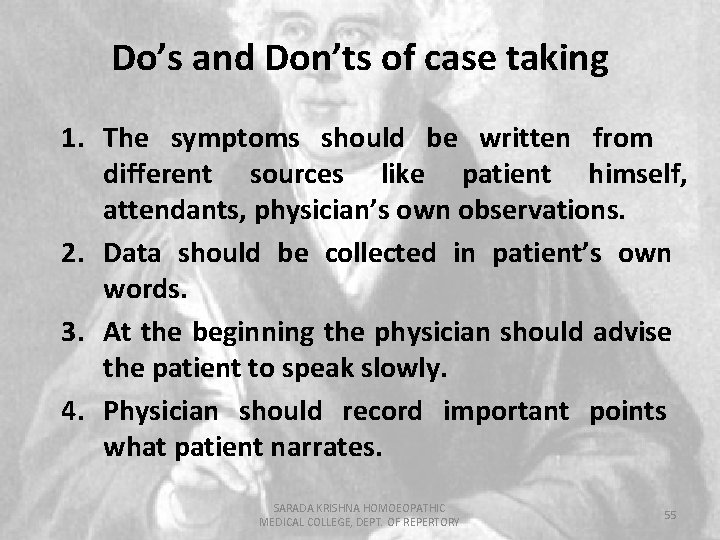
Do’s and Don’ts of case taking 1. The symptoms should be written from different sources like patient himself, attendants, physician’s own observations. 2. Data should be collected in patient’s own words. 3. At the beginning the physician should advise the patient to speak slowly. 4. Physician should record important points what patient narrates. SARADA KRISHNA HOMOEOPATHIC MEDICAL COLLEGE, DEPT. OF REPERTORY 55
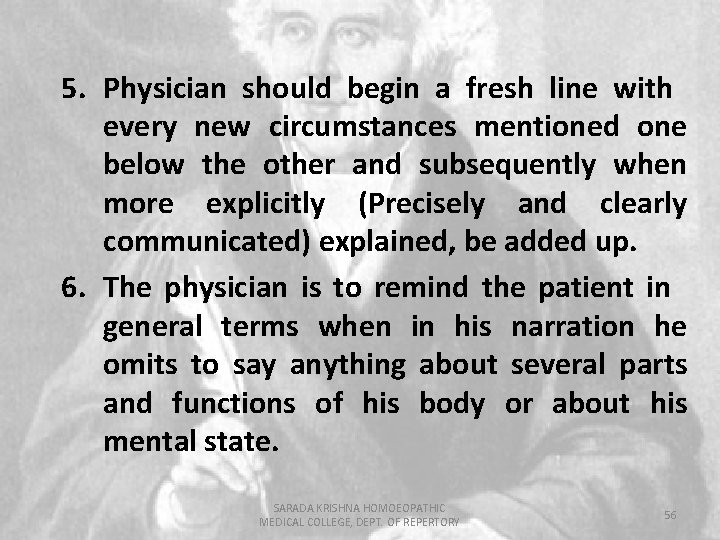
5. Physician should begin a fresh line with every new circumstances mentioned one below the other and subsequently when more explicitly (Precisely and clearly communicated) explained, be added up. 6. The physician is to remind the patient in general terms when in his narration he omits to say anything about several parts and functions of his body or about his mental state. SARADA KRISHNA HOMOEOPATHIC MEDICAL COLLEGE, DEPT. OF REPERTORY 56
7. Special questions are to be asked only when the physician feels that the peculiar, uncommon symptoms of the case has not yet come out in the case taking. 8. Finally the physician has to note down his own observations about the individual peculiarity of the patient in disease and health. SARADA KRISHNA HOMOEOPATHIC MEDICAL COLLEGE, DEPT. OF REPERTORY 57
DONT’S OF CASE TAKING: 1. Don’t interrupt unless patient or his attendant wanders of to the other matters. 2. Don’t ask any direct question that can be answered by yes or no OR don’t ask any leading question that suggest an answer. 3. If patient coming from other physician 1. In chronic cases the original disease picture is to be obtained by referring to the original symptoms appearing before taking medicine or after discontinuing it for several days when the medicinal effects go away SARADA KRISHNA HOMOEOPATHIC MEDICAL COLLEGE, DEPT. OF REPERTORY 58
2. In acute diseases that are of rapid course, a complete picture of the conjoint malady is to be taken into consideration and a suitable homoeopathic medicine is to be prescribed 3. An obvious cause may be present in an acute or a chronic disease, which is to be ascertained. SARADA KRISHNA HOMOEOPATHIC MEDICAL COLLEGE, DEPT. OF REPERTORY 59
CONCEPT OF CASE TAKING IN DIFFERENT TYPES OF DISEASES SARADA KRISHNA HOMOEOPATHIC MEDICAL COLLEGE, DEPT. OF REPERTORY 60
CASE TAKING IN INDIVIDUAL ACUTE DISEASES SARADA KRISHNA HOMOEOPATHIC MEDICAL COLLEGE, DEPT. OF REPERTORY 61
Aphorism 72 • Acute diseases are rapid morbid processes of abnormally deranged vital force. • In acute diseases symptoms evolve quickly and the patient remembers all of them. • Sometimes the disease may be of serious character and demands attention hence the physician must give prompt and efficient aid. SARADA KRISHNA HOMOEOPATHIC MEDICAL COLLEGE, DEPT. OF REPERTORY 62
• In acute diseases the chief complaint strike us and become evident to the senses more quickly than in chronic disease and so less time is required for tracing the picture of disease and much few questions have to be asked. • Acute diseases are caused by an exciting or acute miasms. SARADA KRISHNA HOMOEOPATHIC MEDICAL COLLEGE, DEPT. OF REPERTORY 63
• As a physician you must examine the patient and see what are his symptoms but this is not sufficient. • Sometimes there are things that physician cannot know and can’t observe, so here also all sources of getting totality must be examined. SARADA KRISHNA HOMOEOPATHIC MEDICAL COLLEGE, DEPT. OF REPERTORY 64
• Dr. Hahnemann said in $99, on the whole investigation of acute disease, or of such as have existed but a short time, is much the easiest for the physician because all phenomena and deviations from the health has been but recently lost are still fresh in memory of patient and his friends still continue to novel and striking. • The physician certainly require knowing everything in such cases also, but he was much more to inquire into, they are for the most part spontaneous detailed to him. SARADA KRISHNA HOMOEOPATHIC MEDICAL COLLEGE, DEPT. OF REPERTORY 65
Totality in Acute Diseases • In acute disease, the disorder is located in the lower scale of life. • The central life force is disturbed somewhat, but the change is more superficial in nature. Hence we should concentrate on the particular symptoms. • In acute disease total characteristic symptoms helps in forming totality, one can divide the concept into sector totality and fixed general totality. SARADA KRISHNA HOMOEOPATHIC MEDICAL COLLEGE, DEPT. OF REPERTORY 66
• Sector totality contains symptoms with peculiarities in relation to location, sensation, and modalities. • Fixed totality covers changes at physical, general and mental level. • In all, exciting causes, modalities and other characteristic in relation to physical generals help in forming totality in acute diseases. • Also we can consider objective symptoms, pathological type, location etc. as an eliminating symptom. SARADA KRISHNA HOMOEOPATHIC MEDICAL COLLEGE, DEPT. OF REPERTORY 67
• Dr. Boericke writes, ” often in the course of acute diseases, and in children, where no characteristic symptoms can be obtained, a pathological correspondence may be the only resource, but it is otherwise in the treatment of most chronic diseases. • The totality of symptoms changes more rapidly in acute conditions than in chronic. SARADA KRISHNA HOMOEOPATHIC MEDICAL COLLEGE, DEPT. OF REPERTORY 68
Treating Acute Diseases • If anybody wants to compare prescribing for acute with prescribing for chronic it will be shown that it is more difficult to select a remedy for acute case than a chronic one. • Many seemingly acute conditions are not true diseases but mere indisposition which disappear of themselves under ordinary circumstances when the cause is removed, or yield easily to corrective hygienic, dietic, moral or mechanical measures. SARADA KRISHNA HOMOEOPATHIC MEDICAL COLLEGE, DEPT. OF REPERTORY 69
• Homoeopathic remedy in acute disease accelerate the natural process, which is set in motion by the defensive mechanism. • Acute disease can be aborted without unfavorable consequences but chronic cases cannot be aborted, e. g. A boil, catarrhal fever etc can be aborted which may not prove harmful in the future. But eczema has to be cured by the proper remedy. SARADA KRISHNA HOMOEOPATHIC MEDICAL COLLEGE, DEPT. OF REPERTORY 70
Prescribing in Acute Diseases 1. Examine the entire complaints and select a drug on the totality of symptoms. 2. If totality indicates drug clearly, give it preferably first in medium potency and watch as far as possible effect of each dose, repeating at first, perhaps every 2/3 hours. 1. If improvement sets in well and good, stop the remedy or at least lengthen the interval between doses while improvement lasts. 2. If improvement ceases, reconsider the case to determine if the indication points to a change of remedy. 3. If they do not, repeat the first chosen drug preferable in a highest potency. SARADA KRISHNA HOMOEOPATHIC MEDICAL COLLEGE, DEPT. OF REPERTORY 71
3. When a short acting remedy has almost cured the patient, a corresponding deep acting remedy is often required to finish the case but there should be never any haste to give the latter drug so long as the improvement continues and progress is steady. SARADA KRISHNA HOMOEOPATHIC MEDICAL COLLEGE, DEPT. OF REPERTORY 72
• Sometimes we meet with “Acute exacerbation of chronic disease. ” • Dr. Kent says, ” Avoid getting confused by two disease, images that may exists in the body at the same time. ” • A chronic patient, for instance may be suffering from an acute disease and the physician on being called may say that it is necessary to take the totality of symptoms; take only the acute symptoms, which came on since the attack. SARADA KRISHNA HOMOEOPATHIC MEDICAL COLLEGE, DEPT. OF REPERTORY 73
• The chronic symptoms will not of course, be present when acute miasm is running because the later suppresses or suspends the chronic symptoms but the intelligent physician not knowing this is so, might wrongly gather together all the symptoms that the patient has, had in a life. • The symptoms of the acute attacks are separated by themselves. SARADA KRISHNA HOMOEOPATHIC MEDICAL COLLEGE, DEPT. OF REPERTORY 74
• So we should be clear that the case taking in acute disease must confine itself to the acute state only and not to go into the constitutional state of the patient. • Sometimes while treating the acute illness the patient may be already taking some medicine, then physician is not having time to wait & watch or to discontinue the medicine for few days in such cases, physician has to form complex picture of present signs and symptoms promptly & then he should select a suitable remedy on present signs symptoms or totality. SARADA KRISHNA HOMOEOPATHIC MEDICAL COLLEGE, DEPT. OF REPERTORY 75
CASE TAKING IN EPIDEMIC DISEASES SARADA KRISHNA HOMOEOPATHIC MEDICAL COLLEGE, DEPT. OF REPERTORY 76
• In epidemic diseases the disease cause (whether physical or biological) might be identical or of a nature of fixed miasm, giving rise to a general picture of the disease to with all patients conform to but each individual patient adds to this general symptom complex to make each patient unique and different from other patients. SARADA KRISHNA HOMOEOPATHIC MEDICAL COLLEGE, DEPT. OF REPERTORY 77
• Ex- In cholera epidemic all cholera patients show common picture as to render the diagnosis of cholera very easy. • But if each individual patient is carefully investigated, enough symptoms might be ascertained to individualize one from the other, so that 10 cholera patients might require a different remedy that is most similar in symptoms to each of them, treatment by name of disease is not possible in homoeopathic mode of treatment. SARADA KRISHNA HOMOEOPATHIC MEDICAL COLLEGE, DEPT. OF REPERTORY 78
• Individuals vary from each other also generic picture of the epidemic disease may vary from year to year. • Hahnemann recommends investigating each sporadic epidemic disease as a new and unknown case and selecting medicine according to its symptoms similarity. SARADA KRISHNA HOMOEOPATHIC MEDICAL COLLEGE, DEPT. OF REPERTORY 79
• In epidemic diseases a complete picture of disease becomes familiar and clear by observation of several cases of epidemic. • But a carefully observing physician will be able to impress in his mind a characteristic, sketch of it from examining the first few cases and to select the accurate homoeopathic remedy for it. SARADA KRISHNA HOMOEOPATHIC MEDICAL COLLEGE, DEPT. OF REPERTORY 80
• Each epidemic possesses a peculiar, uniform character common to all individuals attacked by observing the complex of symptoms peculiar to all the patient this common character will be found to point out the homoeopathic specific remedy for all cases in general and thus we can have a complete picture of the disease by observing the suffering of several patients of different constitutions affected. • As they are with disease prevailing at one and the same time with the same disease. SARADA KRISHNA HOMOEOPATHIC MEDICAL COLLEGE, DEPT. OF REPERTORY 81
• And this selected remedy will relieve patients who previous to this epidemic had enjoyed good health and who were free from and developed psora. SARADA KRISHNA HOMOEOPATHIC MEDICAL COLLEGE, DEPT. OF REPERTORY 82
IMPORTANCE OF PHYSICAL EXAMINATION AND LABORATORY INVESTIGATIONS IN CASE TAKING SARADA KRISHNA HOMOEOPATHIC MEDICAL COLLEGE, DEPT. OF REPERTORY 83
• Physical examination and laboratory investigations of the patients has its own scopes in Homoeopathic case taking as evident by the statement “he then makes a note of what he himself observes in the patient and ascertains how much of that was peculiar to the patient in his healthy state. ” SARADA KRISHNA HOMOEOPATHIC MEDICAL COLLEGE, DEPT. OF REPERTORY 84
Hence the physician’s observation plays a great role in homoeopathic case taking, such observation includes: 1. Observation about the individual peculiarity regarding the mental condition of the patient in disease and in health. 2. Observation about the individual peculiarity in the physical state of the patient in disease and in health which includes physical examination of the patient in relation to inspection, palpation, percussion and SARADA KRISHNA HOMOEOPATHIC MEDICAL COLLEGE, DEPT. OF REPERTORY 85
3. Laboratory investigations of different pathological types, biochemical, radiological investigations etc. , so far available. • So after finishing history by the patient and his attendant’s physician duty is to examine patient to find out any systemic abnormality or ask to get pathological investigations in relation to provisional diagnosis, to rule out different possibilities which helps to diagnose the case nosologically. SARADA KRISHNA HOMOEOPATHIC MEDICAL COLLEGE, DEPT. OF REPERTORY 86
• Now nosological diagnosis plays important role in relation to analysis and evaluation of symptoms and also in prescribing the proper similimum. • These nosological rubrics are one of the components of totality in many cases to get group of remedies. SARADA KRISHNA HOMOEOPATHIC MEDICAL COLLEGE, DEPT. OF REPERTORY 87
IMPORTANCE OF DIAGNOSIS IN CASE TAKING SARADA KRISHNA HOMOEOPATHIC MEDICAL COLLEGE, DEPT. OF REPERTORY 88
Diagnosis: 1. Gives importance to the common features of the disease. 2. Diagnosis ascertains the management, prognosis, course and complications and necessity of surgical interference etc. Thus diagnosis of disease gives idea of pathogenesis, functional disturbances and surgical changes, which is very much useful in analysis and evaluation of symptoms. SARADA KRISHNA HOMOEOPATHIC MEDICAL COLLEGE, DEPT. OF REPERTORY 89
3. Diagnosis oriented treatment is necessary where the patient is either unconscious or dumb or has very few indistinct unqualified symptoms or there is serious danger to the patient’s life as in drowning, lightening, shocks etc. 4. Diagnosis helps for the selection of potency and repetition of dose. 5. Diagnosis of the case is important for repertorization because in many repertories there are pathological rubrics that can be considered while prescribing. SARADA KRISHNA HOMOEOPATHIC MEDICAL COLLEGE, DEPT. OF REPERTORY 90
6. Diagnosis gives the idea of patient’s personality and mechanism of production of symptom, location, the pathological changes, Pathogenetic agent’s etc. so by knowing this, it is easy to select proper symptoms for repertorization. 7. To get totality of symptoms, knowledge of diagnosis is important because it helps to determine the individual characteristic symptoms. SARADA KRISHNA HOMOEOPATHIC MEDICAL COLLEGE, DEPT. OF REPERTORY 91
8. After repertorization, selection of remedy and its potency has important value and by diagnosis of the case we are able to decide whether pathological changes are far advanced and have affected any of vital organs and it conditions are serious following measures are contraindicated 1. Use of deep acting constitutional remedies like Silicea, Lycopodium, Sulphur. 2. Use of high potency. 3. Frequent repetition of deep acting remedy. SARADA KRISHNA HOMOEOPATHIC MEDICAL COLLEGE, DEPT. OF REPERTORY 92
9. It helps to make comparative assessment of therapeutic results. 10. Diagnosis is useful to differentiate between common and uncommon symptoms. • Examples: – Excess thirst and craving for sugar is common in diabetes. – Vomiting without nausea becomes common in intracranial tumors. – Occipital headache on walking in morning becomes common in hypertensive patients. SARADA KRISHNA HOMOEOPATHIC MEDICAL COLLEGE, DEPT. OF REPERTORY 93
CASE RECORDING SARADA KRISHNA HOMOEOPATHIC MEDICAL COLLEGE, DEPT. OF REPERTORY 94
• Case recording is the practical and systematic recording of the information gathered during the case taking session. • Here the patient’s story i. e. symptoms and complaints are converted in standard case recording format, which vary according to individual physician’s concept. SARADA KRISHNA HOMOEOPATHIC MEDICAL COLLEGE, DEPT. OF REPERTORY 95
• Case recording has to be done as the case is taken according to the general directions (i. e. Do’s and Don’ts of case taking) explained by Dr. Hahnemann in the practical part of Organon of Medicine. • Recording of the case is the foremost and most essential step, which gives further planning to the procedure. • After converting data in format one can understand whether the collected data is complete or incomplete and helps in asking more details. SARADA KRISHNA HOMOEOPATHIC MEDICAL COLLEGE, DEPT. OF REPERTORY 96
• There are certain precautions while recording the case: – All the symptoms and complaints should be recorded in narrator’s own language without any mutilation – Symptoms and complaints should be recorded in proper intensity, felt and observed in the patient. SARADA KRISHNA HOMOEOPATHIC MEDICAL COLLEGE, DEPT. OF REPERTORY 97
• Case recording is important for: 1. The proper assessments of the case for the first prescription. 2. Knowing the behaviour of the remedy prescribed. 3. For second prescription. 4. Follow up purpose. SARADA KRISHNA HOMOEOPATHIC MEDICAL COLLEGE, DEPT. OF REPERTORY 98
RECORD KEEPING SARADA KRISHNA HOMOEOPATHIC MEDICAL COLLEGE, DEPT. OF REPERTORY 99
DEFINITION: Record keeping is a process of keeping the record of the complaints of the patient and the treatment given to the patient. But most of the doctor do not realize its importance and do not feel the necessary of keeping a record while others feel that record keeping is the laborious work or task. SARADA KRISHNA HOMOEOPATHIC MEDICAL COLLEGE, DEPT. OF REPERTORY 100
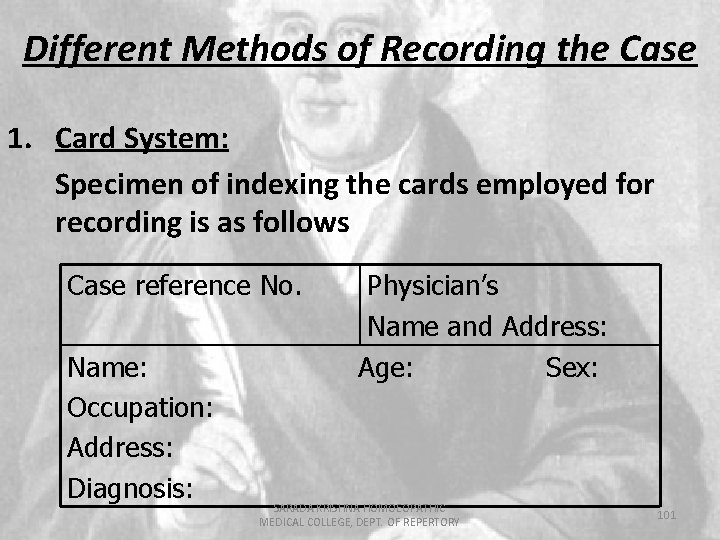
Different Methods of Recording the Case 1. Card System: Specimen of indexing the cards employed for recording is as follows Case reference No. Name: Occupation: Address: Diagnosis: Physician’s Name and Address: Age: Sex: SARADA KRISHNA HOMOEOPATHIC MEDICAL COLLEGE, DEPT. OF REPERTORY 101
2. Bound register System/Closed Method: Recording the complaints and treatment given in a big notebook also called as closed method Case is arranged data-wise with folio number in the register. Record of a chr case is transferred from one folio to another and subsequently to another register. This type of recording the case is more suited in private medical practice. SARADA KRISHNA HOMOEOPATHIC MEDICAL COLLEGE, DEPT. OF REPERTORY 102
3. Loose Leaf folder: Advantages: 1. This method we can keep the record on large scale. Cases are arranged serially or alphabetically 2. Record of a chr case is available at one place. 3. Records of the members of one family can be located in a single folder. 4. It is a flexible system 5. With therefore useful in big Institutions. Disadvantages: 1. Initial cost is more. 2. It essentially requires clerical assistance. SARADA KRISHNA HOMOEOPATHIC MEDICAL COLLEGE, DEPT. OF REPERTORY 103
4. File system: 5. Book form: Many physicians they use to give booklet of questionnaires to their patients in which record is printed with question. So after writing answers to the asked questions by the patients book is used as a record of that patient. 6. Another new method of recording the symptoms of the patient and the treatment given to the case is by using computer with different homoeopathic software. SARADA KRISHNA HOMOEOPATHIC MEDICAL COLLEGE, DEPT. OF REPERTORY 104
Evolution of concept of Record Keeping • Dr. Constantine Hering: A homoeopathic doctor as a faithful bookkeeper. Hering begins his article on Hahnemann’s idea of the Homoeopaths duty of making a written scheme of the image of the disease. • Hering summaries the principles contained in the Organon in the following manner, to listen, to write down, to ask questions, and to arranged, then described his own system of record keeping. SARADA KRISHNA HOMOEOPATHIC MEDICAL COLLEGE, DEPT. OF REPERTORY 105
• • • First her refers to the writing material and recommends the use of pencil and of smooth, unruffled paper to ensure flowing handwriting, which enhances legibility. He further recomemnds loose sheets, instead fo bound journal. Each case history should start with the name of patient the day on which visit took place. At the bottom of each entry Hering always notes the weather condition and position of the moon. The rest of the page is reserved for patient’s symptoms, starting a fresh line with every new circumstance or sign. SARADA KRISHNA HOMOEOPATHIC MEDICAL COLLEGE, DEPT. OF REPERTORY 106
• • Dr. Boenninghausen was the first to publish case histories recorded by Hahnemann himself during the last month of his medical practice in Paris. Dr. Boenninghausen recommends the elaborate , convenient and practical scheme for recording the case histories. Every page is divided into three columns, containing, as much as possible in alphabetical order First the house or family name, then the Christian name, the dwelling place and age, lastly the volume and page in number. SARADA KRISHNA HOMOEOPATHIC MEDICAL COLLEGE, DEPT. OF REPERTORY 107
• • The first column contains the name of the patient who was on the list when the book was started. The second is for new patients, bearing the same family name. Third is for those whose family name is not found. Among that entered with such an arrangement the register will last a long time and will not need to be copied off so frequently. SARADA KRISHNA HOMOEOPATHIC MEDICAL COLLEGE, DEPT. OF REPERTORY 108
• • Dr. J. T. Kent: Dr. Kent wrote, ” it should be known first of all, that the true homoeopathician write out the symptoms or each and every patients and preserve record for the benefit of such patient and the art of healing. ” Lutzes: Scheme of record keeping – due to the enormous expansion of his medical practice he suggested an ingenious (Showing inventiveness and skill) filing slip system (file management) that was revolutionary. SARADA KRISHNA HOMOEOPATHIC MEDICAL COLLEGE, DEPT. OF REPERTORY 109
Importance of Record Keeping 1. For proper assessment of the case or forming the conceptual image of the patient – Without noting down all the complaints of the patient one cannot assess the image of the disease. To find the chronic miasm behind the whole case; by keeping the record of the symptoms Homoeopath can assess the miasm responsible for the given chronic disease and thus he is directed to select the medicine according to the SARADA KRISHNA HOMOEOPATHIC MEDICAL COLLEGE, DEPT. OF REPERTORY 110
In an acute case from the records we can analyse the case that whether the case is common or uncommon. 2. For follow up of the case – when the record of the medicine is maintained it helps to follow the case judiciously and scientifically. 3. Curability and incurability of the case – by proper case record the curability and incurability of the case can be judged and thus we can assure the patient about his treatment. SARADA KRISHNA HOMOEOPATHIC MEDICAL COLLEGE, DEPT. OF REPERTORY 111
4. Record keeping reflects the skill of the physician – records speak of the failure and success of past and present and serve as a guide for future. 5. For clinical teaching and for proving the superiority of Homoeopathy. If the other discards the case as an incurable or the physician of other system label certain cases s hopeless but there are excellent homoeopathic prescribers who successfully treat such patient and bring them back to the healthy state. SARADA KRISHNA HOMOEOPATHIC MEDICAL COLLEGE, DEPT. OF REPERTORY 112
If such records are kept, they can guide the younger homoeopathic generation to cure so called hopeless or incurable cases and thus this recorded document can prove the superiority of the system and for clinical teaching for future Homoeopaths. Thus it can help for publishing the observations and results that we get from our clinical experience. 6. Helps to observe the remedy reactions and progress of the case so that we can know the judgement of the action of the remedy. SARADA KRISHNA HOMOEOPATHIC MEDICAL COLLEGE, DEPT. OF REPERTORY 113
7. Miasmatic cleavage: can be judged from the symptoms with proper case record and without knowing the miasm application we cannot prescribe miasmatic medicine or intercurrent remedy. 8. For research purpose – Record keeping helps for publishing the observations and results of the homoeopathic case 9. For legal procedures – record keeping helps for reference in legal procedures. SARADA KRISHNA HOMOEOPATHIC MEDICAL COLLEGE, DEPT. OF REPERTORY 114
10. Selection of second prescription and for finding out related medicines till the case is completely cured – – When the record of medicine given to the patient is maintained, it helps us to follow the case judiciously and scientifically i. e. record keeping helps use for second prescription to scrutinize the action of medicine after its application. Thus we can apply the antidotal medicine, complementary medicine, palliatives, new medicine or simply sac lac as the case progresses. New symptoms - record keeping helps to inform about the new symptoms thus it guides the physician to proceed in right path. 11. Helps to know the change and for obervation of hering’s law of cure SARADA KRISHNA HOMOEOPATHIC MEDICAL COLLEGE, DEPT. OF REPERTORY 115
12. Ability and disability – restudy of records will confirm the physician himself as regards to his ability and disability of different cases. The physician in the cases can make corrections where he has failed for the first time. 13. Record keeping helps for repertorial analysis. 14. It helps for proper Repertorization that leads to the selection of proper similimum. SARADA KRISHNA HOMOEOPATHIC MEDICAL COLLEGE, DEPT. OF REPERTORY 116
Totality of Symptoms § § § “Totality of symptoms is the outward reflected picture of the internal essence of the disease, that is, of the affection of the vital force. ” Totality is simply the complete picture of the disease. The totality is to the disease what the man, the ego, is to his organism. It is that which gives individuality and personality. Totality is an abstract form or image, comprising all that can be known of the artificial disease, so arranged as to have an individuality of its own SARADA KRISHNA HOMOEOPATHIC MEDICAL COLLEGE, DEPT. OF REPERTORY 117
HAHNEMANNIAN TOTALITY § Hahnemann in his initial practice has taken the entire expression of the patient for the totality and this whole picture should match with that of the similar expression in the MM. SARADA KRISHNA HOMOEOPATHIC MEDICAL COLLEGE, DEPT. OF REPERTORY 118
• This procedure is too tedious to find out the exact remedy and the result is not so satisfactory and later in the Aphorism 153 states that – “In this search for a homoeopathic specific remedy, that is to say, in this comparison of the collective symptoms of the natural disease with the list of symptoms of known medicines, in order to find among these an artificial morbific agent corresponding by similarity to the disease to be cured, the more striking, singular, uncommon and peculiar (characteristic) signs and symptoms of the case of disease are chiefly and most solely to be kept in view; for it is more particularly these that very similar ones in the list of symptoms of the selected medicine must correspond to, in order to constitute it most suitable for effecting the cure. ” SARADA KRISHNA HOMOEOPATHIC MEDICAL COLLEGE, DEPT. OF REPERTORY 119
• • Hahnemann is praising Boenninghausen for publishing the characteristic symptoms of the Homoeopathic medicines and his Repertory (Repertory of Antipsoric) in the foot note of 153 Aphorism. Here the construction of his book is in the complete symptom pattern in each chapter that is, L, S, M, and C. SARADA KRISHNA HOMOEOPATHIC MEDICAL COLLEGE, DEPT. OF REPERTORY 120
So if we go through the Aph 86 Hahnemann asks to interrogate further upon: – Location – Sensation – Character – Onset – Duration – Frequency – Intermittent – Time – Modality • So if we combine the Aph 86 and 153 the acute totality of Hahnemann is complete. That is, the striking, singular, uncommon and peculiar (characteristic) signs and symptoms is nothing but the concomitants. SARADA KRISHNA HOMOEOPATHIC 121 MEDICAL COLLEGE, DEPT. OF REPERTORY
• So the ACUTE TOTALITY consists of: – – Concomitants Modalities with time Sensation and character with onset, duration, frequency. Location • This concept was followed in the construction of Repertories like repertory of antipsorics, Lippe’s Repertory and Boger Boenninghausen Characteristic and Repertory. • Hahnemann has given individual totality for each class of disease that is according to Hahnemann Classification of Disease in the Organon of Medicine. SARADA KRISHNA HOMOEOPATHIC MEDICAL COLLEGE, DEPT. OF REPERTORY 122
• • In case of epidemic diseases (Aph 100, 101, 102 and 103); severe; cases different stages of disease have to be considered before reaching a genus totality. As each case add a new symptom to the totality. Never see the past experience to find out the present genus epidemicus. GENUS EPIDEMICUS TOTALITY (§ 102) – Peculiarities of the collective disease. – Peculiar generals SARADA KRISHNA HOMOEOPATHIC MEDICAL COLLEGE, DEPT. OF REPERTORY 123
CHRONIC TOTALITY • In case of chronic disease, § 210 says – “…. . so called corporeal diseases the condition of the disposition and mind is always altered; and in all cases of disease we are called on to cure the state of the patient’s disposition is to be particularly noted, along with the totality of the symptoms, if we would trace an accurate picture of the disease, in order to be able there-from to treat it homoeopathically with success. ” SARADA KRISHNA HOMOEOPATHIC MEDICAL COLLEGE, DEPT. OF REPERTORY 124
• In addition to this § 94 – “In these investigations, the ascertainable Physical constitution of the patient (especially when the disease is chronic), his moral and intellectual character, his occupation, mode of living and habits, his social and domestic relations, his age, sexual function, etc. , are to be taken into consideration. ” SARADA KRISHNA HOMOEOPATHIC MEDICAL COLLEGE, DEPT. OF REPERTORY 125
• § 88 quotes: “ If in these voluntary details nothing has been mentioned respecting several parts of functions of the body or his mental state, the physician asks what more can be told in regard to these parts and these functions, or the state of his disposition or mind; but in doing this he only makes use of general expressions, in order that his informants may be obliged to enter into special details concerning them. ” SARADA KRISHNA HOMOEOPATHIC MEDICAL COLLEGE, DEPT. OF REPERTORY 126
Foot note of § 88: For example: • What is the character of his stools? • How does he pass his water? • How is it with his day and night sleep? • What is the state of his disposition, his humor, his memory? • How about the thirst? • What sort of taste has he in his mouth? • What kinds of food and drinks are most relished? • What are most repugnant to him? • Has each its full natural taste, or some other unusual taste? • How does he feel after eating or drinking? • Has he anything to tell about the head, the limbs, or the abdomen? SARADA KRISHNA HOMOEOPATHIC MEDICAL COLLEGE, DEPT. OF REPERTORY 127
• So after clubbing all these above aphorisms i. e. 88, 94 and 210, the CHRONIC TOTALITY of a true chronic disease becomes clear. That is: – – • Change in Disposition Mind Physical Constitution Totality of Symptoms This is nothing but what Kent has narrated his totality. SARADA KRISHNA HOMOEOPATHIC MEDICAL COLLEGE, DEPT. OF REPERTORY 128
• • INTERMITTENT DISEASE: (§ 231 -244) In intermittent disease the totality is same as that of chronic diseases, but an additional symptom that is, symptoms in between the attack should be the chief guide to the final selection of the drug. ONE SIDED DISEASE: The presenting Symptomatology is the guide for prescription due to lack of characteristic Symptomatology. Here if the Symptomatology is changing with each prescription then depending upon the totality the drug also varies. SARADA KRISHNA HOMOEOPATHIC MEDICAL COLLEGE, DEPT. OF REPERTORY 129
Miasmatic Assessment • • After forming the totality of the case, physician should assess miasmatic background that helps in deciding the plan of treatment. Knowledge of miasm is the bse of Homoeopathic learning and practice. In real sense, without the knowledge of miasm, there is no Homoeopathy. Theoretical aspect of miasm is already explained in may books of philosophy and also in other books. SARADA KRISHNA HOMOEOPATHIC MEDICAL COLLEGE, DEPT. OF REPERTORY 130
• • Dr. Hahnemann introduced concept of miasms in the treatment of chronic conditions. Understanding of miasm totally depends on present characteristics of the patient. Miasm behaves as an obstacle if not removed before any cure is desired. There are two types of miasm: 1. Acute 2. Chronic SARADA KRISHNA HOMOEOPATHIC MEDICAL COLLEGE, DEPT. OF REPERTORY 131
• • Acute miasm is characterized by suddenness, violence and stormy nature. If is of two types – recurring and non recurring The chronic miasm is the real fundamental cause of all kinds of chronic disease these are 1. Psora 2. Syphilis 3. Sycosis • The Psoric miasm is expressed through weakness, skin complaints, allergies and many other characteristics SARADA KRISHNA HOMOEOPATHIC MEDICAL COLLEGE, DEPT. OF REPERTORY 132
• • • The Syphilitic miasm is characterized by destructiveness. There is introversion destructive, ulceration and destructive temperaments. The Sycotic miasm is eliminates energy outward in the form of warts, tumours, overgrowths and many pathological discharges Final aim of miasmatic assessment is to classify different group of symptoms as per the miasmatic placement and to determine the most dominant miasm and other miasm in the case. SARADA KRISHNA HOMOEOPATHIC MEDICAL COLLEGE, DEPT. OF REPERTORY 133
References • Organon of Medicine- DR. SAMUEL HAHNEMANN • A reference to repertories for homoeopathic students- Dr. SIJU. P. V • Essentials of repertorisation- Dr. SHASHI KANT TIWARI SARADA KRISHNA HOMOEOPATHIC MEDICAL COLLEGE DEPT OF REPERTORY
Thank You SARADA KRISHNA HOMOEOPATHIC MEDICAL COLLEGE, DEPT. OF REPERTORY 135