
Haemostasis in Trauma Role of Viscoelastic Haemostatic Assay





- Slides: 35
Haemostasis in Trauma. Role of Viscoelastic Haemostatic Assay JOINT HOSPITAL SURGICAL GRAND ROUND 14 APRIL 2018 DR. WONG CHEUK WAH QUEEN ELIZABETH HOSPITAL
https: //image. slidesharecdn. com/1 -150412163625 -conversion-gate 01/95/1 -primeira-apresentao-rx-do-trauma-2638. jpg? cb=1428874665
Trauma One of leading causes of death and disability worldwide Classic trimodal distribution of trauma deaths almost half of death occurs within the first hour preventive measures Within 2 days of injury As much as 40% of injury related mortality due to hemorrhage after first week of injury infection and multi-organ failure
Haemostasis in Trauma Resuscitation - damage control - goal directed - massive transfusion protocol - hypothermia, acidosis Pharmacological Surgery - damage control - haemostatic agent/ patches - endovascular occlusive device eg. REBOA - anti-fibrinolytic eg. transamin - coagulation factors eg. Prothrombinex, Novoseven Haemostasis Physical Radioglogical - embolization - direct compression eg. tourniquet, pelvic binder, packing
Physiological mechanism against intravascular coagulation Blood flow Naturally occurring plasma inhibitors Heparin sulphate-antithrombin III mechanism Protein C-thrombomodulin(TM)-protein S mechanism Fibrinolysis Endothelial prostacyclin Hepatic clearance of activated factors Fibrinolysis
Physiological haemostatic response Primary response: vasoconstriction and formation of platelet plug - platelet adhesion: von Willebrand factor - release reaction: conformational change - platelet aggregation: ADP, thromboxane A 2, fibrinogen http: //www. infobarrel. com/Media/Platelet_Plug_Formation_-_Hemostasis
Physiological haemostatic response Secondary response: formation of a fibrin seal - extrinsic pathway - intrinsic pathway - thrombin trigger formation of fibrin monomer, which then polymerizes to stable fibrin with action of XIIIa and calcium ions https: //www. pinterest. com/pin/547328160944798646/
Trauma induced coagulopathy (TIC) Acute traumatic coagulopathy (primary endogenous process), complicated by resuscitation-associated coagulopathy Multifactorial, global failure of the coagulation system Observed in 10 -25% of post major trauma patient Definition: INR >1. 5 or a. PTT of >60 s Itself a poor prognostic factor: Independent of injury severity, transfusion practice, other physiological markers for haemorrhage, was associated with organ dysfunction, early death and overall mortality Causes of trauma induced coagulopathy, Davenport, Brohi arpil 2016 Acute coagulopathy and early deaths post major trauma Biswadev Mitra a, b, *, Peter A. Cameron, Alfredo Mori a, Mark Fitzgeral
Trauma induced coagulopathy Kushimoto, S. , Kudo, D. , & Kawazoe, Y. (2016). Coagulation abnormality in the acute phase of trauma: Acute traumatic coagulopathy and trauma-induced coagulopathy. Japanese Journal of Thrombosis and Hemostasis, 27(4), 399 -
Pathophysiology of TIC 1. Thrombin generation 2. Hypofibrinogenaemia -due to high turnover and early loss - weak clots with increased fibrinolysis - failure of inhibition (PAI-1) vs promotion (t. PA) - thrombin generation is reduced 3. Protein C (PC) pathway activation -promoting fibrinolysis 4. Endothelial response to traumatic injury 5. Platelet dysfunction
2 phenotypes of TIC 1. Global clotting factor depletion with generalized hypocoagulability 2. Predominantly fibrinolytic pattern - Kutcher ME, Ferguson AR, Cohen MJ. A principal component analysis of coagulation after trauma. J Trauma Acute Care Surg. 2013; 74: 1223– 1229. [Pub. Med: 23609271] - Chin TL, Moore EE, Moore HB, et al. A principal component analysis of postinjury viscoelastic assays: clotting factor depletion versus fibrinolysis. Surgery. 2014; 156: 570– 577. [Pub. Med: 24962188]
Resuscitation strategy in trauma with massive hemorrhage Prior to the 2000 s, resuscitation was largely concentrated on the transfusion of packed red blood cells (PRBCs) and synthetic fluid Limited attention was paid to components such as fresh frozen plasma (FFP), until specific coagulation defects were identified by conventional coagulation tests (CCTs) Rotondo MF, Zonies DH. The damage control sequence and underlying logic. Surg Clin North Am 1997; 77: 761– 77
J Trauma. 2007; 63: 805– 813. • First report describing the association of improved mortality with balanced PRBC: FFP ratio • Retrospective study of 246 patients who require >10 units of PRBC in < 24 hours in a US ARMY support Combat Hospital in Iraq • high ratio of FFP to PRBC had the lowest mortality compared with intermediate and low ratio groups (19% vs 34% vs 65%; P<0. 001) • Methodological issues: survival bias due to the lead time taken to thaw FFP • However, this hypothesis was tested and confirmed using additional civilian and military data
JAMA Surg. 2013 February ; 148(2): 127– 136. doi: 10. 1001/2013. jamasurg. 387 • Prospective, multicenter observational cohort study conducted at ten Level 1 trauma centers in the US • Exact times of infused fluids and blood products, as well as patient outcomes were observed • primary outcome: in-hospital mortality • primary independent variables: plasma: RBC and platelet: RBC transfusion ratios
PROMMTT Study Results early infusion of higher plasma and platelets ratios was associated with decreased mortality within six hours of admission, during which 77% of the hemorrhagic deaths had occurred In the first 6 hours, patients with ratios < 1: 2 (plasma/platelet: RBC) were 3– 4 times more likely to die than patients with ratios ≥ 1: 1 Provide optimal plasma/platelet: RBC ratio for further study (≥ 1: 2 to <1: 1)
JAMA. 2015 February 3; 313(5): 471– 482. doi: 10. 1001/jama. 2015. 12. • Multisite RCT from twelve level 1 trauma centres in US • 680 severely injured patients with trauma randomized into two groups: transfusion ratio of 1: 1: 1 versus 1: 1: 2 of FFP: PLT: PRBC • Primary outcome: 24 -hour and 30 -day all-cause mortality • Secondary outcome: 23 prespecified complications
PROPPR Trial Result
Queen Elizabeth Hospital Data 760 trauma cases in 2016, almost half from trauma diversion 28 Massive Transfusion Protocol Activations
QEH Massive Transfusion Protocol • MTP is indicated if the score is ≥ 6
Can we do better? A reduction in blood product use is desirable for patient blood products being a scarce and expensive resource Variable phenotypes of trauma induced coagulopathy identified
How do we assess coagulation function? Conventional coagulation assays (CCA) - prothrombin time (PT) - activated partial thromboplastin time (APTT) - international normalized ratio (INR) Platelet count Fibrinogen level
Is CCA good enough for detecting coagulopathy in trauma? originally designed for the monitoring of therapeutic anticoagulation Mainly assess the time for clot initiation, evolution of the clot beyond the formation of the first strands of fibrin not assessed no evaluation on platelet dysfunction Inaccuracy in reflecting in vivo condition as test is performed with plasma but not whole blood No information on hyperfibrinolysis Results available in 60 -90 minutes, no validated pointof-care test available Gonzalez, E. , Moore, E. E. , & Moore, H. B. (2017). Management of Trauma Induced Coagulopathy with Thrombelastography. Critical Care Clinics, 33(1), 119– 134.
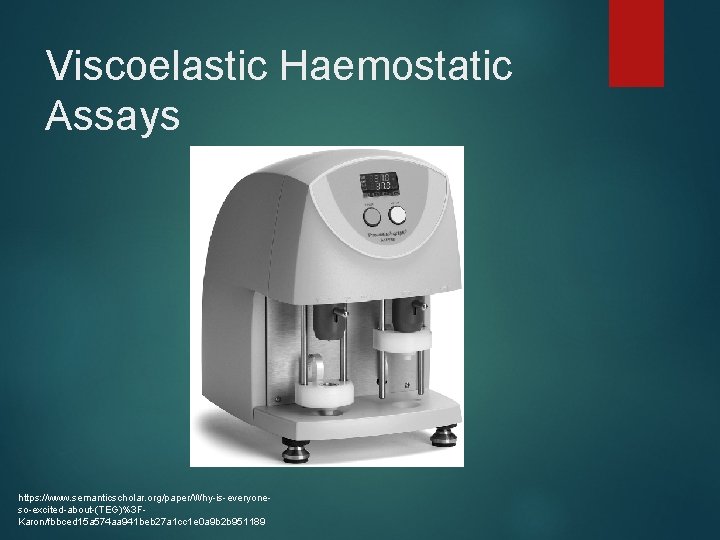
Viscoelastic Haemostatic Assays https: //www. semanticscholar. org/paper/Why-is-everyoneso-excited-about-(TEG)%3 FKaron/fbbced 15 a 574 aa 941 beb 27 a 1 cc 1 e 0 a 9 b 2 b 951189
Viscoelastic Haemostatic Assays (VHA) First described in 1948 by Dr. H Hartert Application in cardiac surgery and liver transplantation Thromboelastography (TEG) (Haemonetics Corp, Niles, IN) Rotational thromblelastometry (ROTEM) (TEM International, Gmb. H, Germany) Characterization of life-span of a clot From time to initial fibrin cross-linking, maximal clot strength, to clot breakdown by fibrinolysis Point-of-care test
• • http: //teg. haemonetics. com/en-gb Thrombelastography (TEGW): practical considerations on its clinical use in trauma resuscitation Luis Teodoro da Luz, Bartolomeu Nascimento and Sandro Rizoli* 0. 36 m. L whole blood Incubated at 37 degree Pin suspended into cup Connected to detector system (torsion wire) Oscillation of cup at an angle to the pin Fibrin formation between cup and pin Rotation from cup transmitted to the pin Tracing generated from pin’s movement
Thrombelastography (TEGW): practical considerations on its clinical use in trauma resuscitation Luis Teodoro da Luz, Bartolomeu Nascimento and Sandro
Thrombelastography (TEGW): practical considerations on its clinical use in trauma resuscitation Luis Teodoro da Luz, Bartolomeu Nascimento and Sandro Rizoli*
VHA-guided resuscitation in trauma? In the 2000 s, studies has found correlation of several VHA (Ro. TEM) parameters with CCTs, demonstrating Ro. TEMs diagnostic potential 1 Ability to detect hyperfibrinolysis, which play a major role in acute trauma coagulopathy, and with an effective therapy (tranexamic acid)2 1. Rugeri L, Levrat A, David JS, Delecroix E, Floccard B, Gros A, Allaouchiche B, Negrier C. Diagnosis of early coagulation abnormalities in trauma patients by rotation thrombelastography. J Thromb Haemost 2007; 5: 289– 95. 2. Theusinger OM, Wanner GA, Emmert MY, Billeter A, Eismon J, Seifert B, Simmen HP, Spahn DR, Baulig W. Hyper brinolysis diagnosed by rotational thromboelastometry (ROTEM) is associated with higher mortality in patients with severe trauma. Anesth Analg 2011; 113: 1003– 12.
1974 consecutive trauma patients have both CCA and VHA (r. TEG) tested, blood component transfusions were reviewed r. TEG results correlated with CCA Several r. TEG metrics outperformed CCT in prediction of transfusion - alpha angle predicted the need for FFP - maximum amplitude predicted PLT requirements - lysis index 30 documented fibrinolysis Cost of r. TEG ($317) compared with the CCTs ($286) Conclusion : r. TEG could replace CCTs entirely
Ann Surg. 2016 Jun; 263(6): 1051 -9. • First RCT on this topic; single centre pragmatic RCT in a level 1 trauma centre in US • Enrolled trauma patients requiring massive transfusion protocol activation to either a VHA-guided (TEG) resuscitation or CCT-guided resuscitation • Primary endpoint was 28 -day survival
Results
Results VHA-guided (TEG) resuscitation resulted in reduced mortality at 28 days (19. 6% vs 36. 4%; P=0. 032) More ICU/ ventilator free day in VHA group but not reaching statistical significance No major differences in the overall volume of blood products transfused at 24 hours more plasma units and more platelet units required in CCA group during the initial 2 hours Importance of giving the right blood products at the right timing
Conclusion Effective haemostasis is the key to improve survival in trauma patients with severe hemorrhage Fixed ratio resuscitation transfusion has been widely adopted and practiced based on current evidence Viscoelastic haemostatic assays use in trauma can provide faster and more complete assessment than CCA VHA guided resuscitation transfusion may reduce mortality in trauma patient Multi-disciplinary approach in managing trauma patients
References Cohen, M. J. , Call, M. , Nelson, M. , Calfee, C. S. , Esmon, C. T. , Brohi, K. , & Pittet, J. F. (2012). Critical Role of Activated Protein C in Early Coagulopathy and Later Organ Failure, Infection and Death in Trauma Patients. Annals of Surgery, 255(2), 379 -385. doi: 10. 1097/sla. 0 b 013 e 318235 d 9 e 6 - (independent factor for overall mortality and organ dysfunction) Kushimoto, S. , Kudo, D. , & Kawazoe, Y. (2016). Coagulation abnormality in the acute phase of trauma: Acute traumatic coagulopathy and trauma-induced coagulopathy. Japanese Journal of Thrombosis and Hemostasis, 27(4), 399 -407. doi: 10. 2491/jjsth. 27. 399 Kashuk JL, Moore EE, Sawyer M, et al. Postinjury coagulopathy management: goal directed resuscitation via POC thrombelastography. Annals of surgery. 2010; 251(4): 604– 614. Gonzalez, E. , Moore, E. E. , & Moore, H. B. (2017). Management of Trauma Induced Coagulopathy with Thrombelastography. Critical Care Clinics, 33(1), 119– 134. http: //doi. org/10. 1016/j. ccc. 2016. 09. 002 Holcomb, J. B. , del Junco, D. J. , Fox, E. E. , Wade, C. E. , Cohen, M. J. , Schreiber, M. A. , … Rahbar, M. H. (2013). The Prospective, Observational, Multicenter, Major Trauma Transfusion (PROMMTT) Study: Comparative Effectiveness of a Time-varying Treatment with Competing Risks. JAMA Surgery, 148(2), 127– 136. http: //doi. org/10. 1001/2013. jamasurg. 387 Holcomb, J. B. , Tilley, B. C. , Baraniuk, S. , Fox, E. E. , Wade, C. E. , Podbielski, J. M. , … van Belle, G. (2015). Transfusion of Plasma, Platelets, and Red Blood Cells in a 1: 1: 1 vs a 1: 1: 2 Ratio and Mortality in Patients With Severe Trauma: The PROPPR Randomized Clinical Trial. JAMA, 313(5), 471– 482. http: //doi. org/10. 1001/jama. 2015. 12 Borgman MA, Spinella PC, Perkins JG, et al. The ratio of blood products transfused affects mortality in patients receiving massive transfusions at a combat support hospital. J Trauma 2007; 63(4): 805 -813. Johansson PI, Stensballe J, Oliveri R, Wade CE, Ostrowski SR, Holcomb JB. How I treat patients with massive hemorrhage. Blood. 2014; 124(20): 3052– 3058 Holcomb JB, Wade CE, Michalek JE, et al. Increased plasma and platelet to red blood cell ratios improves outcome in 466 massively transfused civilian trauma patients. Ann Surg 2008; 248(3): 447 -458.
END