
Haemoglobin Haemoglobin has ONE job to carry oxygen
Haemoglobin
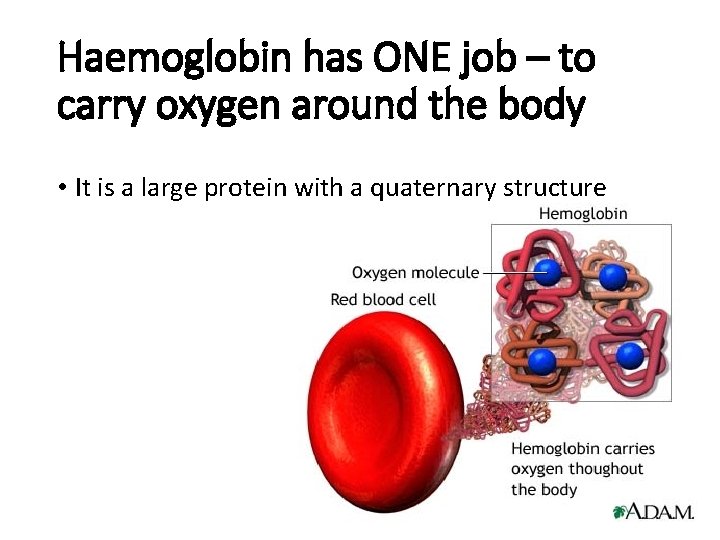
Haemoglobin has ONE job – to carry oxygen around the body • It is a large protein with a quaternary structure

What are proteins? • Proteins are made up of C, H, O, N and some S and P • Transport proteins such as haemoglobin carry oxygen. • The monomer molecules making up proteins are called amino acids. • There are 20 different naturally occurring amino acids. All amino acids have the same general structure: • A carboxyl group (-COOH) • An amino group (-NH 2) attached to a C atom • A variable group called R
Haemoglobin is a globular protein. It’s structure is curled up so that hydrophilic side chains face outwards and hydrophobic side chains face inwards. This makes haemoglobin soluble and therefore good for transport in the blood.
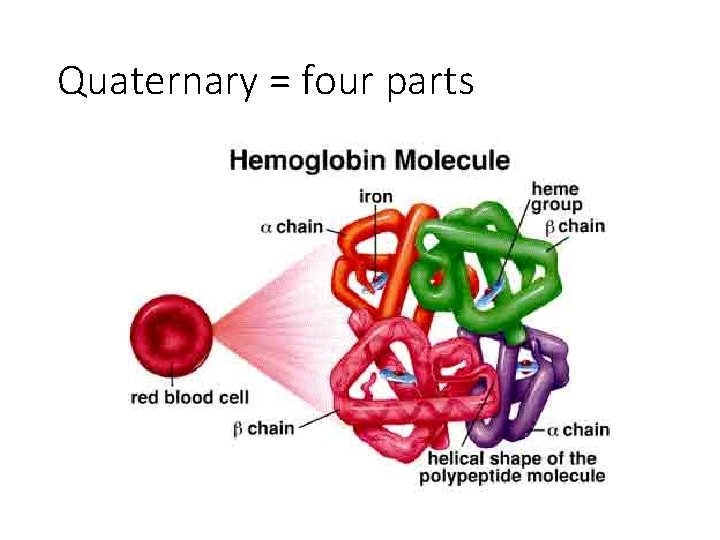
Quaternary = four parts
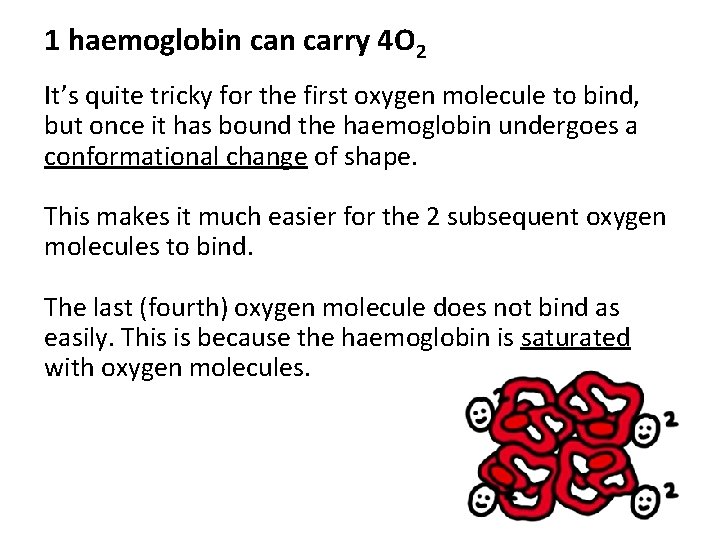
1 haemoglobin carry 4 O 2 It’s quite tricky for the first oxygen molecule to bind, but once it has bound the haemoglobin undergoes a conformational change of shape. This makes it much easier for the 2 subsequent oxygen molecules to bind. The last (fourth) oxygen molecule does not bind as easily. This is because the haemoglobin is saturated with oxygen molecules.

association OR loading Hb + 4 O 2 ⇌ Hb. O 8 dissociation OR unloading Haemoglobin + Oxygen ⇌ Oxyhaemoglobin

Haemoglobin reversibly binds with oxygen so is a good transporter of oxygen: • At the gas exchange surface e. g. lungs: Haemoglobin has a high affinity for O 2 so O 2 binds • At the respiring tissues: Haemoglobin has a low affinity for oxygen. The high conc. of CO 2 causes haemoglobin to change shape, releasing oxygen.
Key terms for your glossary • Affinity • Saturation • Partial pressure • Loading / association • Unloading / dissociation
• Partial Pressure of O 2: The partial pressure of oxygen (p. O 2) is a measure of oxygen concentration. p. O 2 will be high in the lungs, and lower in body tissues such as muscle. • Haemoglobin's affinity for oxygen depends on the p. O 2. Oxygen combines with haemoglobin to form oxyhaemoglobin where there's a high p. O 2, and oxyhaemoglobin breaks down to haemoglobin and oxygen where there's a lower p. O 2.
Knowledge Check 1. There is less oxygen at high altitudes than at sea level. People living at high altitudes have more red blood cells than people living at sea level. Explain the advantage of this to people living at high altitude. (2)
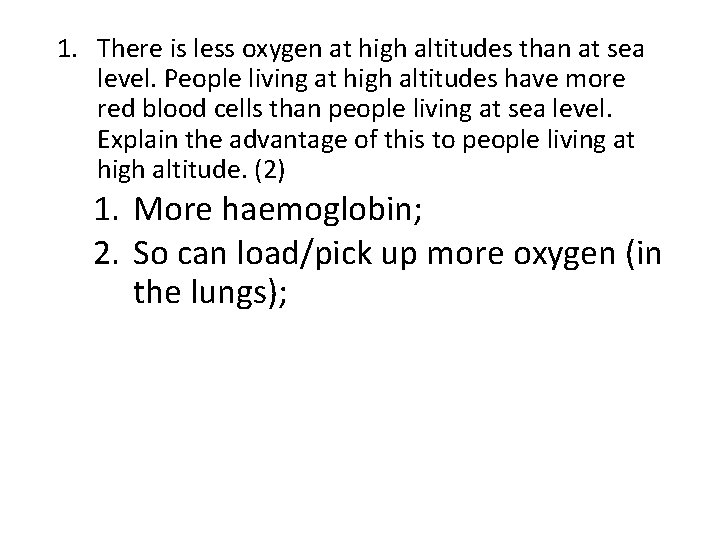
1. There is less oxygen at high altitudes than at sea level. People living at high altitudes have more red blood cells than people living at sea level. Explain the advantage of this to people living at high altitude. (2) 1. More haemoglobin; 2. So can load/pick up more oxygen (in the lungs);
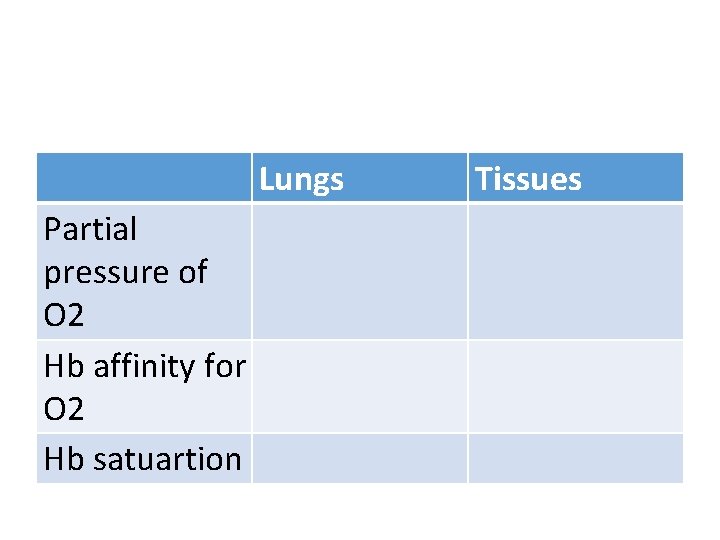
Lungs Partial pressure of O 2 Hb affinity for O 2 Hb satuartion Tissues
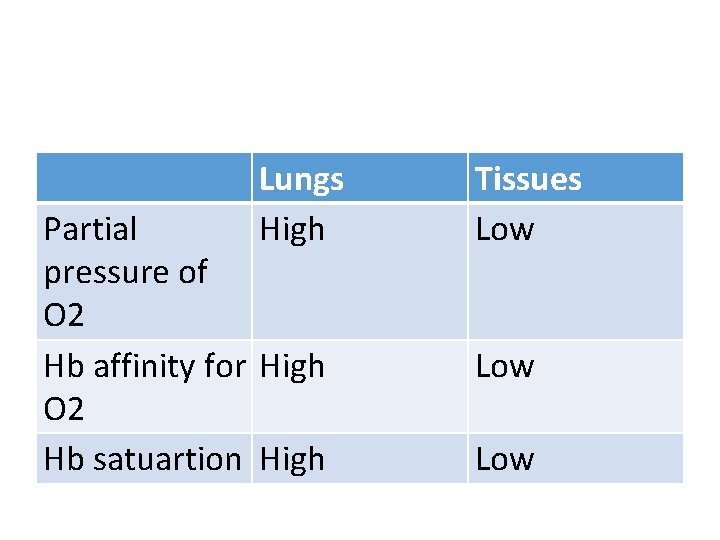
Lungs High Partial pressure of O 2 Hb affinity for High O 2 Hb satuartion High Tissues Low Low
Describe how haemoglobin loads and unloads oxygen in the blood. (4) 1. Oxygen loads onto haemoglobin at high partial pressure. 2. In the lungs haemoglobin has a high affinity for oxygen. 3. Tissues have a low partial pressure of oxygen as it has been used in respiration. 4. In tissues haemoglobin has a lower affinity for oxygen. 5. Haemoglobin unloads oxygen at low partial pressure.
Explain how oxygen is loaded, transported and unloaded in the blood. (6)
1. Haemoglobin carries oxygen (or has a high affinity for oxygen, or oxyhaemoglobin; 2. In red blood cells; 3. Loading of oxygen takes place in the lungs; 4. At high p. O 2; 5. Unloads oxygen to respiring cells or tissues; 6. At low p. O 2; 7. Unloading linked to higher carbon dioxide (concentration);
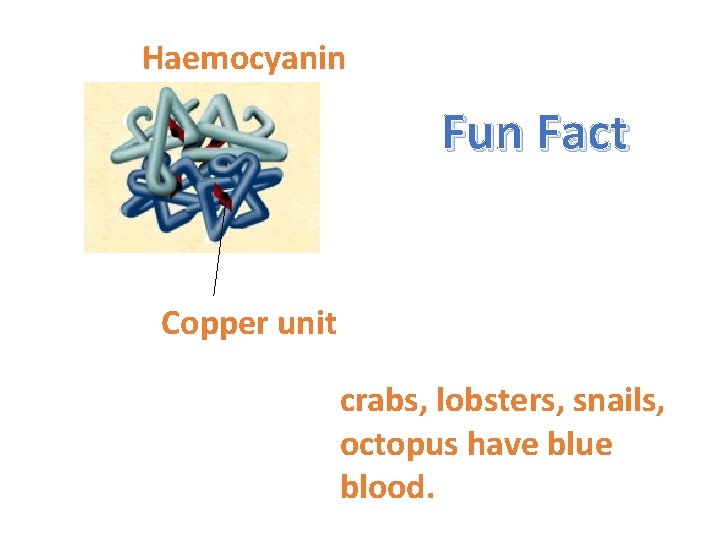
Haemocyanin Fun Fact Copper unit crabs, lobsters, snails, octopus have blue blood.
- Slides: 19