
Haemoglobin 12 March 2021 Dept of physiology 1
Haemoglobin 12 March 2021 Dept. of physiology 1
By the end of class student should… • Draw the structure of haemoglobin (Hb) and give its normal values • Classify normal haemoglobin and list the abnormal Hb • List the physiological and pathological alterations of Hb concentration • Name the various blood indices, give their formulas for calculation. • Give the normal values of various blood indices and conditions of their alterations 12 March 2021 Dept. of physiology 2
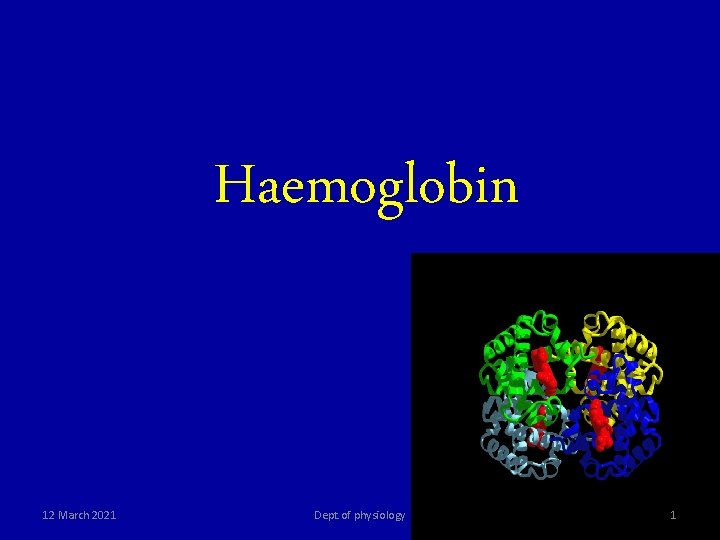
• The haemoglobin is a red globular conjugate protein, comprise almost 90% of the weight of a red cell. • Composed of Haem and Globin. • Starts appearing in intermediate stage. 12 March 2021 Dept. of physiology 3
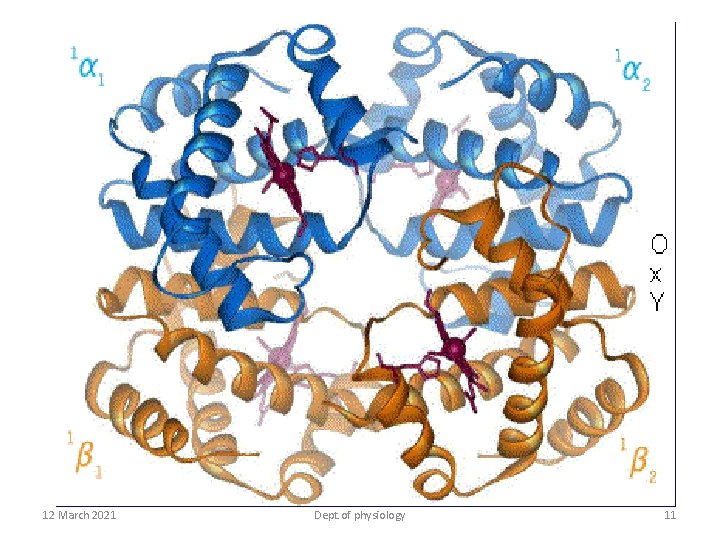
• Globin is made from two similar proteins that "stick together". • Both proteins must be present for the hemoglobin to pick up and release oxygen normally. • One of the component proteins is called Alpha, the other is Beta. (2 chains each)(141, 146 amino acids) 12 March 2021 Dept. of physiology 4
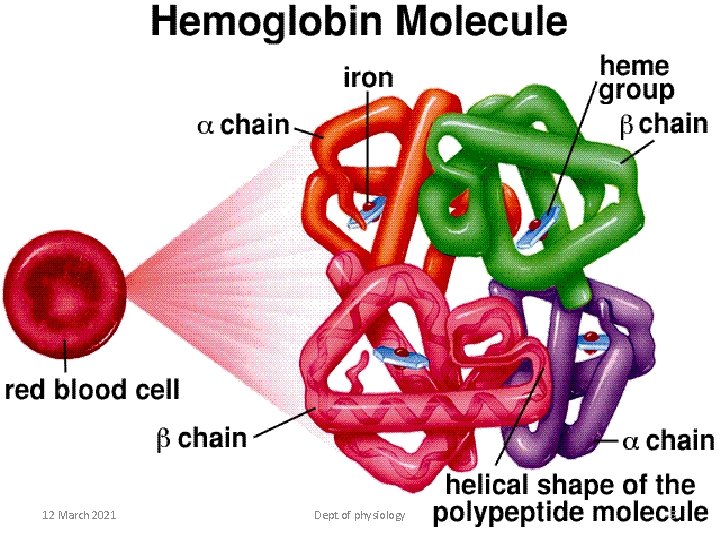
12 March 2021 Dept. of physiology 5
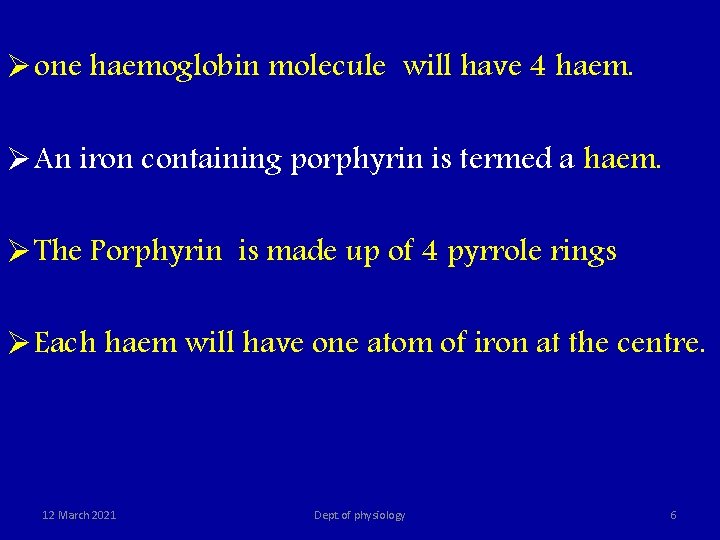
Ø one haemoglobin molecule will have 4 haem. Ø An iron containing porphyrin is termed a haem. Ø The Porphyrin is made up of 4 pyrrole rings Ø Each haem will have one atom of iron at the centre. 12 March 2021 Dept. of physiology 6
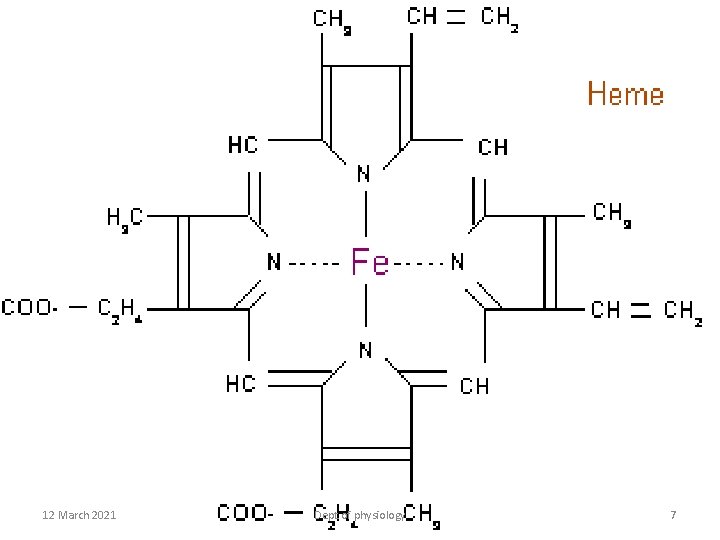
12 March 2021 Dept. of physiology 7
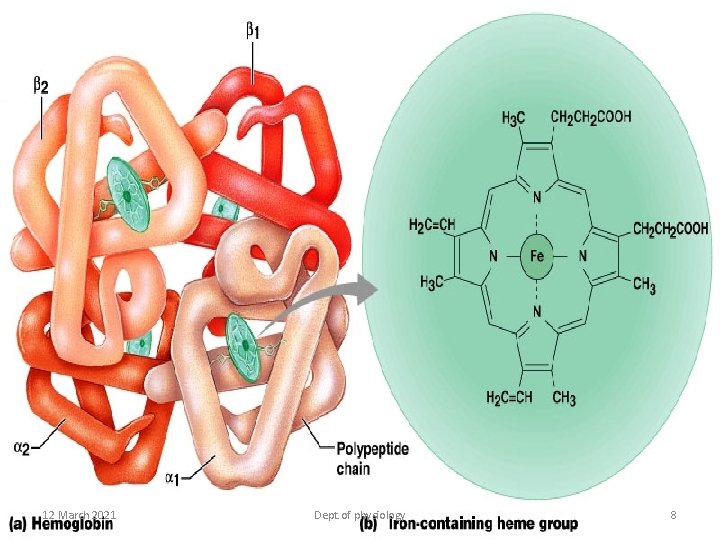
12 March 2021 Dept. of physiology 8
Iron and Hemoglobin • The mineral iron plays an important role in the body’s delivery and use of oxygen. • It binds oxygen to hemoglobin, which then travels in the bloodstream to locations throughout the body. • The iron is in the ferrous form (Fe 2+) • Combine loosely and Reversible Oxygenation 12 March 2021 Dept. of physiology 9
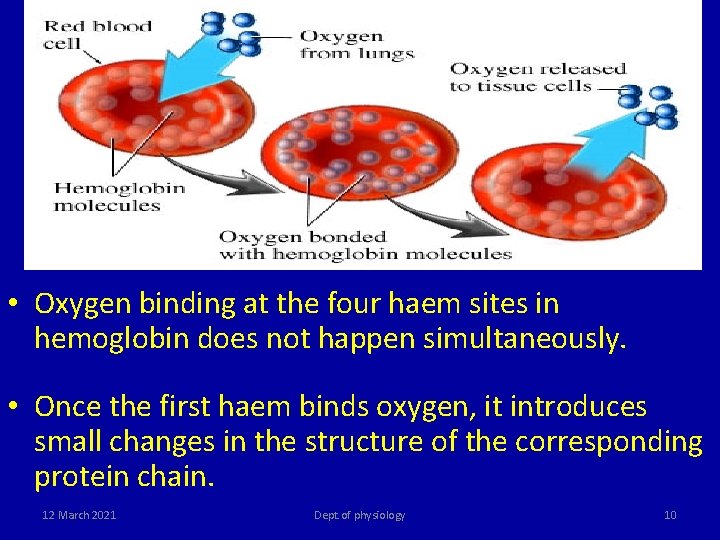
• Oxygen binding at the four haem sites in hemoglobin does not happen simultaneously. • Once the first haem binds oxygen, it introduces small changes in the structure of the corresponding protein chain. 12 March 2021 Dept. of physiology 10
12 March 2021 Dept. of physiology 11
Oxygenation of 1 st haem molecule increases the affinity of 2 nd haem for oxygen Oxygenation of 2 nd haem molecule increases the affinity of 3 rd haem for oxygen Oxygenation of 3 rd haem molecule increases the affinity of 4 th haem for oxygen Affinity of 4 th haem to oxygen is many times that of 1 st haem 12 March 2021 Dept. of physiology 12

• Oxygen-haemoglobin dissociation curve • Sigmoid shape • P 50 (partial pressure of O 2 at which Hb is half saturated with O 2) 26. 6 mm. Hg 12 March 2021 Dept. of physiology 13

Oxy-Haemoglobin Hb+o 2=HBO 2 Carbamino -Haemoglobin co 2+Hb. NH 2=Hb NH COOH Reduced /Deoxygenated Haemoglobin Hb Carboxy/Carbon -Monoxy Haemoglobin CO +Hb (affinity is 200 times that of o 2 ) Methaemoglobin Various drugs/ oxidizing agents : fe 2+ fe 3+ Hb. OH 12 March 2021 Dept. of physiology 14
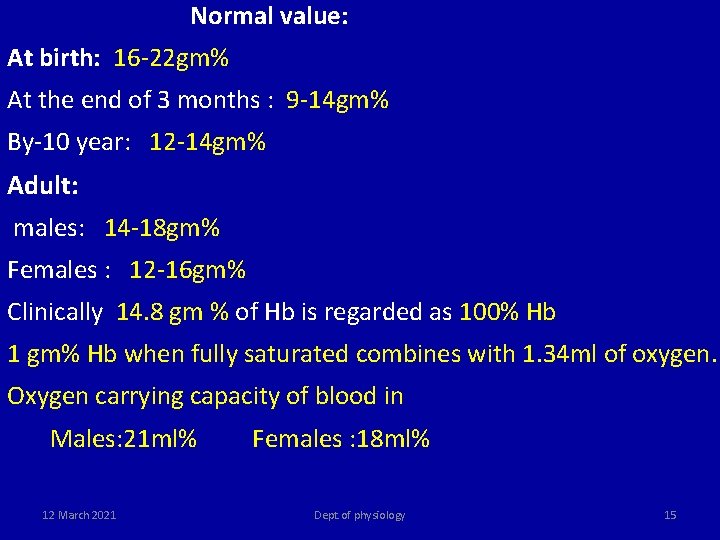
Normal value: At birth: 16 -22 gm% At the end of 3 months : 9 -14 gm% By-10 year: 12 -14 gm% Adult: males: 14 -18 gm% Females : 12 -16 gm% Clinically 14. 8 gm % of Hb is regarded as 100% Hb 1 gm% Hb when fully saturated combines with 1. 34 ml of oxygen. Oxygen carrying capacity of blood in Males: 21 ml% Females : 18 ml% 12 March 2021 Dept. of physiology 15
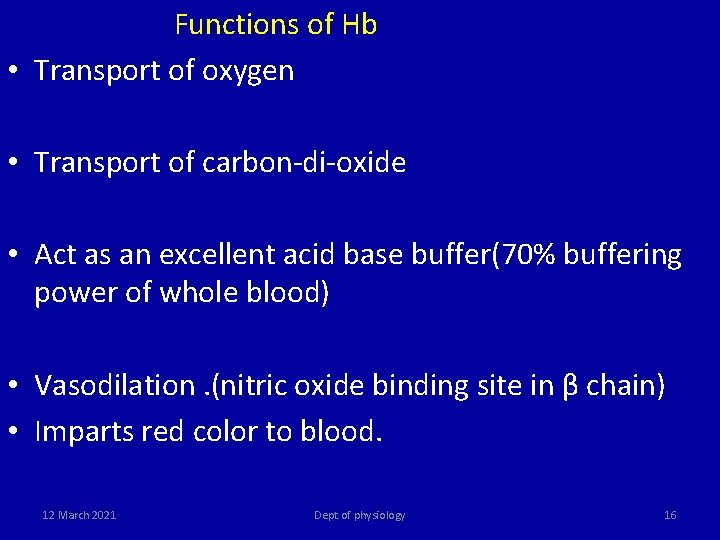
Functions of Hb • Transport of oxygen • Transport of carbon-di-oxide • Act as an excellent acid base buffer(70% buffering power of whole blood) • Vasodilation. (nitric oxide binding site in β chain) • Imparts red color to blood. 12 March 2021 Dept. of physiology 16
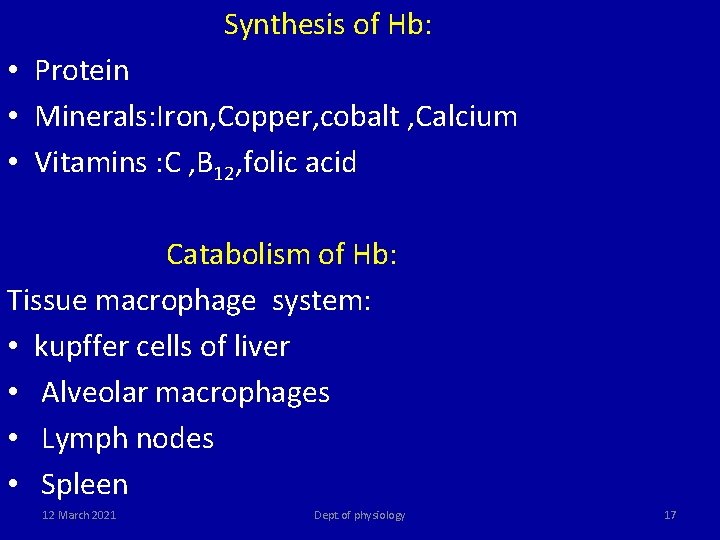
Synthesis of Hb: • Protein • Minerals: Iron, Copper, cobalt , Calcium • Vitamins : C , B 12, folic acid Catabolism of Hb: Tissue macrophage system: • kupffer cells of liver • Alveolar macrophages • Lymph nodes • Spleen 12 March 2021 Dept. of physiology 17
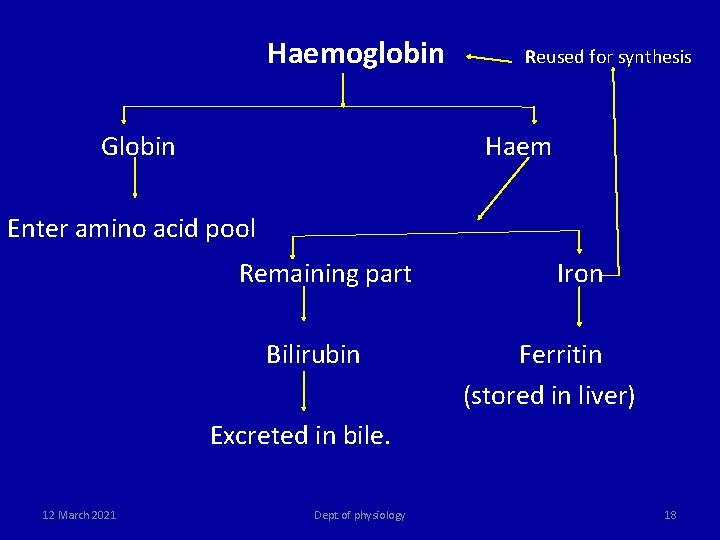
Haemoglobin Globin Reused for synthesis Haem Enter amino acid pool Remaining part Iron Bilirubin Ferritin (stored in liver) Excreted in bile. 12 March 2021 Dept. of physiology 18

Types of Hb Foetal Hb(Hb F): Structure same as adult Hb except that β chain is replaced by γ chain Has greater affinity to oxygen Life span is less ( about 80 days) At birth Hb F predominates it gradually disappears 2 -3 months after birth. 12 March 2021 Dept. of physiology 19
Adult Hb: Hb A (α 2 , β 2) predominately seen Hb A 2 (α 2, δ 2) 2. 5%of total Hb produces no abnormalities regarded as normal Hb. Hb appears in foetus after 5 months of intra uterine life At birth : 20% More than 1 year: >99% 12 March 2021 Dept. of physiology 20
Embryonic Hb Gower 1 - 2 zeta and 2 epsilon Gower 2 - 2 alpha and 2 epsilon Portland - 2 zeta and 2 gamma 12 March 2021 Dept. of physiology 21
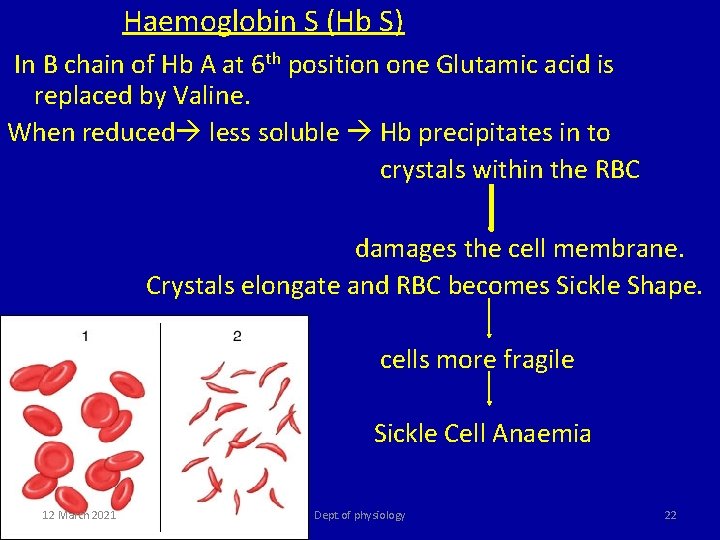
Haemoglobin S (Hb S) In Β chain of Hb A at 6 th position one Glutamic acid is replaced by Valine. When reduced less soluble Hb precipitates in to crystals within the RBC damages the cell membrane. Crystals elongate and RBC becomes Sickle Shape. cells more fragile Sickle Cell Anaemia 12 March 2021 Dept. of physiology 22
Other types: C, E, I, J, M. Hb C consist of 2 α and 2 β chains. But β chain is abnormal. Glutamic acid is replaced by lysine in the 6 th position All these abnormal Hb causes Hemolytic Anemia's. 12 March 2021 Dept. of physiology 23
BLOOD INDICES
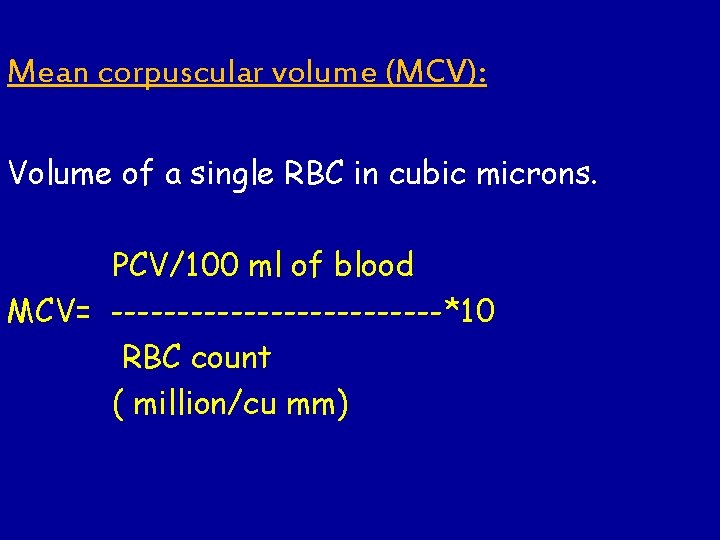
Mean corpuscular volume (MCV): Volume of a single RBC in cubic microns. PCV/100 ml of blood MCV= -------------*10 RBC count ( million/cu mm)
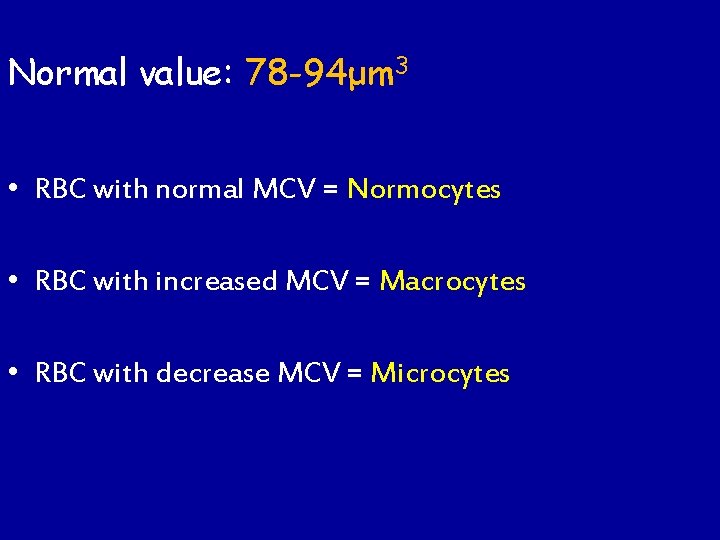
Normal value: 78 -94μm 3 • RBC with normal MCV = Normocytes • RBC with increased MCV = Macrocytes • RBC with decrease MCV = Microcytes
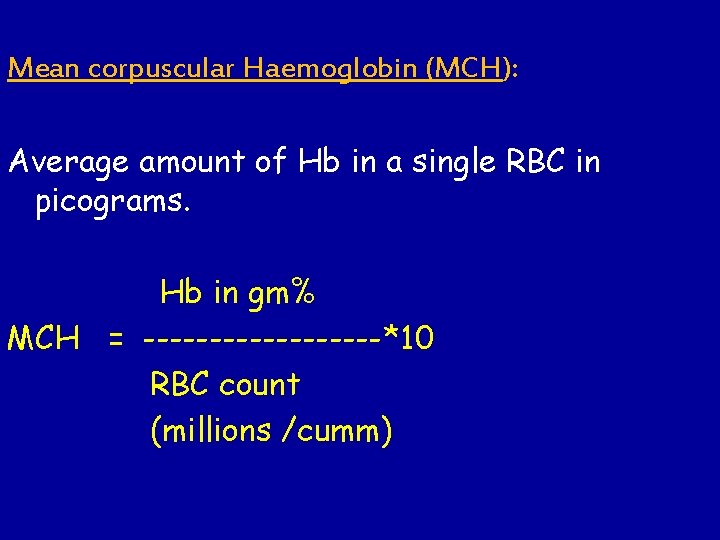
Mean corpuscular Haemoglobin (MCH): Average amount of Hb in a single RBC in picograms. Hb in gm% MCH = ---------*10 RBC count (millions /cumm)
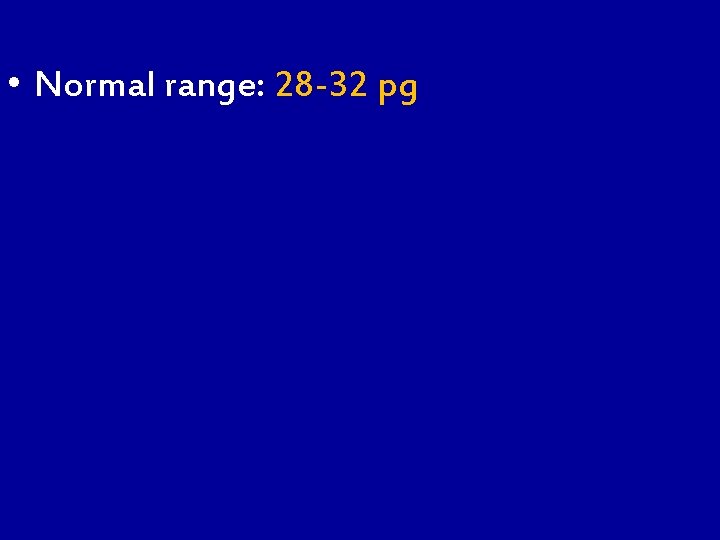
• Normal range: 28 -32 pg
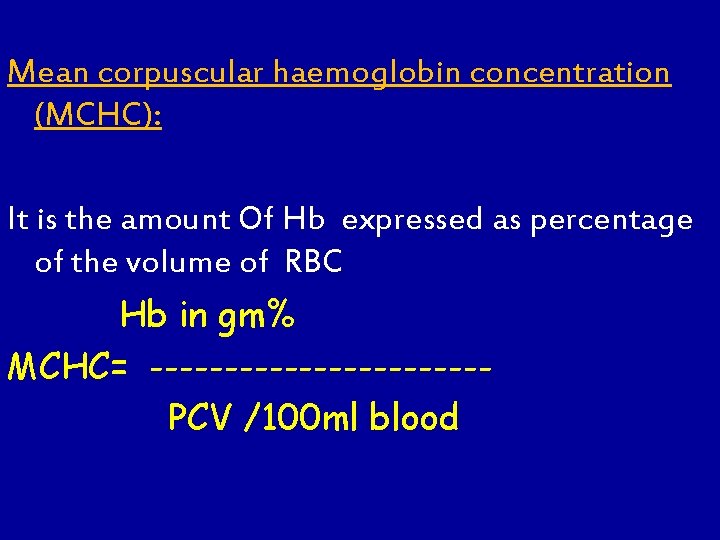
Mean corpuscular haemoglobin concentration (MCHC): It is the amount Of Hb expressed as percentage of the volume of RBC Hb in gm% MCHC= -----------PCV /100 ml blood
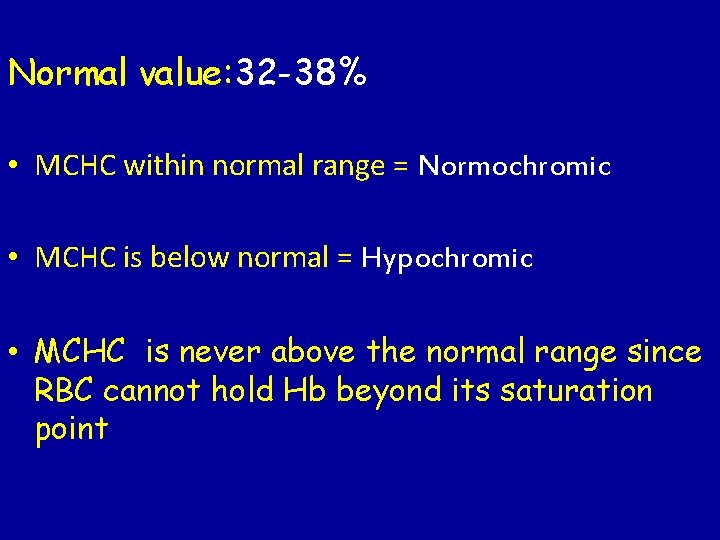
Normal value: 32 -38% • MCHC within normal range = Normochromic • MCHC is below normal = Hypochromic • MCHC is never above the normal range since RBC cannot hold Hb beyond its saturation point
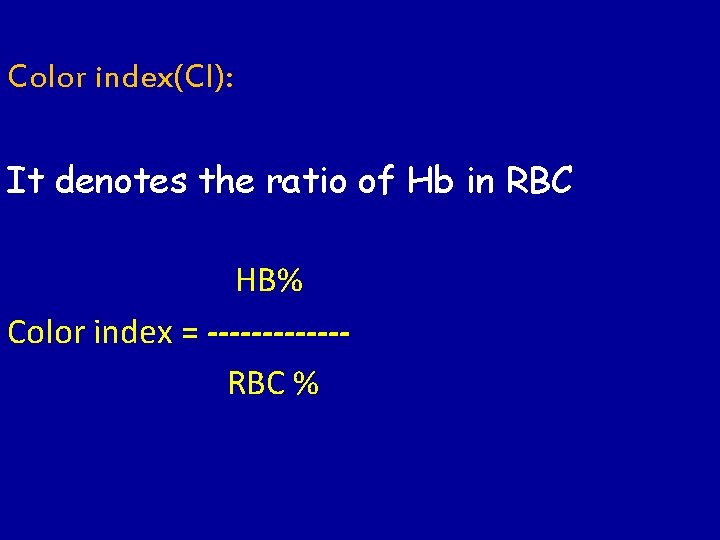
Color index(CI): It denotes the ratio of Hb in RBC HB% Color index = ------ RBC %

• Clinically not used
Summary… AEJ 33
References • Comprehensive Textbook of Medical physiology (Vol 2 first edition) G K Pal • Text book of medical physiology (Vol 2 6 th edition) A K Jain • Essentials of medical physiology (6 th edition) K Sembulingam and Prema Sembulingam AEJ 34
- Slides: 34