
HAEMATOPATHOLOGY Anaemias and leukaemias Anaemia types etiology 1

- Slides: 60
HAEMATOPATHOLOGY
Anaemias and leukaemias
Anaemia • types (etiology): • 1) iron deficiency – most common type – chronic menstrual blood loss, peptic ulcer, haemorrhoids • 2) pernicious anaemia – macrocytic anaemia – +/- neurological disease – folate insufficiency
Anaemia • 3) leukaemia – cause of normocytic anaemia – childhood! • 4) sickle cell trait • 5) thalasaemia
Anaemia • clinical features • tab 22. 2, 3, 4 • • mucosal disease glossitis recurrent aphthae candidiosis and angular stomatitis
Anaemia • dangers of general anesthesia – any reduction of oxygenation → irreparable brain damage, myocardial infarction → gen. anesthesia should be provided in hospital • lowered resistence to infection – oral candidiosis – osteomyelitis
Sickle cell disease and sickle cell trait • people of African, Afro-Caribbean and Mediterranean or Middle Eastern origin • sickle cell diease = homozygotes • sickle cell trait = heterozygotes • abnormal Hb (Hb. S) with the risk of haemolysis, anaemia and other effects • in heterozygotes sufficient normal Hb (Hb. A) is formed to allow normal life
Sickle cell disease and sickle cell trait Sickle cell disease: • complications from polymerisation of deoxygenated Hb. S (less soluable than Hb. A) • → chronic haemolysis → chronic anaemia • exacerbation of sickling raises blood viscosity → blocking of capillaries and sickling crisis • tab 22. 5 • + abnormal susceptibility to infections (Pneumococcal, Meningococcal) and osteomyelitis
Sickle cell disease and sickle cell trait dental aspects of sickle cell disease and s. c. trait: • Hb ≤ 10 g/dl → v. s. homozygote • s. c. trait: gn anaesthesia with full oxygenation s. c. disease: • +/- oral mucosa pale or yellowish due to jaundice • +/- radiographics changes in skull and jaws • prompt atb treatment
Sickle cell disease and sickle cell trait • painfull crisis with analgesics • rigorous dental care necessary due to ↑ susceptibility to infection
The thalassaemias • α-thalassaemias Asians, Africans and Afro. Caribbean • ß-thalassaemias Mediterranean (Greeks) • diminished synthesis of globin chains → resulting relative excess of other chains → precipitation in ery → +/- haemolysis • severity of disease depends on the numbers of affected genes • minor = heterozygotes • major = heterozygotes
The thalassaemias thalassaemia minor: • mild, but persistent microcytic anaemia, otherwise asymptomatic • +/- splenomegaly
The thalassaemias thalassaemia major: • severe hypochromic, microcytic anaemia • great enlargement of liver and spleen • skeletal abnormalities (marrow expansion) • life saving transfusions, but iron depositions in tissues → haemosiderosis → dysfunction of glands and other organs → xerostomia
Leukaemia • leukaemic white blood cells production → supress of other cell lines of the marrow
Leukaemia acute leukaemia • ALL most common leukaemia of children • AML in adults • tab 22. 7 • splenomegaly, hepatomegaly, +/lymphadenopathy • mucosal pallor, abnormal gingival bleeding • tab 22. 8
Leukaemia • management: – biopsy of gingival swelling – vigorous oral hygiene to controll the bacterial population before complications develop – extractions avoided, if necessary – blood transfusion, generous atb cover
Leukaemia • chronic leukaemia
Leukopenia and agranulocytosis leukopenia • WBC ≤ 5000³/l • different causes tab 22. 10 • chance haematological finding x severe immunodeficiency
Leukopenia and agranulocytosis • clinical effects of severe neutropenia: fever prostration, mucosal ulceration • drug induced leukopenias • tab 22. 12
Leukopenia and agranulocytosis aplastic anaemia • failure of production of all bone marrow cells (pancytopenia) • systemic and oral effects: purpura, anaemia, susceptibility of infection • cause: unknown, ai, drug induced • management: stop drugs, give atb and transfusions
Haemorrhagic diseases
Haemorrhagic diseases • haemorrhagic diseases = purpura (platelet deffects) and clotting deffects
Haemorrhagic diseases • Investigation of a history of excessive bleeding: – careful history essential tab. 23. 1 – most of the haemorrhagical diseases are hereditary! – bleeding for up to 24 hrs after an extraction usually due to local causes or a minor defect of haemostasis → more prolonged bleeding is significant
Haemorrhagic diseases • Clinical examination: – signs of anaemia and purpura – examination of the mouth → planning of the operation – haemophilia – all essential extractions carried out at a single operation with f. VIII cover – radiographs (to prevent complications)
Haemorrhagic diseases • Laboratory investigations: – tab 23. 2 – essential is look for anaemia – blood grouping
Haemorrhagic diseases A) Purpura • typical result of platelet disorders • bleeding time prolonged but clotting function normal (with exception of of v. W disease)
Haemorrhagic diseases • general features of purpura: – purpura = bleeding into the skin or mucous membranes causing petechiae or ecchymoses or „spontaneous bruising“ – haemorrhage immediately follows the trauma and ultimately stops spontaneously as a result of normal coagulation – thrombocytopenia = platelets ≤ 100 000 mm³ – spontaneous bleeding uncommon until platelets ≤ 50 000 mm³
Haemorrhagic diseases – typical site palate – +/- excessive gingival bleeding or blood blister – tab 23. 3
Haemorrhagic diseases ITP • Ig. G auto Ab • ↓ number of platelets • children or young adult women • first sign could be profuse gingival bleeding or postextraction haemorrhage • +/- spontaneous bleeding into the skin
Haemorrhagic diseases • management: – corticosteroids – transfusions of platelets – anti…? ? ?
Haemorrhagic diseases AIDS • ai thrombocytopenia can be early sign drug associated purpura • aspirin + others interfere with platelet function • others act as haptens → immune destruction of platelets or suppress marrow function • tab 23. 4
Haemorrhagic diseases localised oral purpura • sometimes blood blister without haemostatic defect • choking sensation („angina bullosa haemorrhagica“) • rupture → ulcer • systemic purpura should be excluded
Haemorrhagic diseases von Willebrand´s disease • both by prolonged bleeding time and deficiency of f. VIII • usually inherited, AD • deficiency of f. VIII mild → purpura more common manifestation
Haemorrhagic diseases B) Clotting disorders • tab 23. 5
Haemorrhagic diseases Haemophilia A • most common, severe • f. VIII deficiency • 6/100 000 • severe haemophilia typically effects in childhood – bleeding into muscles or joints after minor injuries • mild haemophilia (f. VIII ≥ 25%) – no symptoms until an injury, surgery or dental extraction
Haemorrhagic diseases • severe and prolonged bleeding can also follow local anaesthetic injections! (inferior dental blocks!)
Haemorrhagic diseases • clinical features: – positive family history – 30% patients negative history! – bleeding starts after a short delay (normal platelet and vascular responses) → persistent bleeding, can continue for weeks – haemarthroses – intracranial haemorrhage! – deep tissue bleeding → obstruction of airways! – HBV, HCV+! – +/- formation of anti f. VIII Ab
Haemorrhagic diseases • principles of management: – radiographs (local status, prevention of complications) – admission to hospital – replacement therapy – as much surgical work as possible in one session 23. 6 – for dental extraction f. VIII level 50 -75% – postoperatively: atb, risk of bleeding greatest 4 -10 days postoperatively
Haemorrhagic diseases – aspirin and related analgesics avoided! – extractions in mild haemophilia with antifibrinolytic drugs
Haemorrhagic diseases Christmas disease (haemophilia B) • f. IX • inherited • more stable → replacement therapy in longer intervals • other the same as in haemophilia A
Haemorrhagic diseases Acquired clotting defects a) vitamin K deficiency • causes: obstructive jaundice, malabsorption • surgary delayed to haemostasis recover • +/- vitamin K
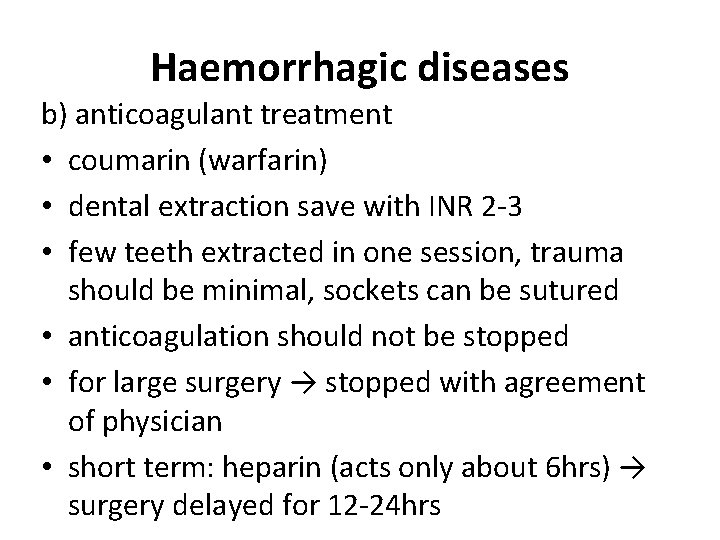
Haemorrhagic diseases b) anticoagulant treatment • coumarin (warfarin) • dental extraction save with INR 2 -3 • few teeth extracted in one session, trauma should be minimal, sockets can be sutured • anticoagulation should not be stopped • for large surgery → stopped with agreement of physician • short term: heparin (acts only about 6 hrs) → surgery delayed for 12 -24 hrs
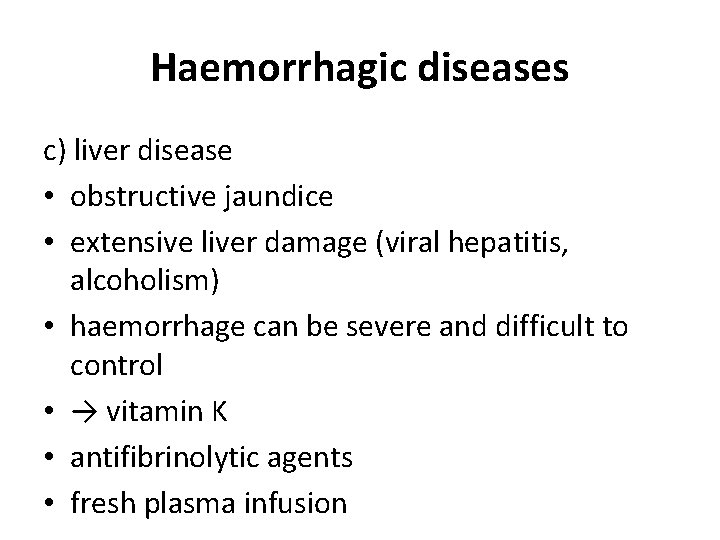
Haemorrhagic diseases c) liver disease • obstructive jaundice • extensive liver damage (viral hepatitis, alcoholism) • haemorrhage can be severe and difficult to control • → vitamin K • antifibrinolytic agents • fresh plasma infusion
Lymphomas
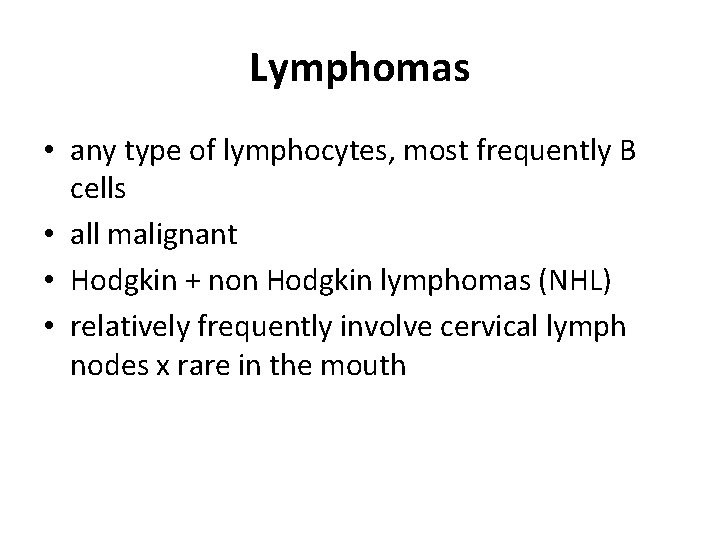
Lymphomas • any type of lymphocytes, most frequently B cells • all malignant • Hodgkin + non Hodgkin lymphomas (NHL) • relatively frequently involve cervical lymph nodes x rare in the mouth
Lymphomas A) NHL • adults predominantly affected • nondescript, soft, painless swelling +/ulcerated • histologically: • + invasion of adjacent tissues • + if traumatised – inflammatory cells can obscure the lymphomatous nature of the tu
Lymphomas • management: – biopsy! – staging!
Lymphomas • Burkitt´s lymphoma • nasopharyngeal (T cell) lymphoma – mlg midline granuloma • MALT! • + local manifestation of gn disease
Cervical lymphadenopathy
Cervical lymphadenopathy • dental and periodontal infections most common cause • lymphomas • HIV infection • tab 26. 1 • investigation: recent viral illness – lymphadenopathy resolves after some months
Cervical lymphadenopathy TBC • Mcb tuberculosis + atypical Mcb • clinical features: • pathology: granulomas, Mcb → Mcb culture or DNA tests • management: suspicion of TBC – affected nodes should be excised intact
Cervical lymphadenopathy Syphilis • lymph nodes enlarged, soft and rubbery • primary or secondary stage • Treponema pallidum in a direct smear or by serological finding • management: atb
Cervical lymphadenopathy Cat scratch disease • tab 26. 4 • pathology: destruction of lymph node architecture, necrosis and lymphocytic infiltration, formation of histiocytic granulomas and central suppuration • WS staining • x deep mycoses
Cervical lymphadenopathy • management: history, clinical features, exclusion of other causes, disease is mild and self limiting, +/- suppuration and sinus formation
Cervical lymphadenopathy Lyme disease • transmitted by insects, deer ticks • tab 26. 5 • management: history + clinical picture • confirmed serologically • atb!
Cervical lymphadenopathy Infectious mononucleosis • self-limiting lymphoproliferative disease • tab 26. 6 • +/- more persistent lymphadenopathy which may mimic a lymphoma • management: peripheral blood picture (atypical lymphocytes), Paul-Bunnell test, anti EBV Ab, ampicillin or amoxicilin should be avoided!
Cervical lymphadenopathy AIDS • soon after infection transient glandular fever like-illness • later +/- wide spread lymphadenopathy (GLS) • → AIDS
Cervical lymphadenopathy Toxoplasmosis • intestinal parasite of many domestic animals (cats) • management: serologically, antimicrobial treatment
Cervical lymphadenopathy Mucocutaneous lymph node syndrome (Kawasaki´s disease) • tab 26. 8 • management: clinical and ECG finding • aspirin, γ-globulin
Cervical lymphadenopathy Drug-associated lymphadenopathies • occasional toxic effect of long term treatment with the antiepileptic drug, phenytoin can mimic lymphoma • management: