
Hadron Form Factors Rolf Ent Jefferson Lab Science

Hadron Form Factors Rolf Ent Jefferson Lab Science & Technology Review July 2002 • Introduction • Pion Form Factor • GEp/GMp ratio • G E n • G Mn • Strangeness Form Factors • Outlook Thomas Jefferson National Accelerator Facility

How are the Nucleons Made from Quarks and Gluons? Why are nucleons interacting via VNN such a good approximation to nature? How do we understand QCD in the confinement regime? A) The distribution of u, d, and s quarks in the hadrons (spatial structure of charge and magnetization in the nucleons is an essential ingredient for conventional nuclear physics; the flavor decomposition of these form factors will provide new insights and a stringent testing ground for QCD-based theories of the nucleon) B) The excited state structure of the hadrons C) The spin structure of the hadrons D) Other hadron properties (polarizability, quark correlations, …. ) Thomas Jefferson National Accelerator Facility
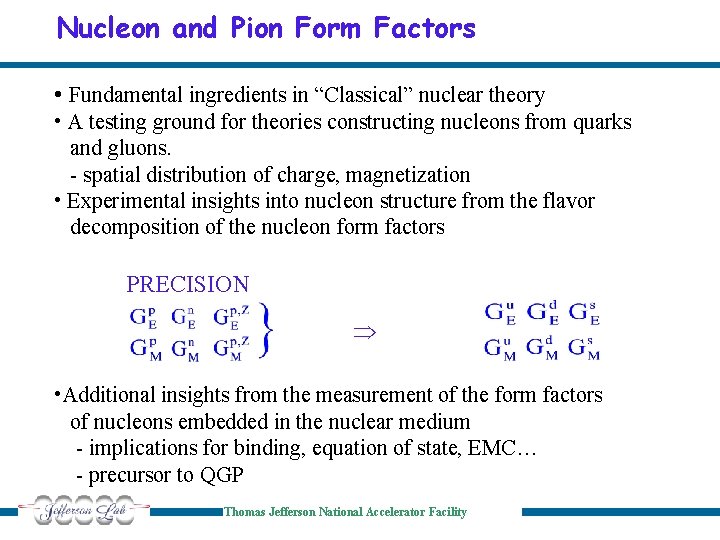
Nucleon and Pion Form Factors • Fundamental ingredients in “Classical” nuclear theory • A testing ground for theories constructing nucleons from quarks and gluons. - spatial distribution of charge, magnetization • Experimental insights into nucleon structure from the flavor decomposition of the nucleon form factors PRECISION • Additional insights from the measurement of the form factors of nucleons embedded in the nuclear medium - implications for binding, equation of state, EMC… - precursor to QGP Thomas Jefferson National Accelerator Facility
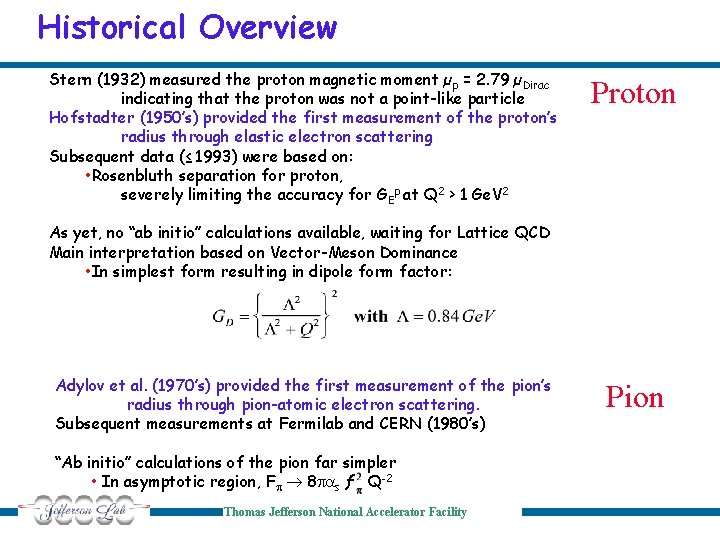
Historical Overview Stern (1932) measured the proton magnetic moment µp = 2. 79 µDirac indicating that the proton was not a point-like particle Hofstadter (1950’s) provided the first measurement of the proton’s radius through elastic electron scattering Subsequent data (≤ 1993) were based on: • Rosenbluth separation for proton, severely limiting the accuracy for GEp at Q 2 > 1 Ge. V 2 Proton As yet, no “ab initio” calculations available, waiting for Lattice QCD Main interpretation based on Vector-Meson Dominance • In simplest form resulting in dipole form factor: Adylov et al. (1970’s) provided the first measurement of the pion’s radius through pion-atomic electron scattering. Subsequent measurements at Fermilab and CERN (1980’s) “Ab initio” calculations of the pion far simpler • In asymptotic region, F 8 s ƒ Q-2 Thomas Jefferson National Accelerator Facility Pion

Charged Pion Electromagnetic Form Factor Potential to approach region where perturbative QCD applies Hall C E 93 -021 results Projected E 01 -004 and 12 Ge. V results Thomas Jefferson National Accelerator Facility
Thomas Jefferson National Accelerator Facility
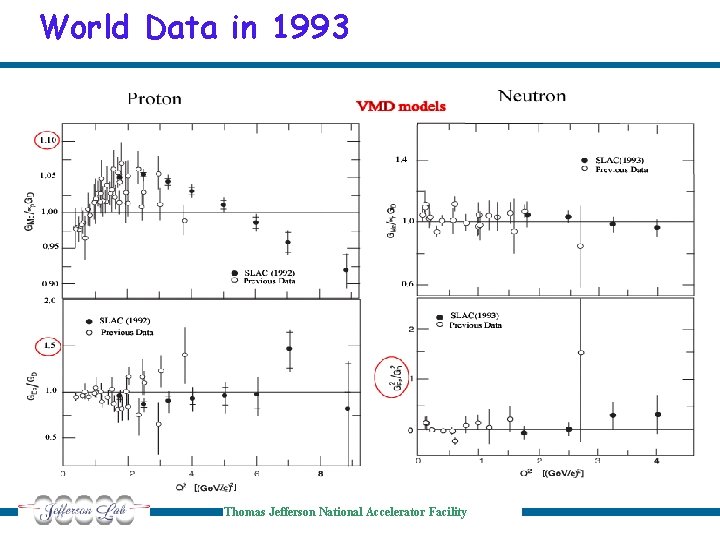
World Data in 1993 Thomas Jefferson National Accelerator Facility
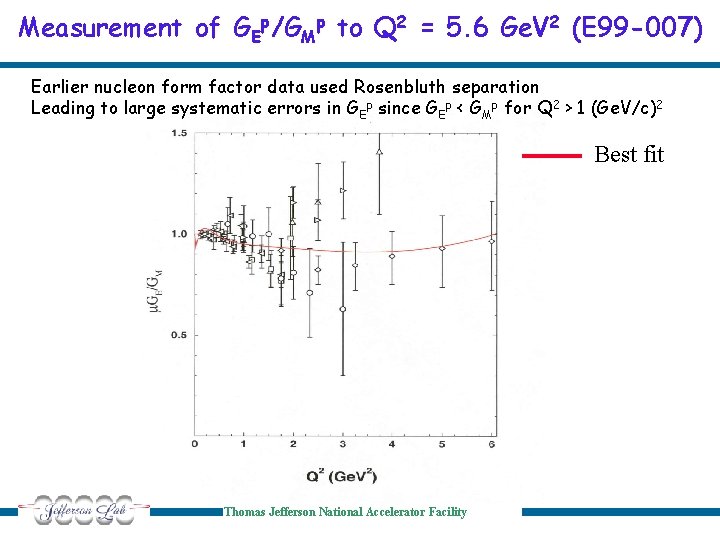
Measurement of GEp/GMp to Q 2 = 5. 6 Ge. V 2 (E 99 -007) Earlier nucleon form factor data used Rosenbluth separation Leading to large systematic errors in GEp since GEp < GMp for Q 2 > 1 (Ge. V/c)2 Best fit Thomas Jefferson National Accelerator Facility
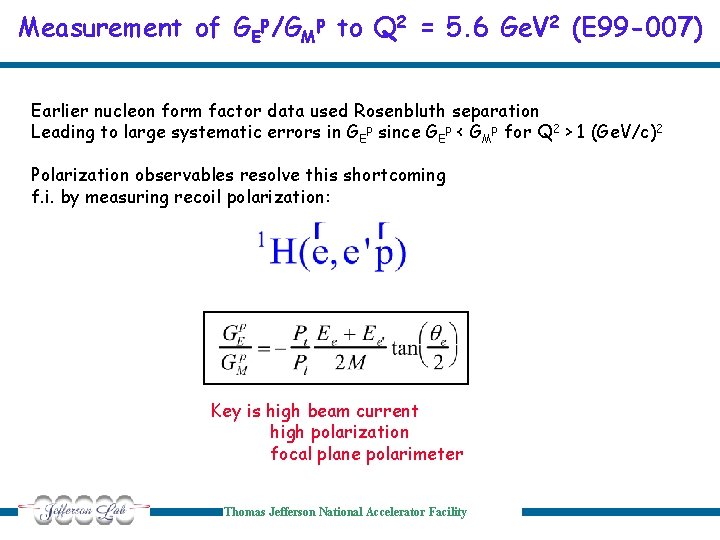
Measurement of GEp/GMp to Q 2 = 5. 6 Ge. V 2 (E 99 -007) Earlier nucleon form factor data used Rosenbluth separation Leading to large systematic errors in GEp since GEp < GMp for Q 2 > 1 (Ge. V/c)2 Polarization observables resolve this shortcoming f. i. by measuring recoil polarization: Key is high beam current high polarization focal plane polarimeter Thomas Jefferson National Accelerator Facility
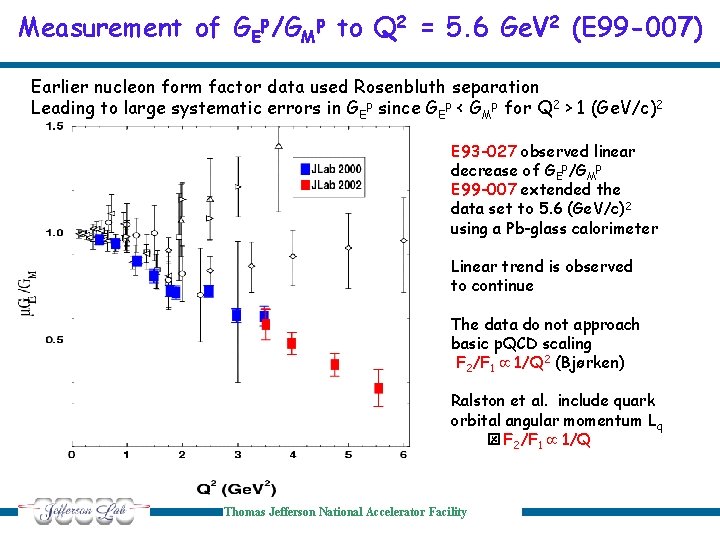
Measurement of GEp/GMp to Q 2 = 5. 6 Ge. V 2 (E 99 -007) Earlier nucleon form factor data used Rosenbluth separation Leading to large systematic errors in GEp since GEp < GMp for Q 2 > 1 (Ge. V/c)2 E 93 -027 observed linear decrease of GEp/GMp E 99 -007 extended the data set to 5. 6 (Ge. V/c)2 using a Pb-glass calorimeter Linear trend is observed to continue The data do not approach basic p. QCD scaling F 2/F 1 µ 1/Q 2 (Bjørken) Ralston et al. include quark orbital angular momentum Lq ý F 2/F 1 µ 1/Q Thomas Jefferson National Accelerator Facility
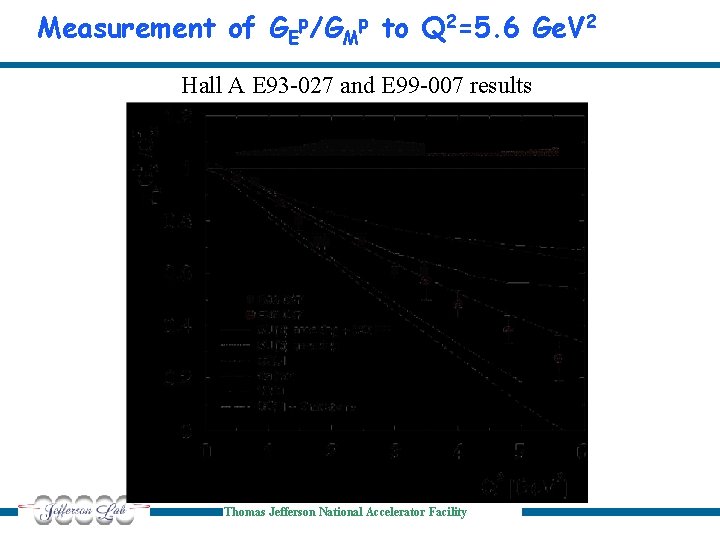
Measurement of GEp/GMp to Q 2=5. 6 Ge. V 2 Hall A E 93 -027 and E 99 -007 results Thomas Jefferson National Accelerator Facility
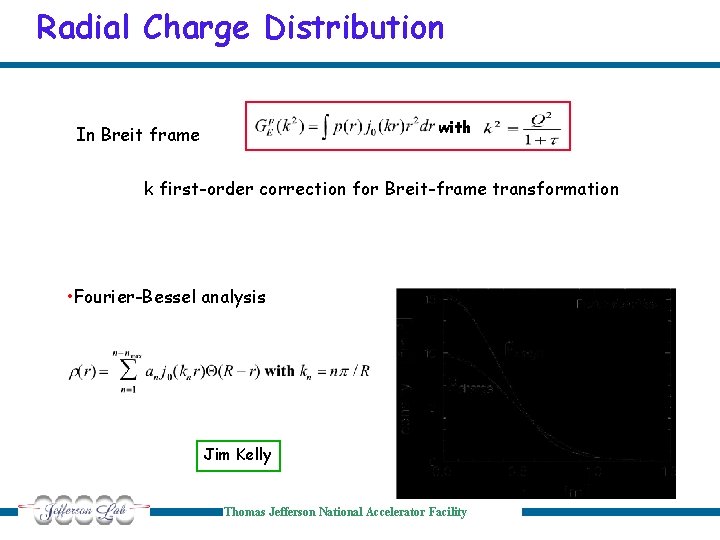
Radial Charge Distribution with In Breit frame k first-order correction for Breit-frame transformation • Fourier-Bessel analysis Jim Kelly Thomas Jefferson National Accelerator Facility
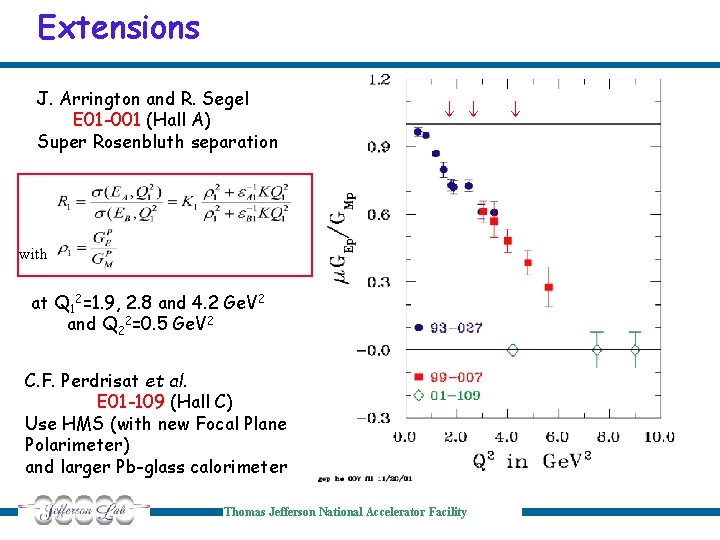
Extensions J. Arrington and R. Segel E 01 -001 (Hall A) Super Rosenbluth separation with at Q 12=1. 9, 2. 8 and 4. 2 Ge. V 2 and Q 22=0. 5 Ge. V 2 C. F. Perdrisat et al. E 01 -109 (Hall C) Use HMS (with new Focal Plane Polarimeter) and larger Pb-glass calorimeter Thomas Jefferson National Accelerator Facility
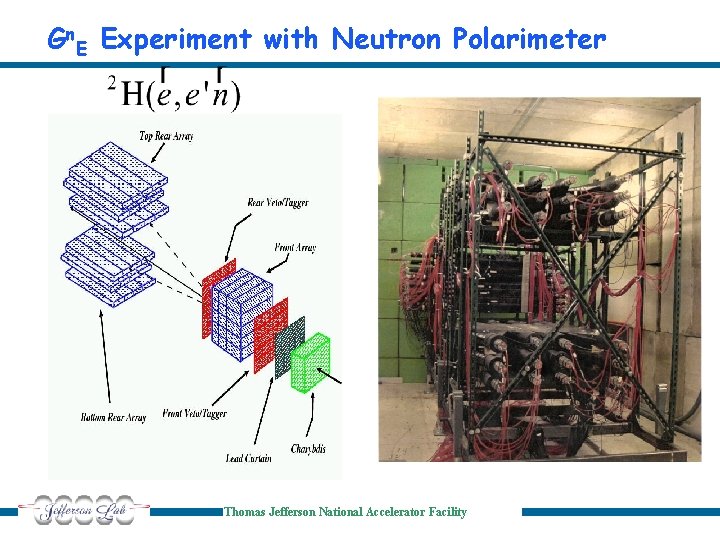
Gn. E Experiment with Neutron Polarimeter Thomas Jefferson National Accelerator Facility
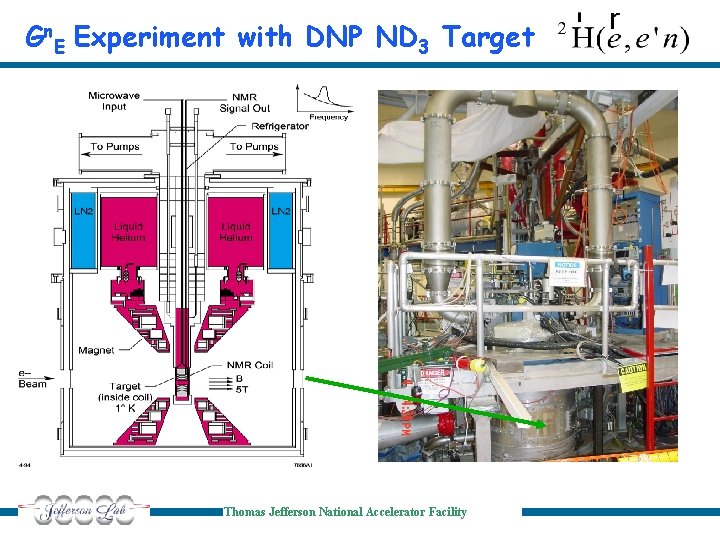
Gn. E Experiment with DNP ND 3 Target Thomas Jefferson National Accelerator Facility
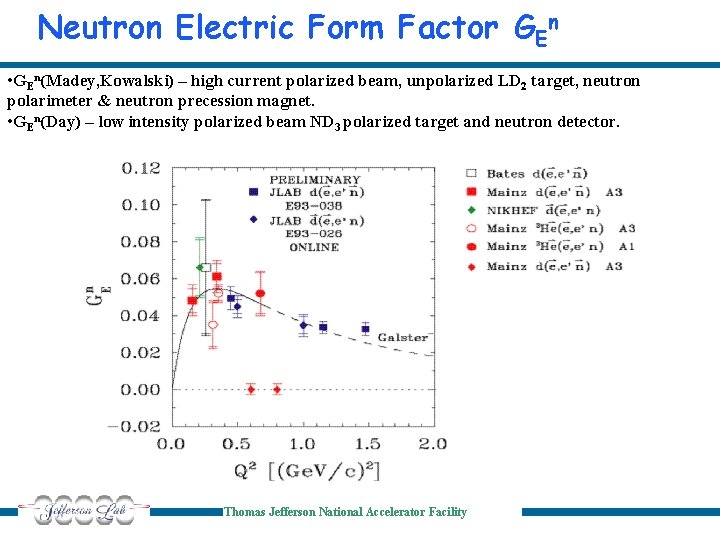
Neutron Electric Form Factor GEn • GEn(Madey, Kowalski) – high current polarized beam, unpolarized LD 2 target, neutron polarimeter & neutron precession magnet. • GEn(Day) – low intensity polarized beam ND 3 polarized target and neutron detector. Thomas Jefferson National Accelerator Facility
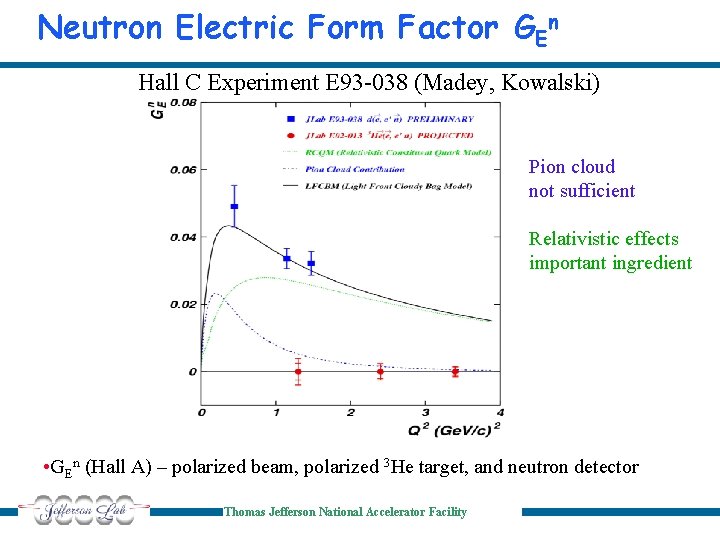
Neutron Electric Form Factor GEn Hall C Experiment E 93 -038 (Madey, Kowalski) Pion cloud not sufficient Relativistic effects important ingredient • GEn (Hall A) – polarized beam, polarized 3 He target, and neutron detector Thomas Jefferson National Accelerator Facility
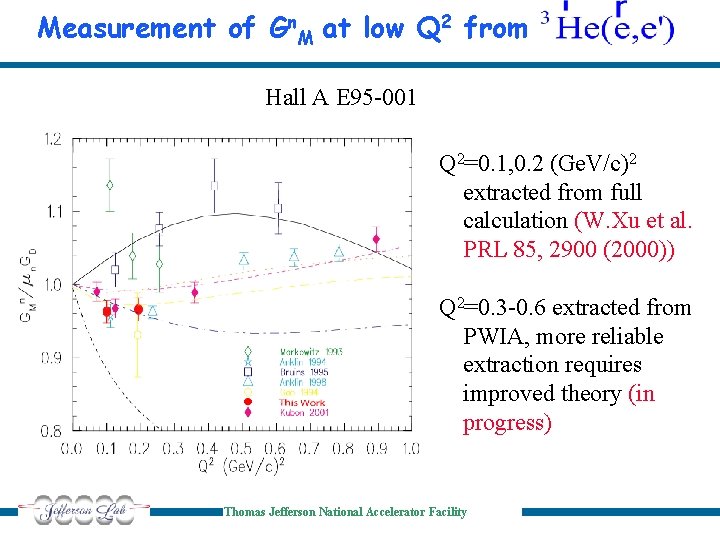
Measurement of Gn. M at low Q 2 from Hall A E 95 -001 Q 2=0. 1, 0. 2 (Ge. V/c)2 extracted from full calculation (W. Xu et al. PRL 85, 2900 (2000)) Q 2=0. 3 -0. 6 extracted from PWIA, more reliable extraction requires improved theory (in progress) Thomas Jefferson National Accelerator Facility
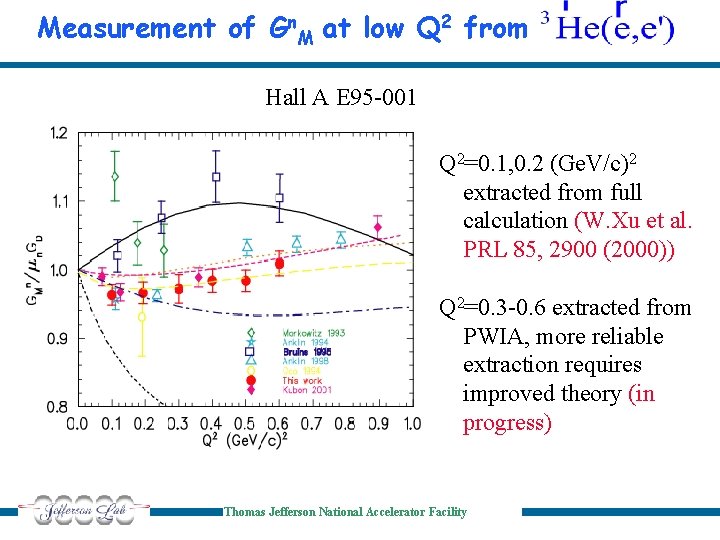
Measurement of Gn. M at low Q 2 from Hall A E 95 -001 Q 2=0. 1, 0. 2 (Ge. V/c)2 extracted from full calculation (W. Xu et al. PRL 85, 2900 (2000)) Q 2=0. 3 -0. 6 extracted from PWIA, more reliable extraction requires improved theory (in progress) Thomas Jefferson National Accelerator Facility
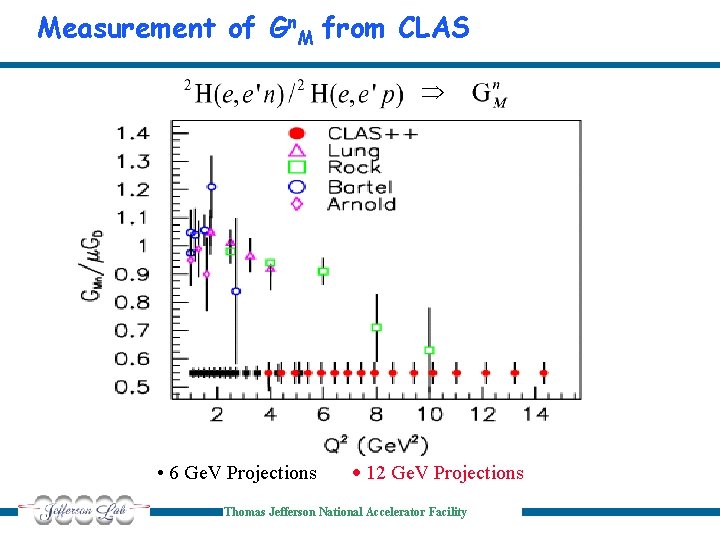
Measurement of Gn. M from CLAS • 6 Ge. V Projections 12 Ge. V Projections Thomas Jefferson National Accelerator Facility
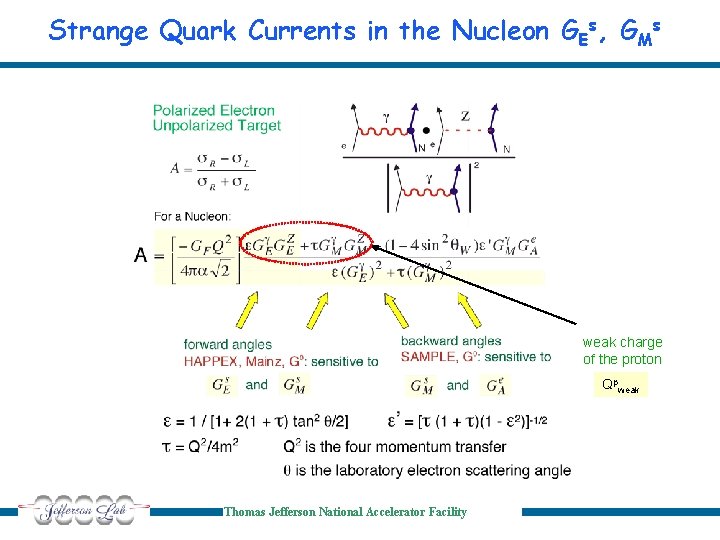
Strange Quark Currents in the Nucleon GEs, GMs weak charge of the proton Qpweak Thomas Jefferson National Accelerator Facility
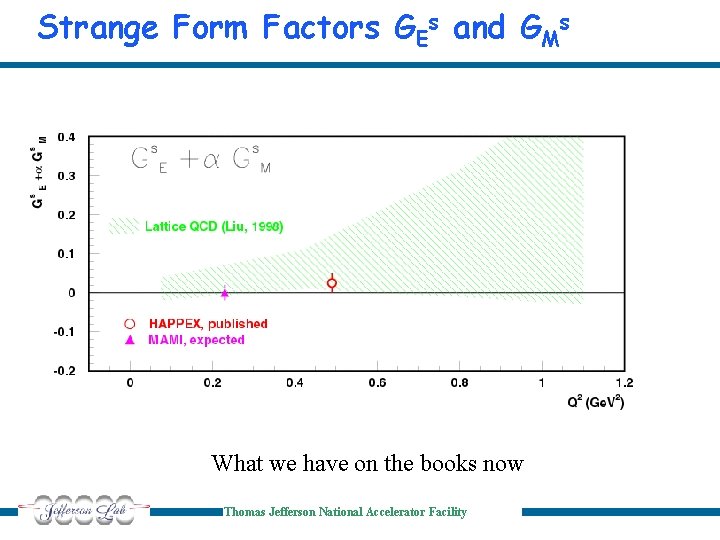
Strange Form Factors GEs and GMs What we have on the books now Thomas Jefferson National Accelerator Facility
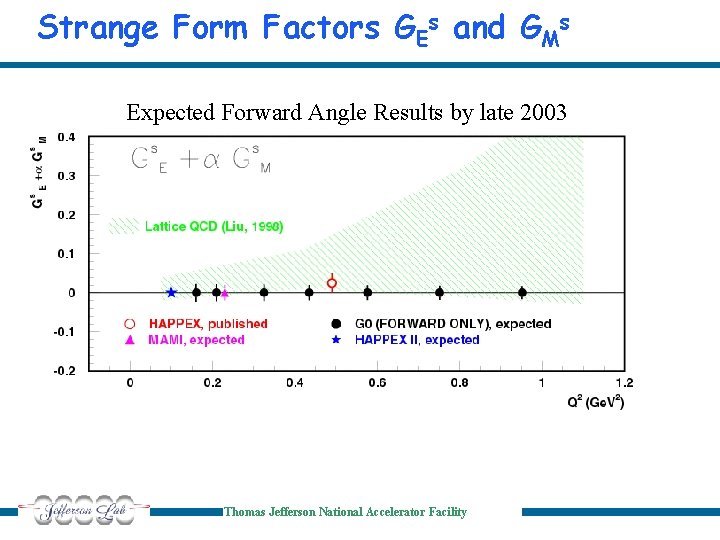
Strange Form Factors GEs and GMs Expected Forward Angle Results by late 2003 Thomas Jefferson National Accelerator Facility
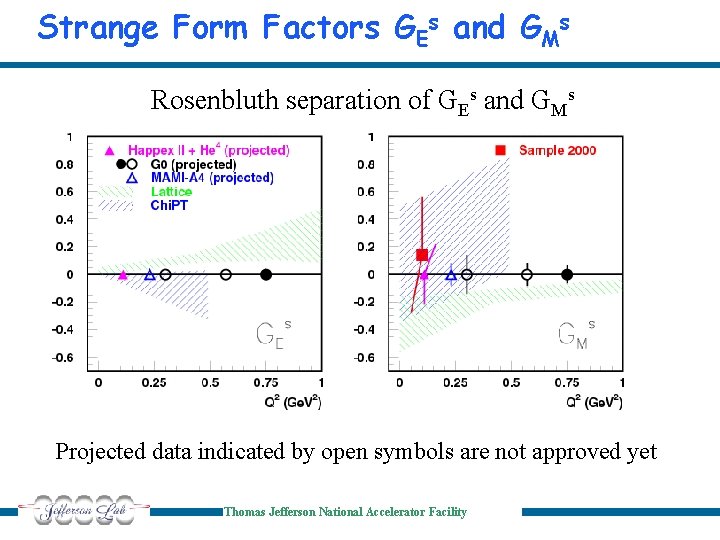
Strange Form Factors GEs and GMs Rosenbluth separation of GEs and GMs Projected data indicated by open symbols are not approved yet Thomas Jefferson National Accelerator Facility
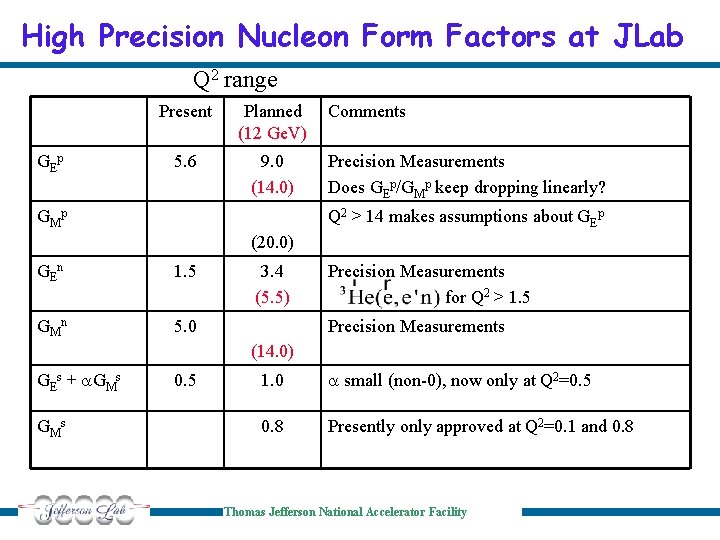
High Precision Nucleon Form Factors at JLab Q 2 range GEp Present Planned (12 Ge. V) 5. 6 9. 0 (14. 0) GM p Comments Precision Measurements Does GEp/GMp keep dropping linearly? Q 2 > 14 makes assumptions about GEp (20. 0) GEn 1. 5 GM n 5. 0 3. 4 (5. 5) Precision Measurements for Q 2 > 1. 5 Precision Measurements (14. 0) GEs + GMs GM s 0. 5 1. 0 small (non-0), now only at Q 2=0. 5 0. 8 Presently only approved at Q 2=0. 1 and 0. 8 Thomas Jefferson National Accelerator Facility
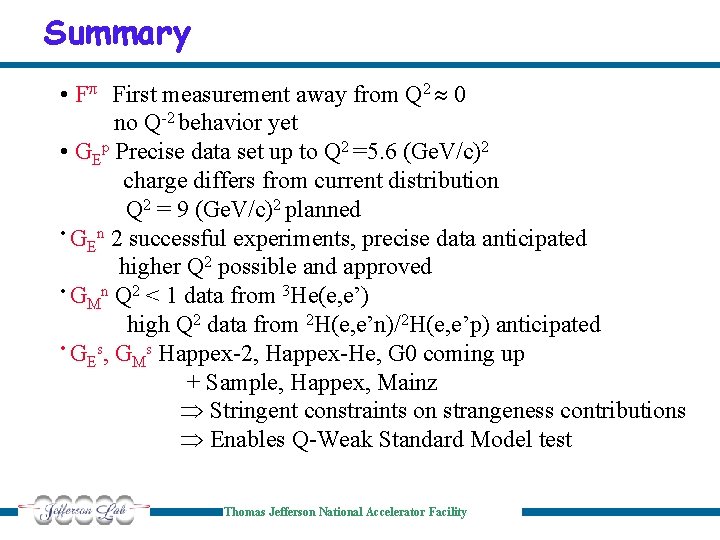
Summary • F First measurement away from Q 2 0 no Q-2 behavior yet • GEp Precise data set up to Q 2 =5. 6 (Ge. V/c)2 charge differs from current distribution Q 2 = 9 (Ge. V/c)2 planned • G n 2 successful experiments, precise data anticipated E higher Q 2 possible and approved • G n Q 2 < 1 data from 3 He(e, e’) M high Q 2 data from 2 H(e, e’n)/2 H(e, e’p) anticipated • G s, G s Happex-2, Happex-He, G 0 coming up E M + Sample, Happex, Mainz Stringent constraints on strangeness contributions Enables Q-Weak Standard Model test Thomas Jefferson National Accelerator Facility
- Slides: 26