
HACCP KEEPING FOOD SAFE IN THE WORKPLACE What
- Slides: 38
HACCP KEEPING FOOD SAFE IN THE WORKPLACE
What does HACCP stand for? H - Hazard A - Analysis C - Critical C - Control P - Points
What is it? HACCP is a structured system that is put into place to stop or prevent potential problems before they happen HACCP principles recognized by companies around the world, but each company has their own systems, and no two companies are the same.
History Created in the 1960 s by Pillsbury, the U. S. Army, and NASA to develop safe food for astronauts. Pillsbury presented the concepts at a food safety conference in 1971, and the USDA adopted it for food manufacturing plants in 1974 It then began to be adopted by other food organizations around the world , and soon became an accepted, standard practice. www. youtube. com/watch? v=AZx 0 RIV 0 wss
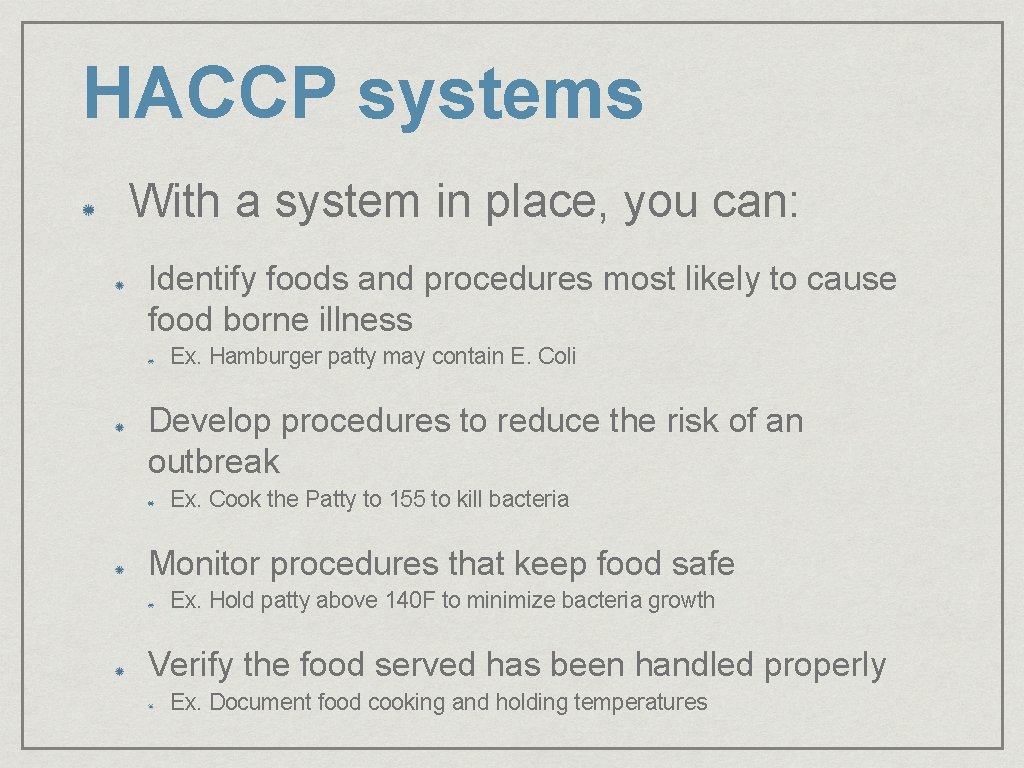
HACCP systems With a system in place, you can: Identify foods and procedures most likely to cause food borne illness Ex. Hamburger patty may contain E. Coli Develop procedures to reduce the risk of an outbreak Ex. Cook the Patty to 155 to kill bacteria Monitor procedures that keep food safe Ex. Hold patty above 140 F to minimize bacteria growth Verify the food served has been handled properly Ex. Document food cooking and holding temperatures
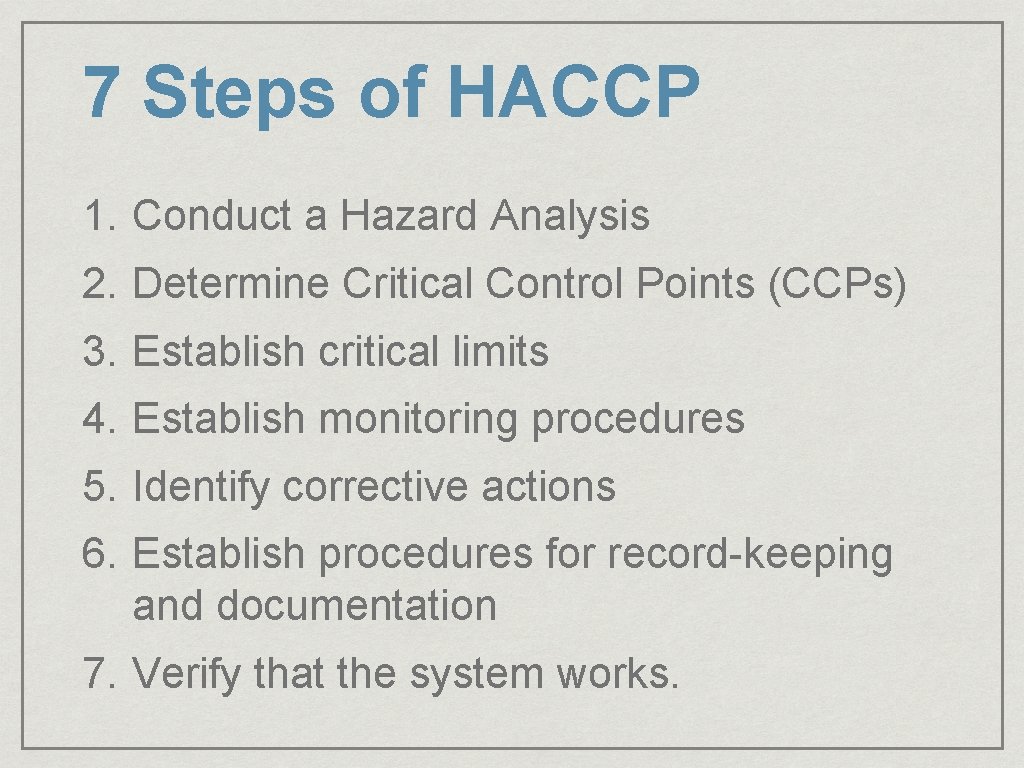
7 Steps of HACCP 1. Conduct a Hazard Analysis 2. Determine Critical Control Points (CCPs) 3. Establish critical limits 4. Establish monitoring procedures 5. Identify corrective actions 6. Establish procedures for record-keeping and documentation 7. Verify that the system works.
Let’s break it down!
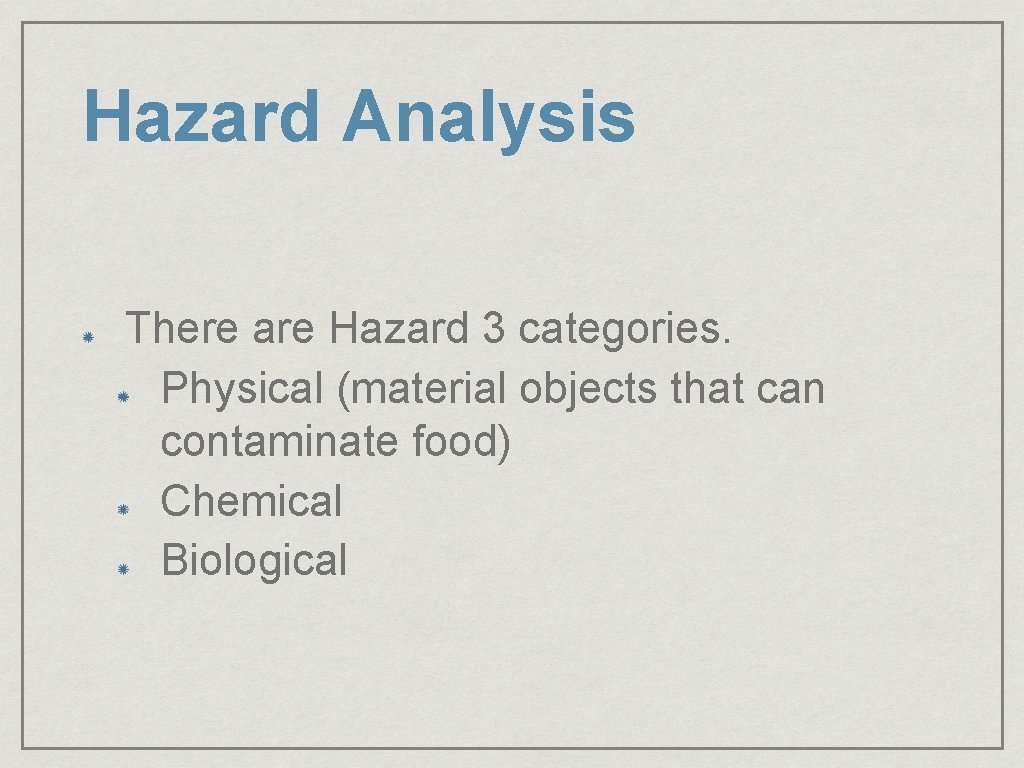
Hazard Analysis There are Hazard 3 categories. Physical (material objects that can contaminate food) Chemical Biological
Round Robin You are going to make a list of potential hazards that could be found in a commercial kitchen. Person 1 starts, and gives one example in the physical category. Then 2 will give an example, etc. Once around the table, switch to the next category, and then the next. Repeat as time allows. Person 1 - In the margin of your I. N. , write down all responses for physical hazards Person 2 - In the margin of your I. N. , write down all responses for chemical hazards Person 3 - In the margin of your I. N. , write down all responses for biological hazards Person 4 - You will be the spokesman. Be prepared to share.
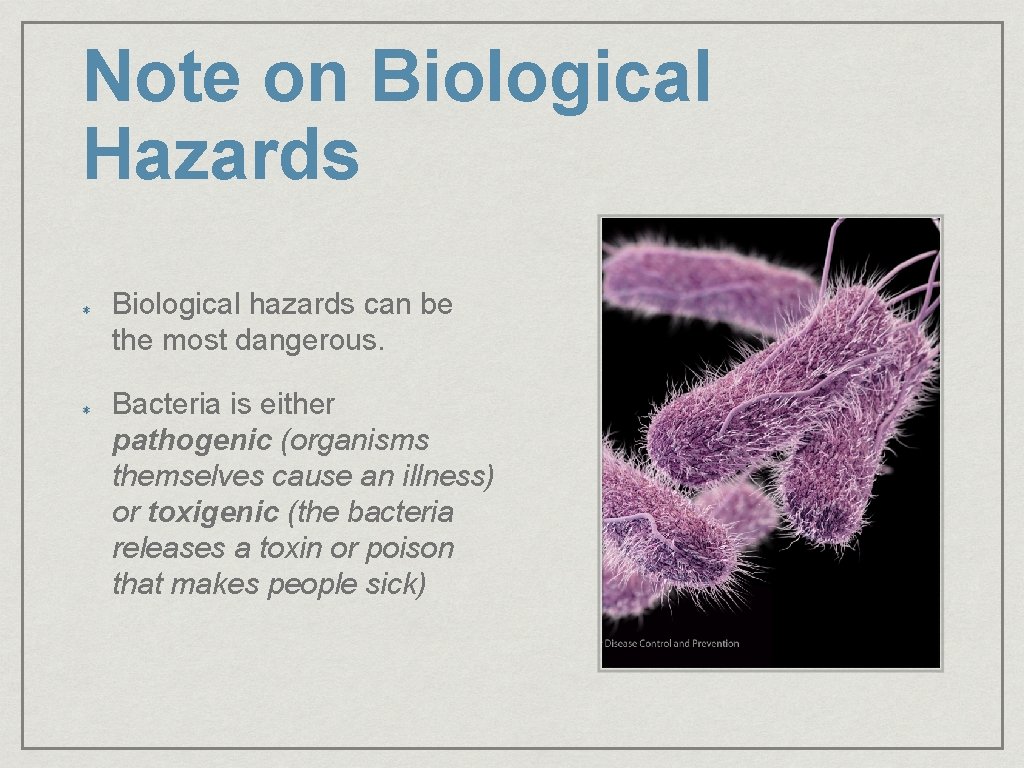
Note on Biological Hazards Biological hazards can be the most dangerous. Bacteria is either pathogenic (organisms themselves cause an illness) or toxigenic (the bacteria releases a toxin or poison that makes people sick)
FATTOM There are 6 factors that impact bacteria growth F - food A - acid T - temperature T - time O - Oxygen M - Moisture
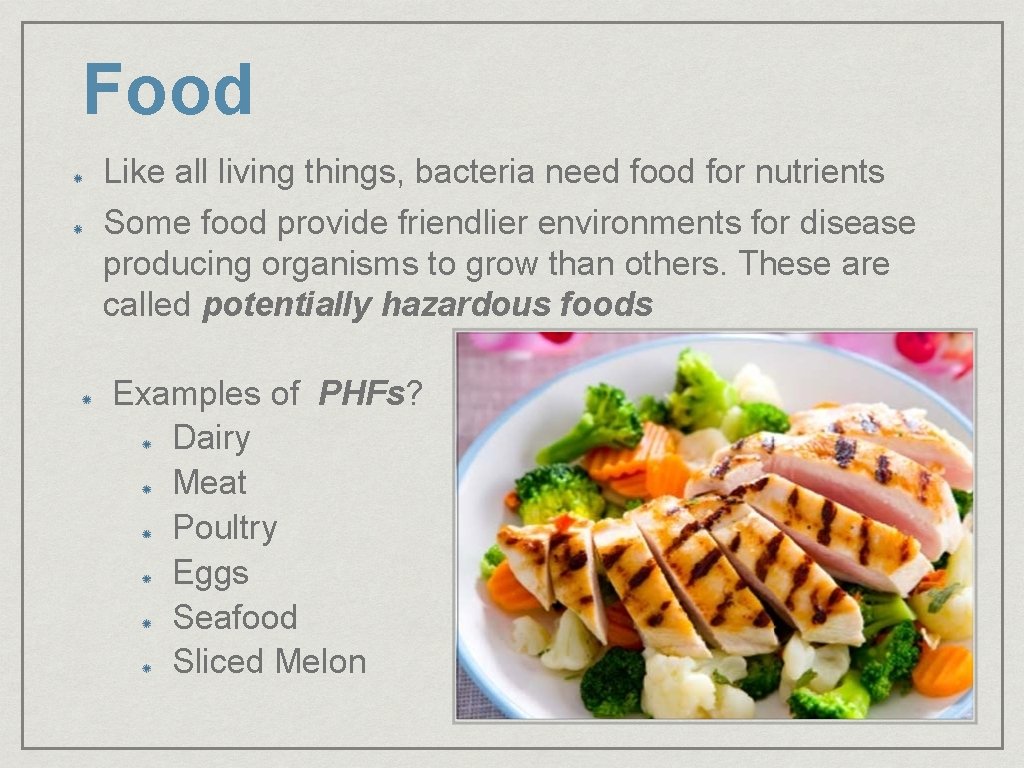
Food Like all living things, bacteria need food for nutrients Some food provide friendlier environments for disease producing organisms to grow than others. These are called potentially hazardous foods Examples of PHFs? Dairy Meat Poultry Eggs Seafood Sliced Melon
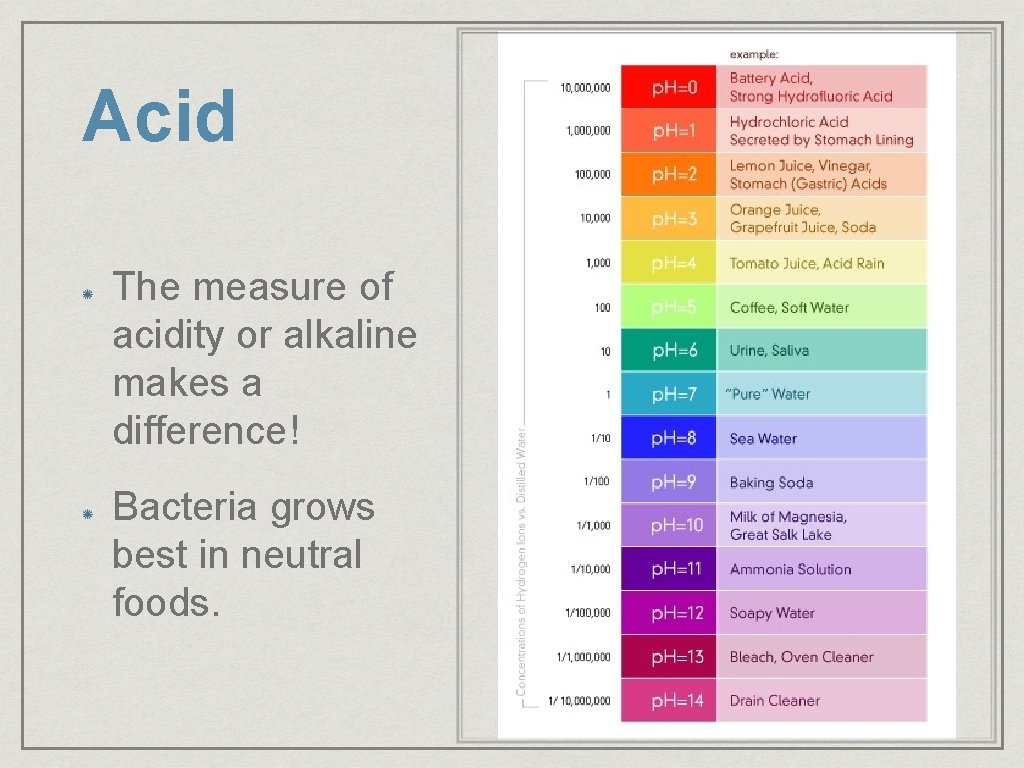
Acid The measure of acidity or alkaline makes a difference! Bacteria grows best in neutral foods.
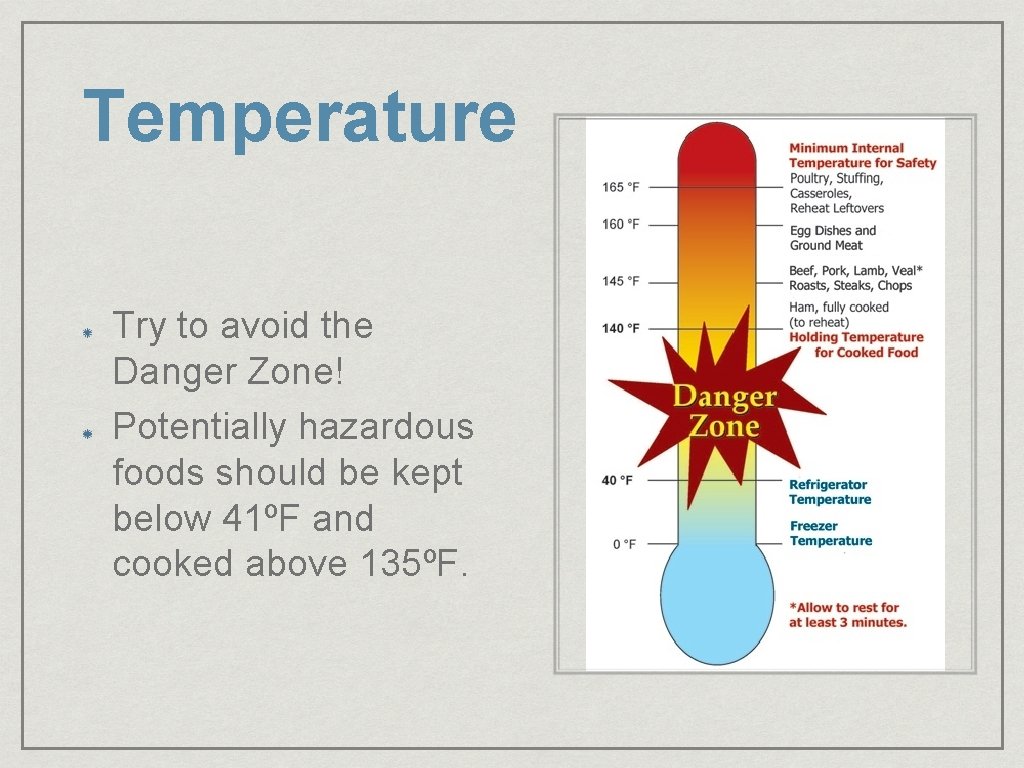
Temperature Try to avoid the Danger Zone! Potentially hazardous foods should be kept below 41ºF and cooked above 135ºF.
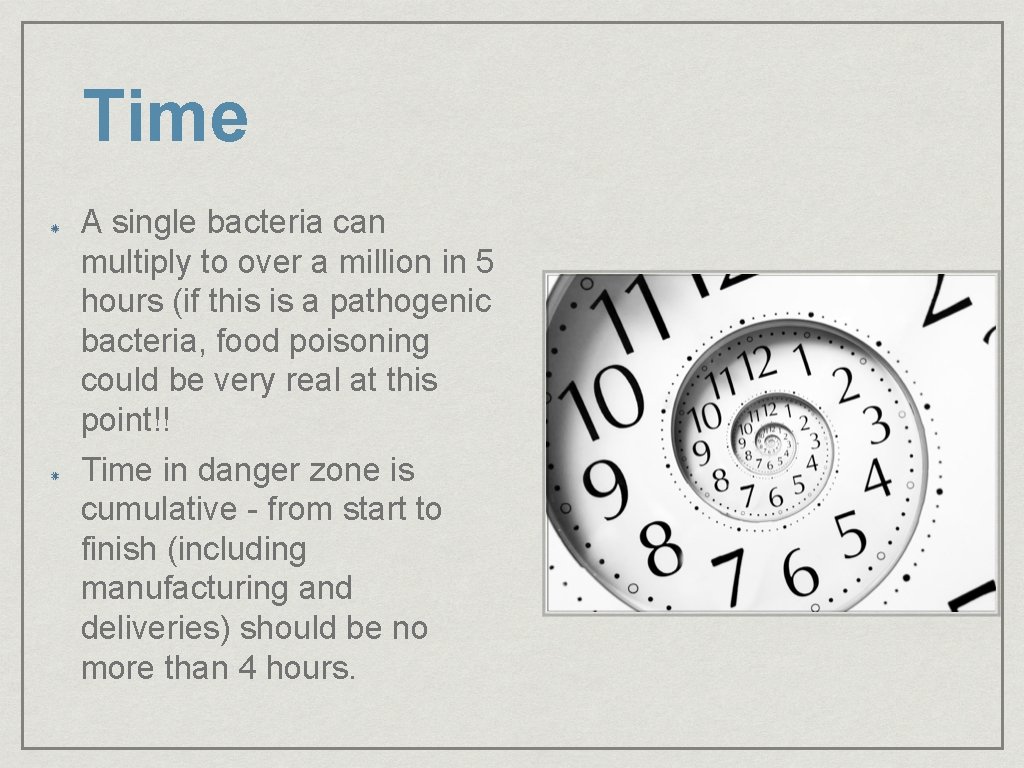
Time A single bacteria can multiply to over a million in 5 hours (if this is a pathogenic bacteria, food poisoning could be very real at this point!! Time in danger zone is cumulative - from start to finish (including manufacturing and deliveries) should be no more than 4 hours.
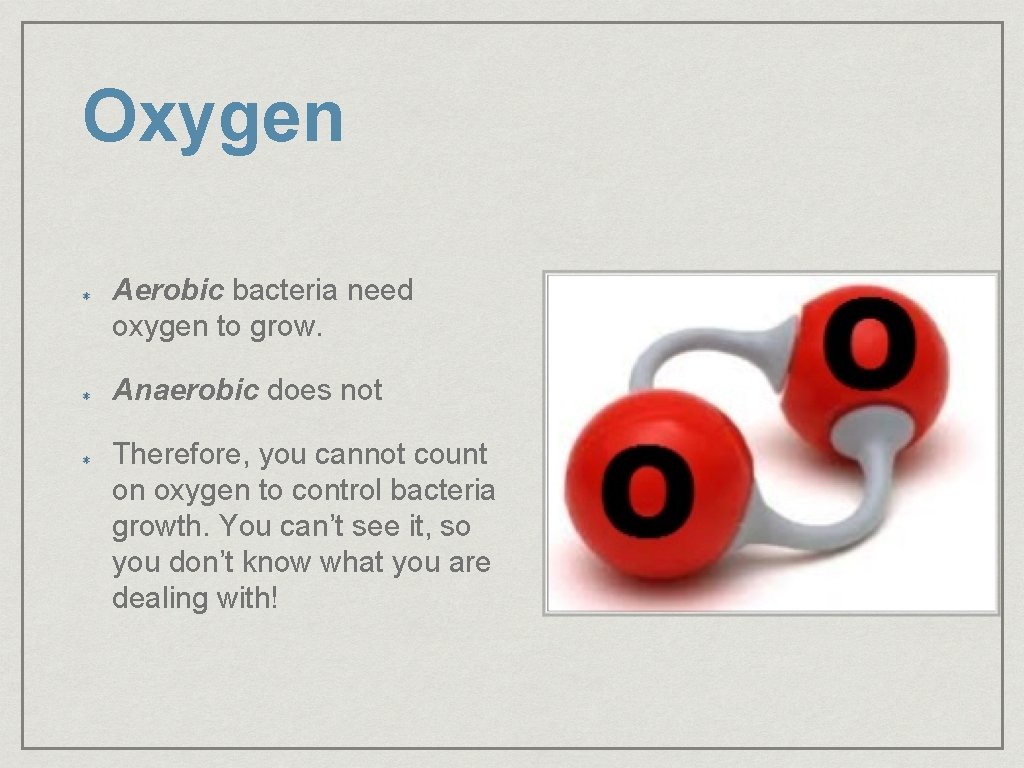
Oxygen Aerobic bacteria need oxygen to grow. Anaerobic does not Therefore, you cannot count on oxygen to control bacteria growth. You can’t see it, so you don’t know what you are dealing with!
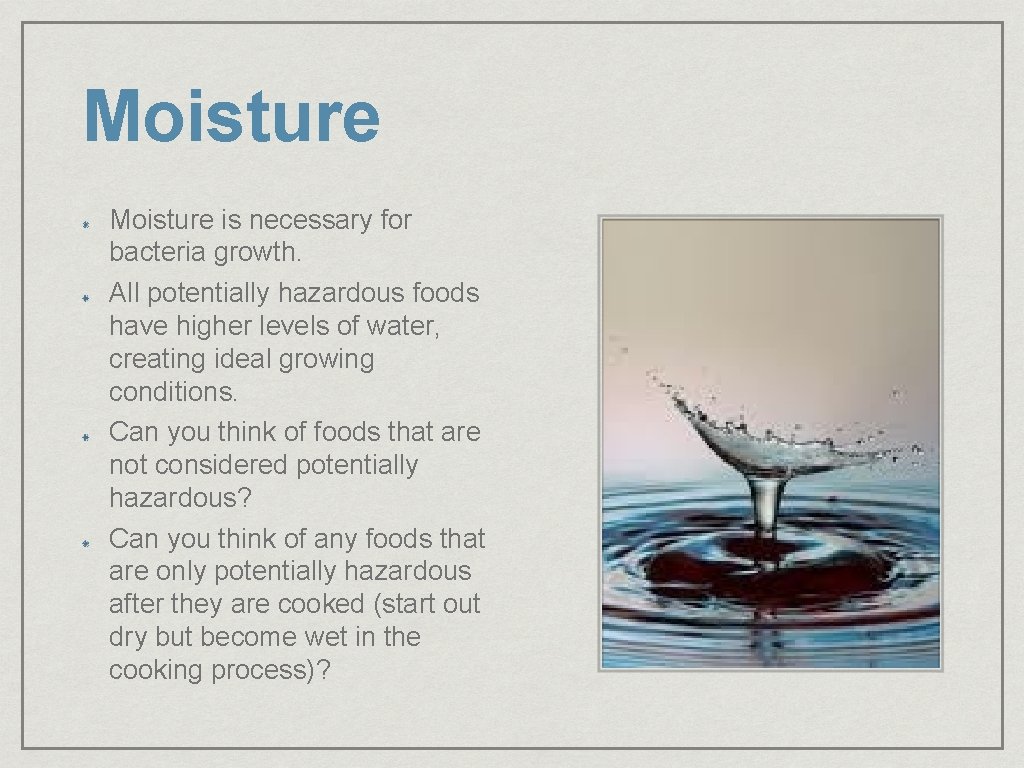
Moisture is necessary for bacteria growth. All potentially hazardous foods have higher levels of water, creating ideal growing conditions. Can you think of foods that are not considered potentially hazardous? Can you think of any foods that are only potentially hazardous after they are cooked (start out dry but become wet in the cooking process)?
Super. Size Me The Smoking Fry - Bonus Clip www. youtube. com/watch? v=VMWq 26 z. H_s. U
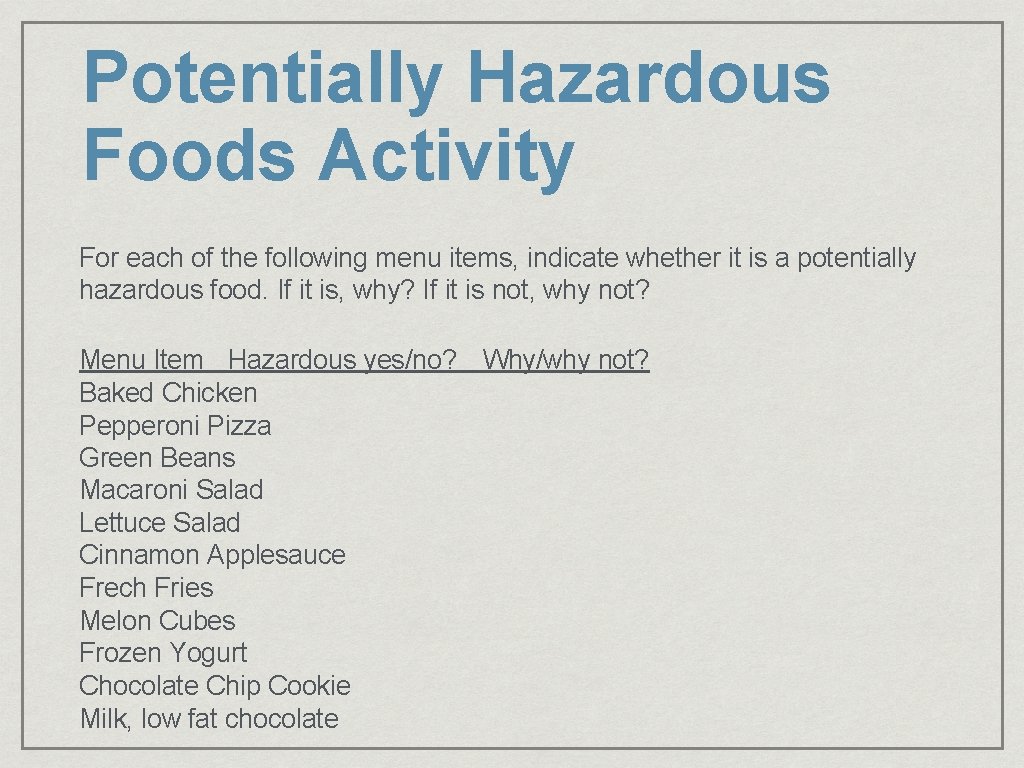
Potentially Hazardous Foods Activity For each of the following menu items, indicate whether it is a potentially hazardous food. If it is, why? If it is not, why not? Menu Item Hazardous yes/no? Why/why not? Baked Chicken Pepperoni Pizza Green Beans Macaroni Salad Lettuce Salad Cinnamon Applesauce Frech Fries Melon Cubes Frozen Yogurt Chocolate Chip Cookie Milk, low fat chocolate
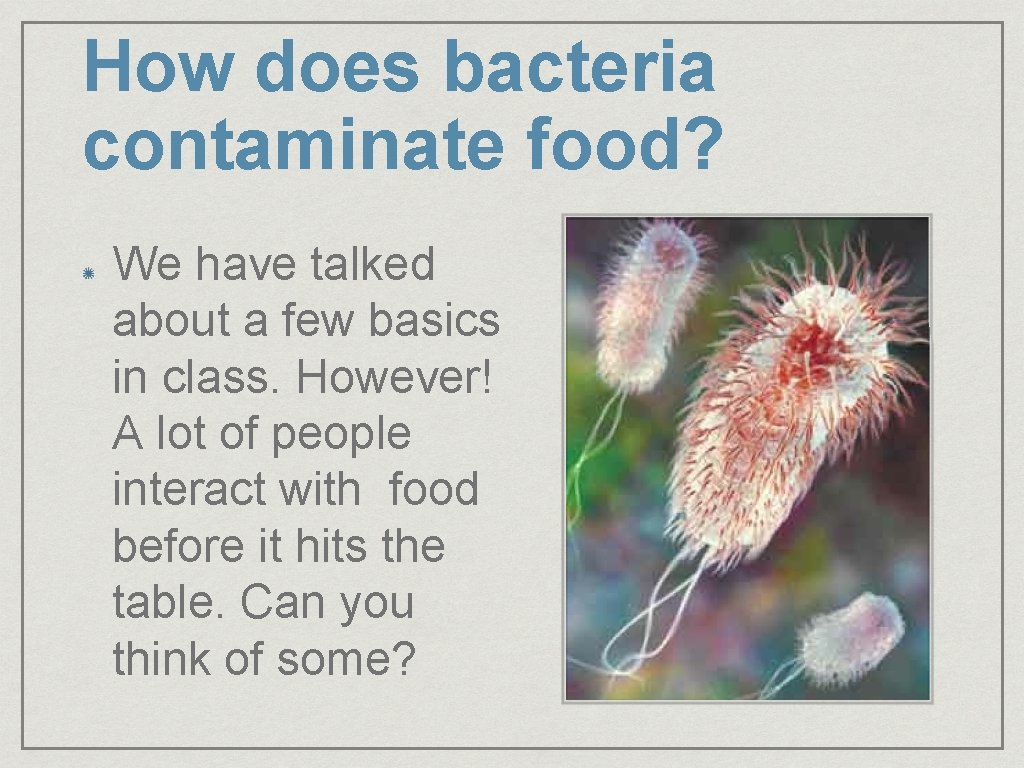
How does bacteria contaminate food? We have talked about a few basics in class. However! A lot of people interact with food before it hits the table. Can you think of some?
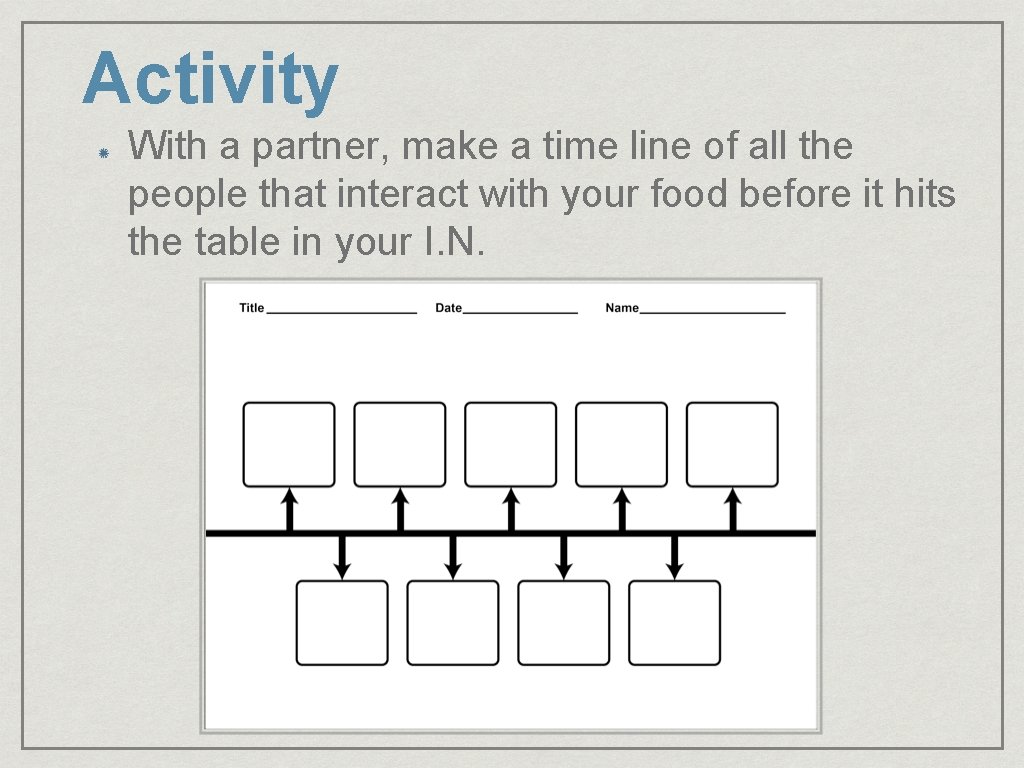
Activity With a partner, make a time line of all the people that interact with your food before it hits the table in your I. N.
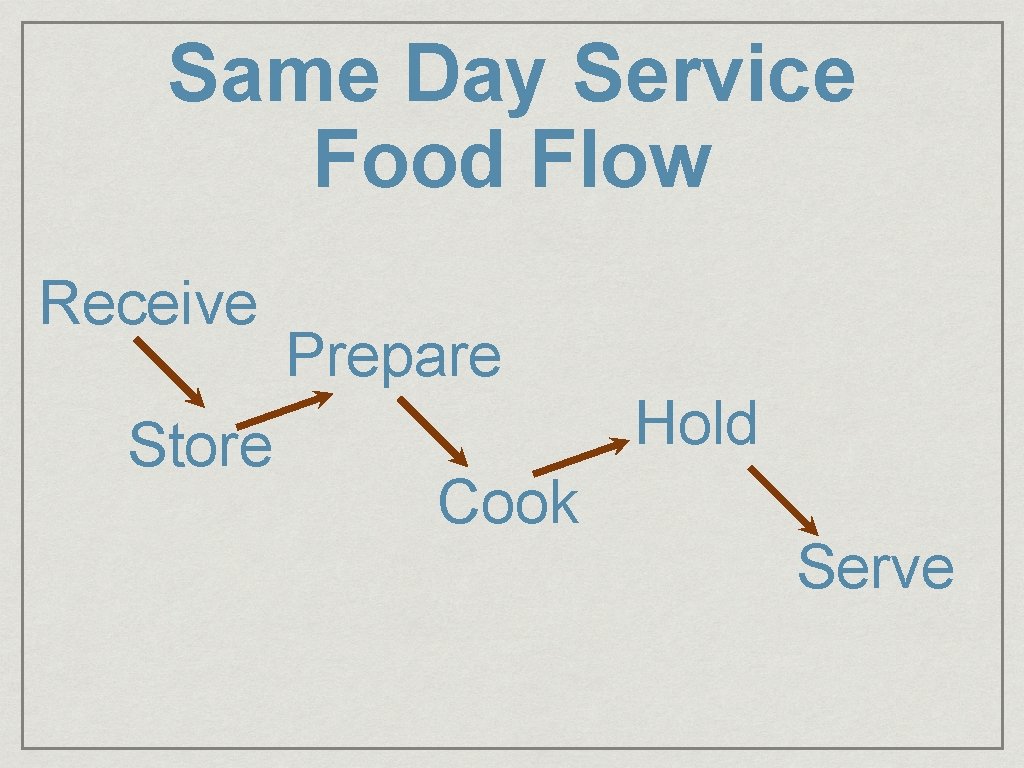
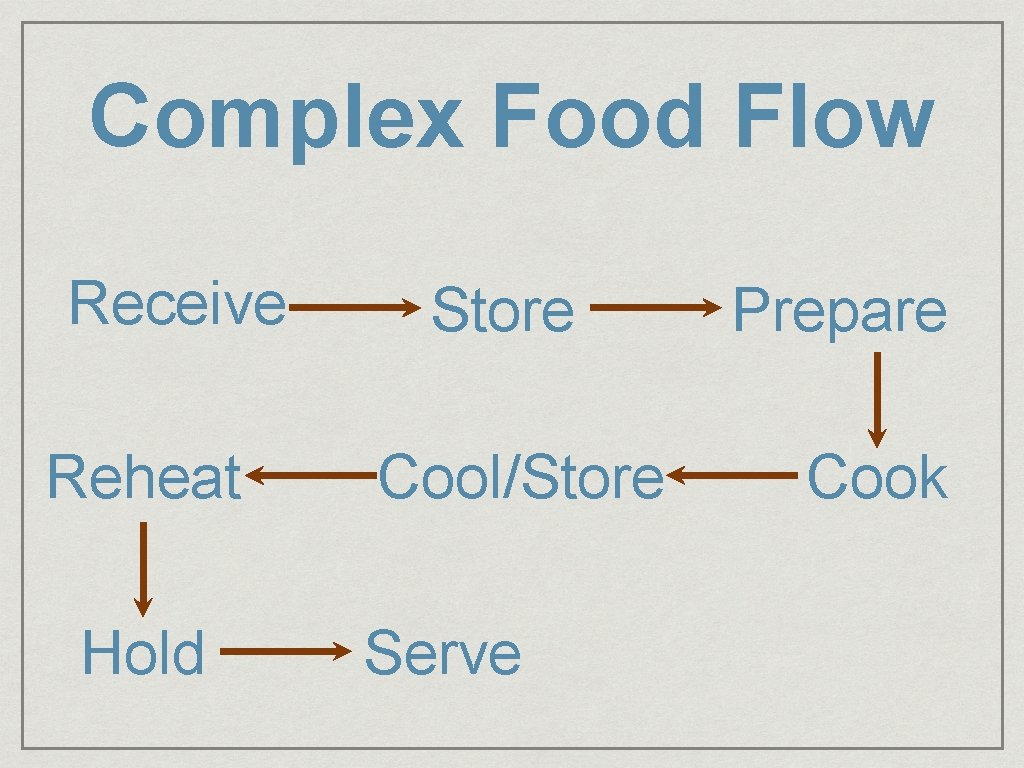
Food Flow The path food takes from receiving through serving is called food flow. Every food prepared in the kitchen is effected by FATTOM because they all have their own food flow. A HACCP plan should be identified for each potentially hazardous food. 3 basic food process flows: No cook - example: deli meat sandwiches Same day service - example: an food cooked and served on the same day Complex - example: slow roasted meats cooked over night and served the next day (prime rib, turkey, etc. )
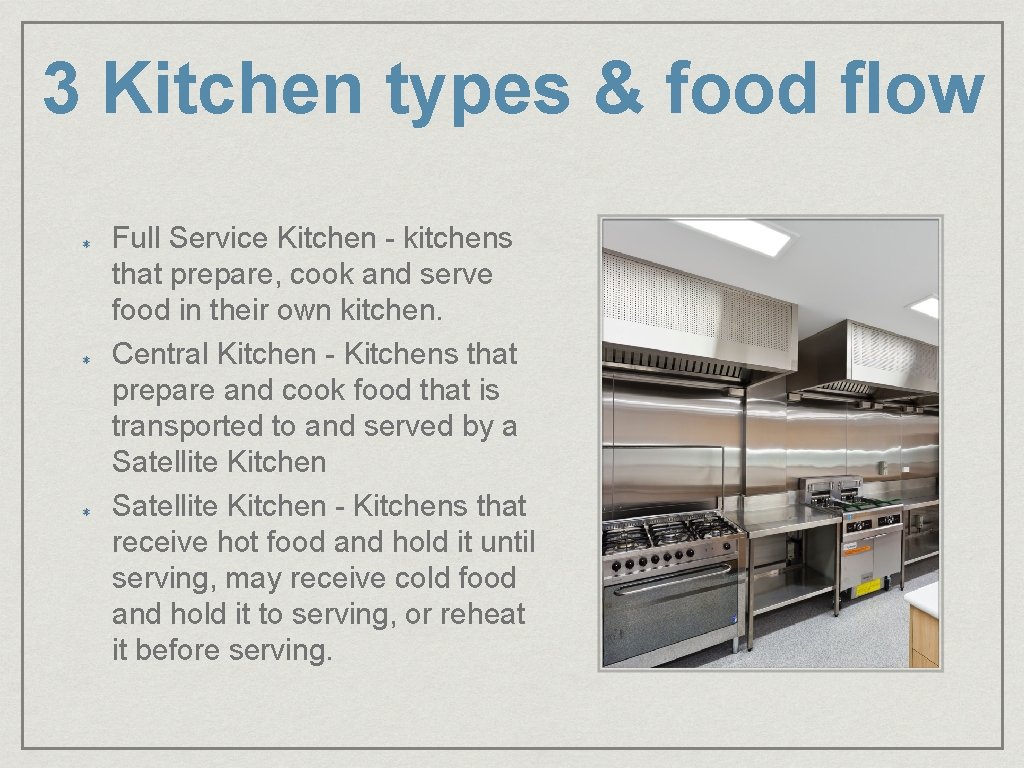
3 Kitchen types & food flow Full Service Kitchen - kitchens that prepare, cook and serve food in their own kitchen. Central Kitchen - Kitchens that prepare and cook food that is transported to and served by a Satellite Kitchen - Kitchens that receive hot food and hold it until serving, may receive cold food and hold it to serving, or reheat it before serving.
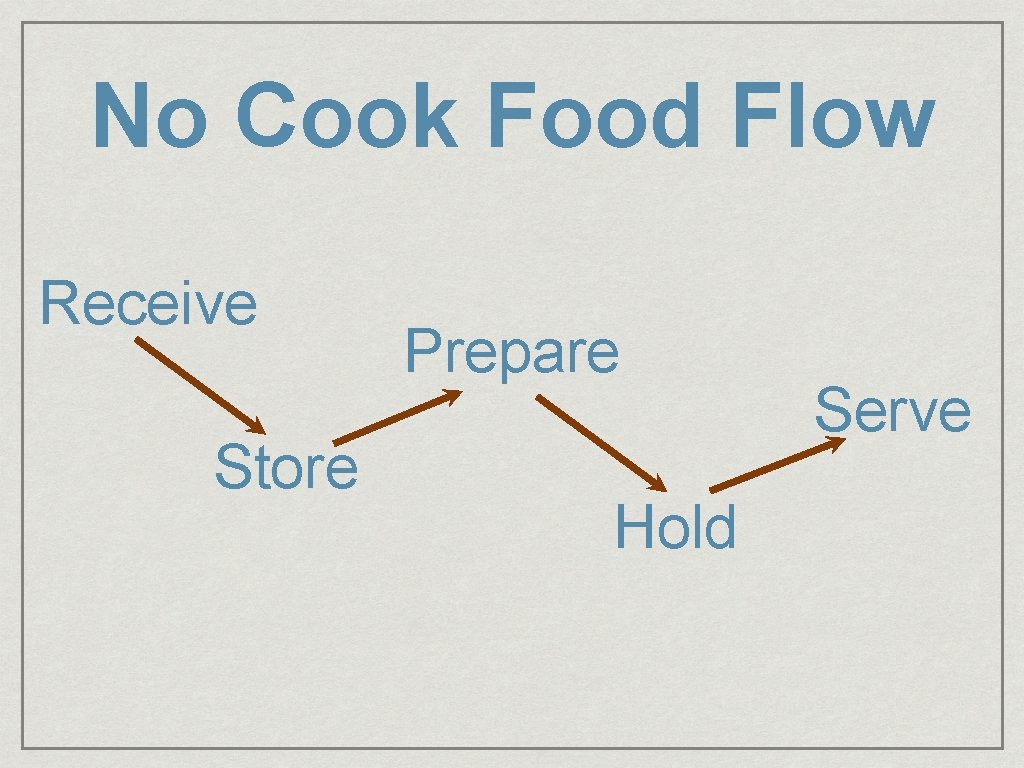
No Cook Food Flow Receive Store Prepare Hold Serve
Same Day Service Food Flow Receive Store Prepare Cook Hold Serve
Complex Food Flow Receive Reheat Hold Store Cool/Store Serve Prepare Cook
Can you find hazards? Now that we have identified potentially hazardous foods, can we identify where and when the hazards might happen? Partner up! Grab the worksheet Potential Hazards in Food Service You will be assigned a product. With your partner, think of potential problems during the food flow of an assigned product.
What are CCPs? Critical Control Points are the vital steps in food handling that prevent, eliminate, or reduce hazard potential Where is the potential problem? How can we stop it from happening?
CCPs continued Usually time and temperature based (but not always). Critical control points are the last point when food safety is at risk. All other risks are simply control points (CP) After a hazard analysis is done, the CCP Decision Tree is used to determine where CCPs exist. Not needed if a food is not potentially hazardous.
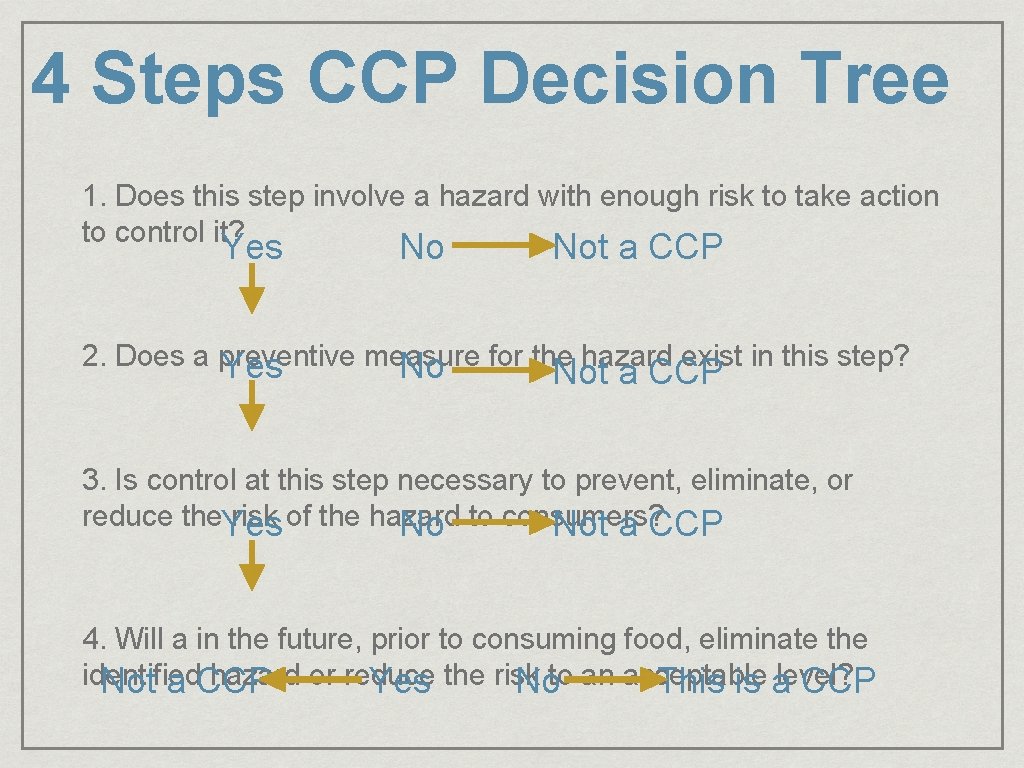
4 Steps CCP Decision Tree 1. Does this step involve a hazard with enough risk to take action to control it? Yes No Not a CCP 2. Does a preventive measure Yes No for the hazard exist in this step? Not a CCP 3. Is control at this step necessary to prevent, eliminate, or reduce the. Yes risk of the hazard No to consumers? Not a CCP 4. Will a in the future, prior to consuming food, eliminate the identified hazard or reduce Not a CCP Yes the risk Noto an acceptable This is alevel? CCP
Keeping Food Safe: Start to Finish Using the Keeping Food Safe worksheet, can you identify CCPs in the food handling process? Note: The hamburger patty is raw, frozen product that will be panned, prepared and served on the same day.
Critical Limits Critical limits are set up to stop something from continuing Example: Speed limits in school zones vs. highways. Each are a critical limit to help ensure safety in each place. Same is true for critical limits in food. They are boundaries set to keep food safe. Example: Bake chicken to internal temperature of 165ºF or higher for at least 15 seconds.
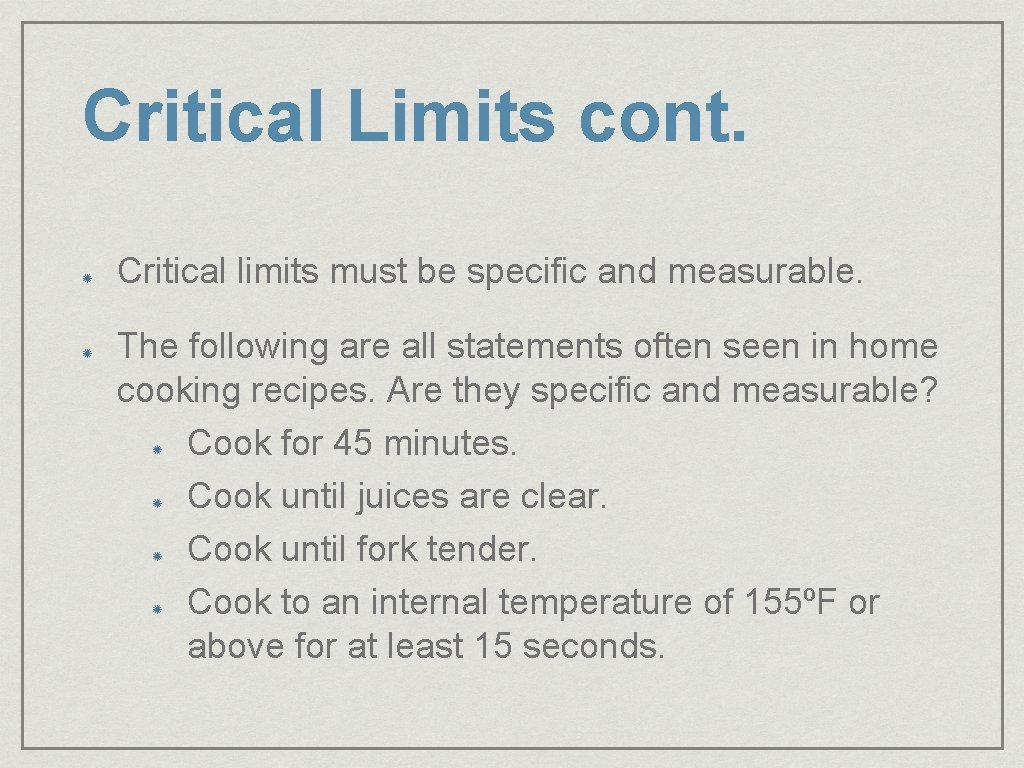
Critical Limits cont. Critical limits must be specific and measurable. The following are all statements often seen in home cooking recipes. Are they specific and measurable? Cook for 45 minutes. Cook until juices are clear. Cook until fork tender. Cook to an internal temperature of 155ºF or above for at least 15 seconds.
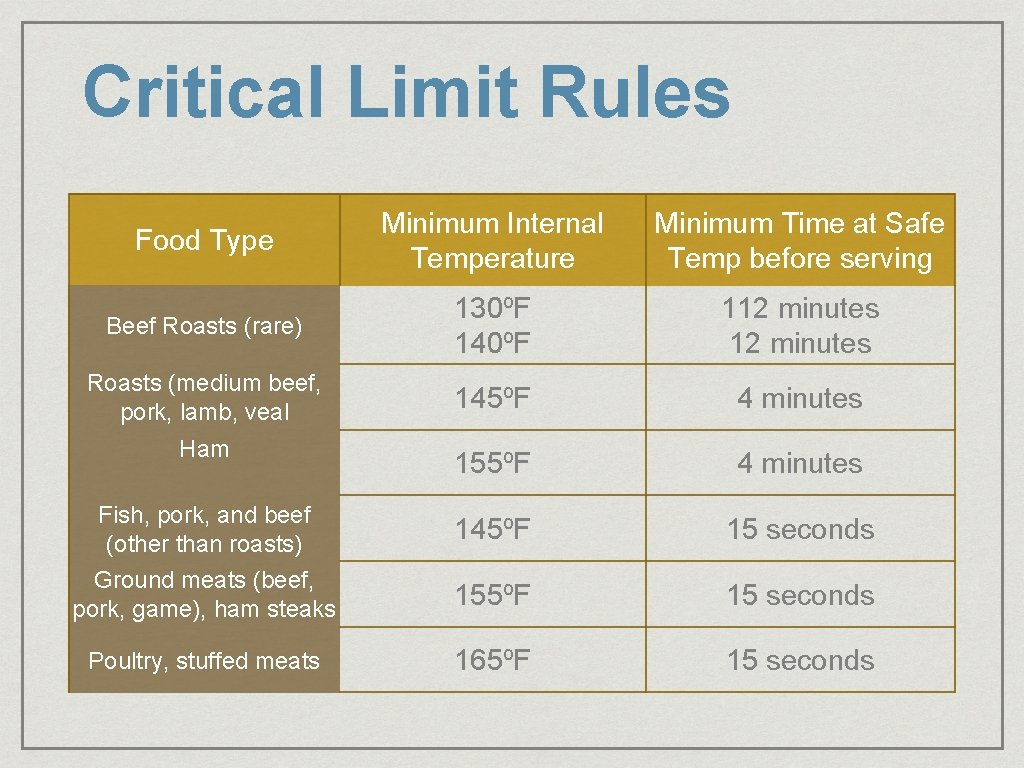
Critical Limit Rules Food Type Minimum Internal Temperature Minimum Time at Safe Temp before serving Beef Roasts (rare) 130ºF 140ºF 112 minutes Roasts (medium beef, pork, lamb, veal 145ºF 4 minutes Ham 155ºF 4 minutes Fish, pork, and beef (other than roasts) 145ºF 15 seconds Ground meats (beef, pork, game), ham steaks 155ºF 15 seconds Poultry, stuffed meats 165ºF 15 seconds
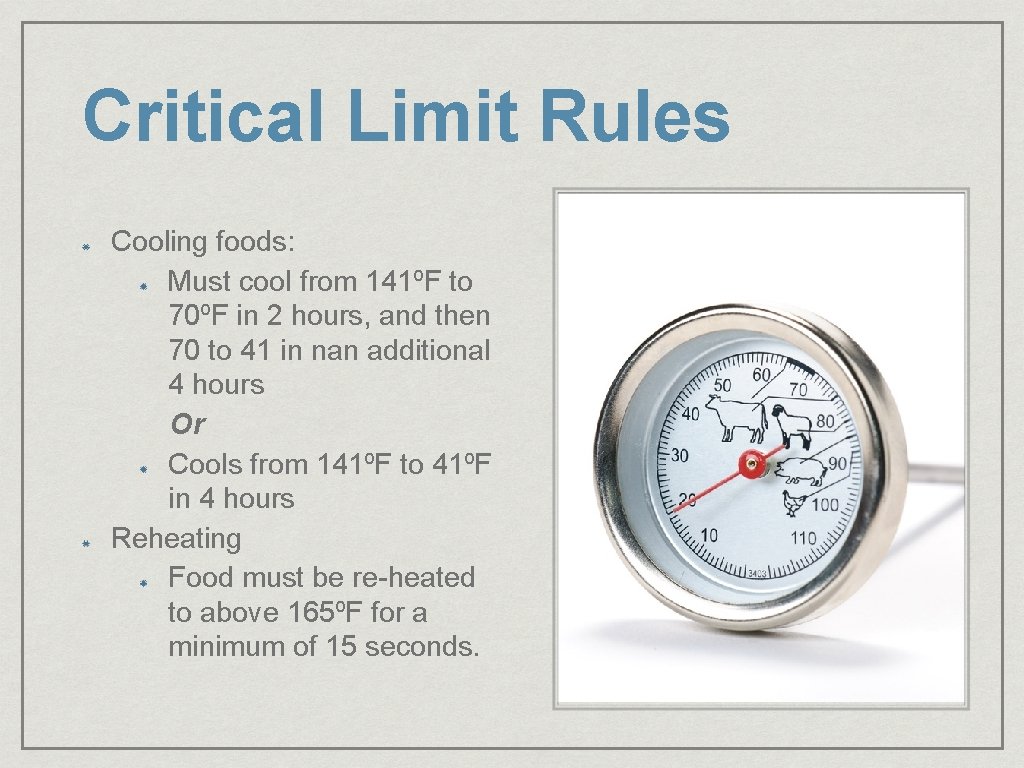
Critical Limit Rules Cooling foods: Must cool from 141ºF to 70ºF in 2 hours, and then 70 to 41 in nan additional 4 hours Or Cools from 141ºF to 41ºF in 4 hours Reheating Food must be re-heated to above 165ºF for a minimum of 15 seconds.
Can you find the CCPs? Look at the recipes for Nachos with Ground Beef, Chicken Salad, and Toasted Grilled Cheese Sandwich. Read through the recipe. With each step, go through the decision tree Are the CCPs in the right places?
Your turn! Read through the recipe you have been assigned. Where should there be CCPs in the recipe? Write them into the recipe.
4 - Executive Chef In addition to 3, I can provide indepth examples and applications beyond what has been taught. 3 - Sous Chef I understand can demonstrate what was taught with no omissions or mistakes. 2 - Line Cook WHERE ARE YOU ON I understand the simple basics of THE LEARNING SCALE? the idea but still cannot demonstrate the more complex details. 1 - Dishwasher If given help, I am able to provide a partial demonstration of understanding. LEARNING GOAL CHECK