
HACCP Hazard Analysis and Critical Control Point Learning

- Slides: 10
HACCP Hazard Analysis and Critical Control Point
Learning outcomes: Understand what the term Hazard Analysis and Critical Control point means. Recognise the terms chemical, biological and physical hazards and give examples of each. Be able to produce a HACCP chart.
Key words Hazard – a danger or a risk. HACCP – a plan for identifying hazards and what action should be taken to avoid these.
HACCP stands for Hazard Analysis Critical. Control Point. It is a written plan that defines the procedures for maintaining control of potentially hazardous food at the critical control points of food preparation or processing.
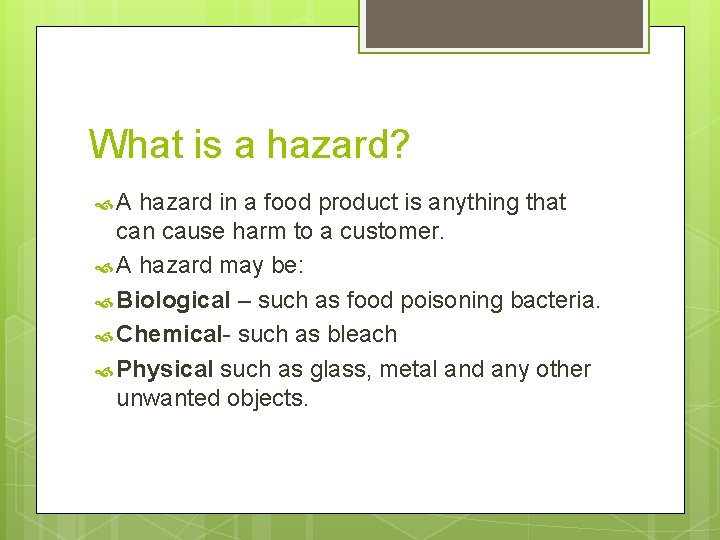
What is a hazard? A hazard in a food product is anything that can cause harm to a customer. A hazard may be: Biological – such as food poisoning bacteria. Chemical- such as bleach Physical such as glass, metal and any other unwanted objects.
Critical Control Points Control points are needed during the making process to make sure that the hazard is removed or reduced to a safe level.
What is a critical control point? If the hazard is a high risk and likely to cause food poisoning, then a control point is critical (important) to ensure the hazard is reduced or removed. This point is then known as a critical control point.
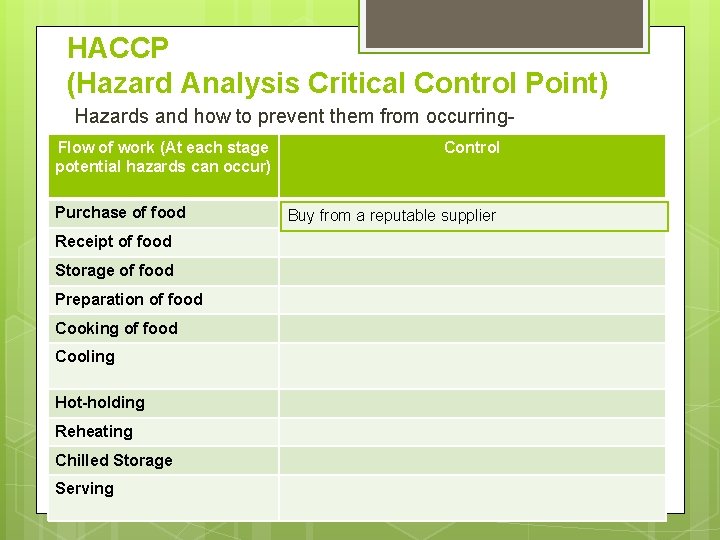
HACCP (Hazard Analysis Critical Control Point) Hazards and how to prevent them from occurring. Flow of work (At each stage potential hazards can occur) Purchase of food Receipt of food Storage of food Preparation of food Cooking of food Cooling Hot-holding Reheating Chilled Storage Serving Control Buy from a reputable supplier
HACCP (Hazard Analysis Critical Control Point) Hazards and how to prevent them from occurring. Flow of work (At each stage potential hazards can occur) Control Purchase of food Buy from a reputable supplier Receipt of food Checking deliveries - for correct temperatures. Storage of food Correct storage – dry, chilled, frozen? Preparation of food To avoid contamination – how? Cooking of food Cooking thoroughly (Above 75°C) Cooling Cool through the danger zone as quickly as possible (5 -63°C) Hot-holding The food kept above 63°C Reheating Not for high risk groups (Above 63° degrees) Chilled Storage Between 1 and 4°C Serving Obey the 4 hour rule for cold food & the 2 hour rule for hot food.
Activity (pair and share) Complete the HACCP chart for making a batch of egg mayonnaise sandwiches.