
HABITS RESIST TEMPORARY THREATS TO GOAL PURSUIT Jen

HABITS RESIST TEMPORARY THREATS TO GOAL PURSUIT Jen Labrecque & Wendy Wood August 26, 2017 Catalina Island, CA
EXPANDING OUR UNDERSTANDING OF HABIT FORMATION Repetition Context stability Perceived automaticity Other aspects of the participant’s mindset? Deliberation? • Can people form habits if they’re thinking deliberately about the behavior, or do they have to be performing it mindlessly? • Do people’s perceptions of automaticity for a behavior depend only on their experience of repetition or also whether they are thinking deliberately while repeating?
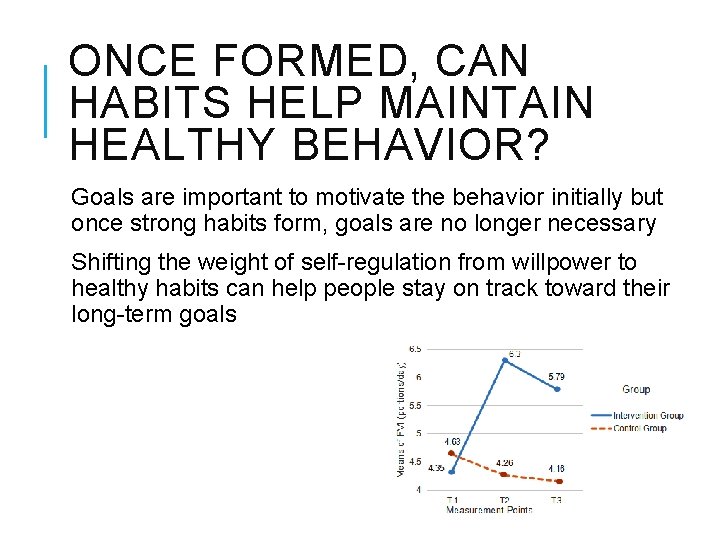
ONCE FORMED, CAN HABITS HELP MAINTAIN HEALTHY BEHAVIOR? Goals are important to motivate the behavior initially but once strong habits form, goals are no longer necessary Shifting the weight of self-regulation from willpower to healthy habits can help people stay on track toward their long-term goals
TODAY’S TALK 1) Test the conditions under which habits form • Repetition? • Deliberative mindset? 2) Asses how habits maintain behavior over time • When intentions change?
HYPOTHESES Effect of practice on habit formation Effect of deliberation on habit formation C-R associations & maintenance
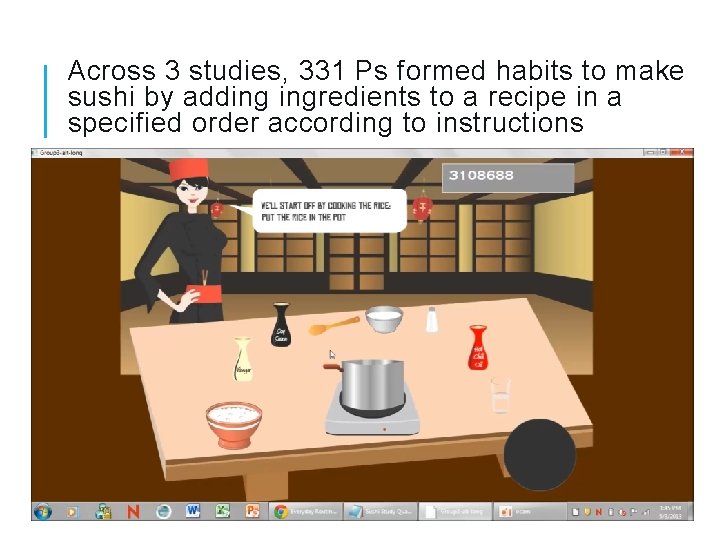
Across 3 studies, 331 Ps formed habits to make sushi by adding ingredients to a recipe in a specified order according to instructions
DELIBERATION MANIPULATION Study 1 (n = 44) Repeat: “You’re now going to play a game in which you learn how to make sushi. ” Study 2 (n = 73) Deliberate: Study 1 + “Try to learn the task because you’ll need to do it later without any instructions. ” Study 3 (n = 214) Repeat (Study 1) vs Deliberate: Study 1 + "Pay close attention to the steps and try to learn them because you’ll need to remember each step and do it without any instructions at the end of the study. "
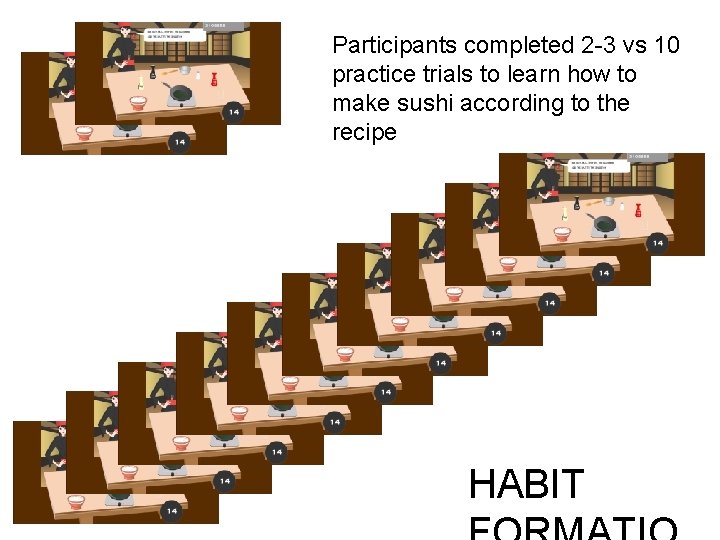
Participants completed 2 -3 vs 10 practice trials to learn how to make sushi according to the recipe HABIT
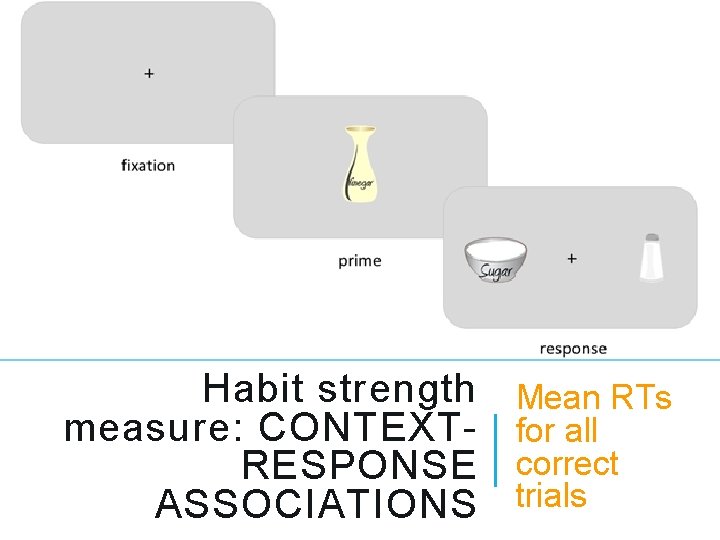
Habit strength measure: CONTEXTRESPONSE ASSOCIATIONS Mean RTs for all correct trials
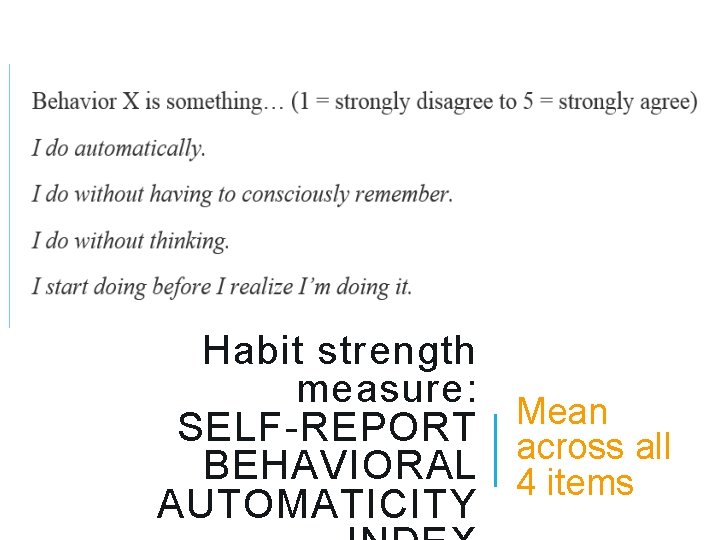
Habit strength measure: Mean SELF-REPORT across all BEHAVIORAL 4 items AUTOMATICITY
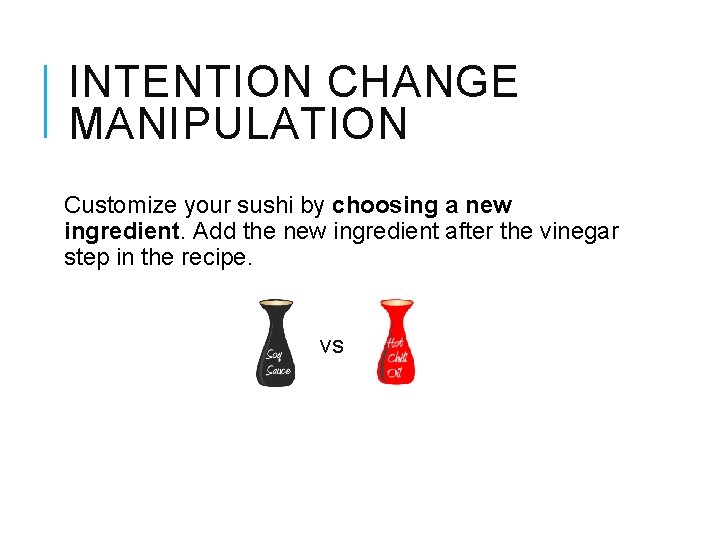
INTENTION CHANGE MANIPULATION Customize your sushi by choosing a new ingredient. Add the new ingredient after the vinegar step in the recipe. vs
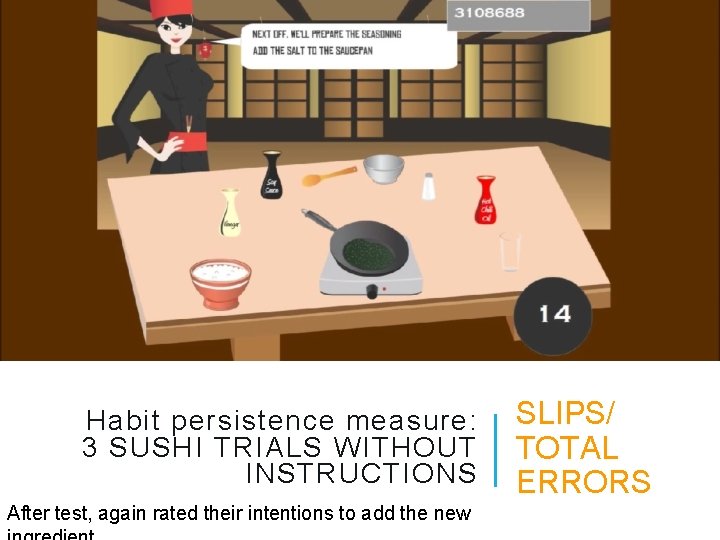
Habit persistence measure: 3 SUSHI TRIALS WITHOUT INSTRUCTIONS After test, again rated their intentions to add the new SLIPS/ TOTAL ERRORS
RESULTS 1) Test the conditions under which habits form • Repetition? • Deliberative mindset? 2) Asses how habits maintain behavior over time • When intentions change?
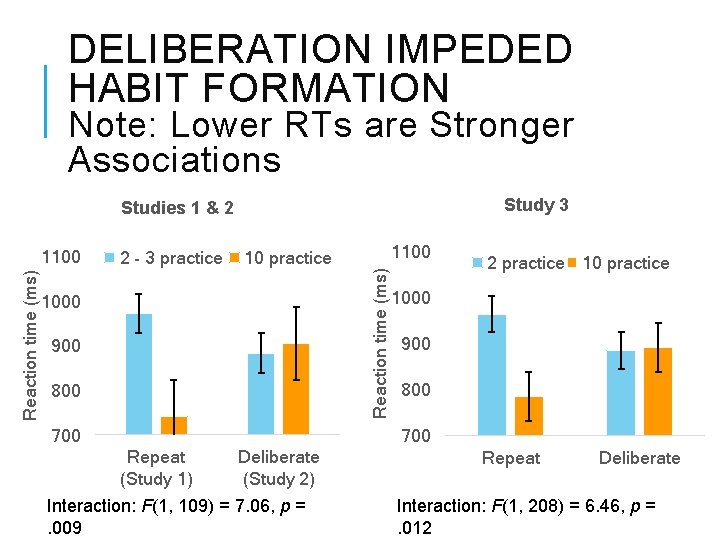
DELIBERATION IMPEDED HABIT FORMATION Note: Lower RTs are Stronger Associations Study 3 Studies 1 & 2 2 - 3 practice 1100 10 practice Reaction time (ms) 1100 1000 900 800 700 2 practice 1000 900 800 700 Repeat (Study 1) Deliberate (Study 2) Interaction: F(1, 109) = 7. 06, p =. 009 Repeat Deliberate Interaction: F(1, 208) = 6. 46, p =. 012
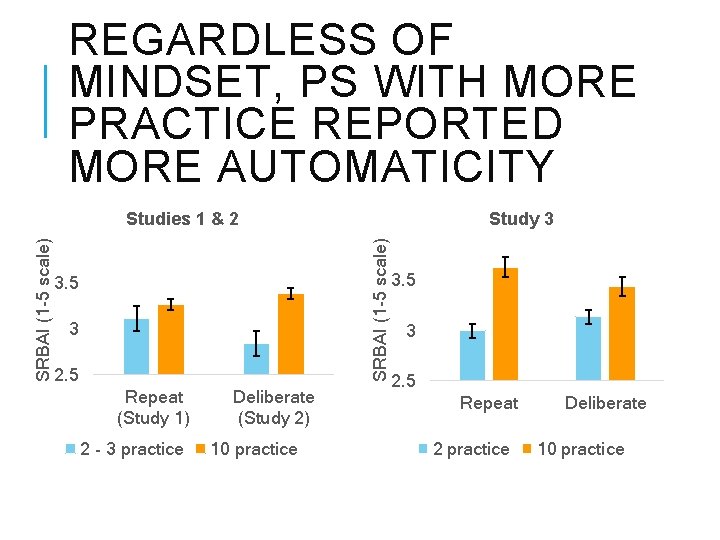
REGARDLESS OF MINDSET, PS WITH MORE PRACTICE REPORTED MORE AUTOMATICITY Study 3 SRBAI (1 -5 scale) Studies 1 & 2 3. 5 3 2. 5 Repeat (Study 1) 2 - 3 practice Deliberate (Study 2) 10 practice 3. 5 3 2. 5 Repeat 2 practice Deliberate 10 practice
RESULTS 1) Test the conditions under which habits form • Repetition? • Deliberate mindset? 2) Asses how habits maintain behavior over time • When intentions change?
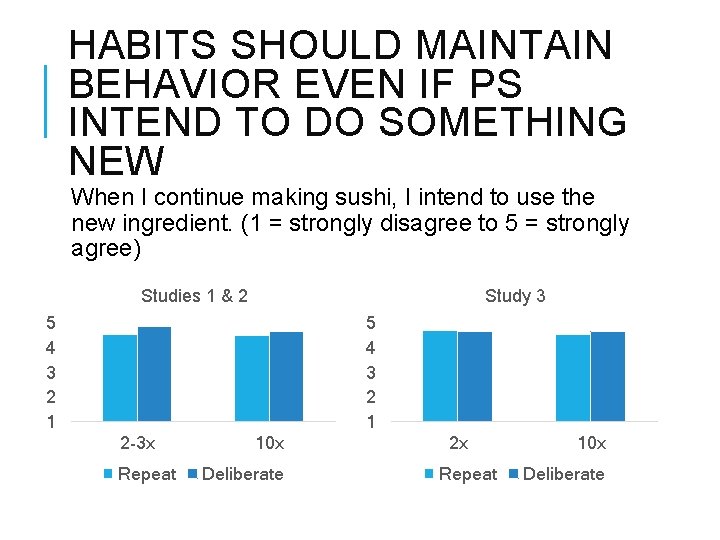
HABITS SHOULD MAINTAIN BEHAVIOR EVEN IF PS INTEND TO DO SOMETHING NEW When I continue making sushi, I intend to use the new ingredient. (1 = strongly disagree to 5 = strongly agree) Studies 1 & 2 Study 3 5 4 3 2 1 2 -3 x Repeat 10 x Deliberate 2 x Repeat 10 x Deliberate
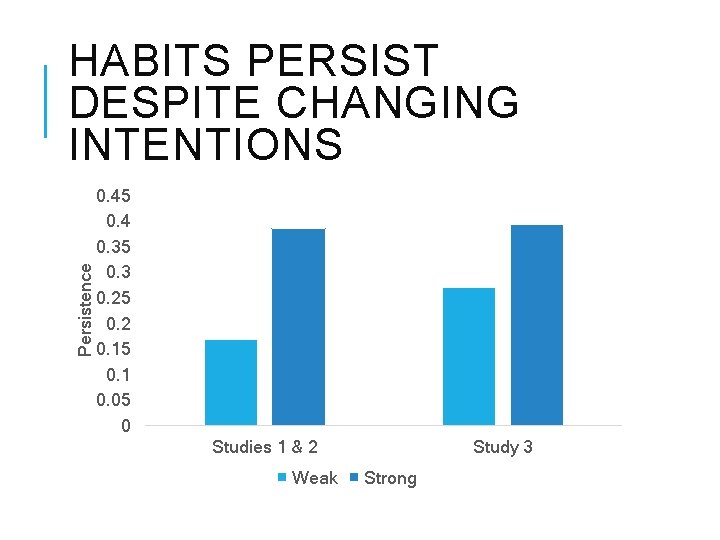
Persistence HABITS PERSIST DESPITE CHANGING INTENTIONS 0. 45 0. 4 0. 35 0. 3 0. 25 0. 2 0. 15 0. 1 0. 05 0 Studies 1 & 2 Weak Study 3 Strong
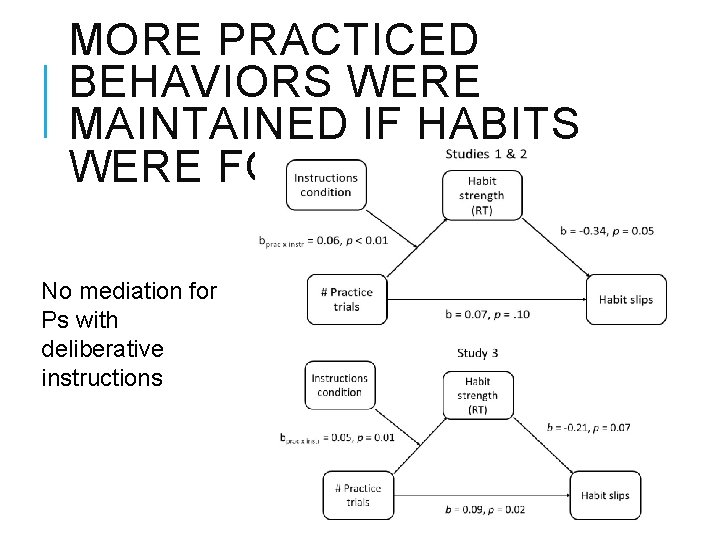
MORE PRACTICED BEHAVIORS WERE MAINTAINED IF HABITS WERE FORMED No mediation for Ps with deliberative instructions
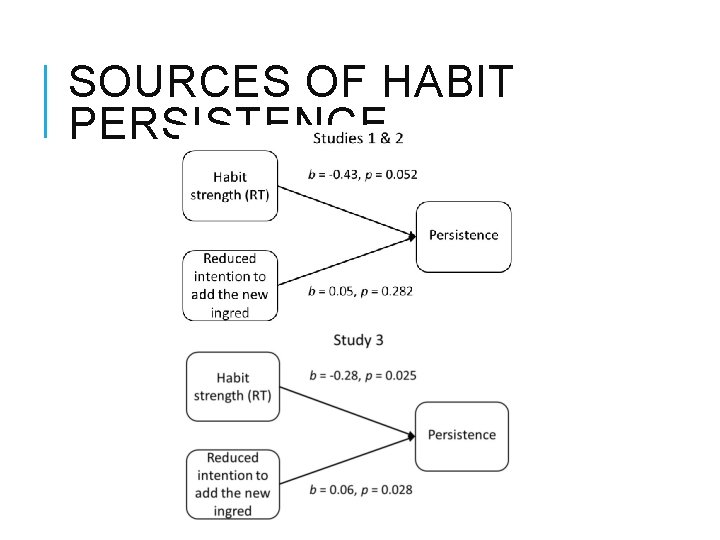
SOURCES OF HABIT PERSISTENCE
SUMMARY What are the conditions under which habits form? Maintain behavior? • More practice produced stronger habits… unless Ps were deliberative • Deliberative mindset impeded habit formation • Even with strong intentions to do something new, Ps fell back into their established habits • Behavior maintenance via habits was explained by formation of strong cognitive associations (and maybe intention change)
APPLICATION TO INTERVENTION • Formation of healthy habits may be a key to maintenance of behavior change that lasts • Keep people on track for their long-term goals despite temporary shifts in goals and willpower • Use habits to your advantage – rather than a barrier to change, they can become an ally! • Make sure the desired behavior can be performed easily without much thought in the moment – too much deliberation will impede habit formation
THANK YOU More info: jenlabrecque. com
- Slides: 23