
Habitat Components What is a habitat Physical area
Habitat Components
What is a habitat? Physical area where an organism resides under natural conditions Must meet the needs of the species, if not the animal will die or need to migrate
What are basic habitat components? Food Provides nutrients to live, grow, move about, and reproduce Source of energy Water Basic needs of life Should be pollutant and contaminant free Does not supply energy
What are basic habitat components? Cover (or shelter) Provides safety Used for nesting, resting, escaping danger, and protection Affects interplay between predator and prey Predator – hunts and uses other animals for food Prey – animals used for food
What are the basic habitat components? Space Area around an organism, home range Territory – area animal will defend Provides air, food sources, and cover
Habitat Requirements of Wildlife: Food, Water, Cover, & Space http: //www. clemson. edu/extension/natural_resources/wil dlife/publications/pdfs/fs 14_habitat_requirements. pdf

Habitat needs must be… Available in adequate amounts High enough quality to meet the needs of animals Distributed where animals need them
How are habitats classified? Three general classes are aquatic, amphibious, and terrestrial
How are habitats classified? Aquatic animals – can live in freshwater, saltwater, warm water, cool water, moving water, and stationary water Main factors affecting aquatic habitat Water Salinity Freshwater Saltwater Brackish Water Temperature Cold water: 38 -58 F Cool water: 59 -72 F Warm water: 73 -86 F Water Movement Currents caused by temperature fluctuations
How are habitats classified? Amphibious animals – can live in both water and on land Require water for one or more important functions other than water itself, such as reproduction, food, and escape Terrestrial Animals – live on land Terrestrial habitats include: Woodland – forest and shrubs Brush – shrubs and herbaceous plants Grasslands Rock – rock piles, crevices Edge – where two habitats meet
What is the relationship between populations and habitat? Populations – number of organisms in a given area Population density – amount of organisms in an area May be crowded or sparse Birth and death rates are signification attributes to population density Birth rate – number of offspring produced in a population over a given time Death rate – number of deaths per thousand population each year
What is the relationship between populations and habitat? Population Density (continued) Immigration – organisms move into a habitat Emigration – organisms move out of a habitat Populations and habitats are interdependent Populations responded differently in varied habitats. Populations generally have large growth in early stages of habitat development (increased habitat components)
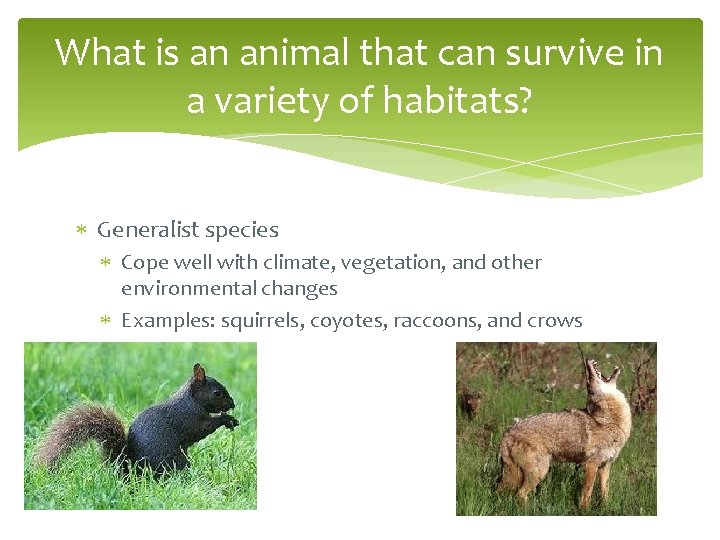
What is an animal that can survive in a variety of habitats? Generalist species Cope well with climate, vegetation, and other environmental changes Examples: squirrels, coyotes, raccoons, and crows
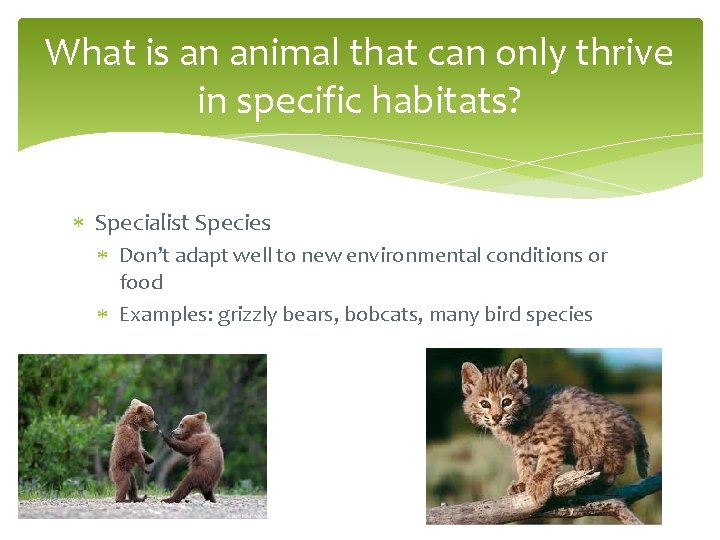
What is an animal that can only thrive in specific habitats? Specialist Species Don’t adapt well to new environmental conditions or food Examples: grizzly bears, bobcats, many bird species
Who can live here? http: //www. nwf. org/Get-Outside/Be-Out. There/Educators/~/media/PDFs/Be%20 Out%20 Ther e/Schoolyard%20 Habitats/whocanlivehere. ashx
What causes habitat destruction? May be destroyed by natural causes, human actions, and pollution
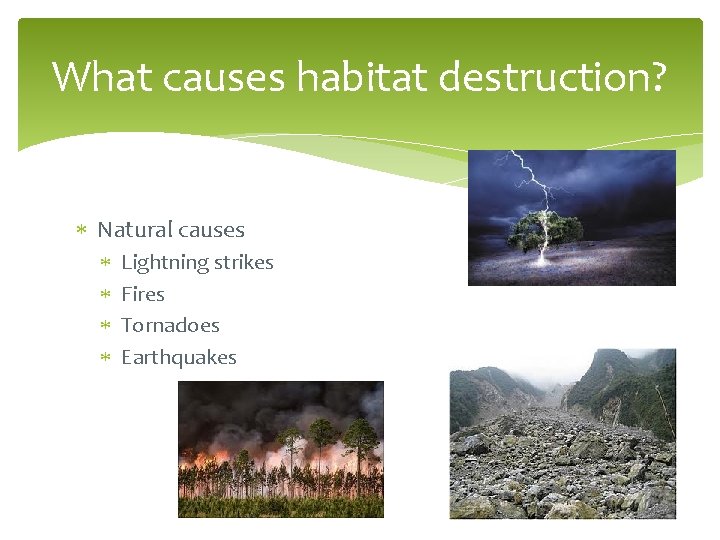
What causes habitat destruction? Natural causes Lightning strikes Fires Tornadoes Earthquakes
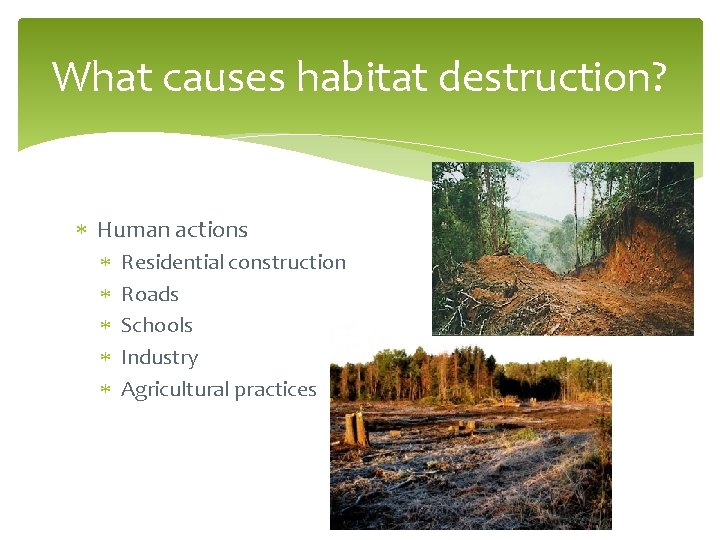
What causes habitat destruction? Human actions Residential construction Roads Schools Industry Agricultural practices
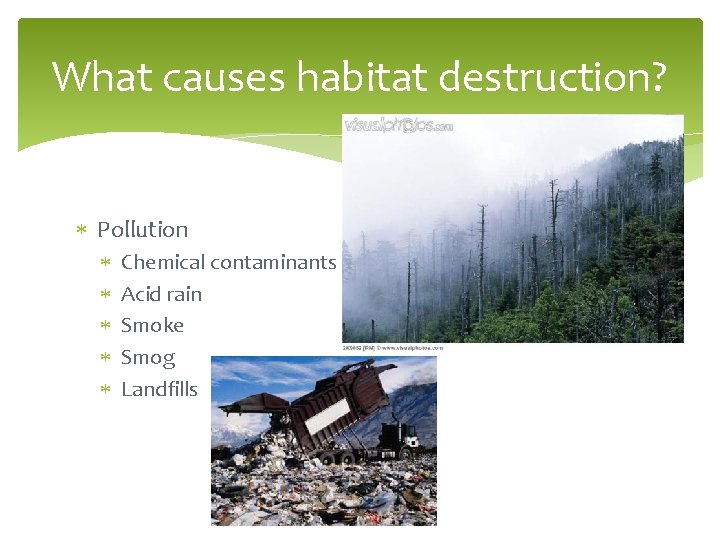
What causes habitat destruction? Pollution Chemical contaminants Acid rain Smoke Smog Landfills
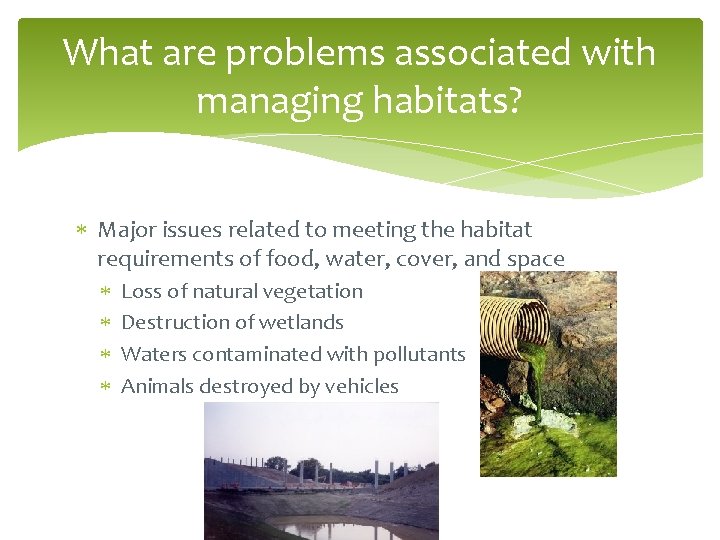
What are problems associated with managing habitats? Major issues related to meeting the habitat requirements of food, water, cover, and space Loss of natural vegetation Destruction of wetlands Waters contaminated with pollutants Animals destroyed by vehicles
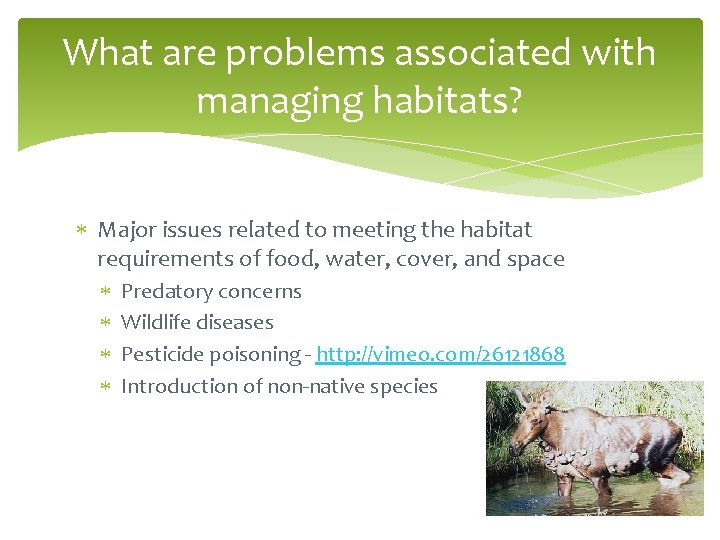
What are problems associated with managing habitats? Major issues related to meeting the habitat requirements of food, water, cover, and space Predatory concerns Wildlife diseases Pesticide poisoning - http: //vimeo. com/26121868 Introduction of non-native species
Review COMPLETE ON A SEPARATE SHEET OF PAPER AND TURN IN WITH YOUR NAME ON IT! YOU MUST WORK ON YOUR OWN BUT CAN USE YOUR NOTES. 1. What is a habitat? 2. What are basic habitat components? 3. Explain the relationship between birth and death rates. How do they correlate? 4. Define population density. 5. Define generalist and specialist species. 6. What causes habitat destruction? 7. What are problems associated with managing habitats?
- Slides: 22