
HA Scenarios Service Availability Levels Recovery Time Customer
HA Scenarios
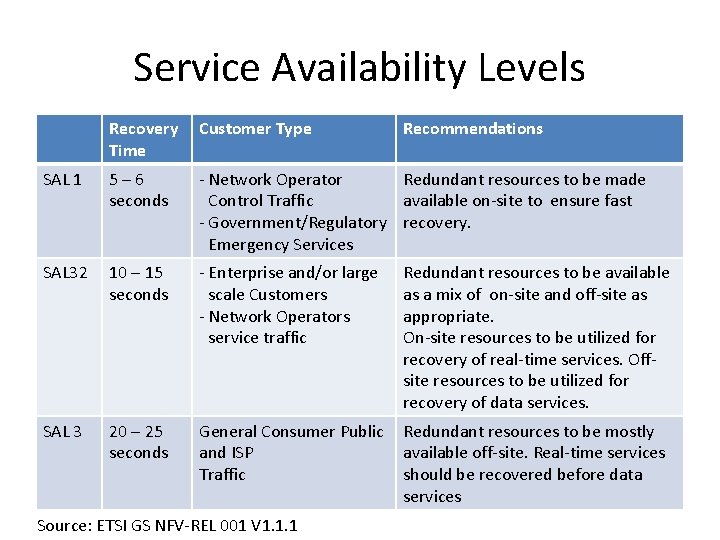
Service Availability Levels Recovery Time Customer Type SAL 1 5– 6 seconds - Network Operator Redundant resources to be made Control Traffic available on-site to ensure fast - Government/Regulatory recovery. Emergency Services SAL 32 10 – 15 seconds - Enterprise and/or large scale Customers - Network Operators service traffic Redundant resources to be available as a mix of on-site and off-site as appropriate. On-site resources to be utilized for recovery of real-time services. Offsite resources to be utilized for recovery of data services. SAL 3 20 – 25 seconds General Consumer Public and ISP Traffic Redundant resources to be mostly available off-site. Real-time services should be recovered before data services Source: ETSI GS NFV-REL 001 V 1. 1. 1 Recommendations
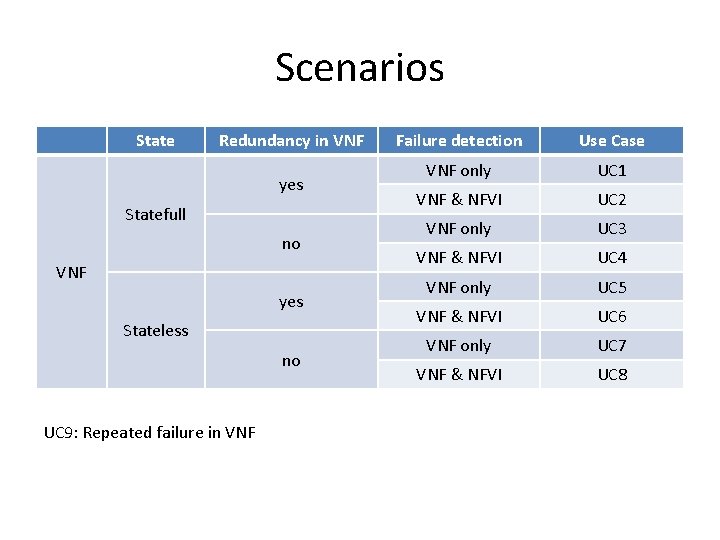
Scenarios State Redundancy in VNF yes Statefull no VNF yes Stateless no UC 9: Repeated failure in VNF Failure detection Use Case VNF only UC 1 VNF & NFVI UC 2 VNF only UC 3 VNF & NFVI UC 4 VNF only UC 5 VNF & NFVI UC 6 VNF only UC 7 VNF & NFVI UC 8
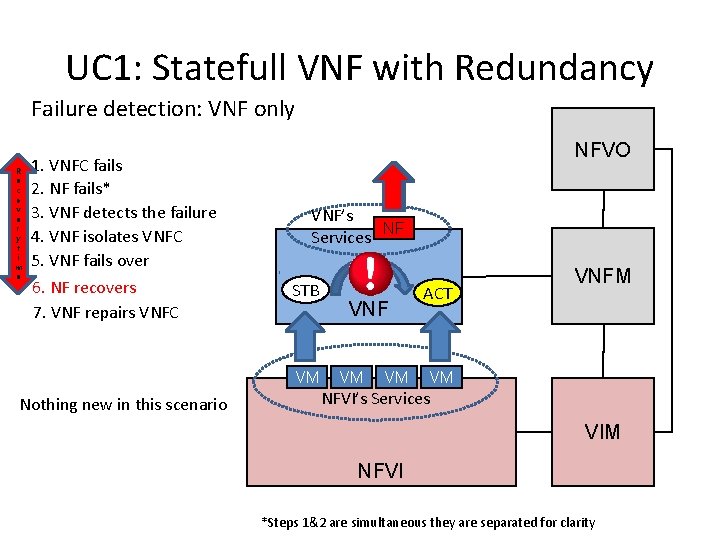
UC 1: Statefull VNF with Redundancy Failure detection: VNF only R e c o v e r y t i m e 1. VNFC fails 2. NF fails* 3. VNF detects the failure 4. VNF isolates VNFC 5. VNF fails over 6. NF recovers 7. VNF repairs VNFC NFVO VNF’s Services NF ACT STB VM Nothing new in this scenario VNF VM VM ACT STB VNFM VM NFVI’s Services VIM NFVI *Steps 1&2 are simultaneous they are separated for clarity
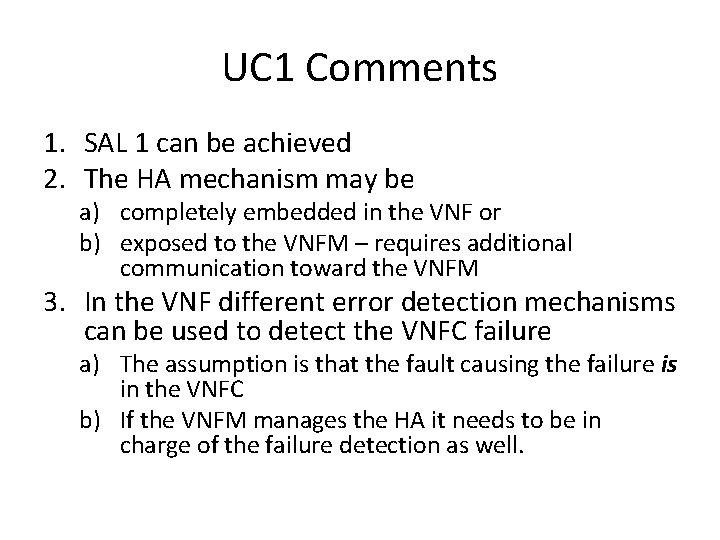
UC 1 Comments 1. SAL 1 can be achieved 2. The HA mechanism may be a) completely embedded in the VNF or b) exposed to the VNFM – requires additional communication toward the VNFM 3. In the VNF different error detection mechanisms can be used to detect the VNFC failure a) The assumption is that the fault causing the failure is in the VNFC b) If the VNFM manages the HA it needs to be in charge of the failure detection as well.
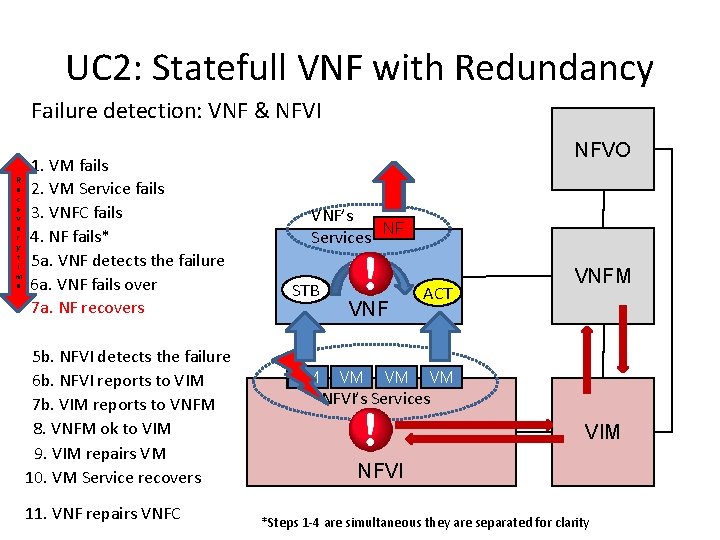
UC 2: Statefull VNF with Redundancy Failure detection: VNF & NFVI R e c o v e r y t i m e 1. VM fails 2. VM Service fails 3. VNFC fails 4. NF fails* 5 a. VNF detects the failure 6 a. VNF fails over 7 a. NF recovers 5 b. NFVI detects the failure 6 b. NFVI reports to VIM 7 b. VIM reports to VNFM 8. VNFM ok to VIM 9. VIM repairs VM 10. VM Service recovers 11. VNF repairs VNFC NFVO VNF’s Services NF ACT STB VM VNF VM VM ACT STB VNFM VM NFVI’s Services VIM NFVI *Steps 1 -4 are simultaneous they are separated for clarity
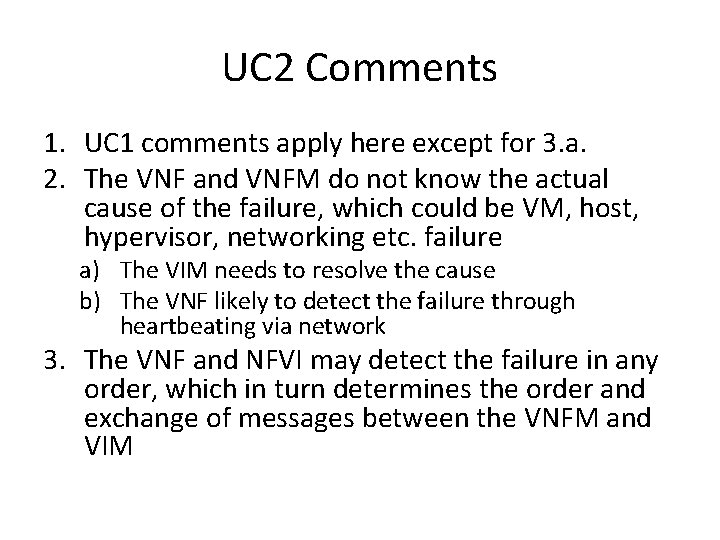
UC 2 Comments 1. UC 1 comments apply here except for 3. a. 2. The VNF and VNFM do not know the actual cause of the failure, which could be VM, host, hypervisor, networking etc. failure a) The VIM needs to resolve the cause b) The VNF likely to detect the failure through heartbeating via network 3. The VNF and NFVI may detect the failure in any order, which in turn determines the order and exchange of messages between the VNFM and VIM
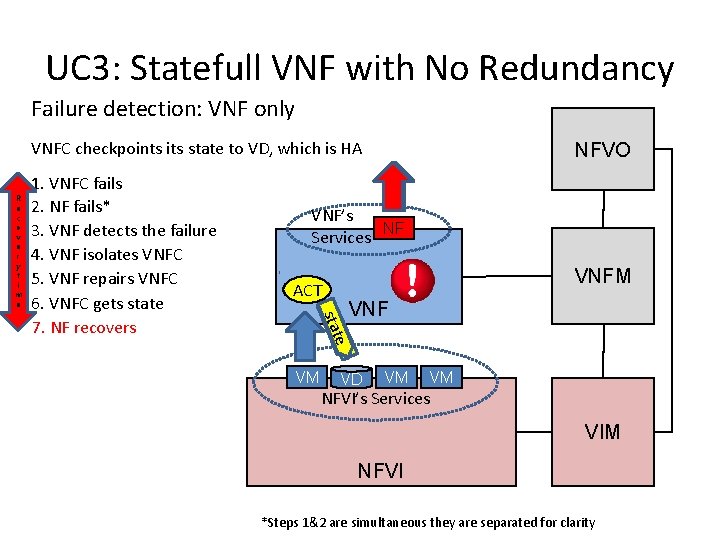
UC 3: Statefull VNF with No Redundancy Failure detection: VNF only VNFC checkpoints its state to VD, which is HA R e c o v e r y t i m e VNF’s Services NF ACT VNFM VNF tee ssttaat 1. VNFC fails 2. NF fails* 3. VNF detects the failure 4. VNF isolates VNFC 5. VNF repairs VNFC 6. VNFC gets state 7. NF recovers NFVO VM VD VM VM NFVI’s Services VIM NFVI *Steps 1&2 are simultaneous they are separated for clarity
UC 3 Comments 1. The assumption is that the v. Disk used by the VNFC is highly available meaning that a) Failures are handled by the NFVI transparently for the VNF b) The VNF have access to its state stored in the v. Disk for at least 99. 999% of the time 2. The VNFC’s availability management could be a) Embedded in the VNF or b) More likely: Done by the VNFM – requires additional communication between the VNF and VNFM see UC 3 -b
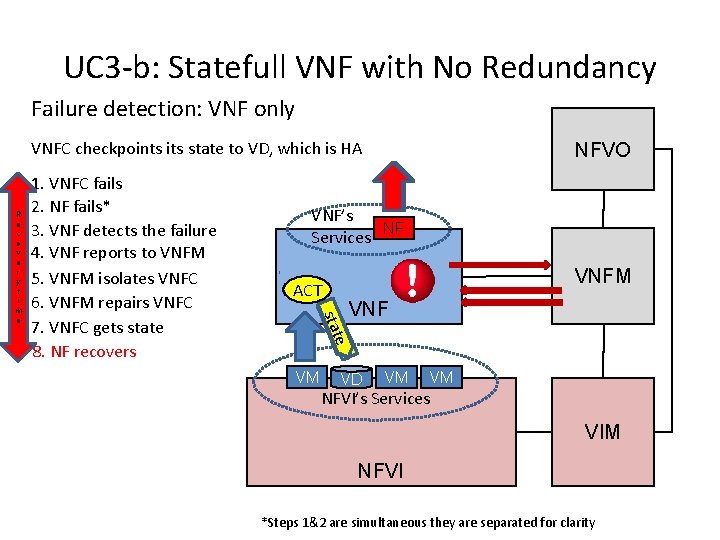
UC 3 -b: Statefull VNF with No Redundancy Failure detection: VNF only VNFC checkpoints its state to VD, which is HA VNF’s Services NF ACT VNFM VNF tee ssttaat R e c o v e r y t i m e 1. VNFC fails 2. NF fails* 3. VNF detects the failure 4. VNF reports to VNFM 5. VNFM isolates VNFC 6. VNFM repairs VNFC 7. VNFC gets state 8. NF recovers NFVO VM VD VM VM NFVI’s Services VIM NFVI *Steps 1&2 are simultaneous they are separated for clarity
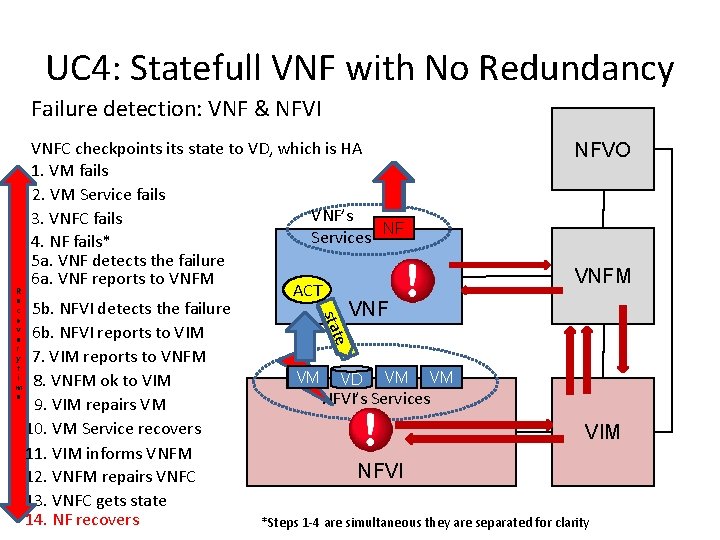
UC 4: Statefull VNF with No Redundancy Failure detection: VNF & NFVI tee ssttaat VNFC checkpoints its state to VD, which is HA NFVO 1. VM fails 2. VM Service fails VNF’s 3. VNFC fails Services NF 4. NF fails* 5 a. VNF detects the failure VNFM 6 a. VNF reports to VNFM R ACT e c 5 b. NFVI detects the failure VNF o v e 6 b. NFVI reports to VIM r y 7. VIM reports to VNFM t i VM VD VM VM m 8. VNFM ok to VIM e NFVI’s Services 9. VIM repairs VM 10. VM Service recovers VIM 11. VIM informs VNFM NFVI 12. VNFM repairs VNFC 13. VNFC gets state 14. NF recovers *Steps 1 -4 are simultaneous they are separated for clarity
UC 4 Comments 1. Comments of UC 3 apply 2. Considering the time needed to repair the VM the target SALs cannot be met without the introduction of some redundancy 3. The VNF(M) does not know the actual cause of the failure, which could be VM, host, hypervisor, networking etc. failure. The VIM needs to resolve the cause 4. The VNFM and NFVI may detect the failure in any order, which in turn determines the order and exchange of messages between the VNFM and VIM
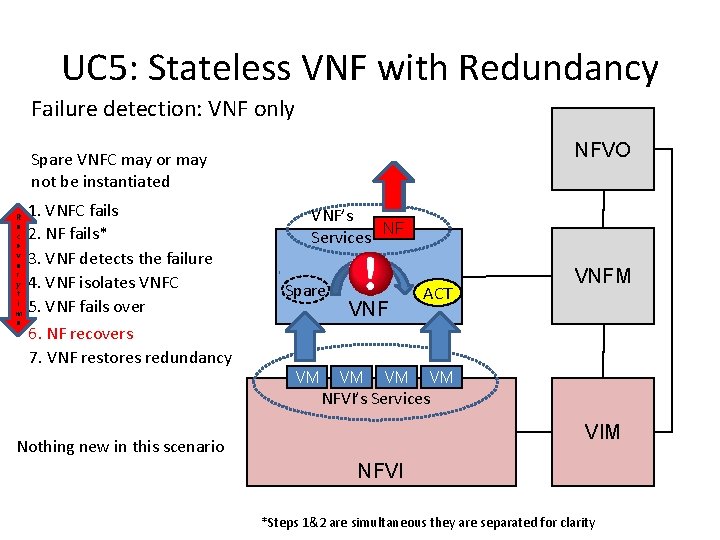
UC 5: Stateless VNF with Redundancy Failure detection: VNF only NFVO Spare VNFC may or may not be instantiated R e c o v e r y t i m e 1. VNFC fails 2. NF fails* 3. VNF detects the failure 4. VNF isolates VNFC 5. VNF fails over 6. NF recovers 7. VNF restores redundancy VNF’s Services NF Spare ACT VM VNF VM VM Spare ACT VNFM VM NFVI’s Services VIM Nothing new in this scenario NFVI *Steps 1&2 are simultaneous they are separated for clarity
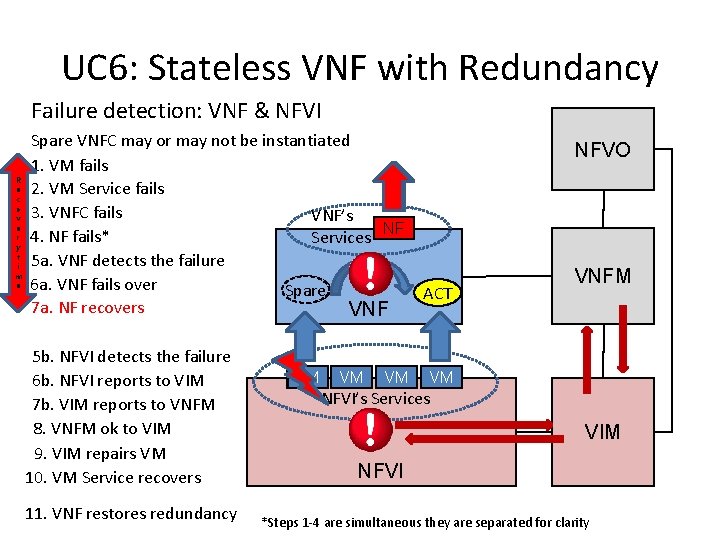
UC 6: Stateless VNF with Redundancy Failure detection: VNF & NFVI R e c o v e r y t i m e Spare VNFC may or may not be instantiated 1. VM fails 2. VM Service fails 3. VNFC fails VNF’s 4. NF fails* Services NF 5 a. VNF detects the failure 6 a. VNF fails over Spare ACT 7 a. NF recovers VNF 5 b. NFVI detects the failure 6 b. NFVI reports to VIM 7 b. VIM reports to VNFM 8. VNFM ok to VIM 9. VIM repairs VM 10. VM Service recovers 11. VNF restores redundancy VM VM VM NFVO VNFM VM NFVI’s Services VIM NFVI *Steps 1 -4 are simultaneous they are separated for clarity
UC 5 & UC 6 Comments • Comments are similar to UC 1 & UC 2
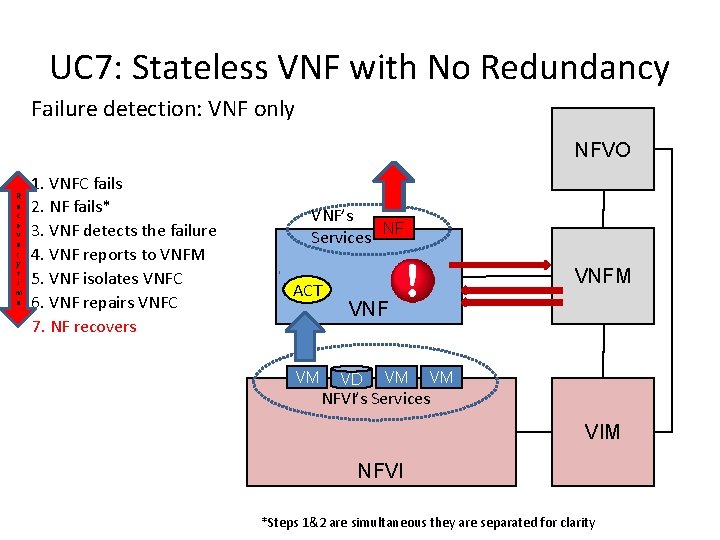
UC 7: Stateless VNF with No Redundancy Failure detection: VNF only NFVO R e c o v e r y t i m e 1. VNFC fails 2. NF fails* 3. VNF detects the failure 4. VNF reports to VNFM 5. VNF isolates VNFC 6. VNF repairs VNFC 7. NF recovers VNF’s Services NF ACT VM VNF VD VM VM NFVI’s Services VIM NFVI *Steps 1&2 are simultaneous they are separated for clarity
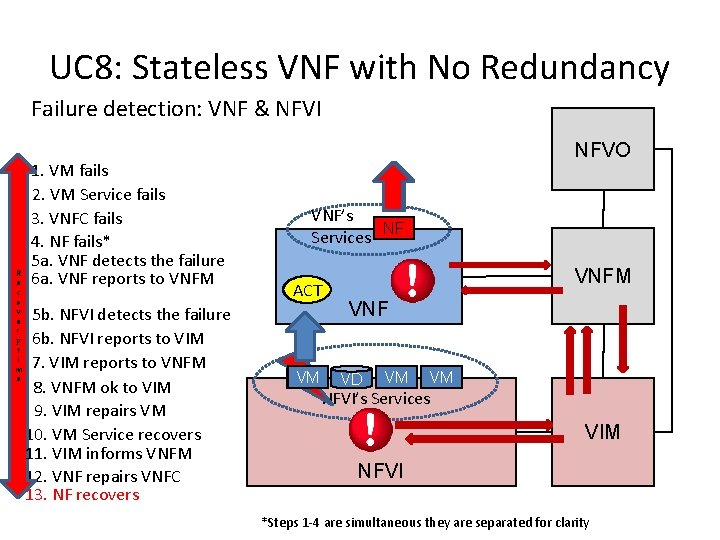
UC 8: Stateless VNF with No Redundancy Failure detection: VNF & NFVI R e c o v e r y t i m e 1. VM fails 2. VM Service fails 3. VNFC fails 4. NF fails* 5 a. VNF detects the failure 6 a. VNF reports to VNFM 5 b. NFVI detects the failure 6 b. NFVI reports to VIM 7. VIM reports to VNFM 8. VNFM ok to VIM 9. VIM repairs VM 10. VM Service recovers 11. VIM informs VNFM 12. VNF repairs VNFC 13. NF recovers NFVO VNF’s Services NF ACT VM VNF VD VM VM NFVI’s Services VIM NFVI *Steps 1 -4 are simultaneous they are separated for clarity
UC 7 & UC 8 Comments • In UC 7 the HA mechanism may be embedded in the VNF or VNFM needs to provide it including the failure detection • In addition for UC 8 the comments are similar to UC 4 – Most importantly the target SALs cannot be achieved in case of UC 8 without redundancy
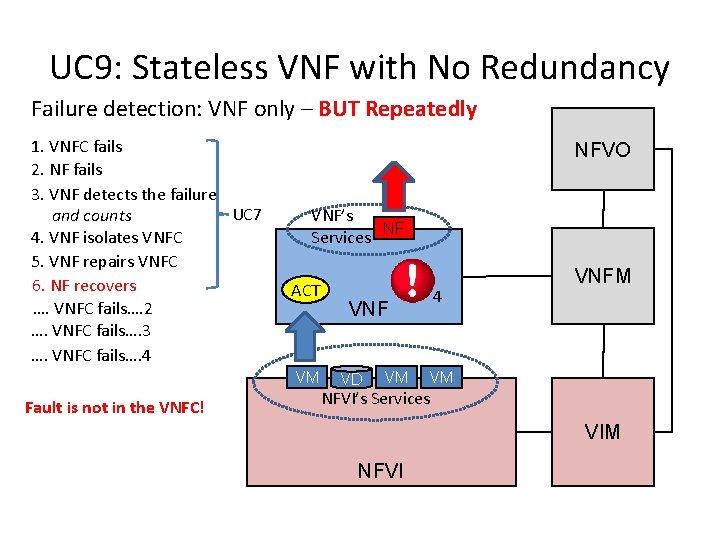
UC 9: Stateless VNF with No Redundancy Failure detection: VNF only – BUT Repeatedly 1. VNFC fails 2. NF fails 3. VNF detects the failure UC 7 and counts 4. VNF isolates VNFC 5. VNF repairs VNFC 6. NF recovers …. VNFC fails…. 2 …. VNFC fails…. 3 …. VNFC fails…. 4 NFVO VNF’s Services NF ACT VM Fault is not in the VNFC! 4 3 21 VNF VD VM VNFM VM NFVI’s Services VIM NFVI
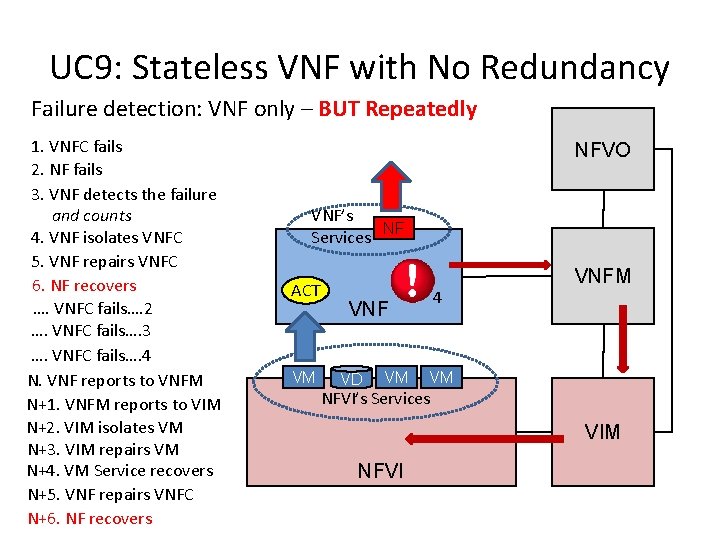
UC 9: Stateless VNF with No Redundancy Failure detection: VNF only – BUT Repeatedly 1. VNFC fails 2. NF fails 3. VNF detects the failure and counts 4. VNF isolates VNFC 5. VNF repairs VNFC 6. NF recovers …. VNFC fails…. 2 …. VNFC fails…. 3 …. VNFC fails…. 4 N. VNF reports to VNFM N+1. VNFM reports to VIM N+2. VIM isolates VM N+3. VIM repairs VM N+4. VM Service recovers N+5. VNF repairs VNFC N+6. NF recovers NFVO VNF’s Services NF ACT VM 4 VNF VD VM VNFM VM NFVI’s Services VIM NFVI
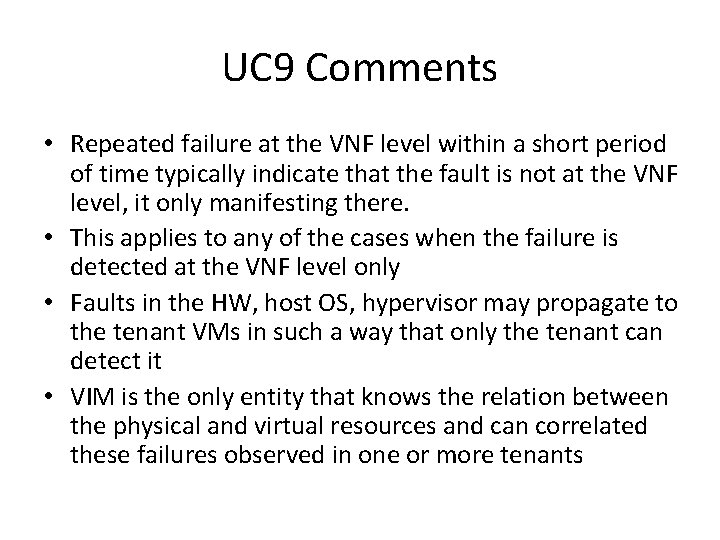
UC 9 Comments • Repeated failure at the VNF level within a short period of time typically indicate that the fault is not at the VNF level, it only manifesting there. • This applies to any of the cases when the failure is detected at the VNF level only • Faults in the HW, host OS, hypervisor may propagate to the tenant VMs in such a way that only the tenant can detect it • VIM is the only entity that knows the relation between the physical and virtual resources and can correlated these failures observed in one or more tenants
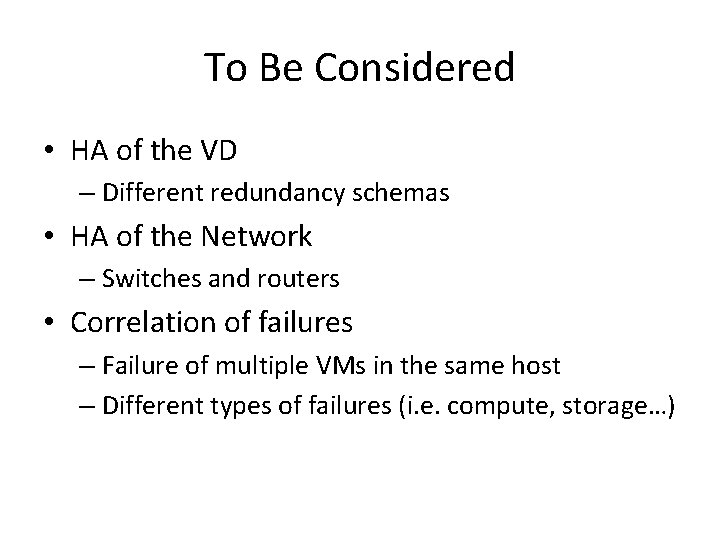
To Be Considered • HA of the VD – Different redundancy schemas • HA of the Network – Switches and routers • Correlation of failures – Failure of multiple VMs in the same host – Different types of failures (i. e. compute, storage…)
- Slides: 22