
HA Resource Hub Submission Form Resource Title What
HA Resource Hub Submission Form Resource Title: What was triangular trade? Age Range: Year 8/ Ks 3 Author name and email contact: Ruth Lingard r. lingard@millthorpe. school. co. uk Necessary prior learning to complete this: This is the second lesson on the slave trade. Resource Details: Power point with links What does it lead to next? Students will look at the experiences of enslaved people and the abolition of the slave trade. Explanation: How should this resource be used? I have kept the lesson very simple to suit home learning. There is also an EASIER worksheet which has a less complex final task. Standard PPT: Task 1: Draw the map into your book using a pencil. (Use the map in your planner to label Africa, Britain, South America, West Indies and North America) Task 2: label the goods that were traded on each part of the journey Task 3: Watch the video to find out more about triangular trade : Triangular Trade explained Task 4: Copy this into your book: Britain’s role • In the 18 th century, around 6 million Africans were taken to the Americas (the United States, The West Indies and South America) as slaves. • Britain was not the only European country involved, but at least a third of the 6 million slaves (2 million) were taken in British ships. • British slave traders and port cities like Liverpool and Bristol grew very rich on the slave trade. Task 5: THINK! Why did Britain do this at that time? (Think back to last lesson on who benefitted) Task 6: Turn this information into a mind map. Add pictures/symbols: Why did Britain take part in the slave trade? • Huge profits were made on every part of the journey • Labour (plantation/ farm workers) desperately needed in the Americas • “Science” – black Africans considered racially “inferior” • Britain was stronger than Africa – we had guns and other weapons unavailable in African war lords were desperate to buy these to be stronger than other African kingdoms. Task 7: Watch this video summarizing the causes and the consequences of the Trans-Atlantic slave trade: How the slave trade worked Write down 2 Consequences of the slave trade for Africa (this is near the end of the video) Task 8: True or False Task 9: So if all these sentences are false- can you re-write them to make them correct?
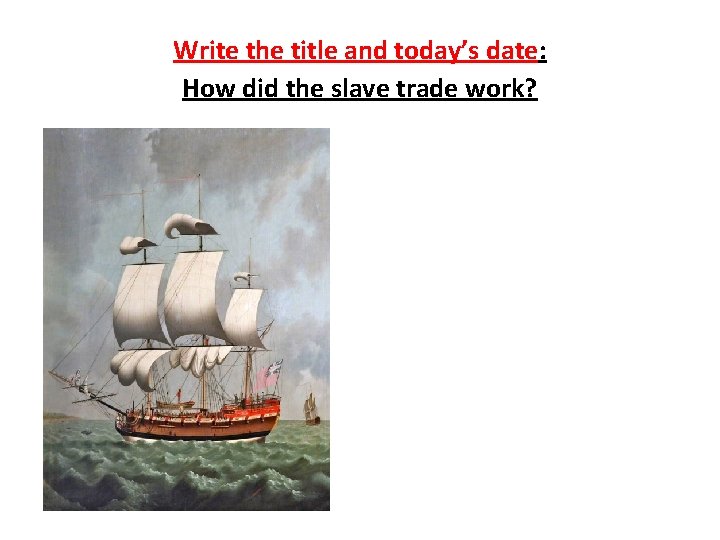
Write the title and today’s date: How did the slave trade work?
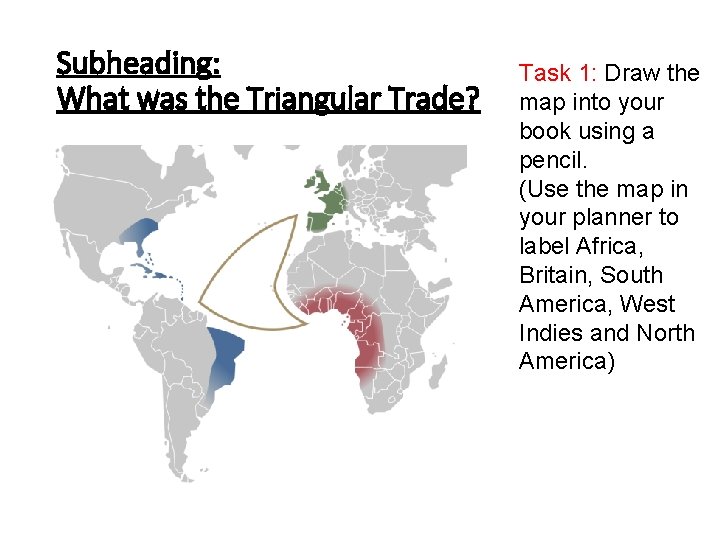
Subheading: What was the Triangular Trade? Task 1: Draw the map into your book using a pencil. (Use the map in your planner to label Africa, Britain, South America, West Indies and North America)
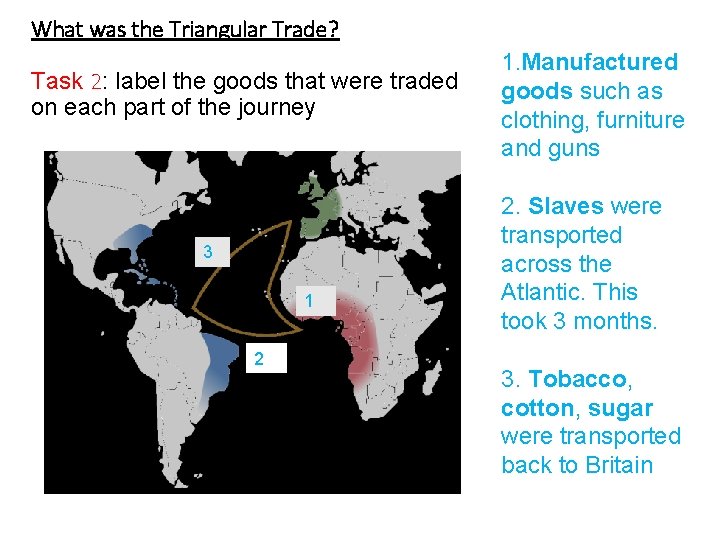
What was the Triangular Trade? Task 2: label the goods that were traded on each part of the journey 3 1 2 1. Manufactured goods such as clothing, furniture and guns 2. Slaves were transported across the Atlantic. This took 3 months. 3. Tobacco, cotton, sugar were transported back to Britain
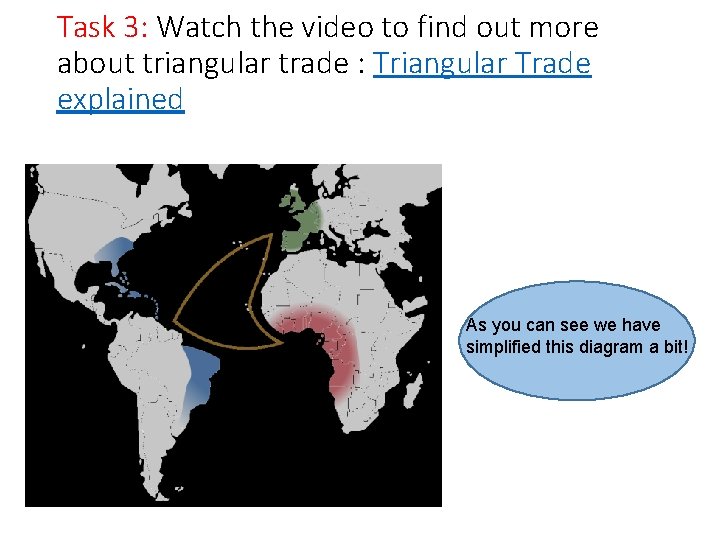
Task 3: Watch the video to find out more about triangular trade : Triangular Trade explained As you can see we have simplified this diagram a bit!
Task 4: Copy this into your book: Britain’s role • In the 18 th century, around 6 million Africans were taken to the Americas (the United States, The West Indies and South America) as slaves. • Britain was not the only European country involved, but at least a third of the 6 million slaves (2 million) were taken in British ships. • British slave traders and port cities like Liverpool and Bristol grew very rich on the slave trade. Task 5; THINK! Why did Britain do this at that time? (Think back to last lesson on who benefitted)
Task 6: Turn this information into a mind map. Add pictures/symbols Why did Britain take part in the slave trade? • Huge profits were made on every part of the journey • Labour (plantation/ farm workers) desperately needed in the Americas • “Science” – black Africans considered racially “inferior” • Britain was stronger than Africa – we had guns and other weapons unavailable in African war lords were desperate to buy these to be stronger than other African kingdoms.
Task 7: Watch this video summarizing the causes and the consequences of the Trans. Atlantic slave trade • How the slave trade worked • Write down 2 Consequences of the slave trade for Africa (this is near the end of the video)
True or False 1. The transatlantic slave trade began in the 14 th century. 2. The “middle passage” journey took almost two weeks. 3. There was a huge need for slaves to work in Britain’s factories. 4. The Americans needed pots and pans from Africa. 5. The slave trade is also known as the rectangular trade.
Task 8 : True or False 1. The transatlantic slave trade began in the 14 th century. 2. The “middle passage” journey took almost two weeks. 3. There was a huge need for slaves to work in Britain’s factories. 4. The Americans needed pots and pans from Africa. 5. The slave trade is also known as the rectangular trade.
Task 9: So if all these sentences are false- can you rewrite them to make them correct? 1. The transatlantic slave trade began in the 14 th century. 2. The “middle passage” journey took almost two weeks. 3. There was a huge need for slaves to work in Britain’s factories. 4. The Americans needed pots and pans from Africa. 5. The slave trade is also known as the rectangular trade.
- Slides: 11