
H1 B One Workforce Grant Program Prospective Applicant
H-1 B One Workforce Grant Program Prospective Applicant Webinar September 28, 2020
Tips for Viewing this Webcast We recommend you to have a hard copy of the FOA when viewing this Webcast When applying for ETA competitive grants, use our Web-Based Toolkit for Prospective Applicants: https: //www. workforcegps. org/resources/2016/05/27/14/00/A pplying_for_ETA_Competitive_Grants-_A_Web-Based_Toolkitfor_Prospective_Applicants
Today’s Speakers Robin Fernkas Deputy Administrator, Office of Workforce Investment U. S. Department of Labor Maya Kelley Program Manager, Division of Strategic Investments U. S. Department of Labor Gregory Scheib Workforce Analyst, Division of Strategic Investments U. S. Department of Labor 3

Today’s Speakers Brinda Ruggles Grant Officer, Office of Grants Management (OGM) U. S. Department of Labor Andrea Chism Grants Management Specialist, OGM U. S. Department of Labor 4
Key H-1 B One Workforce Grant FOA Areas of Focus üProgram Purpose and Design, Geographic Scope, and Expected Outcomes üAward Information, Eligibility, Partnerships, and Priority Consideration Application Submission Requirements 5
Program Purpose and Design, Geographic Scope, and Expected Outcomes 6
Program Purpose The H-1 B One Workforce Grant Program is designed to: Encourage states and economic regions to work with industry stakeholders to develop dynamic workforce strategies that train workers and jobseekers for middle- to high-skilled H-1 B occupations in the IT, advanced manufacturing, and transportation sectors; and Build proof of concepts of innovative training models that can be replicated by the broader workforce system. 7
Geographic Scope Applicants may choose one of the following geographic scopes: Local/regional means serving a part of one state or a contiguous area that includes multiple sites in a regional workforce area or economic region that may cross more than one state. Statewide means serving an entire state or multiple noncontiguous sites (or economic regions) within one state. National means serving multiple economic regions in multiple states across the country. The service area does not need to be contiguous. 8
Program Design Successful applicants will design their grant projects from both: A strategic level, describing planned activities for convening sector partnerships, assessing the needs of proposed industry sectors within a particular geographic scope, and devising a comprehensive workforce strategy; and An operational level, describing how a comprehensive workforce strategy will be implemented, and how training activities that prepare individuals for middle- to high-skilled jobs will be deployed. 9

Program Design (continued) Build new or expand existing sector partnerships that develop a workforce strategy across state and regional workforce and related sector agencies, including employers within the proposed sectorbased initiative(s) and education and training entities; Establish new or expand career pathways in the proposed sectorbased initiative(s) that focus on the skills, competencies, and credentials needed for jobs within the targeted H-1 B industries and occupations; Offer high-quality training options (such as work-based learning training models) to prepare individuals to successfully move into middle- to high-skilled employment within the targeted H-1 B industries and occupations; 10
Program Design (continued) Ensure that participants receive the supportive services necessary to participate fully in employment and training activities; Develop a new or leverage an existing system for reviewing and collecting data, and monitor results to assess program performance; Create a new or leverage an existing infrastructure to successfully sustain the program components and partnerships after the life of the grant; and Generate leveraged funds equal to at least 25 percent of the total requested amount of the grant award to supplement grant activities. 11
Program Design (continued) Training and Education Services Assessment, coaching and counseling, and occupational skills training models that lead to recognized postsecondary credentials. Work-based learning strategies such as: Ø On-the-Job Training (OJT); Ø Customized training for cohorts; Ø Incumbent Worker Training; Ø Registered Apprenticeship Programs; Ø Industry-Recognized Apprenticeship Programs; Ø Pre-apprenticeship programs that articulate to grant-funded apprenticeship programs; Ø Paid work and paid internships, and Ø Classroom, competency-based, and technology-based training strategies. 12
Performance Outcomes H-1 B Performance Outcome Measures Total participants served; Total participants enrolled in education/training activities; Total participants who complete education/training activities and receive a degree, or other type of credential; Total number of unemployed and underemployed participants who complete education/training activities and obtain employment; and Total number of incumbent worker participants who complete training activities and advance into a new position (if serving incumbent workers). 13
Performance Outcomes WIOA Primary Indicators of Performance Employment Rate – 2 nd Quarter After Exit; Employment Rate – 4 th Quarter After Exit; Median Earnings – 2 nd Quarter After Exit; Effectiveness in Serving Employers (Retention with the Same Employer 2 nd and 4 th Quarter After Exit); Credential Attainment; and Measurable Skill Gains. Applicants will provide outcome targets for the following two key WIOA outcomes: Employment Rate – 2 nd Quarter After Exit Employment Rate – 4 th Quarter After Exit 14
Award Information, Eligibility, Partnerships, and Priority Consideration 15
Award Information Up to $150 million to fund approximately 15 -30 grants Grant awards will range from $500, 000 to $10, 000 Applicants should request funding that is commensurate with the scope and scale of the project proposed 16
Eligible Lead Applicants The following four types of entities are eligible to apply as a lead applicant: Businesses, business-related nonprofit organizations, such as industry and trade associations, and organizations functioning as a workforce intermediary for the express purpose of serving the needs of an industry; Education and training providers, including community colleges, other community-based organizations, and for-profit educational and training institutions; Entities involved in administering the public workforce system established under WIOA; and Economic development agencies. 17
The H-1 B One Workforce Partnership All applicants must include the following entities in their H-1 B One Workforce Partnership: Lead applicant; Businesses; Education and training providers; Workforce development entities; and Any optional partners. 18
Required Partners Required partners in the H-1 B One Workforce Partnership: Businesses: At least five employers or an industry/trade association Education and Training Providers: institutions of higher education as defined in Section 101(a) of the Higher Education Act of 1965, including community and technical colleges and systems; joint labormanagement training partnerships; nonprofit, community-based, and faith-based organizations that offer job training, including those organizations that have been approved as WIOA Eligible Training Providers; and for-profit educational institutions. Workforce Development Entities: publicly-funded Workforce Development System entities are State Workforce Agencies, and state and local Workforce Development Boards that administer WIOA funds. 19
Optional Partners Optional partners that can support and advance the work of the H-1 B One Workforce Partnership include (but are not limited to) the following: Organizations functioning as workforce and industry intermediaries; Foundations and philanthropic organizations; Agencies administering federal funding; State Apprenticeship Agencies; State Transportation Agencies; Providers of supportive and specialized services; For-profit job training organizations; disability service providers; and Faith-based organizations. 20
Priority Consideration Applicants that demonstrate, in their abstract, that at least one census tract within their physical service area is designated by the Secretary of Treasury as a qualified Opportunity Zone will receive two bonus points toward their overall application score. More information on Opportunity Zones is available at https: //www. irs. gov/newsroom/opportunity-zones-frequentlyasked-questions 21
Application Submission Requirements 22
Content and Form of Application Submission Section IV. B SF-424 Application For Federal Assistance Project Budget (SF-424 A and Budget Narrative) Project Narrative Attachments to the Project Narrative 23
SF-424 and Project Budget Section IV. B. 1 and Section IV. B. 2 SF-424 Application For Federal Assistance DUNS number Must register with SAM Project Budget SF-424 A: Budget Information Form Budget Narrative 24
Project Narrative Section IV. B. 3 Project Narrative 25 double-spaced singled-sided 8. 5 x 11 pages with Times New Roman 12 point text font and 1 -inch margins Guidelines are found in Section IV. B. 3. A, Project Narrative You must number the Project Narrative beginning with page number 1. 25
One Workforce Training Focus Section IV. B. 3. A(2) Provision of One Workforce training that focuses on H -1 B Occupations Appendix A; or Documentation supporting verifiable data 26
Attachments to the Project Narrative Section IV. B. 4 In addition to the Project Narrative applicants must submit attachments. Must be clearly labeled as Attachments. Only Attachments listed in Section IV. B. 4 of the FOA are excluded from the page limit. No additional materials will be considered. See Section IV. B. 4 for information on valid attachment file names. 27
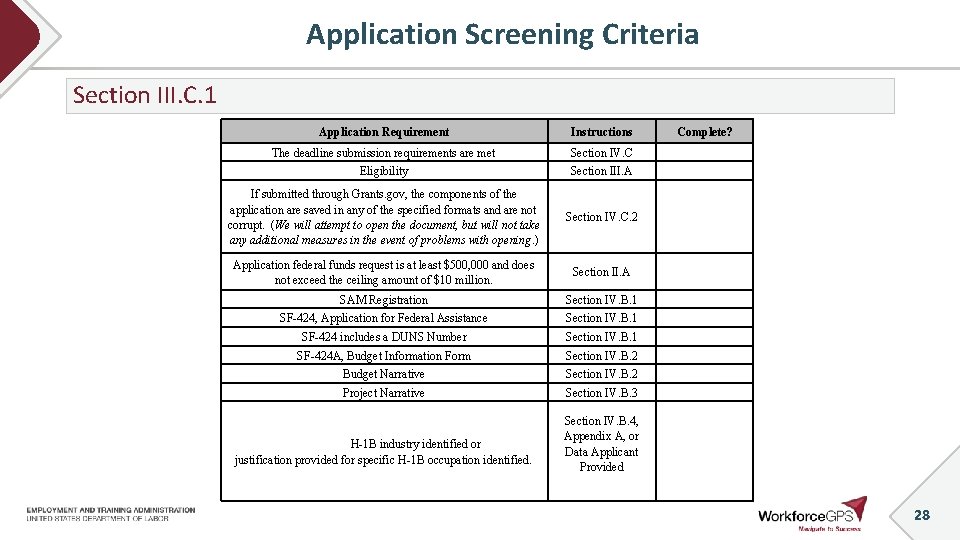
Application Screening Criteria Section III. C. 1 Application Requirement Instructions Complete? The deadline submission requirements are met Section IV. C Eligibility Section III. A If submitted through Grants. gov, the components of the application are saved in any of the specified formats and are not corrupt. (We will attempt to open the document, but will not take any additional measures in the event of problems with opening. ) Section IV. C. 2 Application federal funds request is at least $500, 000 and does not exceed the ceiling amount of $10 million. Section II. A SAM Registration Section IV. B. 1 SF-424, Application for Federal Assistance Section IV. B. 1 SF-424 includes a DUNS Number Section IV. B. 1 SF-424 A, Budget Information Form Section IV. B. 2 Budget Narrative Section IV. B. 2 Project Narrative Section IV. B. 3 H-1 B industry identified or justification provided for specific H-1 B occupation identified. Section IV. B. 4, Appendix A, or Data Applicant Provided 28
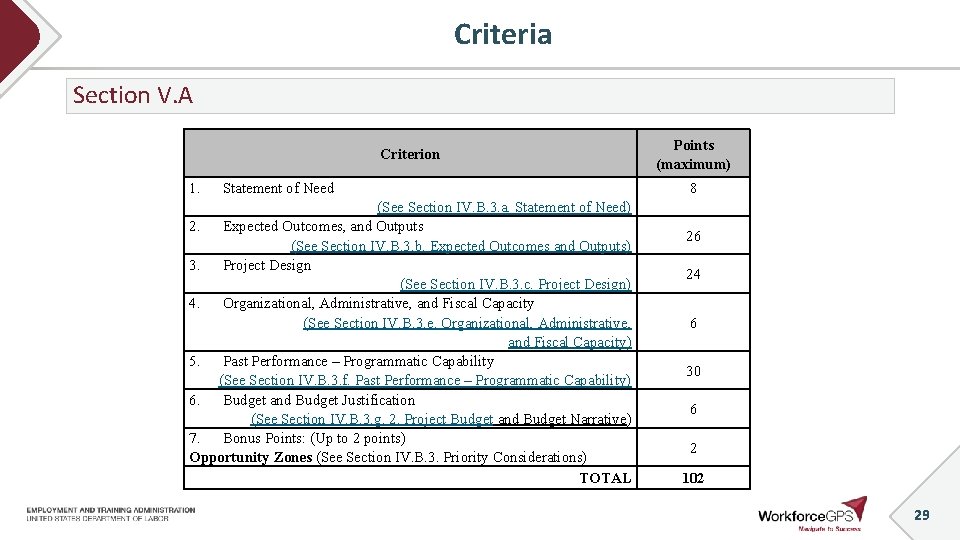
Criteria Section V. A Criterion 1. Statement of Need (See Section IV. B. 3. a. Statement of Need) 2. Expected Outcomes, and Outputs (See Section IV. B. 3. b. Expected Outcomes and Outputs) 3. Project Design (See Section IV. B. 3. c. Project Design) 4. Organizational, Administrative, and Fiscal Capacity (See Section IV. B. 3. e. Organizational, Administrative, and Fiscal Capacity) 5. Past Performance – Programmatic Capability (See Section IV. B. 3. f. Past Performance – Programmatic Capability) 6. Budget and Budget Justification (See Section IV. B. 3. g. 2. Project Budget and Budget Narrative) 7. Bonus Points: (Up to 2 points) Opportunity Zones (See Section IV. B. 3. Priority Considerations) TOTAL Points (maximum) 8 26 24 6 30 6 2 102 29
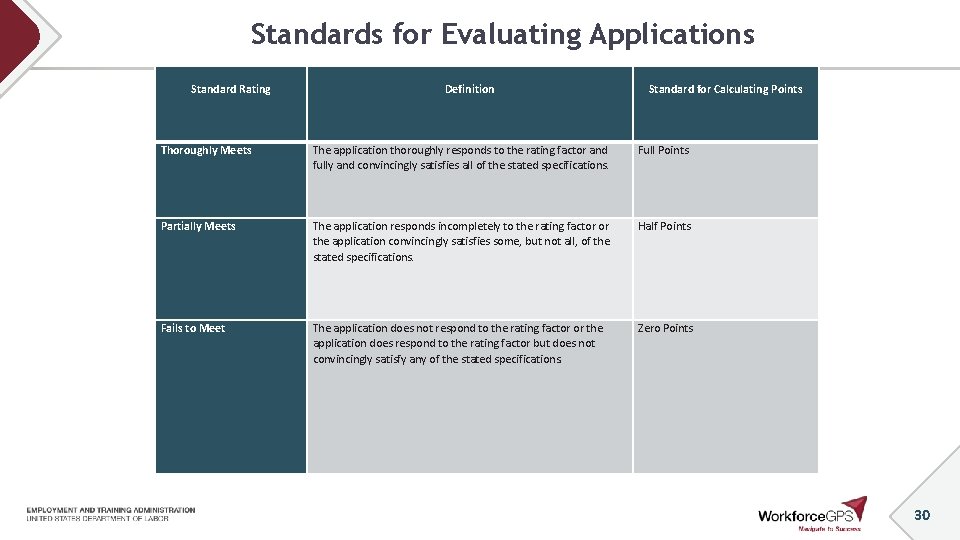
Standards for Evaluating Applications Standard Rating Definition Standard for Calculating Points Thoroughly Meets The application thoroughly responds to the rating factor and fully and convincingly satisfies all of the stated specifications. Full Points Partially Meets The application responds incompletely to the rating factor or the application convincingly satisfies some, but not all, of the stated specifications. Half Points Fails to Meet The application does not respond to the rating factor or the application does respond to the rating factor but does not convincingly satisfy any of the stated specifications. Zero Points 30
Proposal Submission Section IV. C Applications must be received by 4: 00 p. m. (ET) on the closing date, which is November 12, 2020. Method of Submission Online at www. grants. gov v. Reference FOA-ETA-20 -13 31
For More Information FAQs: https: //www. dol. gov/agencies/eta/skills -grants/h 1 -b-skills-training Check back frequently for new ones Questions: Andrea Chism Grants Management Specialist, OGM U. S. Department of Labor Chism. Andrea. N@dol. gov 202 -693 -2655 32

Thank You! Need help? Email: Support@workforce. GPS. org
- Slides: 33