
H 323 and firewalls Problem Statement and Solution
H. 323 and firewalls: Problem Statement and Solution Framework Author: Melinda Shore, Nokia Presenter: Shannon Mc. Cracken
About this document n It’s an IETF Draft n n n Not an official standard Expired July 2000. It describes the problems with trying to use H. 323 through firewalls and NAT devices
What is H. 323? n n Carries (video) phone over TCP/UDP/IP A telecommunications standard Rather complex protocol (compared with HTTP) Uses multiple TCP / UDP connections per call to carry the data

What is a firewall? n n Protects internal network from external threats by filtering traffic Can perform Network Address Translation (NAT) Internal Network 10. 0. 0. * FIRE WALL 10. 0. 0. 2 External Network (Internet) 130. 216. 191. 46 *. *
The Combined Problem n n n H. 323 embeds connection addresses in signalling connection NAT causes a mismatch between IP header and H. 323 stream End-to-end encryption prevents H. 323 aware NAT rewriting the traffic Breaks IP address based authentication But we want encryption and NAT!
Further problems n n RFC 2663: “NAT devices operate on the assumption that each session is independent. ” Applications like H. 323 that use control and follow-on sessions require gateways to interpret and translate the payload. Simple packet filtering will not work We need something more than just NAT or simple firewalls.
Possible solutions n n n Stateful Inspection Application Proxy Virtual Private Network Circuit Proxies RSIP Firewall control protocol
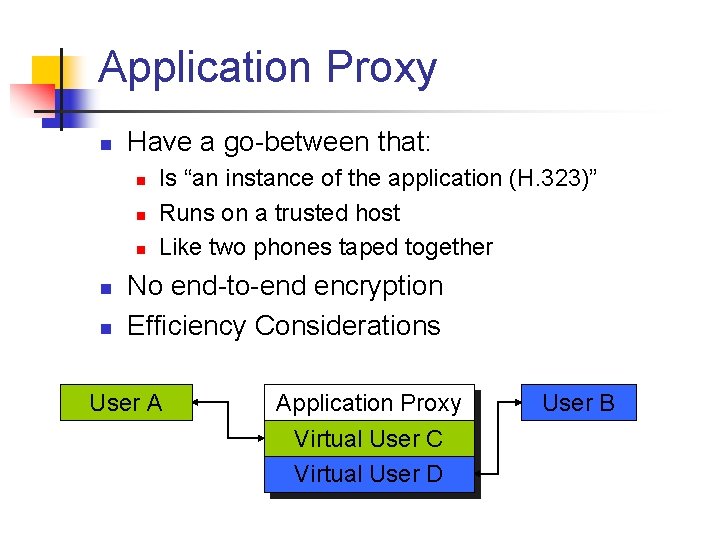
Application Proxy n Have a go-between that: n n n Is “an instance of the application (H. 323)” Runs on a trusted host Like two phones taped together No end-to-end encryption Efficiency Considerations User A Application Proxy Virtual User C Virtual User D User B
Circuit Proxy / Firewall Control n End clients open pinholes in firewall and communicate through them n n n For example, the SOCKS protocol End system must be aware of the circuit proxy—it’s not transparent. Works at the connection level (Circuit Proxy) or packet level (Firewall Control Protocol)
Conclusion n Firewalls and NATs are often difficult for some complex protocols H. 323 alone can’t handle this problem. I think networks will end up having call servers for H. 323 and similar protocols.
Questions? n What applications (if any) need end-toend encrypted signalling?
Another Question n n What to do about incoming connections? The author has not dealt with them
- Slides: 12