
H 3 PO 4 PHOSPHORIC ACID DETERMINATION Polyprotic
- Slides: 9
H 3 PO 4 (PHOSPHORIC ACID) DETERMINATION Polyprotic Acid
Phosphoric acid • Polyprotic acids contain more than one mole ionizable hydronium ions per mole of acids. They ionize to give more than one H+ ions per molecule. • Phosphoric acid is a polyprotic acids. Phosphoric acid containing 3 protons has three acidities different from each other. • Polyprotic acids are ionized to three steps. Each step give one proton and for each step the effect value is 1. Thus, total effect values are three. • It is difficult to tirate 3 rd proton of phosphoric acid as it is very weak.
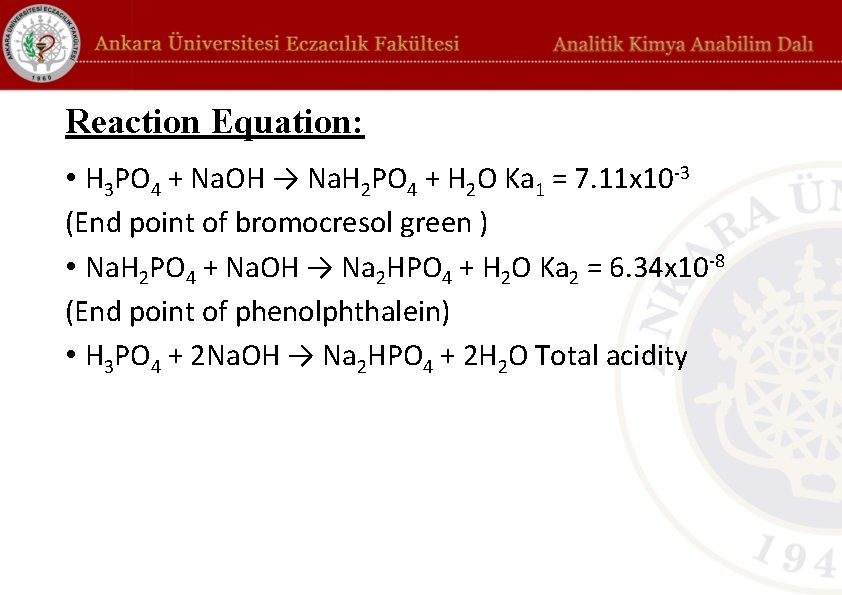
Reaction Equation: • H 3 PO 4 + Na. OH → Na. H 2 PO 4 + H 2 O Ka 1 = 7. 11 x 10 -3 (End point of bromocresol green ) • Na. H 2 PO 4 + Na. OH → Na 2 HPO 4 + H 2 O Ka 2 = 6. 34 x 10 -8 (End point of phenolphthalein) • H 3 PO 4 + 2 Na. OH → Na 2 HPO 4 + 2 H 2 O Total acidity
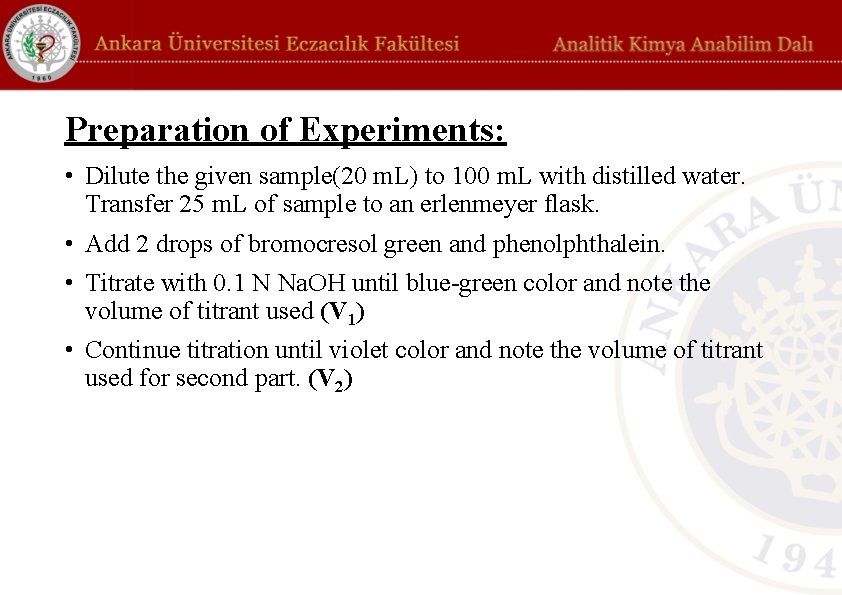
Preparation of Experiments: • Dilute the given sample(20 m. L) to 100 m. L with distilled water. Transfer 25 m. L of sample to an erlenmeyer flask. • Add 2 drops of bromocresol green and phenolphthalein. • Titrate with 0. 1 N Na. OH until blue-green color and note the volume of titrant used (V 1) • Continue titration until violet color and note the volume of titrant used for second part. (V 2)
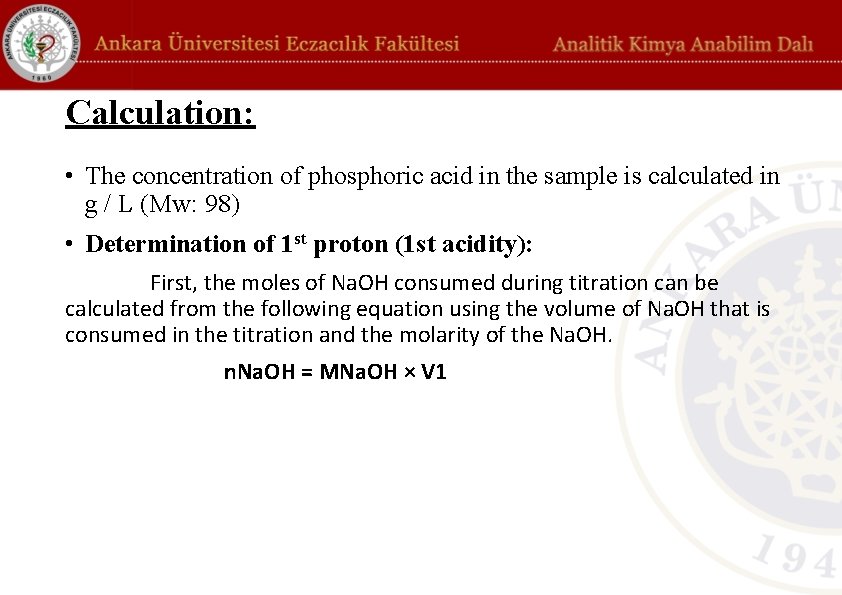
Calculation: • The concentration of phosphoric acid in the sample is calculated in g / L (Mw: 98) • Determination of 1 st proton (1 st acidity): First, the moles of Na. OH consumed during titration can be calculated from the following equation using the volume of Na. OH that is consumed in the titration and the molarity of the Na. OH. n. Na. OH = MNa. OH × V 1
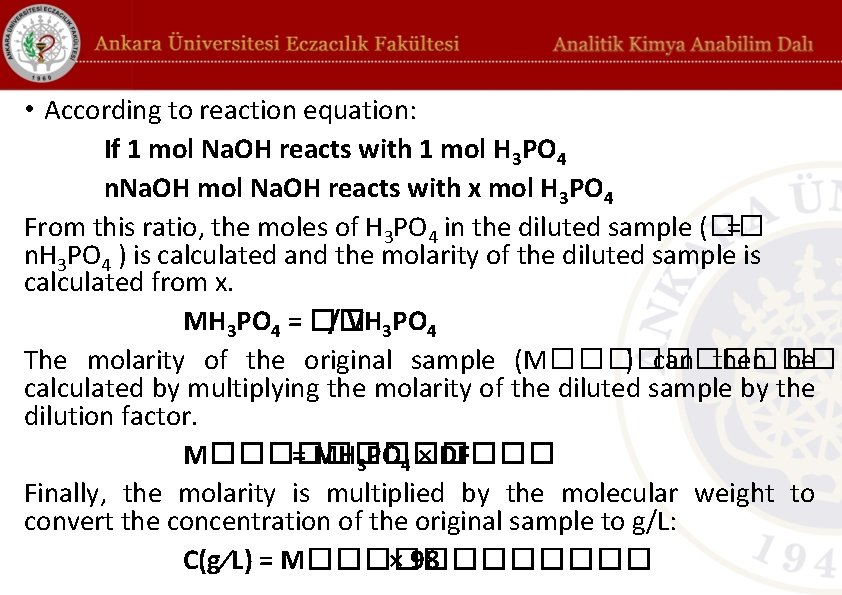
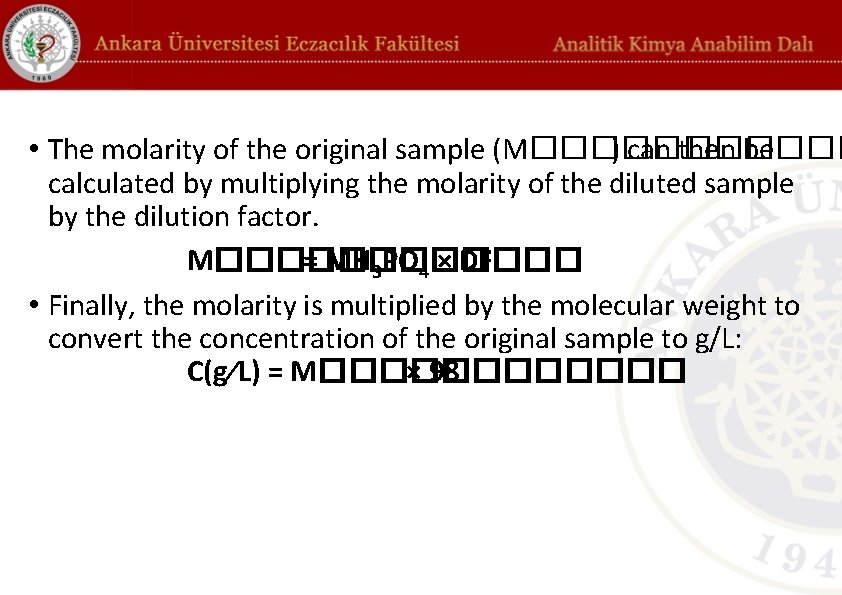
• According to reaction equation: If 1 mol Na. OH reacts with 1 mol H 3 PO 4 n. Na. OH mol Na. OH reacts with x mol H 3 PO 4 From this ratio, the moles of H 3 PO 4 in the diluted sample (�� = n. H 3 PO 4 ) is calculated and the molarity of the diluted sample is calculated from x. MH 3 PO 4 = �� / VH 3 PO 4 The molarity of the original sample (M������ ) can then be calculated by multiplying the molarity of the diluted sample by the dilution factor. M������ = MH 3 PO 4 × DF Finally, the molarity is multiplied by the molecular weight to convert the concentration of the original sample to g/L: C(g⁄L) = M������ × 98
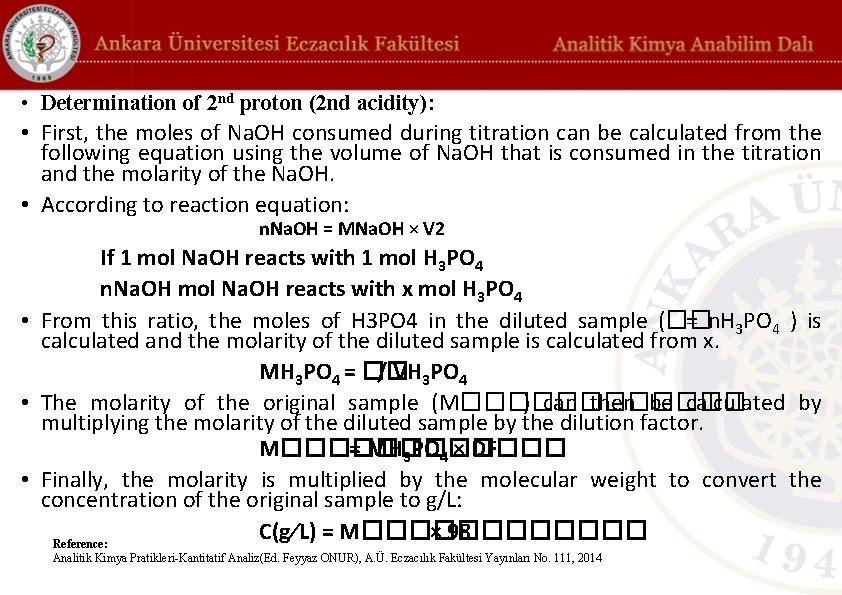
• Determination of 2 nd proton (2 nd acidity): • First, the moles of Na. OH consumed during titration can be calculated from the following equation using the volume of Na. OH that is consumed in the titration and the molarity of the Na. OH. • According to reaction equation: n. Na. OH = MNa. OH × V 2 If 1 mol Na. OH reacts with 1 mol H 3 PO 4 n. Na. OH mol Na. OH reacts with x mol H 3 PO 4 • From this ratio, the moles of H 3 PO 4 in the diluted sample (�� = n. H 3 PO 4 ) is calculated and the molarity of the diluted sample is calculated from x. MH 3 PO 4 = �� / VH 3 PO 4 • The molarity of the original sample (M������ ) can then be calculated by multiplying the molarity of the diluted sample by the dilution factor. M������ = MH 3 PO 4 × DF • Finally, the molarity is multiplied by the molecular weight to convert the concentration of the original sample to g/L: C(g⁄L) = M������ × 98 Reference: Analitik Kimya Pratikleri-Kantitatif Analiz(Ed. Feyyaz ONUR), A. Ü. Eczacılık Fakültesi Yayınları No. 111, 2014
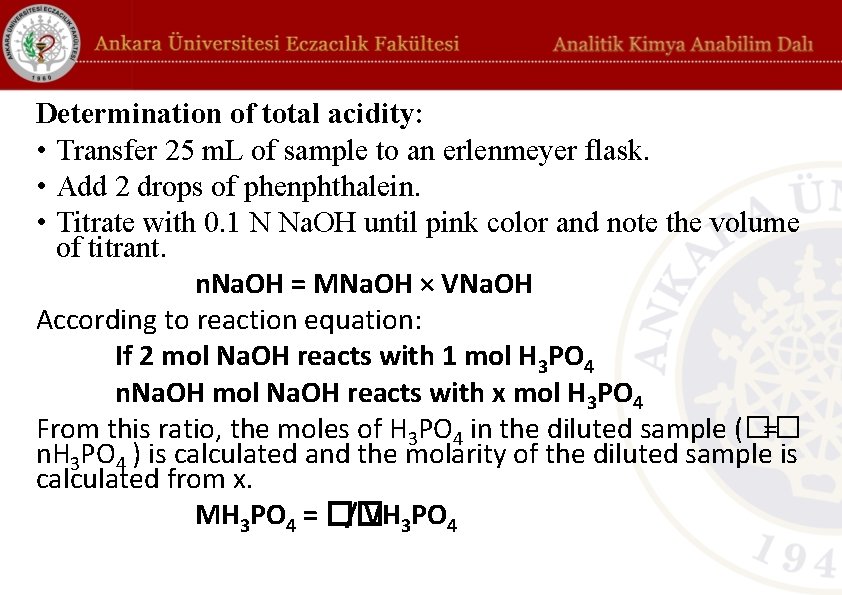
Determination of total acidity: • Transfer 25 m. L of sample to an erlenmeyer flask. • Add 2 drops of phenphthalein. • Titrate with 0. 1 N Na. OH until pink color and note the volume of titrant. n. Na. OH = MNa. OH × VNa. OH According to reaction equation: If 2 mol Na. OH reacts with 1 mol H 3 PO 4 n. Na. OH mol Na. OH reacts with x mol H 3 PO 4 From this ratio, the moles of H 3 PO 4 in the diluted sample (�� = n. H 3 PO 4 ) is calculated and the molarity of the diluted sample is calculated from x. MH 3 PO 4 = �� / VH 3 PO 4
• The molarity of the original sample (M������ ) can then be calculated by multiplying the molarity of the diluted sample by the dilution factor. M������ = MH 3 PO 4 × DF • Finally, the molarity is multiplied by the molecular weight to convert the concentration of the original sample to g/L: C(g⁄L) = M������ × 98