
H 261 A Standard for Video Conferencing Applications
- Slides: 25
H. 261: A Standard for Video. Conferencing Applications Nimrod Peleg Update: Nov. 1999
ITU - Rec. H. 261 Target (1990( • . . . “A Video compression standard developed to facilitate videoconferencing (and videophone) services over the integrated services digital network (ISDN) at p x 64 Kbps ( p=1. . 30”. . . ( • Acceptable quality usually above p=6 (384 Kbps( • Maximum bitrate over ISDN is 1. 92 Mbps (p=30), better than VHS-quality!
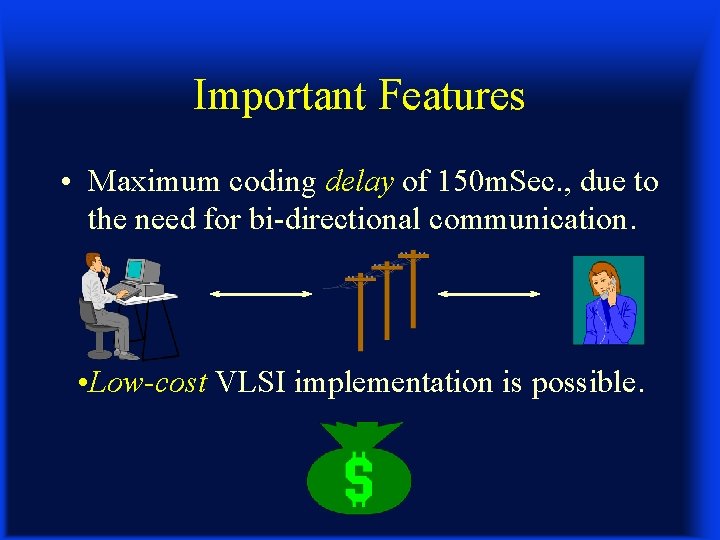
Important Features • Maximum coding delay of 150 m. Sec. , due to the need for bi-directional communication. • Low-cost VLSI implementation is possible.
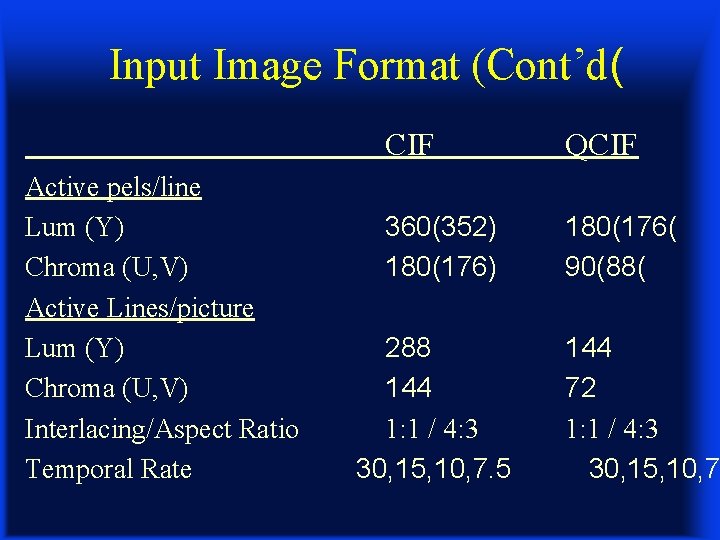
Input Image Format • To enable use of both 525 -lines and 625 -lines TV standards, a new input format was defined: Common Intermediate Format (CIF( • Maximum rate: CIF, 30 fps 37. 3 Mbps for 384 Kbps channel rate, 54: 1 compression ratio needed • Minimum rate: , QCIF, 7. 5 fps 2. 3 Mbps for 64 Kbps channel rate, 36: 1 compression ratio needed
Input Image Format (Cont’d( Active pels/line Lum (Y) Chroma (U, V) Active Lines/picture Lum (Y) Chroma (U, V) Interlacing/Aspect Ratio Temporal Rate CIF QCIF 360(352) 180(176( 90(88( 288 144 1: 1 / 4: 3 30, 15, 10, 7. 5 144 72 1: 1 / 4: 3 30, 15, 10, 7
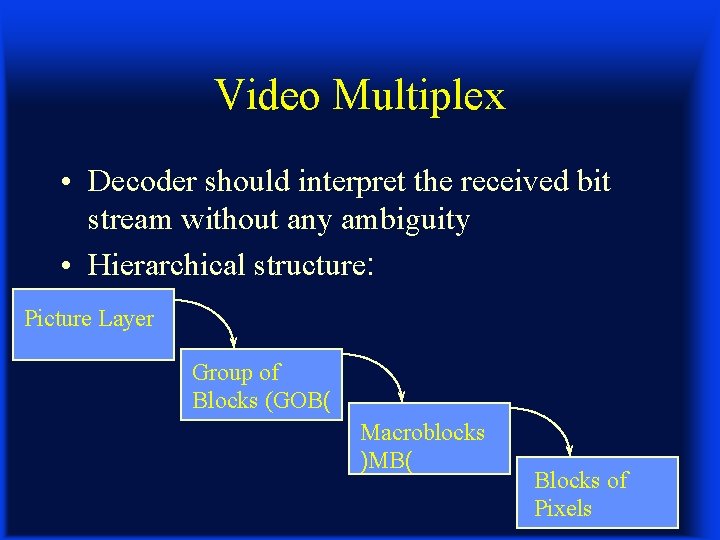
Video Multiplex • Decoder should interpret the received bit stream without any ambiguity • Hierarchical structure: Picture Layer Group of Blocks (GOB( Macroblocks )MB( Blocks of Pixels
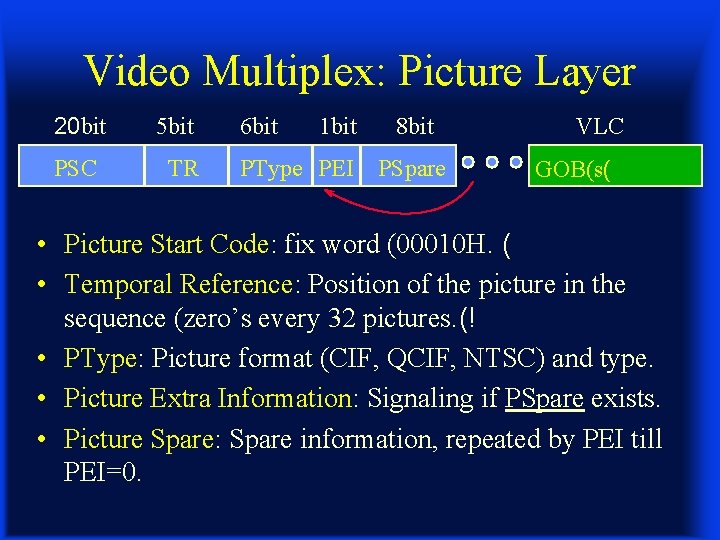
Video Multiplex: Picture Layer 20 bit PSC 5 bit TR 6 bit 1 bit PType PEI 8 bit PSpare VLC GOB(s( • Picture Start Code: fix word (00010 H. ( • Temporal Reference: Position of the picture in the sequence (zero’s every 32 pictures. (! • PType: Picture format (CIF, QCIF, NTSC) and type. • Picture Extra Information: Signaling if PSpare exists. • Picture Spare: Spare information, repeated by PEI till PEI=0.
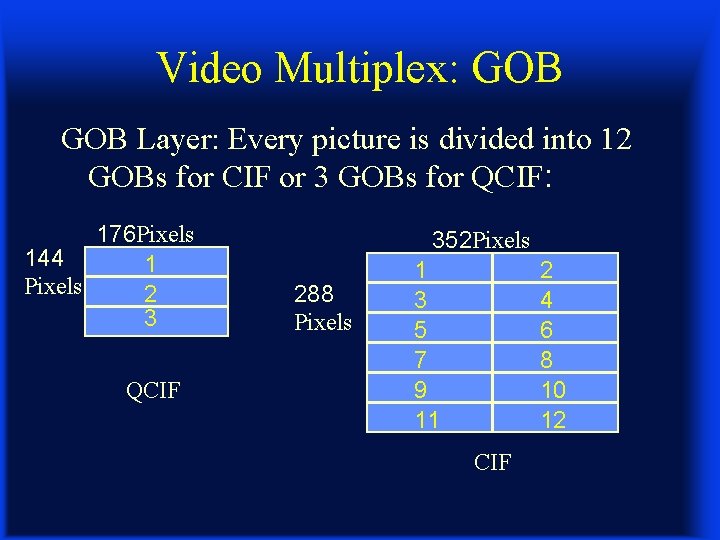
Video Multiplex: GOB Layer: Every picture is divided into 12 GOBs for CIF or 3 GOBs for QCIF: 176 Pixels 144 1 Pixels 2 3 QCIF 352 Pixels 288 Pixels 1 3 5 7 9 11 2 4 6 8 10 12 CIF
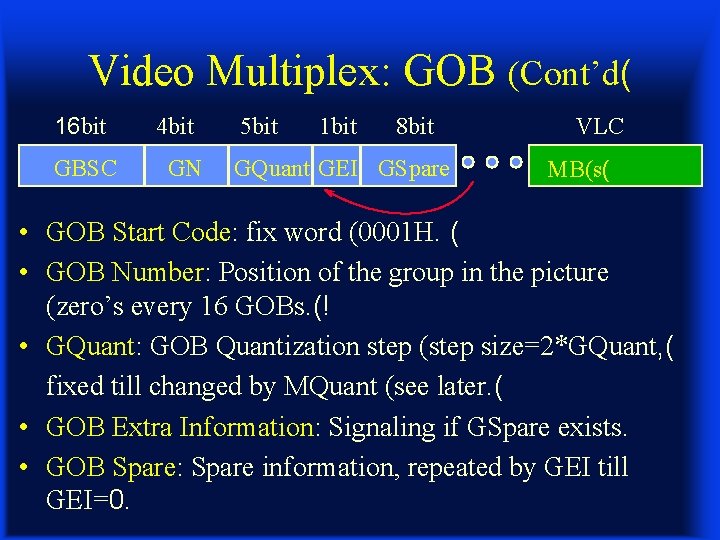
Video Multiplex: GOB (Cont’d( 16 bit GBSC 4 bit GN 5 bit 1 bit 8 bit GQuant GEI GSpare VLC MB(s( • GOB Start Code: fix word (0001 H. ( • GOB Number: Position of the group in the picture (zero’s every 16 GOBs. (! • GQuant: GOB Quantization step (step size=2*GQuant, ( fixed till changed by MQuant (see later. ( • GOB Extra Information: Signaling if GSpare exists. • GOB Spare: Spare information, repeated by GEI till GEI=0.
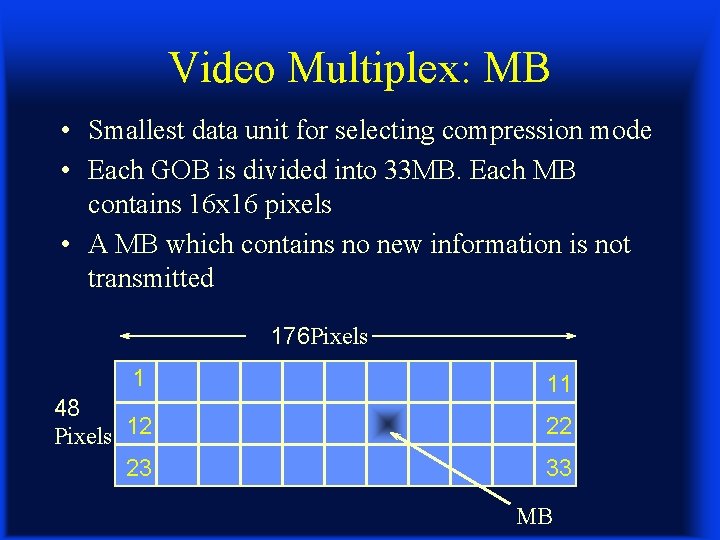
Video Multiplex: MB • Smallest data unit for selecting compression mode • Each GOB is divided into 33 MB. Each MB contains 16 x 16 pixels • A MB which contains no new information is not transmitted 176 Pixels 1 48 Pixels 12 23 11 22 33 MB
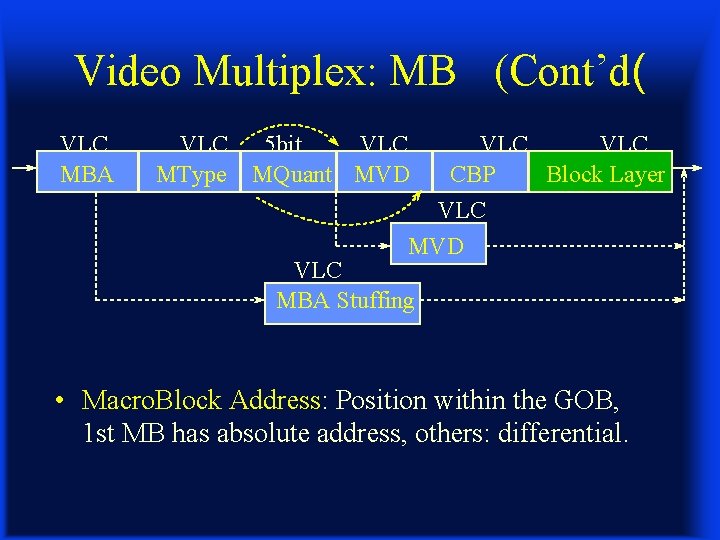
Video Multiplex: MB (Cont’d( VLC MBA VLC MType 5 bit VLC MQuant MVD VLC CBP Block Layer VLC MVD VLC MBA Stuffing • Macro. Block Address: Position within the GOB, 1 st MB has absolute address, others: differential.
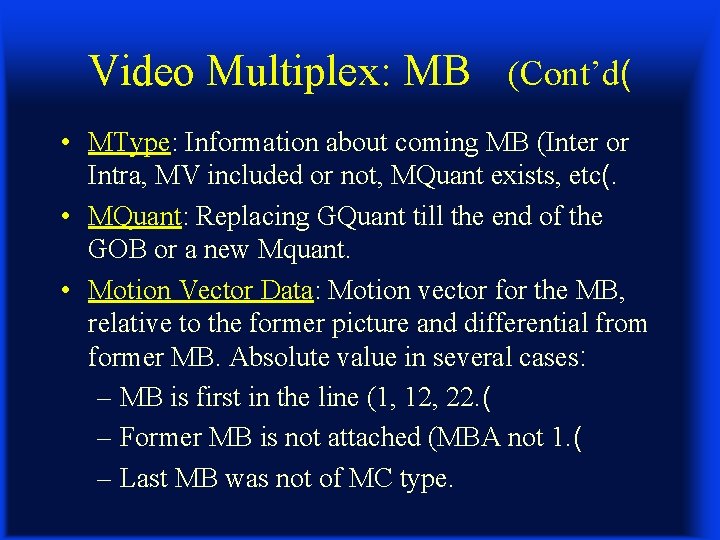
Video Multiplex: MB (Cont’d( • MType: Information about coming MB (Inter or Intra, MV included or not, MQuant exists, etc(. • MQuant: Replacing GQuant till the end of the GOB or a new Mquant. • Motion Vector Data: Motion vector for the MB, relative to the former picture and differential from former MB. Absolute value in several cases: – MB is first in the line (1, 12, 22. ( – Former MB is not attached (MBA not 1. ( – Last MB was not of MC type.
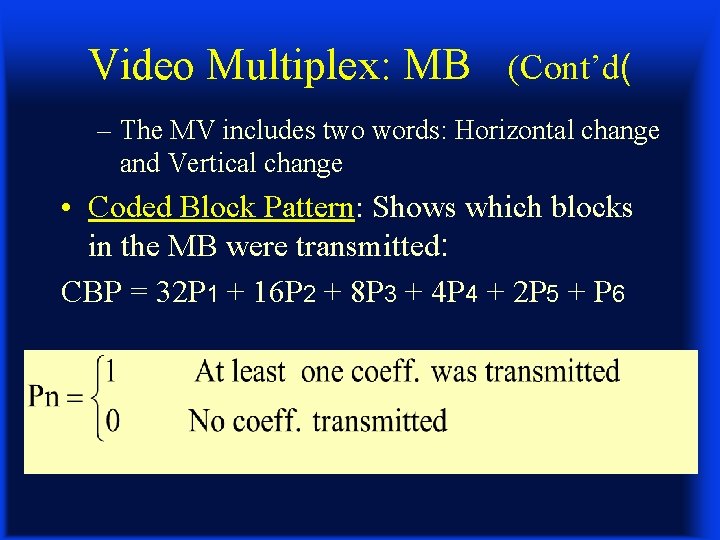
Video Multiplex: MB (Cont’d( – The MV includes two words: Horizontal change and Vertical change • Coded Block Pattern: Shows which blocks in the MB were transmitted: CBP = 32 P 1 + 16 P 2 + 8 P 3 + 4 P 4 + 2 P 5 + P 6
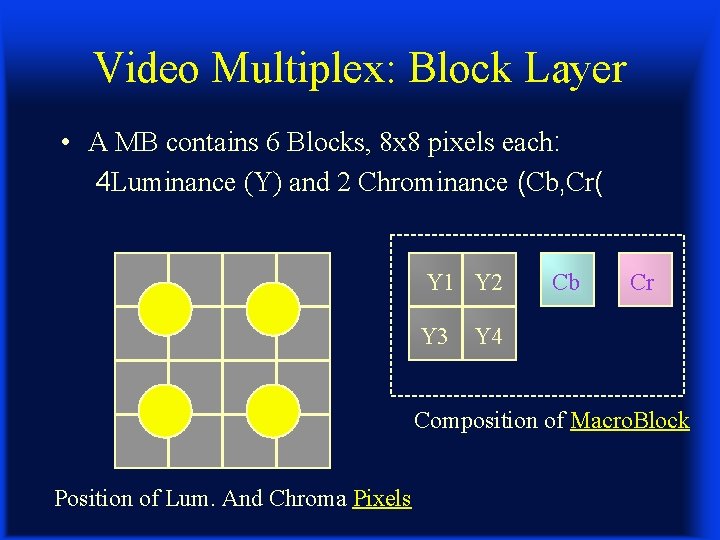
Video Multiplex: Block Layer • A MB contains 6 Blocks, 8 x 8 pixels each: 4 Luminance (Y) and 2 Chrominance (Cb, Cr( Y 1 Y 2 Y 3 Cb Cr Y 4 Composition of Macro. Block Position of Lum. And Chroma Pixels
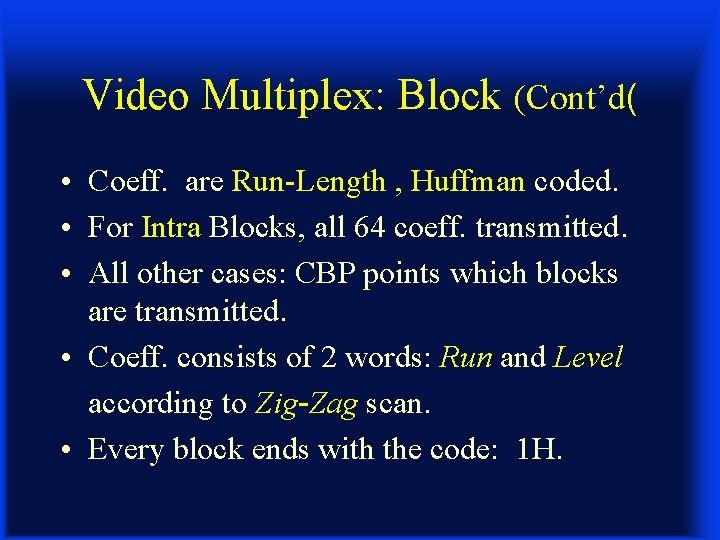
Video Multiplex: Block (Cont’d( • Coeff. are Run-Length , Huffman coded. • For Intra Blocks, all 64 coeff. transmitted. • All other cases: CBP points which blocks are transmitted. • Coeff. consists of 2 words: Run and Level according to Zig-Zag scan. • Every block ends with the code: 1 H.
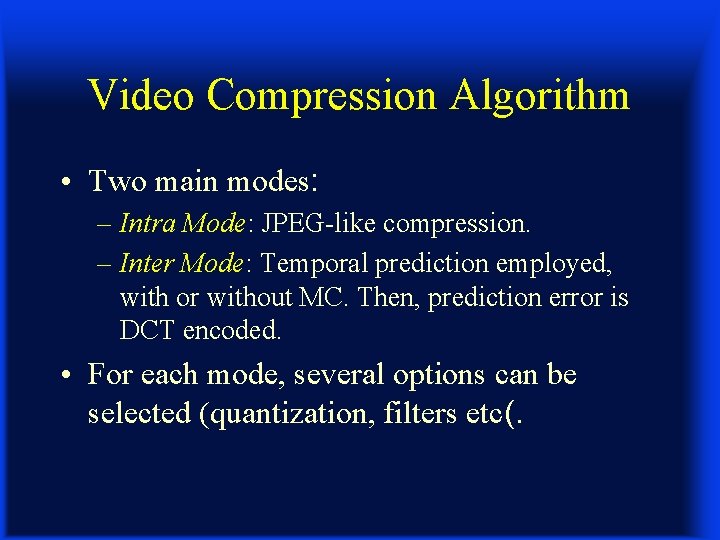
Video Compression Algorithm • Two main modes: – Intra Mode: JPEG-like compression. – Inter Mode: Temporal prediction employed, with or without MC. Then, prediction error is DCT encoded. • For each mode, several options can be selected (quantization, filters etc(.
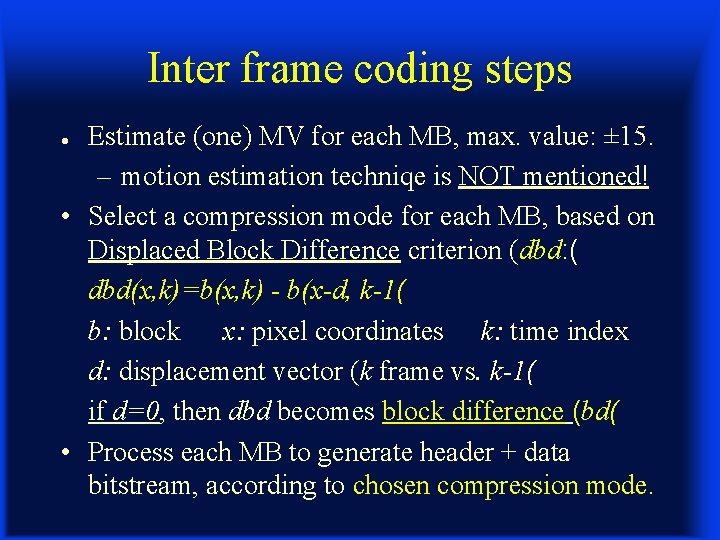
Inter frame coding steps Estimate (one) MV for each MB, max. value: ± 15. – motion estimation techniqe is NOT mentioned! • Select a compression mode for each MB, based on Displaced Block Difference criterion (dbd: ( dbd(x, k)=b(x, k) - b(x-d, k-1( b: block x: pixel coordinates k: time index d: displacement vector (k frame vs. k-1( if d=0, then dbd becomes block difference (bd( • Process each MB to generate header + data bitstream, according to chosen compression mode. l
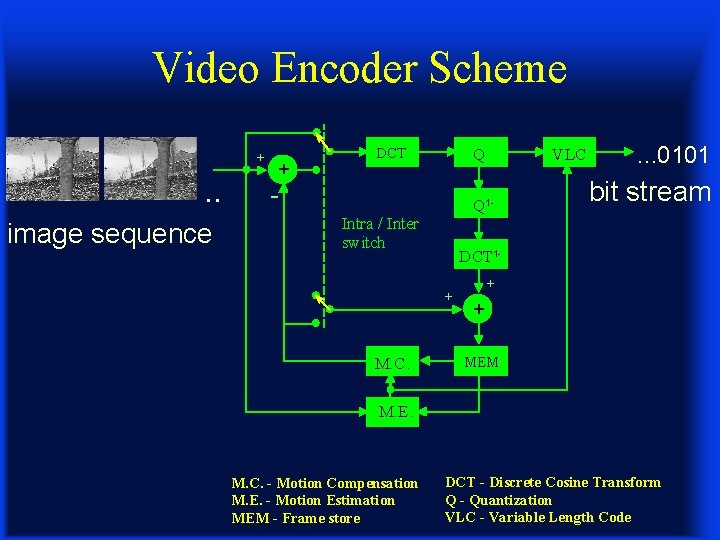
Video Encoder Scheme + . . image sequence + DCT Q - Q 1 - Intra / Inter switch . . . 0101 bit stream DCT 1+ M. C. VLC + + MEM M. E. M. C. - Motion Compensation M. E. - Motion Estimation MEM - Frame store DCT - Discrete Cosine Transform Q - Quantization VLC - Variable Length Code
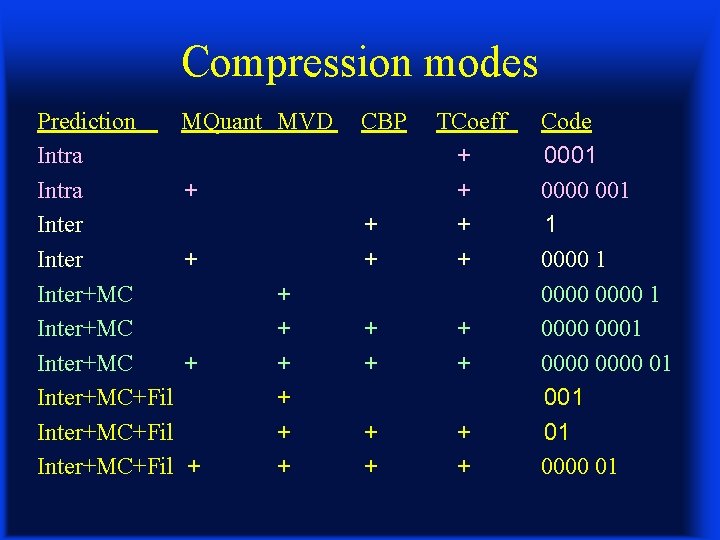
Compression modes Prediction Intra Inter+MC Inter+MC+Fil MQuant MVD CBP + + TCoeff + + + + + + Code 0001 0000 001 1 0000 0000 01 01 0000 01
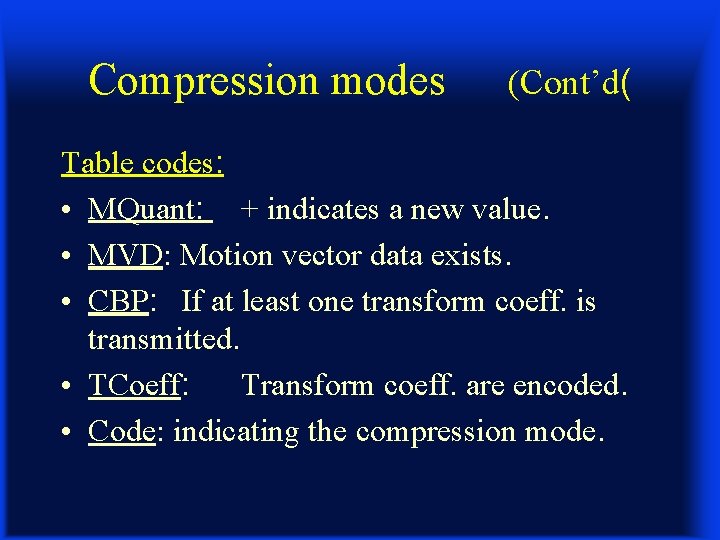
Compression modes (Cont’d( Table codes: • MQuant: + indicates a new value. • MVD: Motion vector data exists. • CBP: If at least one transform coeff. is transmitted. • TCoeff: Transform coeff. are encoded. • Code: indicating the compression mode.
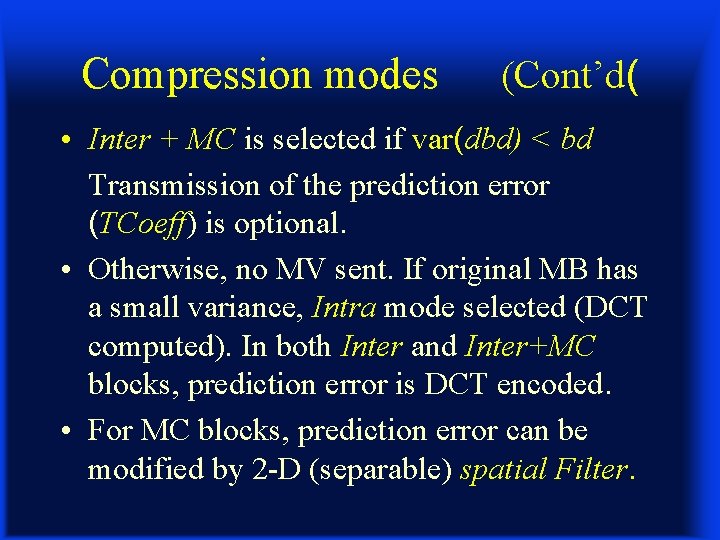
Compression modes (Cont’d( • Inter + MC is selected if var(dbd) < bd Transmission of the prediction error (TCoeff) is optional. • Otherwise, no MV sent. If original MB has a small variance, Intra mode selected (DCT computed). In both Inter and Inter+MC blocks, prediction error is DCT encoded. • For MC blocks, prediction error can be modified by 2 -D (separable) spatial Filter.
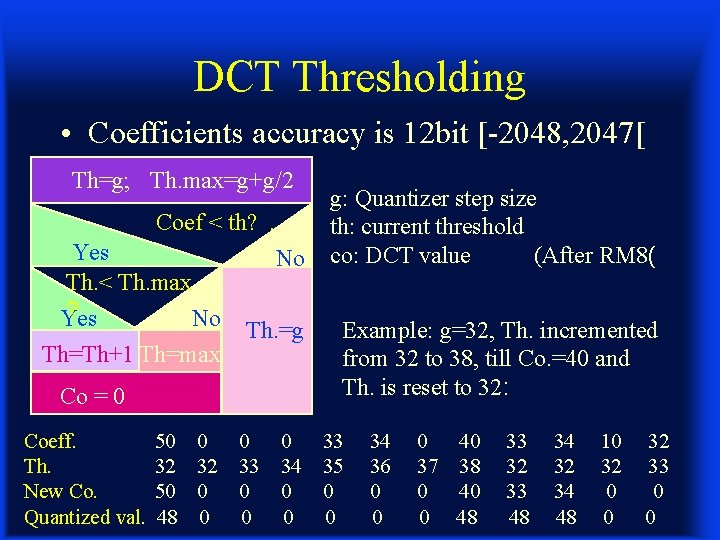
DCT Thresholding • Coefficients accuracy is 12 bit [-2048, 2047[ Th=g; Th. max=g+g/2 Coef < th? . Yes Th. < Th. max ? Yes No Th=Th+1 Th=max No Th. =g Co = 0 Coeff. Th. New Co. Quantized val. 50 0 32 32 50 0 48 0 0 33 0 0 0 34 0 0 g: Quantizer step size th: current threshold co: DCT value (After RM 8( Example: g=32, Th. incremented from 32 to 38, till Co. =40 and Th. is reset to 32: 33 35 0 0 34 36 0 0 0 40 37 38 0 40 0 48 33 32 33 48 34 32 34 48 10 32 0 0 32 33 0 0
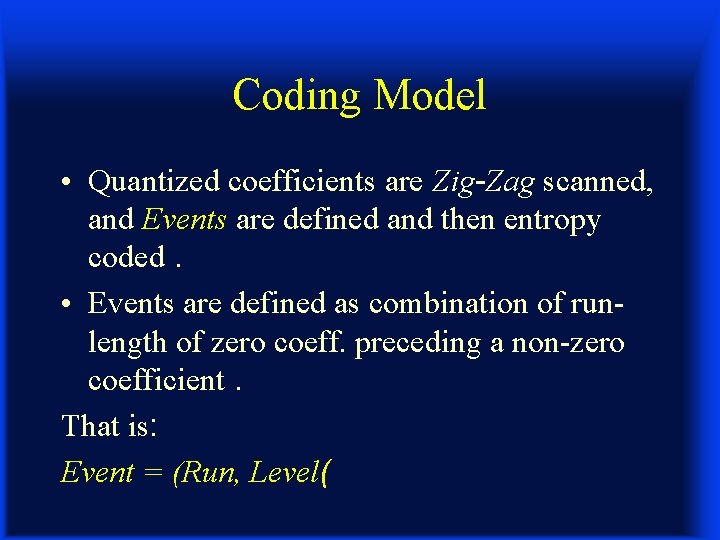
Coding Model • Quantized coefficients are Zig-Zag scanned, and Events are defined and then entropy coded. • Events are defined as combination of runlength of zero coeff. preceding a non-zero coefficient. That is: Event = (Run, Level(
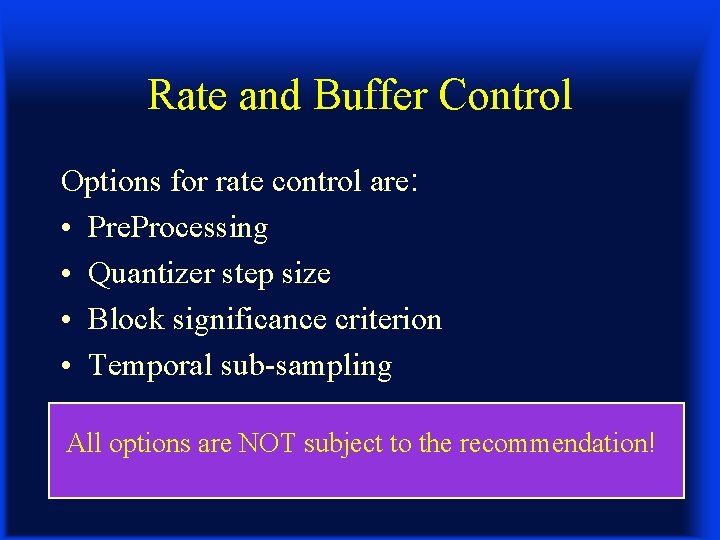
Rate and Buffer Control Options for rate control are: • Pre. Processing • Quantizer step size • Block significance criterion • Temporal sub-sampling All options are NOT subject to the recommendation!
H. 263 Demo. . .