
H 2 Si F 6 Hexafluorosilicic Acid Transportation


- Slides: 62
H 2 Si. F 6 Hexafluorosilicic Acid Transportation & Safety Compiled by G. Glasser, R. Gentle & R. Jones for the National Pure Water Association and UK Councils Against Fluoridation. 2005
H 2 Si. F 6 Information and documentation on this CD-ROM were compiled from public domain sources and is not for sale or resale Every attempt was made by the researchers to provide the most current information possible from the most reliable sources This presentation is meant only for educational purposes and in the event of an incident, contact the appropriate agencies and qualified Physicians Reference
H 2 Si. F 6 All Fluorinated/Fluoride Chemicals can be extremely dangerous when encountered in an emergency situation: • Fire and contact with certain chemicals can cause a release of highly toxic and corrosive vapours • Fluoride-based acids and bases are extremely toxic and can be absorbed through the skin • Acute exposure can result in death • Fluoride vapours can cause permanent damage to the lungs and eyes Reference
H 2 Si. F 6 All liquid fluoride acids should be classified in an unique category Reference
H 2 Si. F 6 Hydrofluoric acid is the most corrosive and toxic of the fluoride acids Reference
H 2 Si. F 6 Toxicological The two mechanisms that cause tissue damage are corrosive burn from the free hydrogen ions and chemical burn from tissue penetration of the fluoride ions Reference
H 2 Si. F 6 Fluoride ions penetrate the skin and form insoluble salts with calcium and magnesium Soluble salts are also formed with other cations in the body but dissociate rapidly Consequently, fluoride ions release, and further tissue destruction occurs Reference
H 2 Si. F 6 Mortality/Morbidity: Local effects include tissue destruction and necrosis Burns may affect underlying bone Systemic fluoride ion poisoning from severe burns is associated with hypocalcemia (low Calcium levels), hyperkalemia (low Potassium levels), hypomagnesemia (low magnesium levels), and sudden death Reference
H 2 Si. F 6 Inhalation of hydrofluoric acid vapours may cause severe throat irritation, cough, dyspnea, cyanosis, lung injury and pulmonary oedema resulting in death Reference
H 2 Si. F 6 While fluoride acids may not react as rapidly as HF, the end result from exposures will be the same if prompt emergency treatment is not available Reference
H 2 Si. F 6 NOTICE Treatment for exposures: Fluoride acid burns require immediate and specialised treatment Speed is of the Essence: Delay in first aid or improper medical treatment may result in greater damage or the result may be fatal Reference
H 2 Si. F 6 Hydrofluoric acid (HF) is the base product used to make any fluoride acid Reference
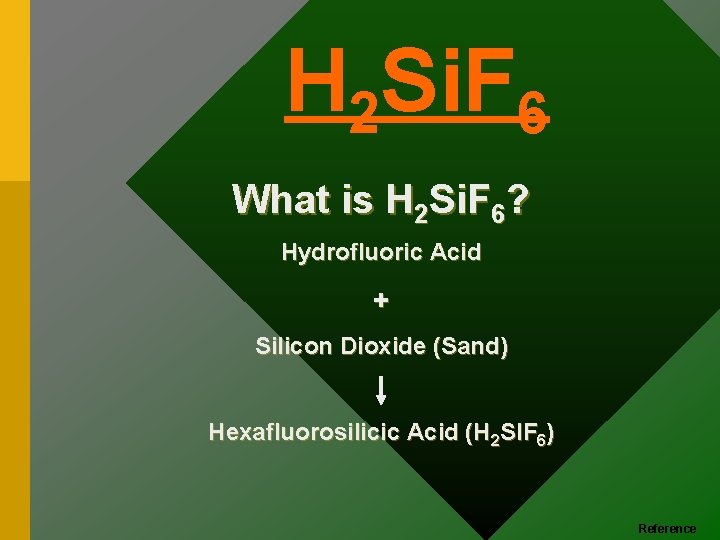
H 2 Si. F 6 What is H 2 Si. F 6? Hydrofluoric Acid + Silicon Dioxide (Sand) Hexafluorosilicic Acid (H 2 SIF 6) Reference
H 2 Si. F 6 CHEMICAL NAME OF SUBSTANCE Fluorosilicic Acid SYNONYMS: • Fluorosilicic Acid • Hydrogen hexafluorosilicate 40% • Hydrofluorosilicic acid • Fluosilicic acid • Hexafluosilicic acid • Silicofluoric acid • Sand acid Reference
H 2 Si. F 6 Sources By-product from the manufacture of phosphate fertiliser and hydrogen fluoride All H 2 Si. F 6 is of a technical/commercial grade used for drinking water fluoridation and industrial production Reference
H 2 Si. F 6 Appearance and Odour Water white to straw yellow, fuming liquid, with pungent odour If you can smell it you are being OVEREXPOSED! Technical Grade H 2 Si. F 6 can contain up to 2. 0% hydrofluoric acid Typical Concentrations 20% - 36% H 2 Si. F 6 Reference
H 2 Si. F 6 Transport and Storage • Transport: TPC class 8. 9? b - TPF class 8. 9? b - IMCO class 8 - ADR class 8. 8 b - RID class 8. 8 b • Storage: Polyethylene drums. Rubber-coated tank-trucks or containers with approximately 20 MT capacity Reference
H 2 Si. F 6 Uses • Drinking water fluoridation • Cement • Latex Foam Rubber • Ceramics and Glass: Glass etching • Electroplating • Sterilization of equipment • Tanning of animal hides • Commercial Laundry: As a neutralizer for alkalis Reference
H 2 Si. F 6 INCOMPATIBLE PRODUCTS • Metal, glass, stoneware, alkali and strong concentrated acids • Separate from strong bases, food and foodstuffs Reference
H 2 Si. F 6 FIRE AND EXPLOSION HAZARDS • Wear approved self-contained acid suits • Reacts with many metals to produce flammable and explosive hydrogen gas • Decomposition will occur above 22°F and produce toxic and corrosive fumes of silicon tetrafluoride and hydrogen fluoride Reference
H 2 Si. F 6 SPILL OR LEAK Emergency Action: • Keep unnecessary people away • Stay upwind, keep out of low areas • Isolate hazard area and deny entry Reference
H 2 Si. F 6 Small Spills • Any personnel in area should wear an approved air supplied acid suit • Dike area to contain material • Do not allow solution to enter sewers or surface water • Neutralize the spill with water and lime (hydrated lime) • Take up with sand or non-combustible absorbent material and place in containers for later disposal • Provide ventilation and be wary of hydrogen generation upon reaction with some metals Reference
H 2 Si. F 6 Large Spills • Any personnel in area should wear an approved air supplied acid suit • Dike area ahead of spill to contain material. Do not allow solution to enter sewers or surface water • Neutralize the spill with water and lime (hydrated lime) • Provide ventilation and be wary of hydrogen generation upon reaction with some metals Reference
H 2 Si. F 6 Large Road or Motorway Spill • Notify hospitals and paramedics of need for specialised treatment • Evacuate bystanders upwind 300 yards • Evacuate residents in about an one-half mile radius Reference
H 2 Si. F 6 DO NOT • Spray water directly onto acid • Attempt to add a neutralising agent directly into the acid Reference
H 2 Si. F 6 PERSONAL PROTECTION INFORMATION Respiratory Protection: Use an approved cartridge respirator with fullface shield Chemical cartridge should provide protection against acid fumes (Hydrogen Fluoride) For concentrations greater than 20 ppm, an approved self-contained breathing apparatus with full-face shield should be used Reference
H 2 Si. F 6 PERSONAL PROTECTION INFORMATION Eye and Face Protection: Use tight-fitting chemical splash goggles and a full-face shield, 8 inch minimum Contact lenses should not be worn Reference
H 2 Si. F 6 PERSONAL PROTECTION INFORMATION Hand, Arm and Body Protection: Prevent contact with skin by use of acid- proof clothing, gloves and shoes Use an approved acid proof suit and boots where liquid or high vapour concentration is possible Reference
H 2 Si. F 6 Symptoms of Exposure Acute: Liquid or vapours can cause severe irritation and burns which may not be apparent for hours Can cause severe irritation to the lungs, nose and throat if swallowed, can cause severe damage to throat and stomach, tetany and death Reference
H 2 Si. F 6 Symptoms of Exposure Chronic: Prolonged exposure could result in bone changes, corrosive effect on mucous membranes including ulceration of nose, throat and bronchial tubes, cough, shock, pulmonary oedema, Fluorosis Reference
H 2 Si. F 6 Aggravated Medical Conditions Any skin condition and/or pre-existing respiratory disease including asthma and emphysema Reference
H 2 Si. F 6 EMERGENCY AND FIRST AID PROCEDURES Inhalation: Remove exposed person to an uncontaminated area immediately If breathing has stopped, start artificial respiration at once Oxygen should be provided for an exposed person having difficulty breathing (but only by an authorized person) until exposed person is able to breathe easily by themselves Exposed person should be examined by a physician Reference
H 2 Si. F 6 EMERGENCY AND FIRST AID PROCEDURES Skin Contact: Exposed person should be removed to an uncontaminated area and subjected immediately to a drenching shower of water for a minimum of 15 to 20 minutes Remove all contaminated clothing while under shower Medical attention should be given as soon as possible for all burns, regardless of how minor they seem Reference
H 2 Si. F 6 EMERGENCY AND FIRST AID PROCEDURES Eye Contact: Flush eyes for at least 15 minutes with large amounts of water Eyelids should be held apart during flushing to ensure contact of water with all accessible tissue of the eyes and lids Medical attention should be given as soon as possible Reference
H 2 Si. F 6 Notes to Physicians: Beware of late onset of pulmonary oedema for up to 48 hours Treat severe burns and inhalation exposures the same as hydrofluoric acid exposures Reference
H 2 Si. F 6 Notes to Physicians: Toxicity: Acute and sub-acute exposures to fluorides from whatever source can be extremely dangerous and should be treated with due diligence Reference
H 2 Si. F 6 Notes to Physicians: Toxicological mechanisms: 1. Fluoride binds to metal-containing enzymes, thereby inactivating them 2. Fluoride binds to calcium, resulting in severe hypocalcemia 3. Fluoride binds to potassium and magnesium ions leading to myocardial irritability and arrhythmia (affects heart function) Reference
H 2 Si. F 6 Notes to Physicians: Toxicological mechanisms: 4. Fluoride may be directly toxic to the Central Nervous System Reference
H 2 Si. F 6 Notes to Physicians: Dermal: Removal or inactivation of the fluoride from the site of contact is important and absorbed fluoride must also be inactivated Reference
H 2 Si. F 6 Notes to Physicians: Dermal: Exposed skin surfaces should be soaked In a calcium or magnesium salt solution, gel or paste Alternatively, quaternary ammonium compounds (e. g. benzalkonium chloride) may be used Reference
H 2 Si. F 6 Notes to Physicians: Inhalation: For serious inhalation exposures the victim should be placed on a calcium gluconate nebulizer as soon as possible Reference
H 2 Si. F 6 Notes to Physicians: Patients suffering with serious exposures should have an immediate assessment of serum calcium and electrolytes Intravenous calcium gluconate, magnesium gluconate and potassium to inactivate serum fluoride and replenish electrolyte levels Reference
H 2 Si. F 6 Notes to Physicians: Blood calcium and electrolytes should be measured every 6 hrs for at least the first 24 hrs in severe cases Reference
H 2 Si. F 6 Notes to Physicians: As soon as possible, patients should be placed on continuous electrocardiograph monitoring for signs of hypocalcaemia or dysrhythmia Reference
H 2 Si. F 6 Example Incidents • 1994 Deltona, Florida • 2001 Port Avonmouth, Bristol • 2005 Phoenix, Arizona Reference
H 2 Si. F 6 Deltona, Florida, 1994 50 people went to hospital Reference
H 2 Si. F 6 Some police and emergency workers were in hospital for up to six weeks Reference
H 2 Si. F 6 In a one mile radius, 2, 700 people were evacuated from their homes for up to 24 hours Reference
H 2 Si. F 6 Clean up required about four days with crews working round the clock Reference
H 2 Si. F 6 The USEPA advised residents not to drink well water until it had been tested for contamination Reference
H 2 Si. F 6 All ground water in the area was tested for contamination Reference
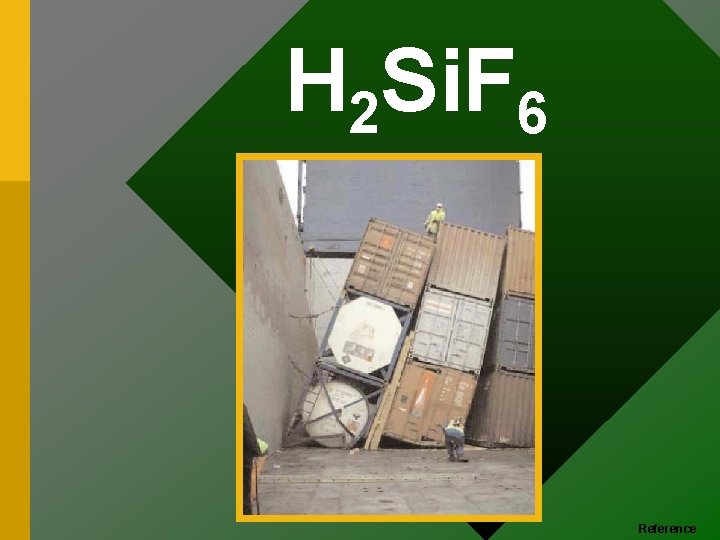
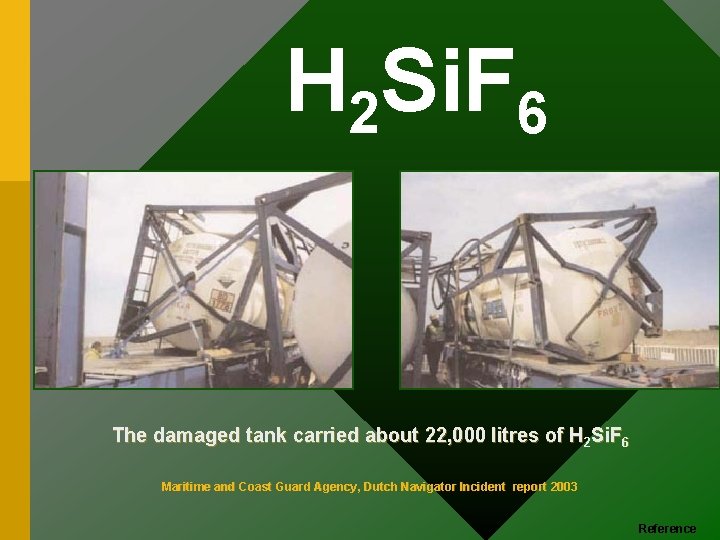
H 2 Si. F 6 Port Avonmouth, UK, 27 April 2001 • Avonmouth, Bristol, a portable tank of H 2 Si. F 6 was damaged in transit from Bilboa, Spain • Upon discovering the damaged container, the Bristol Port Company declared a "Port Emergency" and a "Major Incident" • Much of the port was effectively shut down for about 30 hours Reference
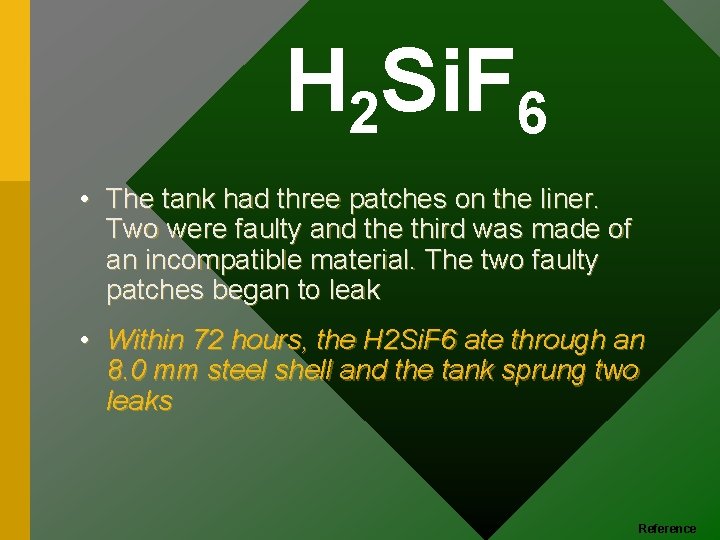
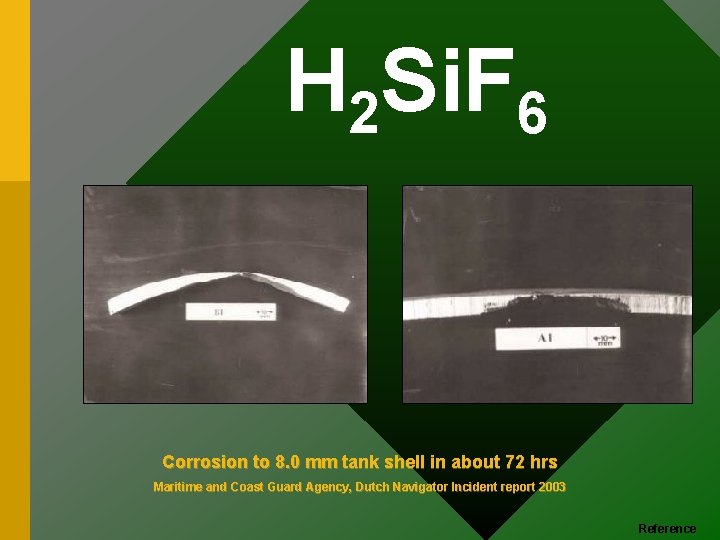
H 2 Si. F 6 • The tank had three patches on the liner. Two were faulty and the third was made of an incompatible material. The two faulty patches began to leak • Within 72 hours, the H 2 Si. F 6 ate through an 8. 0 mm steel shell and the tank sprung two leaks Reference
H 2 Si. F 6 Corrosion to 8. 0 mm tank shell in about 72 hrs Maritime and Coast Guard Agency, Dutch Navigator Incident report 2003 Reference
H 2 Si. F 6 Reference
H 2 Si. F 6 The damaged tank carried about 22, 000 litres of H 2 Si. F 6 Maritime and Coast Guard Agency, Dutch Navigator Incident report 2003 Reference
H 2 Si. F 6 Phoenix, 03 February 2005 • A spill of 110 gallons of hydrofluosilicic acid occurred from a leaking tanker lorry in downtown Phoenix, Arizona • Sixteen people were sent to hospital, including eleven policeman and three firemen • 9, 554 people were notified by a reverse 911 emergency service phone system to stay indoors or in some type of protective shelter Reference
H 2 Si. F 6 The Phoenix fire chief issued a statement to the press saying that, because of the nature of the spill, inhalation exposure was a minimal risk He said, however, skin contact with the hexafluorosilicic acid could be deadly Reference
H 2 Si. F 6 Bulk loads of H 2 i. SF 6 and hydrofluoric acid are being transported on UK roads and motorways everyday ‘It is not a question’ of if a major incident will happen, ‘it is only when’ Reference
H 2 Si. F 6 WARNING Health and Safety Executive's (HSE) Conditions for Approval of Examination Schemes and Programmes set out no detailed requirements for container condition. Internationally agreed standards for container maintenance are not mandatory in the UK Reference
For CD-ROM containing complete documents us as reference material email disk@npwa. freeserve. co. uk for details Reference
Reference