
H 2 S HYDROGEN SULFIDE SAFETY TRAINING INSTRUCTOR

- Slides: 21
H 2 S (HYDROGEN SULFIDE) SAFETY TRAINING INSTRUCTOR: Rolando S. Bulatao Jr.
è What is Hydrogen Sulfide (H 2 S)? è Where do you find H 2 S? è Properties of H 2 S è Detection of H 2 S è Protection against H 2 S hazards è How does H 2 S affect individuals? è Emergency Response and Rescue Procedures è Safety Measures è Proper donning, doffing, and storage of SCBA H 2 S SAFETY TRAINING
è What is Hydrogen Sulfide (H 2 S)? î A colorless (transparent) gas that is heavier than air and tends to accumulate in low-lying areas î Consists of 2 Hydrogen atoms and 1 Sulphur atom î Has an offensive odor similar to rotten eggs at low concentration, at higher concentrations it rapidly deadens the sense of smell î A poisonous gas that can paralyze the breathing system and can kill in minutes î Highly toxic and very corrosive to certain metals and elastomers î Belongs to the inorganic Sulfide family H 2 S SAFETY TRAINING
Other names referred to H 2 S: Stink Damp Rotten-Egg Gas Swamp Gas Dihydrogen Sulfide Hydrogen Sulfide Sour Crude / Sour Gas H 2 S Hepatic Gas Sewer Gas Hydrosulphuric Acid Sulphurated Hydrogen Zwavelwaterstoff
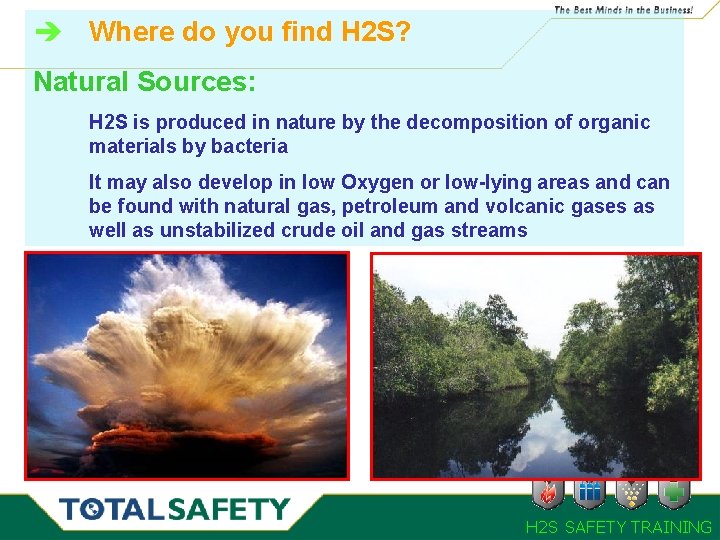
è Where do you find H 2 S? Natural Sources: H 2 S is produced in nature by the decomposition of organic materials by bacteria It may also develop in low Oxygen or low-lying areas and can be found with natural gas, petroleum and volcanic gases as well as unstabilized crude oil and gas streams H 2 S SAFETY TRAINING
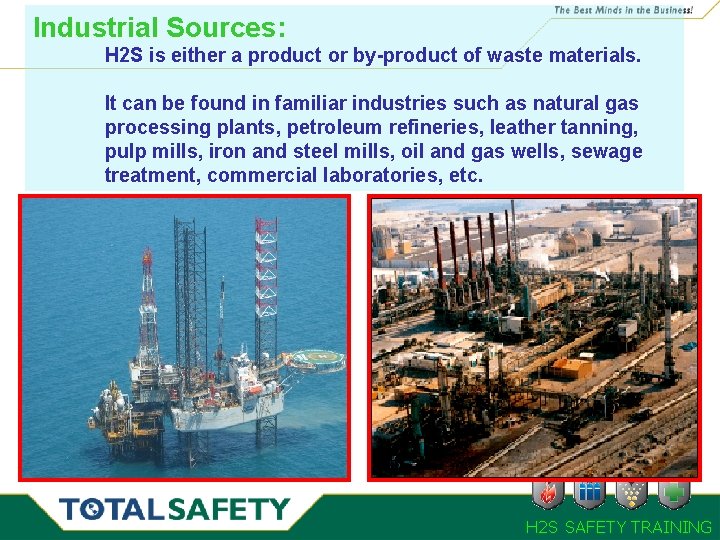
Industrial Sources: H 2 S is either a product or by-product of waste materials. It can be found in familiar industries such as natural gas processing plants, petroleum refineries, leather tanning, pulp mills, iron and steel mills, oil and gas wells, sewage treatment, commercial laboratories, etc. H 2 S SAFETY TRAINING
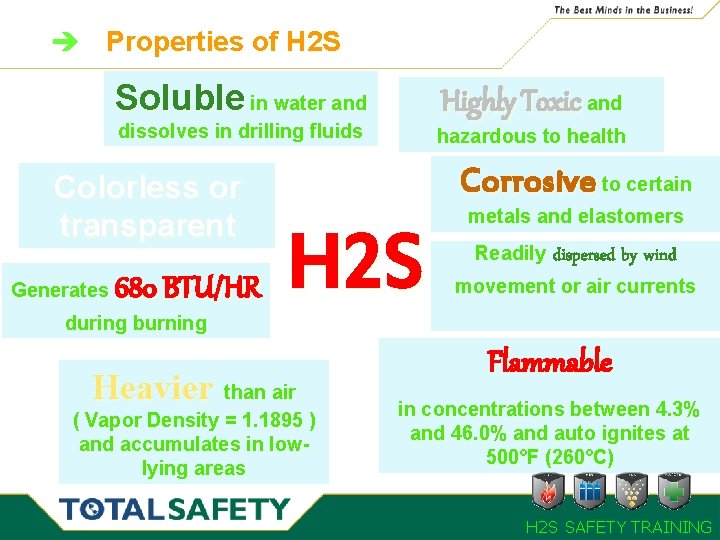
è Properties of H 2 S Soluble in water and Highly Toxic and dissolves in drilling fluids Colorless or transparent Generates 680 BTU/HR during burning hazardous to health Corrosive to certain H 2 S Heavier than air ( Vapor Density = 1. 1895 ) and accumulates in lowlying areas metals and elastomers Readily dispersed by wind movement or air currents Flammable in concentrations between 4. 3% and 46. 0% and auto ignites at 500°F (260°C) H 2 S SAFETY TRAINING
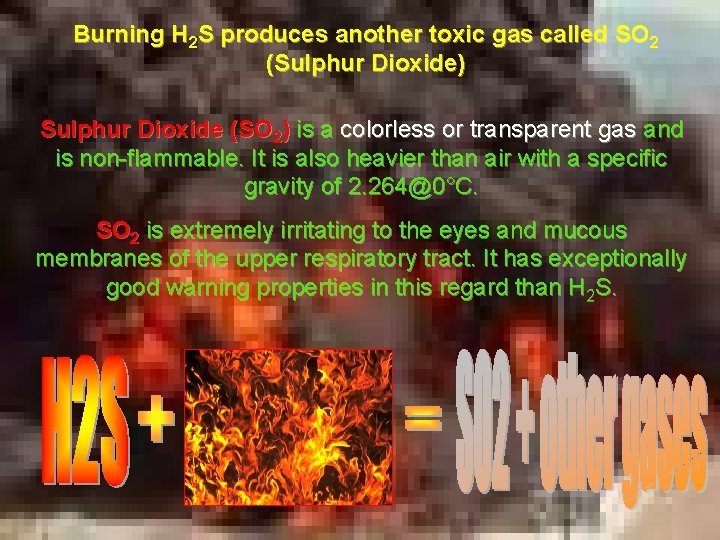
Burning H 2 S produces another toxic gas called SO 2 (Sulphur Dioxide) Sulphur Dioxide (SO 2) is a colorless or transparent gas and is non-flammable. It is also heavier than air with a specific gravity of 2. 264@0°C. SO 2 is extremely irritating to the eyes and mucous membranes of the upper respiratory tract. It has exceptionally good warning properties in this regard than H 2 S.
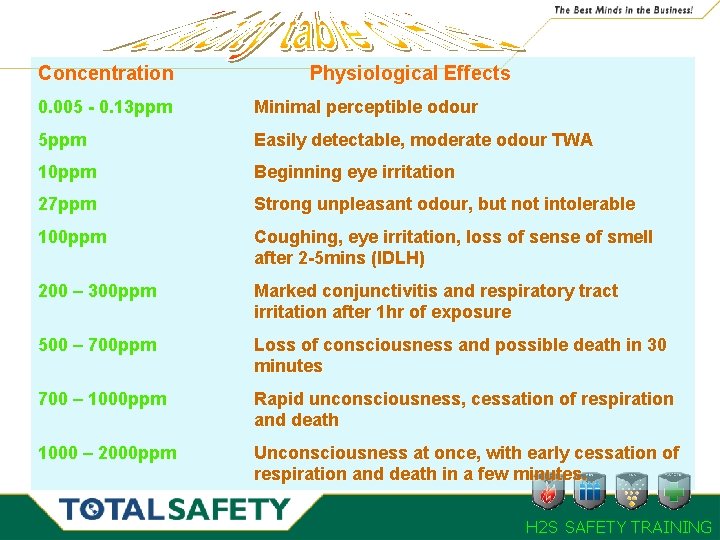
Concentration Physiological Effects 0. 005 - 0. 13 ppm Minimal perceptible odour 5 ppm Easily detectable, moderate odour TWA 10 ppm Beginning eye irritation 27 ppm Strong unpleasant odour, but not intolerable 100 ppm Coughing, eye irritation, loss of sense of smell after 2 -5 mins (IDLH) 200 – 300 ppm Marked conjunctivitis and respiratory tract irritation after 1 hr of exposure 500 – 700 ppm Loss of consciousness and possible death in 30 minutes 700 – 1000 ppm Rapid unconsciousness, cessation of respiration and death 1000 – 2000 ppm Unconsciousness at once, with early cessation of respiration and death in a few minutes. H 2 S SAFETY TRAINING
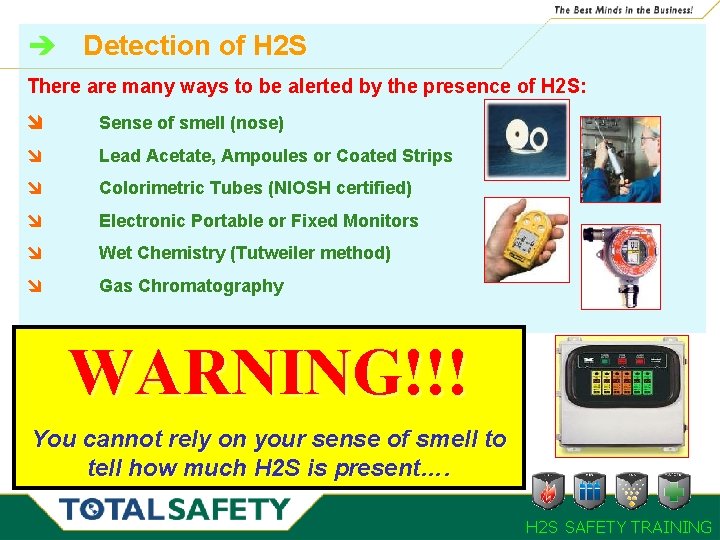
è Detection of H 2 S There are many ways to be alerted by the presence of H 2 S: î Sense of smell (nose) î Lead Acetate, Ampoules or Coated Strips î Colorimetric Tubes (NIOSH certified) î Electronic Portable or Fixed Monitors î Wet Chemistry (Tutweiler method) î Gas Chromatography WARNING!!! You cannot rely on your sense of smell to tell how much H 2 S is present…. H 2 S SAFETY TRAINING
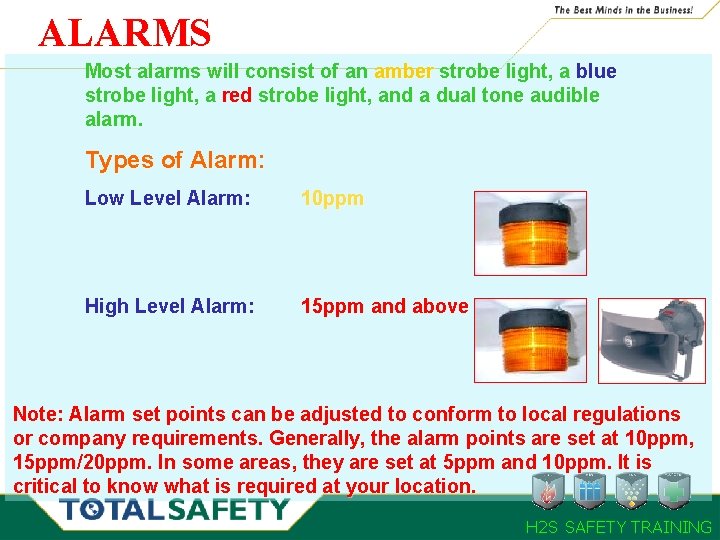
ALARMS Most alarms will consist of an amber strobe light, a blue strobe light, a red strobe light, and a dual tone audible alarm. Types of Alarm: Low Level Alarm: 10 ppm High Level Alarm: 15 ppm and above Note: Alarm set points can be adjusted to conform to local regulations or company requirements. Generally, the alarm points are set at 10 ppm, 15 ppm/20 ppm. In some areas, they are set at 5 ppm and 10 ppm. It is critical to know what is required at your location. H 2 S SAFETY TRAINING
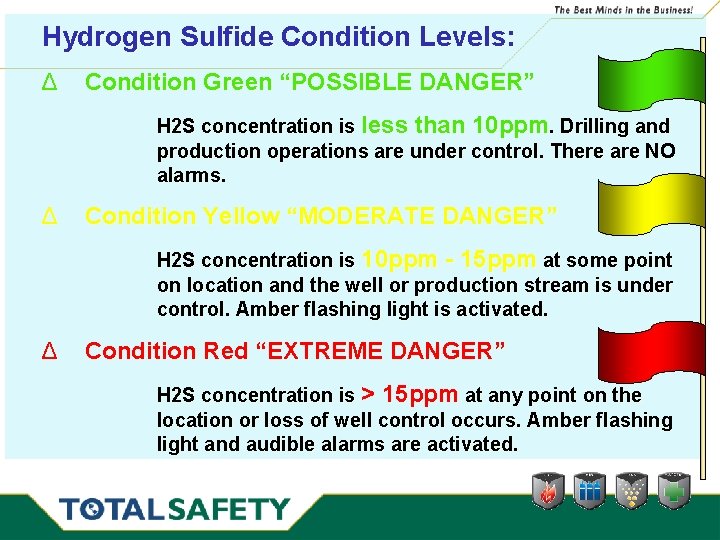
Hydrogen Sulfide Condition Levels: Δ Condition Green “POSSIBLE DANGER” H 2 S concentration is less than 10 ppm. Drilling and production operations are under control. There are NO alarms. Δ Condition Yellow “MODERATE DANGER” H 2 S concentration is 10 ppm - 15 ppm at some point on location and the well or production stream is under control. Amber flashing light is activated. Δ Condition Red “EXTREME DANGER” H 2 S concentration is > 15 ppm at any point on the location or loss of well control occurs. Amber flashing light and audible alarms are activated.
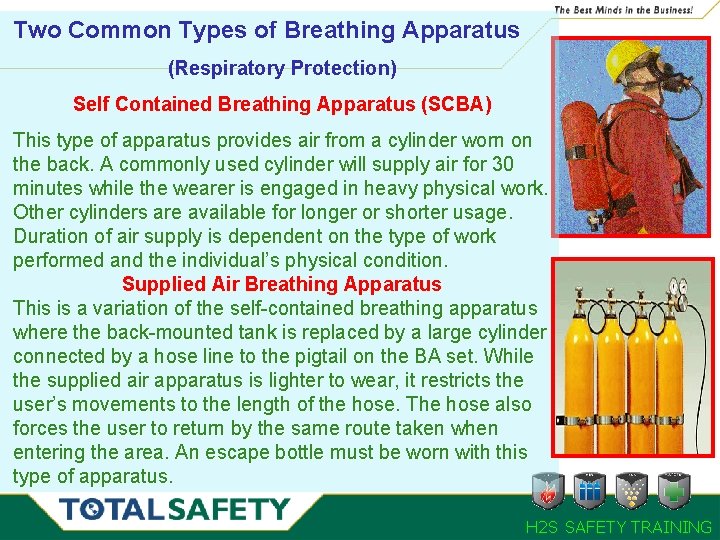
Two Common Types of Breathing Apparatus (Respiratory Protection) Self Contained Breathing Apparatus (SCBA) This type of apparatus provides air from a cylinder worn on the back. A commonly used cylinder will supply air for 30 minutes while the wearer is engaged in heavy physical work. Other cylinders are available for longer or shorter usage. Duration of air supply is dependent on the type of work performed and the individual’s physical condition. Supplied Air Breathing Apparatus This is a variation of the self-contained breathing apparatus where the back-mounted tank is replaced by a large cylinder connected by a hose line to the pigtail on the BA set. While the supplied air apparatus is lighter to wear, it restricts the user’s movements to the length of the hose. The hose also forces the user to return by the same route taken when entering the area. An escape bottle must be worn with this type of apparatus. H 2 S SAFETY TRAINING
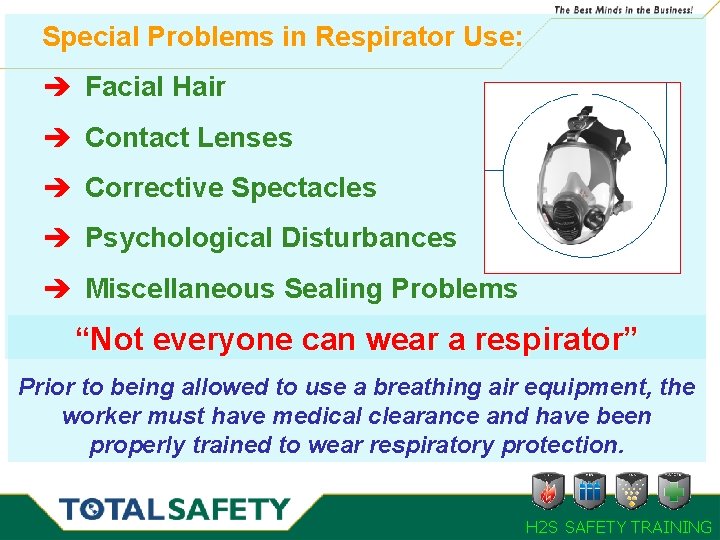
Special Problems in Respirator Use: è Facial Hair è Contact Lenses è Corrective Spectacles è Psychological Disturbances è Miscellaneous Sealing Problems “Not everyone can wear a respirator” Prior to being allowed to use a breathing air equipment, the worker must have medical clearance and have been properly trained to wear respiratory protection. H 2 S SAFETY TRAINING
è How does H 2 S affect Individuals? Factors that determine the effect of H 2 S on individuals: î Duration The length of time the individual is exposed î Frequency How often the individual has been exposed î Intensity How much concentration the individual was exposed to î Individual Susceptibility The individual’s physiological make-up H 2 S SAFETY TRAINING
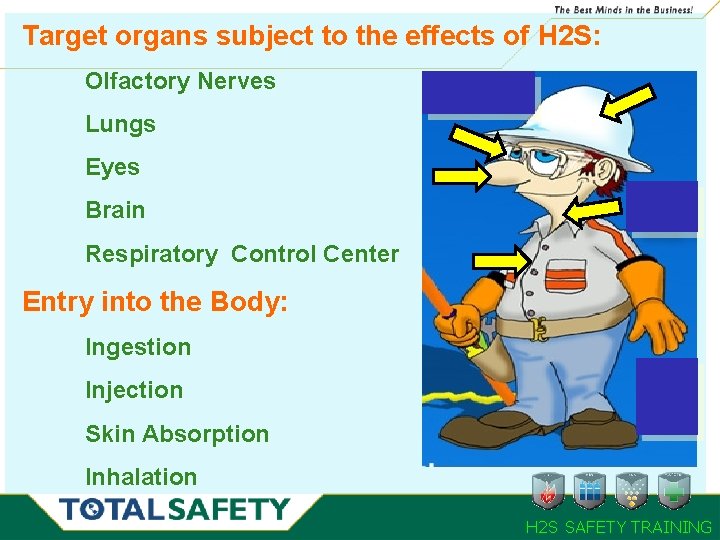
Target organs subject to the effects of H 2 S: Olfactory Nerves Lungs Eyes Brain Respiratory Control Center Entry into the Body: Ingestion Injection Skin Absorption Inhalation H 2 S SAFETY TRAINING
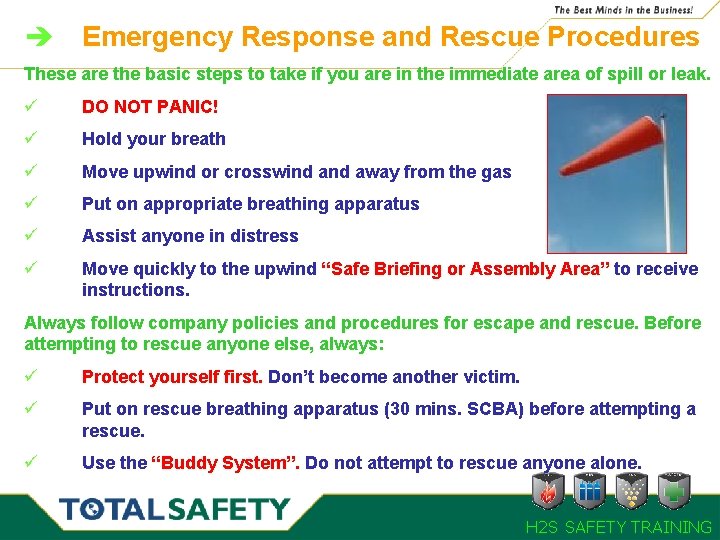
è Emergency Response and Rescue Procedures These are the basic steps to take if you are in the immediate area of spill or leak. ü DO NOT PANIC! ü Hold your breath ü Move upwind or crosswind away from the gas ü Put on appropriate breathing apparatus ü Assist anyone in distress ü Move quickly to the upwind “Safe Briefing or Assembly Area” to receive instructions. Always follow company policies and procedures for escape and rescue. Before attempting to rescue anyone else, always: ü Protect yourself first. Don’t become another victim. ü Put on rescue breathing apparatus (30 mins. SCBA) before attempting a rescue. ü Use the “Buddy System”. Do not attempt to rescue anyone alone. H 2 S SAFETY TRAINING
“EVERYONE SHOULD KNOW WHAT HIS OR HER RESPONSIBILITY IS, IN THE EVENT OF AN H 2 S EMERGENCY SITUATION. ” H 2 S SAFETY TRAINING
No job is so important and No service is so urgent – that we cannot take time to perform our work SAFELY…. H 2 S SAFETY TRAINING
SAFETY FIRST H 2 S SAFETY TRAINING
THANK YOU Please visit our website: www. totalsafety. com Office Address: Villa 298 -A D-Ring Road, Doha, Qatar P. O. Box: 40185 Tel. No. : +974 455 3174 Fax. No. : +974 455 3190 E-mail: tsiqatar@qatar. net. qa Ensuring the Safe Well-being of Workers Worldwide