
H 070 H 470 Topic Title OCR 2016

- Slides: 54
H 070 H 470 Topic. Title © OCR 2016
Guide to the SAMs Component 2 – Human interactions © OCR 2016
H 481/02 Human interactions The Human interactions (02) component is built around two main topics, Changing Spaces; Making Places and Global Connections. Learners will investigate the actions, interactions and spatial patterns of people in places as well as unpicking the flows and connections of global systems (either trade or migration) and global governance (either human rights or power and borders). But what will the assessments look like? This guide will give you an understanding of the format and structure of the exam, an insight into the assessment objectives and a question by question explanation of the sample assessment for H 481/02 Human interactions. This guide can also be used with your students to support revision. © OCR 2016
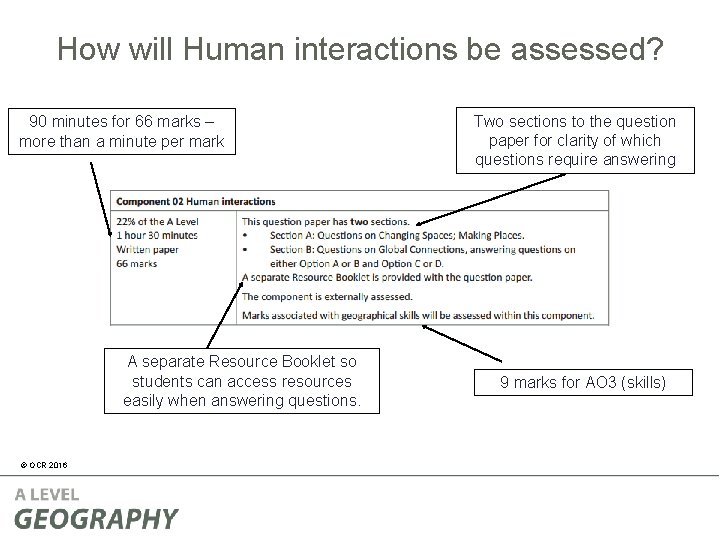
How will Human interactions be assessed? 90 minutes for 66 marks – more than a minute per mark A separate Resource Booklet so students can access resources easily when answering questions. © OCR 2016 Two sections to the question paper for clarity of which questions require answering 9 marks for AO 3 (skills)
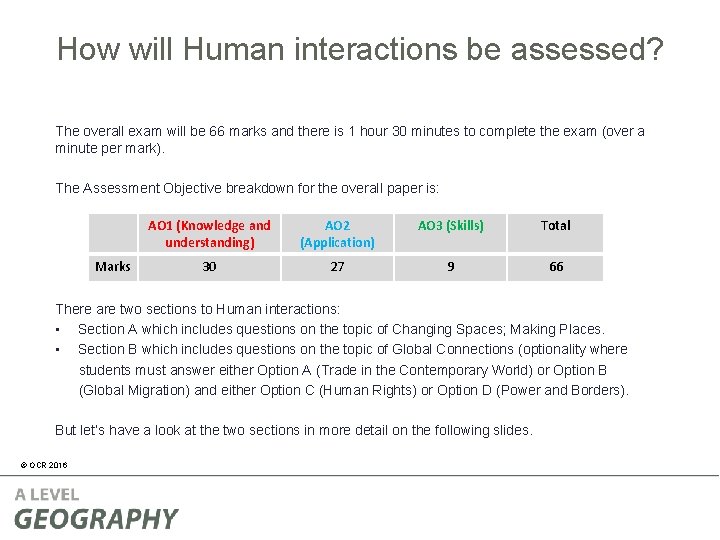
How will Human interactions be assessed? The overall exam will be 66 marks and there is 1 hour 30 minutes to complete the exam (over a minute per mark). The Assessment Objective breakdown for the overall paper is: Marks AO 1 (Knowledge and understanding) AO 2 (Application) AO 3 (Skills) Total 30 27 9 66 There are two sections to Human interactions: • Section A which includes questions on the topic of Changing Spaces; Making Places. • Section B which includes questions on the topic of Global Connections (optionality where students must answer either Option A (Trade in the Contemporary World) or Option B (Global Migration) and either Option C (Human Rights) or Option D (Power and Borders). But let’s have a look at the two sections in more detail on the following slides. © OCR 2016
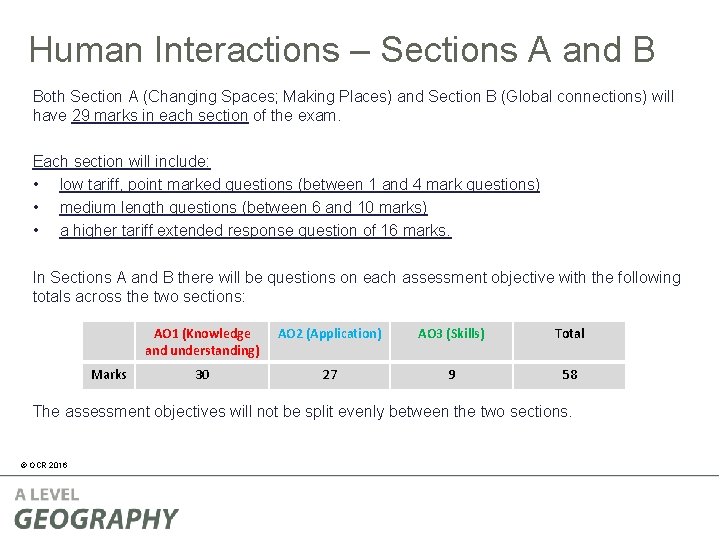
Human Interactions – Sections A and B Both Section A (Changing Spaces; Making Places) and Section B (Global connections) will have 29 marks in each section of the exam. Each section will include: • low tariff, point marked questions (between 1 and 4 mark questions) • medium length questions (between 6 and 10 marks) • a higher tariff extended response question of 16 marks. In Sections A and B there will be questions on each assessment objective with the following totals across the two sections: Marks AO 1 (Knowledge and understanding) AO 2 (Application) AO 3 (Skills) Total 30 27 9 58 The assessment objectives will not be split evenly between the two sections. © OCR 2016
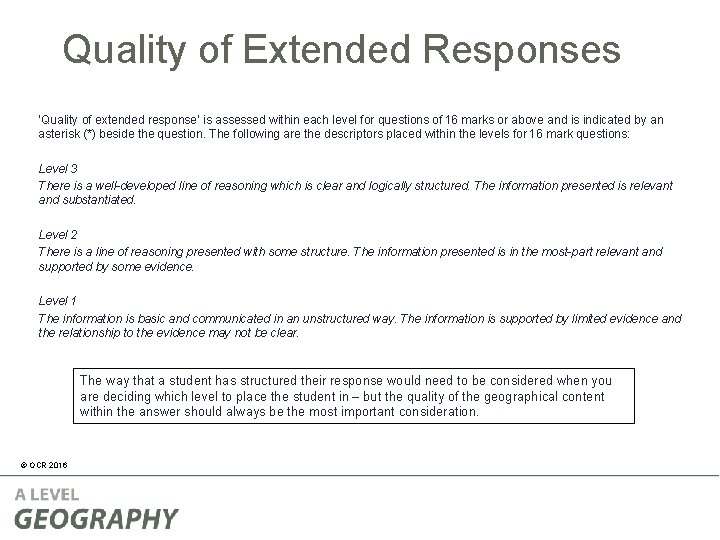
Quality of Extended Responses ‘Quality of extended response’ is assessed within each level for questions of 16 marks or above and is indicated by an asterisk (*) beside the question. The following are the descriptors placed within the levels for 16 mark questions: Level 3 There is a well-developed line of reasoning which is clear and logically structured. The information presented is relevant and substantiated. Level 2 There is a line of reasoning presented with some structure. The information presented is in the most-part relevant and supported by some evidence. Level 1 The information is basic and communicated in an unstructured way. The information is supported by limited evidence and the relationship to the evidence may not be clear. The way that a student has structured their response would need to be considered when you are deciding which level to place the student in – but the quality of the geographical content within the answer should always be the most important consideration. © OCR 2016
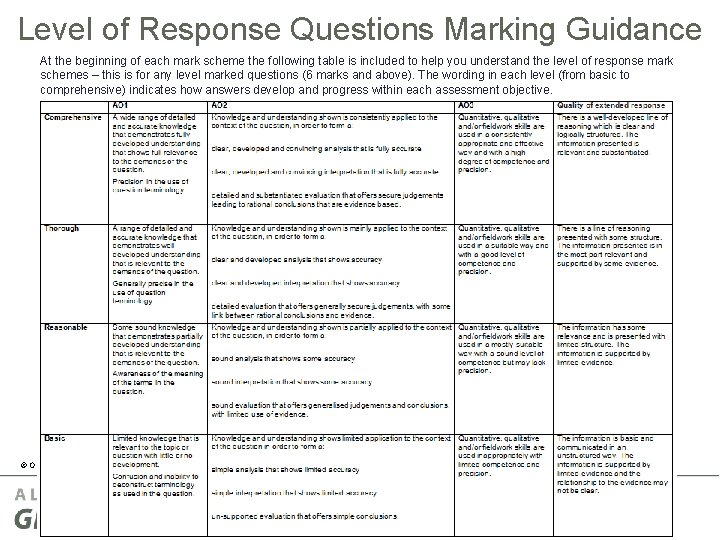
Level of Response Questions Marking Guidance At the beginning of each mark scheme the following table is included to help you understand the level of response mark schemes – this is for any level marked questions (6 marks and above). The wording in each level (from basic to comprehensive) indicates how answers develop and progress within each assessment objective. © OCR 2016
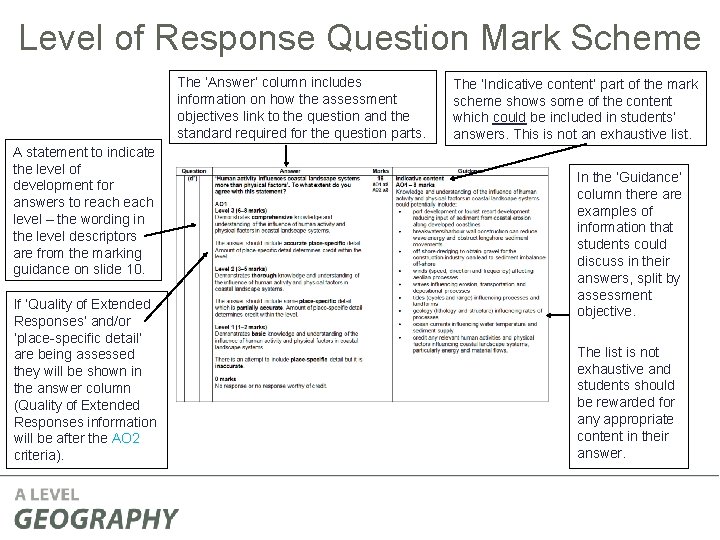
Level of Response Question Mark Scheme The ‘Answer’ column includes information on how the assessment objectives link to the question and the standard required for the question parts. A statement to indicate the level of development for answers to reach level – the wording in the level descriptors are from the marking guidance on slide 10. If ‘Quality of Extended Responses’ and/or ‘place-specific detail’ are being assessed they will be shown in the answer column (Quality of Extended Responses information will be after the AO 2 criteria). © OCR 2016 The ‘Indicative content’ part of the mark scheme shows some of the content which could be included in students’ answers. This is not an exhaustive list. In the ‘Guidance’ column there are examples of information that students could discuss in their answers, split by assessment objective. The list is not exhaustive and students should be rewarded for any appropriate content in their answer.
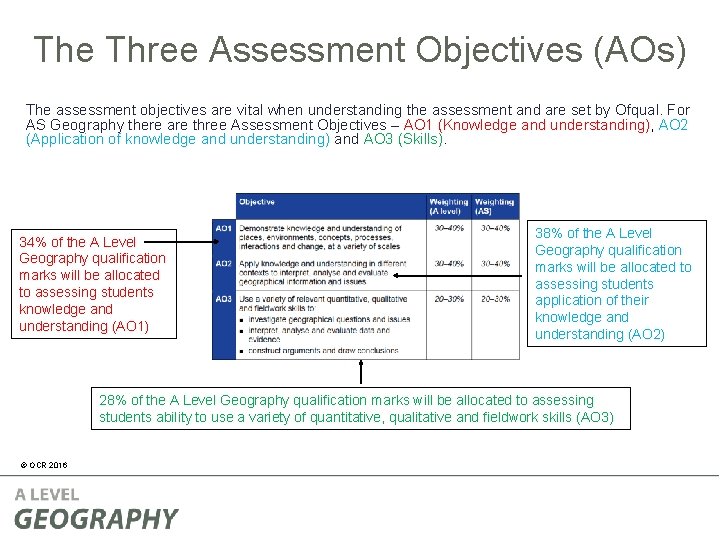
The Three Assessment Objectives (AOs) The assessment objectives are vital when understanding the assessment and are set by Ofqual. For AS Geography there are three Assessment Objectives – AO 1 (Knowledge and understanding), AO 2 (Application of knowledge and understanding) and AO 3 (Skills). 34% of the A Level Geography qualification marks will be allocated to assessing students knowledge and understanding (AO 1) 38% of the A Level Geography qualification marks will be allocated to assessing students application of their knowledge and understanding (AO 2) 28% of the A Level Geography qualification marks will be allocated to assessing students ability to use a variety of quantitative, qualitative and fieldwork skills (AO 3) © OCR 2016
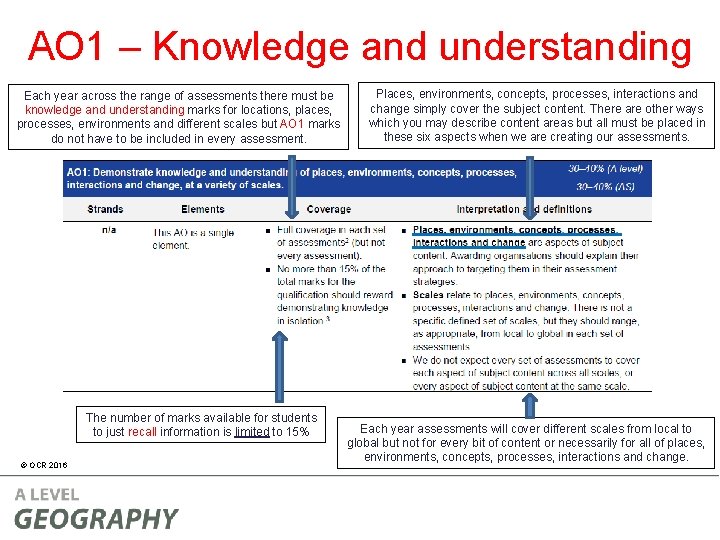
AO 1 – Knowledge and understanding Each year across the range of assessments there must be knowledge and understanding marks for locations, places, processes, environments and different scales but AO 1 marks do not have to be included in every assessment. The number of marks available for students to just recall information is limited to 15% © OCR 2016 Places, environments, concepts, processes, interactions and change simply cover the subject content. There are other ways which you may describe content areas but all must be placed in these six aspects when we are creating our assessments. Each year assessments will cover different scales from local to global but not for every bit of content or necessarily for all of places, environments, concepts, processes, interactions and change.
AO 1 command words AO 1 requires students to demonstrate knowledge and understanding of the specification content, recalling information – including in a case study context. Questions which target AO 1 alone would tend to be shorter answer questions but longer questions may have AO 1 marks allocated to them as well when combined with another assessment objective – particularly with AO 2. Questions with AO 1 marks will require knowledge and understanding – although there may be some marks available for simple recall of information within questions. Explain is the most common command word which requires students to just show knowledge and understanding. Knowledge and understanding will also be required in all ‘essay’ questions of 16 marks and above (where quality of extended response is considered). © OCR 2016
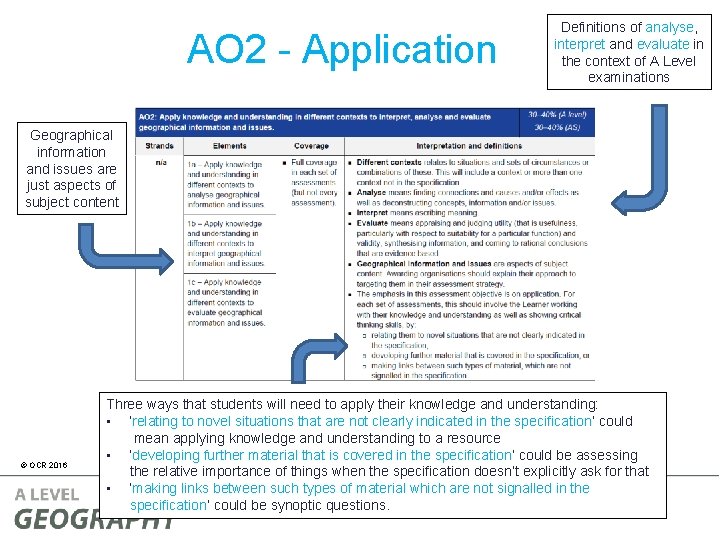
AO 2 - Application Definitions of analyse, interpret and evaluate in the context of A Level examinations Geographical information and issues are just aspects of subject content © OCR 2016 Three ways that students will need to apply their knowledge and understanding: • ‘relating to novel situations that are not clearly indicated in the specification’ could mean applying knowledge and understanding to a resource • ‘developing further material that is covered in the specification’ could be assessing the relative importance of things when the specification doesn’t explicitly ask for that • ‘making links between such types of material which are not signalled in the specification’ could be synoptic questions.
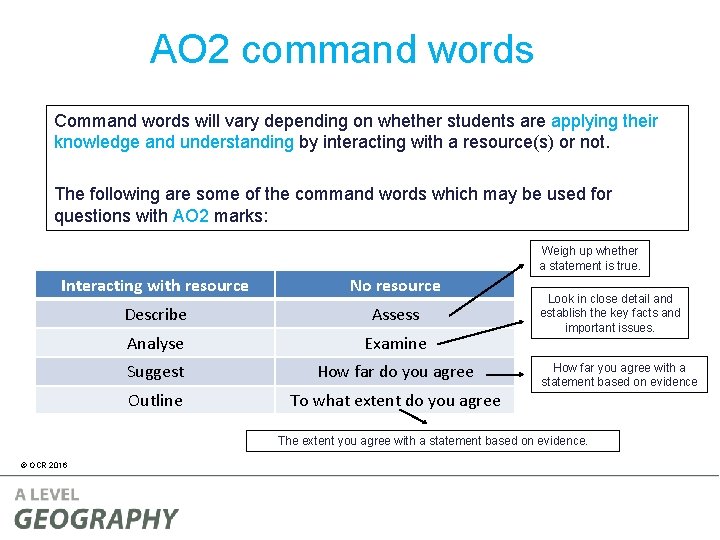
AO 2 command words Command words will vary depending on whether students are applying their knowledge and understanding by interacting with a resource(s) or not. The following are some of the command words which may be used for questions with AO 2 marks: Weigh up whether a statement is true. Interacting with resource No resource Describe Assess Analyse Examine Suggest How far do you agree Outline To what extent do you agree Look in close detail and establish the key facts and important issues. How far you agree with a statement based on evidence The extent you agree with a statement based on evidence. © OCR 2016
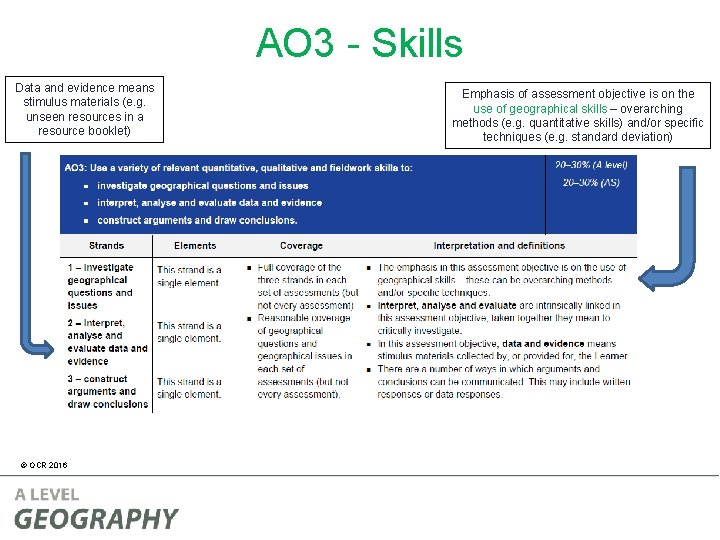
AO 3 - Skills Data and evidence means stimulus materials (e. g. unseen resources in a resource booklet) © OCR 2016 Emphasis of assessment objective is on the use of geographical skills – overarching methods (e. g. quantitative skills) and/or specific techniques (e. g. standard deviation)
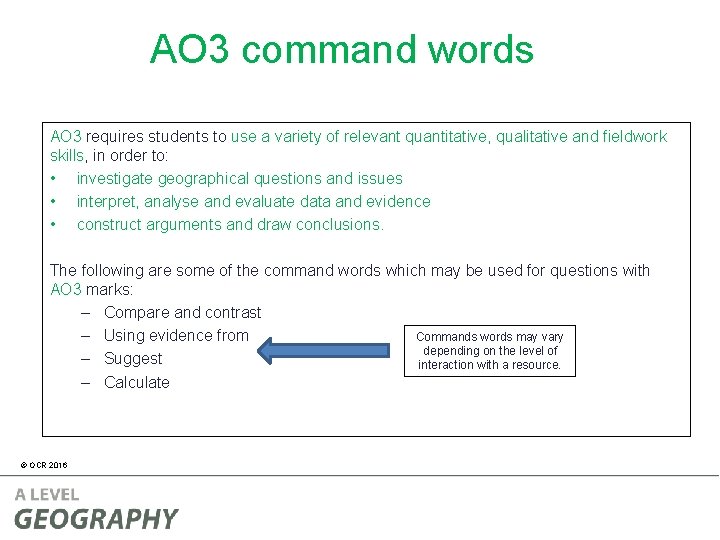
AO 3 command words AO 3 requires students to use a variety of relevant quantitative, qualitative and fieldwork skills, in order to: • investigate geographical questions and issues • interpret, analyse and evaluate data and evidence • construct arguments and draw conclusions. The following are some of the command words which may be used for questions with AO 3 marks: – Compare and contrast Commands words may vary – Using evidence from depending on the level of – Suggest interaction with a resource. – Calculate © OCR 2016
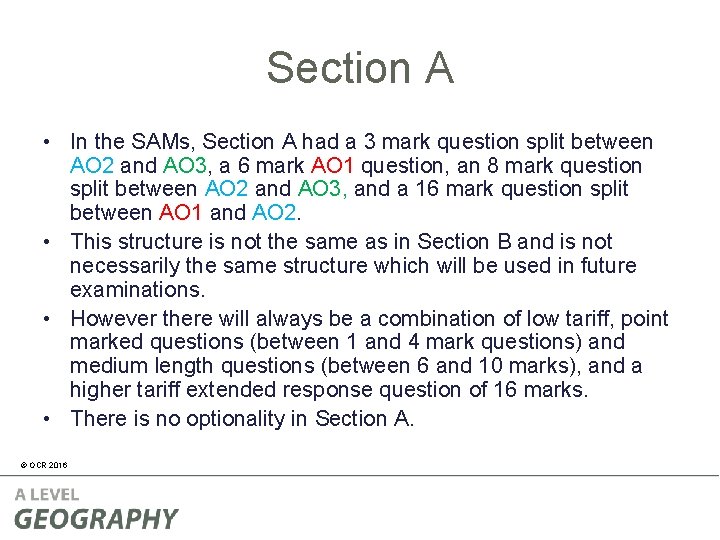
Section A • In the SAMs, Section A had a 3 mark question split between AO 2 and AO 3, a 6 mark AO 1 question, an 8 mark question split between AO 2 and AO 3, and a 16 mark question split between AO 1 and AO 2. • This structure is not the same as in Section B and is not necessarily the same structure which will be used in future examinations. • However there will always be a combination of low tariff, point marked questions (between 1 and 4 mark questions) and medium length questions (between 6 and 10 marks), and a higher tariff extended response question of 16 marks. • There is no optionality in Section A. © OCR 2016
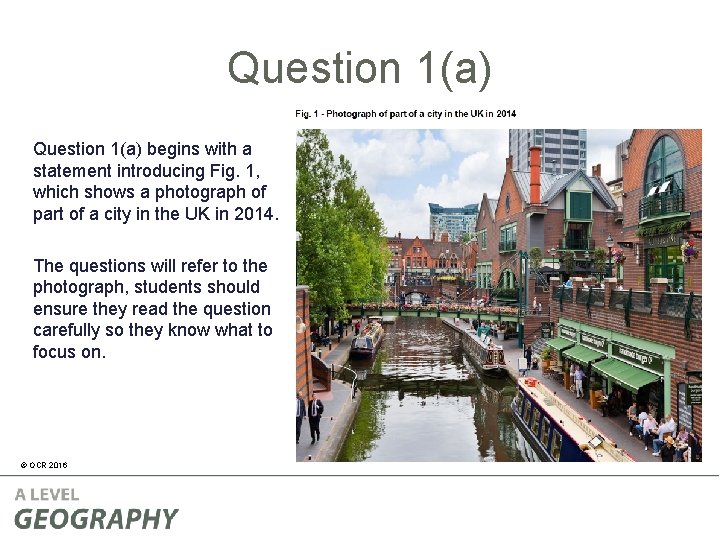
Question 1(a) begins with a statement introducing Fig. 1, which shows a photograph of part of a city in the UK in 2014. The questions will refer to the photograph, students should ensure they read the question carefully so they know what to focus on. © OCR 2016
Question 1(a) – 3 marks Explain how one piece of evidence from Fig. 1 shows this place has been rebranded to construct a new place image. For this question students must use their geographical skill of interpreting…a range of source material including textual and visual sources in order to pick out a piece of evidence form Fig. 1 which shows the place has been rebranded to construct a new place image. Students must also apply their knowledge and understanding of how a range of strategies can be used to rebrand places to explain how the piece of evidence from Fig. 1 shows this place has been rebranded to construct a new place image. Students are applying their knowledge and understanding to a novel situation – one of the three ways we must assess the application of knowledge and understanding. There are three marks available for this short answer question. As this is a low tariff question it is point marked, therefore there is one mark available for specific evidence interpreted from the resource ( ) and two marks for drawing conclusions from the specific resource evidence that this place has been rebranded to construct a new place image (DEV). © OCR 2016
Question 1(a) – 3 marks Explain how one piece of evidence from Fig. 1 shows this place has been rebranded to construct a new place image. Exemplar answers given in the mark scheme include: Boat trips are available along the canal ( ). This canal was most likely used for industrial purposes in the past (DEV), now it has rebranded to attract tourists to the area, possibly drawing on its heritage (DEV). Restaurants/café culture along the canal side ( ). Café culture is a relatively new addition to the UK but part of a rebranding process to create a positive atmosphere where people can meet and enjoy leisure time (DEV). The range of restaurants and cafes creates ‘something for everyone, ’ an inclusive space where people can relax together (DEV). The use of street furniture in the form of hanging baskets and lighting ( ). This shows that planners have tried to make the area attractive and encourage people to use the space (DEV). Lighting up the area makes people feel safer at night time and is part of the rebranding process (DEV). Split level/multifunctional in layout ( ). Space has been maximised with the canal and walkways below and the road with buildings in the background of the image above (DEV). Making spaces multi-functional is part of the rebranding process and assists in creating the 24 hour city (DEV). Greenery in the form of trees and flowers have been added to the area ( ). This is often a strategic move by planners to make the place feel more attractive, it was a technique used historically in industrial times (DEV) and greenery is said to improve mood and health of people who use the area (DEV). © OCR 2016
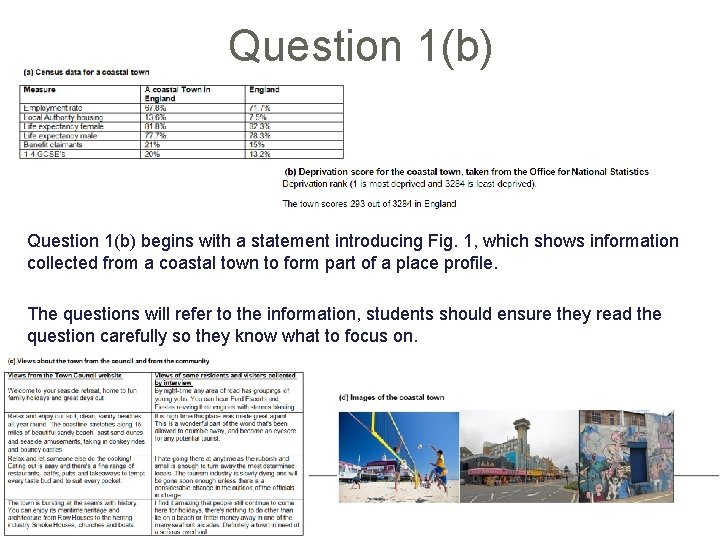
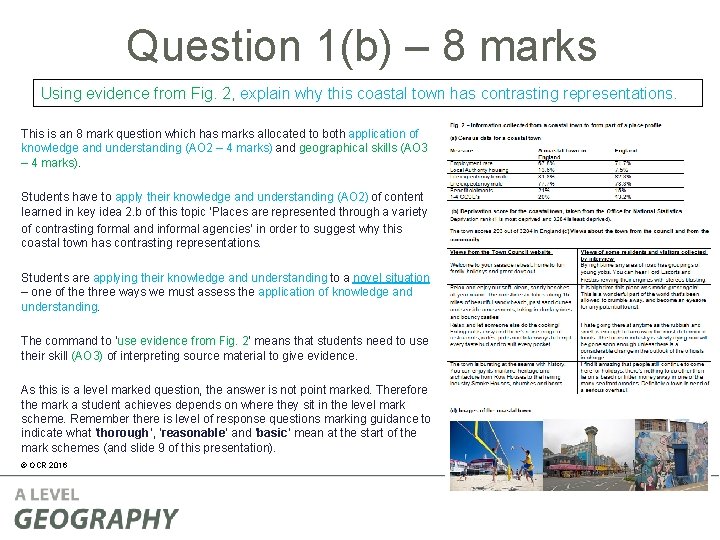
Question 1(b) begins with a statement introducing Fig. 1, which shows information collected from a coastal town to form part of a place profile. The questions will refer to the information, students should ensure they read the question carefully so they know what to focus on. © OCR 2016
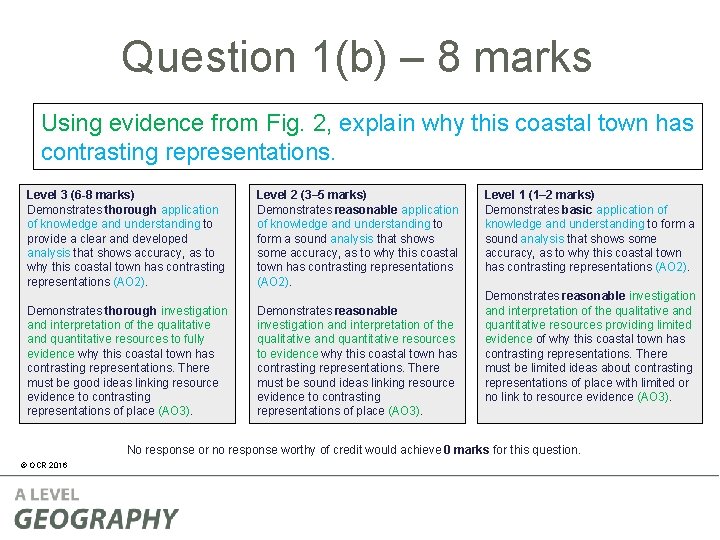
Question 1(b) – 8 marks Using evidence from Fig. 2, explain why this coastal town has contrasting representations. This is an 8 mark question which has marks allocated to both application of knowledge and understanding (AO 2 – 4 marks) and geographical skills (AO 3 – 4 marks). Students have to apply their knowledge and understanding (AO 2) of content learned in key idea 2. b of this topic ‘Places are represented through a variety of contrasting formal and informal agencies’ in order to suggest why this coastal town has contrasting representations. Students are applying their knowledge and understanding to a novel situation – one of the three ways we must assess the application of knowledge and understanding. The command to ‘use evidence from Fig. 2’ means that students need to use their skill (AO 3) of interpreting source material to give evidence. As this is a level marked question, the answer is not point marked. Therefore the mark a student achieves depends on where they sit in the level mark scheme. Remember there is level of response questions marking guidance to indicate what ‘thorough’, ‘reasonable’ and ‘basic’ mean at the start of the mark schemes (and slide 9 of this presentation). © OCR 2016
Question 1(b) – 8 marks Using evidence from Fig. 2, explain why this coastal town has contrasting representations. Level 3 (6 -8 marks) Demonstrates thorough application of knowledge and understanding to provide a clear and developed analysis that shows accuracy, as to why this coastal town has contrasting representations (AO 2). Demonstrates thorough investigation and interpretation of the qualitative and quantitative resources to fully evidence why this coastal town has contrasting representations. There must be good ideas linking resource evidence to contrasting representations of place (AO 3). Level 2 (3– 5 marks) Demonstrates reasonable application of knowledge and understanding to form a sound analysis that shows some accuracy, as to why this coastal town has contrasting representations (AO 2). Demonstrates reasonable investigation and interpretation of the qualitative and quantitative resources to evidence why this coastal town has contrasting representations. There must be sound ideas linking resource evidence to contrasting representations of place (AO 3). Level 1 (1– 2 marks) Demonstrates basic application of knowledge and understanding to form a sound analysis that shows some accuracy, as to why this coastal town has contrasting representations (AO 2). Demonstrates reasonable investigation and interpretation of the qualitative and quantitative resources providing limited evidence of why this coastal town has contrasting representations. There must be limited ideas about contrasting representations of place with limited or no link to resource evidence (AO 3). No response or no response worthy of credit would achieve 0 marks for this question. © OCR 2016
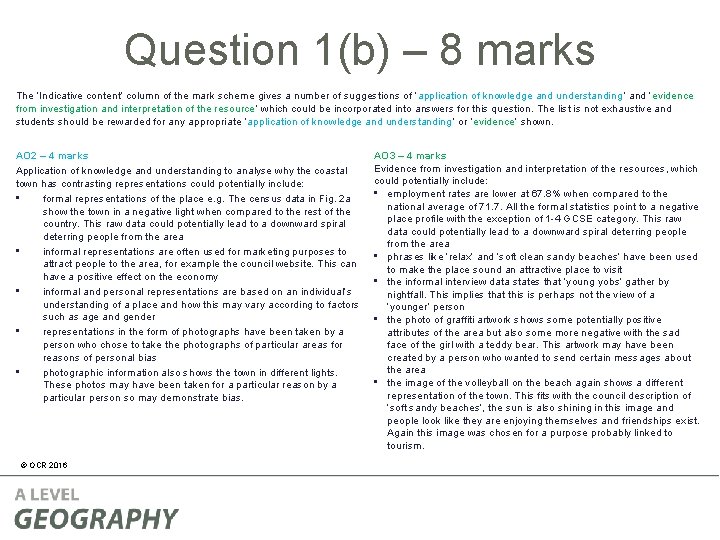
Question 1(b) – 8 marks The ‘Indicative content’ column of the mark scheme gives a number of suggestions of ‘application of knowledge and understanding’ and ‘evidence from investigation and interpretation of the resource’ which could be incorporated into answers for this question. The list is not exhaustive and students should be rewarded for any appropriate ‘application of knowledge and understanding’ or ‘evidence’ shown. AO 2 – 4 marks Application of knowledge and understanding to analyse why the coastal town has contrasting representations could potentially include: • formal representations of the place e. g. The census data in Fig. 2 a show the town in a negative light when compared to the rest of the country. This raw data could potentially lead to a downward spiral deterring people from the area • informal representations are often used for marketing purposes to attract people to the area, for example the council website. This can have a positive effect on the economy • informal and personal representations are based on an individual’s understanding of a place and how this may vary according to factors such as age and gender • representations in the form of photographs have been taken by a person who chose to take the photographs of particular areas for reasons of personal bias • photographic information also shows the town in different lights. These photos may have been taken for a particular reason by a particular person so may demonstrate bias. © OCR 2016 AO 3 – 4 marks Evidence from investigation and interpretation of the resources, which could potentially include: • employment rates are lower at 67. 8% when compared to the national average of 71. 7. All the formal statistics point to a negative place profile with the exception of 1 -4 GCSE category. This raw data could potentially lead to a downward spiral deterring people from the area • phrases like ‘relax’ and ‘soft clean sandy beaches’ have been used to make the place sound an attractive place to visit • the informal interview data states that ‘young yobs’ gather by nightfall. This implies that this is perhaps not the view of a ‘younger’ person • the photo of graffiti artwork shows some potentially positive attributes of the area but also some more negative with the sad face of the girl with a teddy bear. This artwork may have been created by a person who wanted to send certain messages about the area • the image of the volleyball on the beach again shows a different representation of the town. This fits with the council description of ‘soft sandy beaches’, the sun is also shining in this image and people look like they are enjoying themselves and friendships exist. Again this image was chosen for a purpose probably linked to tourism.
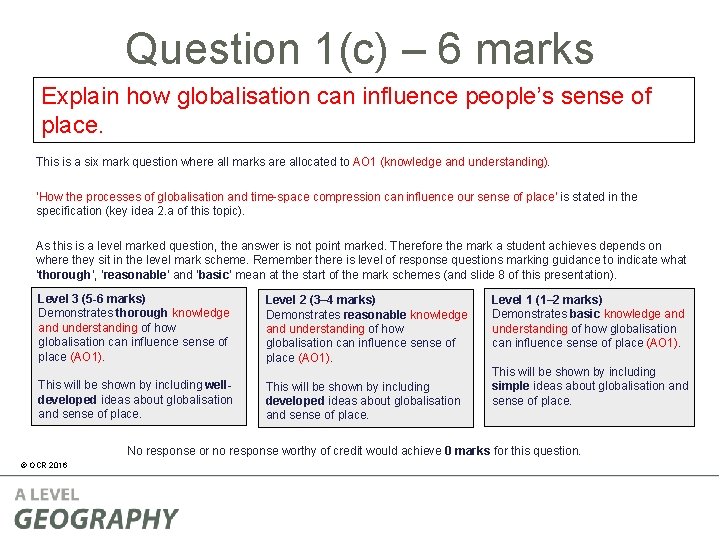
Question 1(c) – 6 marks Explain how globalisation can influence people’s sense of place. This is a six mark question where all marks are allocated to AO 1 (knowledge and understanding). ‘How the processes of globalisation and time-space compression can influence our sense of place’ is stated in the specification (key idea 2. a of this topic). As this is a level marked question, the answer is not point marked. Therefore the mark a student achieves depends on where they sit in the level mark scheme. Remember there is level of response questions marking guidance to indicate what ‘thorough’, ‘reasonable’ and ‘basic’ mean at the start of the mark schemes (and slide 8 of this presentation). Level 3 (5 -6 marks) Demonstrates thorough knowledge and understanding of how globalisation can influence sense of place (AO 1). This will be shown by including welldeveloped ideas about globalisation and sense of place. Level 2 (3– 4 marks) Demonstrates reasonable knowledge and understanding of how globalisation can influence sense of place (AO 1). This will be shown by including developed ideas about globalisation and sense of place. Level 1 (1– 2 marks) Demonstrates basic knowledge and understanding of how globalisation can influence sense of place (AO 1). This will be shown by including simple ideas about globalisation and sense of place. No response or no response worthy of credit would achieve 0 marks for this question. © OCR 2016
Question 1(c) – 6 marks Explain how globalisation can influence people’s sense of place. The ‘Indicative content’ column of the mark scheme gives a number of suggestions of knowledge and understanding which could be incorporated into answers for this question. The list is not exhaustive and students should be rewarded for any appropriate knowledge and understanding shown. Knowledge and understanding of globalisation and how this can influence sense of place could potentially include: • how rapid globalisation has led to time-space compression, where transport and communications have helped shrink time and space, therefore influencing place meaning • globalisation and global brands can impact places, threatening what makes them unique and important in their individual right • anti-globalisation activists would argue that homogenised landscapes have been created where global corporations like Starbucks can be found on every street corner. These can create perceptions of familiarity where people feel comforted, where they know what they are getting and like they have been somewhere before. Examples might include New York where numerous films and songs about this place have been available globally, creating a sense of place about somewhere you may have never been • it can also lead to some people feeling that the local place has been done a disservice as local more unique businesses might be put of operation, creating feelings of dis-location • some people might argue that globalisation has created a new exciting sense of place through a new kind of diversity, making places appear more exciting with influences from all around the world in the form of food, fashion and music. © OCR 2016
Question 1(d)* – 16 marks ‘Placemaking is used by governments only to attract inward investment. ’ How far do you agree with this statement? The final question for Sections A of the Human interactions (02) question paper will always be a 16 mark question which will have 8 marks allocated to AO 1 (knowledge and understanding) and 8 marks allocated to AO 2 (application of knowledge and understanding). This question requires knowledge and understanding (AO 1 = 8 marks) of how governments use placemaking (key ideas 5. a, 5. b and 5. c of this topic in the specification). For higher tariff extended response questions (16 marks and over) students are expected to incorporate case study knowledge as appropriate and for this question the case study in key ideas 5. c is the most obvious to include. However students could include other case study information if appropriate. This question also requires the application of knowledge and understanding (AO 2 = 8 marks) in order to develop further the material covered in the specification – another way we must assess application of knowledge and understanding. The command to ‘how far do you agree’ and the key words ‘only to’ indicate that students must apply their knowledge and understanding by analysing and evaluating. Students must weigh up information to determine how far they agree that placemaking is only used by governments to attract inward investment. There is no ‘correct’ way in which students should answer this question and the response will very much depend on the case study covered to determine whether students agree with this statement or not. © OCR 2016
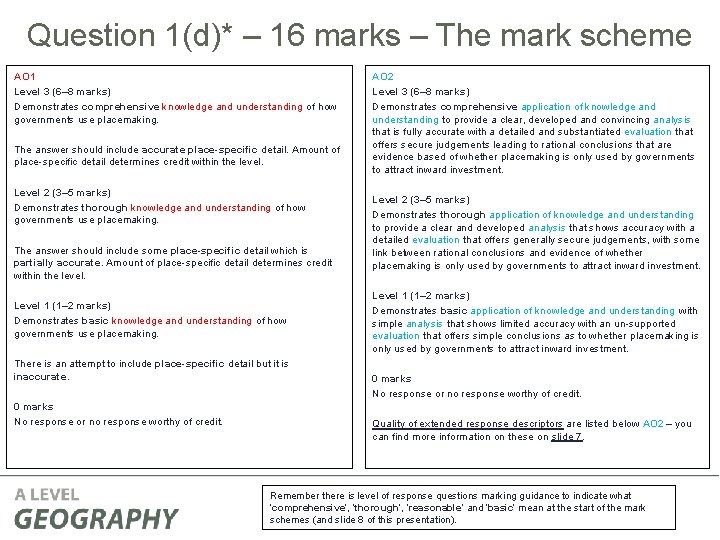
Question 1(d)* – 16 marks – The mark scheme AO 1 Level 3 (6– 8 marks) Demonstrates comprehensive knowledge and understanding of how governments use placemaking. The answer should include accurate place-specific detail. Amount of place-specific detail determines credit within the level. Level 2 (3– 5 marks) Demonstrates thorough knowledge and understanding of how governments use placemaking. The answer should include some place-specific detail which is partially accurate. Amount of place-specific detail determines credit within the level. Level 1 (1– 2 marks) Demonstrates basic knowledge and understanding of how governments use placemaking. There is an attempt to include place-specific detail but it is inaccurate. 0 marks No response or no response worthy of credit. AO 2 Level 3 (6– 8 marks) Demonstrates comprehensive application of knowledge and understanding to provide a clear, developed and convincing analysis that is fully accurate with a detailed and substantiated evaluation that offers secure judgements leading to rational conclusions that are evidence based of whether placemaking is only used by governments to attract inward investment. Level 2 (3– 5 marks) Demonstrates thorough application of knowledge and understanding to provide a clear and developed analysis that shows accuracy with a detailed evaluation that offers generally secure judgements, with some link between rational conclusions and evidence of whether placemaking is only used by governments to attract inward investment. Level 1 (1– 2 marks) Demonstrates basic application of knowledge and understanding with simple analysis that shows limited accuracy with an un-supported evaluation that offers simple conclusions as to whether placemaking is only used by governments to attract inward investment. 0 marks No response or no response worthy of credit. Quality of extended response descriptors are listed below AO 2 – you can find more information on these on slide 7. © OCR 2016 Remember there is level of response questions marking guidance to indicate what ‘comprehensive’, ‘thorough’, ‘reasonable’ and ‘basic’ mean at the start of the mark schemes (and slide 8 of this presentation).
Question 1(d)* – 16 marks – Indicative content The ‘Indicative content’ column of the mark scheme gives a number of suggestions of ‘knowledge and understanding’ and ‘application of knowledge and understanding’ which could be incorporated into answers for this question. The list is not exhaustive and students should be rewarded for any appropriate ‘knowledge and understanding’ or ‘application of knowledge and understanding’ shown. The answer will depend on the choice of place(s) and government could be local, national or regional. The concept of placemaking can be described in more than one way. One description from The Project for Public Spaces organisation defines it as ‘placemaking inspires people to collectively reimagine and reinvent public spaces as the heart of every community. Strengthening the connection between people and the places they share, Placemaking refers to a collaborative process by which we can shape our public realm in order to maximize shared value. ’ AO 1 – 8 marks Knowledge and understanding of placemaking and how governments use it could potentially include: • How governments use placemaking to attract inward investment for example: o reinventing a place e. g. Dubai has reinvented itself from a small fishing village to a hub city with many global brands locating there. Dubai is now a regional hub in several areas o planning e. g. three decades ago Jebel Ali became the Middle East’s first big “free zone” (a place where foreign firms can operate, unusually, without a local partner and with less red tape and lower taxes than in the rest of the emirate). Now it is the world’s largest, and Dubai has 22 such zones in total, most based around particular industries. The number of companies in it grew by 14% in 2013 and 18% in 2014, to reach 1, 225. More growth is expected, with $1 billion worth of new development planned o land-use zoning o creating infrastructure e. g. in Cambridge the creation of a specific ‘Science Park’ as a zone that has attracted many high tech companies, including Astra Zenica which was originally founded in Sweden o © OCR 2016 specific policies e. g. Birmingham now offers direct flights to India and China and this has supported foreign direct investment growth which increased by more than 50% against a national increase of just 11% in 2013. This has created an additional 4, 000 local jobs and is worth an estimated £ 174 million to the local economy per year. AO 2 – 8 marks Apply knowledge and understanding to analyse and evaluate whether placemaking is only used by governments to attract inward investment could potentially include: • why governments use placemaking for reasons other than attracting inward investment e. g. to improve the environmental quality of the area for local residents, to reduce crime rates, to increase social cohesion • the concept of placemaking, for example that placemaking itself has people at the heart of it and so placemaking purely for economic gain is not possible as placemaking is about how the environment and society would benefit too. • strategic placemaking for example that it exists to target certain things, achieving a particular goal in addition to creating quality places. It aims to create places that are uniquely attractive to talented workers so that they want to be there and live there, by so doing, they create the circumstances for substantial job creation and income growth by attracting businesses that are looking for concentrations of talented workers. • the level of agreement with the statement that governments only use placemaking to attract inward investment • whether inward investment is the most important reason why places rebrand, if not why not and what is more important? e. g. environmental, social and / or political reasons • the role and range of players in the placemaking process for example community groups, governments, TNCs.
Section B • • • © OCR 2016 In Section B, option A and B will always have an identical structure so that they are comparable. In Section B, option C and D will always have an identical structure so that they are comparable. In the SAMs, options A and B had a 2 mark AO 2 question, a 3 mark AO 2 question, a 4 mark AO 3 question and an 8 mark AO 1 question. Options C and D had a 16 mark question split between AO 1 and AO 2. This structure is not the same as in Section A and is not necessarily the same structure which will be used in future examinations. However there will always be a combination of low tariff, point marked questions (between 1 and 4 mark questions) and medium length questions (between 6 and 10 marks) in one set of options and a higher tariff extended response question of 16 marks in the other set of options. Any pair of options (A and B or C and D) could have the higher tariff extended response questions, with the other pairing therefore containing the short and medium length response questions.
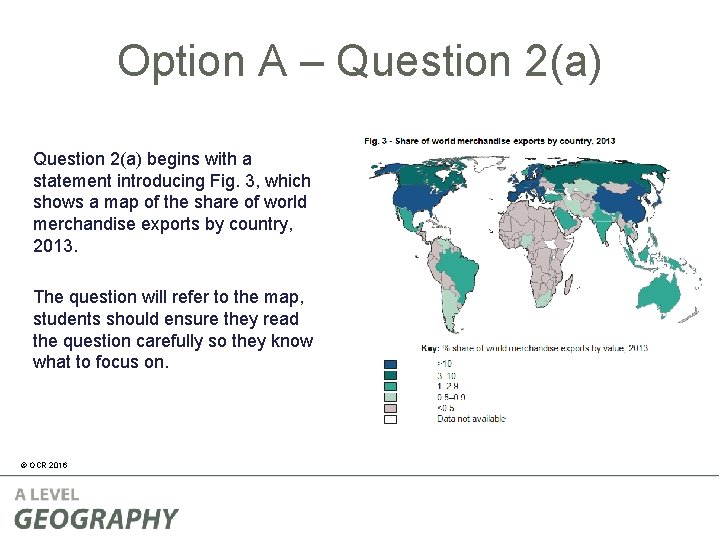
Option A – Question 2(a) begins with a statement introducing Fig. 3, which shows a map of the share of world merchandise exports by country, 2013. The question will refer to the map, students should ensure they read the question carefully so they know what to focus on. © OCR 2016
Option A – Question 2(a)(i) – 2 marks Suggest two ways the share of world merchandise exports by country, shown in Fig. 3, can influence flows of people. For this question students must apply their knowledge and understanding of how international trade can influence flows of people (key idea 1. b of this topic in the specification). Students are applying their knowledge and understanding to a novel situation – one of the three ways we must assess the application of knowledge and understanding. There are two marks ( ) available for ways the share of world merchandise exports by country in 2013 shown in Fig. 3 influences flows of people. However, the mark scheme does state that opposite points should not be credited (e. g. the same trend but for ACs and LIDCs). © OCR 2016
Option A – Question 2(a)(i) – 2 marks Suggest two ways the share of world merchandise exports by country, shown in Fig. 3, can influence flows of people. The high percentage of world merchandise exports in advanced countries such as the USA or countries within the EU could attract people to these countries looking for employment ( ). There is a significantly higher percentage of merchandise exports for northern hemisphere countries compared to southern hemisphere countries and so with greater opportunities for jobs it could cause flows of people from the southern hemisphere to the northern hemisphere ( ). Brazil and Saudi Arabia both have a much greater share of world merchandise exports than other countries in their region which could attract a number of people from within the country to these port / hub areas looking for employment ( ). The lower percentages of share of world merchandise exports in Africa could cause significant outward migration ( ). © OCR 2016
Option A – Question 2(a)(ii) – 3 marks Explain one factor that might account for the spatial variations in Fig. 3. For this question students must apply their knowledge and understanding of changes in international trade patterns and reasons why this might take place (key idea 2. b of this topic in the specification). Students are applying their knowledge and understanding to a novel situation – one of the three ways we must assess the application of knowledge and understanding. There is one mark ( ) available for stating a factor that might account for the spatial variations in the share of world merchandise exports, with two marks (DEV) for explaining the factor which might account for the spatial variations. © OCR 2016
Option A – Question 2(a)(ii) – 3 marks Explain one factor that might account for the spatial variations in Fig. 3. Ability to negotiate trade agreements or be in a trade bloc ( ) for example being in the EU or NAFTA makes it easier for money and goods to be moved around between those countries (DEV). Financial incentives such as the removal or lowering of tariffs when countries trade within these blocs is an incentive to be part of them (DEV). Political instability / conflict ( ) can be a barrier to trade leading to low productivity of raw materials and /or manufactured goods and therefore export rates (DEV) as the country invests more heavily in the conflict. It also makes it challenging for goods to travel safely by road, air or shipping destinations (DEV ). Effects of trade embargoes / economic sanctions ( ) the percentage share of a country’s global merchandise exports are lowered as a result of economic sanctions or trade embargoes applied for political reasons (DEV) e. g. the USA applies embargoes against countries which it considers to be state sponsors of terrorism (DEV). Level of productivity of a country can be linked to exports ( ) exports of the least developed countries are held back by their relatively low productive capacity (because of limited diversification of industry, limited infrastructure, poor governance) (DEV), whereas many ACs have strong global trade with high productivity for merchandise in a wide range of primary and secondary industries including their ability to exploit natural resources (DEV). © OCR 2016
Option A – Question 2(a)(iii) – 4 marks For the data presentation technique shown in Fig. 3, suggest how effective the technique is for showing the share of world merchandise exports by country. This is a four mark question where all marks are allocated to AO 3 (skills). ‘Undertake informed and critical questioning of data sources, analytical methodologies, data reporting and presentation’ is stated in the specification (section 4. 1 of the geographical skills list in the specification) and this question is directly targeting this skill. For this question students must make points suggesting how effective the data presentation technique shown in Fig. 3 is for showing the share of world merchandise exports by country. There are four marks available for this short answer question. As this is a low tariff question it is point marked, therefore there are marks for each suggestion of how effective the choropleth mapping technique is for showing the share of world merchandise exports by country in Fig. 3 ( ). © OCR 2016
Option A – Question 2(a)(iii) – 4 marks For the data presentation technique shown in Fig. 3, suggest how effective the technique is for showing the share of world merchandise exports by country. Colour is used effectively with graduated shades of one colour to show differences in share of merchandise exports, for example USA (dark shade >10%) and Pakistan (light shade < 0. 5%) ( ). The shading also allows easy recognition of spatial variations at global and intra-regional scales, for example the contrasts between Sub-Saharan Africa and Europe ( ). Class intervals are large therefore the map does not provide precise % values for each individual country e. g. 3%10% ( ). Class intervals appear to be arbitrary and irregular, which affects the visual image of the map ( ). Block shading of a whole country gives the false impression that production of merchandise for export is evenly distributed within that country ( ). Since countries vary greatly in size, the block shading of large units has a dominating effect on the appearance of the map; for example both Russia and South Korea have a large share of world merchandise exports but Russia is more noticeable ( ). The map projection (Mercator) exaggerates scale away from the equator; this produces a disproportionate visual effect of the share of world merchandise exports; countries towards the poles appear larger and more dominant than those nearer the equator ( ). © OCR 2016
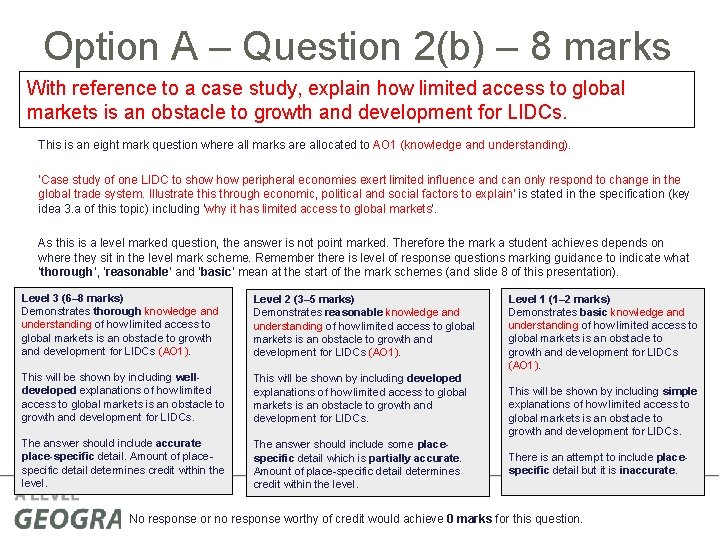
Option A – Question 2(b) – 8 marks With reference to a case study, explain how limited access to global markets is an obstacle to growth and development for LIDCs. This is an eight mark question where all marks are allocated to AO 1 (knowledge and understanding). ‘Case study of one LIDC to show peripheral economies exert limited influence and can only respond to change in the global trade system. Illustrate this through economic, political and social factors to explain’ is stated in the specification (key idea 3. a of this topic) including ‘why it has limited access to global markets’. As this is a level marked question, the answer is not point marked. Therefore the mark a student achieves depends on where they sit in the level mark scheme. Remember there is level of response questions marking guidance to indicate what ‘thorough’, ‘reasonable’ and ‘basic’ mean at the start of the mark schemes (and slide 8 of this presentation). Level 3 (6– 8 marks) Demonstrates thorough knowledge and understanding of how limited access to global markets is an obstacle to growth and development for LIDCs (AO 1). This will be shown by including welldeveloped explanations of how limited access to global markets is an obstacle to growth and development for LIDCs. Level 2 (3– 5 marks) Demonstrates reasonable knowledge and understanding of how limited access to global markets is an obstacle to growth and development for LIDCs (AO 1). This will be shown by including developed explanations of how limited access to global markets is an obstacle to growth and development for LIDCs. The answer should include accurate place-specific detail. Amount of place© OCR 2016 specific detail determines credit within the level. The answer should include some placespecific detail which is partially accurate. Amount of place-specific detail determines credit within the level. Level 1 (1– 2 marks) Demonstrates basic knowledge and understanding of how limited access to global markets is an obstacle to growth and development for LIDCs (AO 1). This will be shown by including simple explanations of how limited access to global markets is an obstacle to growth and development for LIDCs. There is an attempt to include placespecific detail but it is inaccurate. No response or no response worthy of credit would achieve 0 marks for this question.
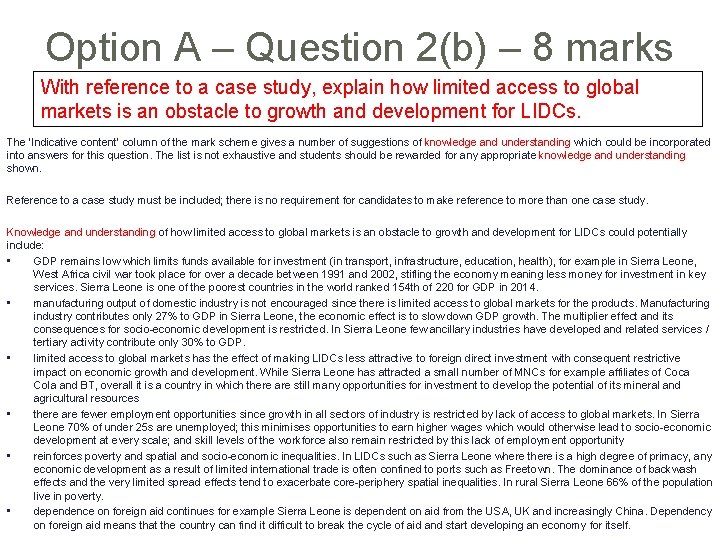
Option A – Question 2(b) – 8 marks With reference to a case study, explain how limited access to global markets is an obstacle to growth and development for LIDCs. The ‘Indicative content’ column of the mark scheme gives a number of suggestions of knowledge and understanding which could be incorporated into answers for this question. The list is not exhaustive and students should be rewarded for any appropriate knowledge and understanding shown. Reference to a case study must be included; there is no requirement for candidates to make reference to more than one case study. Knowledge and understanding of how limited access to global markets is an obstacle to growth and development for LIDCs could potentially include: • GDP remains low which limits funds available for investment (in transport, infrastructure, education, health), for example in Sierra Leone, West Africa civil war took place for over a decade between 1991 and 2002, stifling the economy meaning less money for investment in key services. Sierra Leone is one of the poorest countries in the world ranked 154 th of 220 for GDP in 2014. • manufacturing output of domestic industry is not encouraged since there is limited access to global markets for the products. Manufacturing industry contributes only 27% to GDP in Sierra Leone, the economic effect is to slow down GDP growth. The multiplier effect and its consequences for socio-economic development is restricted. In Sierra Leone few ancillary industries have developed and related services / tertiary activity contribute only 30% to GDP. • limited access to global markets has the effect of making LIDCs less attractive to foreign direct investment with consequent restrictive impact on economic growth and development. While Sierra Leone has attracted a small number of MNCs for example affiliates of Coca Cola and BT, overall it is a country in which there are still many opportunities for investment to develop the potential of its mineral and agricultural resources • there are fewer employment opportunities since growth in all sectors of industry is restricted by lack of access to global markets. In Sierra Leone 70% of under 25 s are unemployed; this minimises opportunities to earn higher wages which would otherwise lead to socio-economic development at every scale; and skill levels of the workforce also remain restricted by this lack of employment opportunity • reinforces poverty and spatial and socio-economic inequalities. In LIDCs such as Sierra Leone where there is a high degree of primacy, any © OCR 2016 economic development as a result of limited international trade is often confined to ports such as Freetown. The dominance of backwash effects and the very limited spread effects tend to exacerbate core-periphery spatial inequalities. In rural Sierra Leone 66% of the population live in poverty. • dependence on foreign aid continues for example Sierra Leone is dependent on aid from the USA, UK and increasingly China. Dependency on foreign aid means that the country can find it difficult to break the cycle of aid and start developing an economy for itself.
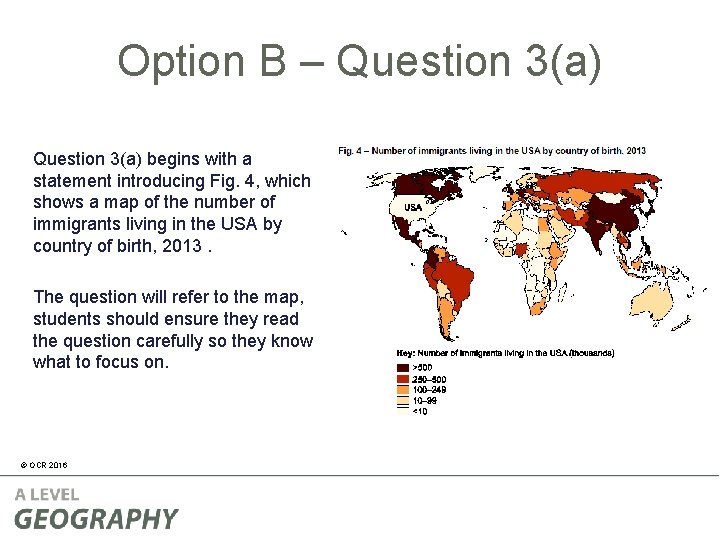
Option B – Question 3(a) begins with a statement introducing Fig. 4, which shows a map of the number of immigrants living in the USA by country of birth, 2013. The question will refer to the map, students should ensure they read the question carefully so they know what to focus on. © OCR 2016
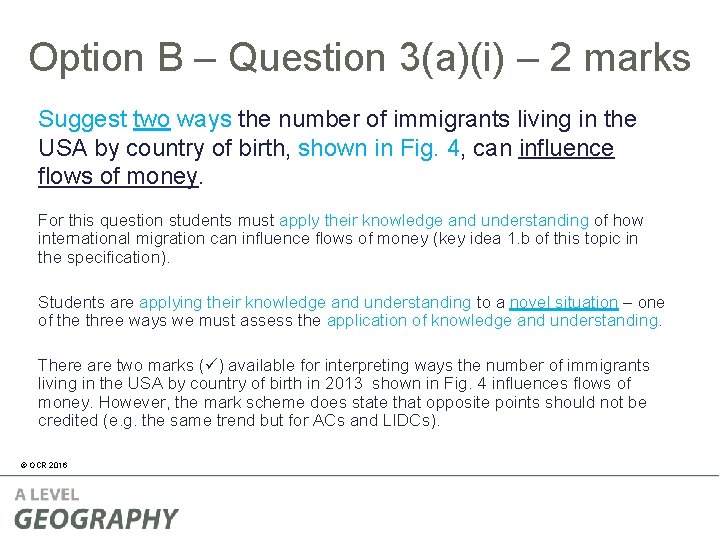
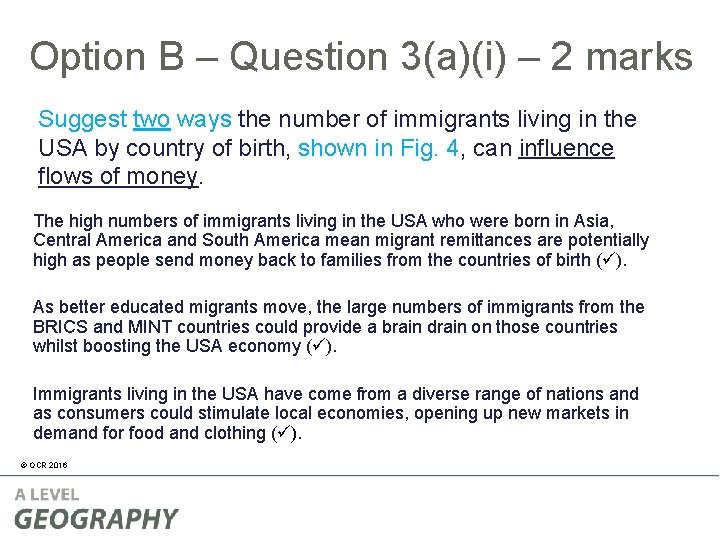
Option B – Question 3(a)(i) – 2 marks Suggest two ways the number of immigrants living in the USA by country of birth, shown in Fig. 4, can influence flows of money. For this question students must apply their knowledge and understanding of how international migration can influence flows of money (key idea 1. b of this topic in the specification). Students are applying their knowledge and understanding to a novel situation – one of the three ways we must assess the application of knowledge and understanding. There are two marks ( ) available for interpreting ways the number of immigrants living in the USA by country of birth in 2013 shown in Fig. 4 influences flows of money. However, the mark scheme does state that opposite points should not be credited (e. g. the same trend but for ACs and LIDCs). © OCR 2016
Option B – Question 3(a)(i) – 2 marks Suggest two ways the number of immigrants living in the USA by country of birth, shown in Fig. 4, can influence flows of money. The high numbers of immigrants living in the USA who were born in Asia, Central America and South America mean migrant remittances are potentially high as people send money back to families from the countries of birth ( ). As better educated migrants move, the large numbers of immigrants from the BRICS and MINT countries could provide a brain drain on those countries whilst boosting the USA economy ( ). Immigrants living in the USA have come from a diverse range of nations and as consumers could stimulate local economies, opening up new markets in demand for food and clothing ( ). © OCR 2016
Option B – Question 3(a)(ii) – 3 marks Explain one factor that might account for the spatial variations in Fig. 4. For this question students must apply their knowledge and understanding of changes in international migration patterns and reasons why this might take place (key idea 2. b of this topic in the specification). Students are applying their knowledge and understanding to a novel situation – one of the three ways we must assess the application of knowledge and understanding. There is one mark ( ) available for stating a factor that might account for the spatial variations in number of immigrants living in the USA, with two marks (DEV) for explaining the factor which might account for the spatial variations. © OCR 2016
Option B – Question 3(a)(ii) – 3 marks Explain one factor that might account for the spatial variations in Fig. 4. Accessibility, distance and transport ( ) for example the USA borders Mexico and so can be accessed without the need for travel via air or sea (DEV). Migrants from bordering countries such as Canada and Mexico have strong economic ties to the USA and their migration could vary in timescales as they may not become permanent citizens, as it is closer for them to travel to their country of origin (DEV). Poverty / wealth of potential migrant ( ) migrants from ACs and EDCs with greater wealth have more freedom to migrate and choose their destination because they can afford to travel (DEV). Migrants from those countries could potentially be more educated to they are attracted to the USA due to the economic and employment opportunities e. g. Silicon Valley (DEV). Established diasporic communities / family reunification ( ) for example from Mexico or Iran where there already large populations of these nationalities settled (DEV). These communities are established with economic and social networks, this encourages further migrants to establish a life in the USA and join the community groups (DEV). Percentage of skilled / qualified population in work force may influence ability to migrate ( ), for example the UK has a high number of immigrants living in the USA and the UK has a highly skilled workforce. The movement of skilled workers could be related to MNC or large companies employing international staff e. g. Glaxo Smith Klein (DEV). Political alliances between countries such as the UK and USA could make it less challenging for people to overcome entry requirements and migrate to the USA (DEV). © OCR 2016
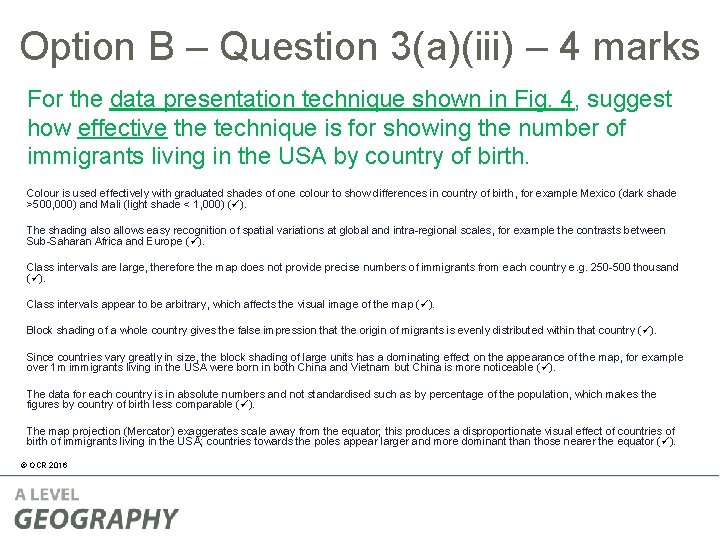
Option B – Question 3(a)(iii) – 4 marks For the data presentation technique shown in Fig. 4, suggest how effective the technique is for showing the number of immigrants living in the USA by country of birth. This is a four mark question where all marks are allocated to AO 3 (skills). ‘Undertake informed and critical questioning of data sources, analytical methodologies, data reporting and presentation’ is stated in the specification (section 4. 1 of the geographical skills list in the specification) and this question is directly targeting this skill. For this question students must make points suggesting how effective the data presentation technique shown in Fig. 4 is for showing the number of immigrants living in the USA by country of birth. There are four marks available for this short answer question. As this is a low tariff question it is point marked, therefore there are marks for each suggestion of how effective the choropleth mapping technique is for showing the number of immigrants living in the USA by country of birth in Fig. 4 ( ). © OCR 2016
Option B – Question 3(a)(iii) – 4 marks For the data presentation technique shown in Fig. 4, suggest how effective the technique is for showing the number of immigrants living in the USA by country of birth. Colour is used effectively with graduated shades of one colour to show differences in country of birth, for example Mexico (dark shade >500, 000) and Mali (light shade < 1, 000) ( ). The shading also allows easy recognition of spatial variations at global and intra-regional scales, for example the contrasts between Sub-Saharan Africa and Europe ( ). Class intervals are large, therefore the map does not provide precise numbers of immigrants from each country e. g. 250 -500 thousand ( ). Class intervals appear to be arbitrary, which affects the visual image of the map ( ). Block shading of a whole country gives the false impression that the origin of migrants is evenly distributed within that country ( ). Since countries vary greatly in size, the block shading of large units has a dominating effect on the appearance of the map, for example over 1 m immigrants living in the USA were born in both China and Vietnam but China is more noticeable ( ). The data for each country is in absolute numbers and not standardised such as by percentage of the population, which makes the figures by country of birth less comparable ( ). The map projection (Mercator) exaggerates scale away from the equator; this produces a disproportionate visual effect of countries of birth of immigrants living in the USA; countries towards the poles appear larger and more dominant than those nearer the equator ( ). © OCR 2016
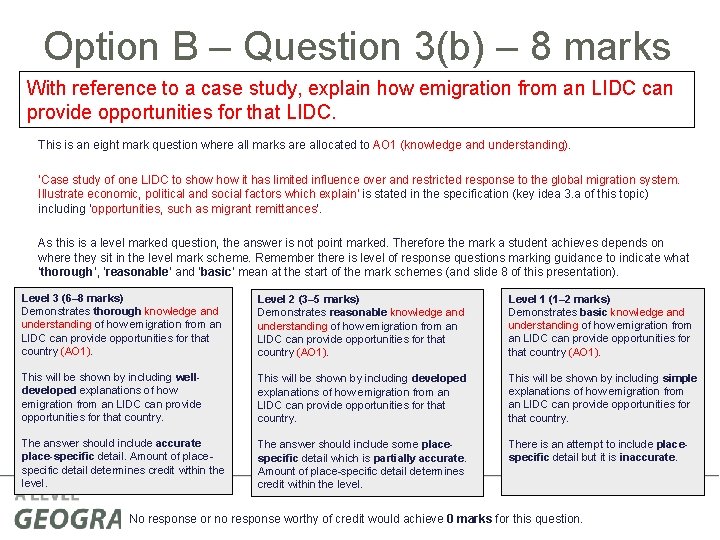
Option B – Question 3(b) – 8 marks With reference to a case study, explain how emigration from an LIDC can provide opportunities for that LIDC. This is an eight mark question where all marks are allocated to AO 1 (knowledge and understanding). ‘Case study of one LIDC to show it has limited influence over and restricted response to the global migration system. Illustrate economic, political and social factors which explain’ is stated in the specification (key idea 3. a of this topic) including ‘opportunities, such as migrant remittances’. As this is a level marked question, the answer is not point marked. Therefore the mark a student achieves depends on where they sit in the level mark scheme. Remember there is level of response questions marking guidance to indicate what ‘thorough’, ‘reasonable’ and ‘basic’ mean at the start of the mark schemes (and slide 8 of this presentation). Level 3 (6– 8 marks) Demonstrates thorough knowledge and understanding of how emigration from an LIDC can provide opportunities for that country (AO 1). This will be shown by including welldeveloped explanations of how emigration from an LIDC can provide opportunities for that country. Level 2 (3– 5 marks) Demonstrates reasonable knowledge and understanding of how emigration from an LIDC can provide opportunities for that country (AO 1). This will be shown by including developed explanations of how emigration from an LIDC can provide opportunities for that country. Level 1 (1– 2 marks) Demonstrates basic knowledge and understanding of how emigration from an LIDC can provide opportunities for that country (AO 1). This will be shown by including simple explanations of how emigration from an LIDC can provide opportunities for that country. The answer should include accurate place-specific detail. Amount of place© OCR 2016 specific detail determines credit within the level. The answer should include some placespecific detail which is partially accurate. Amount of place-specific detail determines credit within the level. There is an attempt to include placespecific detail but it is inaccurate. No response or no response worthy of credit would achieve 0 marks for this question.
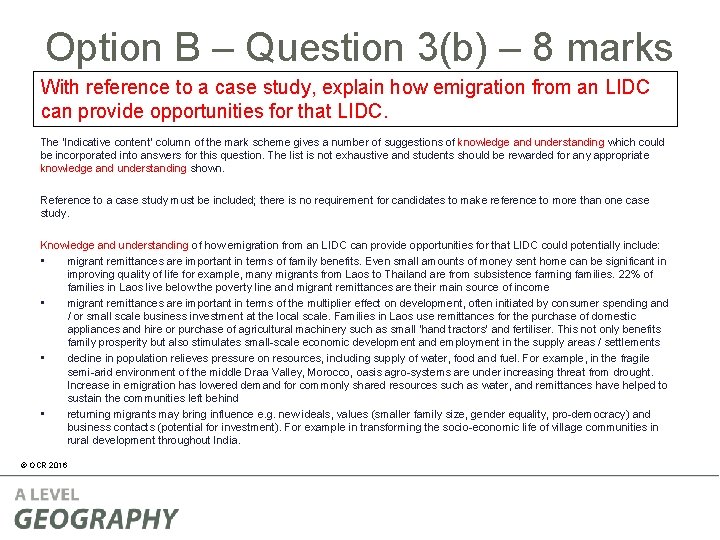
Option B – Question 3(b) – 8 marks With reference to a case study, explain how emigration from an LIDC can provide opportunities for that LIDC. The ‘Indicative content’ column of the mark scheme gives a number of suggestions of knowledge and understanding which could be incorporated into answers for this question. The list is not exhaustive and students should be rewarded for any appropriate knowledge and understanding shown. Reference to a case study must be included; there is no requirement for candidates to make reference to more than one case study. Knowledge and understanding of how emigration from an LIDC can provide opportunities for that LIDC could potentially include: • migrant remittances are important in terms of family benefits. Even small amounts of money sent home can be significant in improving quality of life for example, many migrants from Laos to Thailand are from subsistence farming families. 22% of families in Laos live below the poverty line and migrant remittances are their main source of income • migrant remittances are important in terms of the multiplier effect on development, often initiated by consumer spending and / or small scale business investment at the local scale. Families in Laos use remittances for the purchase of domestic appliances and hire or purchase of agricultural machinery such as small ‘hand tractors’ and fertiliser. This not only benefits family prosperity but also stimulates small-scale economic development and employment in the supply areas / settlements • decline in population relieves pressure on resources, including supply of water, food and fuel. For example, in the fragile semi-arid environment of the middle Draa Valley, Morocco, oasis agro-systems are under increasing threat from drought. Increase in emigration has lowered demand for commonly shared resources such as water, and remittances have helped to sustain the communities left behind • returning migrants may bring influence e. g. new ideals, values (smaller family size, gender equality, pro-democracy) and business contacts (potential for investment). For example in transforming the socio-economic life of village communities in rural development throughout India. © OCR 2016
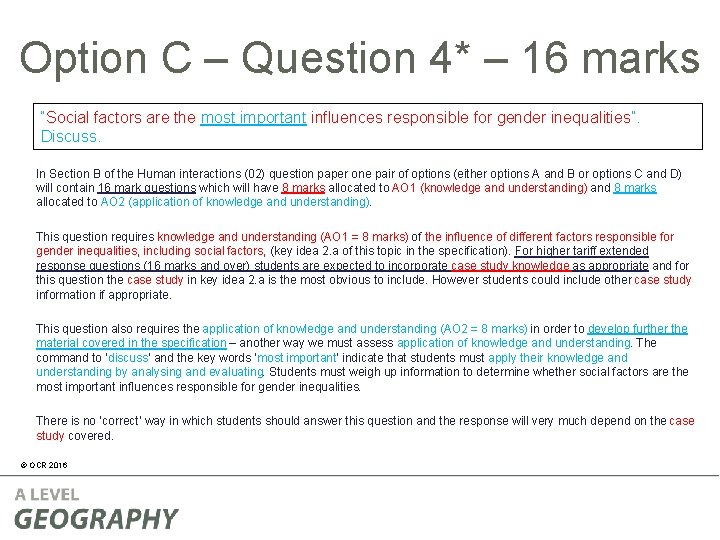
Option C – Question 4* – 16 marks “Social factors are the most important influences responsible for gender inequalities”. Discuss. In Section B of the Human interactions (02) question paper one pair of options (either options A and B or options C and D) will contain 16 mark questions which will have 8 marks allocated to AO 1 (knowledge and understanding) and 8 marks allocated to AO 2 (application of knowledge and understanding). This question requires knowledge and understanding (AO 1 = 8 marks) of the influence of different factors responsible for gender inequalities, including social factors, (key idea 2. a of this topic in the specification). For higher tariff extended response questions (16 marks and over) students are expected to incorporate case study knowledge as appropriate and for this question the case study in key idea 2. a is the most obvious to include. However students could include other case study information if appropriate. This question also requires the application of knowledge and understanding (AO 2 = 8 marks) in order to develop further the material covered in the specification – another way we must assess application of knowledge and understanding. The command to ‘discuss’ and the key words ‘most important’ indicate that students must apply their knowledge and understanding by analysing and evaluating. Students must weigh up information to determine whether social factors are the most important influences responsible for gender inequalities. There is no ‘correct’ way in which students should answer this question and the response will very much depend on the case study covered. © OCR 2016
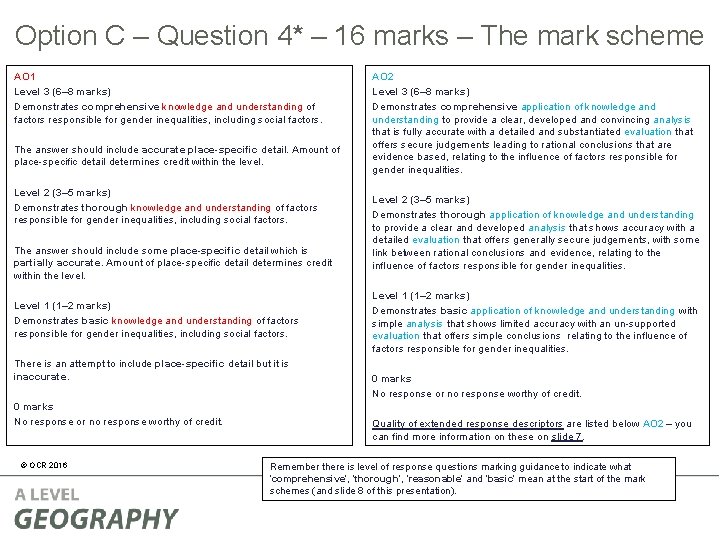
Option C – Question 4* – 16 marks – The mark scheme AO 1 Level 3 (6– 8 marks) Demonstrates comprehensive knowledge and understanding of factors responsible for gender inequalities, including social factors. The answer should include accurate place-specific detail. Amount of place-specific detail determines credit within the level. Level 2 (3– 5 marks) Demonstrates thorough knowledge and understanding of factors responsible for gender inequalities, including social factors. The answer should include some place-specific detail which is partially accurate. Amount of place-specific detail determines credit within the level. Level 1 (1– 2 marks) Demonstrates basic knowledge and understanding of factors responsible for gender inequalities, including social factors. There is an attempt to include place-specific detail but it is inaccurate. 0 marks No response or no response worthy of credit. © OCR 2016 AO 2 Level 3 (6– 8 marks) Demonstrates comprehensive application of knowledge and understanding to provide a clear, developed and convincing analysis that is fully accurate with a detailed and substantiated evaluation that offers secure judgements leading to rational conclusions that are evidence based, relating to the influence of factors responsible for gender inequalities. Level 2 (3– 5 marks) Demonstrates thorough application of knowledge and understanding to provide a clear and developed analysis that shows accuracy with a detailed evaluation that offers generally secure judgements, with some link between rational conclusions and evidence, relating to the influence of factors responsible for gender inequalities. Level 1 (1– 2 marks) Demonstrates basic application of knowledge and understanding with simple analysis that shows limited accuracy with an un-supported evaluation that offers simple conclusions relating to the influence of factors responsible for gender inequalities. 0 marks No response or no response worthy of credit. Quality of extended response descriptors are listed below AO 2 – you can find more information on these on slide 7. Remember there is level of response questions marking guidance to indicate what ‘comprehensive’, ‘thorough’, ‘reasonable’ and ‘basic’ mean at the start of the mark schemes (and slide 8 of this presentation).
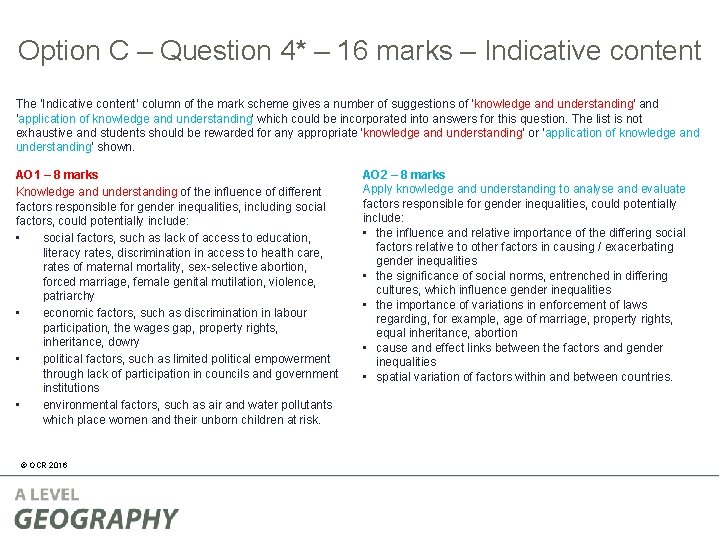
Option C – Question 4* – 16 marks – Indicative content The ‘Indicative content’ column of the mark scheme gives a number of suggestions of ‘knowledge and understanding’ and ‘application of knowledge and understanding’ which could be incorporated into answers for this question. The list is not exhaustive and students should be rewarded for any appropriate ‘knowledge and understanding’ or ‘application of knowledge and understanding’ shown. AO 1 – 8 marks Knowledge and understanding of the influence of different factors responsible for gender inequalities, including social factors, could potentially include: • social factors, such as lack of access to education, literacy rates, discrimination in access to health care, rates of maternal mortality, sex-selective abortion, forced marriage, female genital mutilation, violence, patriarchy • economic factors, such as discrimination in labour participation, the wages gap, property rights, inheritance, dowry • political factors, such as limited political empowerment through lack of participation in councils and government institutions • environmental factors, such as air and water pollutants which place women and their unborn children at risk. © OCR 2016 AO 2 – 8 marks Apply knowledge and understanding to analyse and evaluate factors responsible for gender inequalities, could potentially include: • the influence and relative importance of the differing social factors relative to other factors in causing / exacerbating gender inequalities • the significance of social norms, entrenched in differing cultures, which influence gender inequalities • the importance of variations in enforcement of laws regarding, for example, age of marriage, property rights, equal inheritance, abortion • cause and effect links between the factors and gender inequalities • spatial variation of factors within and between countries.
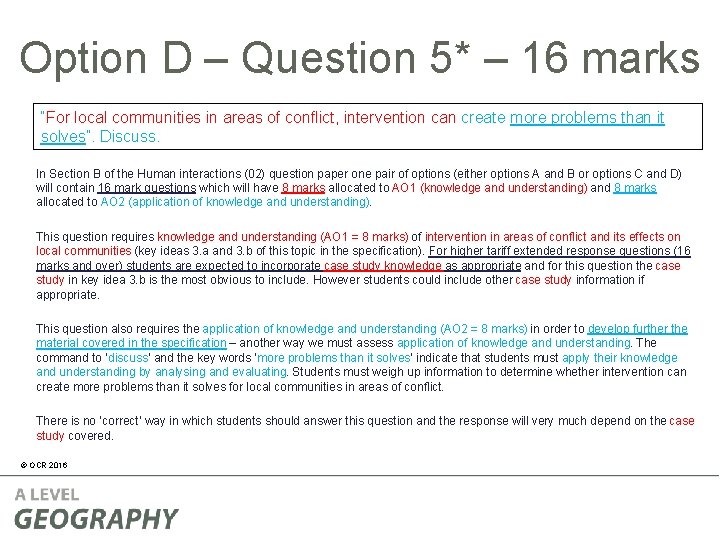
Option D – Question 5* – 16 marks “For local communities in areas of conflict, intervention can create more problems than it solves”. Discuss. In Section B of the Human interactions (02) question paper one pair of options (either options A and B or options C and D) will contain 16 mark questions which will have 8 marks allocated to AO 1 (knowledge and understanding) and 8 marks allocated to AO 2 (application of knowledge and understanding). This question requires knowledge and understanding (AO 1 = 8 marks) of intervention in areas of conflict and its effects on local communities (key ideas 3. a and 3. b of this topic in the specification). For higher tariff extended response questions (16 marks and over) students are expected to incorporate case study knowledge as appropriate and for this question the case study in key idea 3. b is the most obvious to include. However students could include other case study information if appropriate. This question also requires the application of knowledge and understanding (AO 2 = 8 marks) in order to develop further the material covered in the specification – another way we must assess application of knowledge and understanding. The command to ‘discuss’ and the key words ‘more problems than it solves’ indicate that students must apply their knowledge and understanding by analysing and evaluating. Students must weigh up information to determine whether intervention can create more problems than it solves for local communities in areas of conflict. There is no ‘correct’ way in which students should answer this question and the response will very much depend on the case study covered. © OCR 2016
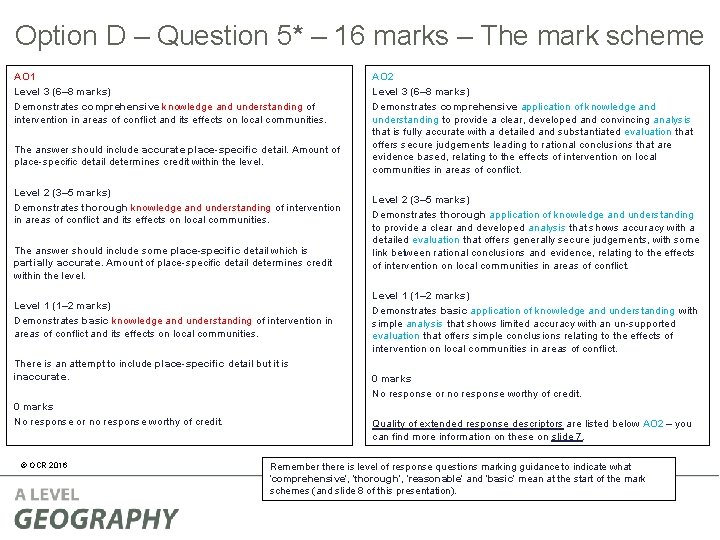
Option D – Question 5* – 16 marks – The mark scheme AO 1 Level 3 (6– 8 marks) Demonstrates comprehensive knowledge and understanding of intervention in areas of conflict and its effects on local communities. The answer should include accurate place-specific detail. Amount of place-specific detail determines credit within the level. Level 2 (3– 5 marks) Demonstrates thorough knowledge and understanding of intervention in areas of conflict and its effects on local communities. The answer should include some place-specific detail which is partially accurate. Amount of place-specific detail determines credit within the level. Level 1 (1– 2 marks) Demonstrates basic knowledge and understanding of intervention in areas of conflict and its effects on local communities. There is an attempt to include place-specific detail but it is inaccurate. 0 marks No response or no response worthy of credit. © OCR 2016 AO 2 Level 3 (6– 8 marks) Demonstrates comprehensive application of knowledge and understanding to provide a clear, developed and convincing analysis that is fully accurate with a detailed and substantiated evaluation that offers secure judgements leading to rational conclusions that are evidence based, relating to the effects of intervention on local communities in areas of conflict. Level 2 (3– 5 marks) Demonstrates thorough application of knowledge and understanding to provide a clear and developed analysis that shows accuracy with a detailed evaluation that offers generally secure judgements, with some link between rational conclusions and evidence, relating to the effects of intervention on local communities in areas of conflict. Level 1 (1– 2 marks) Demonstrates basic application of knowledge and understanding with simple analysis that shows limited accuracy with an un-supported evaluation that offers simple conclusions relating to the effects of intervention on local communities in areas of conflict. 0 marks No response or no response worthy of credit. Quality of extended response descriptors are listed below AO 2 – you can find more information on these on slide 7. Remember there is level of response questions marking guidance to indicate what ‘comprehensive’, ‘thorough’, ‘reasonable’ and ‘basic’ mean at the start of the mark schemes (and slide 8 of this presentation).
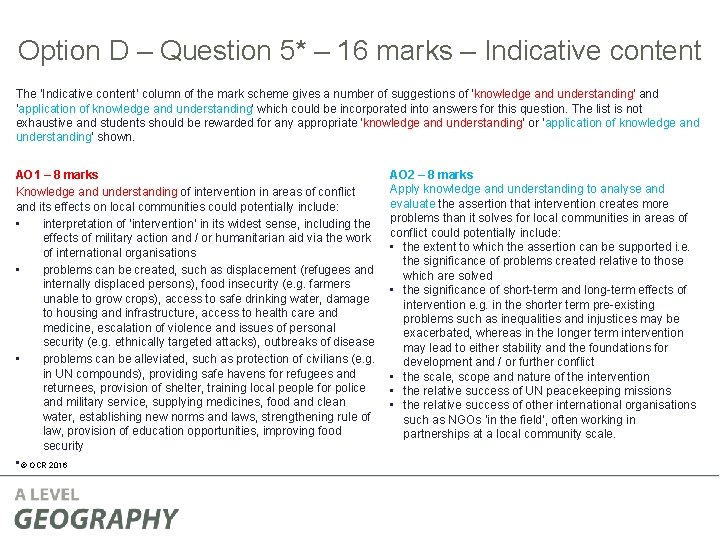
Option D – Question 5* – 16 marks – Indicative content The ‘Indicative content’ column of the mark scheme gives a number of suggestions of ‘knowledge and understanding’ and ‘application of knowledge and understanding’ which could be incorporated into answers for this question. The list is not exhaustive and students should be rewarded for any appropriate ‘knowledge and understanding’ or ‘application of knowledge and understanding’ shown. AO 1 – 8 marks Knowledge and understanding of intervention in areas of conflict and its effects on local communities could potentially include: • interpretation of ‘intervention’ in its widest sense, including the effects of military action and / or humanitarian aid via the work of international organisations • problems can be created, such as displacement (refugees and internally displaced persons), food insecurity (e. g. farmers unable to grow crops), access to safe drinking water, damage to housing and infrastructure, access to health care and medicine, escalation of violence and issues of personal security (e. g. ethnically targeted attacks), outbreaks of disease • problems can be alleviated, such as protection of civilians (e. g. in UN compounds), providing safe havens for refugees and returnees, provision of shelter, training local people for police and military service, supplying medicines, food and clean water, establishing new norms and laws, strengthening rule of law, provision of education opportunities, improving food security • © OCR 2016. AO 2 – 8 marks Apply knowledge and understanding to analyse and evaluate the assertion that intervention creates more problems than it solves for local communities in areas of conflict could potentially include: • the extent to which the assertion can be supported i. e. the significance of problems created relative to those which are solved • the significance of short-term and long-term effects of intervention e. g. in the shorter term pre-existing problems such as inequalities and injustices may be exacerbated, whereas in the longer term intervention may lead to either stability and the foundations for development and / or further conflict • the scale, scope and nature of the intervention • the relative success of UN peacekeeping missions • the relative success of other international organisations such as NGOs ‘in the field’, often working in partnerships at a local community scale.