
Gynecological procedures Done by Ola Hijjawi VAGINAL PROCEDURES
Gynecological procedures Done by : Ola Hijjawi
VAGINAL PROCEDURES I. Cervical Conization II. Cervical Cerclage III. Colporaphy IV. Dilation & Curettage
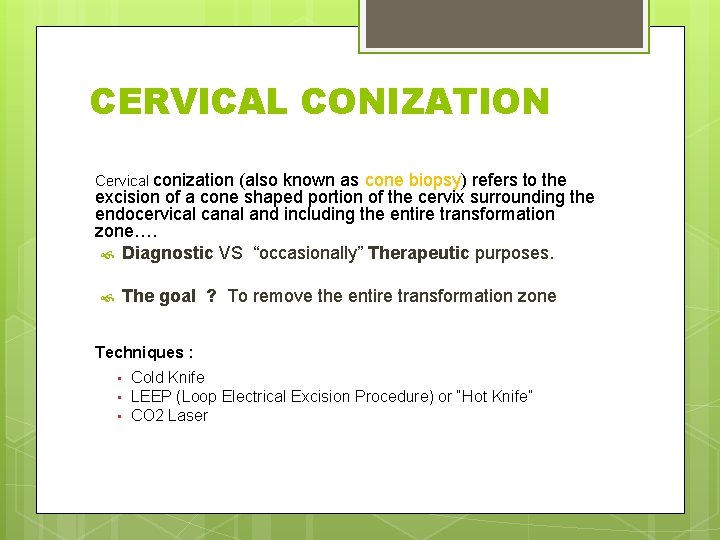
CERVICAL CONIZATION Cervical conization (also known as cone biopsy) biopsy refers to the excision of a cone shaped portion of the cervix surrounding the endocervical canal and including the entire transformation zone…. Diagnostic VS “occasionally” Therapeutic purposes. The goal ? To remove the entire transformation zone Techniques : • • • Cold Knife LEEP (Loop Electrical Excision Procedure) or “Hot Knife” CO 2 Laser
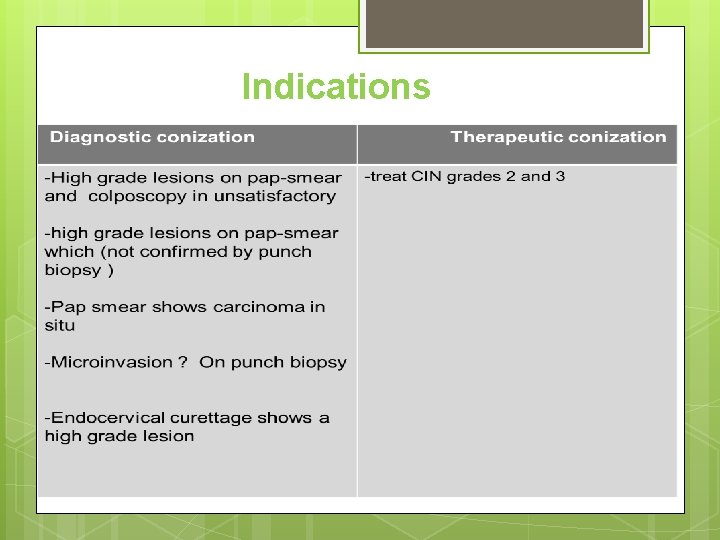
Indications Indication
CONTRAINDICATIONS should be avoided during pregnancy because it causes significant (>500 m. L) bleeding. 30% delayed post op hemorrhage 10% fetal loss But it can be used in pregnancy in the presence of invasive cancer discovered during the first or second trimester
Complications Intraoperative bleeding Postoperative bleeding Infection Late Complications (cervical insufficiency and cervical stenosis. )
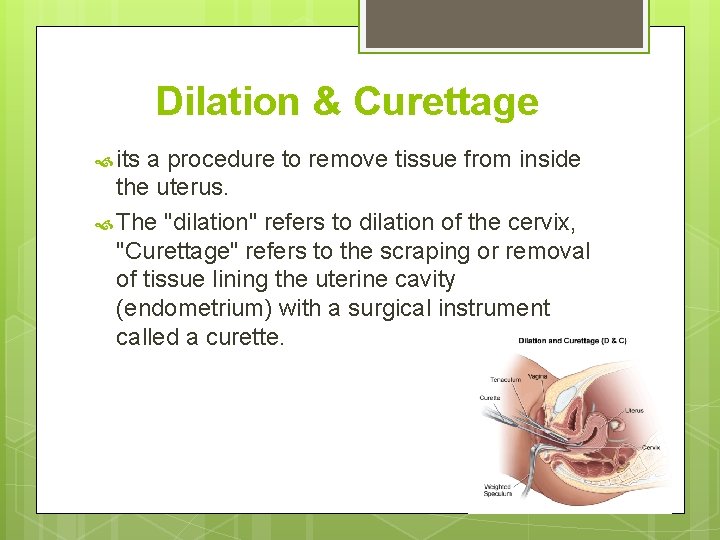
Dilation & Curettage its a procedure to remove tissue from inside the uterus. The "dilation" refers to dilation of the cervix, "Curettage" refers to the scraping or removal of tissue lining the uterine cavity (endometrium) with a surgical instrument called a curette.
Indications Diagnostic: - Abnormal uterine bleeding: irregular bleeding, menorrhagia, suspected malignant or premalignant condition. - Retained material in the endometrial cavity. - Evaluation of intracavitary findings from imaging procedures (abnormal endometrial appearance due to suspected polyps or fibroids. Therapeutic: - Suction procedures for management of uterine hemorrhage. - Treatment and evaluation of gestational trophoblastic disease. - Hemorrhage unresponsive to hormone therapy.
Contraindications Absolute: Relative: - Severe - Viable desired intrauterine pregnancy. - Inability to visualize the cervical os. - Obstructed vagina. cervical stenosis. - Cervical/uterine anomalies. - Bleeding disorder. Complications: - Bleeding or hemorrhage. - Cervical laceration. - Uterine perforation.
Common incisions Vaginal incisions : For vaginal surgeries there are only two incisions to consider. 1) For vaginal prolapse : Midline incision is used, this allows the skin to be reflected and to gain access to the fascia and underlying tissues. 2) For vaginal hysterectomy : the vaginal mucosa around the cervix is excised to gain access to the uterosacral ligaments and vesicouterine space and pouch of Douglas.
The morbidity associated with vaginal incisions is very low; many patients experience almost no pain after vaginal surgery. It’s important to know that adhesion bands can form between the anterior and posterior vagina, which can be troublesome and interfere with intercourse sometimes.
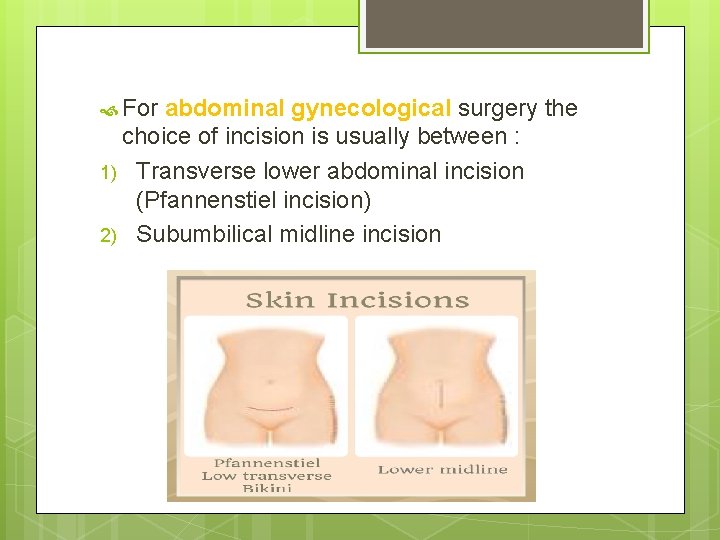
For abdominal gynecological surgery the choice of incision is usually between : 1) Transverse lower abdominal incision (Pfannenstiel incision) 2) Subumbilical midline incision
Pfannenstiel incision Transversely, two finger breadths above the pubic symphysis. Strong when repaired with low risk of herniation or dehiscence. Not very painful (limited to one or two dermatomes). Cosmetically attractive (lower than the ‘underwear line’). Surgical access limited to pelvic organs. The main drawback for it that it cannot be easily extended or made larger so surgeon is forced to do inverted T incision for better access.
Midline incision Vertically from pubic symphysis up to umbilicus. Less strong; prone to herniation or dehiscence. More painful when large (involves several dermatomes). Cosmetically unattractive. Major (+) that it Can easily be extend around umbilicus up to the xiphisternum. Gives excellent surgical access & allows flexibility that’s why it’s used in emergency cases Its often favored by oncologists, and also when significant surgical difficulty is anticipated from adhesions, large fibroids or ovarian cysts).
Laparoscopic surgery holds several advantages over open abdominal surgery : 1) Wound is smaller ( 1 cm length ) so less postop pain. 2) Risk of herniation is very low. 3) More rapid discharge from hospital within 24 -48 hours & more cost effective. Although the operating time may be longer.
Note : All Surgical incisions should be made after consideration of the requirements for surgical access and potential difficulties, but also the strength and recovery time for each type of incision.
Surgical sutures Surgical suture materials are essential elements for surgical practice. The ideal suture material is one that : 1) Allows secure knot tying without slippage 2) Provokes little tissue reaction 3) Does not increase the risk of infection 4) Retains enough tensile strength until the healing process has laid down enough collagen and connective tissue to restore integrity of the tissues and can be wholly reabsorbed by the body
Sutures can be characterized by two properties: monofilament versus multifilament, and absorbable versus nonabsorbable. Multifilament sutures are generally more secure in knot tying than monofilament sutures so will require fewer throws to secure the knot and thus reduce the amount of suture material used. But multifilament sutures carry a greater risk of infection than monofilament sutures, because the spaces between the filaments retain bacteria. For most indications in gynecology absorbable sutures will be preferred to non-absorbable sutures
How many time does it take to degrade the suture material ? ? Time is influenced by : Inflammation infection the general health of the patient >> The choice of which material is used depends on the length of time for which tensile strength is required. So when long time strength is required we use Non-absorbable sutures.
Preoperative care All information should be given to the patient about success rate, outcome , recovery time. Full History Full Physical exam Investigation Counseling and acquiring an informed consent Psychological preparation Medical consultation
Preoperative Care Counseling is considered an important part of preoperative care…>> The PREPARED Checklist The procedure The Reason or indication Our Expectations The preference that the patient may have The Alternatives or options The Risks and possible complication The Expense The Decision to perform or not to perform the procedure.
Postop care & recovery The patient will have regular (usually 4 hourly) observations of temperature, pulse and blood pressure in the first 24 hours. Most patients will be given intravenous fluids for the first 12– 24 hours after surgery until they can resume eating and drinking. The patient should be asked about the presence and site of any pain, particularly pain that is more than one would expect from a recent surgical wound or which is in a different site.
For all cases of either abdominal or vaginal surgery, the abdomen should be palpated for localized tenderness (suggesting a haematoma, peritonism or distension, and bowel sounds should be checked for return of peristalsis and exclude obstruction or ileus). The abdominal wound should be checked for inflammation, bruising or discharge. If drains are present, these should be checked.
Generally patients should be encouraged to mobilize as soon as possible and oral intake resumed at the earliest opportunity. Single-dose antibiotic prophylaxis is usually give intraoperatively for all gynaecological surgery. Wound dressings should be removed by 48– 72 hours after surgery and abdominal wound sutures are usually removed on day 5 for Pfannenstiel incisions or day 7– 10 for midline incisions.
Usually 6 weeks is recommended before resumption of full activity and intercourse after major surgery. For less major surgery a gradual resumption of activity from about 4 weeks is acceptable.

THANK YOU ANY QUESTIONS ?
- Slides: 26