
Gymnosperms Chapter 5 Section 2 What are Gymnosperms
- Slides: 12
Gymnosperms Chapter 5 Section 2
What are Gymnosperms • Seed Plant • Naked seeds – Not enclosed in a protective covering • Needlelike or scale-like leaves • Deep growing root system • Examples – Shrubs – Most are trees
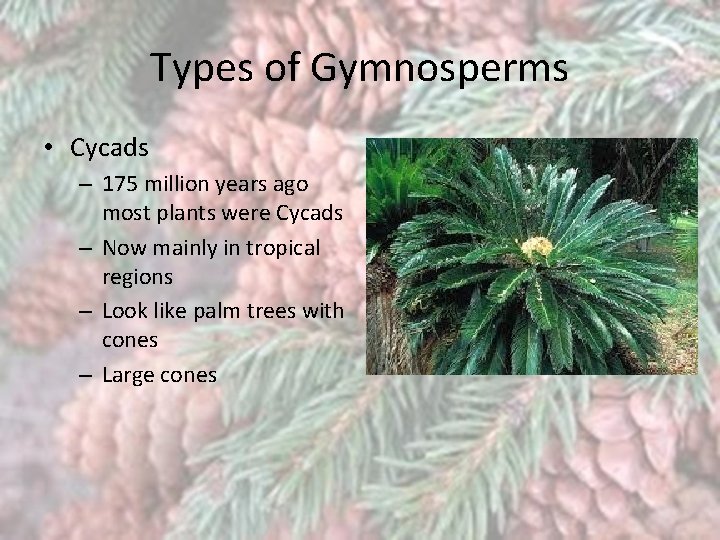
Types of Gymnosperms • Cycads – 175 million years ago most plants were Cycads – Now mainly in tropical regions – Look like palm trees with cones – Large cones
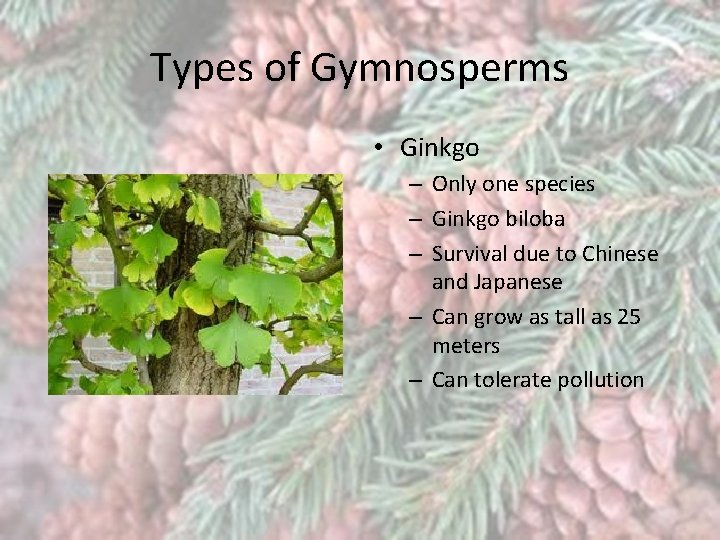
Types of Gymnosperms • Ginkgo – Only one species – Ginkgo biloba – Survival due to Chinese and Japanese – Can grow as tall as 25 meters – Can tolerate pollution
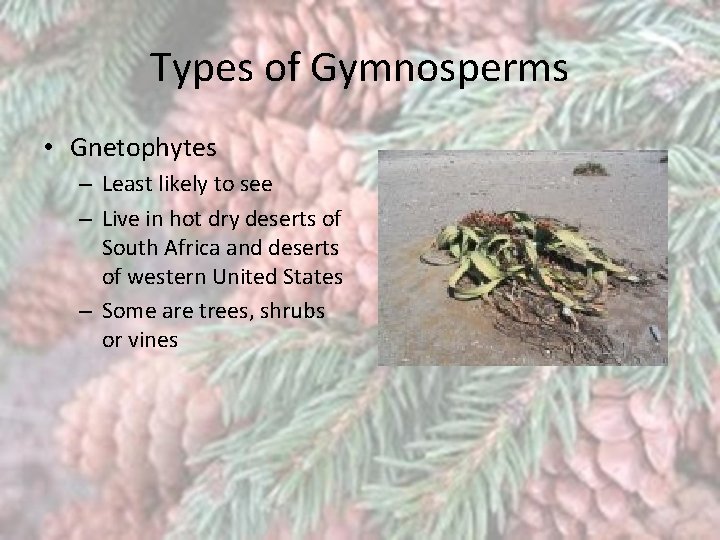
Types of Gymnosperms • Gnetophytes – Least likely to see – Live in hot dry deserts of South Africa and deserts of western United States – Some are trees, shrubs or vines
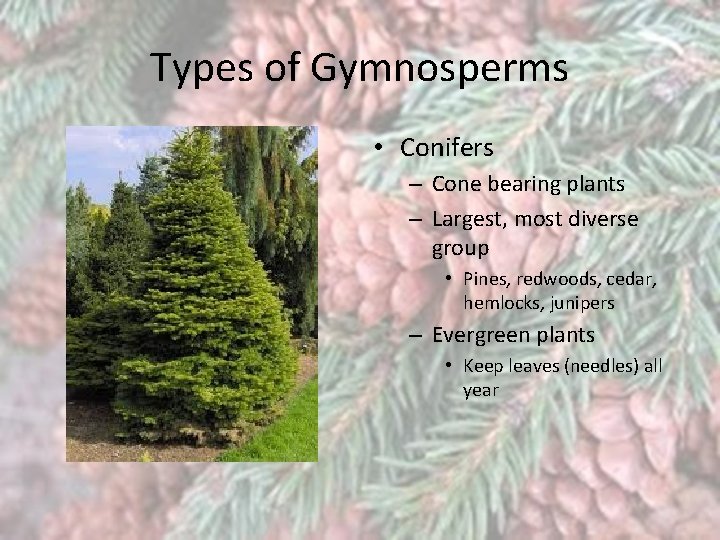
Types of Gymnosperms • Conifers – Cone bearing plants – Largest, most diverse group • Pines, redwoods, cedar, hemlocks, junipers – Evergreen plants • Keep leaves (needles) all year
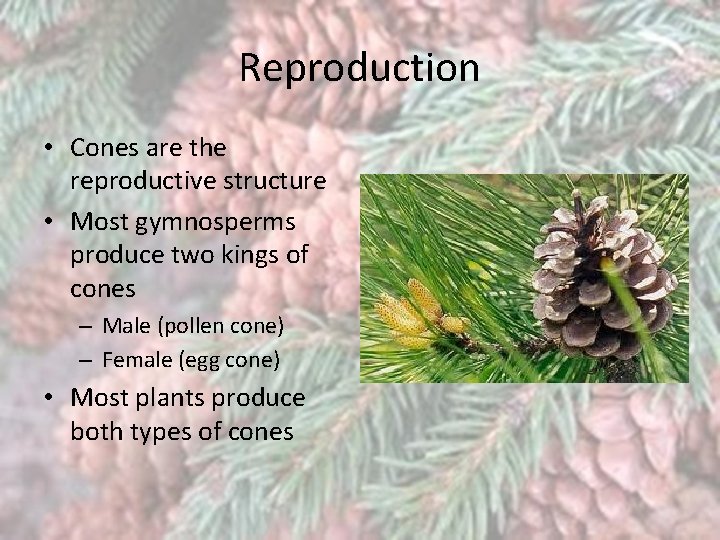
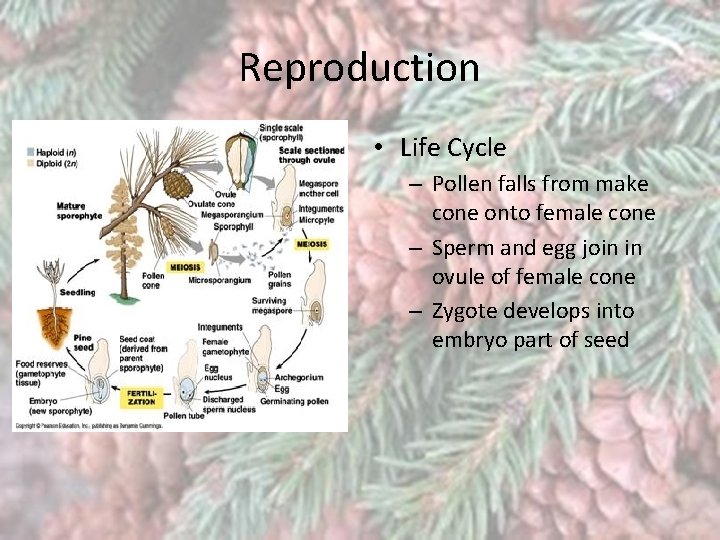
Reproduction • Cones are the reproductive structure • Most gymnosperms produce two kings of cones – Male (pollen cone) – Female (egg cone) • Most plants produce both types of cones
• Male cones – Smaller than female – Produce tiny grains of pollen • Will later become sperm – Male cones produce so many grains of pollen they can overflow the spaces between the cone’s scales. • Female cones – Contain at least one ovule • Structure that contains the egg cell • After fertilization the ovule will become the seed
Reproduction • Life Cycle – Pollen falls from make cone onto female cone – Sperm and egg join in ovule of female cone – Zygote develops into embryo part of seed
Pollination and Fertilization • Pollination – Transfer of pollen from the male reproductive structure to the female reproductive structure – Wind transfers the pollen – Pollen collects on sticky substance around ovule – Scales of female cone close to seal in the pollen – Fertilization occurs – Seed develops on the scale – Female cones stay on tree until seed are mature • Could take years – Male cones fall from tree when they lose their pollen
See Dispersal • Female cone increases in size as seed grows • Orientation on tree changes – Immature seed- cone points upward – Mature seed- cone points downward • When seeds are mature – Cone opens – Wind shakes seeds from cones and carries them away – Only a few seed will land in suitable surroundings
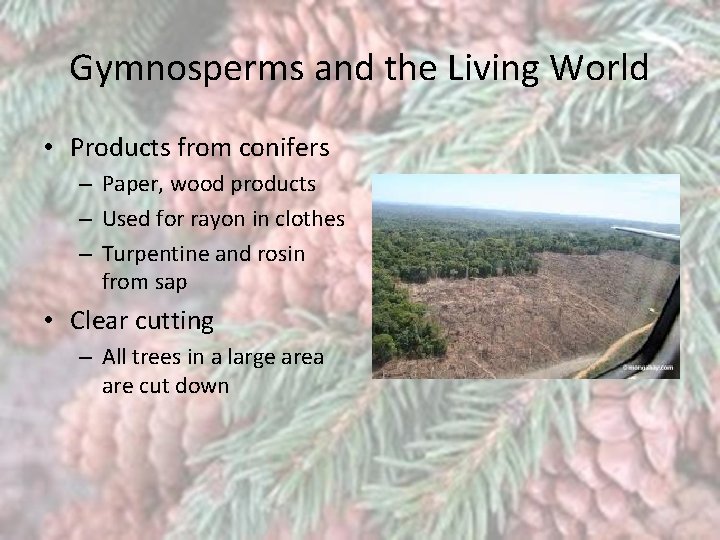
Gymnosperms and the Living World • Products from conifers – Paper, wood products – Used for rayon in clothes – Turpentine and rosin from sap • Clear cutting – All trees in a large area are cut down