
GY 111 Physical Geology Geologic Time Measurement Geological
- Slides: 20
GY 111 Physical Geology Geologic Time Measurement
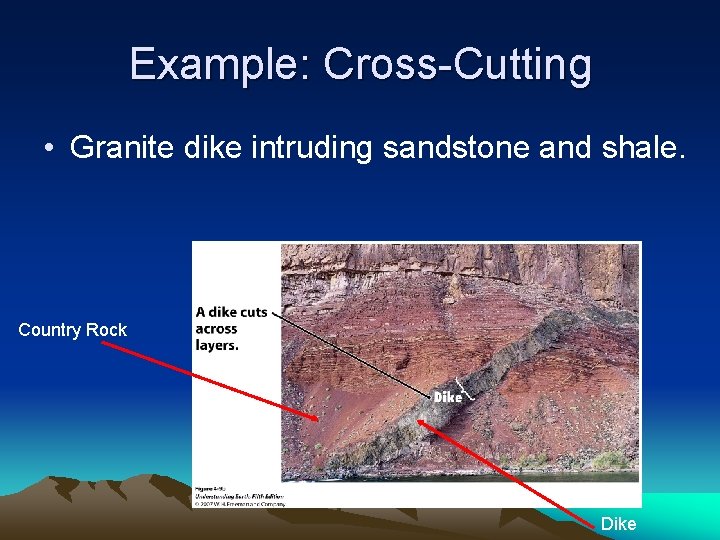
Geological “Clocks” • Geologic time determination is subdivided into 2 categories: – Relative Dating: simply determines whether or not an event occurs before or after another event (e. g. a granite dike is younger than the surrounding sandstone since it intrudes across the sandstone in an outcrop). – Absolute Dating: assigns a date to an event in terms of years before present with an error bracket (e. g. 366 Ma +/- 5 Ma)
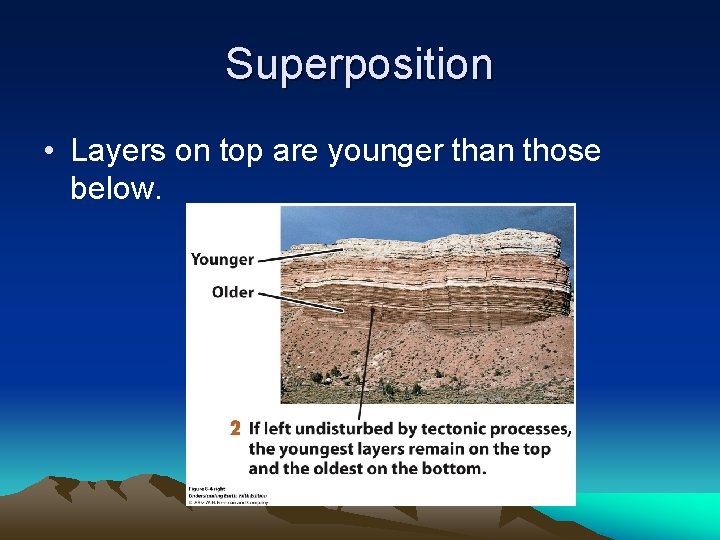
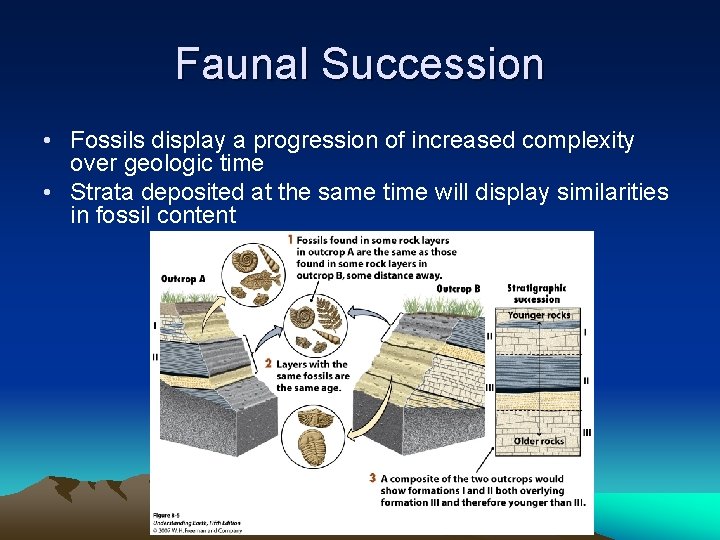
Stratigraphic Principles • Principle of Original Horizontality: layers of sedimentary strata are assumed to be deposited in a horizontal or near horizontal orientation. • Principle of Superposition: in a sequence of undeformed strata the younger layers are uppermost in the sequence. • Principle of Faunal Succession: life has evolved over time therefore more recent life forms occur only in young strata.
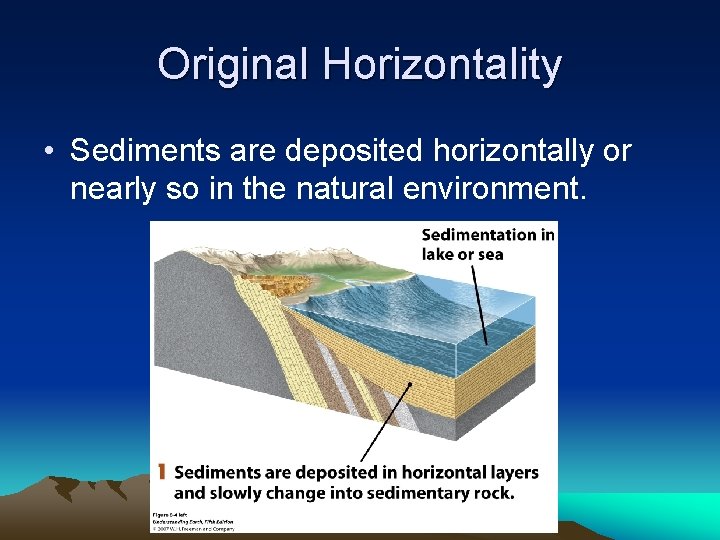
Original Horizontality • Sediments are deposited horizontally or nearly so in the natural environment.
Superposition • Layers on top are younger than those below.
Faunal Succession • Fossils display a progression of increased complexity over geologic time • Strata deposited at the same time will display similarities in fossil content
Cross-cutting Relationships • If a body of rock cuts across another it must be younger than the rock it cuts. • If an inclusion of one type of rock is found contained in another the inclusion must be older than the surrounding rock.
Example: Cross-Cutting • Granite dike intruding sandstone and shale. Country Rock Dike
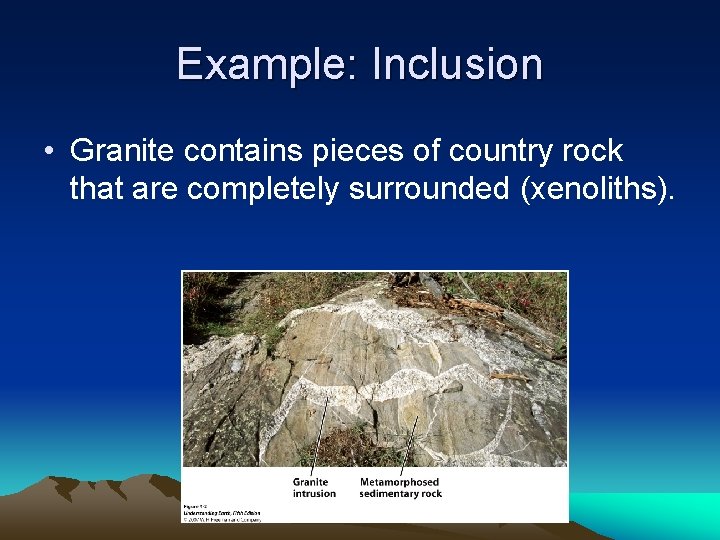
Example: Inclusion • Granite contains pieces of country rock that are completely surrounded (xenoliths).
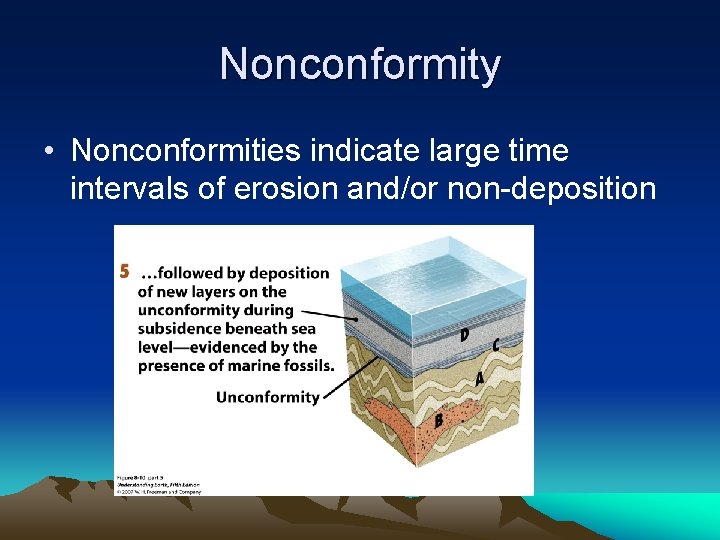
Unconformities • Represent erosional events where strata is removed, or is simply a time of non-deposition. • Types of Unconformities: – Angular: tilted layers of strata below unconformity – Disconformity: layers above and below unconformity are parallel to the unconformity – Nonconformity: crystalline rocks are found below the unconformity, sedimentary rocks above
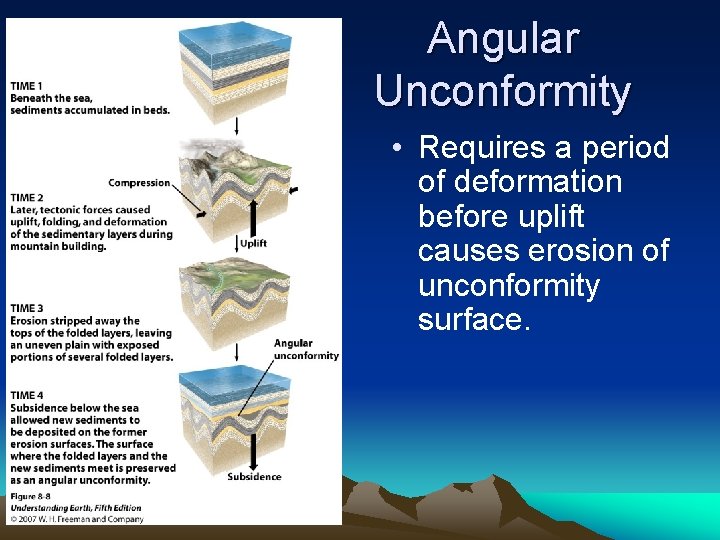
Angular Unconformity • Requires a period of deformation before uplift causes erosion of unconformity surface.
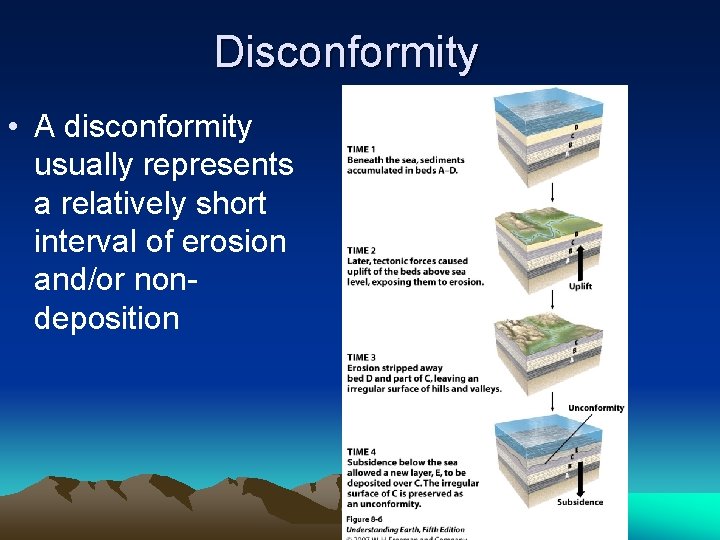
Disconformity • A disconformity usually represents a relatively short interval of erosion and/or nondeposition
Nonconformity • Nonconformities indicate large time intervals of erosion and/or non-deposition
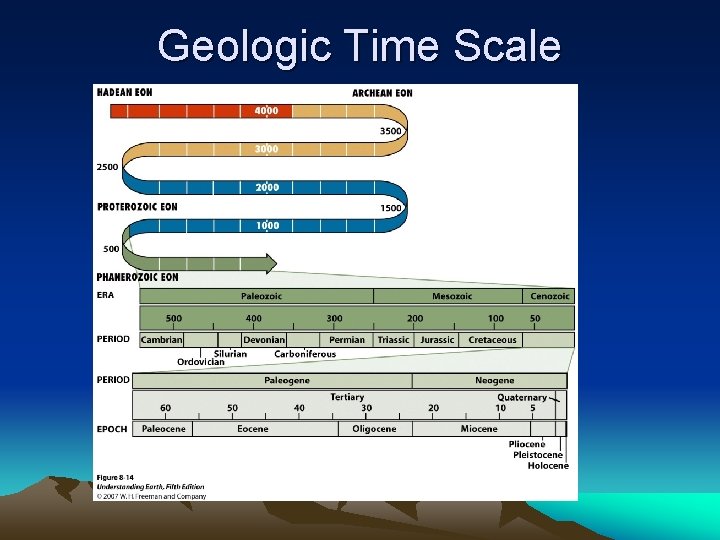
Geologic Time Scale
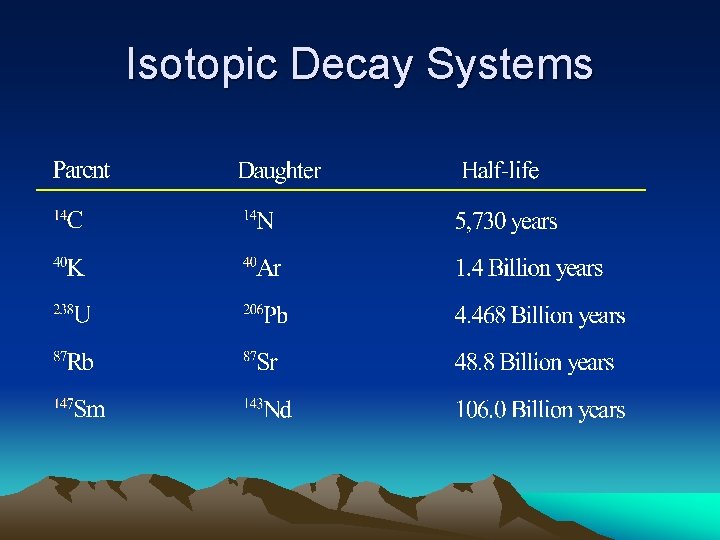
Radiometric Decay • Isotopes are elements with different atomic mass numbers. • Some isotopes decay into different elemental isotopes at a predictable rate. • Using an instrument that can detect isotopic abundances (mass spectrometer) the age of a rock can be estimated. • The starting isotope is the “parent” and the decay product is the “daughter” isotope.
Radiometric Age Calculation
Isotopic Decay Systems
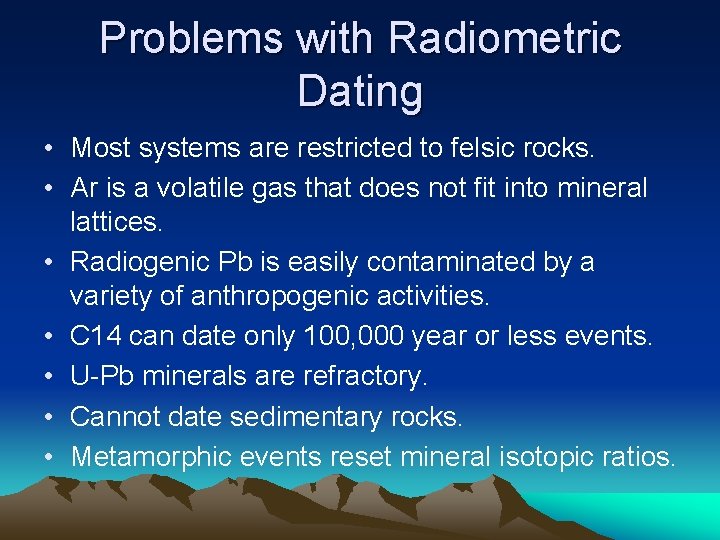
Problems with Radiometric Dating • Most systems are restricted to felsic rocks. • Ar is a volatile gas that does not fit into mineral lattices. • Radiogenic Pb is easily contaminated by a variety of anthropogenic activities. • C 14 can date only 100, 000 year or less events. • U-Pb minerals are refractory. • Cannot date sedimentary rocks. • Metamorphic events reset mineral isotopic ratios.
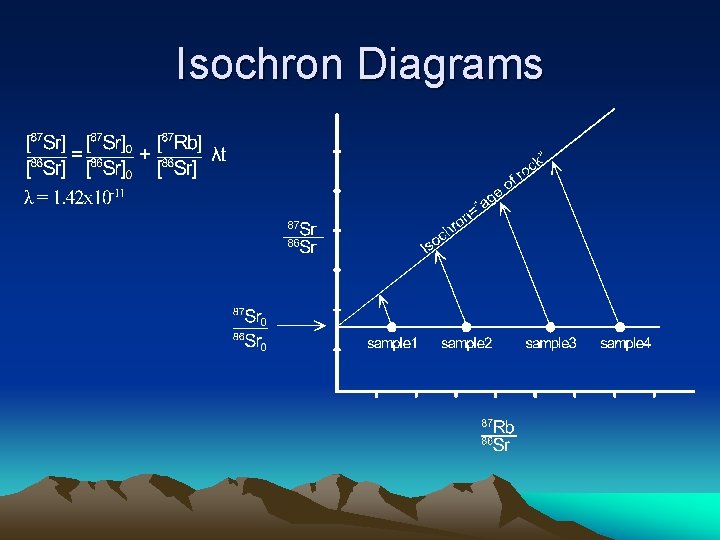
Isochron Diagrams
Exam Summary • Know the various types of relative dating. • Know the Eons, Eras, and Periods of the Geologic Time Scale. • Know the important date boundaries on the geologic time scale. • Know the types of radiometric isotopic systems. • Be familiar with how a isochron diagram works. • Know the various types of unconformities.