
GY 111 Physical Geology Earthquakes and Seismic Waves


- Slides: 31
GY 111 Physical Geology Earthquakes and Seismic Waves
Earthquake Mechanisms • Brittle Mechanical Model: “stick-slip” • Focal point: 3 D point inside the lithosphere where the seismic event occurs • Epicenter: projection of focal point to the map surface
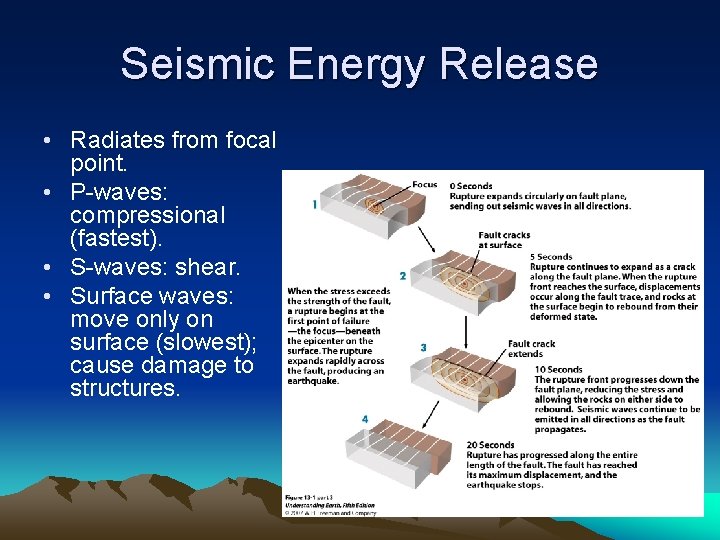
Seismic Energy Release • Radiates from focal point. • P-waves: compressional (fastest). • S-waves: shear. • Surface waves: move only on surface (slowest); cause damage to structures.
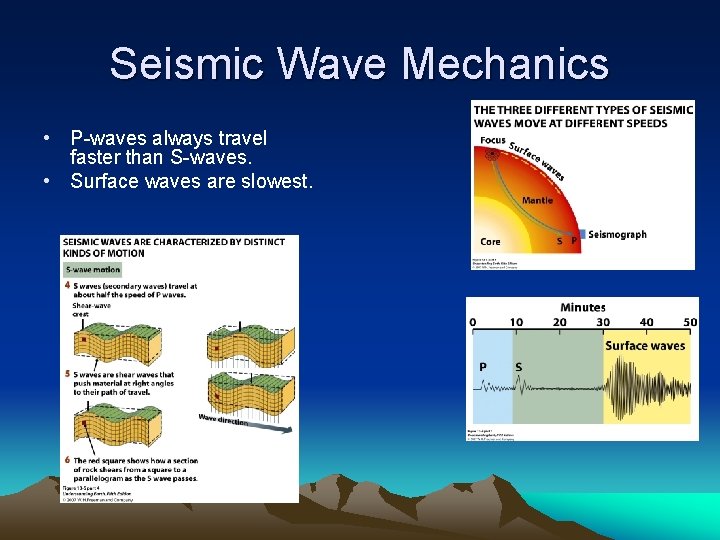
Seismic Wave Mechanics • P-waves always travel faster than S-waves. • Surface waves are slowest.
Seismic Wave Summary • P(compressional)-waves: move fastest (710/sec), vibration direction parallel to wave path. Transmitted through all materials. • S(shear)-waves: intermediate speed (4 -6 km/sec), vibration direction perpendicular to wave path. Can only be transmitted through solid material. • Surface waves: move along rock/air interface, created by energy transfer from P wave and S waves. These waves cause damage to manmade structures.
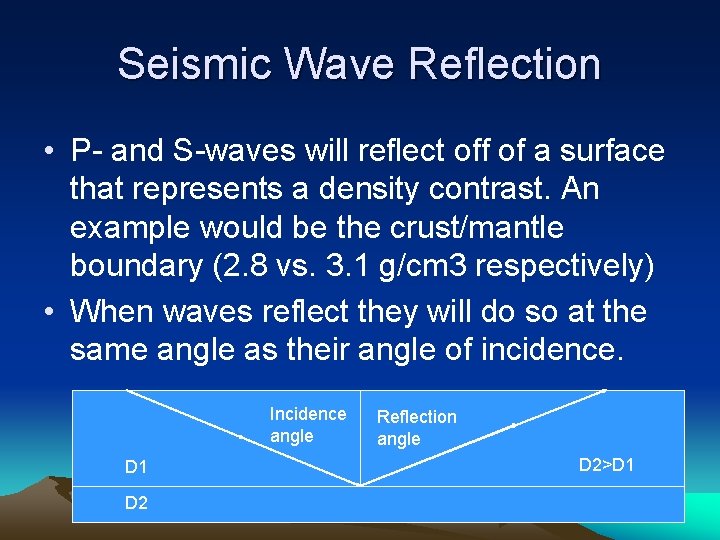
Seismic Wave Reflection • P- and S-waves will reflect off of a surface that represents a density contrast. An example would be the crust/mantle boundary (2. 8 vs. 3. 1 g/cm 3 respectively) • When waves reflect they will do so at the same angle as their angle of incidence. Incidence angle D 1 D 2 Reflection angle D 2>D 1
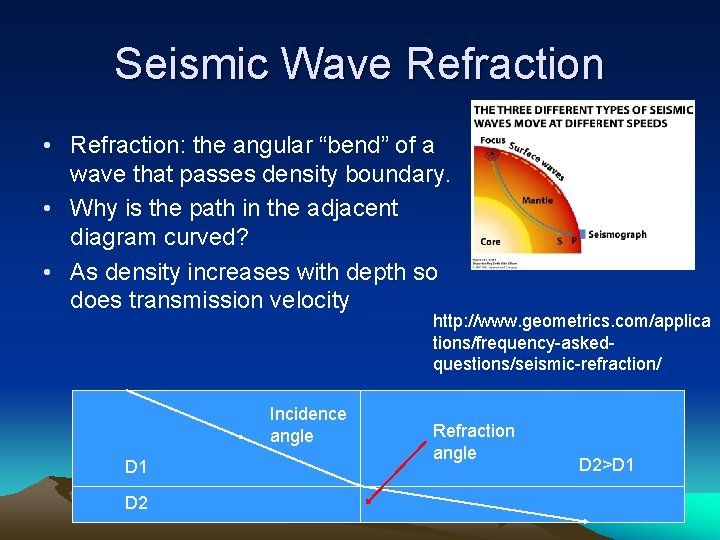
Seismic Wave Refraction • Refraction: the angular “bend” of a wave that passes density boundary. • Why is the path in the adjacent diagram curved? • As density increases with depth so does transmission velocity http: //www. geometrics. com/applica tions/frequency-askedquestions/seismic-refraction/ Incidence angle D 1 D 2 Refraction angle D 2>D 1
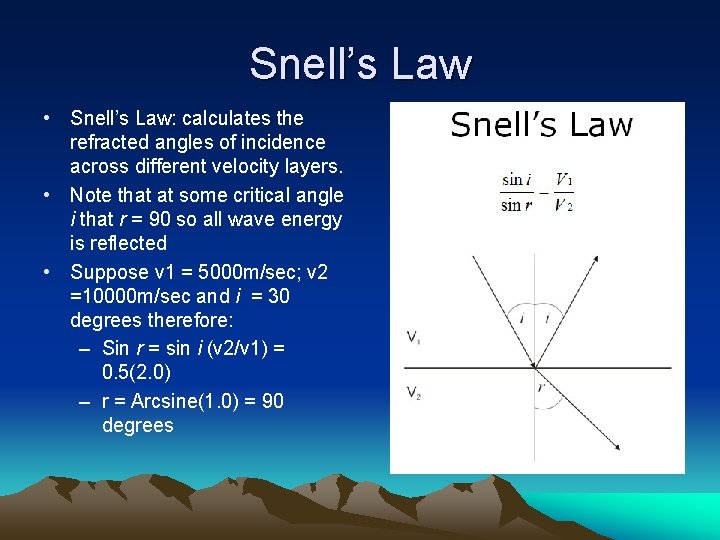
Snell’s Law • Snell’s Law: calculates the refracted angles of incidence across different velocity layers. • Note that at some critical angle i that r = 90 so all wave energy is reflected • Suppose v 1 = 5000 m/sec; v 2 =10000 m/sec and i = 30 degrees therefore: – Sin r = sin i (v 2/v 1) = 0. 5(2. 0) – r = Arcsine(1. 0) = 90 degrees
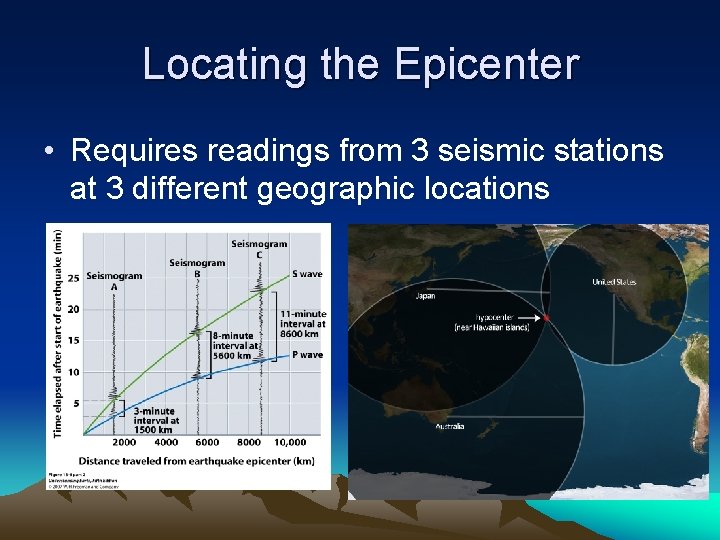
Locating the Epicenter • Requires readings from 3 seismic stations at 3 different geographic locations
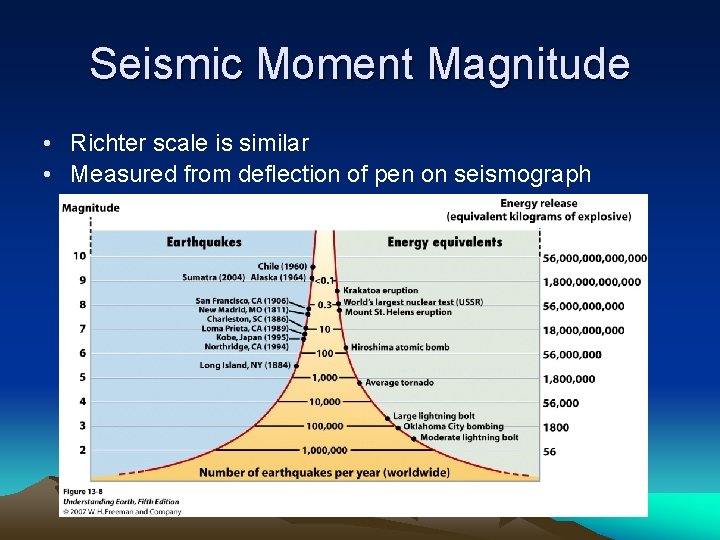
Seismic Moment Magnitude • Richter scale is similar • Measured from deflection of pen on seismograph
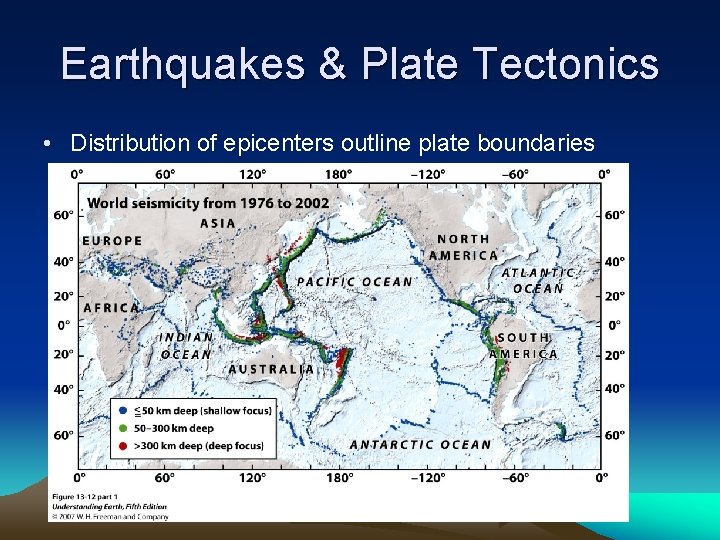
Earthquakes & Plate Tectonics • Distribution of epicenters outline plate boundaries
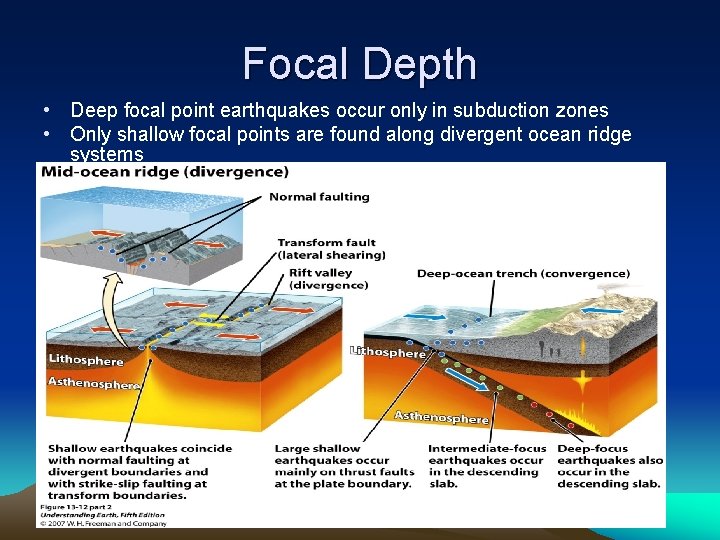
Focal Depth • Deep focal point earthquakes occur only in subduction zones • Only shallow focal points are found along divergent ocean ridge systems
Focal Point Depth and Plate Tectonics • Divergent Boundaries: only shallow depth seismic events (< 7 km). • Transform Boundaries: shallow to intermediate (1 – 35 km). • Convergent Boundaries: shallow to deep focal points (1 – 700 km).
Deep Focal Point Seismicity • The lithosphere is normally a maximum of 35 km depth so deep earthquakes should be impossible. • The fact that 700 km deep seismicity occurs can only be explained by subduction moving brittle material rapidly into the mantle.
Subduction Zone Dip Angle • The geographic distribution of focal point depths determines the dip angle of the subductions zone: – If shallow, intermediate, and deep focal point earthquakes occur in a narrow zone the dip of the subduction zone is steep. – If shallow, intermediate, and deep focal point earthquakes occur in a wide belt the dip on the subduction zone is shallow.
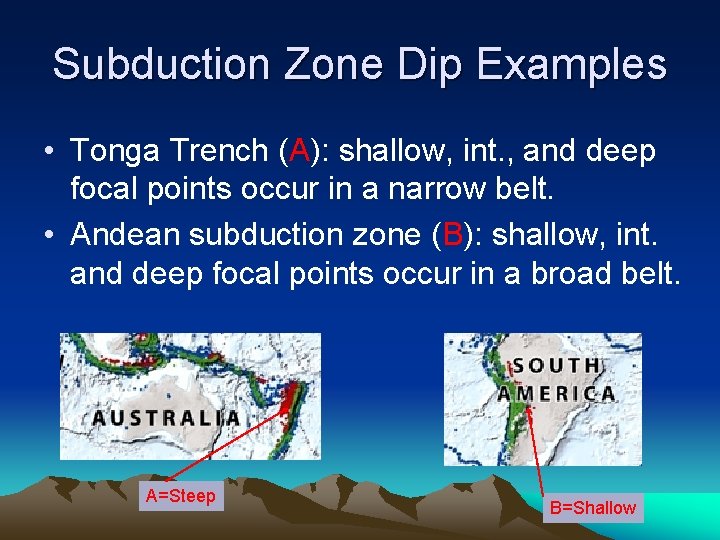
Subduction Zone Dip Examples • Tonga Trench (A): shallow, int. , and deep focal points occur in a narrow belt. • Andean subduction zone (B): shallow, int. and deep focal points occur in a broad belt. A=Steep B=Shallow
Tectonic Significance of Dip Variation on Subduction Zones • Steep subduction zones occur when old (150 Ma) ocean lithosphere cools and become too dense to float on the asthenosphere. • Shallow subduction occurs when young buoyant ocean lithosphere is forced to subduct under continental lithosphere. The ocean lithosphere “underplates” the continent causing unusually high mountains (Andes).
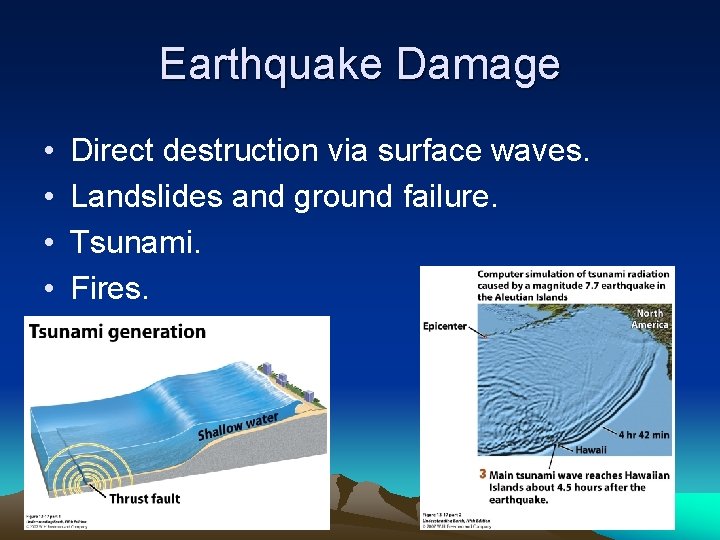
Earthquake Damage • • Direct destruction via surface waves. Landslides and ground failure. Tsunami. Fires.
Tsunamis and Plate Tectonics • Most tsunamis are generated at convergent plate boundaries. • The subducted oceanic plate can have sudden vertical displacement of several tens of meters that moves the entire water column (3 -10 km) vertically up or down. • The generated tsunami radiates from the focal point at approximately 500 mph and may circle the globe several times before dissipating.
Tsunami Video • Note that in the tsunami video there are not any giant breaking waves, rather tsunamis are more like a sudden rise in sea level everywhere along the shoreline. • A major tsunami is preceded by a sudden drop in sea level exposing the sea floor. • Just as destructive as the advance of sea water is the backwash movement as the tsunami recedes. • Tsunamis may occur in several cycles – the first advance is not necessarily the most intense. https: //www. youtube. com/watch? v=wy. OPau 0 gp. Fw
Tsunami Wave Physics • • Velocity = 800 kph (500 mph) Wavelength = 200 km in open ocean Amplitude = 1 -3 meters in open ocean As the wave begins to “feel bottom” approaching the shoreline velocity drops to 80 kph (50 mph) but amplitude (wave height) grows to 30 m (100 feet) or more. • Funnel shaped embayments may increase wave height even more.
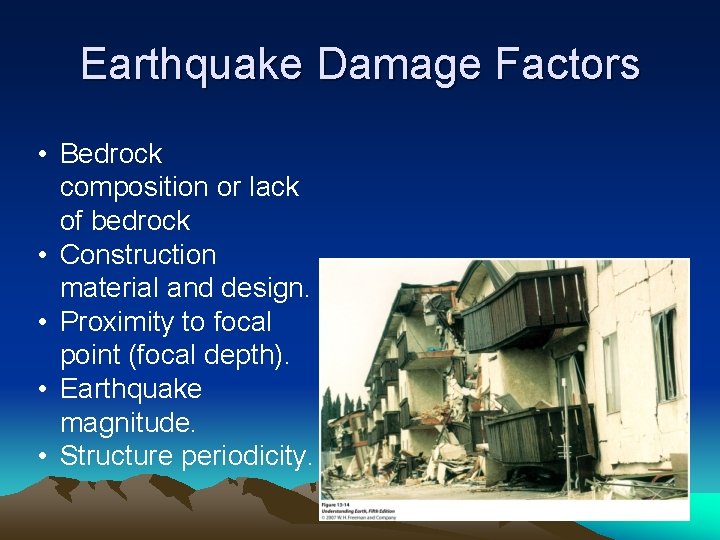
Earthquake Damage Factors • Bedrock composition or lack of bedrock • Construction material and design. • Proximity to focal point (focal depth). • Earthquake magnitude. • Structure periodicity.
Bedrock Composition • Crystalline bedrock (metamorphic or igneous) is most resistant to earthquake damage. • Soft-sediments or rocks with an inherent weakness (bedding, cleavage, joint fractures) are unstable during seismic wave vibration and may undergo liquefaction. • Liquefaction: where a solid material transitions to liquid behavior because of some external factor (seismic waves).
Construction Material and Design • Earthquake resistant structures contain an internal structural frame that can elastically bend to dissipate seismic wave energy (steel frame buildings). • Brick and Cinder Block construction does not fare well under seismic surface waves. • Wood frame buildings potentially are resistant if designed properly – but this is not generally the case. • If seismic surface wavelength matches the periodicity of the structure it will not survive even low magnitude earthquakes.
Proximity to Focal Point • Focal points range from surface level to >700 km. • Deep earthquakes allow for energy to dissipate before reaching the surface. • Rocks become stronger at greater depth therefore it takes massive stress levels to cause fault slip therefore most large magnitude earthquakes (>8. 0) originate as deep focal points.
Earthquake Magnitude • Magnitudes are measured by how violently a recording pen is deflected on a seismograph. • Magnitude scales are exponential – each unit increase is 30 times the energy of lower magnitude. • The point on the fault surface where the energy release begins is termed the focal point.
Structure Periodicity • All structures have a vibration periodicity that is the time period of vibrations or rocking. • If a seismic surface wave period matched the period of a building the building is doomed to fail. • You can think of periodicity as the “period” of pendulum – the longer the pendulum arm the longer the period, • For most seismic waves a 3 -4 storie building matches the periodicity of seismic surface waves.
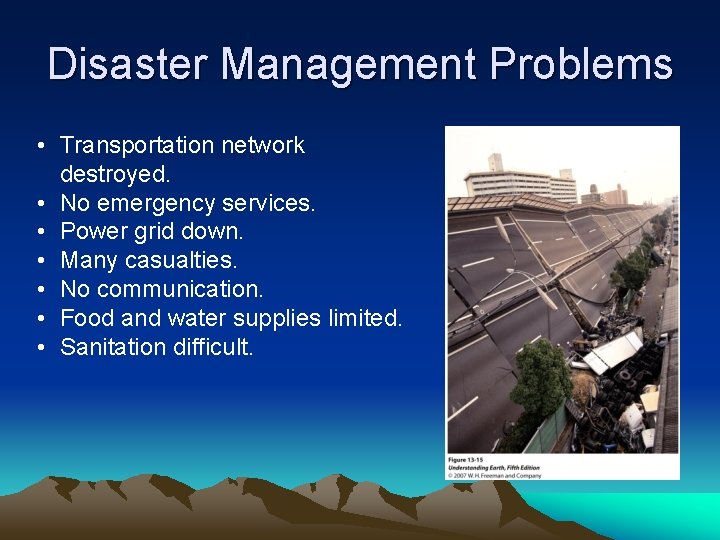
Disaster Management Problems • Transportation network destroyed. • No emergency services. • Power grid down. • Many casualties. • No communication. • Food and water supplies limited. • Sanitation difficult.
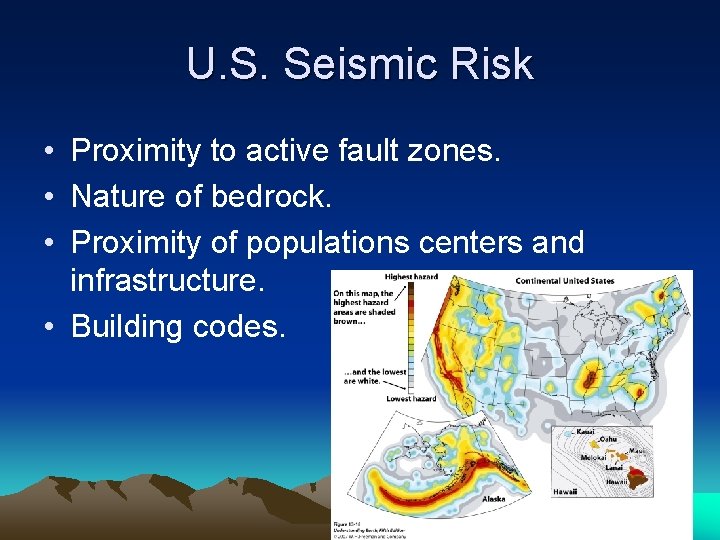
U. S. Seismic Risk • Proximity to active fault zones. • Nature of bedrock. • Proximity of populations centers and infrastructure. • Building codes.
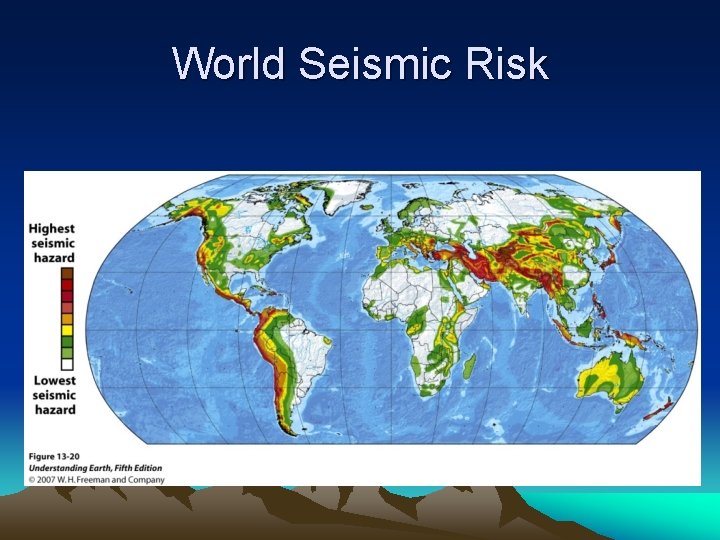
World Seismic Risk
Exam Summary • Know differences between P-, S-, and surface waves. • Be familiar with the stick-slip theory of earthquake propagation. • Know how epicenters and focal points are located with seismic data. • Be familiar with the association of earthquake types with various plate tectonic boundaries. • Be familiar with the differences between wind-generated ocean waves and seismic sea waves (Tsunamis). • Be familiar with reflection and refraction and Snell’s Law.