
GY 111 Physical Geology Deformation of the Earths
- Slides: 40
GY 111 Physical Geology Deformation of the Earth’s Crust
Stress & Strain • Stress: a force applied to an area. – Example: tire pressure in psi. • Strain: a change in original shape or volume (produced by stress). • Elastic strain: analogous to a steel spring or rubber band. • Plastic strain: analogous to deforming mud or putty.
Types of Stress • Lithostatic Stress: stress due to the burial and overlying overburden of rock. • Lithostatic stress can only cause a change in volume referred to as dilation. • Directed stress: stress is unequal in different directions. • Directed stress is generated by plate tectonic motion and will cause a change in shape referred to as distortion.
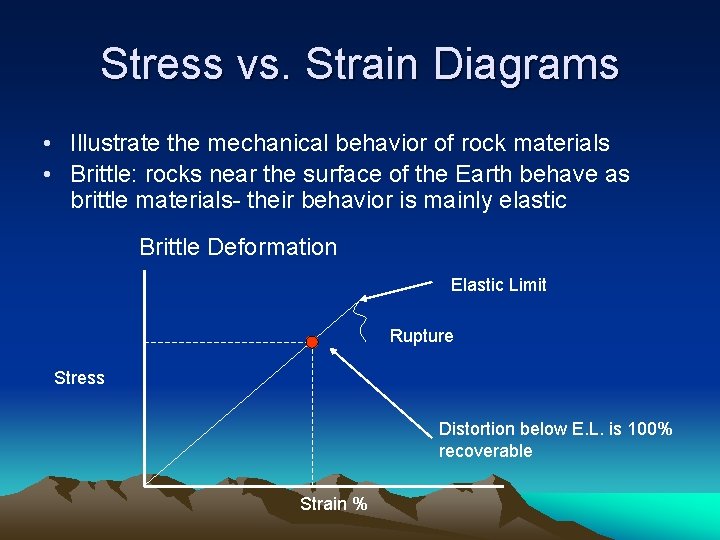
Stress vs. Strain Diagrams • Illustrate the mechanical behavior of rock materials • Brittle: rocks near the surface of the Earth behave as brittle materials- their behavior is mainly elastic Brittle Deformation Elastic Limit Rupture Stress Distortion below E. L. is 100% recoverable Strain %
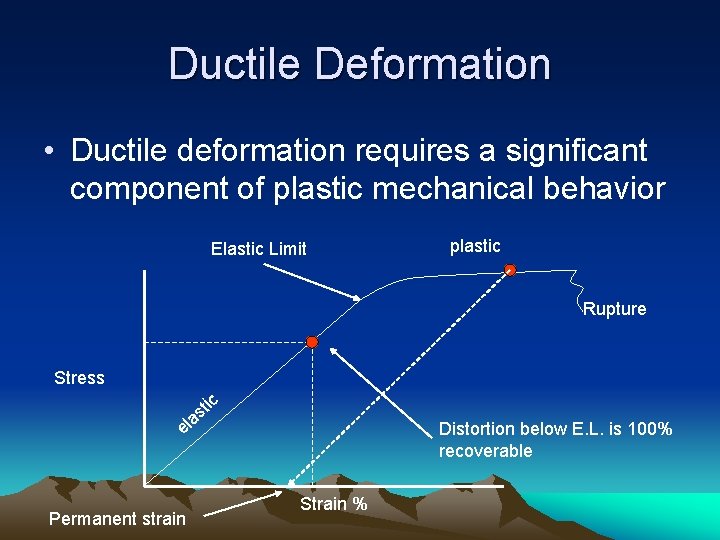
Ductile Deformation • Ductile deformation requires a significant component of plastic mechanical behavior Elastic Limit plastic Rupture Stress ic t as el Permanent strain Distortion below E. L. is 100% recoverable Strain %
Mechanical Behavior of Rocks • Near-surface rocks that are under low T-P conditions behave as brittle material: – Fault fracture (slippage). – Joint fracture (no slippage). • Deep rocks under elevated T-P conditions behave as ductile material: – Folding.
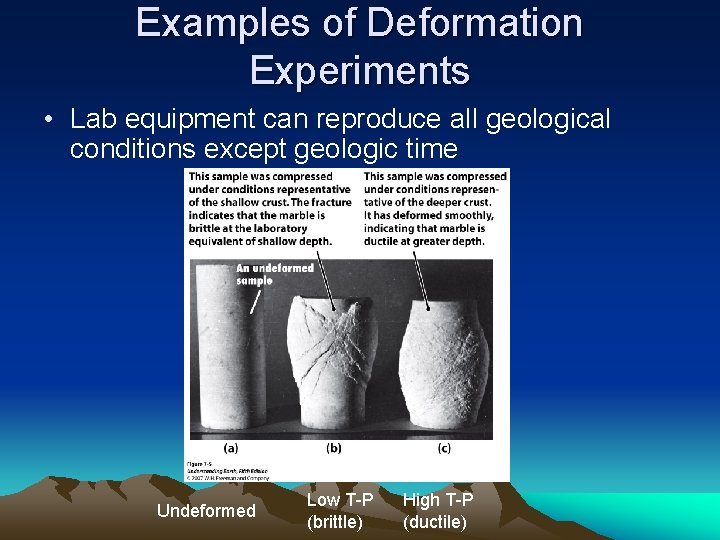
Examples of Deformation Experiments • Lab equipment can reproduce all geological conditions except geologic time Undeformed Low T-P (brittle) High T-P (ductile)
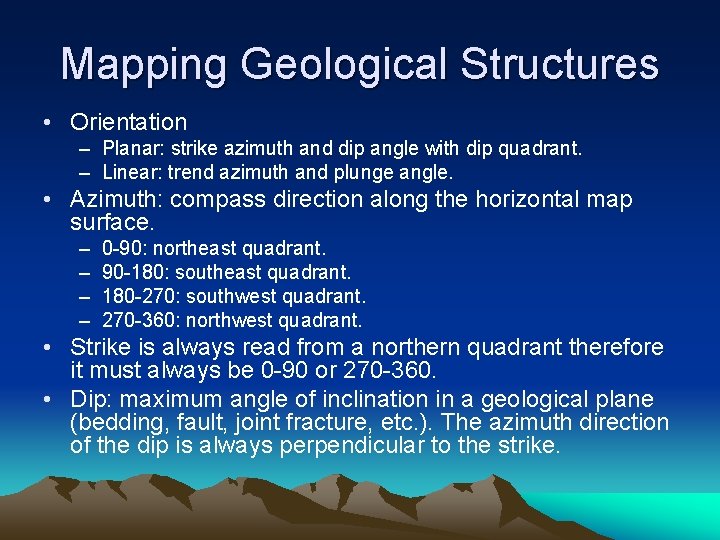
Mapping Geological Structures • Orientation – Planar: strike azimuth and dip angle with dip quadrant. – Linear: trend azimuth and plunge angle. • Azimuth: compass direction along the horizontal map surface. – – 0 -90: northeast quadrant. 90 -180: southeast quadrant. 180 -270: southwest quadrant. 270 -360: northwest quadrant. • Strike is always read from a northern quadrant therefore it must always be 0 -90 or 270 -360. • Dip: maximum angle of inclination in a geological plane (bedding, fault, joint fracture, etc. ). The azimuth direction of the dip is always perpendicular to the strike.
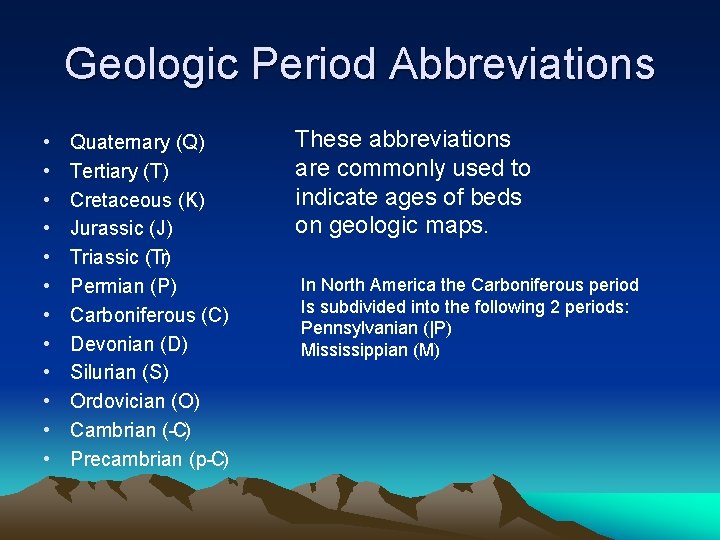
Geologic Period Abbreviations • • • Quaternary (Q) Tertiary (T) Cretaceous (K) Jurassic (J) Triassic (Tr) Permian (P) Carboniferous (C) Devonian (D) Silurian (S) Ordovician (O) Cambrian (-C) Precambrian (p-C) These abbreviations are commonly used to indicate ages of beds on geologic maps. In North America the Carboniferous period Is subdivided into the following 2 periods: Pennsylvanian (|P) Mississippian (M)
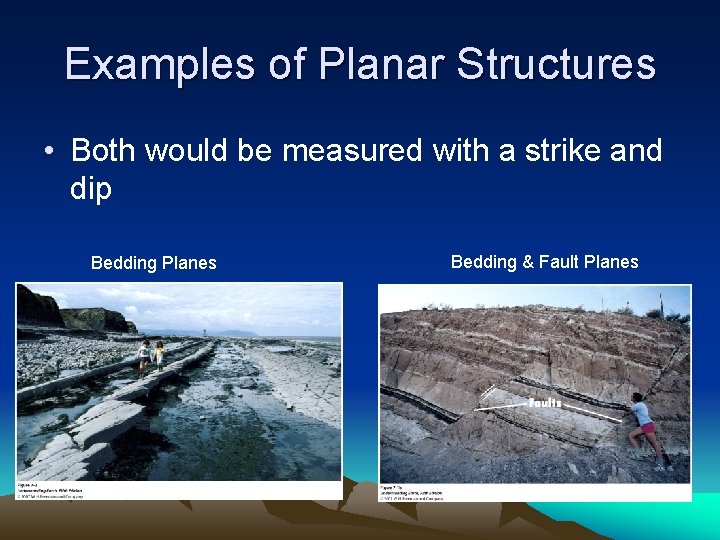
Examples of Planar Structures • Both would be measured with a strike and dip Bedding Planes Bedding & Fault Planes
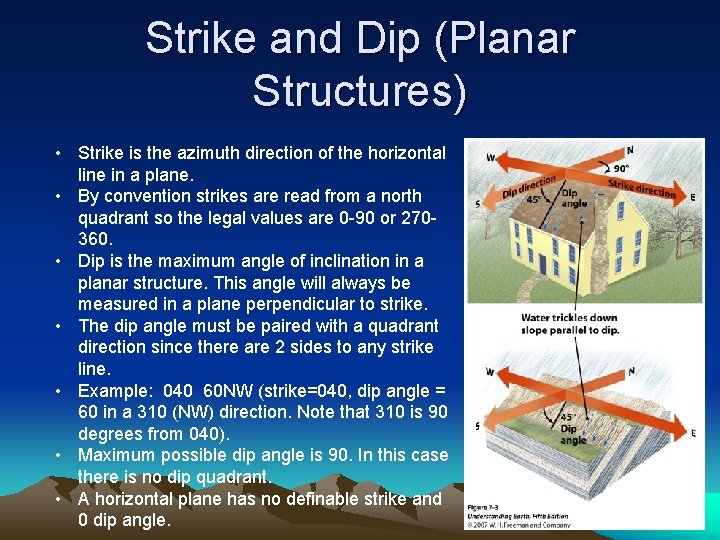
Strike and Dip (Planar Structures) • Strike is the azimuth direction of the horizontal line in a plane. • By convention strikes are read from a north quadrant so the legal values are 0 -90 or 270360. • Dip is the maximum angle of inclination in a planar structure. This angle will always be measured in a plane perpendicular to strike. • The dip angle must be paired with a quadrant direction since there are 2 sides to any strike line. • Example: 040 60 NW (strike=040, dip angle = 60 in a 310 (NW) direction. Note that 310 is 90 degrees from 040). • Maximum possible dip angle is 90. In this case there is no dip quadrant. • A horizontal plane has no definable strike and 0 dip angle.
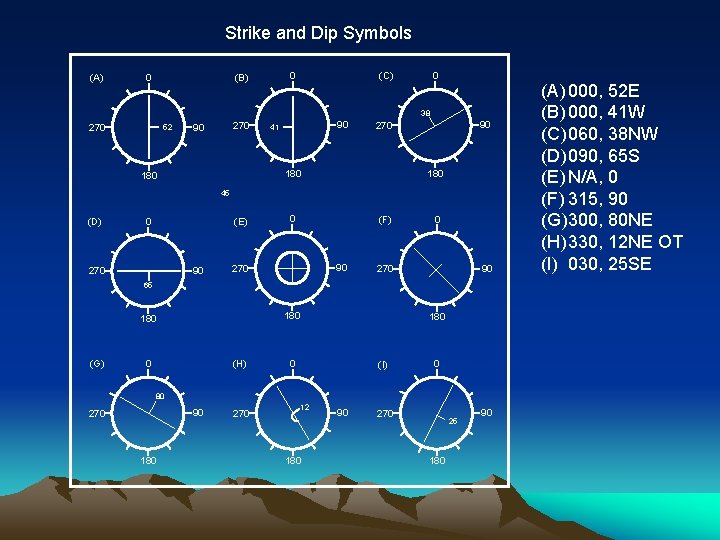
Strike and Dip Symbols (A) 0 0 (B) (C) 0 38 270 52 270 90 90 41 180 90 270 180 45 (D) (E) 0 90 270 0 (F) 90 270 0 90 270 65 180 (G) (H) 0 180 0 (I) 0 80 90 270 180 270 12 180 90 270 25 180 90 (A) 000, 52 E (B) 000, 41 W (C) 060, 38 NW (D) 090, 65 S (E) N/A, 0 (F) 315, 90 (G)300, 80 NE (H) 330, 12 NE OT (I) 030, 25 SE
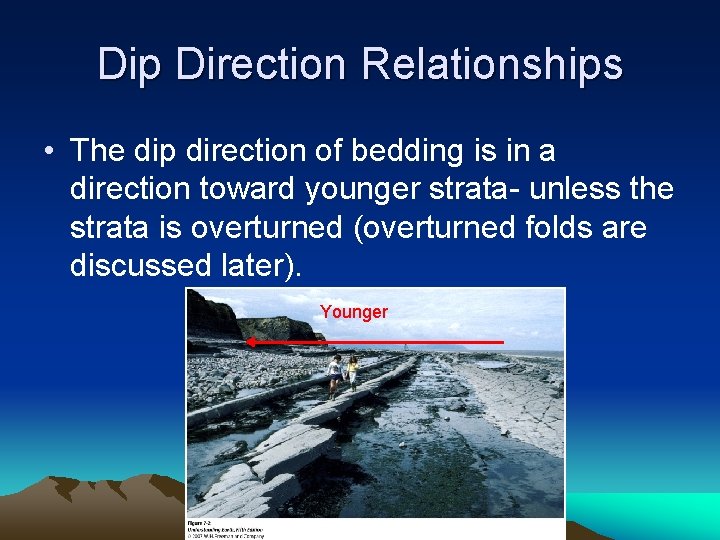
Dip Direction Relationships • The dip direction of bedding is in a direction toward younger strata- unless the strata is overturned (overturned folds are discussed later). Younger
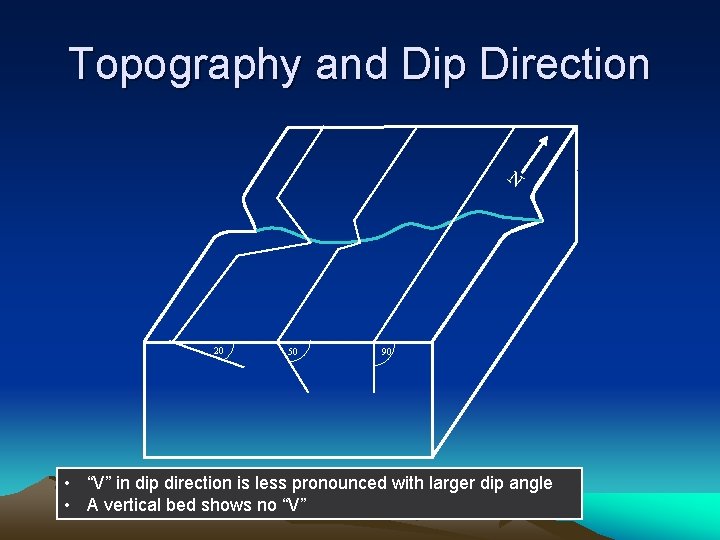
Topography and Dip Direction N 20 50 90 • “V” in dip direction is less pronounced with larger dip angle • A vertical bed shows no “V”
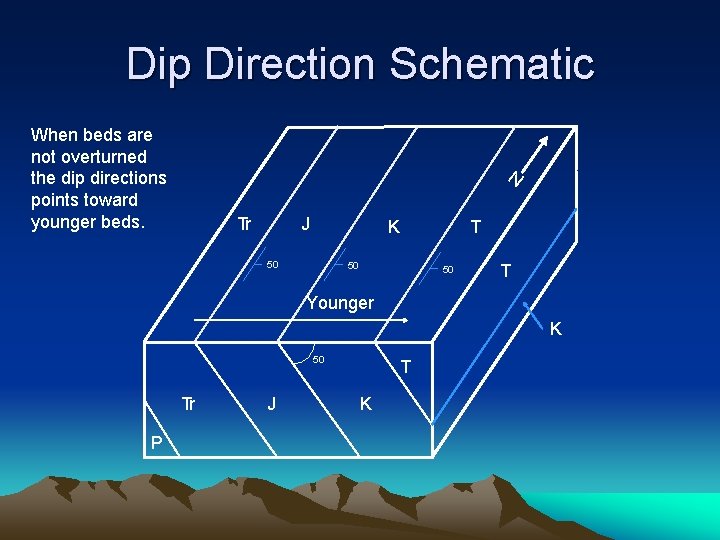
Dip Direction Schematic When beds are not overturned the dip directions points toward younger beds. N Tr J K 50 50 T Younger K 50 Tr P J T K
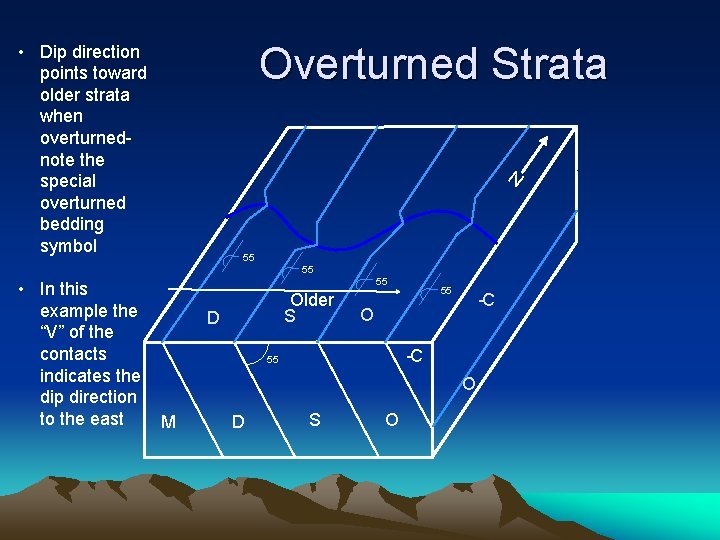
Overturned Strata • Dip direction points toward older strata when overturnednote the special overturned bedding symbol N 55 55 • In this example the “V” of the contacts indicates the dip direction to the east 55 Older S D 55 -C O -C 55 O M D S O
Trend and Plunge (Linear Structure) • Trend: azimuth direction of a linear structure projected up to a horizontal plane. • Plunge: incline angle of a linear structure. • Note that the trend may have any azimuth value 0 -360. • Maximum possible plunge is 90. • Linear structures with a plunge of 90 have no definable trend direction.
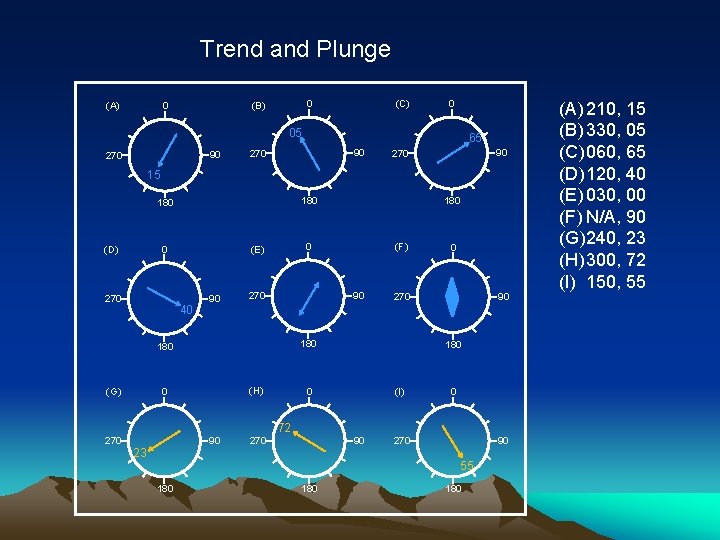
Trend and Plunge (A) 0 0 (B) (C) 0 05 90 270 65 90 270 15 180 (D) 0 270 0 (E) 40 90 270 (H) 90 72 90 180 0 (I) 90 270 180 0 23 (F) 90 270 180 (G) 180 0 90 270 55 180 180 (A) 210, 15 (B) 330, 05 (C) 060, 65 (D) 120, 40 (E) 030, 00 (F) N/A, 90 (G)240, 23 (H) 300, 72 (I) 150, 55
Faulting • Faults are generated in brittle rock layers when the elastic limit is exceeded by deformation forces. • Because brittle behavior is confined to the lithosphere faults do not extend into the asthenosphere.
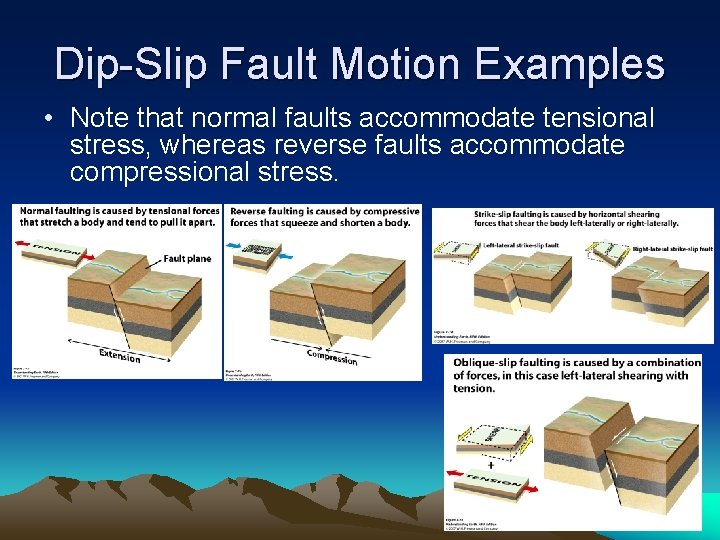
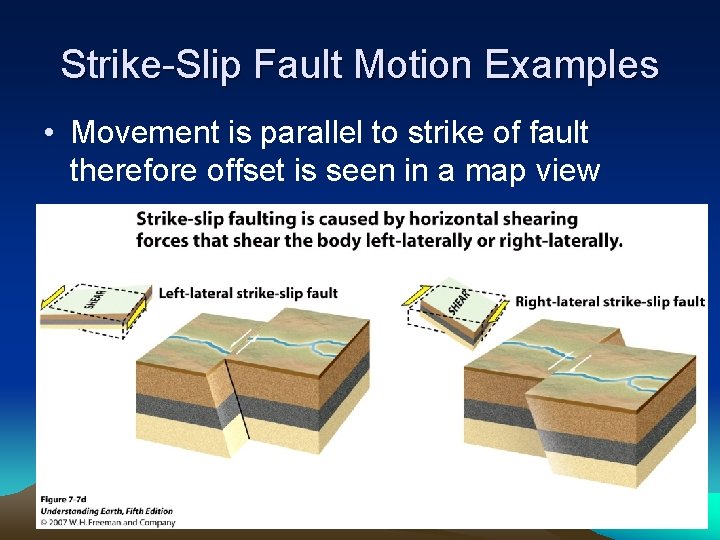
Fault Classification • Classified by the nature of the slippage of one fault block past another block. – Dip Slip: slippage is parallel to dip of fault. • Normal: hanging wall down motion • Reverse: hanging wall up motion – A special case of reverse where the fault dips < 45 degrees – Strike Slip: slippage is parallel to strike of fault. • Right lateral: a right-hand turn must be followed to find offset features • Left lateral: a left-hand turn must be followed to find offset features – Oblique Slip: has combined strike-slip and dip-slip motion.
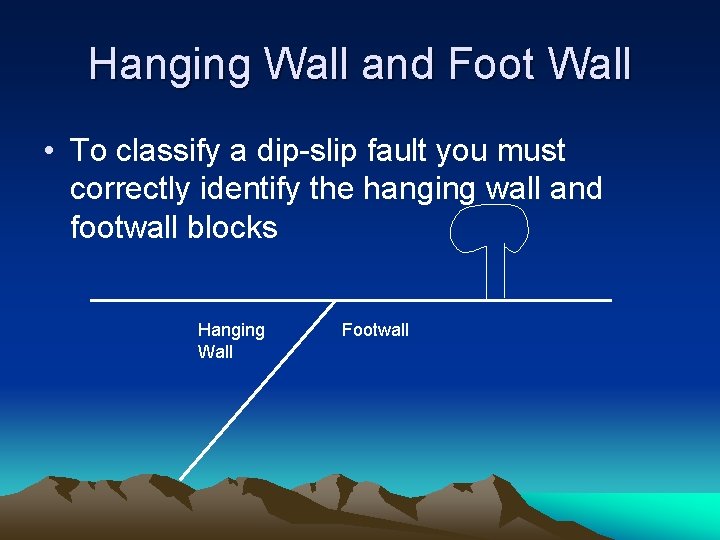
Hanging Wall and Foot Wall • To classify a dip-slip fault you must correctly identify the hanging wall and footwall blocks Hanging Wall Footwall
Dip-Slip Fault Motion Examples • Note that normal faults accommodate tensional stress, whereas reverse faults accommodate compressional stress.
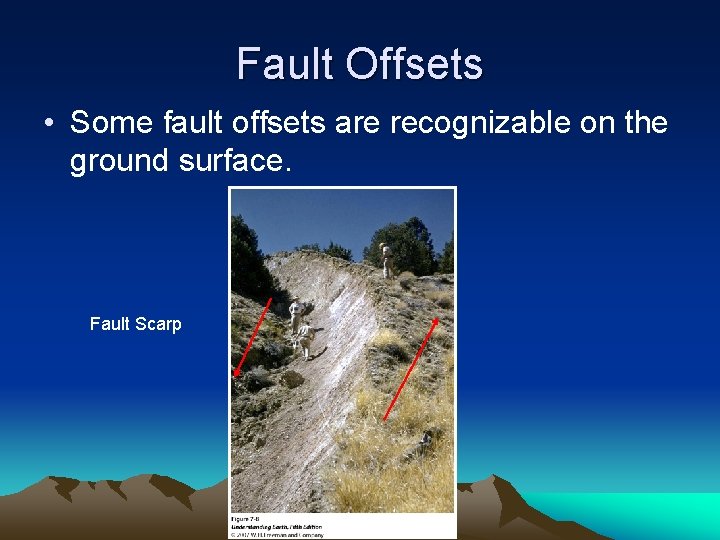
Fault Offsets • Some fault offsets are recognizable on the ground surface. Fault Scarp
Strike-Slip Fault Motion Examples • Movement is parallel to strike of fault therefore offset is seen in a map view
Tectonic Associations of Fault Types • Divergent: tension tends to produce normal dip-slip faults. • Convergent: compression tends to produce thrust (low-dip angle reverse dipslip) faults. • Transform: shear produces strike-slip faults.
Folding • Folding is produced by the compression generated at convergent plate boundaries. • Folds require rocks to be under significant T and P so that the layers of rock can bend without breaking (i. e. ductile).
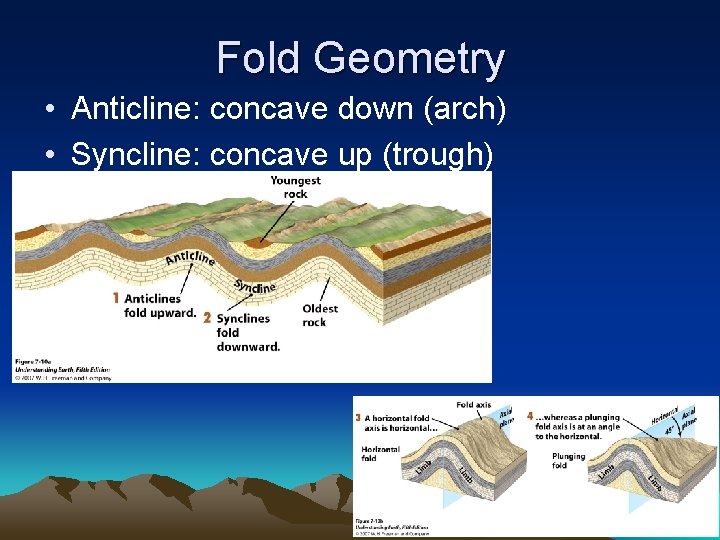
Fold Geometry • Anticline: concave down (arch) • Syncline: concave up (trough)
Fold Age Relationships • Anticlines contain the oldest strata in the center of the structure. Bedding dips away from the center of the structure if the fold is not overturned. • Synclines contain the youngest strata in the center of the structure. Bedding dips toward the center of the structure if the fold is not overturned.
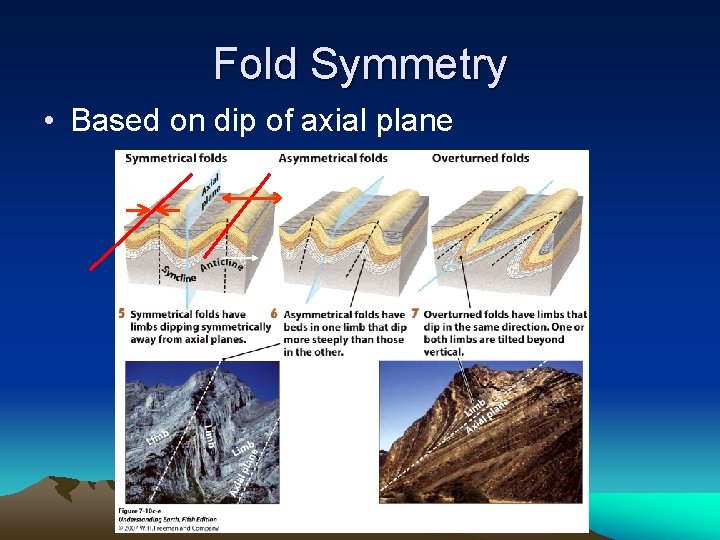
Fold Symmetry • Based on dip of axial plane
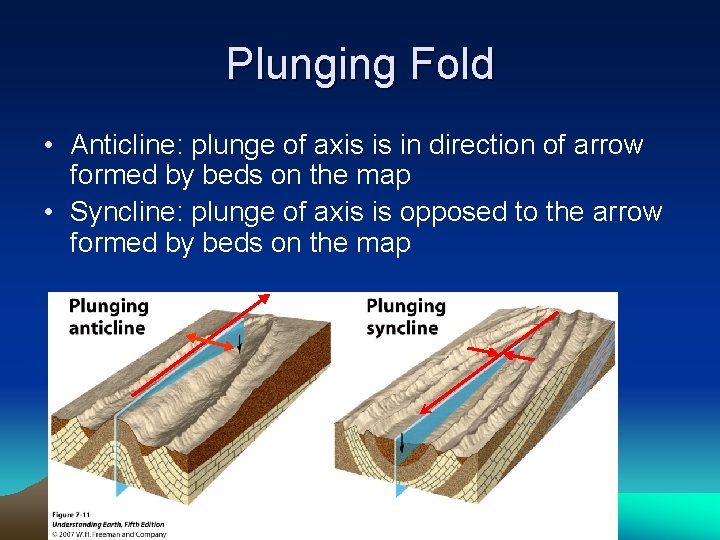
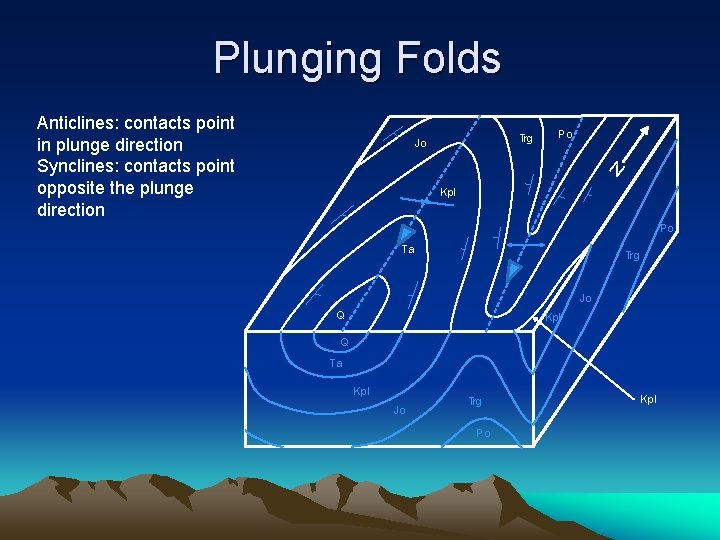
Plunging Fold • Anticline: plunge of axis is in direction of arrow formed by beds on the map • Syncline: plunge of axis is opposed to the arrow formed by beds on the map
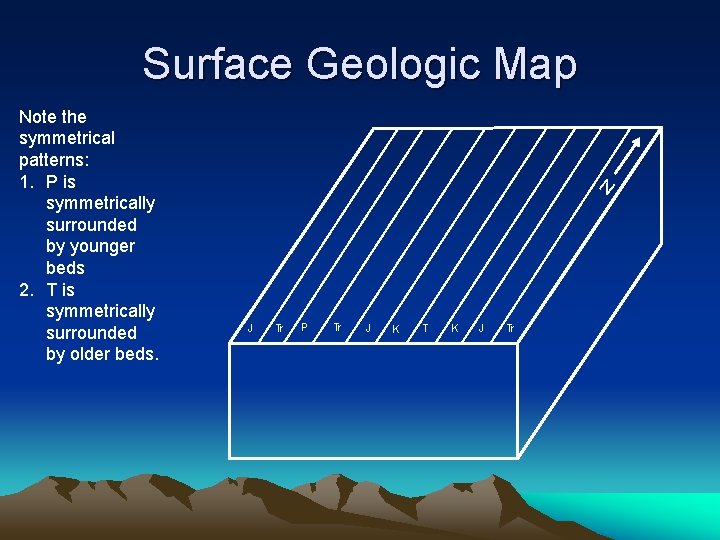
Surface Geologic Map Note the symmetrical patterns: 1. P is symmetrically surrounded by younger beds 2. T is symmetrically surrounded by older beds. N J Tr P Tr J K T K J Tr
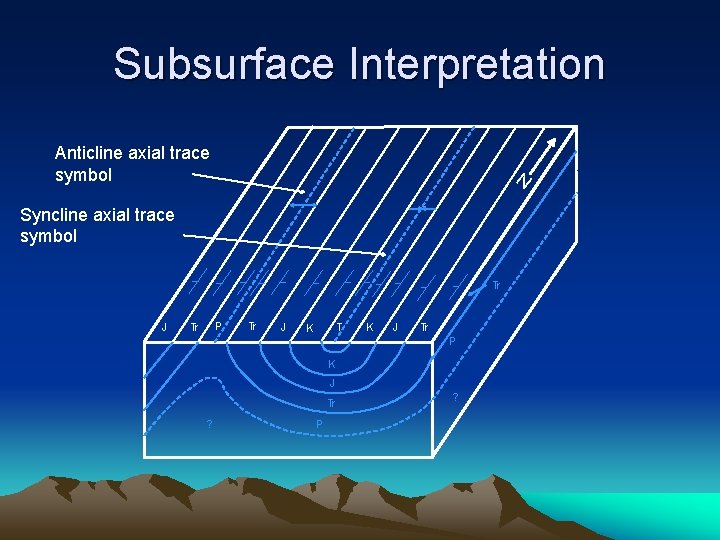
Subsurface Interpretation Anticline axial trace symbol N Syncline axial trace symbol Tr J P Tr Tr J T K K J Tr P K J Tr ? P ?
Plunging Folds Anticlines: contacts point in plunge direction Synclines: contacts point opposite the plunge direction Trg Jo Po N Kpl Po Ta Trg Jo Q Kpl Q Ta Kpl Jo Trg Po Kpl
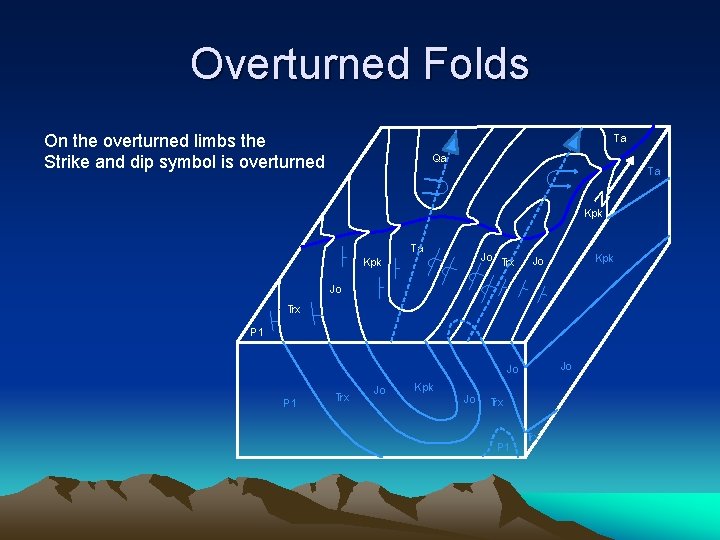
Overturned Folds On the overturned limbs the Strike and dip symbol is overturned Ta Qa Ta N Kpk Ta Jo Trx Kpk Jo Jo Trx P 1 Jo Jo P 1 Trx Jo Kpk Jo Trx P 1 Trx
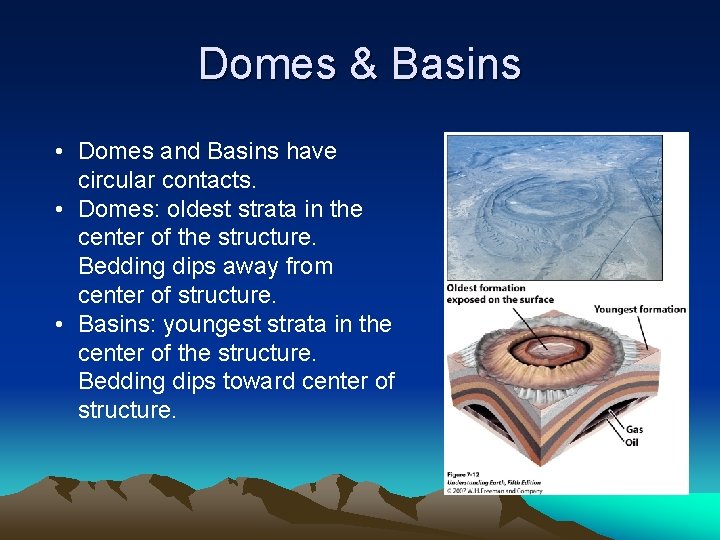
Domes & Basins • Domes and Basins have circular contacts. • Domes: oldest strata in the center of the structure. Bedding dips away from center of structure. • Basins: youngest strata in the center of the structure. Bedding dips toward center of structure.
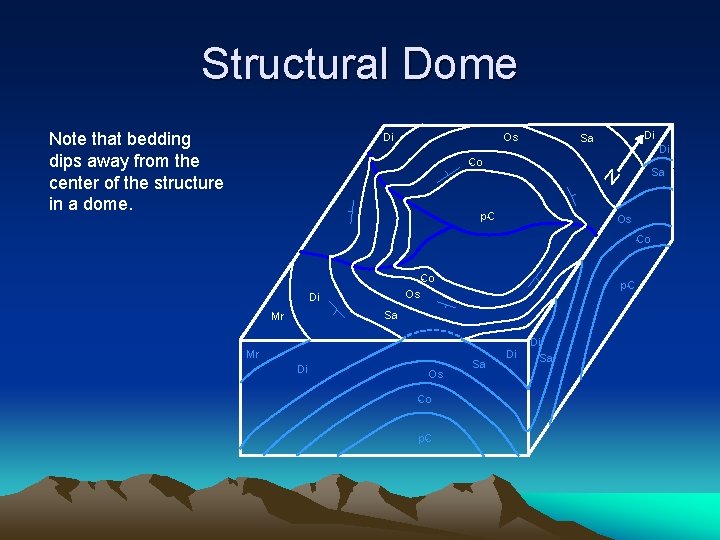
Structural Dome Note that bedding dips away from the center of the structure in a dome. Di Os Di Sa -Co Di N p-C Sa Os -Co p-C Os Di Sa Mr Mr Di Os -Co p-C Sa Di Di Sa
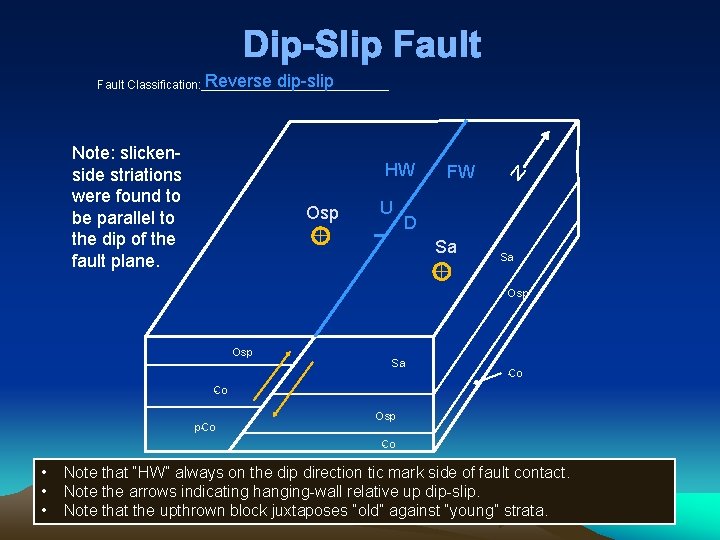
Dip-Slip Fault Reverse dip-slip Fault Classification: ______________ Note: slickenside striations were found to be parallel to the dip of the fault plane. HW Osp U FW N D Sa Sa Osp Sa -Co p-Co Osp -Co • • • Note that “HW” always on the dip direction tic mark side of fault contact. Note the arrows indicating hanging-wall relative up dip-slip. Note that the upthrown block juxtaposes “old” against “young” strata.
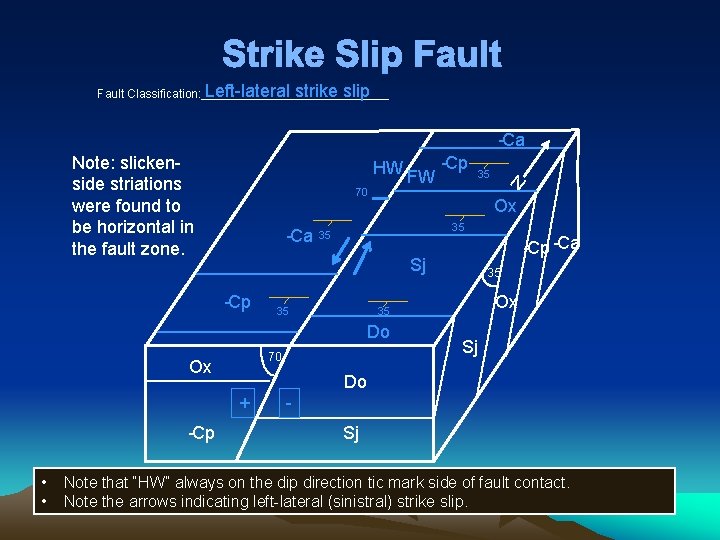
Strike Slip Fault Left-lateral strike slip Fault Classification: ______________ -Ca Note: slickenside striations were found to be horizontal in the fault zone. HW 70 -Ca 35 35 35 -Cp -Ca 35 Ox 35 70 Ox N 35 Ox Do Sj Do + • • -Cp Sj -Cp FW Sj Note that “HW” always on the dip direction tic mark side of fault contact. Note the arrows indicating left-lateral (sinistral) strike slip.
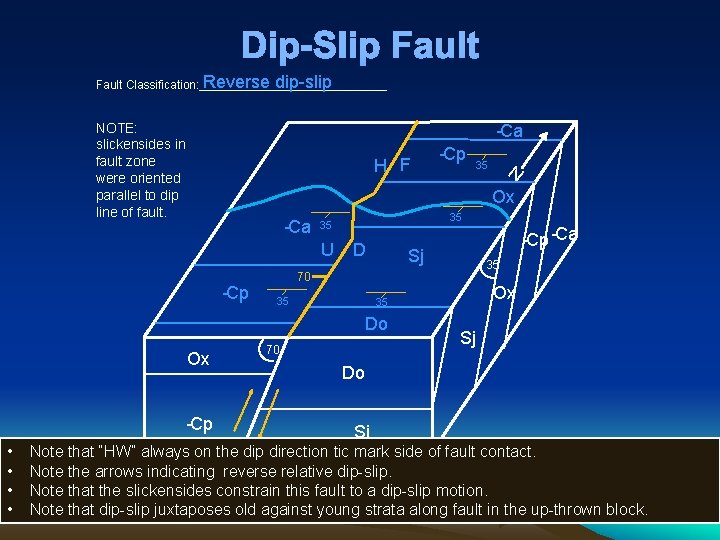
Dip-Slip Fault Reverse dip-slip Fault Classification: ______________ NOTE: slickensides in fault zone were oriented parallel to dip line of fault. -Ca H F N 35 Ox -Ca -Cp 35 35 U D Ox -Cp -Ca Sj 35 70 35 Ox 35 Do • • -Cp 70 Sj Do Sj Note that “HW” always on the dip direction tic mark side of fault contact. Note the arrows indicating reverse relative dip-slip. Note that the slickensides constrain this fault to a dip-slip motion. Note that dip-slip juxtaposes old against young strata along fault in the up-thrown block.
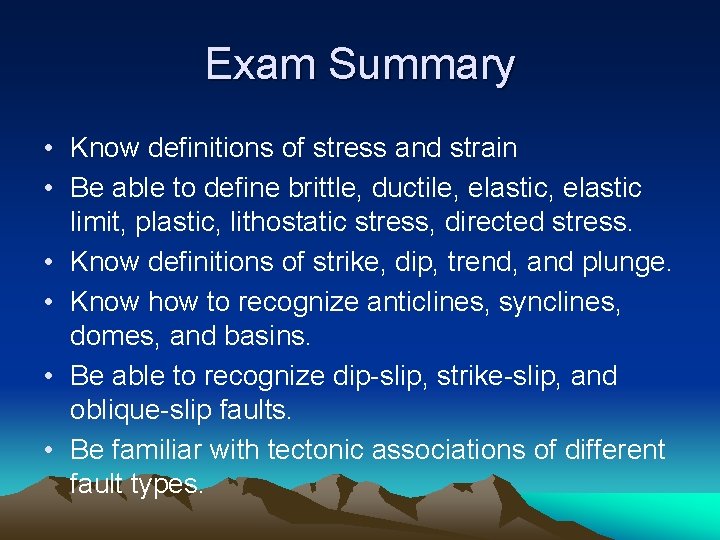
Exam Summary • Know definitions of stress and strain • Be able to define brittle, ductile, elastic limit, plastic, lithostatic stress, directed stress. • Know definitions of strike, dip, trend, and plunge. • Know how to recognize anticlines, synclines, domes, and basins. • Be able to recognize dip-slip, strike-slip, and oblique-slip faults. • Be familiar with tectonic associations of different fault types.