
Gulfs of Execution and Evaluation A Bad Day
Gulfs of Execution and Evaluation
A Bad Day for an Object • User can’t act and can’t think – Broken mapping – Can’t achieve goals – No feedback
How people interact with objects • Have a goal • Have ability to ACT • Evaluate actions – Did ACT=>GOAL?
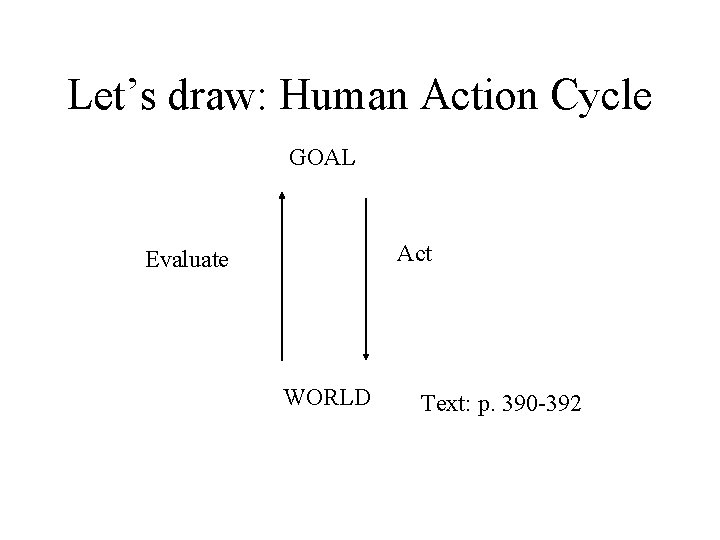
Let’s draw: Human Action Cycle GOAL Act Evaluate WORLD Text: p. 390 -392
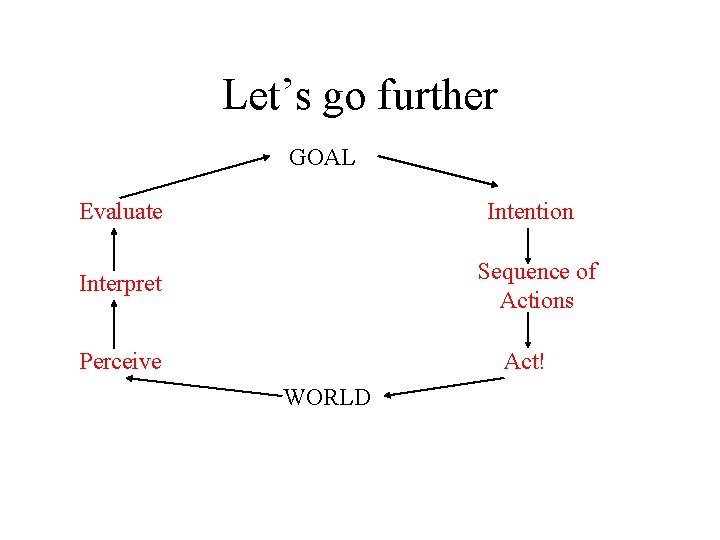
Let’s go further GOAL Evaluate Interpret Intention Act Evaluate Perceive Sequence of Actions Act! WORLD
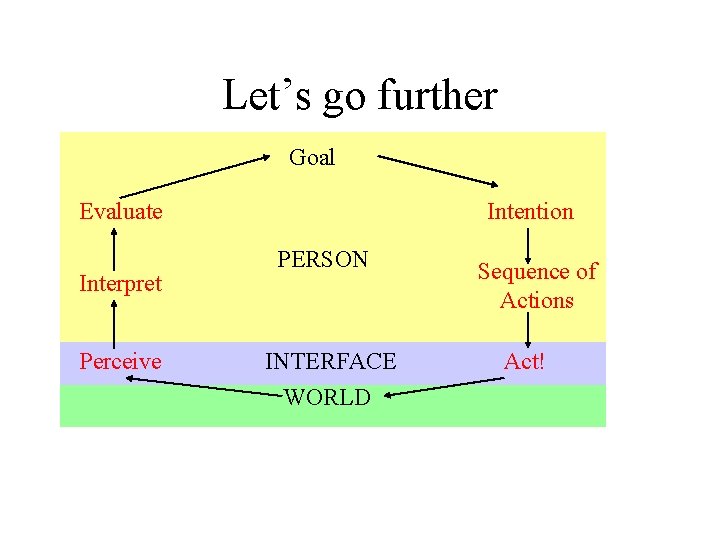
Let’s go further Goal Evaluate Interpret Perceive Intention PERSON INTERFACE WORLD Sequence of Actions Act!
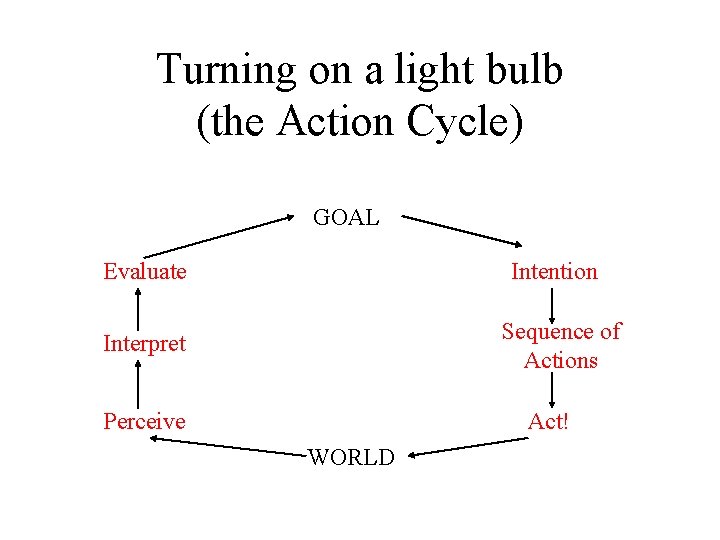
Turning on a light bulb (the Action Cycle) GOAL Evaluate Interpret Intention Act Evaluate Perceive Sequence of Actions Act! WORLD
So what are the Gulfs • Execution: have an intention but can’t act • Evaluation: Can’t figure out whether the goal has been achieved
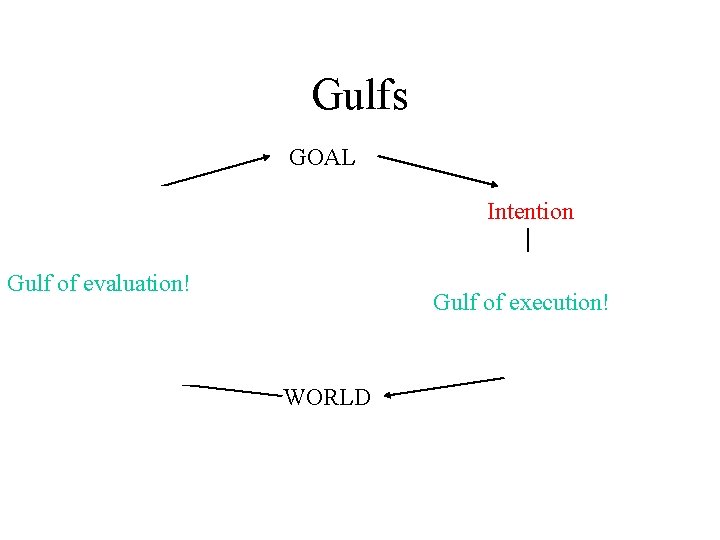
Gulfs GOAL Evaluate Intention Sequence of Gulf of. Actions execution! Gulf of Interpret evaluation! Perceive WORLD
Questions • Why is intention left in the diagram?
7 Gulf Based Design Questions • 1. Do I know what it does? • 2. Do I know what actions I can take? • 3. Can I map each of my intentions to a movement? • 4. Can I make those actions easily? • 5. Do I know what state or mode its in? • 6. Can I interpret that state? • 7. Can I tell when my goal has been achieved?
Back to light bulbs • Have you ever seen – A lamp that wasn’t obviously a light? – A lamp you didn’t know how to turn on or off or how many levels it had? – A lamp where you didn’t know how the switch worked? – The switch was hard to flip? – You couldn’t tell if it was on/off/or on and burned out?
• Other examples?
When do you deliberately design a gulf of execution?
When do you not want a gulf of execution?
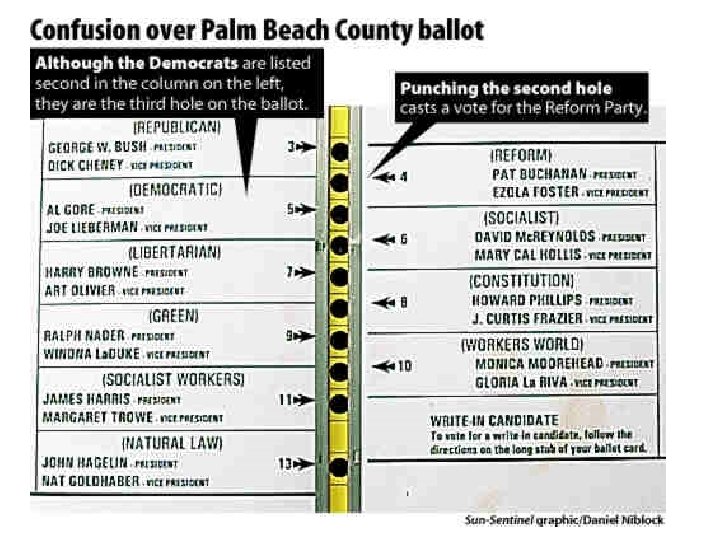
Mini Design Exercise • With a partner or small group, design a better voting system. • How will your system support the complete action cycle?
- Slides: 17