
Gulf Coasts Barrier Islands MS Coastal Islands The
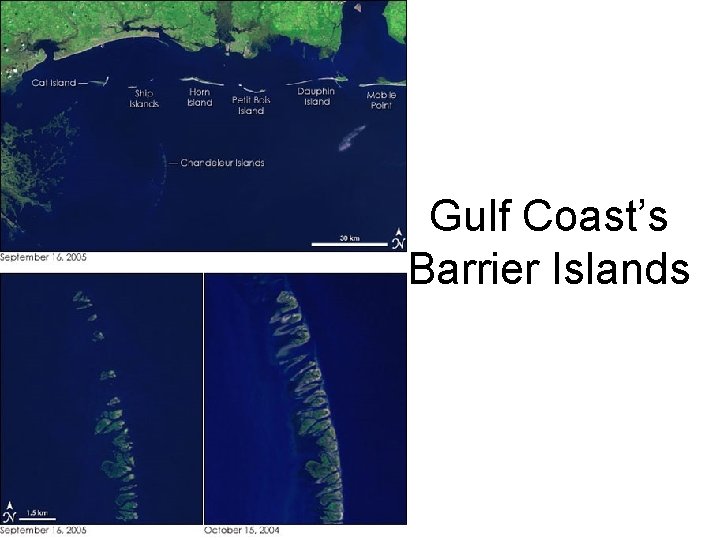
Gulf Coast’s Barrier Islands
MS Coastal Islands • • The Sand that forms our barrier islands comes from the Appalachian Mountains esp. around Georgia, so today’s sand dunes were perhaps, thousands of years ago, a mountain top near Georgia and South Carolina. The main sand component is quartz. The Mississippi Sound is an average of 12 -15 feet deep. Our islands are moving west and in 100’s of years will eventually be in LA.
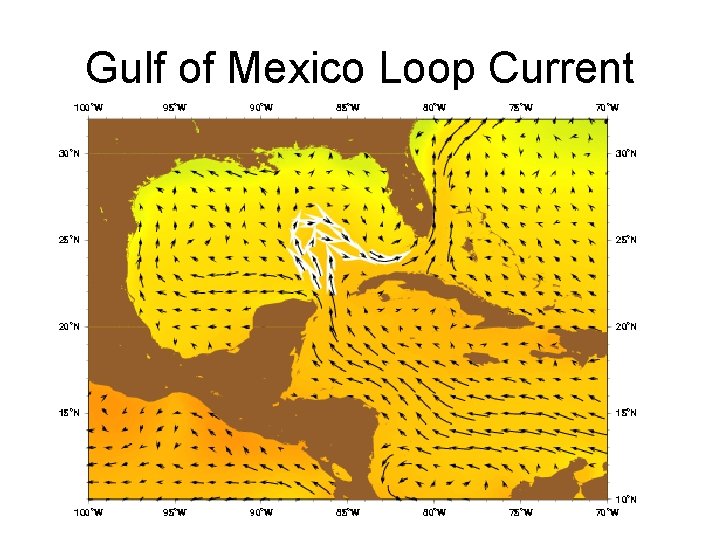
Gulf of Mexico Loop Current
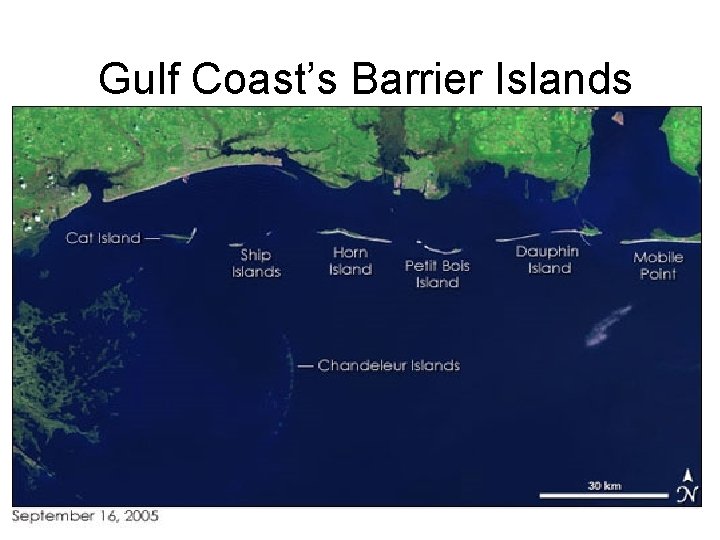
Gulf Coast’s Barrier Islands
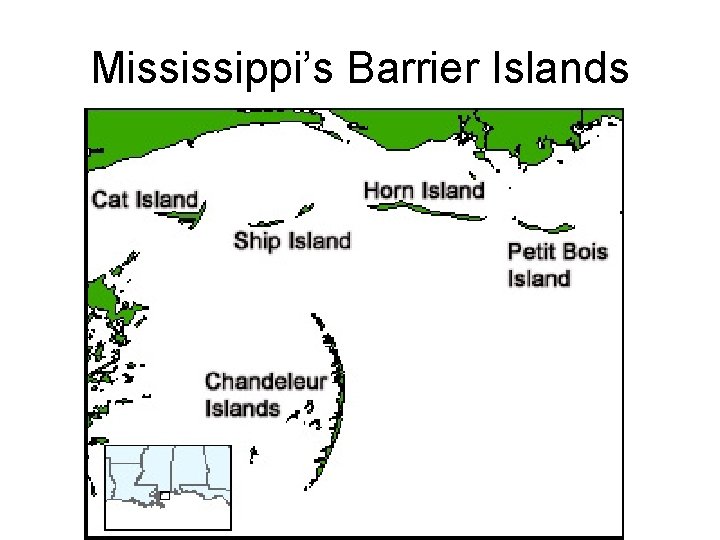
Mississippi’s Barrier Islands
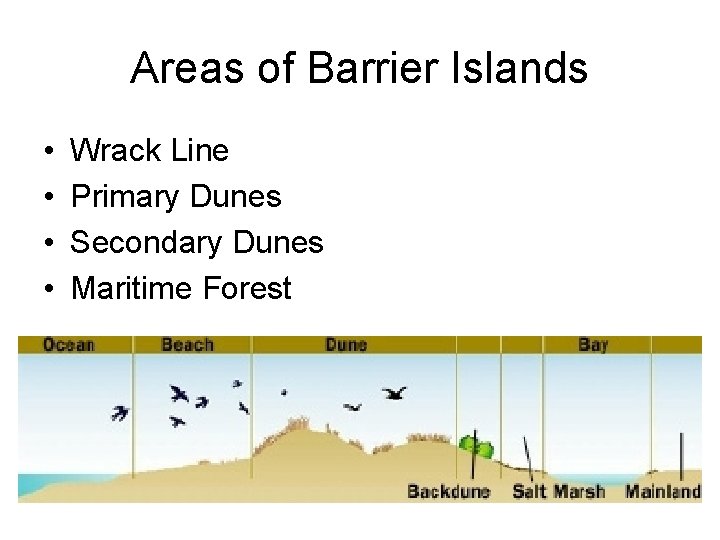
Areas of Barrier Islands • • Wrack Line Primary Dunes Secondary Dunes Maritime Forest
The Isle of Caprice *Emerged around 1900 *Favorite excursion resort in 1920’s for New Orleanians escaping the hot, humid summers. *Storm erosion and harvesting of sea oats cut back the island. *The casino on it burned and then the island disappeared completely with a hurricane in 1947.
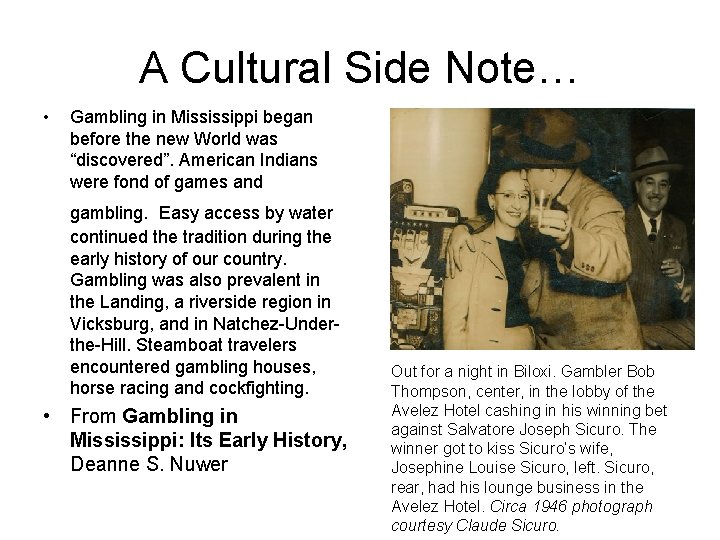
A Cultural Side Note… • Gambling in Mississippi began before the new World was “discovered”. American Indians were fond of games and gambling. Easy access by water continued the tradition during the early history of our country. Gambling was also prevalent in the Landing, a riverside region in Vicksburg, and in Natchez-Underthe-Hill. Steamboat travelers encountered gambling houses, horse racing and cockfighting. • From Gambling in Mississippi: Its Early History, Deanne S. Nuwer Out for a night in Biloxi. Gambler Bob Thompson, center, in the lobby of the Avelez Hotel cashing in his winning bet against Salvatore Joseph Sicuro. The winner got to kiss Sicuro’s wife, Josephine Louise Sicuro, left. Sicuro, rear, had his lounge business in the Avelez Hotel. Circa 1946 photograph courtesy Claude Sicuro.
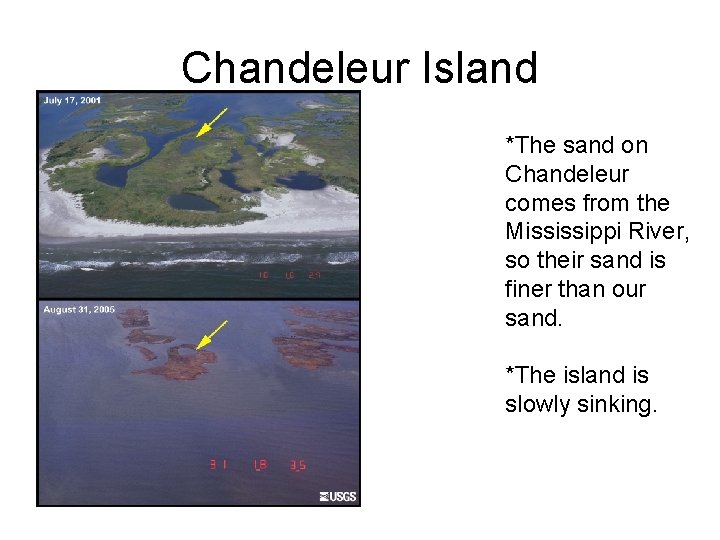
Chandeleur Island *The sand on Chandeleur comes from the Mississippi River, so their sand is finer than our sand. *The island is slowly sinking.
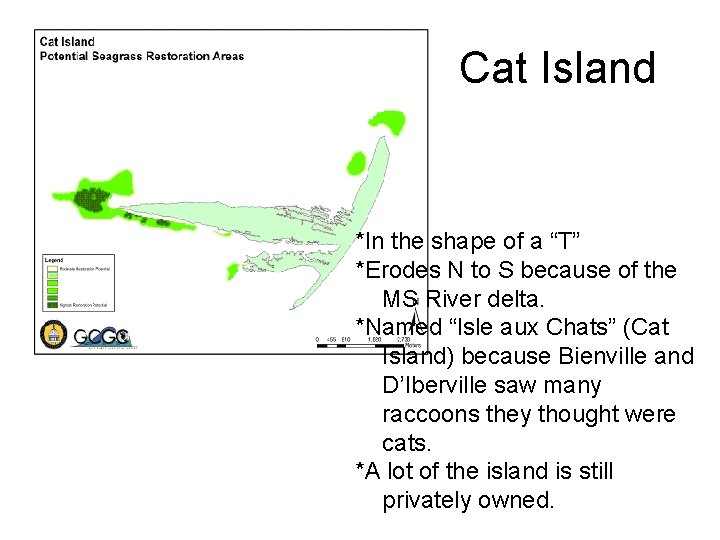
Cat Island *In the shape of a “T” *Erodes N to S because of the MS River delta. *Named “Isle aux Chats” (Cat Island) because Bienville and D’Iberville saw many raccoons they thought were cats. *A lot of the island is still privately owned.
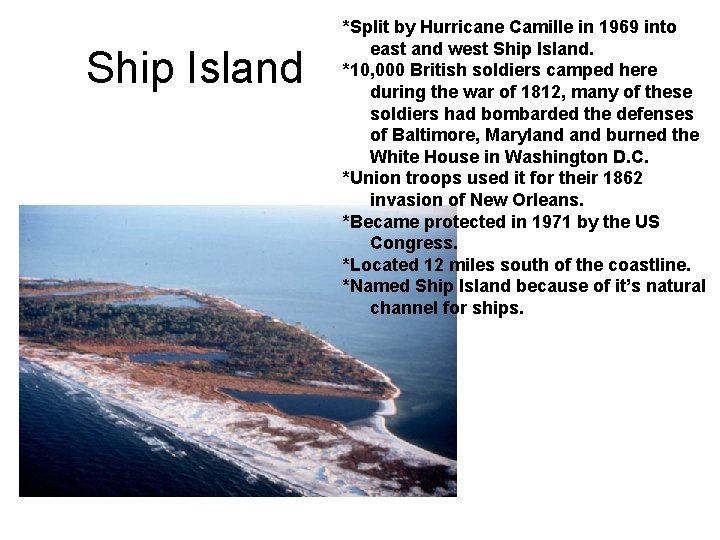
Ship Island *Split by Hurricane Camille in 1969 into east and west Ship Island. *10, 000 British soldiers camped here during the war of 1812, many of these soldiers had bombarded the defenses of Baltimore, Maryland burned the White House in Washington D. C. *Union troops used it for their 1862 invasion of New Orleans. *Became protected in 1971 by the US Congress. *Located 12 miles south of the coastline. *Named Ship Island because of it’s natural channel for ships.
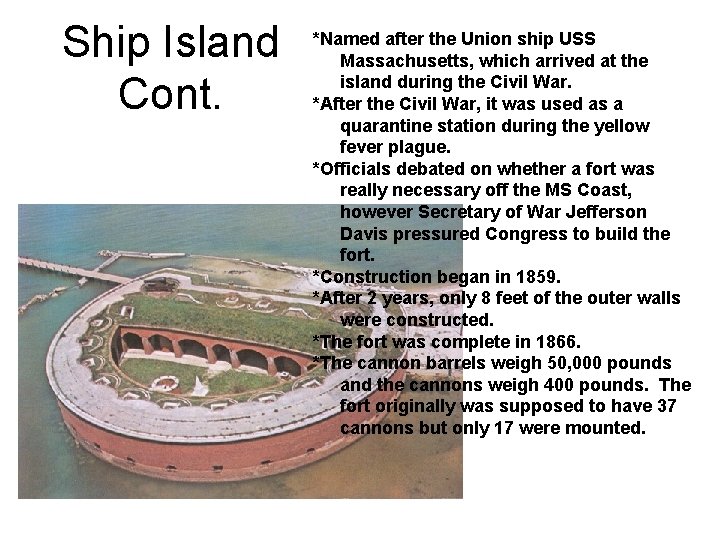
Ship Island Cont. *Named after the Union ship USS Massachusetts, which arrived at the island during the Civil War. *After the Civil War, it was used as a quarantine station during the yellow fever plague. *Officials debated on whether a fort was really necessary off the MS Coast, however Secretary of War Jefferson Davis pressured Congress to build the fort. *Construction began in 1859. *After 2 years, only 8 feet of the outer walls were constructed. *The fort was complete in 1866. *The cannon barrels weigh 50, 000 pounds and the cannons weigh 400 pounds. The fort originally was supposed to have 37 cannons but only 17 were mounted.
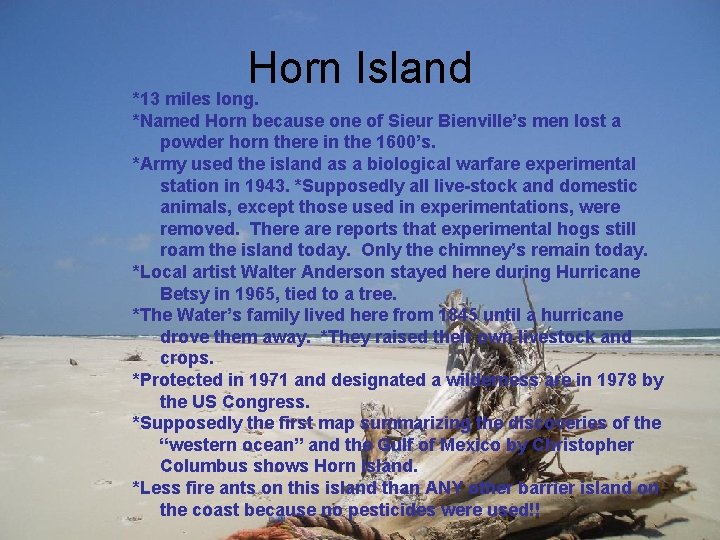
Horn Island *13 miles long. *Named Horn because one of Sieur Bienville’s men lost a powder horn there in the 1600’s. *Army used the island as a biological warfare experimental station in 1943. *Supposedly all live-stock and domestic animals, except those used in experimentations, were removed. There are reports that experimental hogs still roam the island today. Only the chimney’s remain today. *Local artist Walter Anderson stayed here during Hurricane Betsy in 1965, tied to a tree. *The Water’s family lived here from 1845 until a hurricane drove them away. *They raised their own livestock and crops. *Protected in 1971 and designated a wilderness are in 1978 by the US Congress. *Supposedly the first map summarizing the discoveries of the “western ocean” and the Gulf of Mexico by Christopher Columbus shows Horn Island. *Less fire ants on this island than ANY other barrier island on the coast because no pesticides were used!!
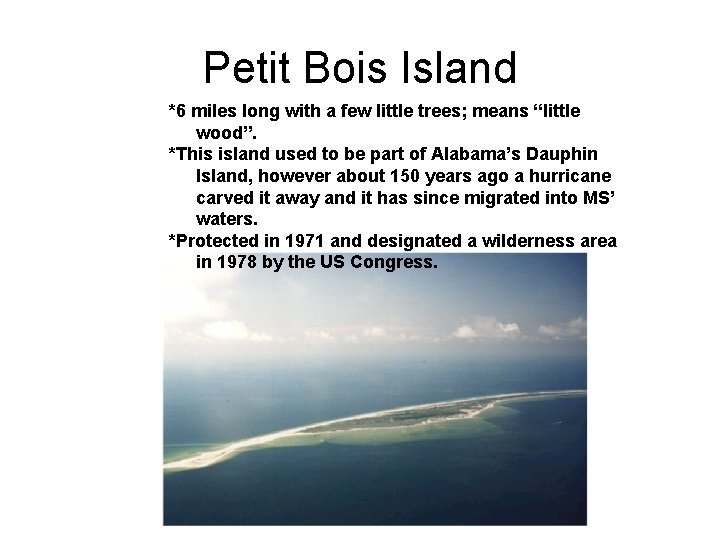
Petit Bois Island *6 miles long with a few little trees; means “little wood”. *This island used to be part of Alabama’s Dauphin Island, however about 150 years ago a hurricane carved it away and it has since migrated into MS’ waters. *Protected in 1971 and designated a wilderness area in 1978 by the US Congress.
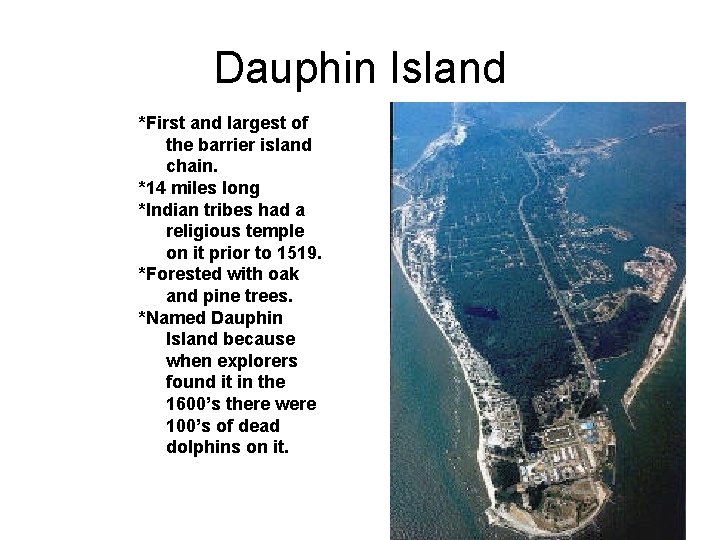
Dauphin Island *First and largest of the barrier island chain. *14 miles long *Indian tribes had a religious temple on it prior to 1519. *Forested with oak and pine trees. *Named Dauphin Island because when explorers found it in the 1600’s there were 100’s of dead dolphins on it.
Island Vegetation Zones • Salt and brackish marsh – Saltgrass, rushes • Tidal freshwater marsh – Arrowhead, spikerush, bullrush • Maritime shrub – . Rosemary (Rosmarinus officinalis) a woody, perennial herb with fragrant evergreen needle-like leaves, a member of the mint family; "dew of the sea", scrub oaks, eastern baccharis • Maritime slash pine savannah – Slash pine, salt meadow cordgrass • Maritime evergreen forest – Live oak, upland laurel oak, slash pine
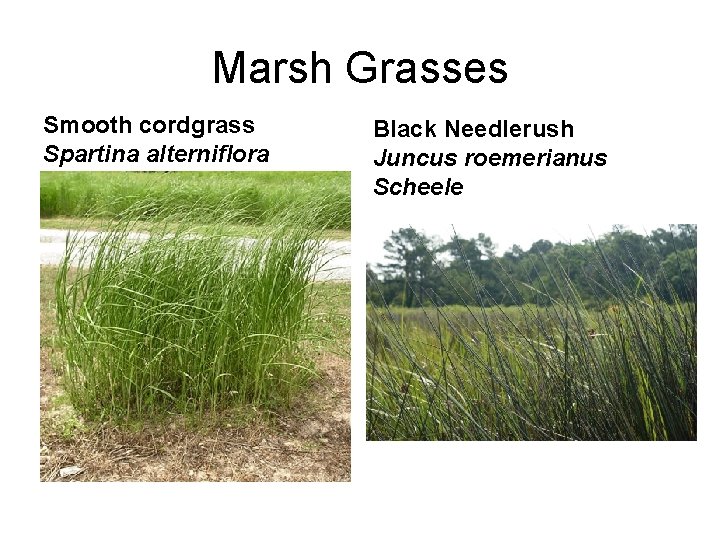
Marsh Grasses Smooth cordgrass Spartina alterniflora Black Needlerush Juncus roemerianus Scheele
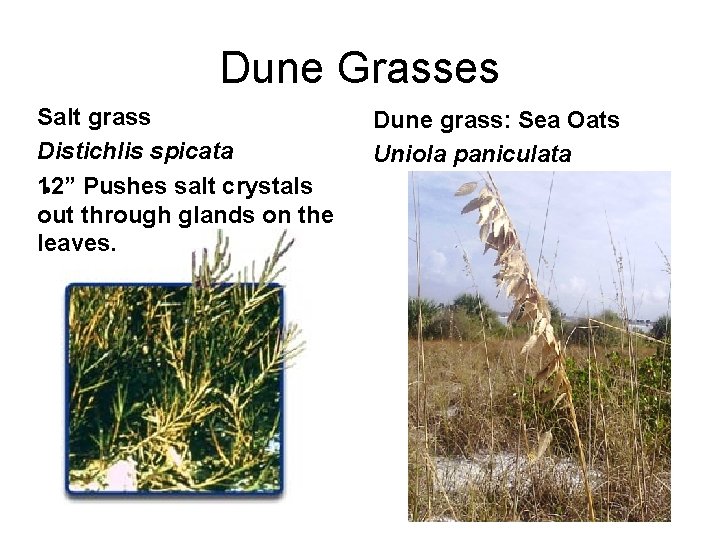
Dune Grasses Salt grass Distichlis spicata 12” Pushes salt crystals • out through glands on the leaves. Dune grass: Sea Oats Uniola paniculata
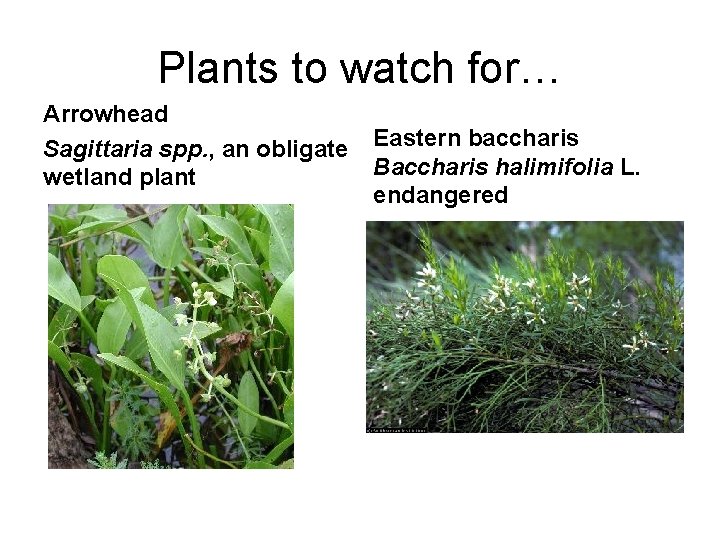
Plants to watch for… Arrowhead Sagittaria spp. , an obligate Eastern baccharis Baccharis halimifolia L. wetland plant endangered
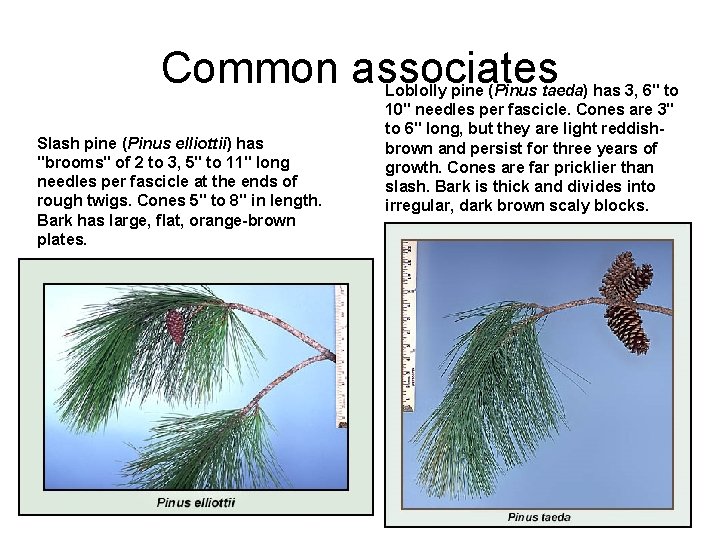
Common associates Slash pine (Pinus elliottii) has "brooms" of 2 to 3, 5" to 11" long needles per fascicle at the ends of rough twigs. Cones 5" to 8" in length. Bark has large, flat, orange-brown plates. Loblolly pine (Pinus taeda) has 3, 6" to 10" needles per fascicle. Cones are 3" to 6" long, but they are light reddishbrown and persist for three years of growth. Cones are far pricklier than slash. Bark is thick and divides into irregular, dark brown scaly blocks.
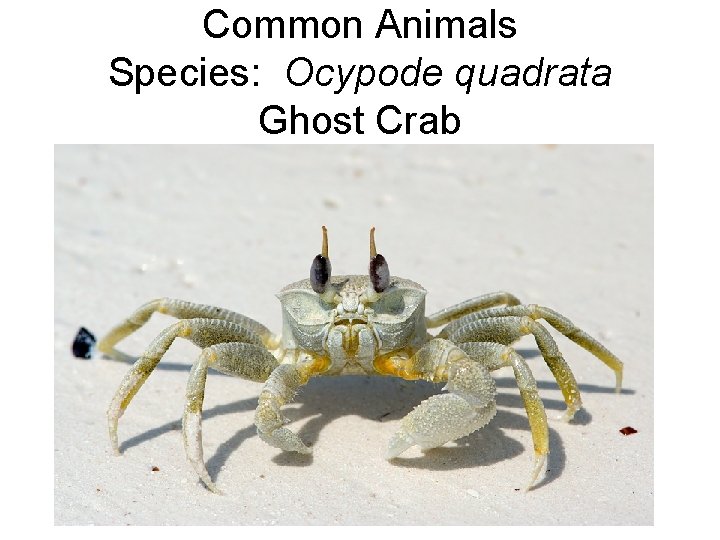
Common Animals Species: Ocypode quadrata Ghost Crab
Species: Ocypode quadrata Ghost Crab • Scuttle at speeds up to 10 mph • Sharp 360° vision which they use to see flying insects and catch them in mid air. The ghost crab, however, cannot see directly up, so it must burrow into the ground to prevent birds from catching it. • Ghost crab tunnels down four feet into the ground at a 45° angle, creating 1 -2 inch wide holes, which speckle the beach. • At dusk, these crabs will sprint to the ocean in order to obtain oxygen from the water which washes over their gills • Ghost crabs hibernate during the winter, holding their breath for six months, by storing oxygen in sacs near the gills. They can also have a natural filter system which gathers oxygen from the air, enough to survive for one year without entering into water.
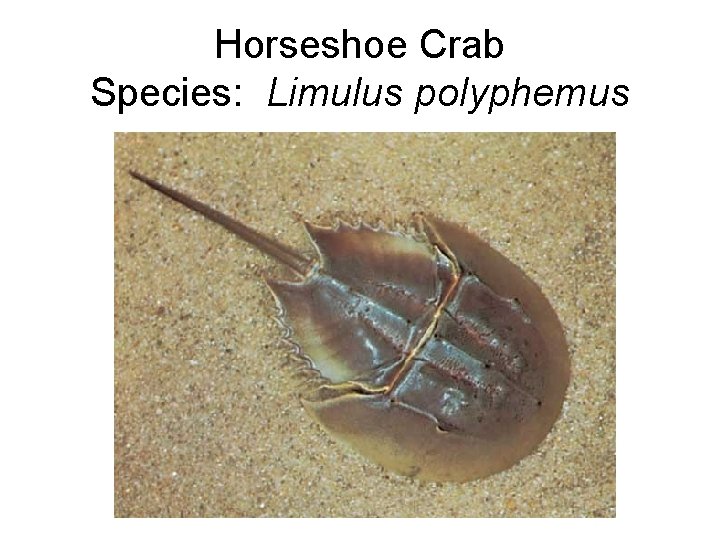
Horseshoe Crab Species: Limulus polyphemus
Horseshoe Crab Species: Limulus polyphemus • A marine chelicerate arthropod. Despite its name, it is more closely related to spiders, ticks, and scorpions than to crabs • The female is typically 25 to 30 percent larger than the male. • Before becoming mature around age 9, they have to shed their shells some 17 times. They can live for as long as 31 years. • Lay 15, 000 -64, 000 eggs per female • Horseshoe crabs are distant relatives of spiders and are probably descended from the ancient eurypterids (sea scorpions). They evolved in the shallow seas of the Paleozoic Era (540 -248 million years ago). The four species of horseshoe crab are the only remaining members of the class Merostomata, one of the oldest classes of marine arthropods. Horseshoe crabs are often referred to as living fossils, as they have changed little in the last 445 million years • Horseshoe crabs possess the rare ability to regrow lost limbs.
Horseshoe Crab Species: Limulus polyphemus • Horseshoe crabs are valuable as a species to the medical research community. The horseshoe crab has a simple but effective immune system. When a foreign object such as a bacterium enters through a wound in the animal's body, a substance called Limulus Amebocyte Lysate (LAL) almost immediately clots into a clear gel-like material, effectively trapping the foreign body. LAL is used to test for bacterial endotoxins in pharmaceuticals and for several bacterial diseases. If the bacterium is harmful, the blood will form a clot. Horseshoe crabs are helpful in finding remedies for diseases that have developed resistances to penicillin and other drugs. Horseshoe crabs are returned to the ocean after bleeding. Studies show that blood volume returns to normal in about a week, though blood cell count can take two to three months to fully rebound. A single horseshoe crab can be worth $2, 500 over its lifetime for periodic blood extractions.
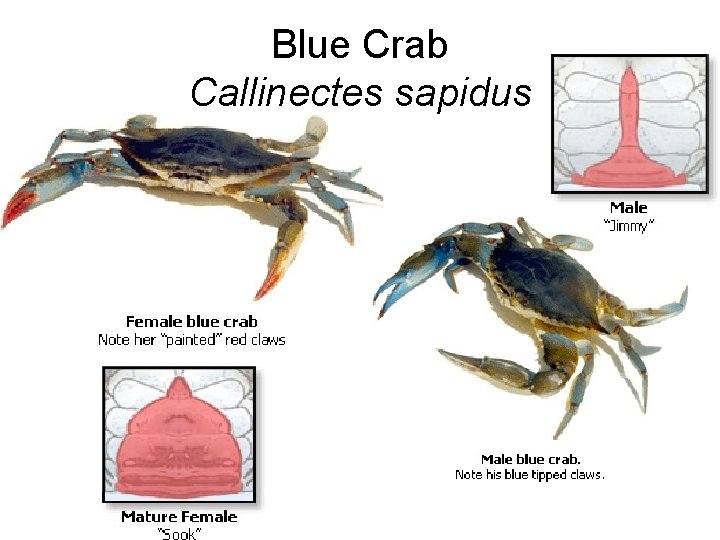
Blue Crab Callinectes sapidus
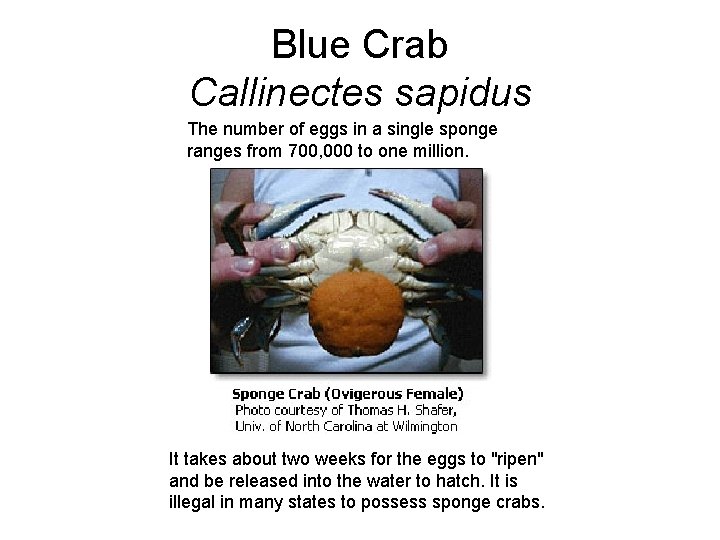
Blue Crab Callinectes sapidus The number of eggs in a single sponge ranges from 700, 000 to one million. It takes about two weeks for the eggs to "ripen" and be released into the water to hatch. It is illegal in many states to possess sponge crabs.
Blue Crab Callinectes sapidus • • Greek calli="beautiful", nectes="swimmer", and Latin sapidus="savory" The blue crab is an omnivore, eating both plants and animals. Blue crabs typically consume thin-shelled bivalves, annelids, fish, plants, and nearly any other item they can find The most important commercial crab species in the Gulf of Mexico. Though she mates only once, she stores a portion of the sperm and is capable of producing fertile eggs for one or more additional "sponges" during her life. Males will mate throughout their life span. It has been estimated that a crab (including larval molts) will shed approximately 25 times during its life
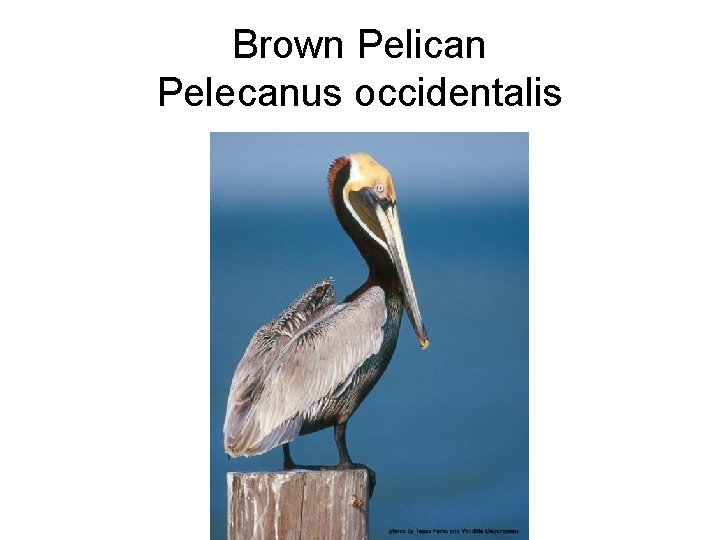
Brown Pelican Pelecanus occidentalis
Brown Pelican Pelecanus occidentalis • Shooting for feathers and to "protect" fishing caused declines in pelican populations in the first half of the 20 th century. Pesticide poisoning, especially by DDT, caused severe declines across the range in the late 1950's and the expiration from Louisiana ("the pelican state"). It was listed as Endangered throughout the range in 1970. The ban on DDT led to a population recovery, and it was removed from the Endangered Species list in Atlantic Coast states in 1985. Breeding numbers in most states are stable or increasing, and the total population in the United States now exceeds historical levels. • Is the smallest of the eight species of pelican, although it is a large bird in nearly every other regard. It is 106 -137 cm (42 -54 in) in length, weighs from 2. 75 to 5. 5 kg (6 -12 lb) and has a wingspan from 1. 83 to 2. 5 m (6 to 8. 2 ft).
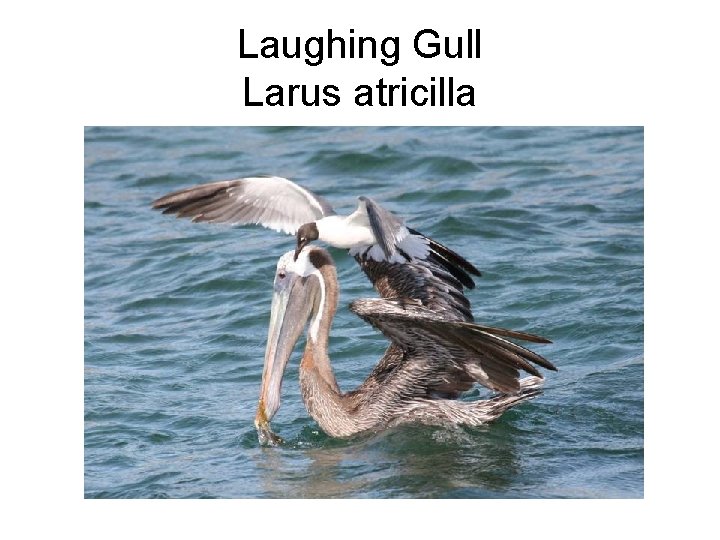
Laughing Gull Larus atricilla
Laughing Gull Larus atricilla • Nest colonies in northeastern United States were nearly eliminated by egg and plume hunters in the late 19 th century. Populations have increased over the last century, following protection. • The male and female Laughing Gull usually build their nest together. If a male cannot find a mate, he may start building a nest platform and then use it to attract a female. • Laughing Gulls take three years to reach adult plumage. Immature birds are always darker than most similar sized gulls other than Franklin's. First year birds are greyer below and have paler heads than first year Franklin's, and second years can be distinguished on the wing pattern and structure.
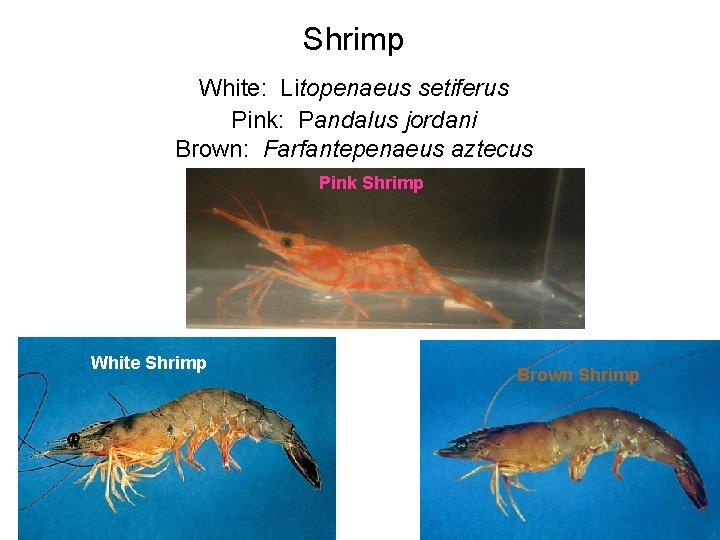
Shrimp White: Litopenaeus setiferus Pink: Pandalus jordani Brown: Farfantepenaeus aztecus Pink Shrimp White Shrimp Brown Shrimp
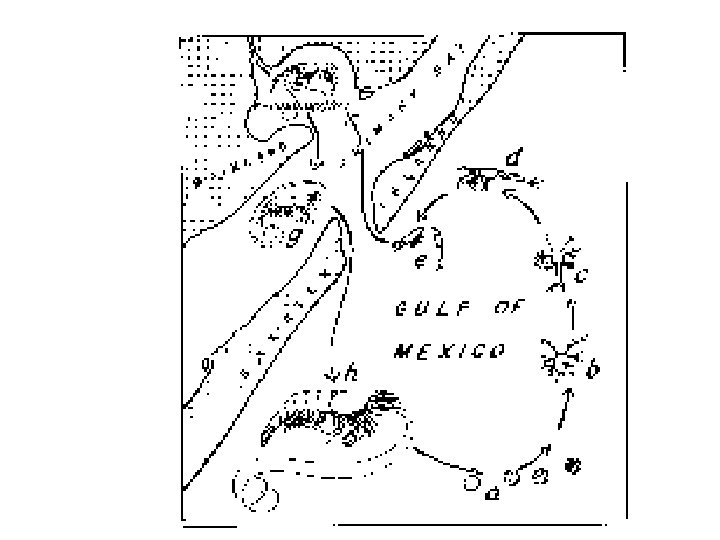
White Shrimp Litopenaeus setiferus • Few white shrimp live as long as a year, and the maximum lifespan is about two years • Spawning happens as far as 9 km from the shore, and involves between 50, 000 and 1 million eggs being released at a time. The eggs sink to the bottom of the water as they are released and hatch 10 -12 hours later. • Juvenile shrimp can grow 1. 2 mm per day during late spring and summer months, but growth is slow in the spring.
Brown Shrimp Farfantepenaeus aztecus • Adults are typically 30– 50 mm (1¼– 2 in) long, although individuals up to 90 mm have been recorded. • They live in shallow water, which can also be slightly brackish, and feed nocturnally. During the day, they remain buried in the sand to escape predatory birds and fish, with only their antennae protruding.
Pink Shrimp Pandalus jordani • Sexually dimorphic, with large males attaining a length of 169 mm, and large females reaching over 280 mm • Individuals reaching sexual maturity may live a year or more • Sub-adults and adults show pronounced diurnal activity patterns, remaining burrowed in the substratum during the daylight hours, and becoming active in the water column in the evening.
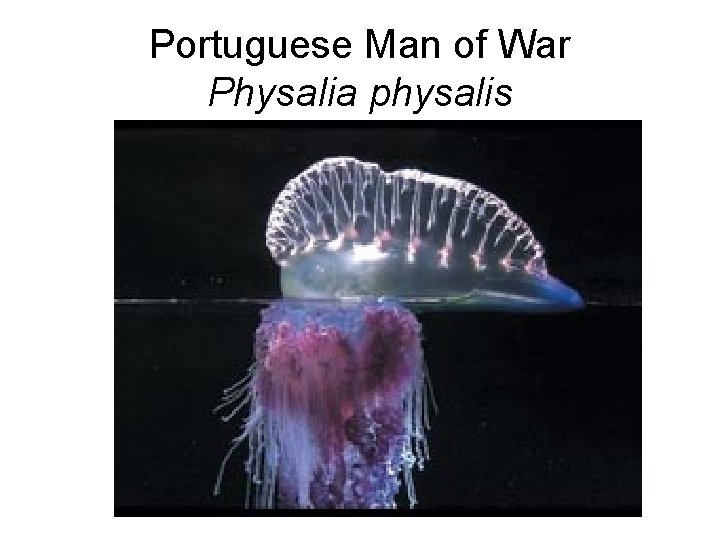
Portuguese Man of War Physalia physalis
Portuguese Man of War Physalia physalis • Commonly thought of as a jellyfish but is actually a siphonophore—a colony of specialized polyps and medusoids. • It has no means of propulsion, but is moved by a combination of winds, currents, and tides. Very rarely is a single Portuguese Man O' War seen, but rather the discovery of one is usually a warning of more to come • To escape a surface attack, the pneumatophore can be deflated allowing the Man O' War to briefly submerge. • Below the main body dangle long tentacles, which sometimes reach ten metres (33 feet) in length below the surface, although one metre (three feet) is the average • Stings from the tentacles can be dangerous to humans, but usually are not. These stings usually cause excruciating pain, and have even been the cause of a few deaths. Detached tentacles and specimens which wash up on shore can sting just as painfully as the intact creature in the water for days to weeks after their detachment. The venom can travel up to the lymph nodes and may cause, depending on the amount of venom, more intense pain. Medical attention is usually necessary, especially in extreme cases.
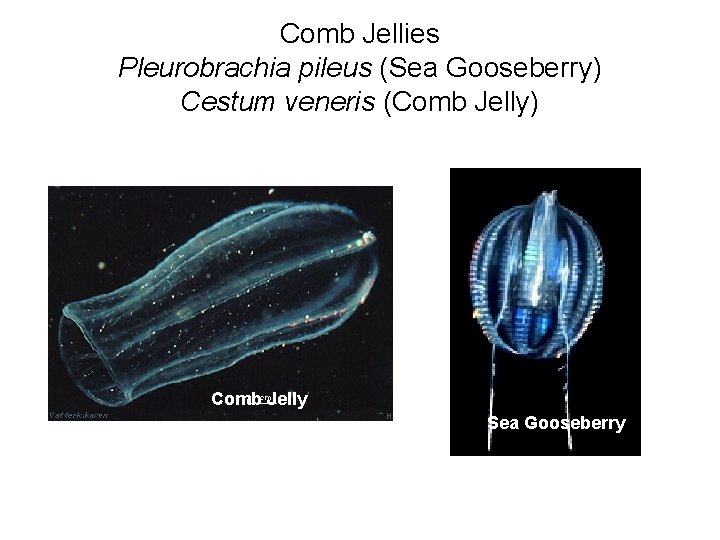
Comb Jellies Pleurobrachia pileus (Sea Gooseberry) Cestum veneris (Comb Jelly) Comb Jelly Sea Gooseberry
Comb Jellies Pleurobrachia pileus (Sea Gooseberry) Cestum veneris (Comb Jelly) • Despite their appearance, they are zoologically not jellyfish, not least because they lack the characteristic cnidocytes (stinging cells) but have connective tissues and a nervous system. There are close to 150 described species of ctenophora spread throughout the world's oceans, from shallow estuarine waters to the deep sea • The light emission of ctenophores is not bioluminescence but merely diffraction of ambient light, • There is no separate exit from the stomach apart from two 'anal pores', which despite their name appear to be only moderately used for excretion, so indigestible waste is principally expelled via the mouth.
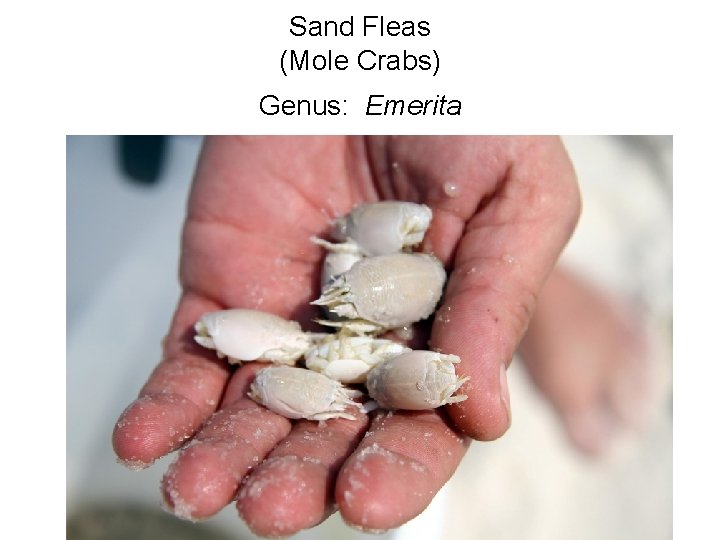
Sand Fleas (Mole Crabs) Genus: Emerita
Sand Fleas (Mole Crabs) Genus: Emerita • Mole crabs live under sand in shallow water near the shore, and live from two to three years. They have the color of rippled sand at the water's edge and live mostly buried in the sand in the zone where the waves wash up onto the beach, with their antennnae reaching into the water forming a V-shaped obstacle in the water as the wave recedes. These antennae filter plankton and organic debris from the water. Mole crabs also eat the tentacles of Portuguese man o’ war, which are collected by winding the tentacle around the mole crab's leg. Their camouflage protects them from their predators - chiefly fish and birds.

A great resource for teachers • http: //www. marine-ed. org/bridge/
- Slides: 45