
Gulf Coast Energy Outlook Gregory B Upton Jr

Gulf Coast Energy Outlook Gregory B. Upton Jr. , Ph. D. Louisiana State University Center for Energy Studies American Council of Engineering Companies of Louisiana Baton Rouge, LA. November 16, 2017
Introduction The Era of Shale Up-Stream Oil and Gas Outlook Industrial Outlook Employment Outlook Conclusions © LSU Center for Energy Studies 2

Introduction © LSU Center for Energy Studies 3
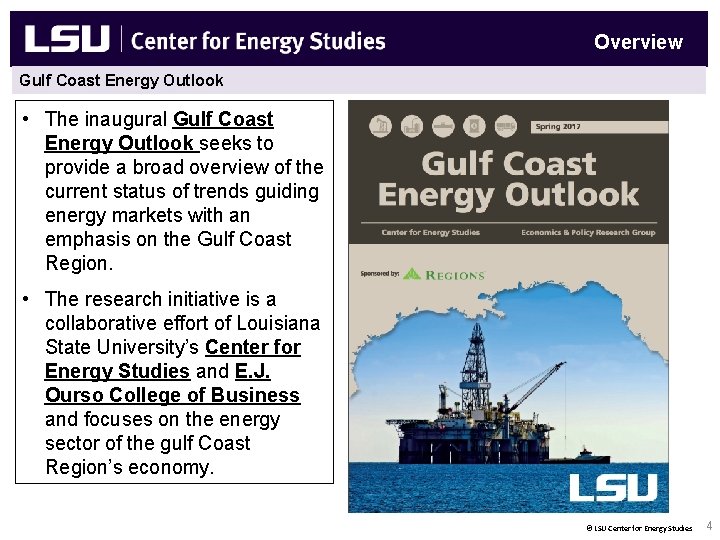
Overview Gulf Coast Energy Outlook • The inaugural Gulf Coast Energy Outlook seeks to provide a broad overview of the current status of trends guiding energy markets with an emphasis on the Gulf Coast Region. • The research initiative is a collaborative effort of Louisiana State University’s Center for Energy Studies and E. J. Ourso College of Business and focuses on the energy sector of the gulf Coast Region’s economy. © LSU Center for Energy Studies 4
Introduction • The advent of shale oil and gas has fundamentally shifted the energy outlook not only here in on the U. S. Gulf Coast, but also globally. • U. S. shale production has led to significant decreases in global prices, and all eyes are on the resilience of U. S. producers in determining long term price forecasts. • While Gulf Coast production has increased significantly with shale, the composition of this production has changed significantly, creating potential winners and losers. • Significant opportunities for industrial expansion have been created, and historic investments in mid-stream and down-stream sectors are on the horizon. • The advent of shale has also fundamentally changed electricity markets, shifting towards lower emissions natural gas and creating opportunities for significant growth in renewables. © LSU Center for Energy Studies 5
The Era of Shale © LSU Center for Energy Studies 6
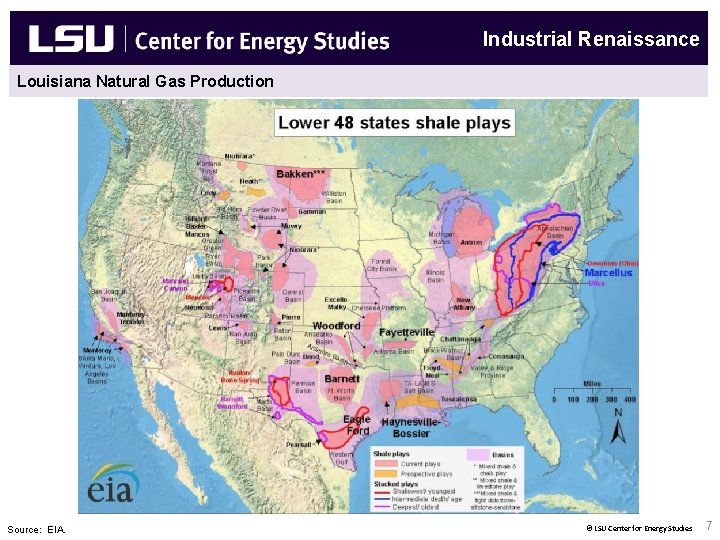
Industrial Renaissance Louisiana Natural Gas Production New Natural Gas End Uses & Fuel Diversity Concerns Source: EIA. © LSU Center for Energy Studies 7
Up-Stream Historical Trends Up-Stream Oil and Gas • From 1980 until the early 2000 s, both Texas and Louisiana experienced significant decreases in crude production—both in absolute terms as well as a share of total US production. This was offset, though, by the relative increased share of Federal Offshore production. • Due to the advent of shale oil production, Texas has seen a resurgence in crude production and now accounts for almost 60% of Gulf Coast Production. • While Federal Offshore production has remained relatively flat, its relative share had declined significantly. The future of investment in offshore production is uncertain. • Louisiana (state production) now accounts for less than three percent of our region’s production. • Gulf Coast relative share of U. S. production is now a larger share than at any point in the past four decades. © LSU Center for Energy Studies 8
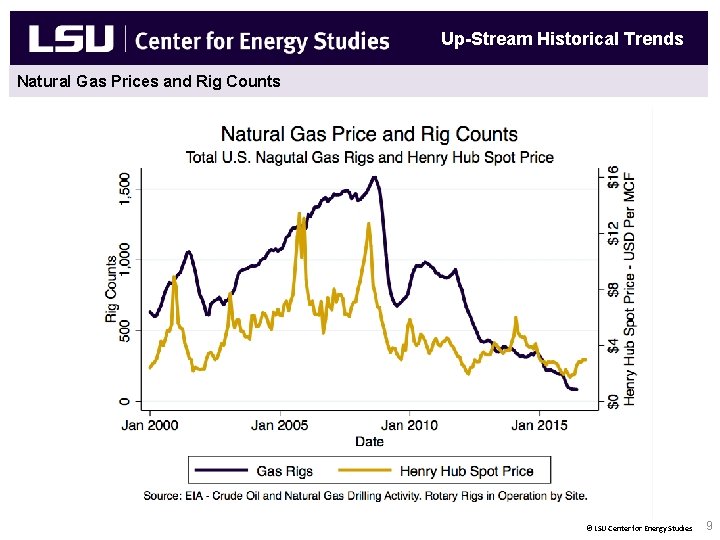
Up-Stream Historical Trends Natural Gas Prices and Rig Counts New Natural Gas End Uses & Fuel Diversity Concerns © LSU Center for Energy Studies 9
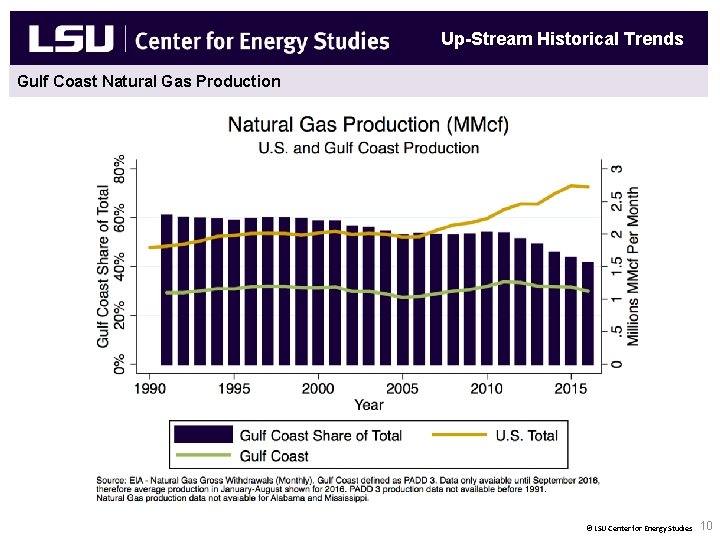
Up-Stream Historical Trends Gulf Coast Natural Gas Production New Natural Gas End Uses & Fuel Diversity Concerns © LSU Center for Energy Studies 10
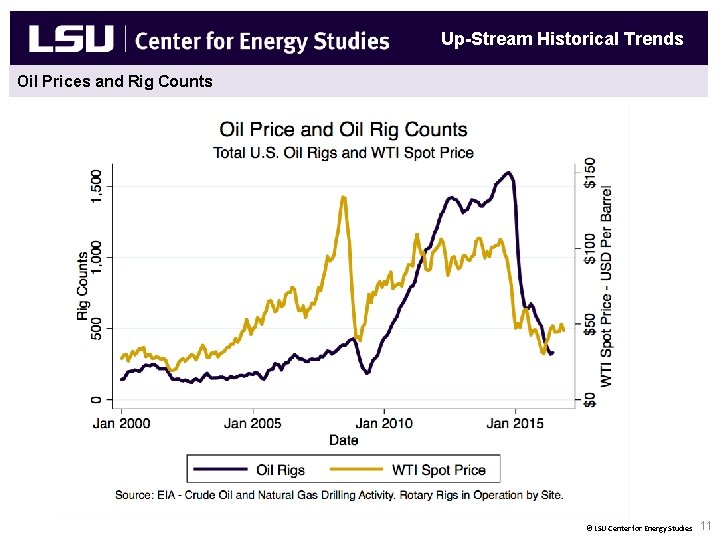
Up-Stream Historical Trends Oil Prices and Rig Counts New Natural Gas End Uses & Fuel Diversity Concerns © LSU Center for Energy Studies 11
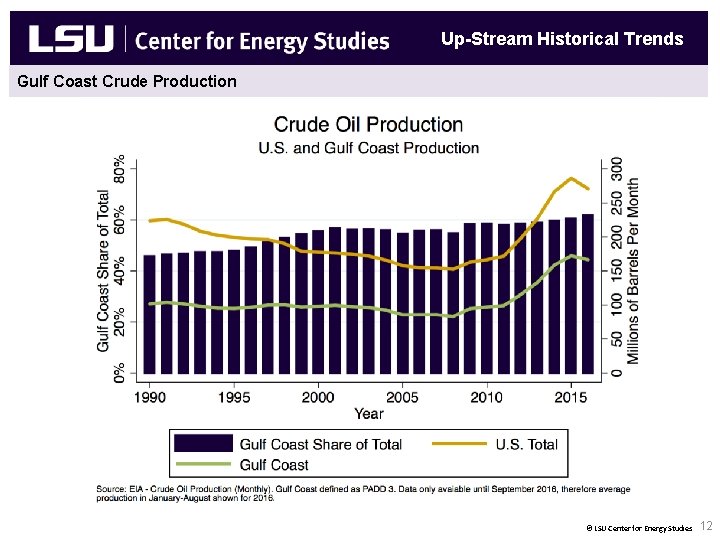
Up-Stream Historical Trends Gulf Coast Crude Production New Natural Gas End Uses & Fuel Diversity Concerns © LSU Center for Energy Studies 12
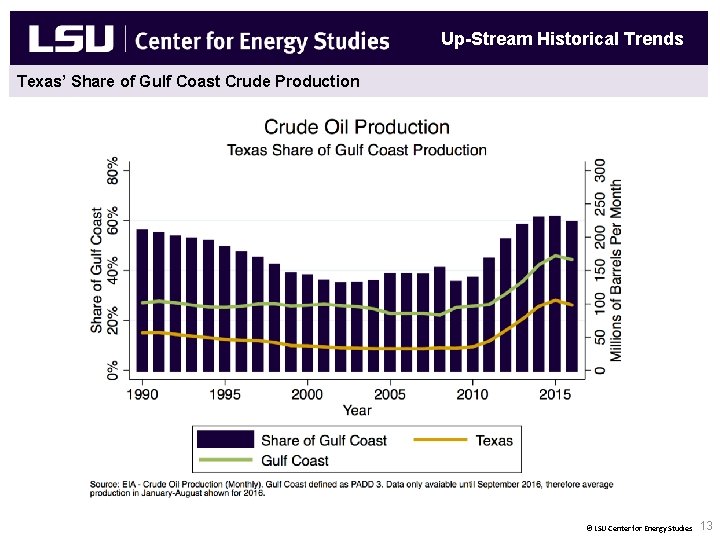
Up-Stream Historical Trends Texas’ Share of Gulf Coast Crude Production New Natural Gas End Uses & Fuel Diversity Concerns © LSU Center for Energy Studies 13
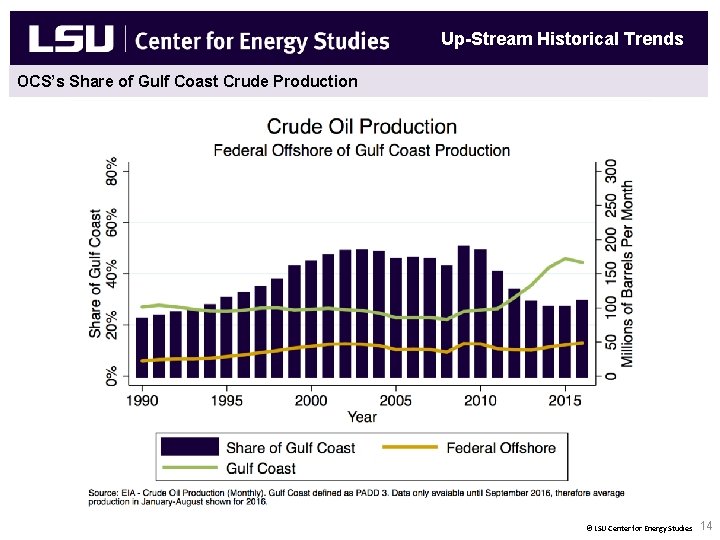
Up-Stream Historical Trends OCS’s Share of Gulf Coast Crude Production New Natural Gas End Uses & Fuel Diversity Concerns © LSU Center for Energy Studies 14
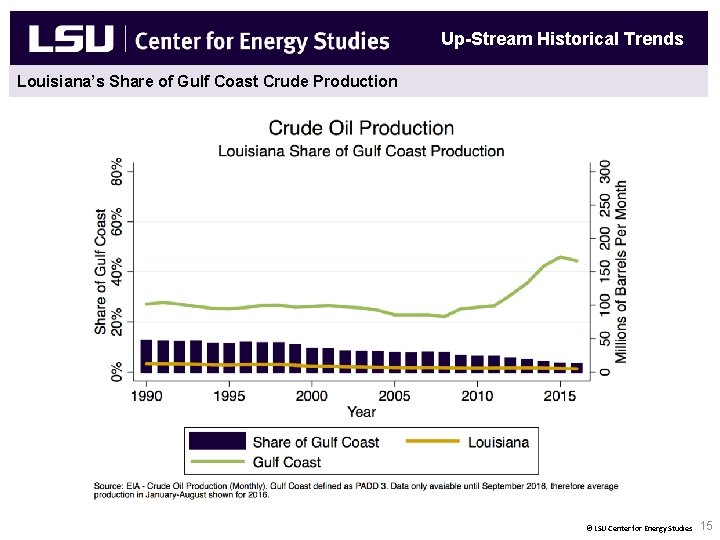
Up-Stream Historical Trends Louisiana’s Share of Gulf Coast Crude Production New Natural Gas End Uses & Fuel Diversity Concerns © LSU Center for Energy Studies 15
Up-Stream Oil and Gas Outlook © LSU Center for Energy Studies 16
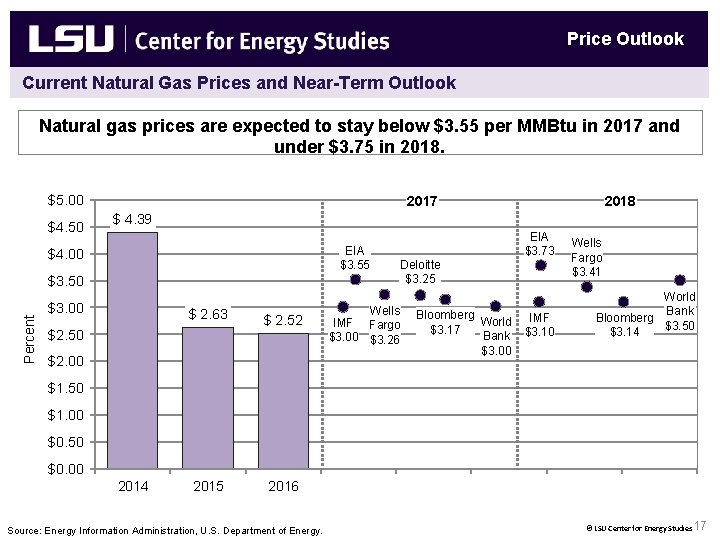
Price Outlook Current Natural Gas Prices and Near-Term Outlook Natural gas prices are expected to stay below $3. 55 per MMBtu in 2017 and under $3. 75 in 2018. $5. 00 $4. 50 2017 $ 4. 39 EIA $3. 55 $4. 00 $3. 50 Percent 2018 $3. 00 $ 2. 63 $ 2. 52 2015 2016 $2. 50 $2. 00 EIA $3. 73 Deloitte $3. 25 Wells IMF Fargo $3. 00 $3. 26 Bloomberg World $3. 17 Bank $3. 00 IMF $3. 10 Wells Fargo $3. 41 World Bank Bloomberg $3. 50 $3. 14 $1. 50 $1. 00 $0. 50 $0. 00 2014 Source: Energy Information Administration, U. S. Department of Energy. © LSU Center for Energy Studies 17
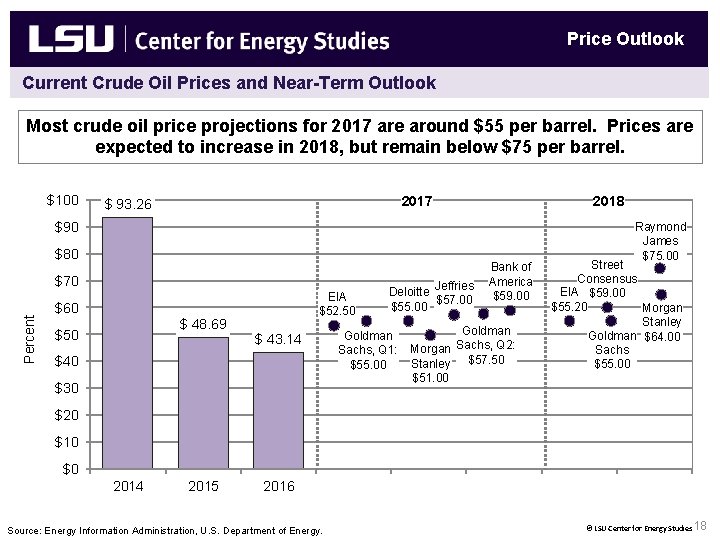
Price Outlook Current Crude Oil Prices and Near-Term Outlook Most crude oil price projections for 2017 are around $55 per barrel. Prices are expected to increase in 2018, but remain below $75 per barrel. $100 2017 $ 93. 26 2018 $90 $80 Percent $70 EIA $52. 50 $60 $ 48. 69 $50 $ 43. 14 $40 $30 Jeffries Deloitte $57. 00 $55. 00 Goldman Sachs, Q 1: $55. 00 Bank of America $59. 00 Goldman Morgan Sachs, Q 2: Stanley $57. 50 $51. 00 Raymond James $75. 00 Street Consensus EIA $59. 00 $55. 20 Morgan Stanley Goldman $64. 00 Sachs $55. 00 $20 $10 $0 2014 2015 2016 Source: Energy Information Administration, U. S. Department of Energy. © LSU Center for Energy Studies 18
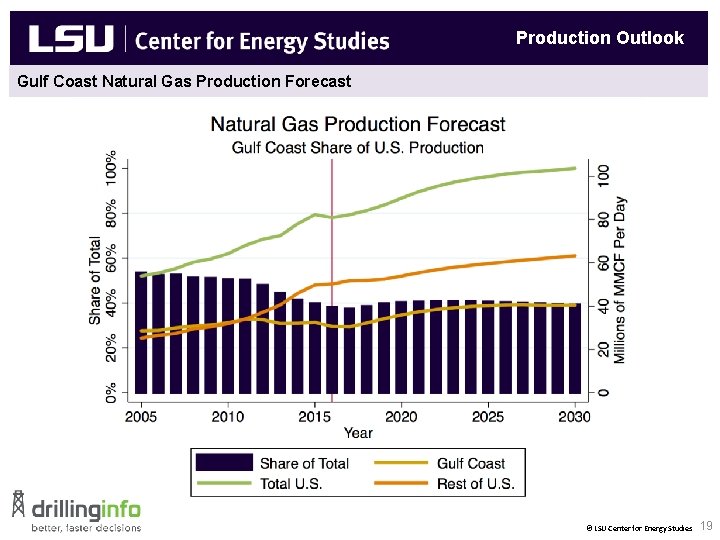
Production Outlook Gulf Coast Natural Gas Production Forecast New Natural Gas End Uses & Fuel Diversity Concerns © LSU Center for Energy Studies 19
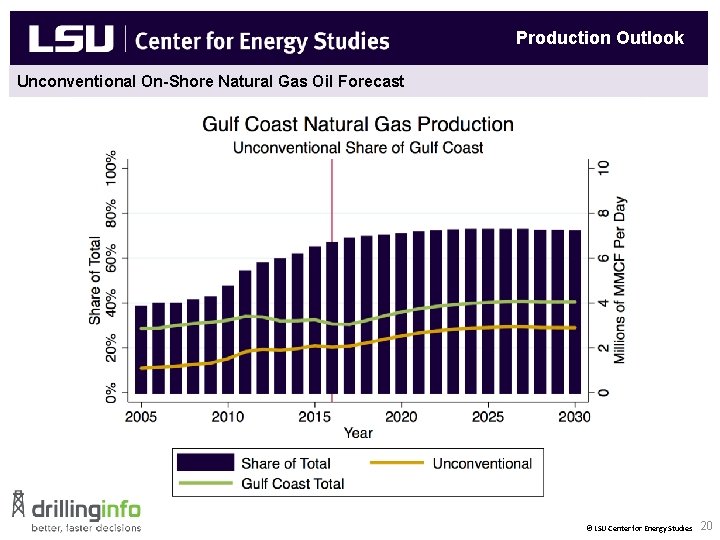
Production Outlook Unconventional On-Shore Natural Gas Oil Forecast New Natural Gas End Uses & Fuel Diversity Concerns © LSU Center for Energy Studies 20
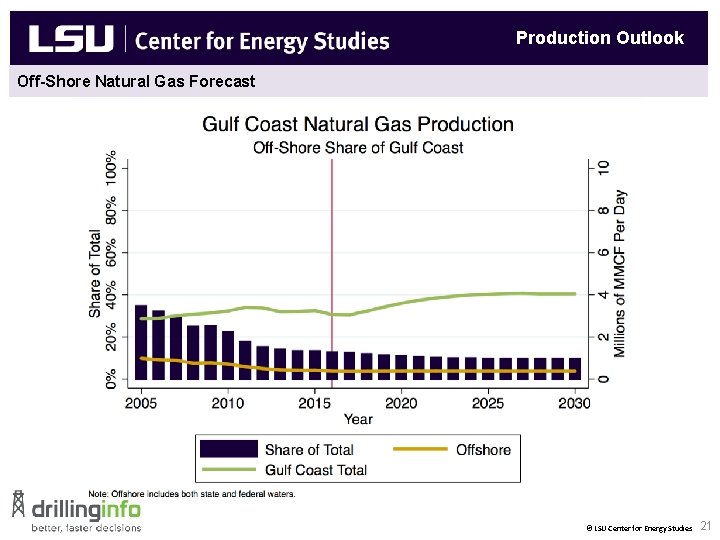
Production Outlook Off-Shore Natural Gas Forecast New Natural Gas End Uses & Fuel Diversity Concerns © LSU Center for Energy Studies 21
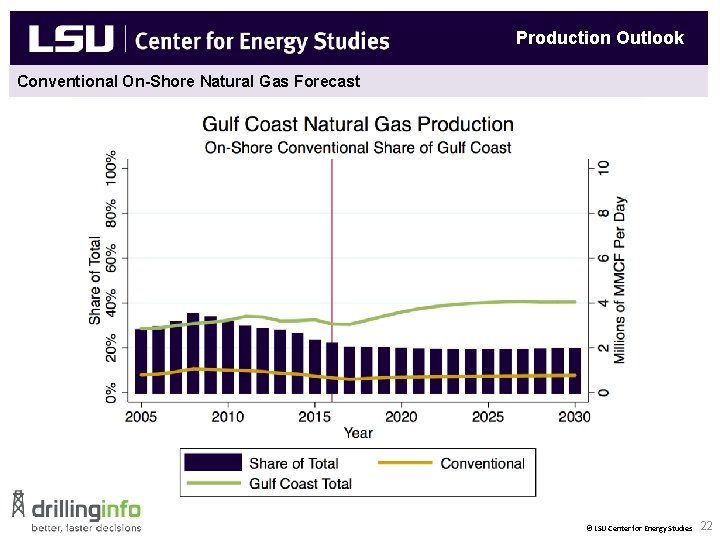
Production Outlook Conventional On-Shore Natural Gas Forecast New Natural Gas End Uses & Fuel Diversity Concerns © LSU Center for Energy Studies 22
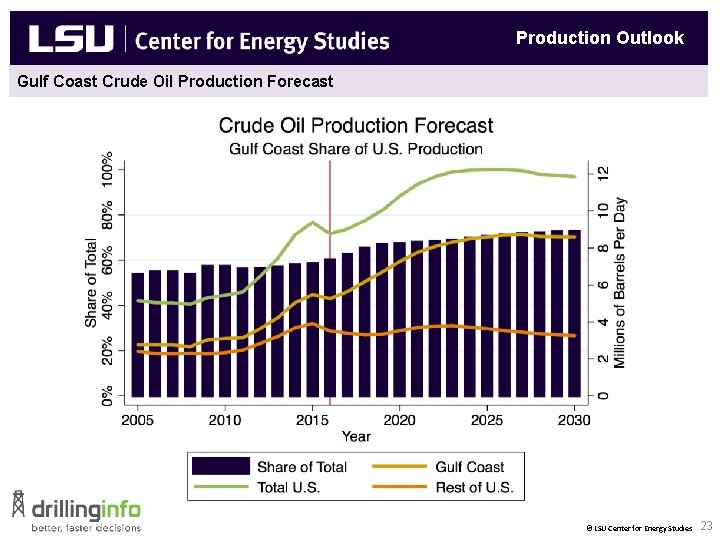
Production Outlook Gulf Coast Crude Oil Production Forecast New Natural Gas End Uses & Fuel Diversity Concerns © LSU Center for Energy Studies 23
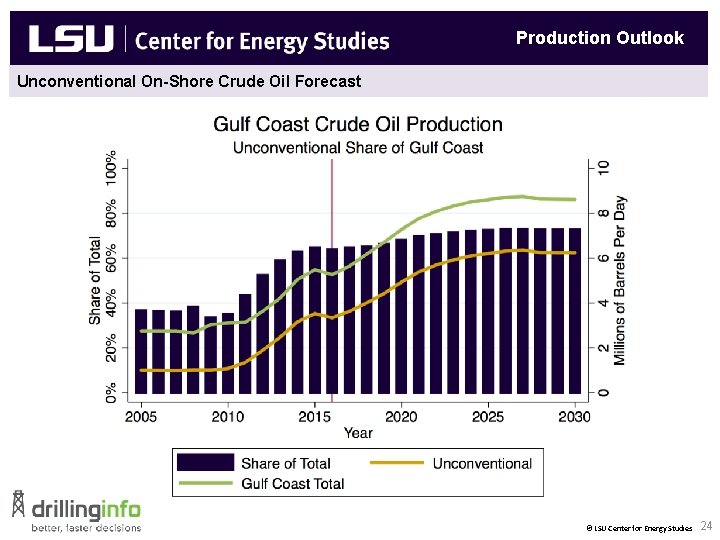
Production Outlook Unconventional On-Shore Crude Oil Forecast New Natural Gas End Uses & Fuel Diversity Concerns © LSU Center for Energy Studies 24
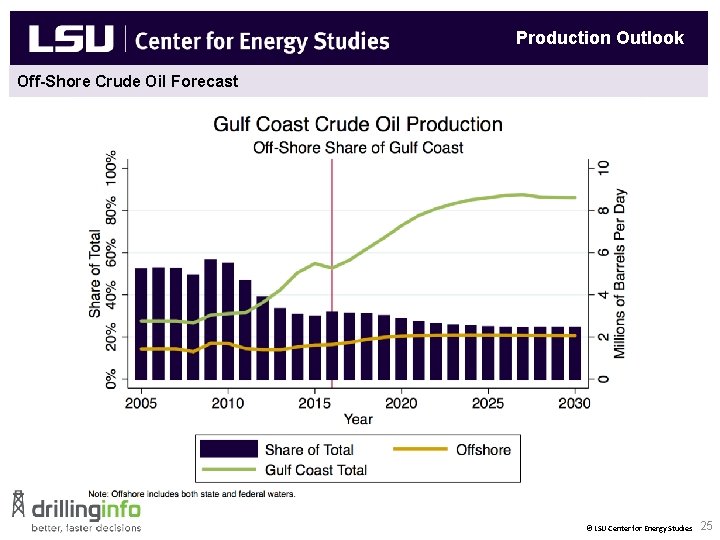
Production Outlook Off-Shore Crude Oil Forecast New Natural Gas End Uses & Fuel Diversity Concerns © LSU Center for Energy Studies 25
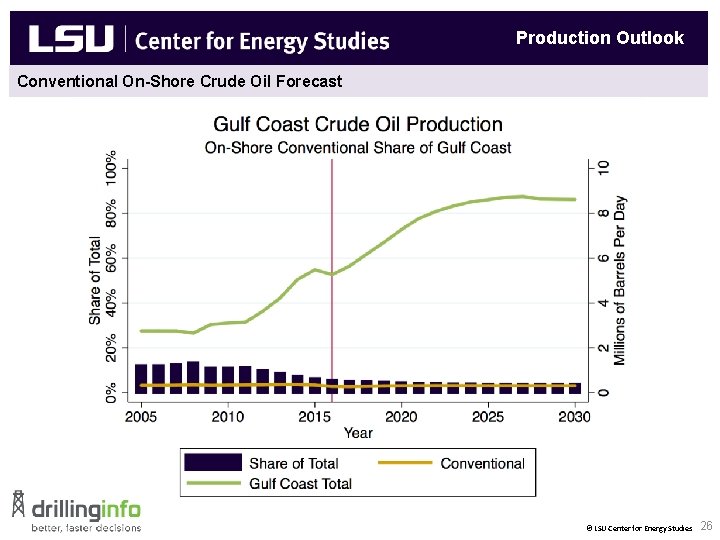
Production Outlook Conventional On-Shore Crude Oil Forecast New Natural Gas End Uses & Fuel Diversity Concerns © LSU Center for Energy Studies 26
Industrial Outlook © LSU Center for Energy Studies 27
Industrial Outlook • There is a symbiotic relationship between natural gas prices and Louisiana’s energy-intensive manufacturing base. Louisiana manufacturing relies heavily on natural gas for heat, steam, power generation and most importantly, feedstock purposes. Louisiana’s chemical industry is particularly reliant upon natural gas and natural gas liquids since both are used to produce a wide range of goods. 1 • Abundant and inexpensive natural gas along side the U. S. increase in oil production has led to significant industrial investments. • Significant investments in crude oil transport, including pipeline reversals, expansions, and additions, alongside the lifting of the crude oil export ban create an environment that allows for the Gulf Coast to become the epicenter for hydrocarbon trading. 2 1. 2. David E. Dismukes (2013). Unconventional Resources and Louisiana’s Manufacturing Development Renaissance. Baton Rouge, LA: Louisiana State University, Center for Energy Studies and author’s updates. Upton (2016). Crude Oil Exports and the Louisiana Economy. A discussion of the U. S. policy of restricting crude oil exports and its implications for Louisiana. Baton Rouge, LA: Louisiana State University, Center for Energy Studies. © LSU Center for Energy Studies 28
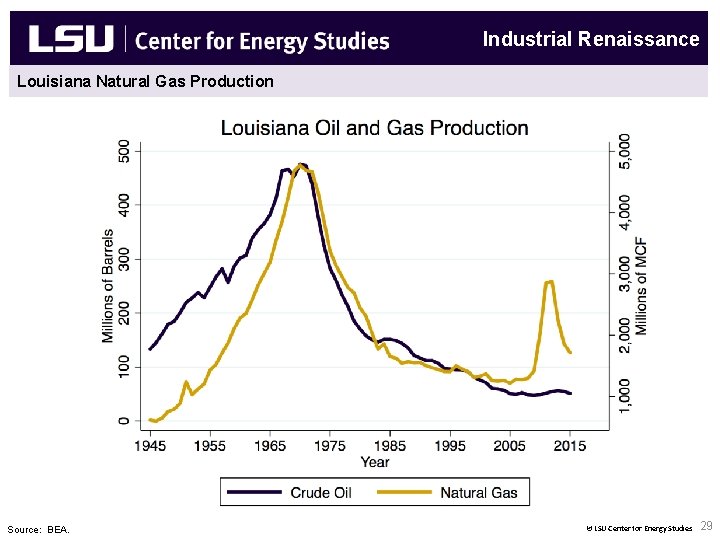
Industrial Renaissance Louisiana Natural Gas Production New Natural Gas End Uses & Fuel Diversity Concerns Source: BEA. © LSU Center for Energy Studies 29
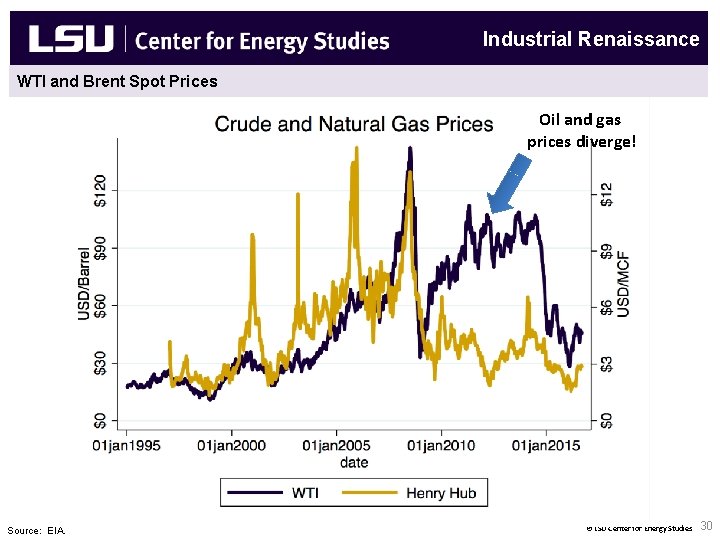
Industrial Renaissance WTI and Brent Spot Prices New Natural Gas End Uses & Fuel Diversity Concerns Source: EIA. Oil and gas prices diverge! © LSU Center for Energy Studies 30
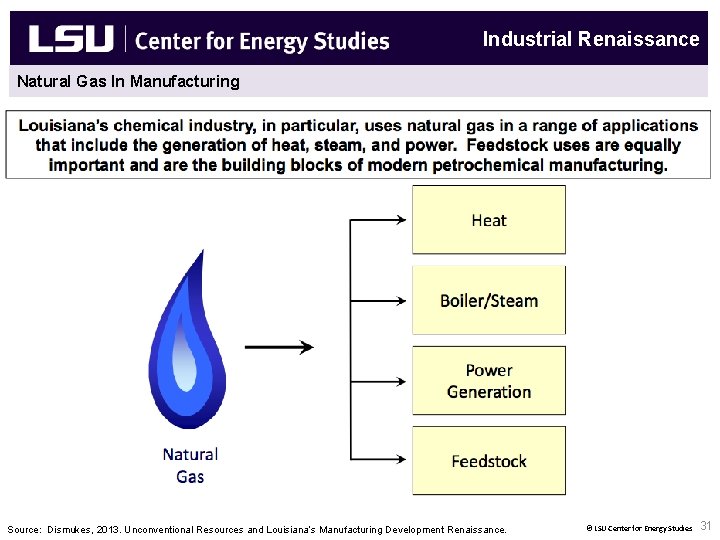
Industrial Renaissance Natural Gas In Manufacturing New Natural Gas End Uses & Fuel Diversity Concerns Source: Dismukes, 2013. Unconventional Resources and Louisiana’s Manufacturing Development Renaissance. © LSU Center for Energy Studies 31
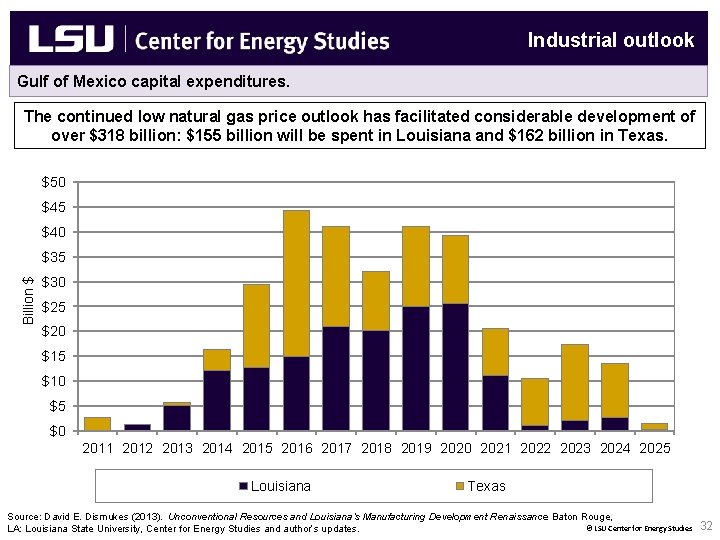
Industrial outlook Gulf of Mexico capital expenditures. The continued low natural gas price outlook has facilitated considerable development of over $318 billion: $155 billion will be spent in Louisiana and $162 billion in Texas. $50 $45 $40 Billion $ $35 $30 $25 $20 $15 $10 $5 $0 2011 2012 2013 2014 2015 2016 2017 2018 2019 2020 2021 2022 2023 2024 2025 Louisiana Texas Source: David E. Dismukes (2013). Unconventional Resources and Louisiana’s Manufacturing Development Renaissance. Baton Rouge, © LSU Center for Energy Studies LA: Louisiana State University, Center for Energy Studies and author’s updates. 32
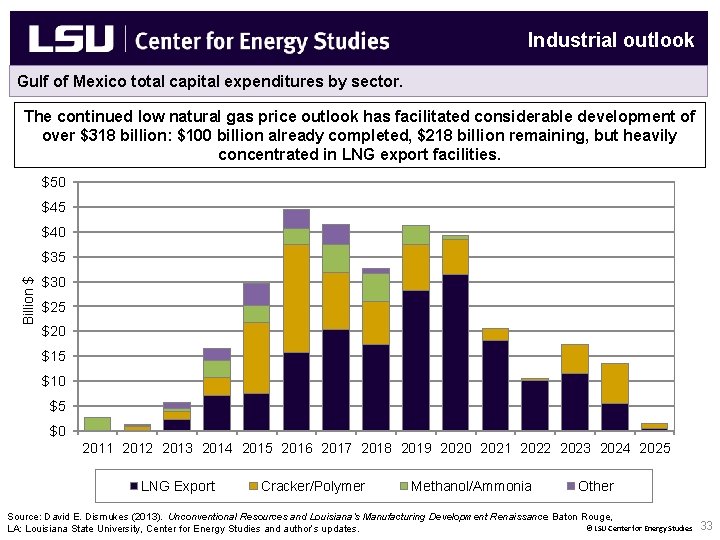
Industrial outlook Gulf of Mexico total capital expenditures by sector. The continued low natural gas price outlook has facilitated considerable development of over $318 billion: $100 billion already completed, $218 billion remaining, but heavily concentrated in LNG export facilities. $50 $45 $40 Billion $ $35 $30 $25 $20 $15 $10 $5 $0 2011 2012 2013 2014 2015 2016 2017 2018 2019 2020 2021 2022 2023 2024 2025 LNG Export Cracker/Polymer Methanol/Ammonia Other Source: David E. Dismukes (2013). Unconventional Resources and Louisiana’s Manufacturing Development Renaissance. Baton Rouge, © LSU Center for Energy Studies LA: Louisiana State University, Center for Energy Studies and author’s updates. 33
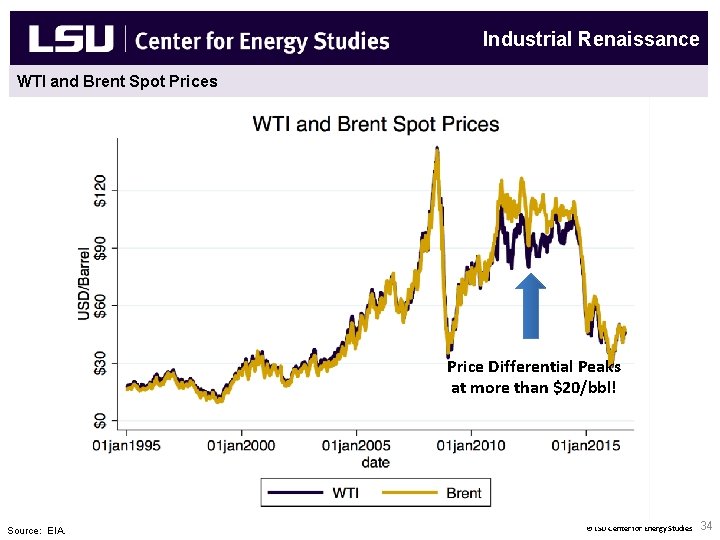
Industrial Renaissance WTI and Brent Spot Prices New Natural Gas End Uses & Fuel Diversity Concerns Price Differential Peaks at more than $20/bbl! Source: EIA. © LSU Center for Energy Studies 34
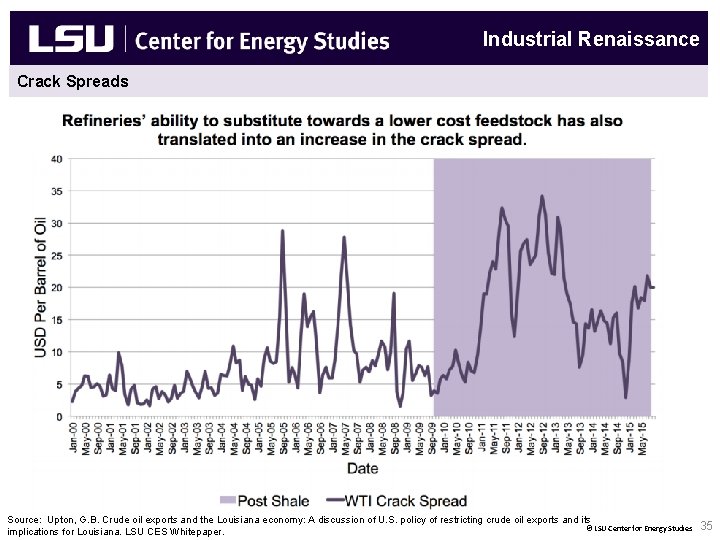
Industrial Renaissance Crack Spreads New Natural Gas End Uses & Fuel Diversity Concerns Source: Upton, G. B. Crude oil exports and the Louisiana economy: A discussion of U. S. policy of restricting crude oil exports and its © LSU Center for Energy Studies implications for Louisiana. LSU CES Whitepaper. 35

Workforce © LSU Center for Energy Studies 36
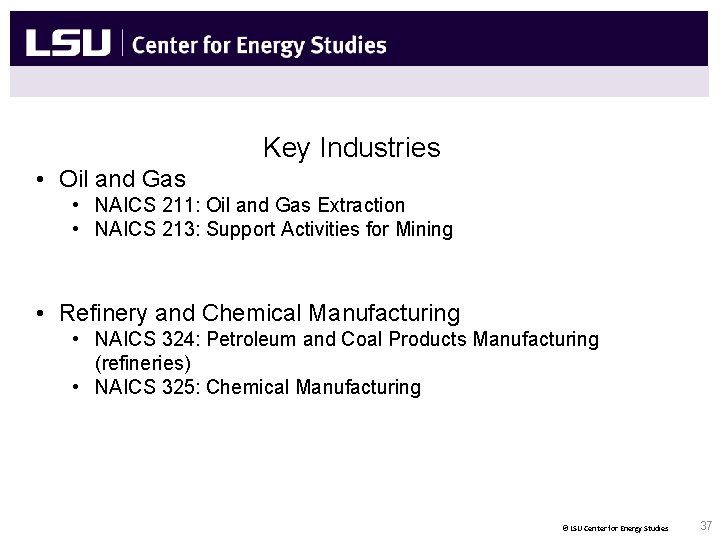
Key Industries • Oil and Gas • NAICS 211: Oil and Gas Extraction • NAICS 213: Support Activities for Mining • Refinery and Chemical Manufacturing • NAICS 324: Petroleum and Coal Products Manufacturing (refineries) • NAICS 325: Chemical Manufacturing © LSU Center for Energy Studies 37
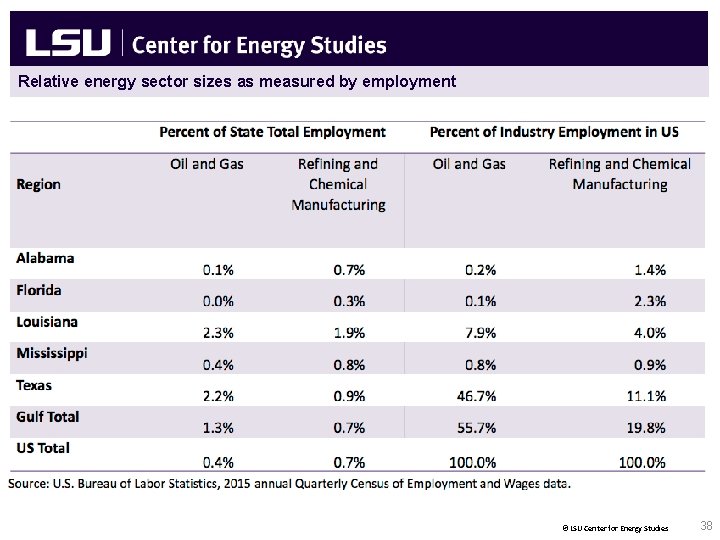
Relative energy sector sizes as measured by employment © LSU Center for Energy Studies 38
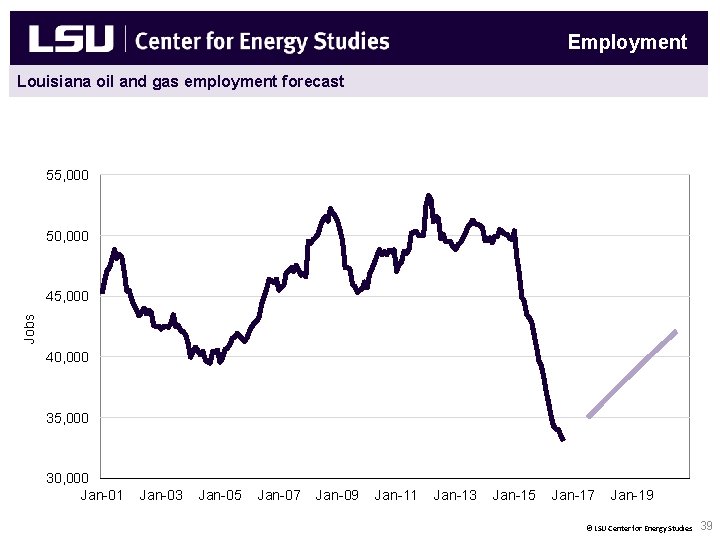
Employment Louisiana oil and gas employment forecast 55, 000 50, 000 Jobs 45, 000 40, 000 35, 000 30, 000 Jan-01 Jan-03 Jan-05 Jan-07 Jan-09 Jan-11 Jan-13 Jan-15 Jan-17 Jan-19 © LSU Center for Energy Studies 39
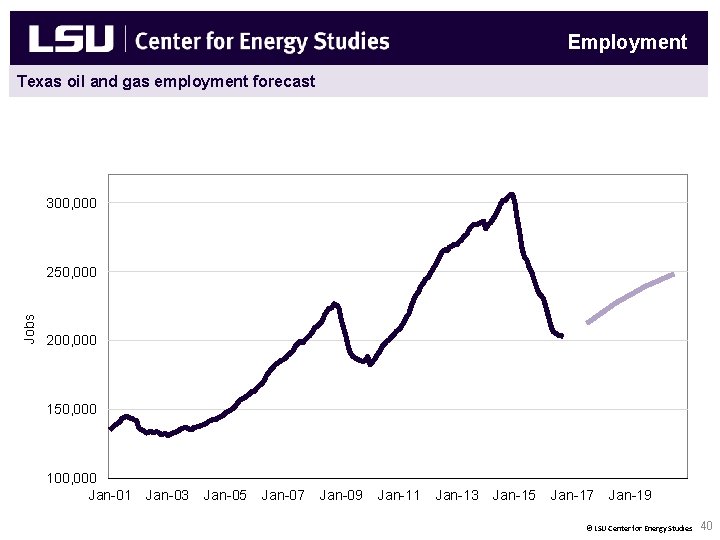
Employment Texas oil and gas employment forecast 300, 000 Jobs 250, 000 200, 000 150, 000 100, 000 Jan-01 Jan-03 Jan-05 Jan-07 Jan-09 Jan-11 Jan-13 Jan-15 Jan-17 Jan-19 © LSU Center for Energy Studies 40
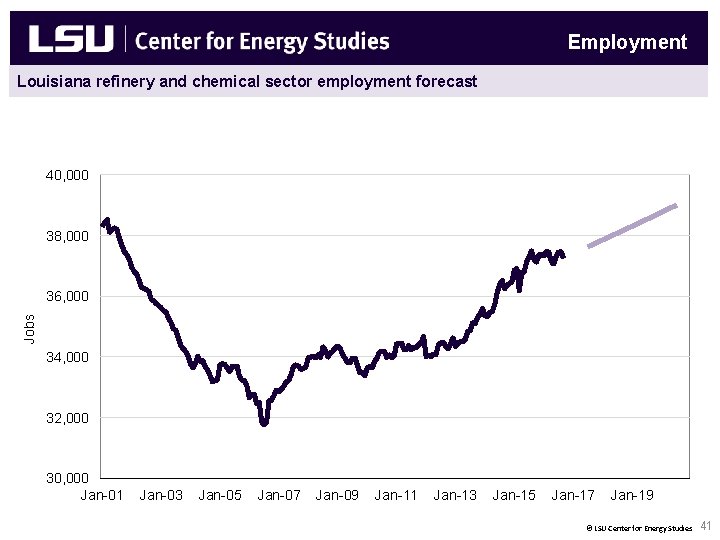
Employment Louisiana refinery and chemical sector employment forecast 40, 000 38, 000 Jobs 36, 000 34, 000 32, 000 30, 000 Jan-01 Jan-03 Jan-05 Jan-07 Jan-09 Jan-11 Jan-13 Jan-15 Jan-17 Jan-19 © LSU Center for Energy Studies 41
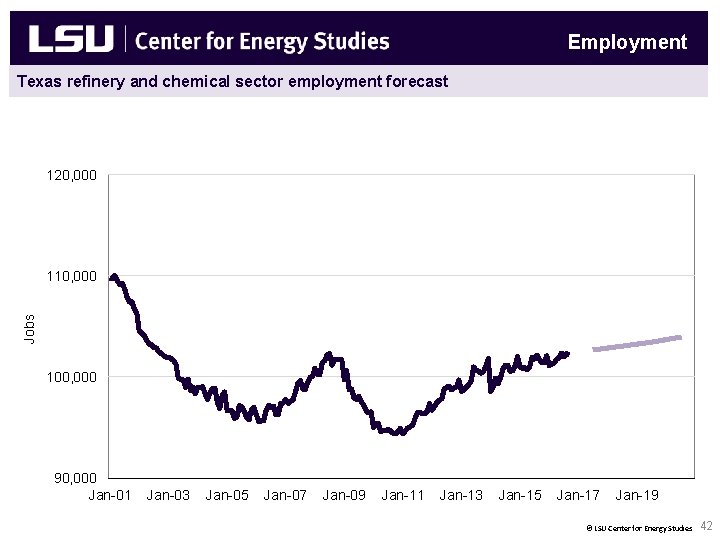
Employment Texas refinery and chemical sector employment forecast 120, 000 Jobs 110, 000 100, 000 90, 000 Jan-01 Jan-03 Jan-05 Jan-07 Jan-09 Jan-11 Jan-13 Jan-15 Jan-17 Jan-19 © LSU Center for Energy Studies 42
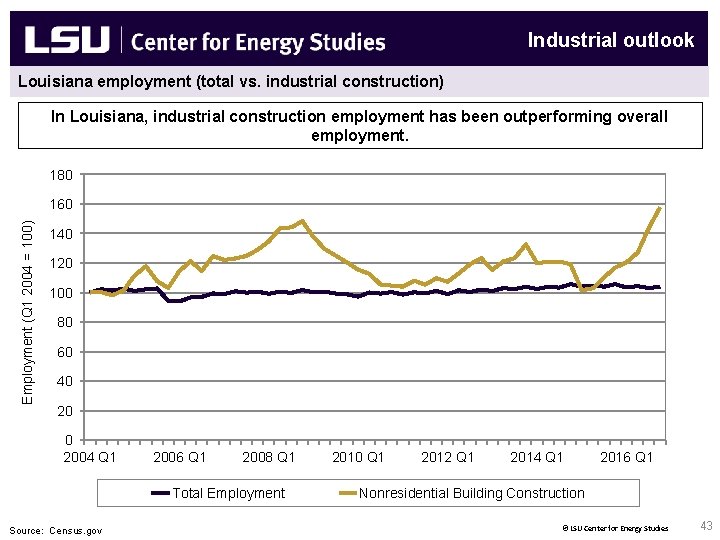
Industrial outlook Louisiana employment (total vs. industrial construction) In Louisiana, industrial construction employment has been outperforming overall employment. 180 Employment (Q 1 2004 = 100) 160 140 120 100 80 60 40 2004 Q 1 2006 Q 1 2008 Q 1 Total Employment Source: Census. gov 2010 Q 1 2012 Q 1 2014 Q 1 2016 Q 1 Nonresidential Building Construction © LSU Center for Energy Studies 43
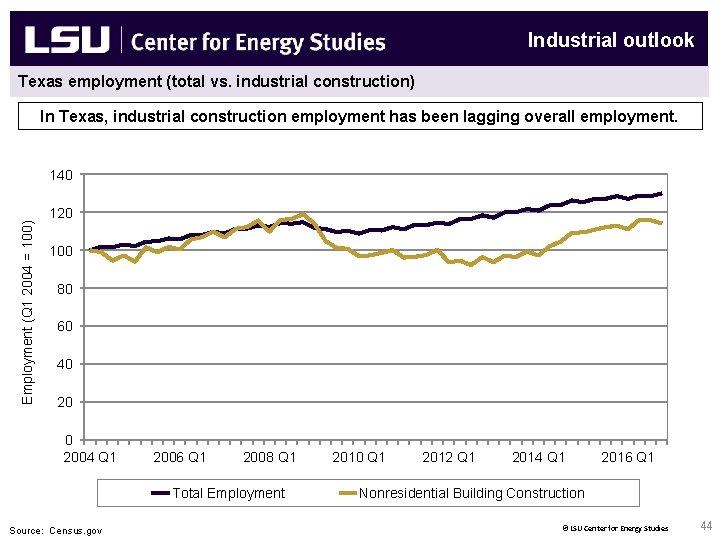
Industrial outlook Texas employment (total vs. industrial construction) In Texas, industrial construction employment has been lagging overall employment. 140 Employment (Q 1 2004 = 100) 120 100 80 60 40 2004 Q 1 2006 Q 1 2008 Q 1 Total Employment Source: Census. gov 2010 Q 1 2012 Q 1 2014 Q 1 2016 Q 1 Nonresidential Building Construction © LSU Center for Energy Studies 44
Export Opportunities © LSU Center for Energy Studies 45
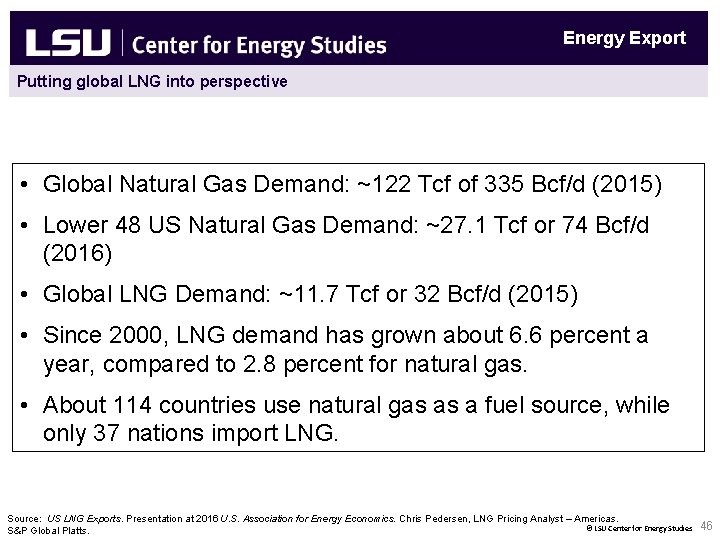
Energy Export Putting global LNG into perspective • Global Natural Gas Demand: ~122 Tcf of 335 Bcf/d (2015) • Lower 48 US Natural Gas Demand: ~27. 1 Tcf or 74 Bcf/d (2016) • Global LNG Demand: ~11. 7 Tcf or 32 Bcf/d (2015) • Since 2000, LNG demand has grown about 6. 6 percent a year, compared to 2. 8 percent for natural gas. • About 114 countries use natural gas as a fuel source, while only 37 nations import LNG. Source: US LNG Exports. Presentation at 2016 U. S. Association for Energy Economics. Chris Pedersen, LNG Pricing Analyst – Americas. © LSU Center for Energy Studies S&P Global Platts. 46
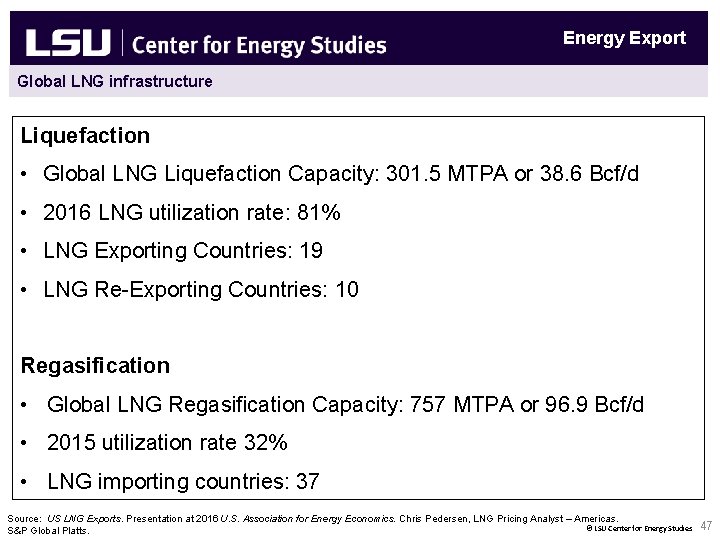
Energy Export Global LNG infrastructure Liquefaction • Global LNG Liquefaction Capacity: 301. 5 MTPA or 38. 6 Bcf/d • 2016 LNG utilization rate: 81% • LNG Exporting Countries: 19 • LNG Re-Exporting Countries: 10 Regasification • Global LNG Regasification Capacity: 757 MTPA or 96. 9 Bcf/d • 2015 utilization rate 32% • LNG importing countries: 37 Source: US LNG Exports. Presentation at 2016 U. S. Association for Energy Economics. Chris Pedersen, LNG Pricing Analyst – Americas. © LSU Center for Energy Studies S&P Global Platts. 47
Energy Export Natural gas/LNG to play a larger role in the future Natural Gas • 40 percent of the growth in global energy demand from 2014 -2040 is projected to be met by natural gas. LNG • IEA report forecasts liquefaction capacity to grow 45 percent between 2015 -2021. • China, India, Brazil, Mexico, South America, Nigeria, Egypt, Turkey, Saudi Arabia, Iran, Thailand & Indonesia will account for roughly 80 percent of the new growth in energy demand through 2040. Source: US LNG Exports. Presentation at 2016 U. S. Association for Energy Economics. Chris Pedersen, LNG Pricing Analyst – Americas. © LSU Center for Energy Studies S&P Global Platts. 48
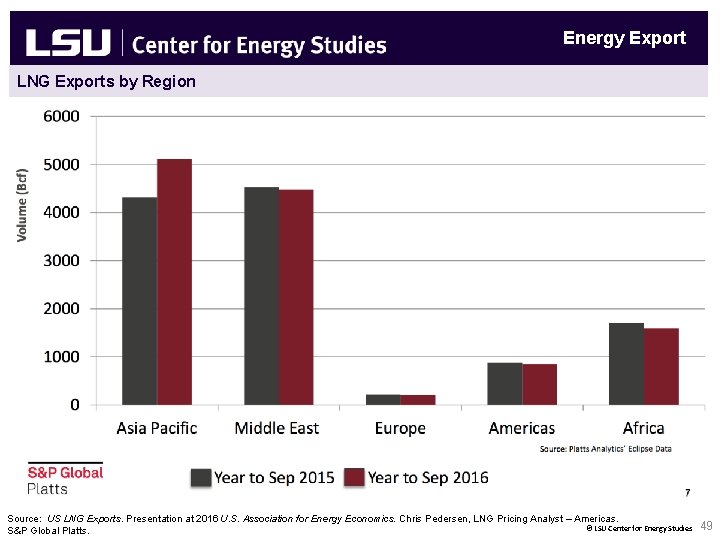
Energy Export LNG Exports by Region Source: US LNG Exports. Presentation at 2016 U. S. Association for Energy Economics. Chris Pedersen, LNG Pricing Analyst – Americas. © LSU Center for Energy Studies S&P Global Platts. 49
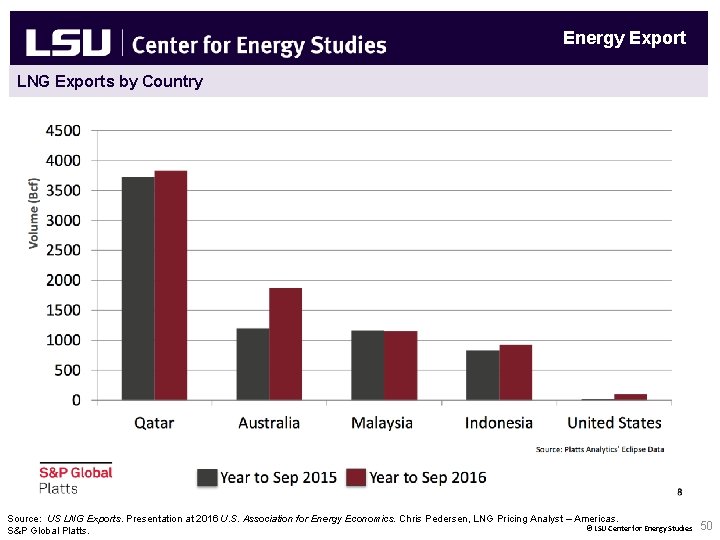
Energy Export LNG Exports by Country Source: US LNG Exports. Presentation at 2016 U. S. Association for Energy Economics. Chris Pedersen, LNG Pricing Analyst – Americas. © LSU Center for Energy Studies S&P Global Platts. 50
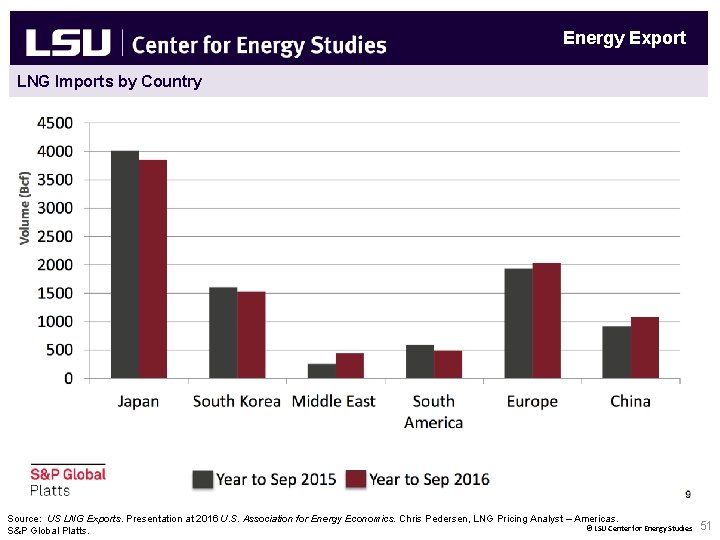
Energy Export LNG Imports by Country Source: US LNG Exports. Presentation at 2016 U. S. Association for Energy Economics. Chris Pedersen, LNG Pricing Analyst – Americas. © LSU Center for Energy Studies S&P Global Platts. 51
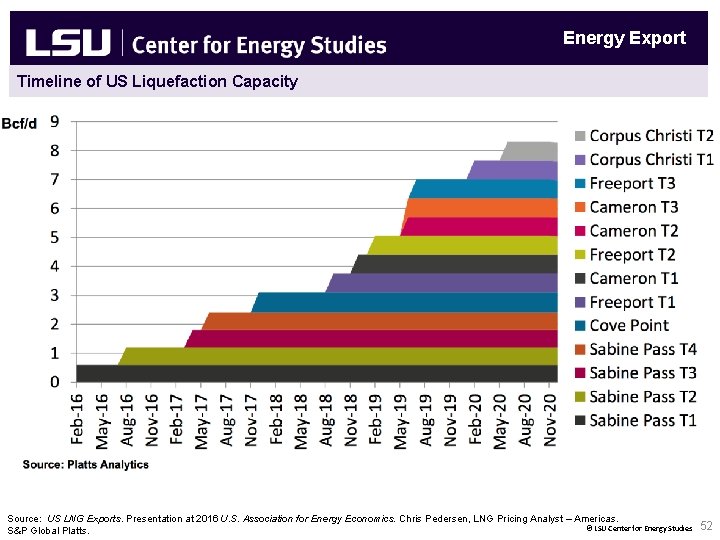
Energy Export Timeline of US Liquefaction Capacity Source: US LNG Exports. Presentation at 2016 U. S. Association for Energy Economics. Chris Pedersen, LNG Pricing Analyst – Americas. © LSU Center for Energy Studies S&P Global Platts. 52
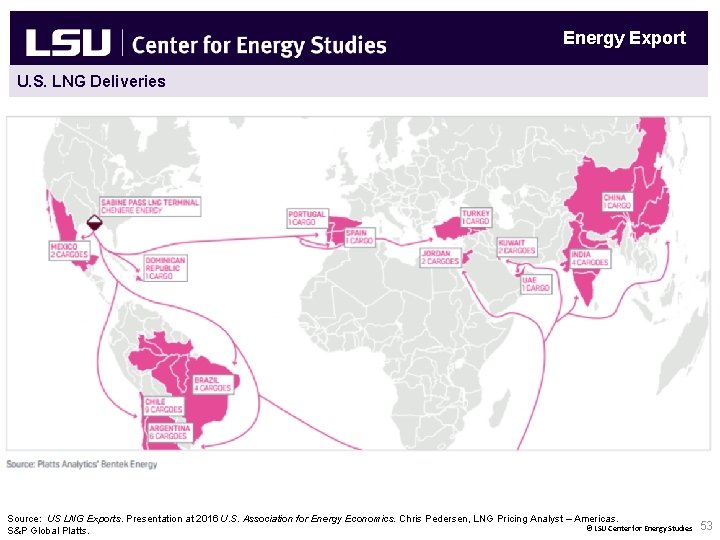
Energy Export U. S. LNG Deliveries Source: US LNG Exports. Presentation at 2016 U. S. Association for Energy Economics. Chris Pedersen, LNG Pricing Analyst – Americas. © LSU Center for Energy Studies S&P Global Platts. 53
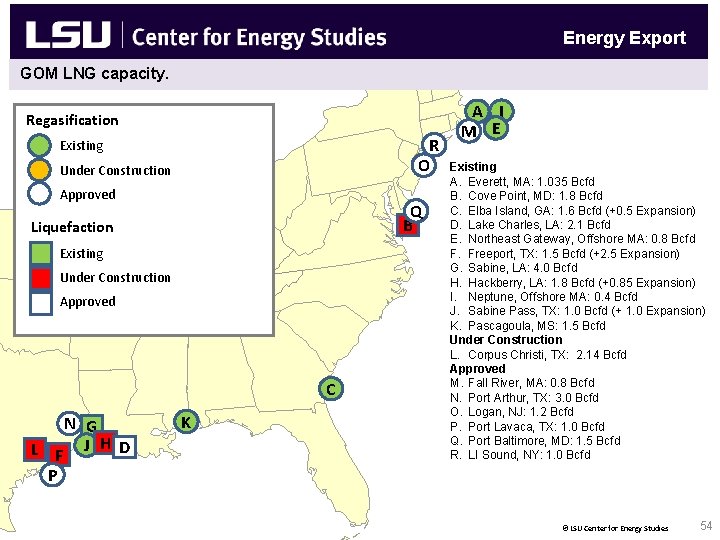
Energy Export GOM LNG capacity. Regasification R O Existing Under Construction Approved Q B Liquefaction Existing Under Construction Approved C N G L F J H D P K A I M E Existing A. Everett, MA: 1. 035 Bcfd B. Cove Point, MD: 1. 8 Bcfd C. Elba Island, GA: 1. 6 Bcfd (+0. 5 Expansion) D. Lake Charles, LA: 2. 1 Bcfd E. Northeast Gateway, Offshore MA: 0. 8 Bcfd F. Freeport, TX: 1. 5 Bcfd (+2. 5 Expansion) G. Sabine, LA: 4. 0 Bcfd H. Hackberry, LA: 1. 8 Bcfd (+0. 85 Expansion) I. Neptune, Offshore MA: 0. 4 Bcfd J. Sabine Pass, TX: 1. 0 Bcfd (+ 1. 0 Expansion) K. Pascagoula, MS: 1. 5 Bcfd Under Construction L. Corpus Christi, TX: 2. 14 Bcfd Approved M. Fall River, MA: 0. 8 Bcfd N. Port Arthur, TX: 3. 0 Bcfd O. Logan, NJ: 1. 2 Bcfd P. Port Lavaca, TX: 1. 0 Bcfd Q. Port Baltimore, MD: 1. 5 Bcfd R. LI Sound, NY: 1. 0 Bcfd © LSU Center for Energy Studies 54
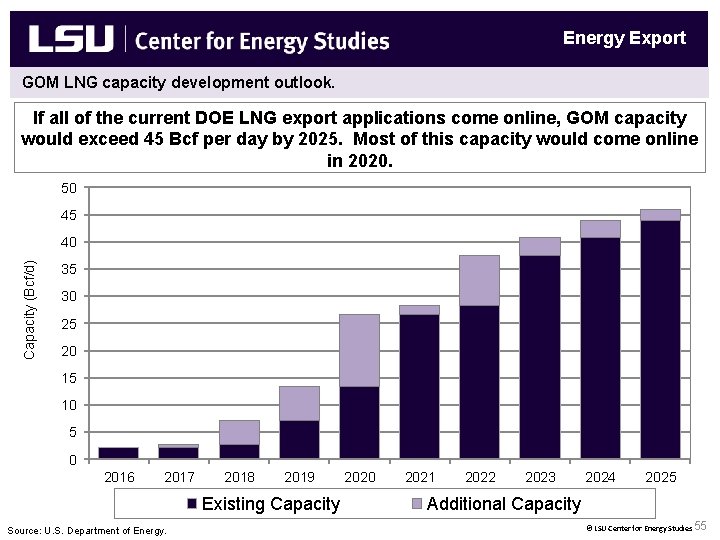
Energy Export GOM LNG capacity development outlook. If all of the current DOE LNG export applications come online, GOM capacity would exceed 45 Bcf per day by 2025. Most of this capacity would come online in 2020. 50 45 Capacity (Bcf/d) 40 35 30 25 20 15 10 5 0 2016 2017 2018 2019 Existing Capacity Source: U. S. Department of Energy. 2020 2021 2022 2023 2024 2025 Additional Capacity © LSU Center for Energy Studies 55
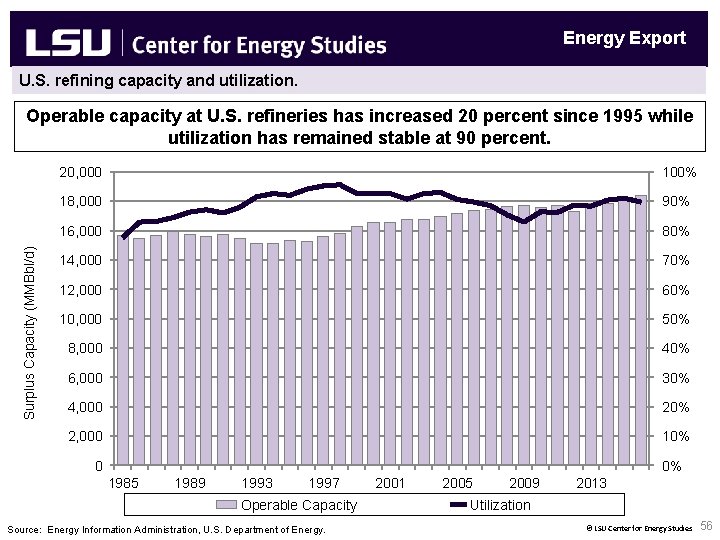
Energy Export U. S. refining capacity and utilization. Surplus Capacity (MMBbl/d) Operable capacity at U. S. refineries has increased 20 percent since 1995 while utilization has remained stable at 90 percent. 20, 000 100% 18, 000 90% 16, 000 80% 14, 000 70% 12, 000 60% 10, 000 50% 8, 000 40% 6, 000 30% 4, 000 20% 2, 000 10% 0 0% 1985 1989 1993 1997 Operable Capacity Source: Energy Information Administration, U. S. Department of Energy. 2001 2005 2009 2013 Utilization © LSU Center for Energy Studies 56
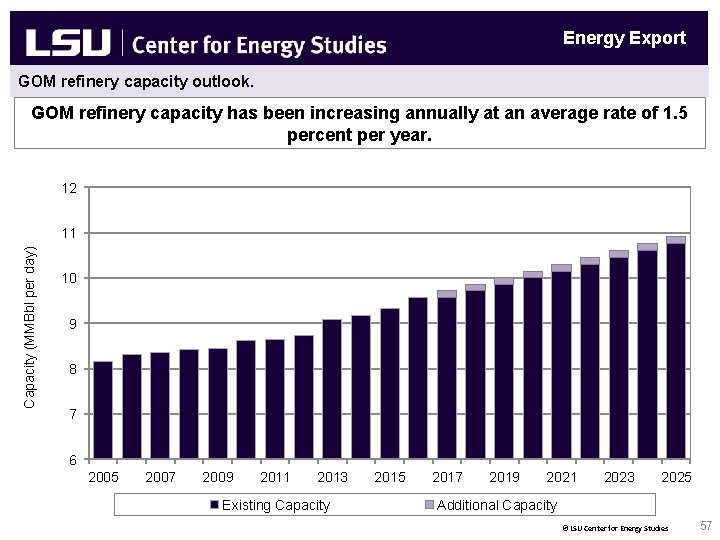
Energy Export GOM refinery capacity outlook. GOM refinery capacity has been increasing annually at an average rate of 1. 5 percent per year. 12 Capacity (MMBbl per day) 11 10 9 8 7 6 2005 2007 2009 2011 2013 Existing Capacity 2015 2017 2019 2021 2023 2025 Additional Capacity © LSU Center for Energy Studies 57
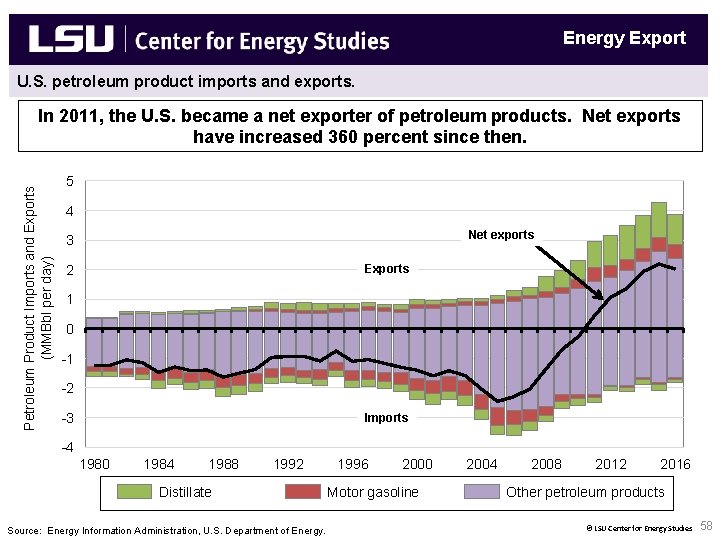
Energy Export U. S. petroleum product imports and exports. Petroleum Product Imports and Exports (MMBbl per day) In 2011, the U. S. became a net exporter of petroleum products. Net exports have increased 360 percent since then. 5 4 Net exports 3 2 Exports 1 0 -1 -2 -3 Imports -4 1980 1984 1988 1992 Distillate Source: Energy Information Administration, U. S. Department of Energy. 1996 2000 Motor gasoline 2004 2008 2012 2016 Other petroleum products © LSU Center for Energy Studies 58
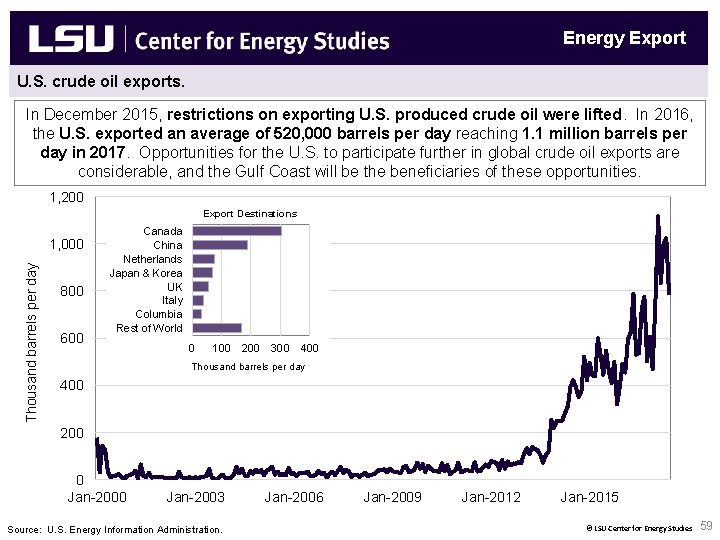
Energy Export U. S. crude oil exports. In December 2015, restrictions on exporting U. S. produced crude oil were lifted. In 2016, the U. S. exported an average of 520, 000 barrels per day reaching 1. 1 million barrels per day in 2017. Opportunities for the U. S. to participate further in global crude oil exports are considerable, and the Gulf Coast will be the beneficiaries of these opportunities. 1, 200 Export Destinations Thousand barrels per day 1, 000 800 600 Canada China Netherlands Japan & Korea UK Italy Columbia Rest of World 0 100 200 300 400 Thousand barrels per day 400 200 0 Jan-2003 Source: U. S. Energy Information Administration. Jan-2006 Jan-2009 Jan-2012 Jan-2015 © LSU Center for Energy Studies 59
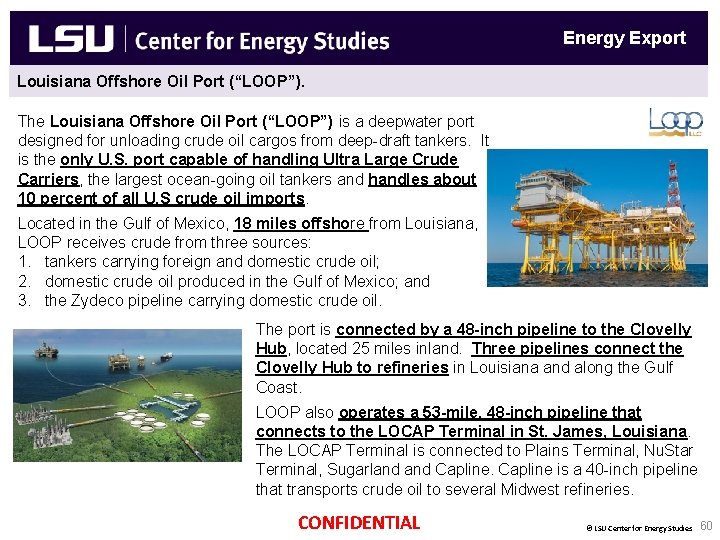
Energy Export Louisiana Offshore Oil Port (“LOOP”). The Louisiana Offshore Oil Port (“LOOP”) is a deepwater port designed for unloading crude oil cargos from deep-draft tankers. It is the only U. S. port capable of handling Ultra Large Crude Carriers, the largest ocean-going oil tankers and handles about 10 percent of all U. S crude oil imports. Located in the Gulf of Mexico, 18 miles offshore from Louisiana, LOOP receives crude from three sources: 1. tankers carrying foreign and domestic crude oil; 2. domestic crude oil produced in the Gulf of Mexico; and 3. the Zydeco pipeline carrying domestic crude oil. The port is connected by a 48 -inch pipeline to the Clovelly Hub, located 25 miles inland. Three pipelines connect the Clovelly Hub to refineries in Louisiana and along the Gulf Coast. LOOP also operates a 53 -mile, 48 -inch pipeline that connects to the LOCAP Terminal in St. James, Louisiana. The LOCAP Terminal is connected to Plains Terminal, Nu. Star Terminal, Sugarland Capline is a 40 -inch pipeline that transports crude oil to several Midwest refineries. CONFIDENTIAL © LSU Center for Energy Studies 60
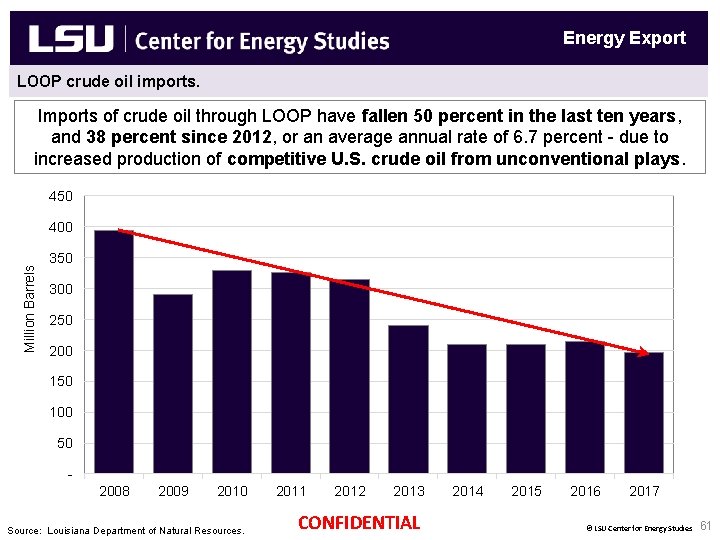
Energy Export LOOP crude oil imports. Imports of crude oil through LOOP have fallen 50 percent in the last ten years, and 38 percent since 2012, or an average annual rate of 6. 7 percent - due to increased production of competitive U. S. crude oil from unconventional plays. 450 Million Barrels 400 350 300 250 200 150 100 50 2008 2009 2010 Source: Louisiana Department of Natural Resources. 2011 2012 2013 CONFIDENTIAL 2014 2015 2016 2017 © LSU Center for Energy Studies 61
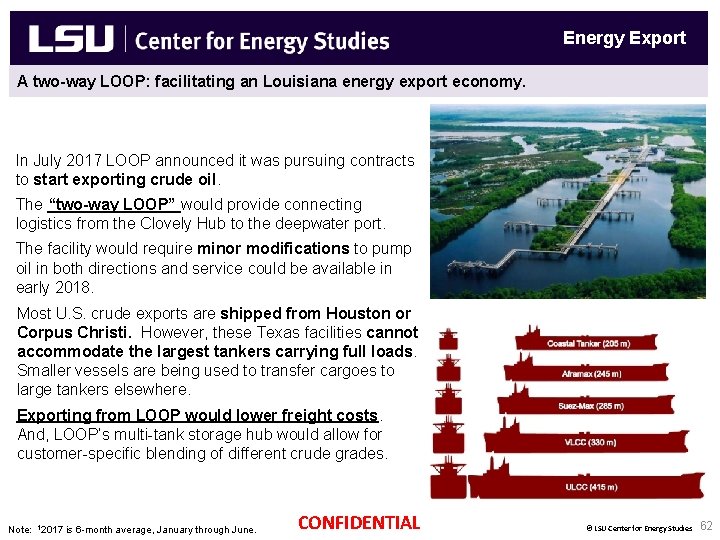
Energy Export A two-way LOOP: facilitating an Louisiana energy export economy. In July 2017 LOOP announced it was pursuing contracts to start exporting crude oil. The “two-way LOOP” would provide connecting logistics from the Clovely Hub to the deepwater port. The facility would require minor modifications to pump oil in both directions and service could be available in early 2018. Most U. S. crude exports are shipped from Houston or Corpus Christi. However, these Texas facilities cannot accommodate the largest tankers carrying full loads. Smaller vessels are being used to transfer cargoes to large tankers elsewhere. Exporting from LOOP would lower freight costs. And, LOOP’s multi-tank storage hub would allow for customer-specific blending of different crude grades. Note: 12017 is 6 -month average, January through June. CONFIDENTIAL © LSU Center for Energy Studies 62
Conclusions © LSU Center for Energy Studies 63
Conclusions • Over the past decade, worldwide energy markets have been fundamentally changed due to the advent of U. S. shale oil and gas development. • These changes have not only impacted where hydrocarbons are produced, but has also created significant change to the transportation, processing, and final use. • The gulf coast has seen large increases in oil and gas production, with these increases mainly concentrated in Texas. Louisiana and Federal Offshore production have decreased in their relative importance. • Significant investments in the refining, petrochemicals, and transport of hydrocarbons have been made, and will continue to be made over the next decade. The Gulf Coast is well positioned, and could potentially become the world-cited crude benchmark. © LSU Center for Energy Studies 64
Questions, Comments and Discussion www. enrg. lsu. edu gupton 3@lsu. edu
- Slides: 65